Chapter 1: The Science of Physics
Lesson 1: What is Physics?
Objectives
The student will be able to:
• Identify activities in fields that involve the major areas
within physics
• Describe the processes of the scientific method
• Describe the role of models and diagrams in physics
What is Physics?
a
Lets look at the fields of science you've seen so far:
Earth Science - The study of rocks, fossils, sediment, soil,
landforms, water features, and the natural processes that create
them.
Biology - The study of living organisms
Chemistry - The study of the composition of substances, their
properties and reactions
So... what’s left?
Physics - The study of the physical universe
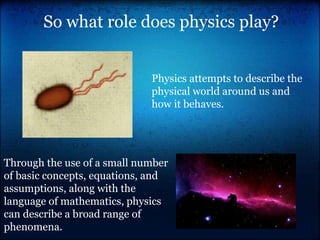
So what role does physics play?
Physics attempts to describe the
physical world around us and
how it behaves.
Through the use of a small number
of basic concepts, equations, and
assumptions, along with the
language of mathematics, physics
can describe a broad range of
phenomena.
The Main Areas of Physics
Physics can be broken down into seven main categories:
Name The study of...
Mechanics motion and its causes
Thermodynamics heat and temperature
Vibrations and Waves specific types of repetitive motions
Optics Light
Electromagnetism electricity, magnetism, and light
Relativity particles moving at any speed, relative to an
observer
Quantum Mechanics behavior of particles like protons, neutrons,
electrons, and even smaller things
Which area of physics would be the most
relevant to each of these situations?
o A high school football game
o Food preparation for the prom
o Playing in the school band
o Lightning in a thunderstorm
o Wearing a pair of sunglasses outside in the sun
Scientific Method.. In Case You Forgot
Observation & data
collection lead to a
question
Hypotheses are
formulated and
objectively tested using
experiments
Interpret the results
and revise the
hypothesis if
necessary
State conclusions in a form
that others can evaluate
Models in Science
The physical world is very complex, and often physicists will use
simple models to explain the most fundamental features of a
particular phenomena.
Examples of Models:
Cloth Physics
DC Circuits
Simplifying the Physical World
a
a
First identify the system you are attempting to study
System - set of items or interactions considered a distinct
physical entity for the purpose of study
Next, disregard all characteristics of the system that have little
to no effect on its motion.
At this point, we have constructed a model for our situation.
Model - a replica or description designed to show the structure
or workings of an object, system, or concept
What’s relevant if we want to study the ball’s motion?
How are models helpful?
1. Models can help build hypotheses
How are models helpful?
2. Models help guide experimental design
• Any hypothesis must be tested in a controlled experiment
• Controlled experiment: experiment involving manipulation
of a single variable/factor
The Best Hypotheses
The best hypotheses can make predictions in new situations.
For example, Galileo developed a hypothesis for the free-fall of
objects in space. However, the technology to create a vacuum
would not be available for many years later. Still, his hypothesis
was able to make accurate predictions about falling objects,
even in the presence of air resistance.
Wrap Up
• Give an example of a part of a car that pertains to each field
of physics and briefly describe how that part contributes to
the cars operation.
• Is there a single "correct" way for following the scientific
method?
• How is a model helpful when attempting to understand a
concept?

1.1 What is Physics?

  • 1.
    Chapter 1: TheScience of Physics Lesson 1: What is Physics?
  • 2.
    Objectives The student willbe able to: • Identify activities in fields that involve the major areas within physics • Describe the processes of the scientific method • Describe the role of models and diagrams in physics
  • 3.
    What is Physics? a Letslook at the fields of science you've seen so far: Earth Science - The study of rocks, fossils, sediment, soil, landforms, water features, and the natural processes that create them. Biology - The study of living organisms Chemistry - The study of the composition of substances, their properties and reactions So... what’s left? Physics - The study of the physical universe
  • 4.
    So what roledoes physics play? Physics attempts to describe the physical world around us and how it behaves. Through the use of a small number of basic concepts, equations, and assumptions, along with the language of mathematics, physics can describe a broad range of phenomena.
  • 5.
    The Main Areasof Physics Physics can be broken down into seven main categories: Name The study of... Mechanics motion and its causes Thermodynamics heat and temperature Vibrations and Waves specific types of repetitive motions Optics Light Electromagnetism electricity, magnetism, and light Relativity particles moving at any speed, relative to an observer Quantum Mechanics behavior of particles like protons, neutrons, electrons, and even smaller things
  • 6.
    Which area ofphysics would be the most relevant to each of these situations? o A high school football game o Food preparation for the prom o Playing in the school band o Lightning in a thunderstorm o Wearing a pair of sunglasses outside in the sun
  • 7.
    Scientific Method.. InCase You Forgot Observation & data collection lead to a question Hypotheses are formulated and objectively tested using experiments Interpret the results and revise the hypothesis if necessary State conclusions in a form that others can evaluate
  • 8.
    Models in Science Thephysical world is very complex, and often physicists will use simple models to explain the most fundamental features of a particular phenomena. Examples of Models: Cloth Physics DC Circuits
  • 9.
    Simplifying the PhysicalWorld a a First identify the system you are attempting to study System - set of items or interactions considered a distinct physical entity for the purpose of study Next, disregard all characteristics of the system that have little to no effect on its motion. At this point, we have constructed a model for our situation. Model - a replica or description designed to show the structure or workings of an object, system, or concept
  • 10.
    What’s relevant ifwe want to study the ball’s motion?
  • 13.
    How are modelshelpful? 1. Models can help build hypotheses
  • 14.
    How are modelshelpful? 2. Models help guide experimental design • Any hypothesis must be tested in a controlled experiment • Controlled experiment: experiment involving manipulation of a single variable/factor
  • 15.
    The Best Hypotheses Thebest hypotheses can make predictions in new situations. For example, Galileo developed a hypothesis for the free-fall of objects in space. However, the technology to create a vacuum would not be available for many years later. Still, his hypothesis was able to make accurate predictions about falling objects, even in the presence of air resistance.
  • 16.
    Wrap Up • Givean example of a part of a car that pertains to each field of physics and briefly describe how that part contributes to the cars operation. • Is there a single "correct" way for following the scientific method? • How is a model helpful when attempting to understand a concept?

Editor's Notes

  • #14 Galileo didn’t have a vacuum to use so he tested his hypothesis by rolling bowling bowls down increasingly steep ramps