Oceans PPt. by, Robin D. Seamon
 
 
Ocean Notes Salt water/ salinity 360 million square miles 3.5 billion years old 100,000 + species 28 degrees to 86 degrees F 7 miles down in some places Mineral composition: sodium chloride magnesium calcium potassium
Ocean Exploration: oceanographer electronic devices measure with radar underwater cameras gear: Wet suit Jimmy suit Mooring Buoys Drills Submersibles Satellites Computers
Food Energy Minerals Medicine Transportation Influence Climate Ocean Resources
 
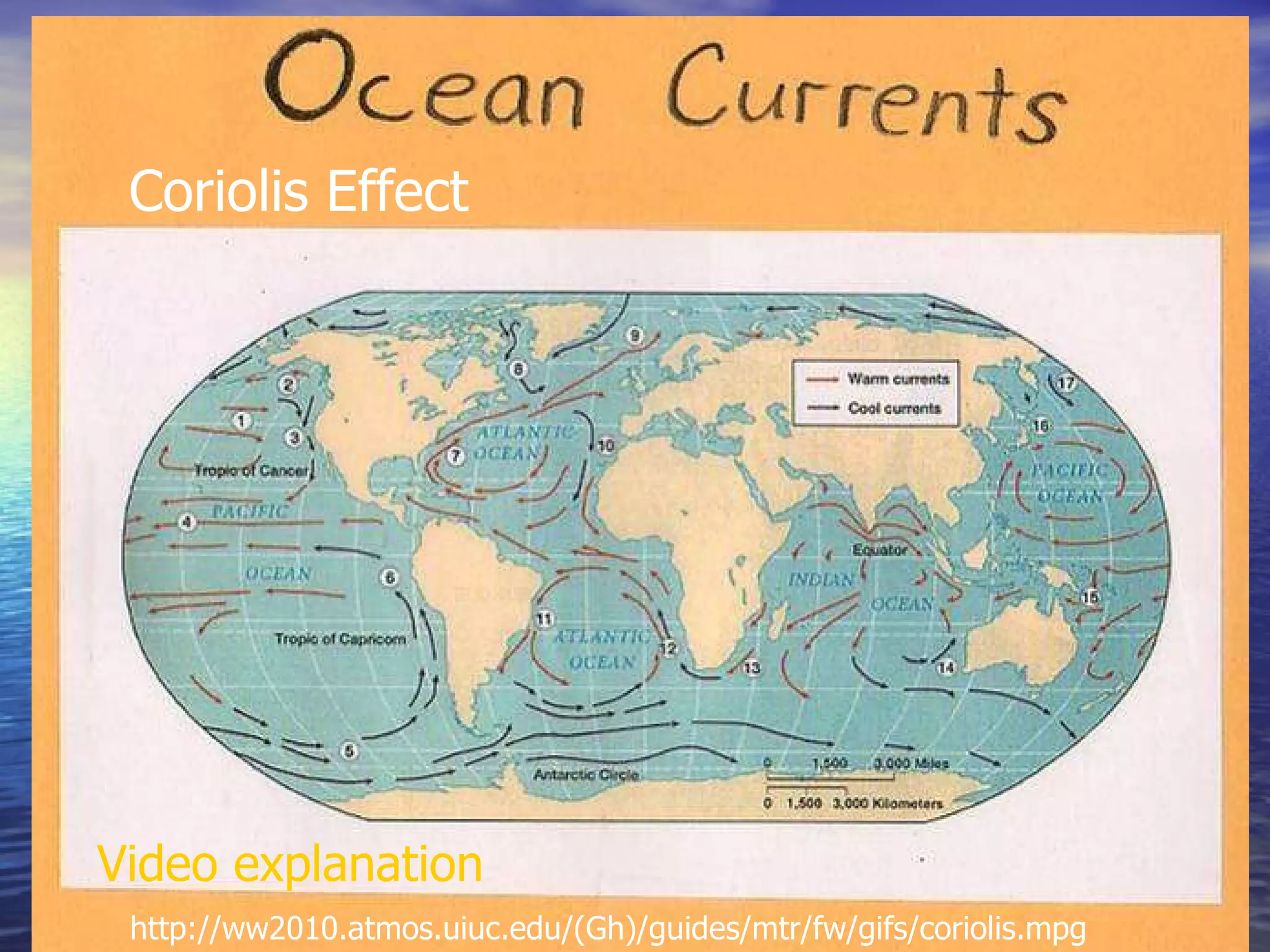
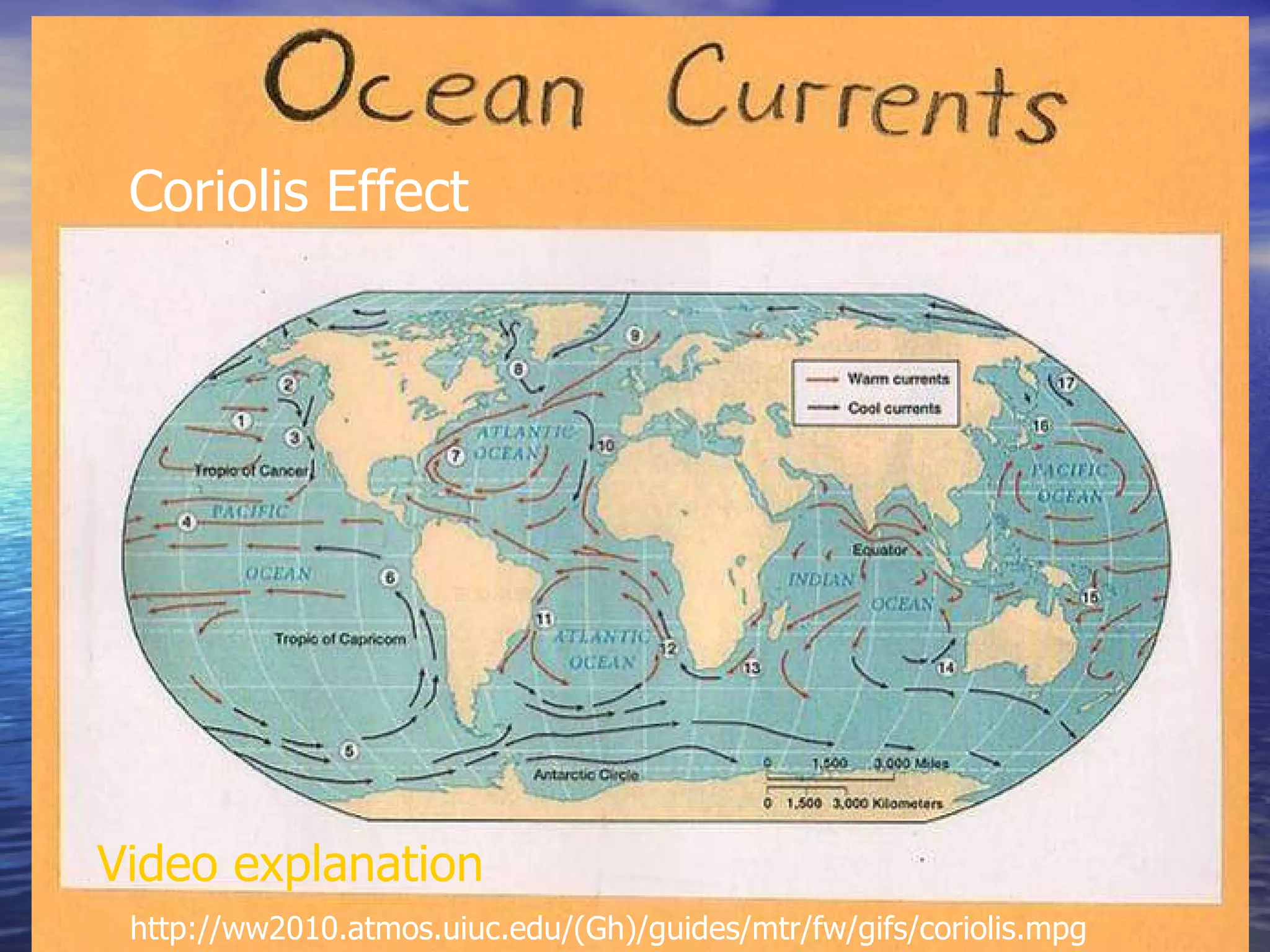
Ocean Currents Coriolis Effect http://ww2010.atmos.uiuc.edu/(Gh)/guides/mtr/fw/gifs/coriolis.mpg Video explanation
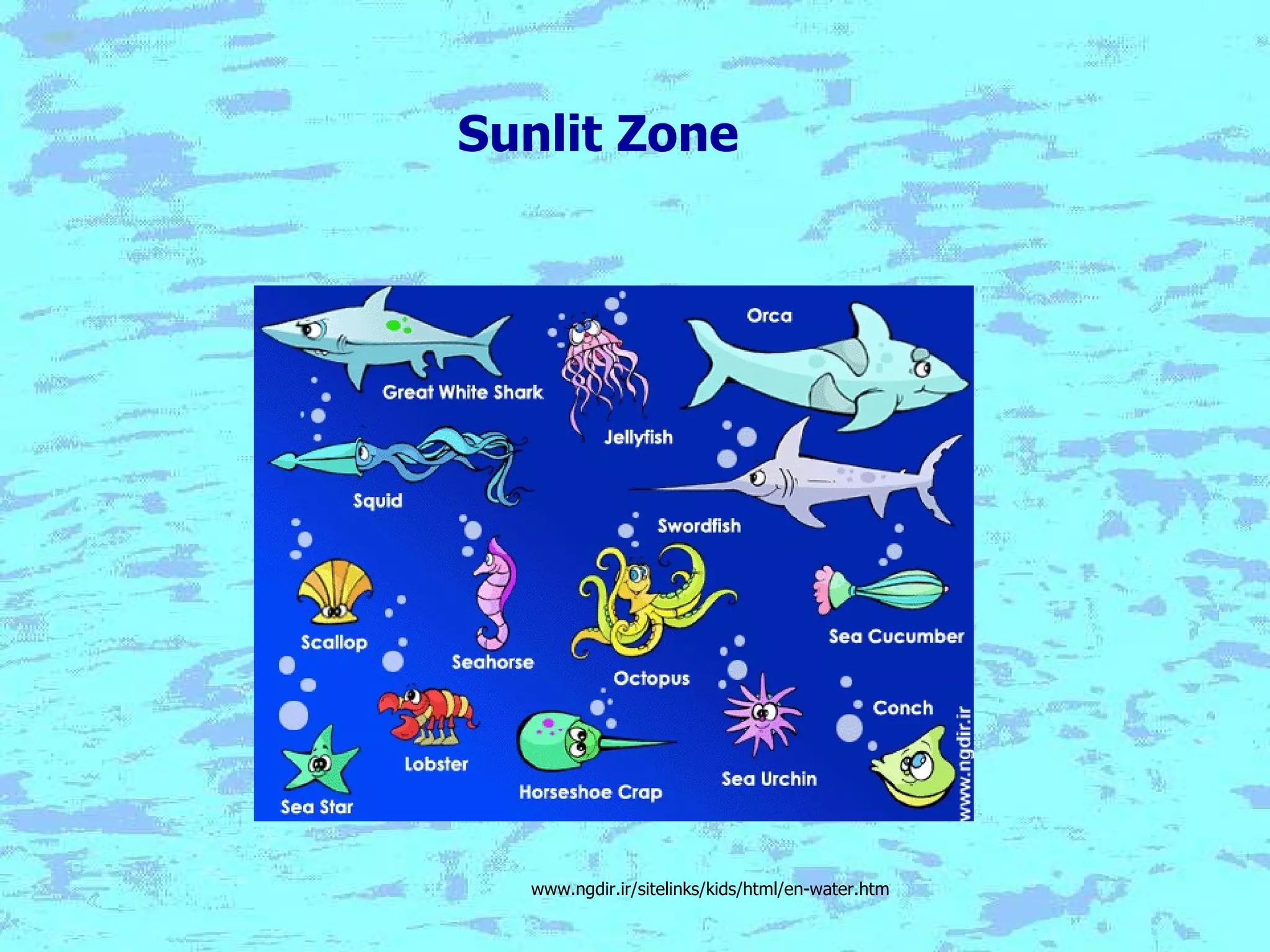
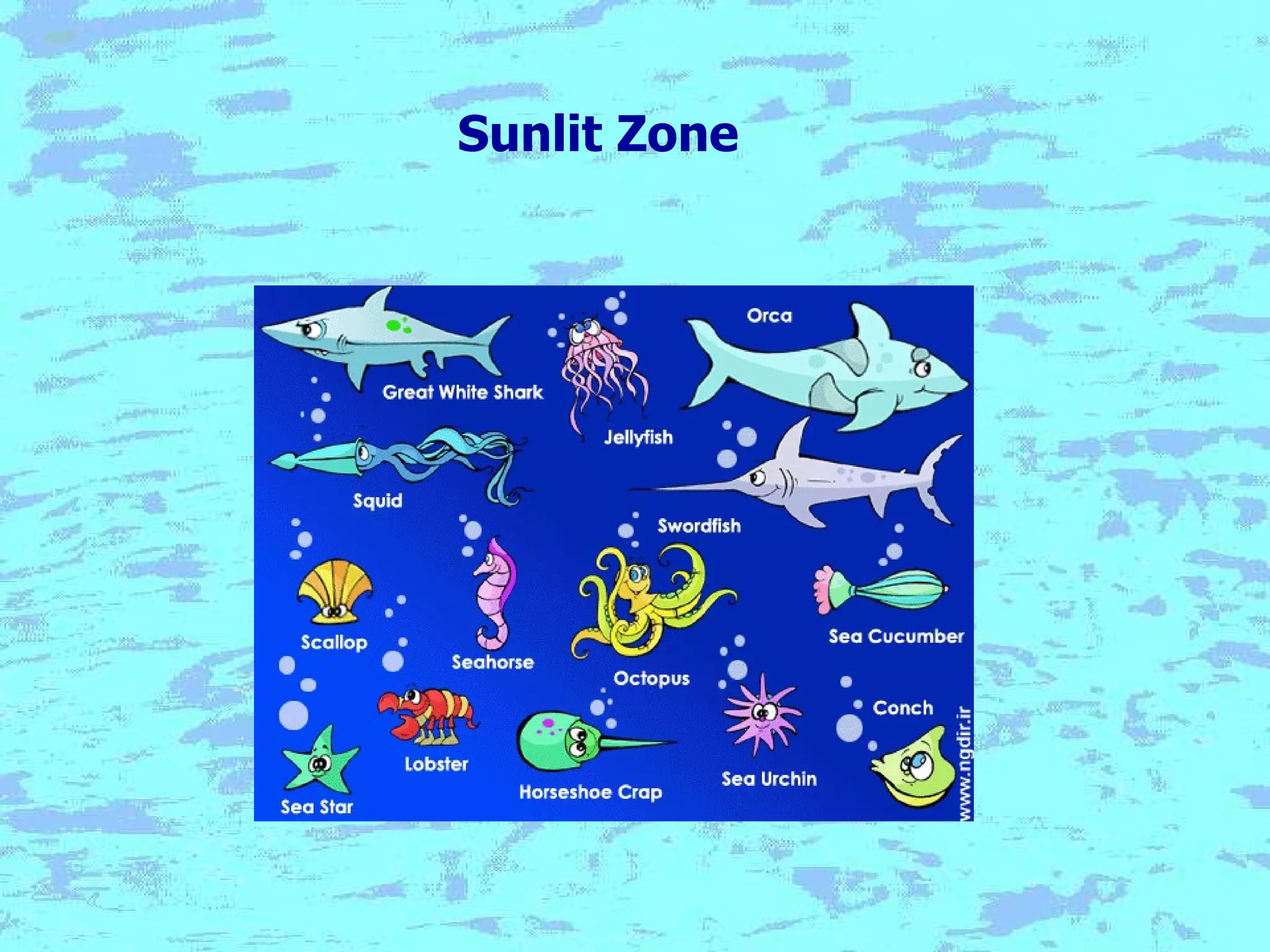
Sunlit Zone www.ngdir.ir/sitelinks/kids/html/en-water.htm
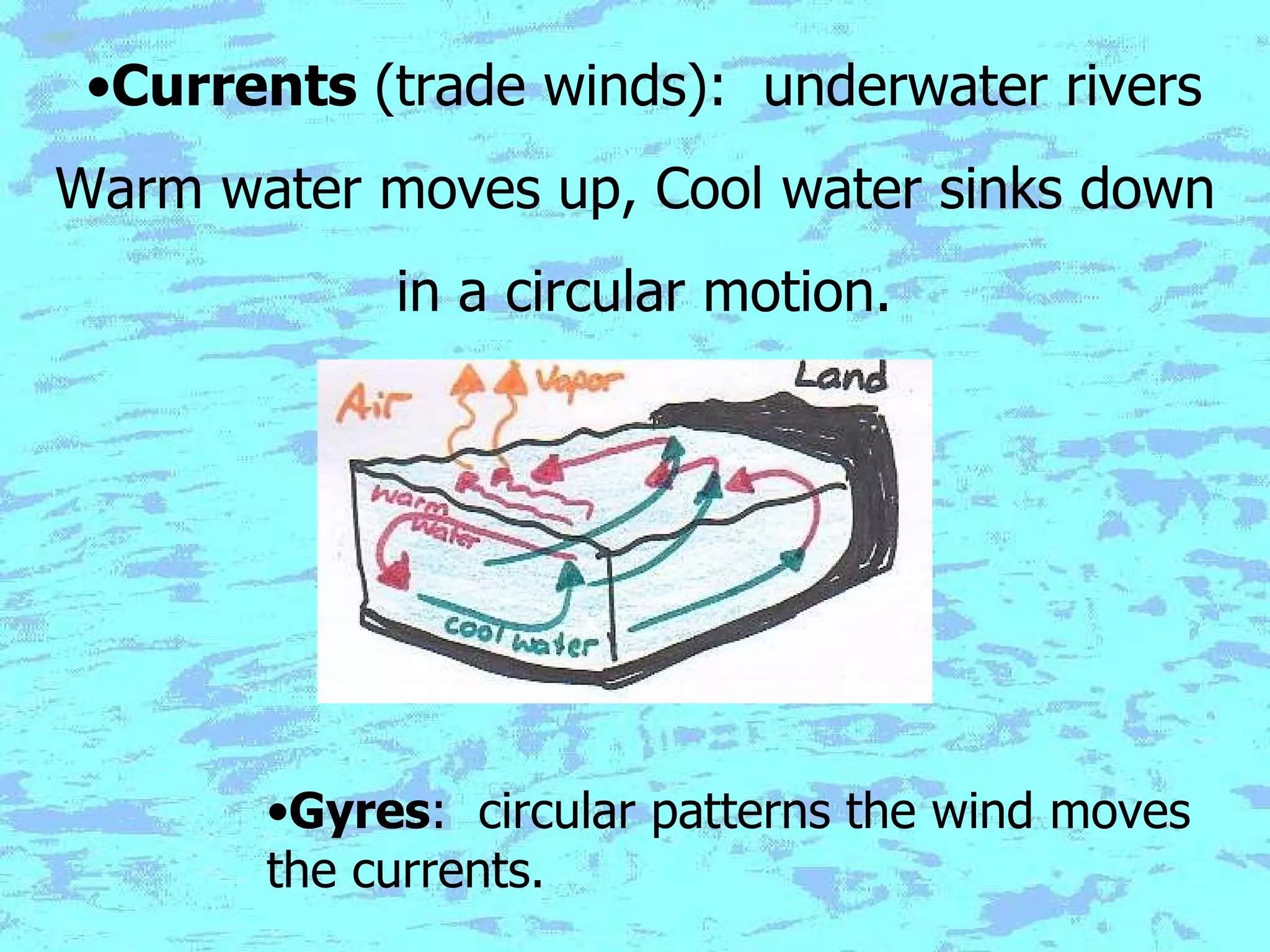
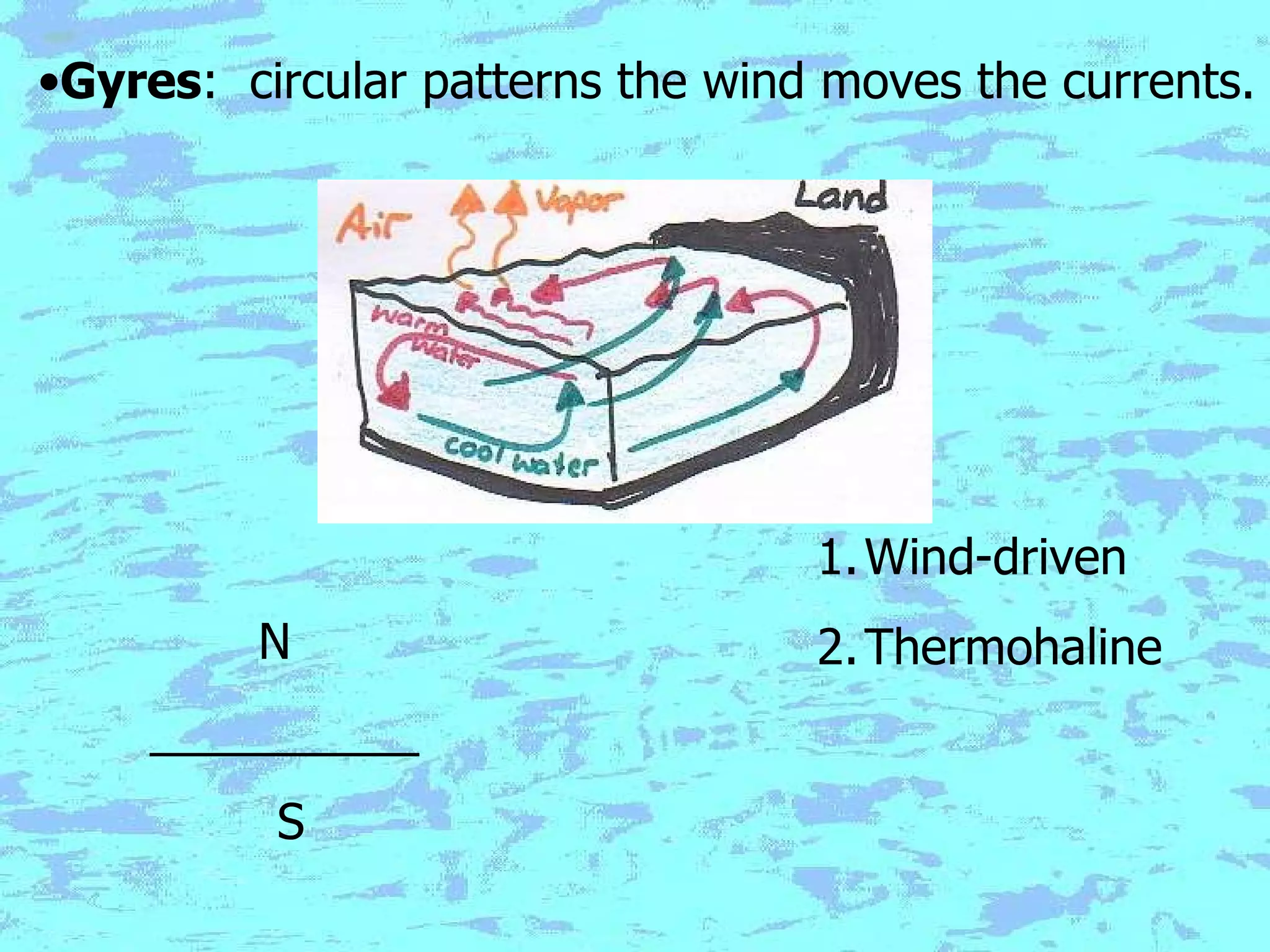
Currents  (trade winds):  underwater rivers Warm water moves up, Cool water sinks down  in a circular motion. Gyres :  circular patterns the wind moves the currents.
Gyres :  circular patterns the wind moves the currents. N __________ S Wind-driven Thermohaline
Influences Climate Summary Summer Ocean stores heat Winter Ocean releases heat Currents carry off excess heat from tropical oceans to polar oceans Warming polar oceans (GLOBAL WARMING) MAJOR source of precipitation
Ocean Currents Coriolis Effect http://ww2010.atmos.uiuc.edu/(Gh)/guides/mtr/fw/gifs/coriolis.mpg Video explanation
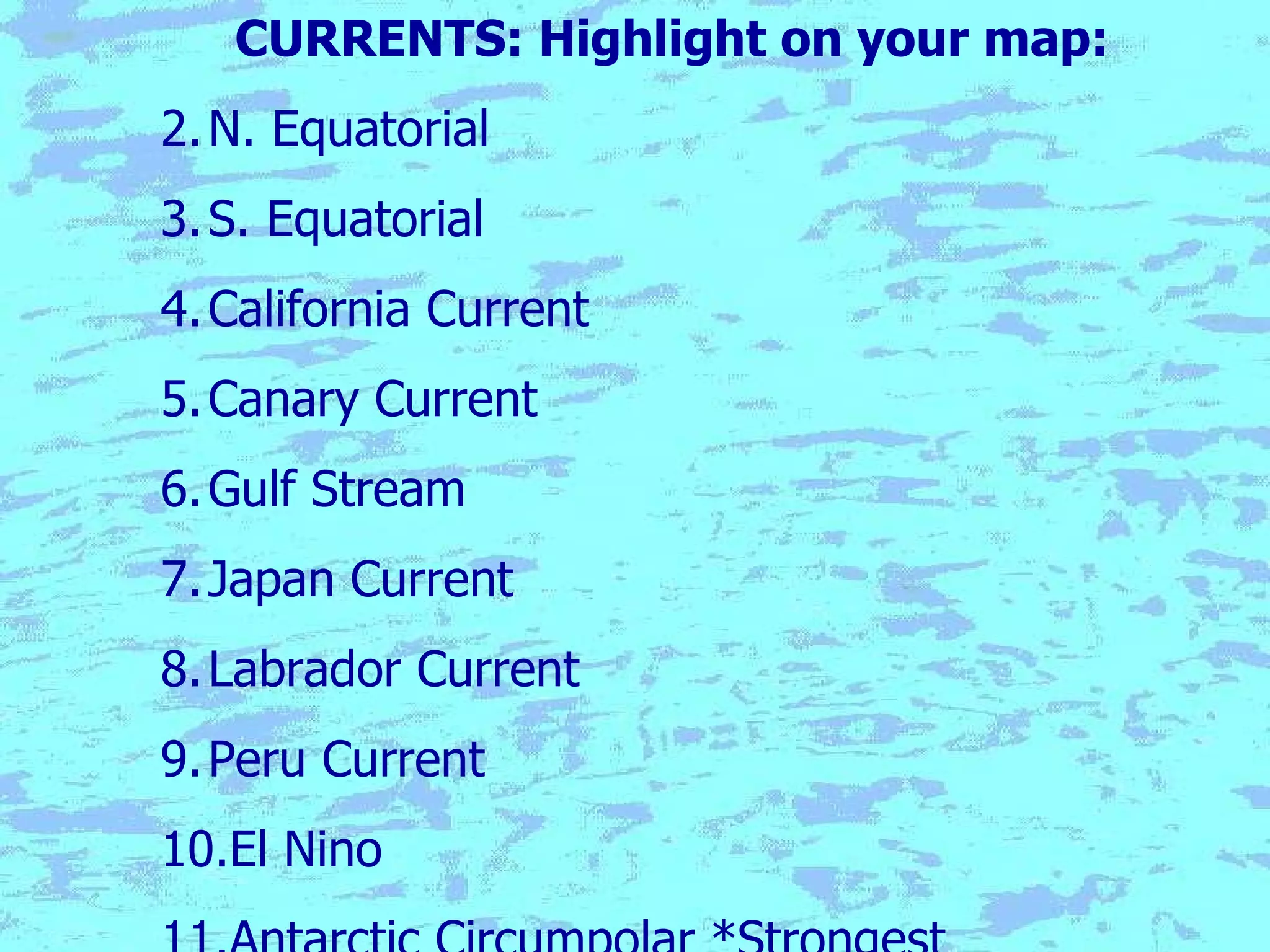
CURRENTS: Highlight on your map: N. Equatorial S. Equatorial California Current Canary Current Gulf Stream Japan Current Labrador Current Peru Current El Nino Antarctic Circumpolar *Strongest
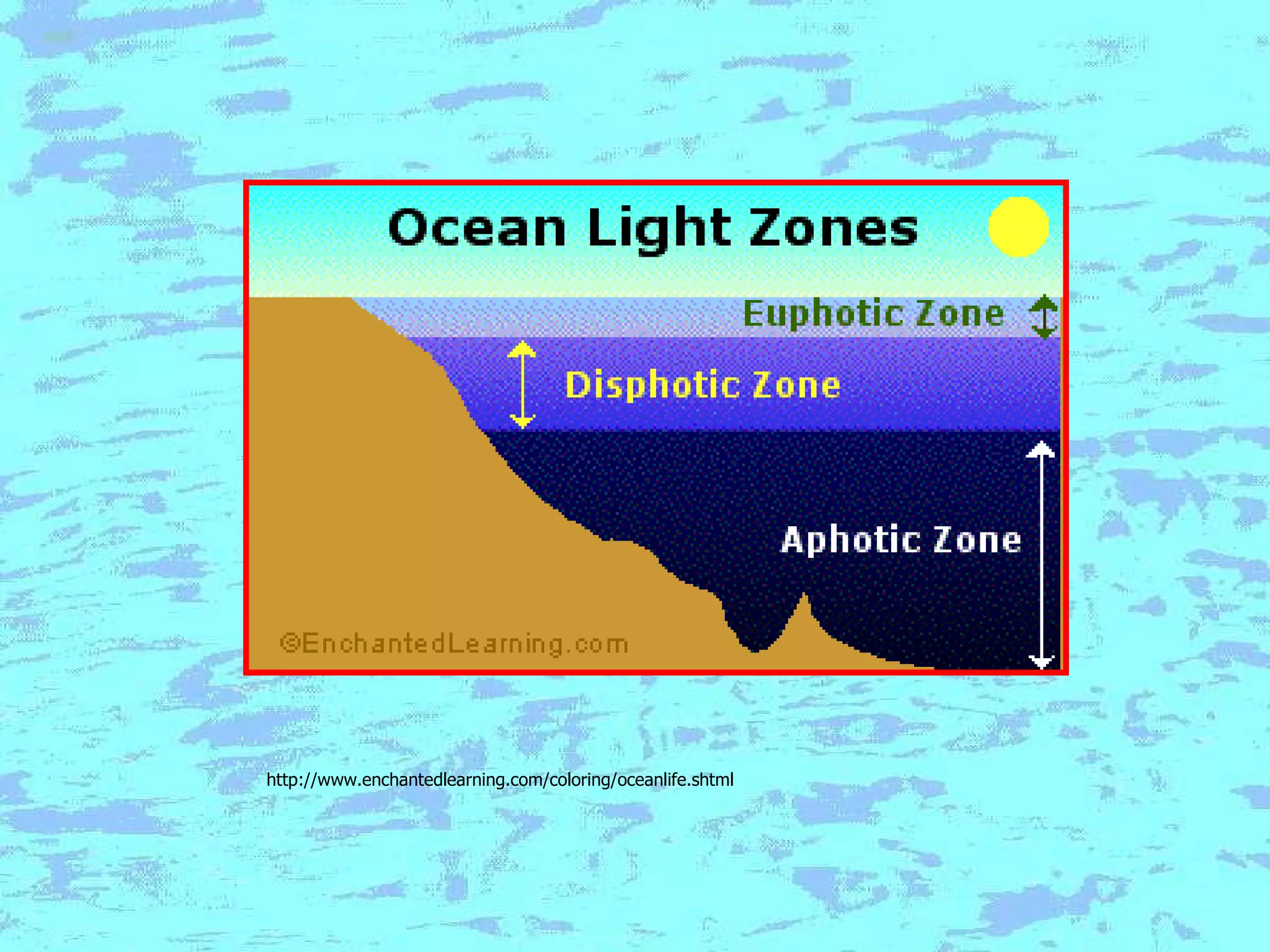
http://www.enchantedlearning.com/coloring/oceanlife.shtml
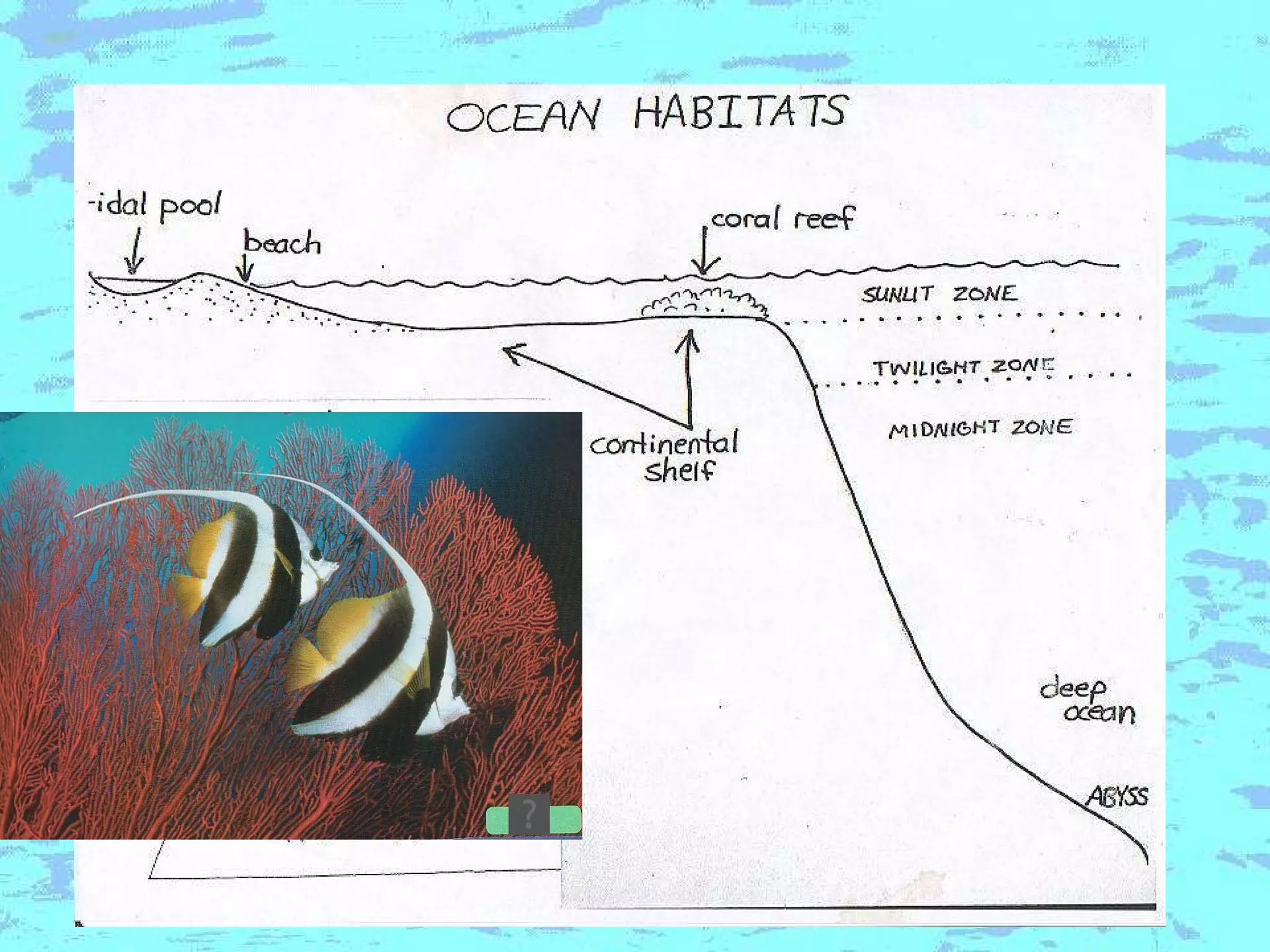
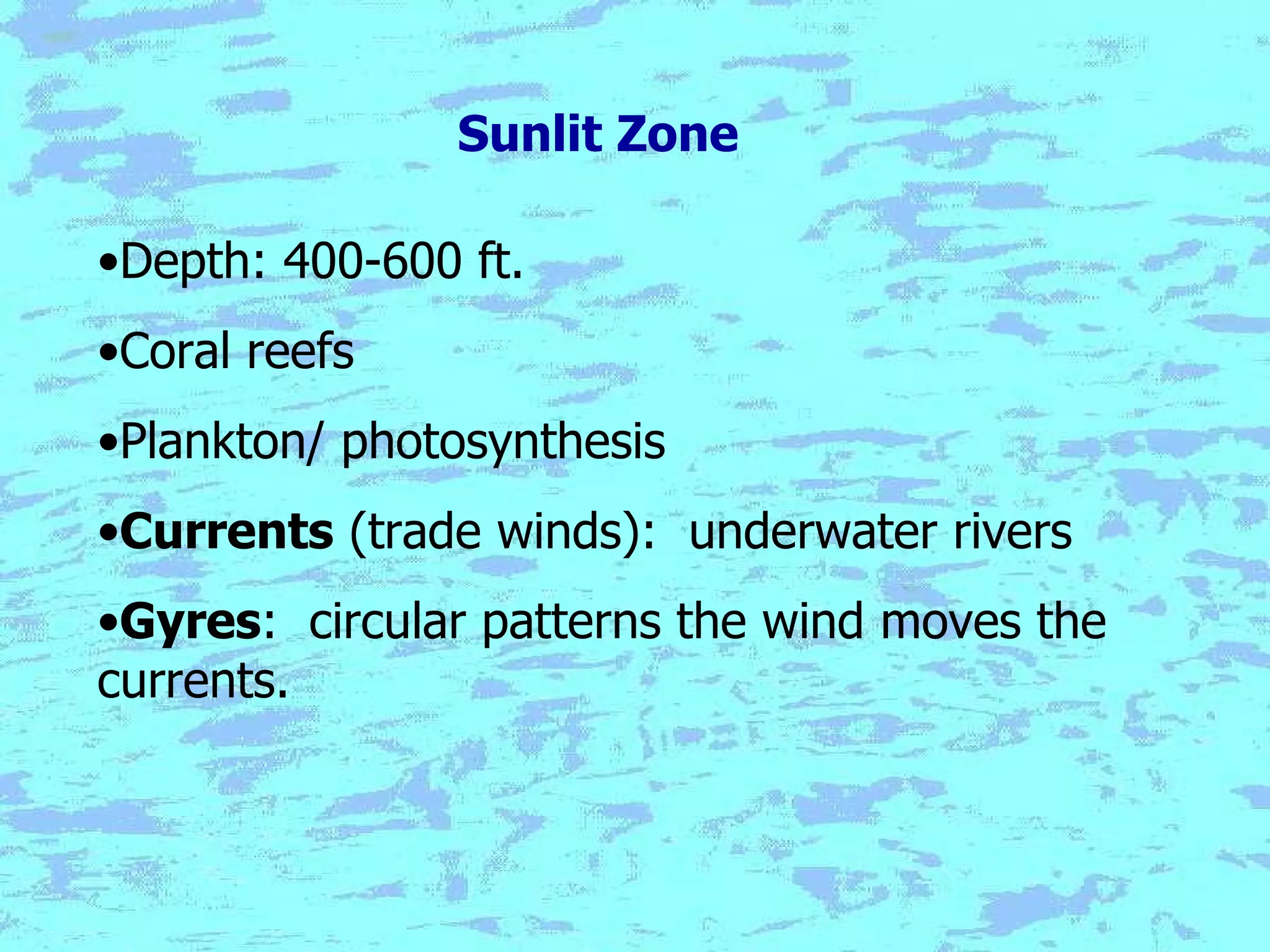
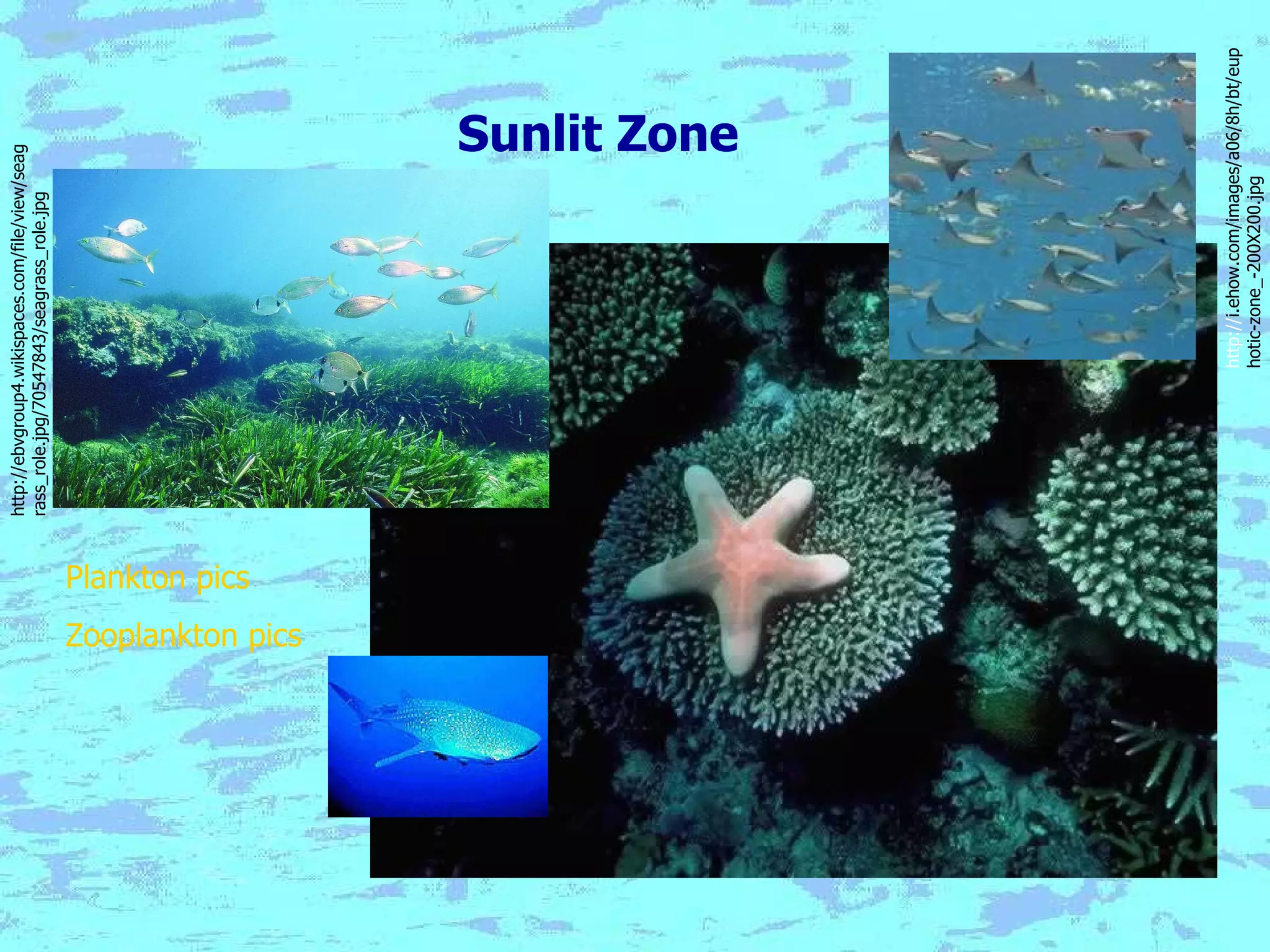
Sunlit Zone Depth: 400-600 ft. Coral reefs Plankton/ photosynthesis Currents  (trade winds):  underwater rivers Gyres :  circular patterns the wind moves the currents.
Sunlit Zone Plankton  pics Zooplankton  pics http://ebvgroup4.wikispaces.com/file/view/seagrass_role.jpg/70547843/seagrass_role.jpg http:// i.ehow.com/images/a06/8h/bt/euphotic-zone_-200X200.jpg
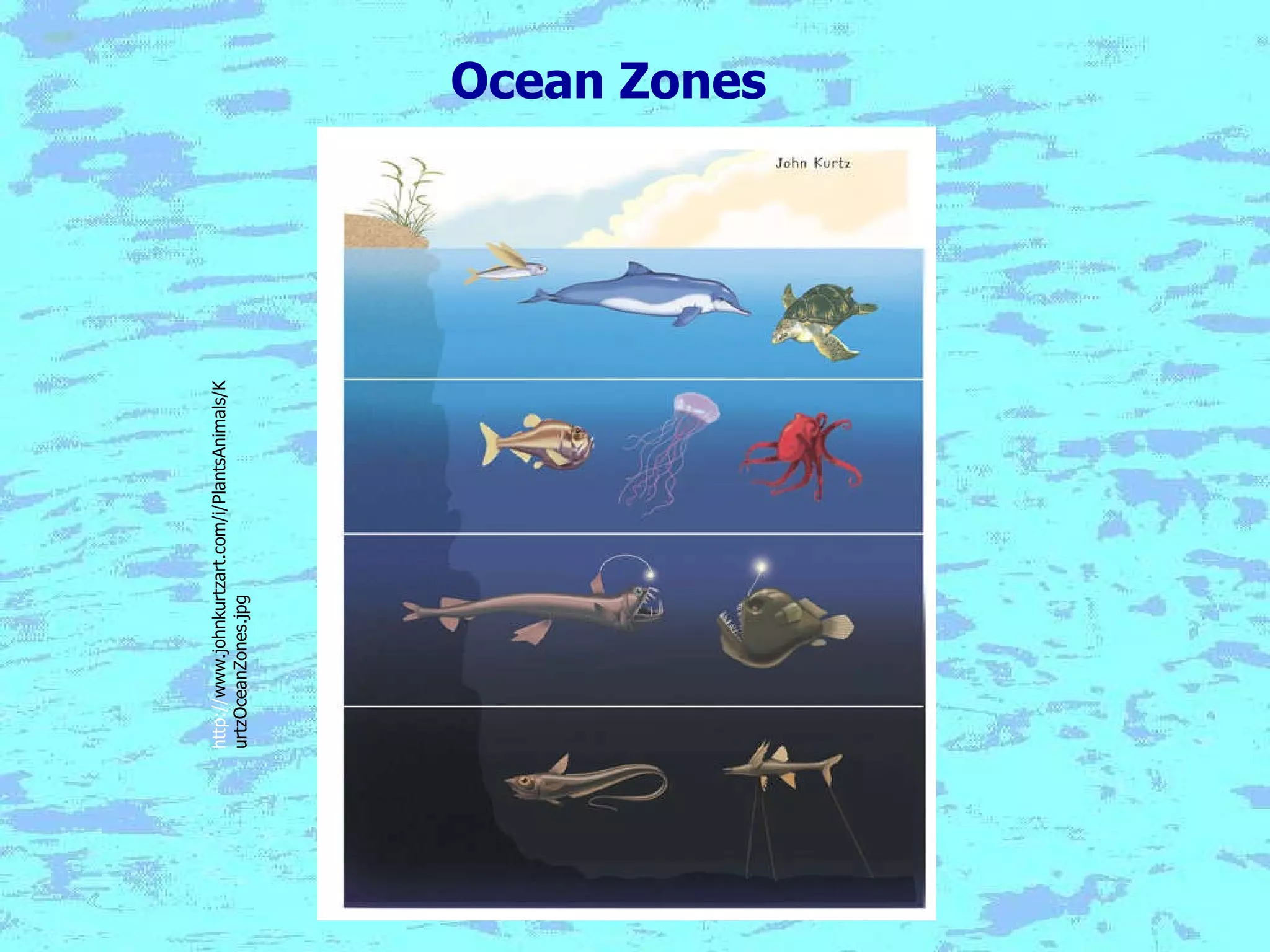
Ocean Zones http:// www.johnkurtzart.com/i/PlantsAnimals/KurtzOceanZones.jpg
Sunlit Zone
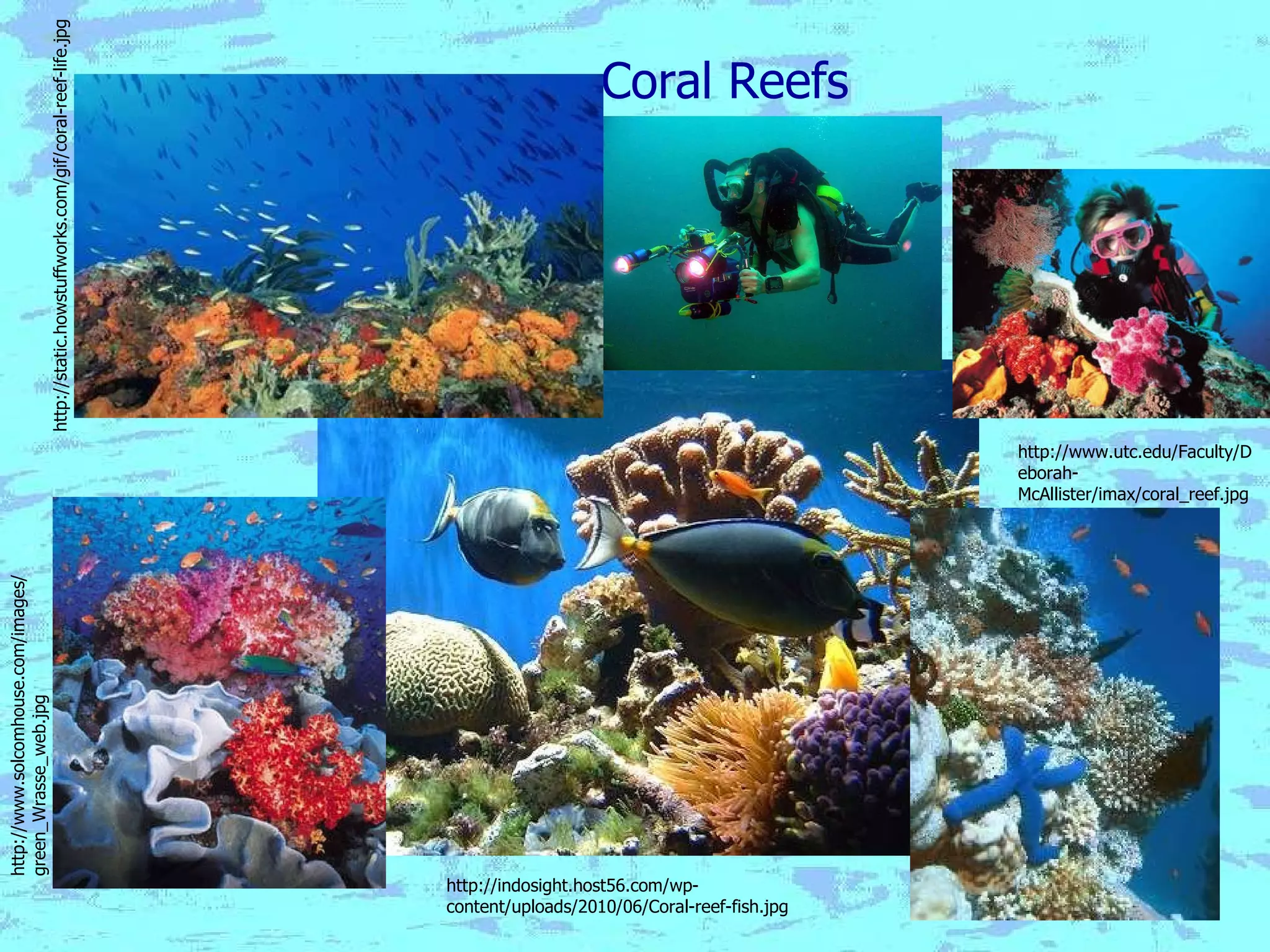
Coral Reefs http://static.howstuffworks.com/gif/coral-reef-life.jpg http://www.solcomhouse.com/images/green_Wrasse_web.jpg http://indosight.host56.com/wp-content/uploads/2010/06/Coral-reef-fish.jpg http://www.utc.edu/Faculty/Deborah-McAllister/imax/coral_reef.jpg
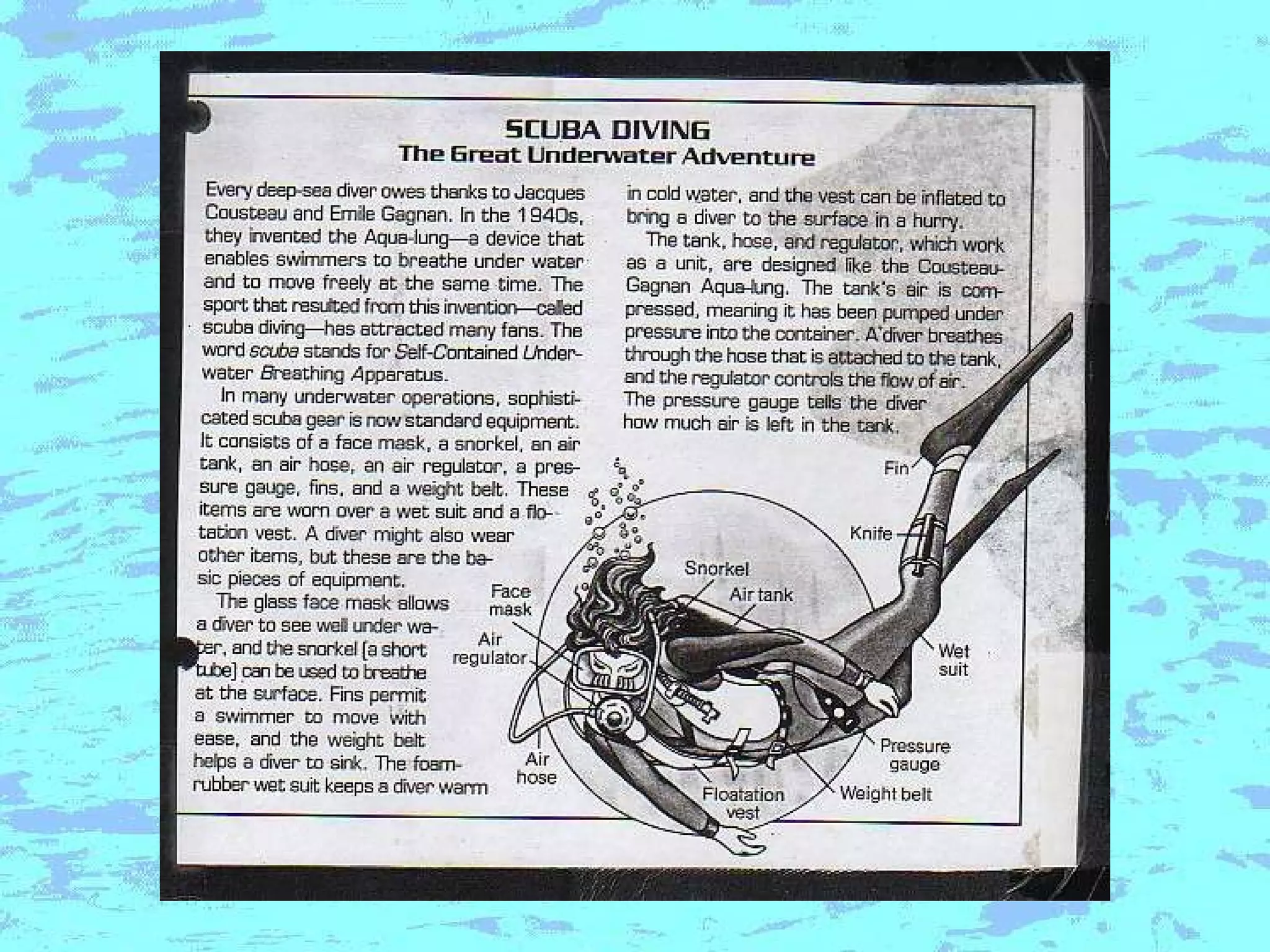
Scuba Gear
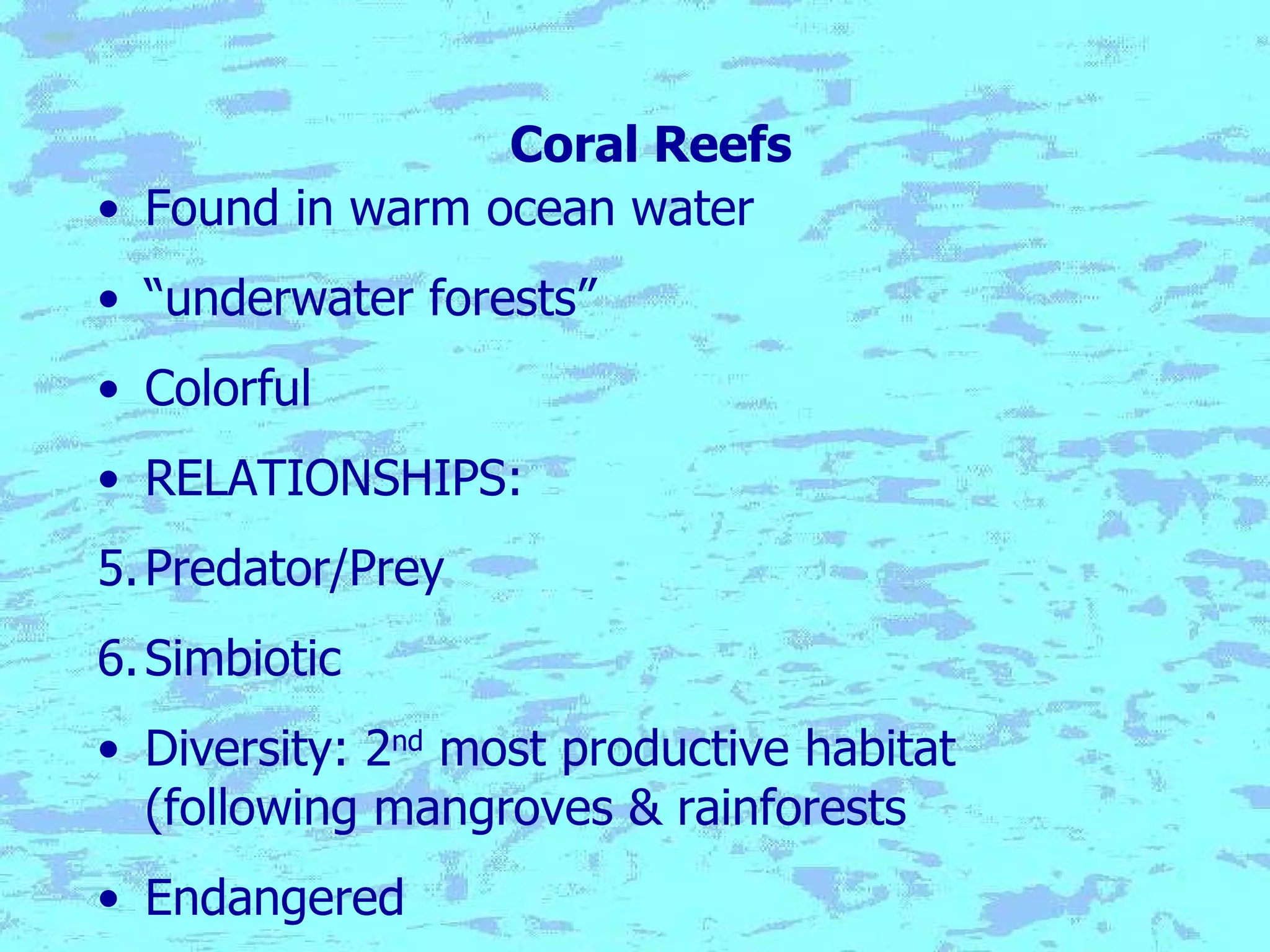
Coral Reefs Found in warm ocean water “ underwater forests” Colorful RELATIONSHIPS: Predator/Prey Simbiotic Diversity: 2 nd  most productive habitat (following mangroves & rainforests Endangered
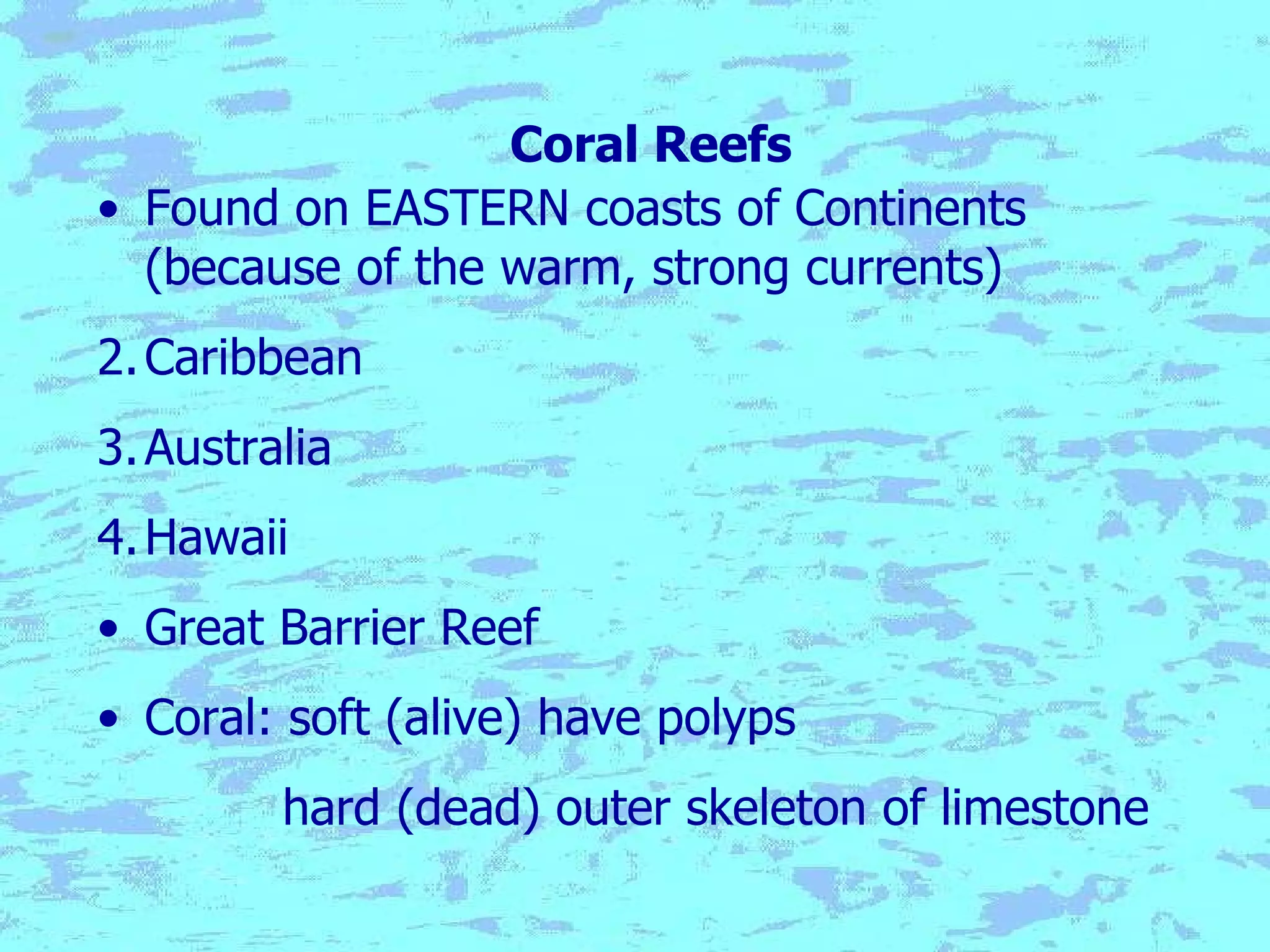
Coral Reefs Found on EASTERN coasts of Continents (because of the warm, strong currents) Caribbean Australia Hawaii Great Barrier Reef Coral: soft (alive) have polyps hard (dead) outer skeleton of limestone
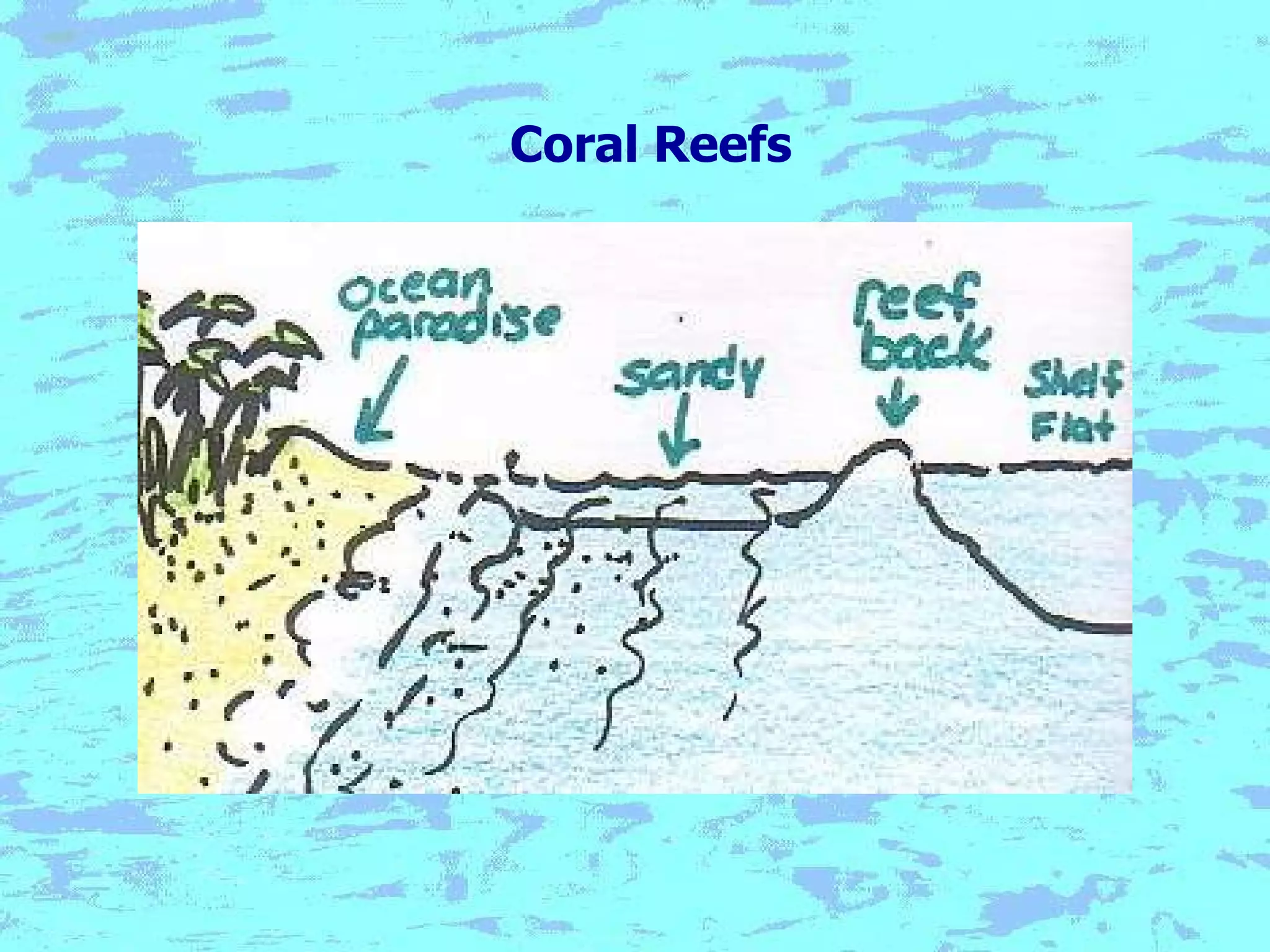
Coral Reefs
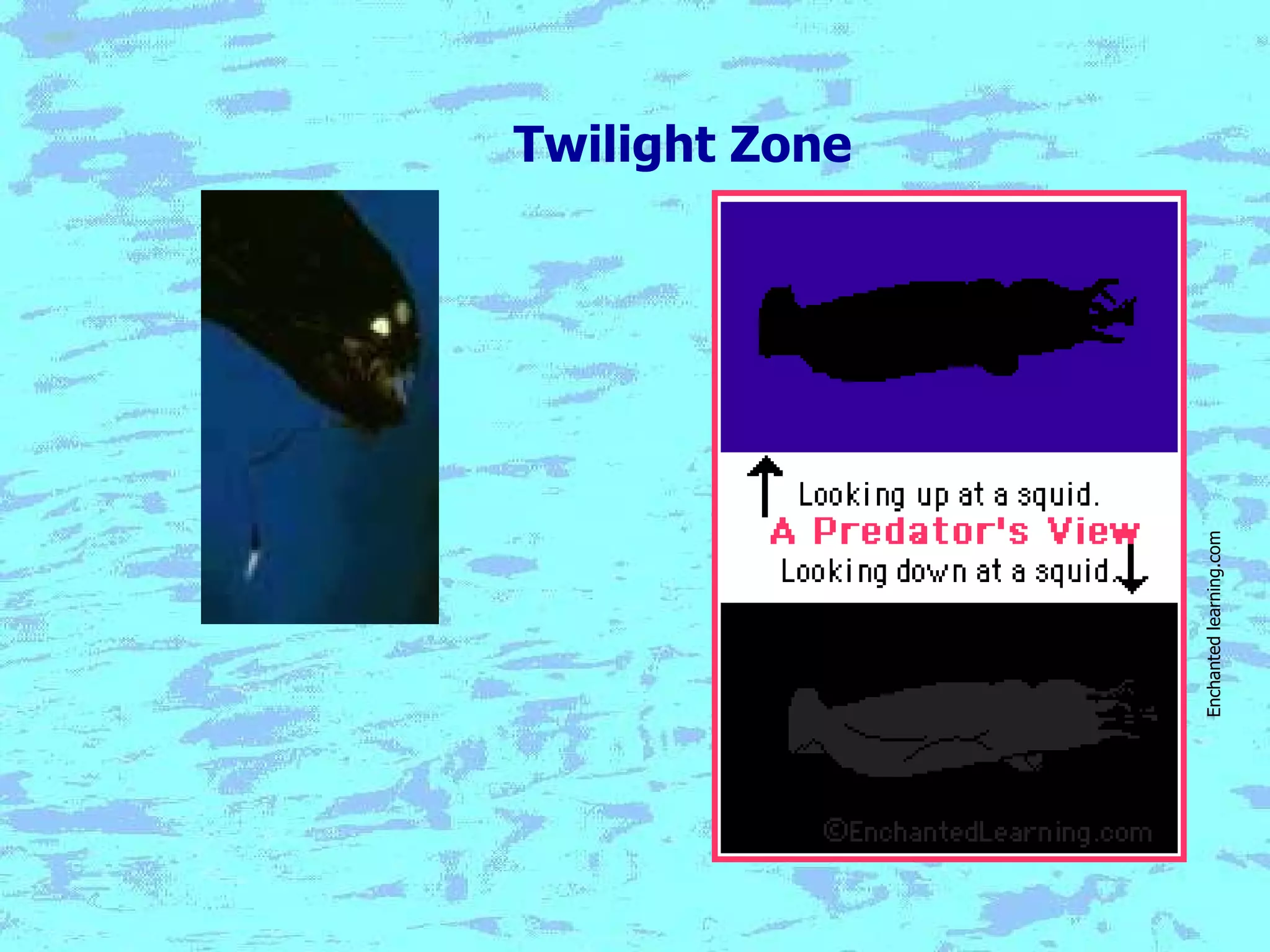
Twilight Zone Enchanted learning.com
Twilight Zone 200-4,000 feet down Sunlight barely gets through the water:  Hard to see, not dark, not light (like dawn and dusk above water) Large predators: sharks Below the continental shelf, at the drop-off zone
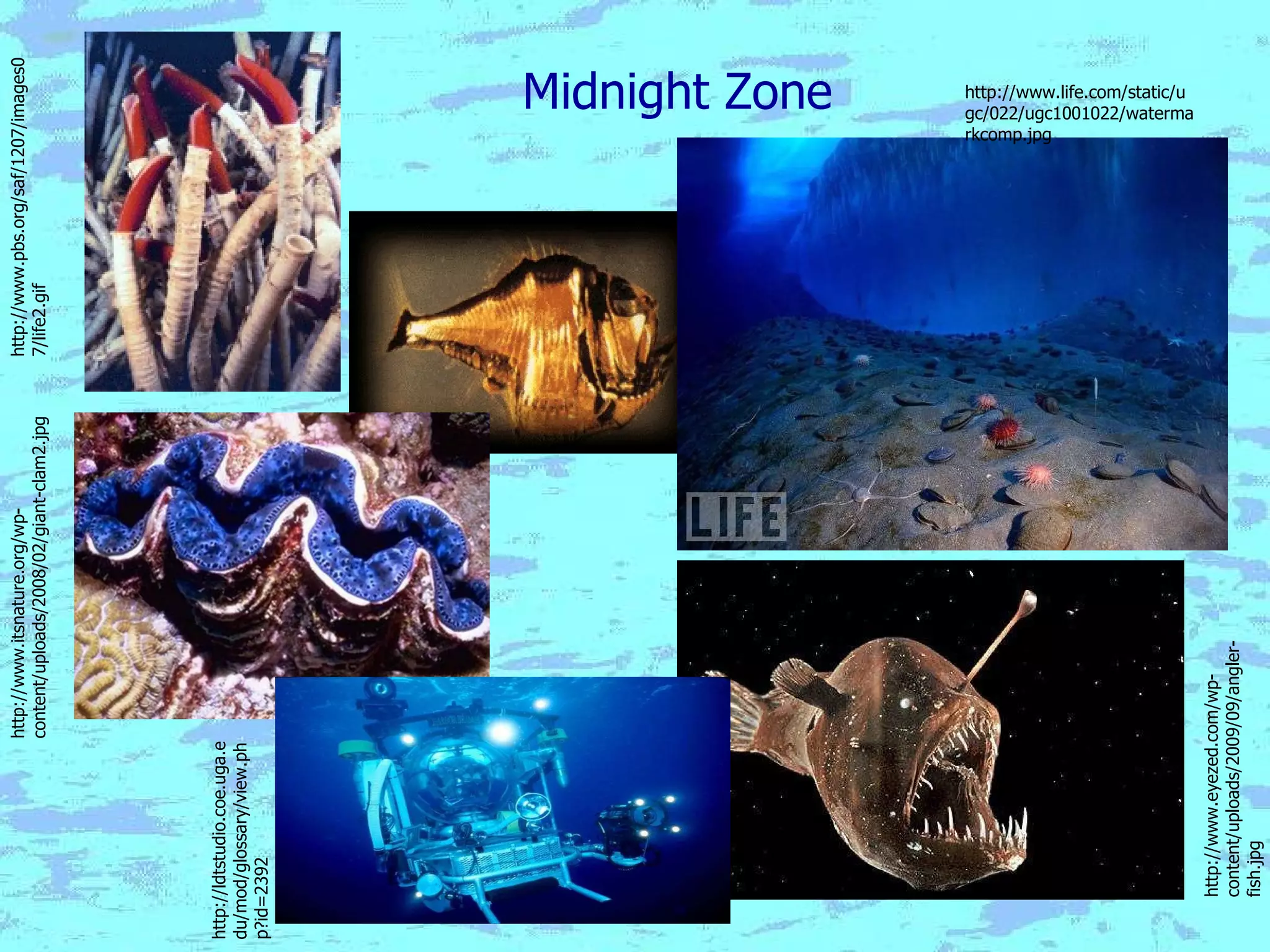
Midnight Zone http://www.pbs.org/saf/1207/images07/life2.gif http://www.itsnature.org/wp-content/uploads/2008/02/giant-clam2.jpg http://www.eyezed.com/wp-content/uploads/2009/09/angler-fish.jpg http://ldtstudio.coe.uga.edu/mod/glossary/view.php?id=2392 http://www.life.com/static/ugc/022/ugc1001022/watermarkcomp.jpg
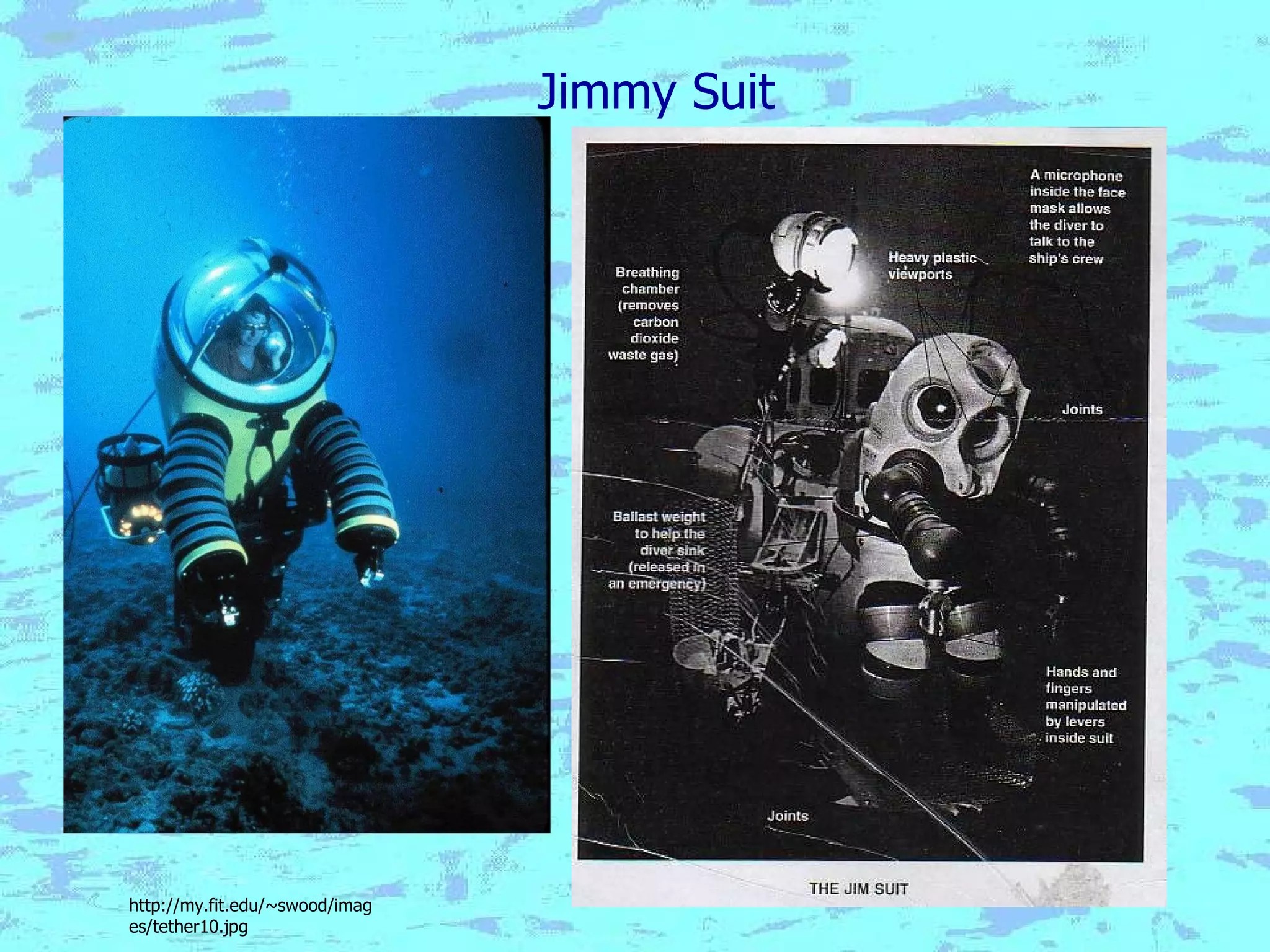
Jimmy Suit http://my.fit.edu/~swood/images/tether10.jpg
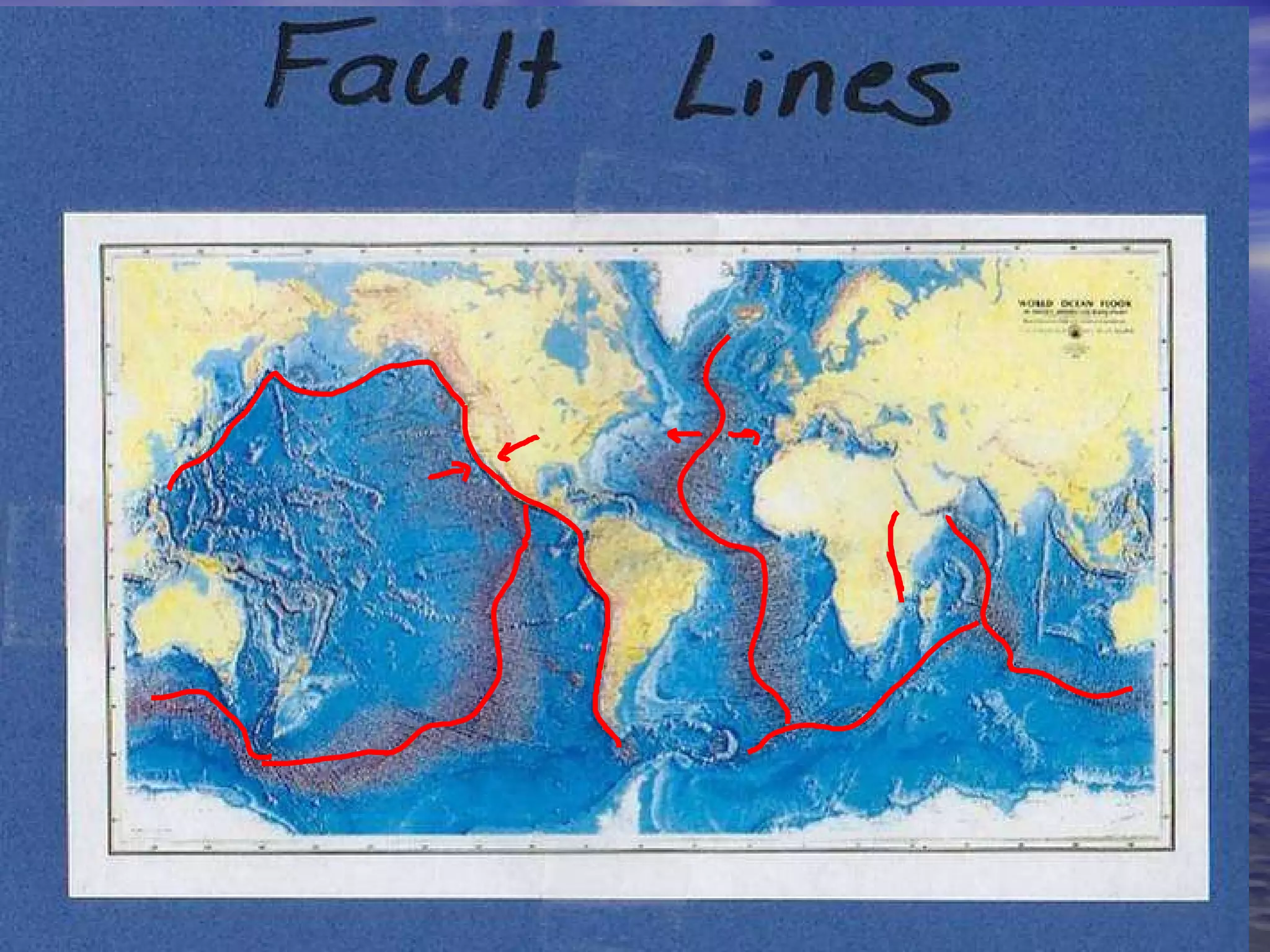
Midnight Zone Complete darkness Blind/white animals Faults/trenches Pacific trench is deepest (36,198 ft down) PLATE TECHTONICS: create underwater mountains, trenches, vents, volcanoes, plains
Mid-Ocean ridge:   Mid-Atlantic Ridge 5,000 ft above sea floor, some through island to make islands Through 3 oceans Along ridges are  HOT vents  (black smokers) -Copper, iron, sulfur, zinc flow out -Strange marine life -Special bacteria use chemicals & heat to make food -1 foot giant clams -giant red tube worms, crabs, blind or glowing fish
Abyssal Plains :  Ooze, sediment PLATE TECTONICS Trenches: Seamounts: volcanic activity with the mountains,
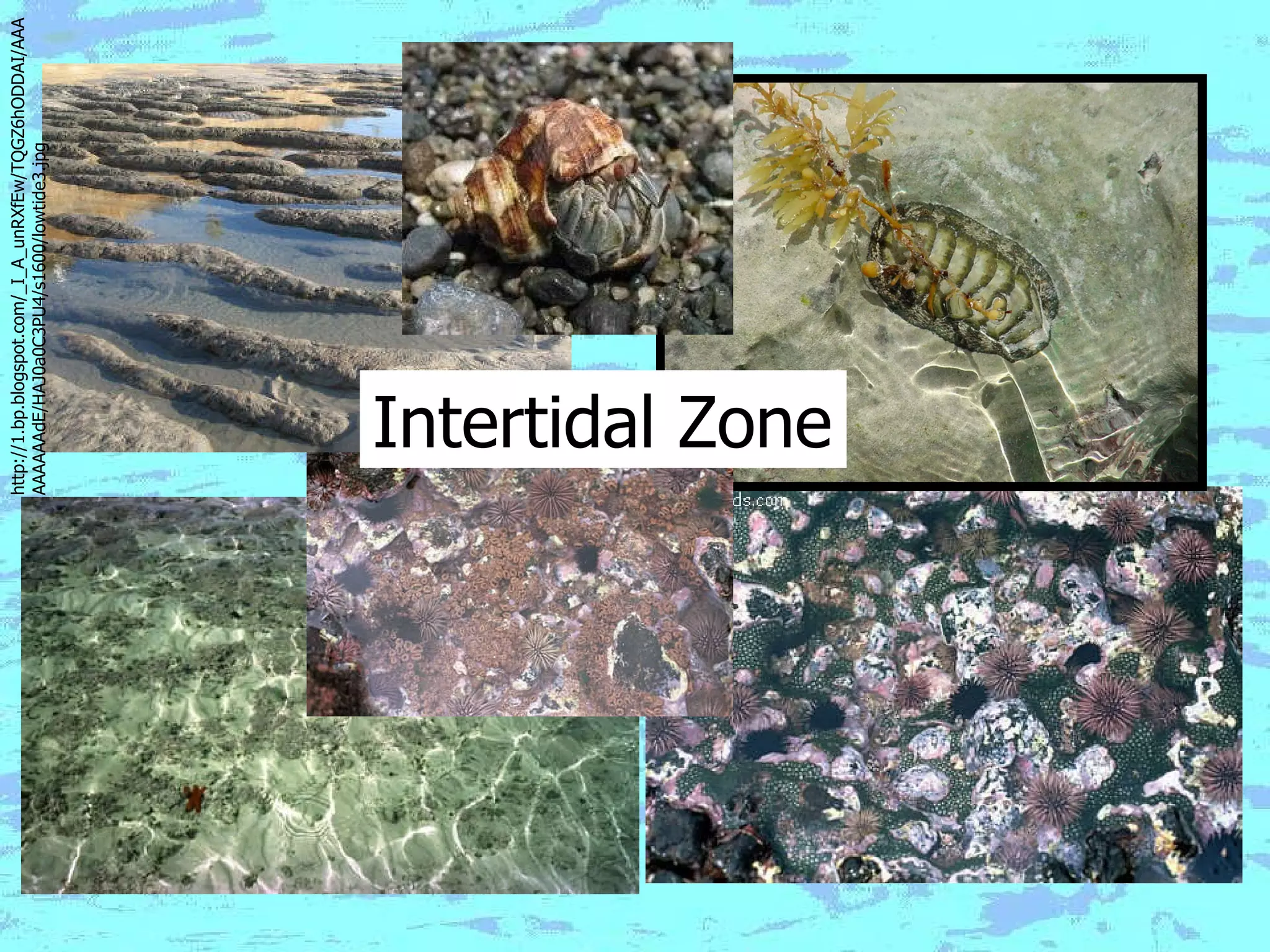
Intertidal Zone http://1.bp.blogspot.com/_I_A_unRXfEw/TQGZ6hODDAI/AAAAAAAAAdE/HAJ0a0C3PU4/s1600/lowtide3.jpg
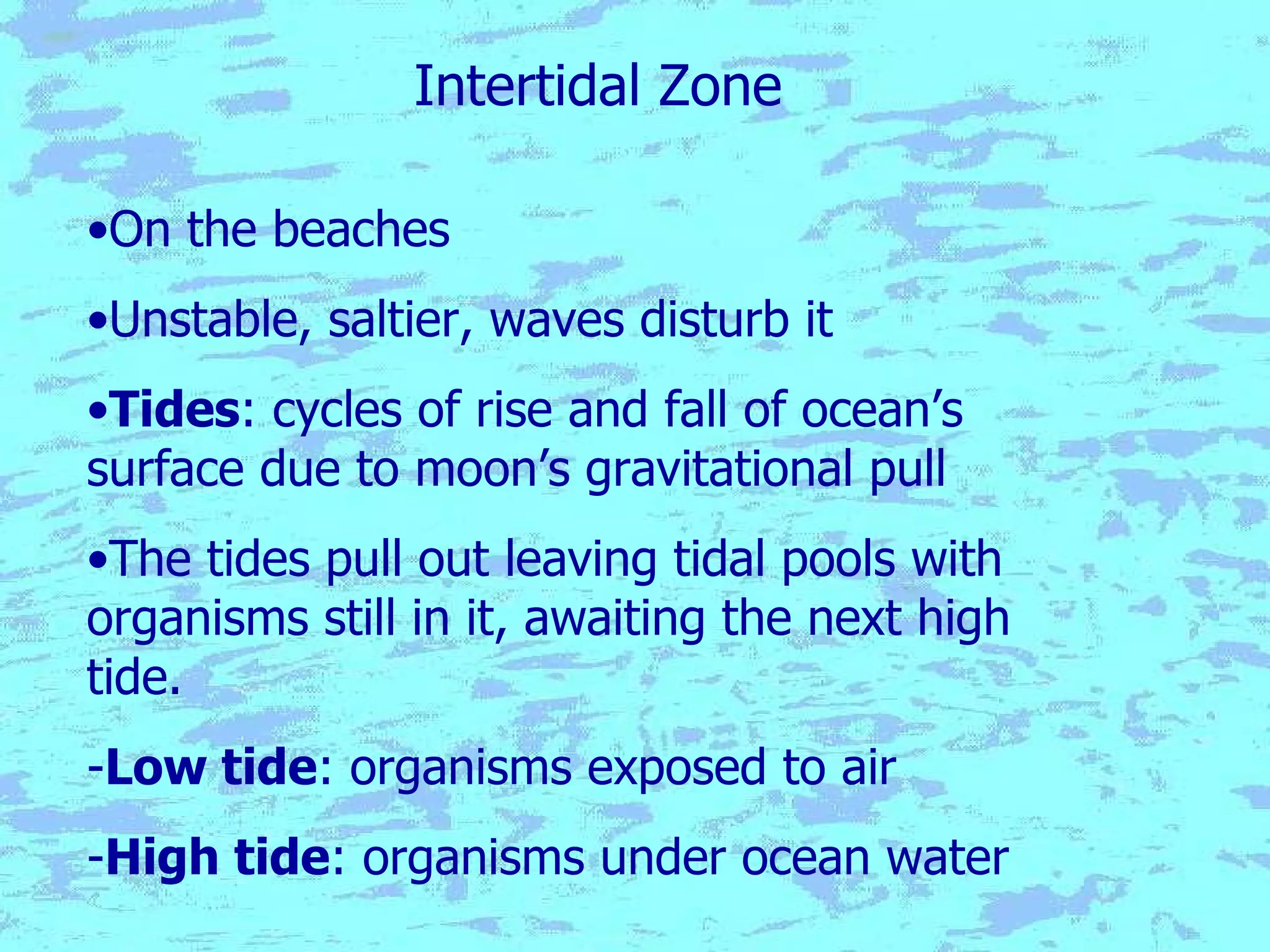
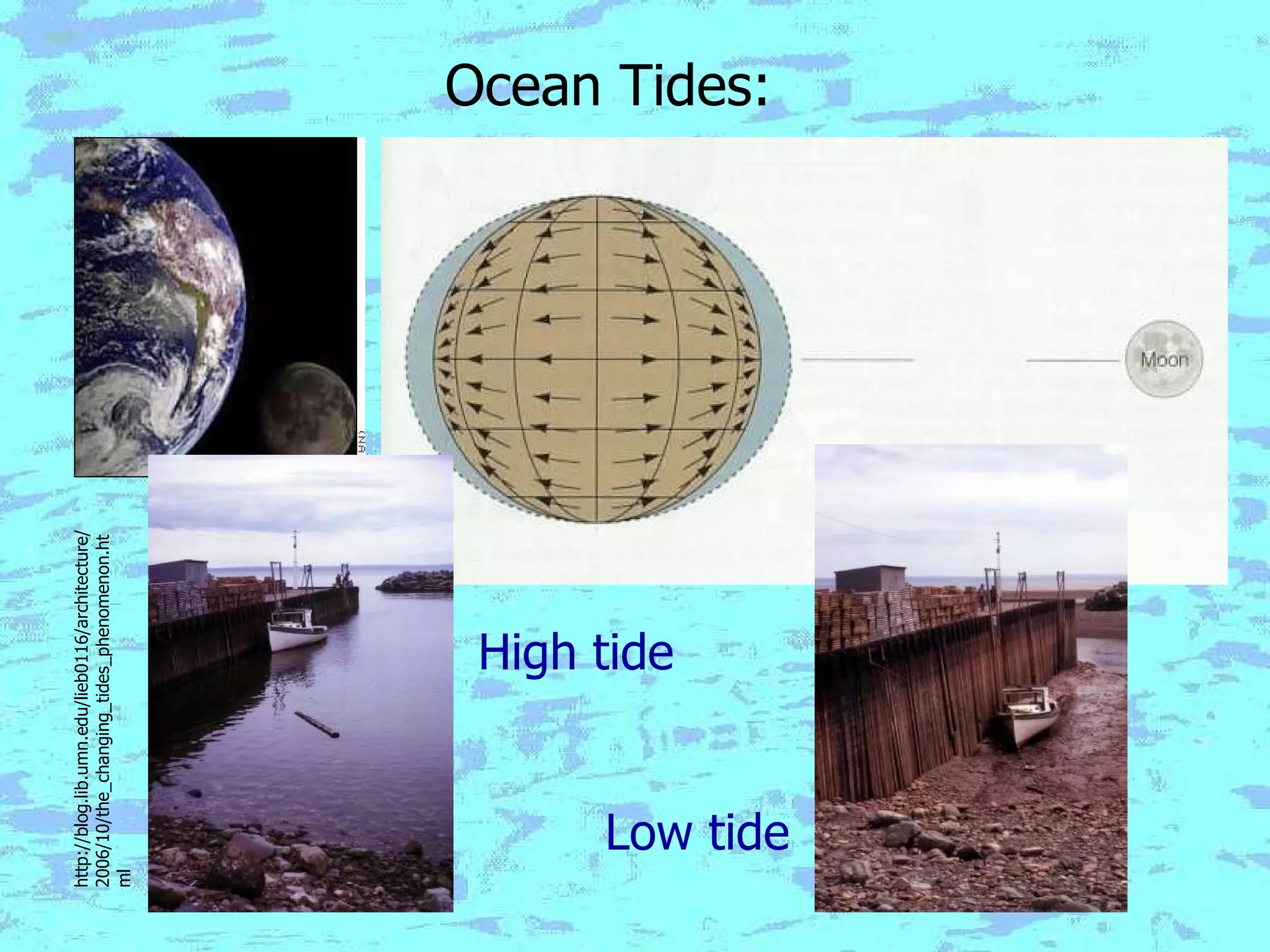
Intertidal Zone On the beaches Unstable, saltier, waves disturb it Tides : cycles of rise and fall of ocean’s surface due to moon’s gravitational pull The tides pull out leaving tidal pools with organisms still in it, awaiting the next high tide. - Low tide : organisms exposed to air - High tide : organisms under ocean water
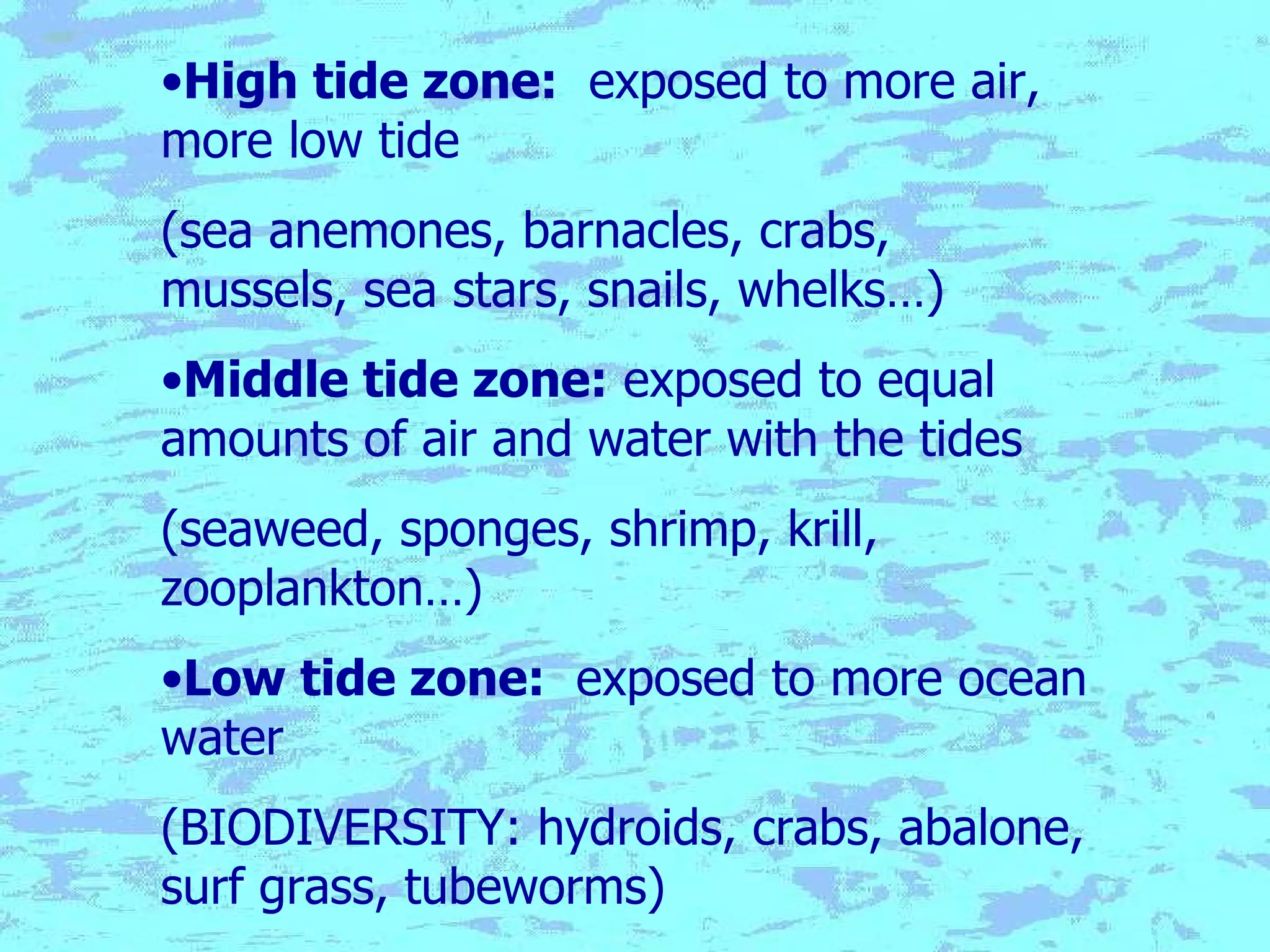
High tide zone:   exposed to more air, more low tide (sea anemones, barnacles, crabs, mussels, sea stars, snails, whelks…) Middle tide zone:  exposed to equal amounts of air and water with the tides (seaweed, sponges, shrimp, krill, zooplankton…) Low tide zone:   exposed to more ocean water (BIODIVERSITY: hydroids, crabs, abalone, surf grass, tubeworms)
Ocean Tides: High tide Low tide http://blog.lib.umn.edu/lieb0116/architecture/2006/10/the_changing_tides_phenomenon.html
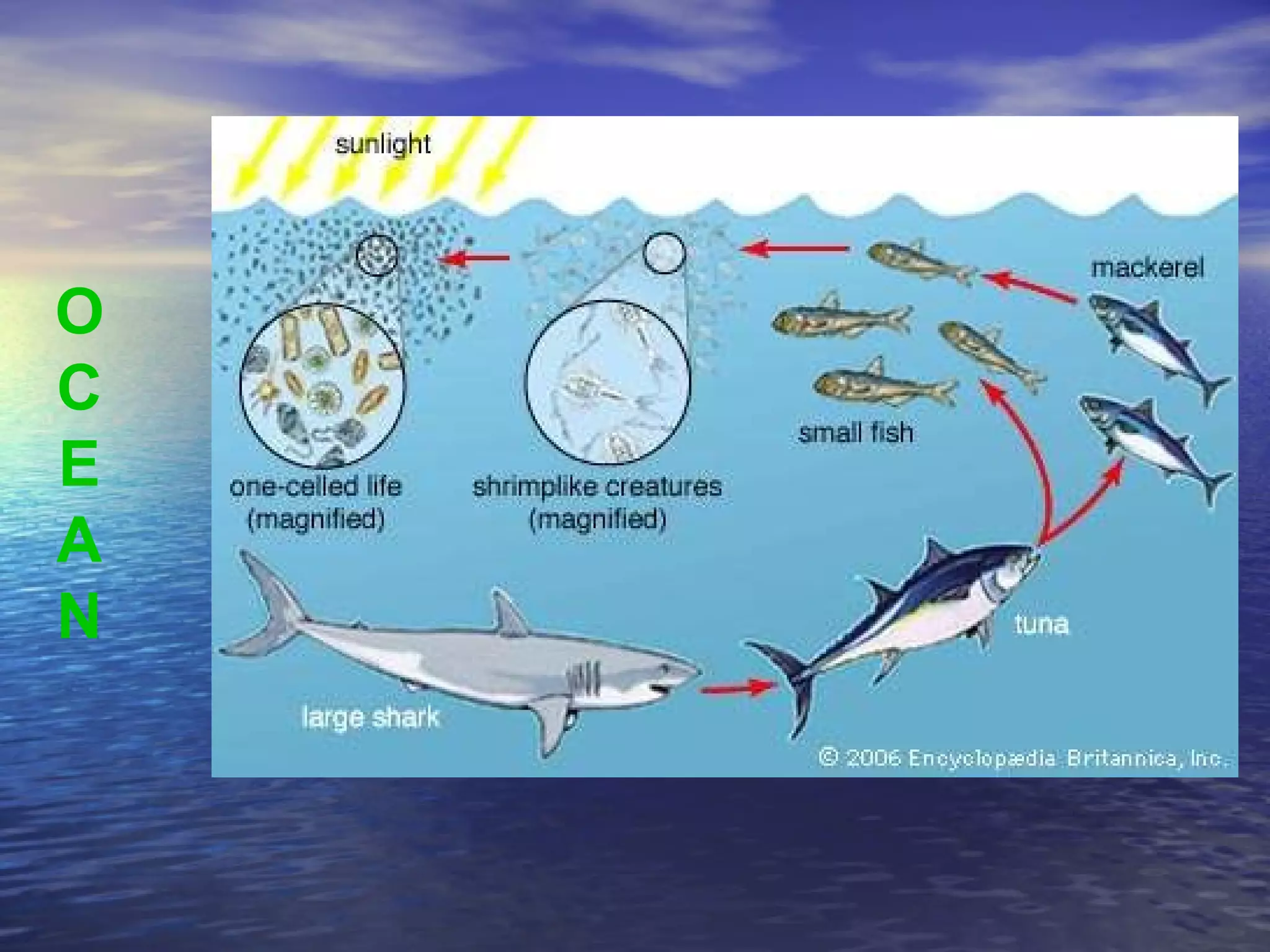
OCEAN
HSW  Surviving the OCEAN  (3min) HSW Surviving a  MAN OVERBOARD  (2 min) HSW Surviving  on a LIFE RAFT  (2 min) HSW Surviving  SHARKS  (2 min) HSW  Phytoplankton & Oceanic  Deadzones  (2 min)
Works Cited Photos:  CNN.com  nature www.lhup.edu/~dsimanek/scenario/tides101.htm www.nhptv.org/natureworks/nwep6j.htm   http://www.princeton.edu/~jhalderm/pics/2000-08= bermuda/chiton.jpg http://en.wikipedia.org http://images.google.com Deep Exploration : Go to the ocean Floor Video Watch divers with Jean Michel Cousteau

Ocean notes: a comprehensive study on different ocean zones including intertidal, euphotic, disphotic, and aphotic zones, mentioning global warming & climate change, currents, energy flows, with video links

  • 1.
    Oceans PPt. by,Robin D. Seamon
  • 2.
  • 3.
  • 4.
    Ocean Notes Saltwater/ salinity 360 million square miles 3.5 billion years old 100,000 + species 28 degrees to 86 degrees F 7 miles down in some places Mineral composition: sodium chloride magnesium calcium potassium
  • 5.
    Ocean Exploration: oceanographerelectronic devices measure with radar underwater cameras gear: Wet suit Jimmy suit Mooring Buoys Drills Submersibles Satellites Computers
  • 6.
    Food Energy MineralsMedicine Transportation Influence Climate Ocean Resources
  • 7.
  • 8.
    Ocean Currents CoriolisEffect http://ww2010.atmos.uiuc.edu/(Gh)/guides/mtr/fw/gifs/coriolis.mpg Video explanation
  • 9.
  • 10.
    Currents (tradewinds): underwater rivers Warm water moves up, Cool water sinks down in a circular motion. Gyres : circular patterns the wind moves the currents.
  • 11.
    Gyres : circular patterns the wind moves the currents. N __________ S Wind-driven Thermohaline
  • 12.
    Influences Climate SummarySummer Ocean stores heat Winter Ocean releases heat Currents carry off excess heat from tropical oceans to polar oceans Warming polar oceans (GLOBAL WARMING) MAJOR source of precipitation
  • 13.
    Ocean Currents CoriolisEffect http://ww2010.atmos.uiuc.edu/(Gh)/guides/mtr/fw/gifs/coriolis.mpg Video explanation
  • 14.
    CURRENTS: Highlight onyour map: N. Equatorial S. Equatorial California Current Canary Current Gulf Stream Japan Current Labrador Current Peru Current El Nino Antarctic Circumpolar *Strongest
  • 15.
  • 16.
    Sunlit Zone Depth:400-600 ft. Coral reefs Plankton/ photosynthesis Currents (trade winds): underwater rivers Gyres : circular patterns the wind moves the currents.
  • 17.
    Sunlit Zone Plankton pics Zooplankton pics http://ebvgroup4.wikispaces.com/file/view/seagrass_role.jpg/70547843/seagrass_role.jpg http:// i.ehow.com/images/a06/8h/bt/euphotic-zone_-200X200.jpg
  • 18.
    Ocean Zones http://www.johnkurtzart.com/i/PlantsAnimals/KurtzOceanZones.jpg
  • 19.
  • 20.
    Coral Reefs http://static.howstuffworks.com/gif/coral-reef-life.jpghttp://www.solcomhouse.com/images/green_Wrasse_web.jpg http://indosight.host56.com/wp-content/uploads/2010/06/Coral-reef-fish.jpg http://www.utc.edu/Faculty/Deborah-McAllister/imax/coral_reef.jpg
  • 21.
  • 22.
    Coral Reefs Foundin warm ocean water “ underwater forests” Colorful RELATIONSHIPS: Predator/Prey Simbiotic Diversity: 2 nd most productive habitat (following mangroves & rainforests Endangered
  • 23.
    Coral Reefs Foundon EASTERN coasts of Continents (because of the warm, strong currents) Caribbean Australia Hawaii Great Barrier Reef Coral: soft (alive) have polyps hard (dead) outer skeleton of limestone
  • 24.
  • 25.
  • 26.
    Twilight Zone 200-4,000feet down Sunlight barely gets through the water: Hard to see, not dark, not light (like dawn and dusk above water) Large predators: sharks Below the continental shelf, at the drop-off zone
  • 27.
    Midnight Zone http://www.pbs.org/saf/1207/images07/life2.gifhttp://www.itsnature.org/wp-content/uploads/2008/02/giant-clam2.jpg http://www.eyezed.com/wp-content/uploads/2009/09/angler-fish.jpg http://ldtstudio.coe.uga.edu/mod/glossary/view.php?id=2392 http://www.life.com/static/ugc/022/ugc1001022/watermarkcomp.jpg
  • 28.
  • 29.
    Midnight Zone Completedarkness Blind/white animals Faults/trenches Pacific trench is deepest (36,198 ft down) PLATE TECHTONICS: create underwater mountains, trenches, vents, volcanoes, plains
  • 30.
    Mid-Ocean ridge: Mid-Atlantic Ridge 5,000 ft above sea floor, some through island to make islands Through 3 oceans Along ridges are HOT vents (black smokers) -Copper, iron, sulfur, zinc flow out -Strange marine life -Special bacteria use chemicals & heat to make food -1 foot giant clams -giant red tube worms, crabs, blind or glowing fish
  • 31.
    Abyssal Plains : Ooze, sediment PLATE TECTONICS Trenches: Seamounts: volcanic activity with the mountains,
  • 32.
  • 33.
    Intertidal Zone Onthe beaches Unstable, saltier, waves disturb it Tides : cycles of rise and fall of ocean’s surface due to moon’s gravitational pull The tides pull out leaving tidal pools with organisms still in it, awaiting the next high tide. - Low tide : organisms exposed to air - High tide : organisms under ocean water
  • 34.
    High tide zone: exposed to more air, more low tide (sea anemones, barnacles, crabs, mussels, sea stars, snails, whelks…) Middle tide zone: exposed to equal amounts of air and water with the tides (seaweed, sponges, shrimp, krill, zooplankton…) Low tide zone: exposed to more ocean water (BIODIVERSITY: hydroids, crabs, abalone, surf grass, tubeworms)
  • 35.
    Ocean Tides: Hightide Low tide http://blog.lib.umn.edu/lieb0116/architecture/2006/10/the_changing_tides_phenomenon.html
  • 36.
  • 37.
    HSW Survivingthe OCEAN (3min) HSW Surviving a MAN OVERBOARD (2 min) HSW Surviving on a LIFE RAFT (2 min) HSW Surviving SHARKS (2 min) HSW Phytoplankton & Oceanic Deadzones (2 min)
  • 38.
    Works Cited Photos: CNN.com nature www.lhup.edu/~dsimanek/scenario/tides101.htm www.nhptv.org/natureworks/nwep6j.htm http://www.princeton.edu/~jhalderm/pics/2000-08= bermuda/chiton.jpg http://en.wikipedia.org http://images.google.com Deep Exploration : Go to the ocean Floor Video Watch divers with Jean Michel Cousteau