
Marine Water
Ecosystem
• The Marine Environment
• The Marine Biota
• Zonation of the Sea
• Quantitative Study of Plankton
• Communities of the Marine Environment
• Mangroves and Coral Reefs
• Communities of Oceanic Region
• And Estuary
Marine Ecology is the scientific study of marine-life
habitat, populations, and interactions among
organisms and the surrounding environment
including their abiotic and biotic factors.
Living(Biotic) Non- Living(Abiotic)
 Fish
 Phytoplankton
 Dinoflagellates
 Coral
 Bacteria
 Mangroves
etc..
 Sunlight
 Water Temperature
 Currents
 Sediments/sand
 Substrate
 Water pressure
etc..
For centuries man Regarded the sea as a restless
surface which first hindered, then aided his efforts
to explore the world. He also learned that the sea
was a source of food which could be harvested, by
dint of great effort, to supplement the products of
land and fresh water.
HMS Challenger – One of the first ship specifically
equipped for the study of the sea
“He must consider the oceans as an integral part of his “total life-support system” and
not as an inert “supply depot” that is merely there for the taking”
The Oceans, seas, bays, estuaries and other major
water bodies including their surface interface and
interaction with the atmosphere and with the land
seaward of the mean high water marks.
1. The sea is big: it covers 70
percent of the earth surface.
2. The sea is deep and all life
extends to its depth.
 Pressure in the ocean
increases by about
1 atmosphere for every 10
meters of depth, the amount
of pressure experienced by
many marine organisms is
extreme.
Marine Environment
3. The sea is continuous,
not separated as are
land and freshwater
habitats.
 Temperature
 Salinity
 Depth
Marine Environment
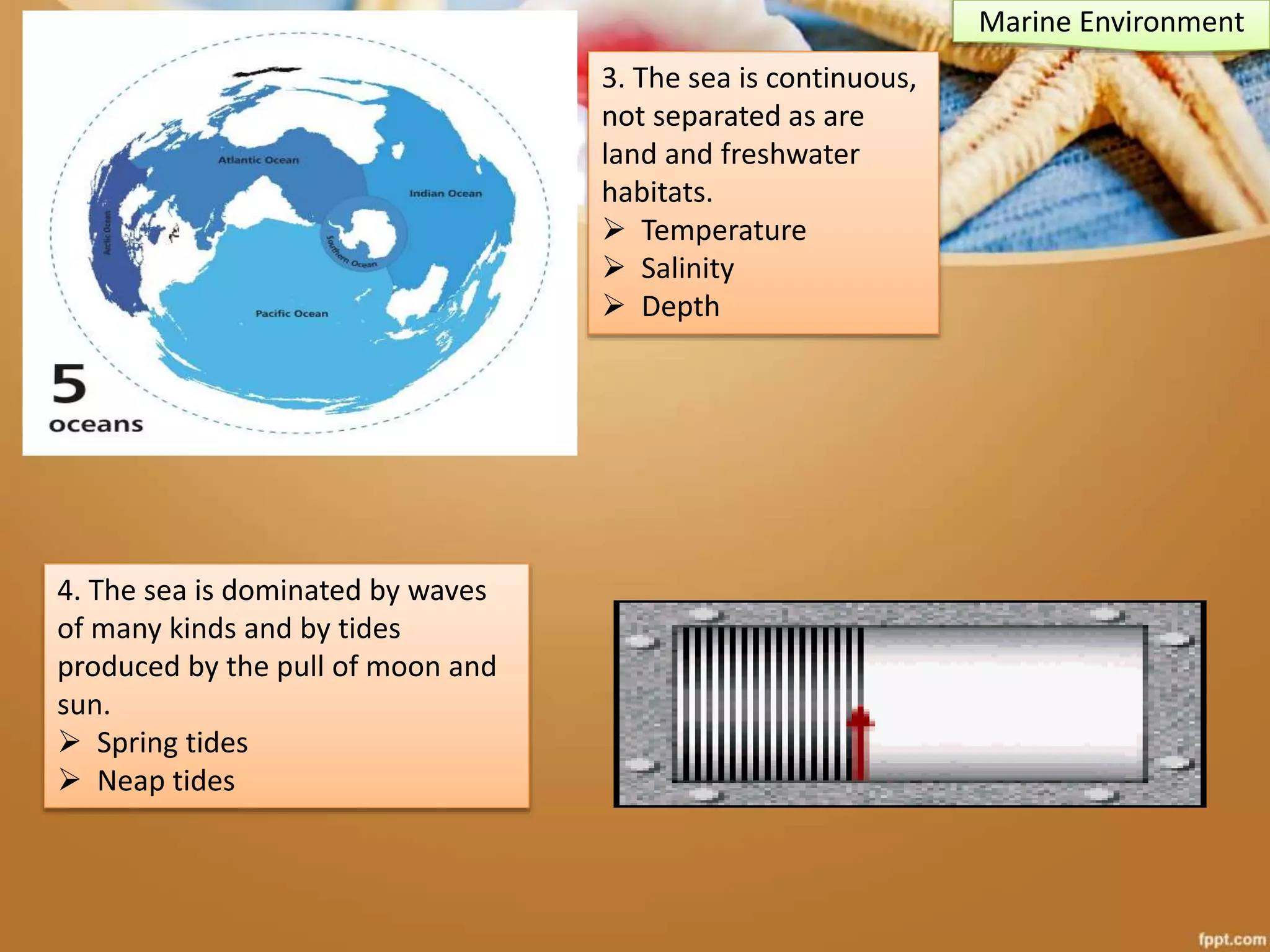
4. The sea is dominated by waves
of many kinds and by tides
produced by the pull of moon and
sun.
 Spring tides
 Neap tides
Marine Environment
5. The concentration of dissolved nutrients is
low and constitutes an important limiting
factor in determining the size of marine
population.
 oxygen
4. The sea is in continuous circulation
air temperature difference between
poles and equator.(Ocean Conveyor
Belt or “thermohaline circulation”)
 Upwelling
 Outwelling
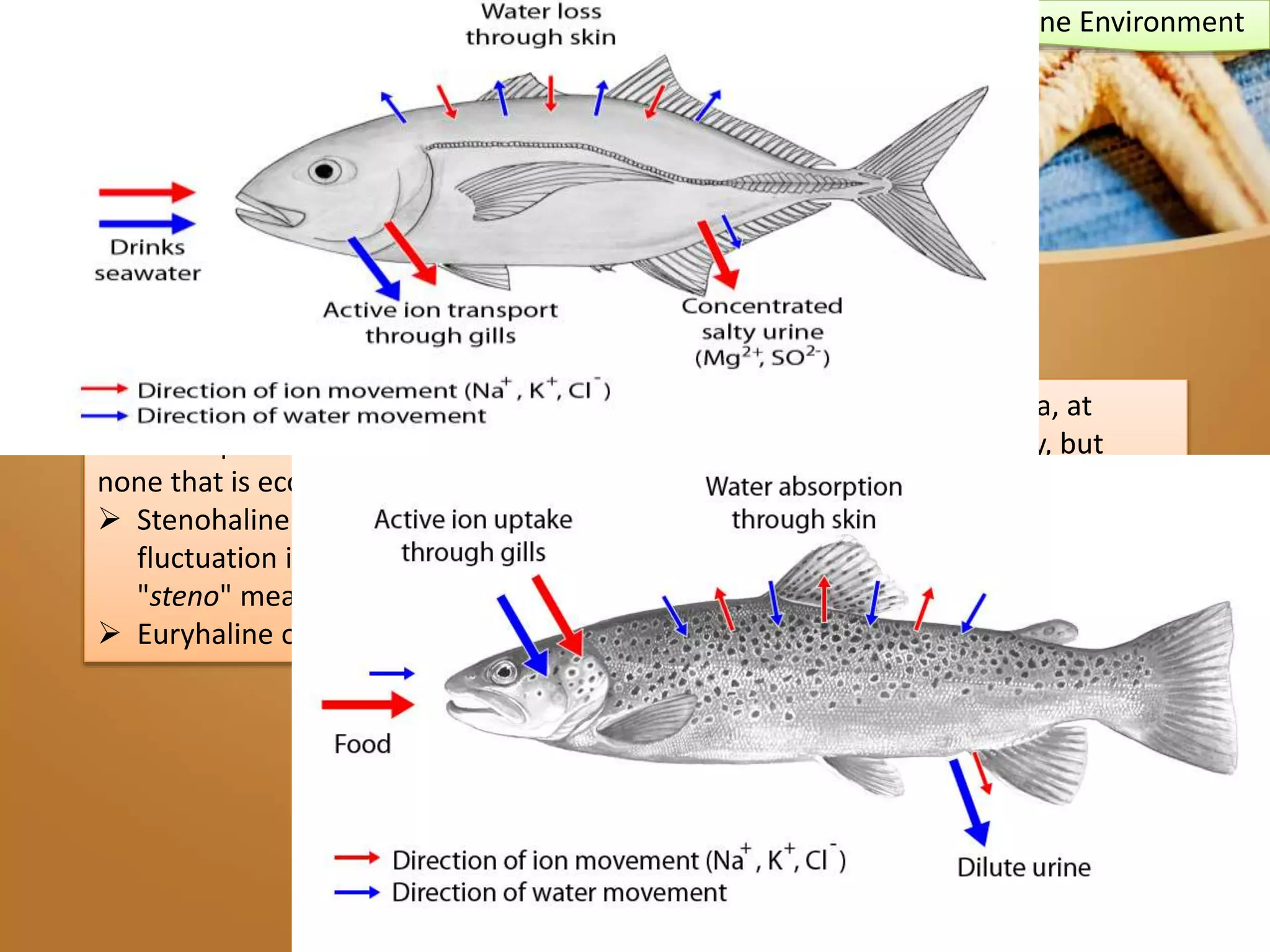
7. The sea is salty. salinity is remarkably constant throughout the deep sea, at
about 35 parts per thousand. There are some minor differences in salinity, but
none that is ecologically significant, except in the Mediterranean and Red Seas.
 Stenohaline describes an organism, usually fish that cannot tolerate a wide
fluctuation in the salinityof water. Stenohaline is derived from the words:
"steno" meaning narrow, and "haline" meaning salt.
 Euryhaline organisms are able to adapt to a wide range of salinities.
Marine Environment
Life in the Sea
The Marine Biota
The five major kingdoms
in the ocean are:
Monera:single-celled organisms without nucleus (Prokaryotes)
Protista:single-celled organisms with nucleus (Eukaryotes)
Fungi : important in decomposition and recycling.
Metaphyta: plants that grow attached to the sea floor.
Metazoa: all multicellular animals in the ocean.
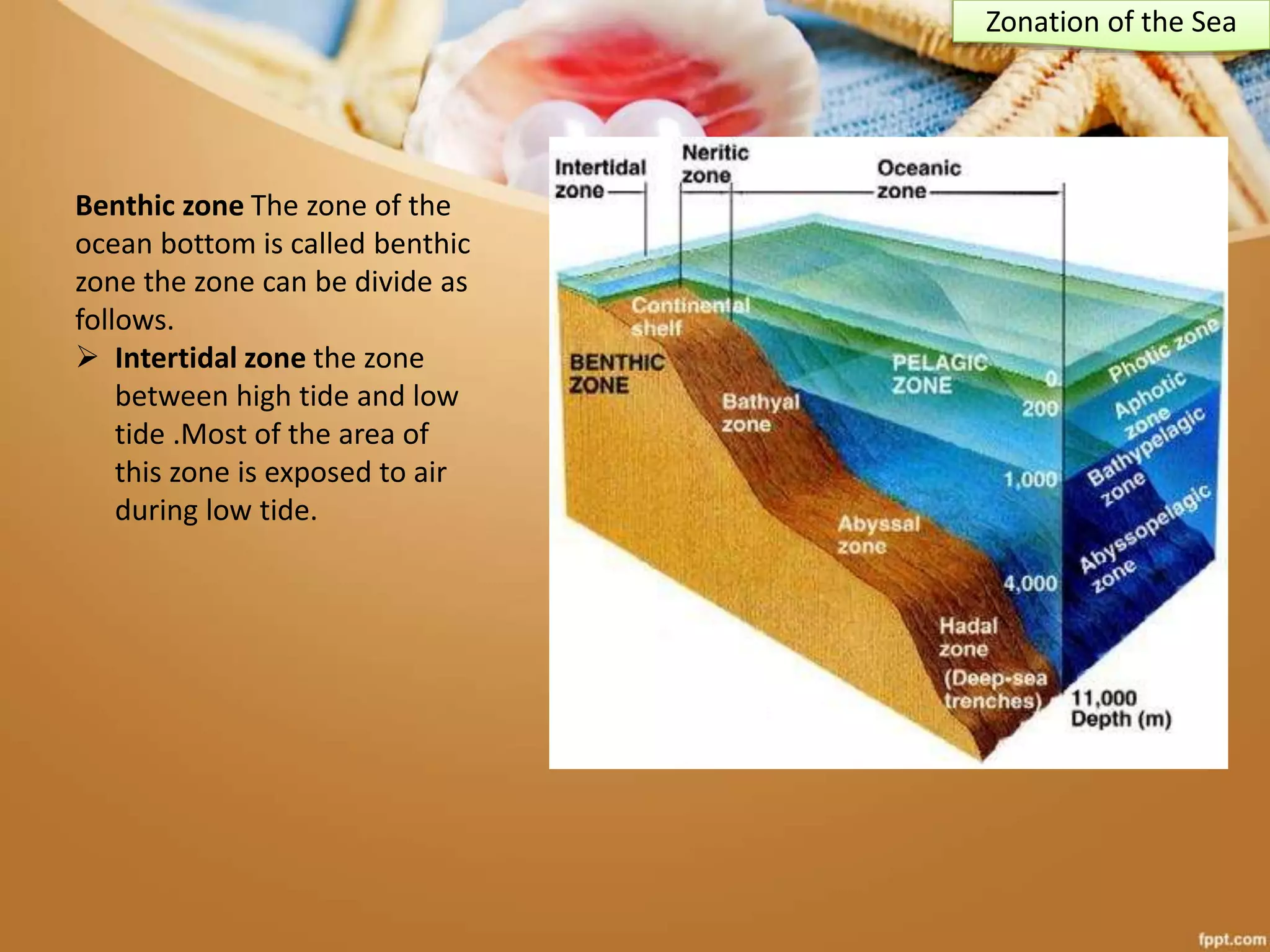
The sea or ocean of the sea is divided into various
divisions which is called zonation of sea
The marine environment can be divided into two
zones:
 Pelagic zone
 Benthic zone
Pelagic from the greek word pelages
which means open sea .The pelagic
zone occupies 1330 million cubic
miles. Fish that live in pelagic area
called pelagic fish
Neritic zone this is the part of the
ocean extending frim low tide mark to
the edge of continental shelf.
 neritic zone has generally well
oxygenated water .
 low water pressure and stable
water temperature.
 Zooplankton ,free floating
foraminifera are to small fish and
shrimp live in this zone.
Oceanic zone The oceanic zone begins in the area off shore where the water measures
200meters deep or deeper .It is the region of open sea beyond the edge of continental
shelf and includes 65% of the oceans completely open water shelf break deep open water.
Zonation of the Sea
Oceanic Zone Subdivision
Zonation of the Sea
1. Epipelagic (sunlit) This zone stars
from the surface down to 200m.
 this is illuminated zone at the
surface of the sea ,where there is
light for photosynthesis .
 Nearly all primary production in the
ocean occurs here.
 with the light heat comes and this
heat is responsible for the wide
range if temperature.
 organism found in this zone are
planktons, seaweeds , jellyfish etc.
2. Mesopelagic (twilit) Zone stars
from 200meters down to 1000 meters
,sometimes referred from mid water
zone.
 although light penetrate this
second layer ,it is sufficient for
photosynthesis.
 sometimes creature live in this
zone are bioluminescent .
 organisms that available here are
squid ,cuttlefish ,wolfish ,swordfish
etc.
 a great diversity of strange and
bizarre fishes can be found here.
Zonation of the Sea
3. Bathypelagic (Midnight) From
100 meters down to 400m. from
ancient Greek Bathys means
deep.
 at this depth the ocean is pitch
black apart from occasional
bioluminescent organisms such
as lantern fish.
 there is no living plant life.
 most species depends on prey
for food
ex. Giant squid.
 most of the animals that live
at this depth are black or red in
color due to lack of light.
Zonation of the Sea
4. Abyssopelagic (lower midnight)
The name is derived from the
Greek abyssos means bottomless
and from 400m down to 600m .
 the water temperature us near
freezing and there is no light at
all.
 this zone is mostly unknown
and very few species are
known to live here.
 the abyssal plain is covered
with soft sludge composed of
dead organism from above.
Zonation of the Sea
Benthic zone The zone of the
ocean bottom is called benthic
zone the zone can be divide as
follows.
 Intertidal zone the zone
between high tide and low
tide .Most of the area of
this zone is exposed to air
during low tide.
Zonation of the Sea
The continental shelf ,rise and slope together are
called continental margin.
 Continental Shelf is shallow ,near horizontal
seafloor extension from the shoreline to the
upper continental slope .
 this shelf forms the shallow margin of each deep
basin.
 it is one of the most productive zone of the
ocean .
 this area is commercially very important. The
bottom is composed of fume sediments like sand
and silt.
Zonation of the Sea
Continental slope begins at the shelf break and plunge
downward to great depths of the ocean basin proper.
 Continental Rise many continental slopes end in
gently sloping smooth surfaced features called
continental rise.
Zonation of the Sea
PLANKTON Not only does plankton occupy the key role in the ocean
ecosystem ,but it lends itself to quantitative sampling.. 1830 J, Vaughan
Thompson and 1845 Johannes Muller used the now called plankton.
Plankton was not proposed until Muller was studying the life history of
starfish.
 Plankton net are generally made of bolting silk or nylon ,the strands if
which are held firmly by binding it.
 Clark Bumpus -a closing net equipped with a metering device that
measures the amount of water filtered and use to the given depth can
be sampled without contamination while the nerves being lowered and
raise. -Net plankton and nannoplankton also called macro and micro
plankton. >the most important photosynthetic organisms are not
relatively large netpankton,but the nannoplankton, especially tiny green
flagellates 2 to 25 microns in size.
Net plankton and nannoplankton
also called macro and micro
plankton.
 the most important
photosynthetic organisms are not
relatively large net pankton,but
the nannoplankton,especially tiny
green flagellates 2 to 25 microns
in size.
Ex. Nanno plankton -may also dominate the metabolism of coastal coast. Tiny
flagellates- most of them colorless but some containing chlorophyll ,have also been
found in abundance in the aphotic zone at depth of 1000 meters or more. And these
presume to live heterotrophically at least of the time dissolved organic matter
originating in the photic zone. These flagellates may be one of the jey of food chain
links.
Quantitative Study of
Plankton
 phytoplankton diatoms and
dinoflagellates.
 micro flagellates
 Green algae(Chlorophyta)
 Brown algae(Phaeophyta)
 Red algae (Rhodophyta)
Producer
Some of fixed algae are economic
importance as a source of agar
and other products on Northern
rocky coasts "seaweed "harvest is
a regular industry and in Japan
certain species are culture food .
 Giant crustaceans
 Large copepods
 Small copepod
 Chaetognaths
 Medusae
 Salp
Consumer
Composition of Communities of
the Continental Shelf Region
Zooplankton Play vital role in marine
ecosystems. Variation in the zooplankton
species composition ,biomass and
secondary production will change the
structure and function of the ecosystem.
Mangroves and Coral
Reefs
Mangroves
Mangroves are among the few
emergent land plants that
tolerate the salinities of the open
sea.
Mangroves are not only important
in extending coasts and building
islands, but also in protecting
coasts from excessive erosion
which might otherwise be
produced by fierce tropical
storms.
Mangroves and Coral
Reefs
Coral Reefs
 Coral reefs are widely distributed in shallow waters of warm seas.
 Coral reefs is not a heterotrophic community, but a complete ecosystem
with a tropic structure that includes a large biomass of green plants.
 Corals produce large amounts of mucus protects the delicate animals
from siltation, while perhaps also providing the reef community with
another means of trapping particulate nutrients.
Mangroves and Coral
Reefs
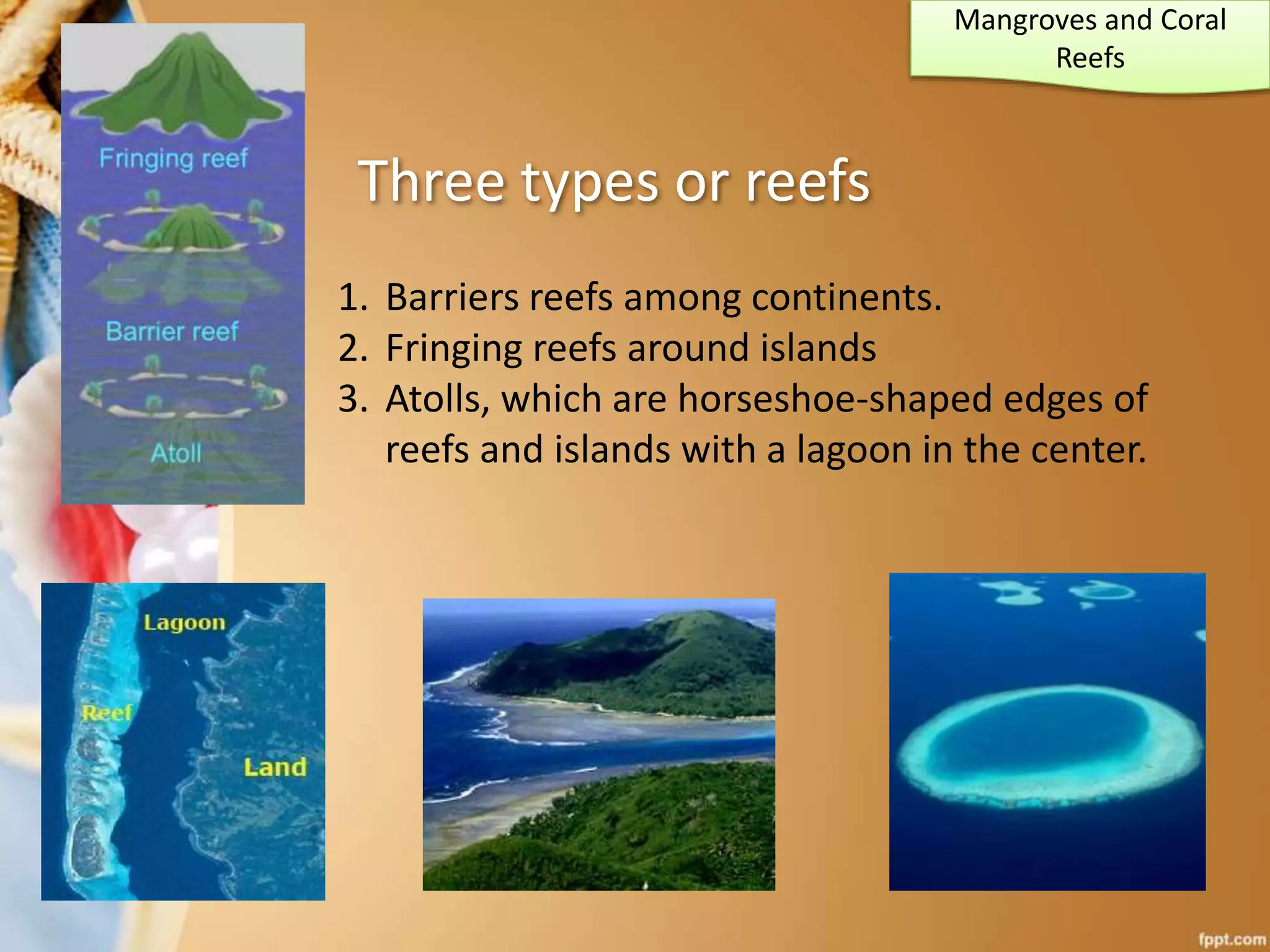
Three types or reefs
1. Barriers reefs among continents.
2. Fringing reefs around islands
3. Atolls, which are horseshoe-shaped edges of
reefs and islands with a lagoon in the center.
All in all mangroves and coral reefs are both
important as “land builders” which help form
islands and extend shores.
Mangroves and Coral
Reefs
Communities of the
oceanic region.
 Oceanic phytoplankton predominantly
as “micro plankton”.
 Zooplankton or “zooplankton”
 Oceanic birds
 whales
An estuary is a semi-enclosed coastal body of water
with freshwater flowing into it and a connection to
the open sea.
Estuaries—areas where fresh and saltwater mix—are made
up of many different types of habitats. These habitats can
include oyster reefs, coral reefs, rocky shores, submerged
aquatic vegetation, marshes, and mangroves. There are also
different animals that live in each of these different habitats.
Fish, shellfish, and migratory birds are just a few of the
animals that can live in an estuary.
Estuaries are often associated with high rates of biological
productivity. They are among the most productive ecosystems in the
world and are home to unique plant and animal communities. Many
animal species rely on estuaries for food and as places to nest and
breed. An estuary has very little wave action, so it provides a calm
refuge from the open sea. Some of the animals, such as flounder, eels,
and striped bass are temporary residents, while fishes such as
sticklebacks, silversides, as well as mud snails, fiddler crabs, ribbed
mussels, and oysters may spend their entire lives there. In almost all
estuaries the salinity of the water changes over the tidal cycle. To
survive in these conditions, plants and animals must be able to
respond quickly to these changes and tolerate a wide range of
salinities. Relatively few organisms have evolved adaptations to such
stressful conditions, so estuaries tend to have lower biodiversity than
other coastal habitats in the same region. Some organisms have
evolved special physical structures to cope with changing salinity. The
smooth cord grass in salt marshes, for example, has special filters on
its roots to remove salts from the water it absorbs and salt glands on
its leaves that expel excess salt.
Marine water
Marine water

Marine water

  • 1.
  • 2.
    • The MarineEnvironment • The Marine Biota • Zonation of the Sea • Quantitative Study of Plankton • Communities of the Marine Environment • Mangroves and Coral Reefs • Communities of Oceanic Region • And Estuary
  • 3.
    Marine Ecology isthe scientific study of marine-life habitat, populations, and interactions among organisms and the surrounding environment including their abiotic and biotic factors. Living(Biotic) Non- Living(Abiotic)  Fish  Phytoplankton  Dinoflagellates  Coral  Bacteria  Mangroves etc..  Sunlight  Water Temperature  Currents  Sediments/sand  Substrate  Water pressure etc..
  • 4.
    For centuries manRegarded the sea as a restless surface which first hindered, then aided his efforts to explore the world. He also learned that the sea was a source of food which could be harvested, by dint of great effort, to supplement the products of land and fresh water. HMS Challenger – One of the first ship specifically equipped for the study of the sea
  • 5.
    “He must considerthe oceans as an integral part of his “total life-support system” and not as an inert “supply depot” that is merely there for the taking”
  • 6.
    The Oceans, seas,bays, estuaries and other major water bodies including their surface interface and interaction with the atmosphere and with the land seaward of the mean high water marks.
  • 7.
    1. The seais big: it covers 70 percent of the earth surface. 2. The sea is deep and all life extends to its depth.  Pressure in the ocean increases by about 1 atmosphere for every 10 meters of depth, the amount of pressure experienced by many marine organisms is extreme. Marine Environment
  • 8.
    3. The seais continuous, not separated as are land and freshwater habitats.  Temperature  Salinity  Depth Marine Environment 4. The sea is dominated by waves of many kinds and by tides produced by the pull of moon and sun.  Spring tides  Neap tides
  • 9.
    Marine Environment 5. Theconcentration of dissolved nutrients is low and constitutes an important limiting factor in determining the size of marine population.  oxygen 4. The sea is in continuous circulation air temperature difference between poles and equator.(Ocean Conveyor Belt or “thermohaline circulation”)  Upwelling  Outwelling
  • 10.
    7. The seais salty. salinity is remarkably constant throughout the deep sea, at about 35 parts per thousand. There are some minor differences in salinity, but none that is ecologically significant, except in the Mediterranean and Red Seas.  Stenohaline describes an organism, usually fish that cannot tolerate a wide fluctuation in the salinityof water. Stenohaline is derived from the words: "steno" meaning narrow, and "haline" meaning salt.  Euryhaline organisms are able to adapt to a wide range of salinities. Marine Environment
  • 11.
  • 12.
    The Marine Biota Thefive major kingdoms in the ocean are: Monera:single-celled organisms without nucleus (Prokaryotes) Protista:single-celled organisms with nucleus (Eukaryotes) Fungi : important in decomposition and recycling. Metaphyta: plants that grow attached to the sea floor. Metazoa: all multicellular animals in the ocean.
  • 13.
    The sea orocean of the sea is divided into various divisions which is called zonation of sea The marine environment can be divided into two zones:  Pelagic zone  Benthic zone
  • 14.
    Pelagic from thegreek word pelages which means open sea .The pelagic zone occupies 1330 million cubic miles. Fish that live in pelagic area called pelagic fish Neritic zone this is the part of the ocean extending frim low tide mark to the edge of continental shelf.  neritic zone has generally well oxygenated water .  low water pressure and stable water temperature.  Zooplankton ,free floating foraminifera are to small fish and shrimp live in this zone. Oceanic zone The oceanic zone begins in the area off shore where the water measures 200meters deep or deeper .It is the region of open sea beyond the edge of continental shelf and includes 65% of the oceans completely open water shelf break deep open water. Zonation of the Sea
  • 15.
    Oceanic Zone Subdivision Zonationof the Sea 1. Epipelagic (sunlit) This zone stars from the surface down to 200m.  this is illuminated zone at the surface of the sea ,where there is light for photosynthesis .  Nearly all primary production in the ocean occurs here.  with the light heat comes and this heat is responsible for the wide range if temperature.  organism found in this zone are planktons, seaweeds , jellyfish etc.
  • 16.
    2. Mesopelagic (twilit)Zone stars from 200meters down to 1000 meters ,sometimes referred from mid water zone.  although light penetrate this second layer ,it is sufficient for photosynthesis.  sometimes creature live in this zone are bioluminescent .  organisms that available here are squid ,cuttlefish ,wolfish ,swordfish etc.  a great diversity of strange and bizarre fishes can be found here. Zonation of the Sea
  • 17.
    3. Bathypelagic (Midnight)From 100 meters down to 400m. from ancient Greek Bathys means deep.  at this depth the ocean is pitch black apart from occasional bioluminescent organisms such as lantern fish.  there is no living plant life.  most species depends on prey for food ex. Giant squid.  most of the animals that live at this depth are black or red in color due to lack of light. Zonation of the Sea
  • 18.
    4. Abyssopelagic (lowermidnight) The name is derived from the Greek abyssos means bottomless and from 400m down to 600m .  the water temperature us near freezing and there is no light at all.  this zone is mostly unknown and very few species are known to live here.  the abyssal plain is covered with soft sludge composed of dead organism from above. Zonation of the Sea
  • 19.
    Benthic zone Thezone of the ocean bottom is called benthic zone the zone can be divide as follows.  Intertidal zone the zone between high tide and low tide .Most of the area of this zone is exposed to air during low tide. Zonation of the Sea
  • 20.
    The continental shelf,rise and slope together are called continental margin.  Continental Shelf is shallow ,near horizontal seafloor extension from the shoreline to the upper continental slope .  this shelf forms the shallow margin of each deep basin.  it is one of the most productive zone of the ocean .  this area is commercially very important. The bottom is composed of fume sediments like sand and silt. Zonation of the Sea
  • 21.
    Continental slope beginsat the shelf break and plunge downward to great depths of the ocean basin proper.  Continental Rise many continental slopes end in gently sloping smooth surfaced features called continental rise. Zonation of the Sea
  • 22.
    PLANKTON Not onlydoes plankton occupy the key role in the ocean ecosystem ,but it lends itself to quantitative sampling.. 1830 J, Vaughan Thompson and 1845 Johannes Muller used the now called plankton. Plankton was not proposed until Muller was studying the life history of starfish.  Plankton net are generally made of bolting silk or nylon ,the strands if which are held firmly by binding it.  Clark Bumpus -a closing net equipped with a metering device that measures the amount of water filtered and use to the given depth can be sampled without contamination while the nerves being lowered and raise. -Net plankton and nannoplankton also called macro and micro plankton. >the most important photosynthetic organisms are not relatively large netpankton,but the nannoplankton, especially tiny green flagellates 2 to 25 microns in size.
  • 23.
    Net plankton andnannoplankton also called macro and micro plankton.  the most important photosynthetic organisms are not relatively large net pankton,but the nannoplankton,especially tiny green flagellates 2 to 25 microns in size. Ex. Nanno plankton -may also dominate the metabolism of coastal coast. Tiny flagellates- most of them colorless but some containing chlorophyll ,have also been found in abundance in the aphotic zone at depth of 1000 meters or more. And these presume to live heterotrophically at least of the time dissolved organic matter originating in the photic zone. These flagellates may be one of the jey of food chain links. Quantitative Study of Plankton
  • 25.
     phytoplankton diatomsand dinoflagellates.  micro flagellates  Green algae(Chlorophyta)  Brown algae(Phaeophyta)  Red algae (Rhodophyta) Producer Some of fixed algae are economic importance as a source of agar and other products on Northern rocky coasts "seaweed "harvest is a regular industry and in Japan certain species are culture food .  Giant crustaceans  Large copepods  Small copepod  Chaetognaths  Medusae  Salp Consumer Composition of Communities of the Continental Shelf Region Zooplankton Play vital role in marine ecosystems. Variation in the zooplankton species composition ,biomass and secondary production will change the structure and function of the ecosystem.
  • 26.
    Mangroves and Coral Reefs Mangroves Mangrovesare among the few emergent land plants that tolerate the salinities of the open sea. Mangroves are not only important in extending coasts and building islands, but also in protecting coasts from excessive erosion which might otherwise be produced by fierce tropical storms.
  • 27.
    Mangroves and Coral Reefs CoralReefs  Coral reefs are widely distributed in shallow waters of warm seas.  Coral reefs is not a heterotrophic community, but a complete ecosystem with a tropic structure that includes a large biomass of green plants.  Corals produce large amounts of mucus protects the delicate animals from siltation, while perhaps also providing the reef community with another means of trapping particulate nutrients.
  • 28.
    Mangroves and Coral Reefs Threetypes or reefs 1. Barriers reefs among continents. 2. Fringing reefs around islands 3. Atolls, which are horseshoe-shaped edges of reefs and islands with a lagoon in the center.
  • 29.
    All in allmangroves and coral reefs are both important as “land builders” which help form islands and extend shores. Mangroves and Coral Reefs
  • 30.
    Communities of the oceanicregion.  Oceanic phytoplankton predominantly as “micro plankton”.  Zooplankton or “zooplankton”  Oceanic birds  whales
  • 31.
    An estuary isa semi-enclosed coastal body of water with freshwater flowing into it and a connection to the open sea.
  • 32.
    Estuaries—areas where freshand saltwater mix—are made up of many different types of habitats. These habitats can include oyster reefs, coral reefs, rocky shores, submerged aquatic vegetation, marshes, and mangroves. There are also different animals that live in each of these different habitats. Fish, shellfish, and migratory birds are just a few of the animals that can live in an estuary.
  • 33.
    Estuaries are oftenassociated with high rates of biological productivity. They are among the most productive ecosystems in the world and are home to unique plant and animal communities. Many animal species rely on estuaries for food and as places to nest and breed. An estuary has very little wave action, so it provides a calm refuge from the open sea. Some of the animals, such as flounder, eels, and striped bass are temporary residents, while fishes such as sticklebacks, silversides, as well as mud snails, fiddler crabs, ribbed mussels, and oysters may spend their entire lives there. In almost all estuaries the salinity of the water changes over the tidal cycle. To survive in these conditions, plants and animals must be able to respond quickly to these changes and tolerate a wide range of salinities. Relatively few organisms have evolved adaptations to such stressful conditions, so estuaries tend to have lower biodiversity than other coastal habitats in the same region. Some organisms have evolved special physical structures to cope with changing salinity. The smooth cord grass in salt marshes, for example, has special filters on its roots to remove salts from the water it absorbs and salt glands on its leaves that expel excess salt.