Prepared By: SULTIZ, LARRY J.
 Biologists early became intrigued with the
amazing variety of life to be found along
the shores and among the coral reefs.
 HMS Challenger (1872) – the first to be
specifically equipped for the study of the
sea.
What is marine ecology?
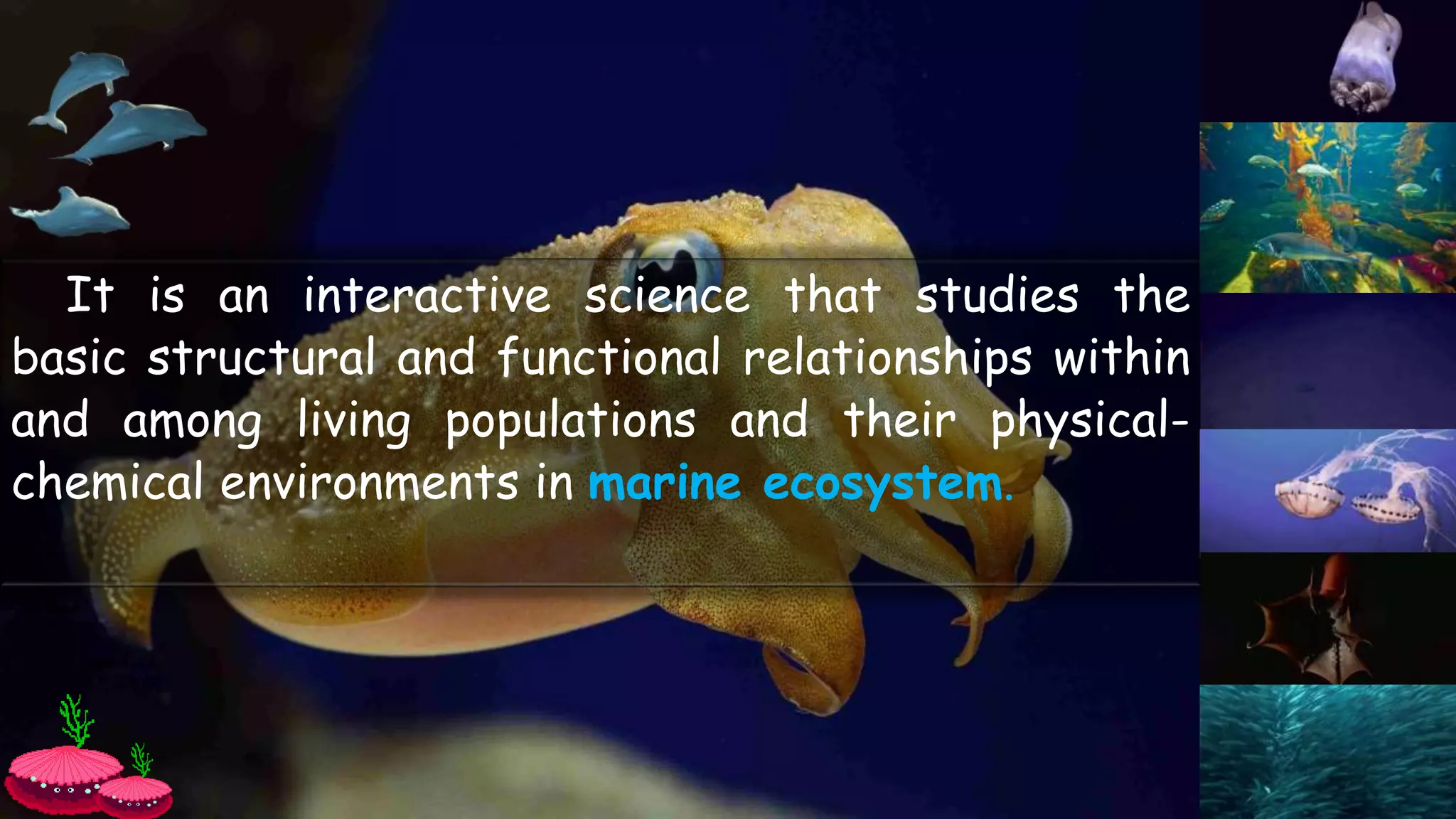
It is an interactive science that studies the
basic structural and functional relationships within
and among living populations and their physical-
chemical environments in marine ecosystem.
 Estuaries
Subtopics:
• Ecological features of the sea Ecological features of the sea
 Zonation
 Mangroves and Coral Reefs
 Marine Biota and Communities
Features of Marine
Ecology
Features of Marine Ecology
1. The sea is big – it covers 70% of the Earth’s
surface.
2. The sea is deep and life extends to all its
depths
- Although apparently there are no abiotic
zones in the ocean, life is much denser around
the margin of continents and island.
3. The sea is continuous, not separated as our
land and fresh water habitats.
4. The sea is in continuous circulation- air
temperature differences between poles and
equator set up strong winds such as the trade
winds (blowing steadily in the same direction the
year around) which, together with rotation of
the Earth, create different currents.
Features of Marine Ecology
2 types of water movement that
contributes to coastal fertility
 Upwelling- occurs where the winds consistently
move surface water away from precipitous
coastal slopes, bringing to the surface cold
water rich in nutrients which have been
accumulating in the depths.
-The most productive marine area is located in
this region.
Insert Figure
The major currents acts as giant pinwheel (gyres)
which run clockwise in the northern hemisphere
and counter clockwise in the southern hemisphere.
Example:
Peru Current- it creates one of the richest
fisheries in the world.
It also support large population of seabirds that
deposits countless tons of nitrate and phosphate-
rich guano on coastal island.
 Out-welling-occurs which nutrient-rich
estuarine water move out the sea.
5. The sea is dominated by waves of many kind
and by tides produced by the pull of moon and
sun.
 Tides are chiefly responsible for the mark
periodicities. Tides have periodicity of about
121/2 hours.
 High tides- occur in most localities twice daily,
being about 50 minutes later on successive day.
6. The sea is salty- the average salinity or salt
contents is 35 parts of salts by weight per 1000
parts of water, or 3.5%.
 Sea water has the pH of 8.2
7. The concentration of dissolved nutrients is
low and constitutes an important limiting
factor in determining the size of marine
population.
Every two weeks when sun and moon are
“working together” the amplitude of tides
increased.
Spring tides- when high tides are very high and
low tides are very low.
Neap tides- when the sun and moon cancel one
another. The tidal range varies from less than 1
foot in the open sea to 50 feet in the certain
enclosed bays.
8. The ocean and some groups of organisms
that live in it are older than the ocean floor,
which is constantly altered and renewed by
tectonic and sedimentary processes.
- the sea floor is apparently slowly spreading
outward from mid-ocean ridges, pushing
continents apart as it progresses.
Example: continental drift
The Marine Biota
What is Marine Biota?
Biota
 The combined flora and fauna of a region.
 The animal or plant life of a particular region.
The great richness of the marine biota can be
illustrated by comparing a sample of marine
plankton with a comparable one taken from a large
lake.
Zonation in the
Sea
What is zonation ?
Figure 2.2 Main division of the marine environment
Zonation is a bit of biological terminology
that refers to the way an ecosystem can be
divided up into zones based on a particular
factor, such as altitude or latitude.
Zonation
Marine Environments
Life Zones in the Ocean
I. Horizontal zones
- Those extending from the sea.
A.Coastal Zone:
- region in which tides expose the sea bottom for
some part of each day. The habitats are
alternately submerge under salt water and
waterlogged for hours and then exposed to the
air and dried out for hours. Also known as littoral,
near shore, and intertidal zone.
B. Pelagic Zone:
- located seaward of the coastal zone’s low-tide
mark, this contains the vast open waters of the
ocean. Two subdivisions are recognized:
b. Oceanic Zone
- the region of the sea extending to the edge of
the continental shelf, over the continental slope,
and over ocean floor. It is characterized by
darkness and tremendous pressure. Vertical line
zones are significant here.
a. Neretic Zone
- the water underlying the continental shelf. With
the exemption of Antarctica, these waters
usually extend to a depth of 600 ft. Sunlight
penetrates the entire water column.
Life Zones in the Ocean
II. Vertical line zones of the oceanic zone
A.Neustic zone:
the thin film or “skin” formed by surface tension
at the surface of the water.
B. Euphotic zone:
the top of the water column as far down as light is
available for photosynthesis. Depending upon
water clarity, the bottom of the euphotic zone is
about 500 ft. below sea level. Also known as
epipelagic zone.
C. Aphotic zone:
the remainder of the water column below the
euphotic zone. Food chains usually begin with
detritus or living algae and bacteria sinking
from above. This zone is further subdivided
by depth as follows:
Mesopelagic zone: 500 to 3,280 ft. below the sea
surface.
Bathypelagic zone: 3,280 to 13,000 ft. below the
sea surface.
Abyssopelagic zone: 13,000 to 20,000 ft. below
the sea surface.
Hadal zone: 20,000 to 35,000 ft. below the sea
surface.
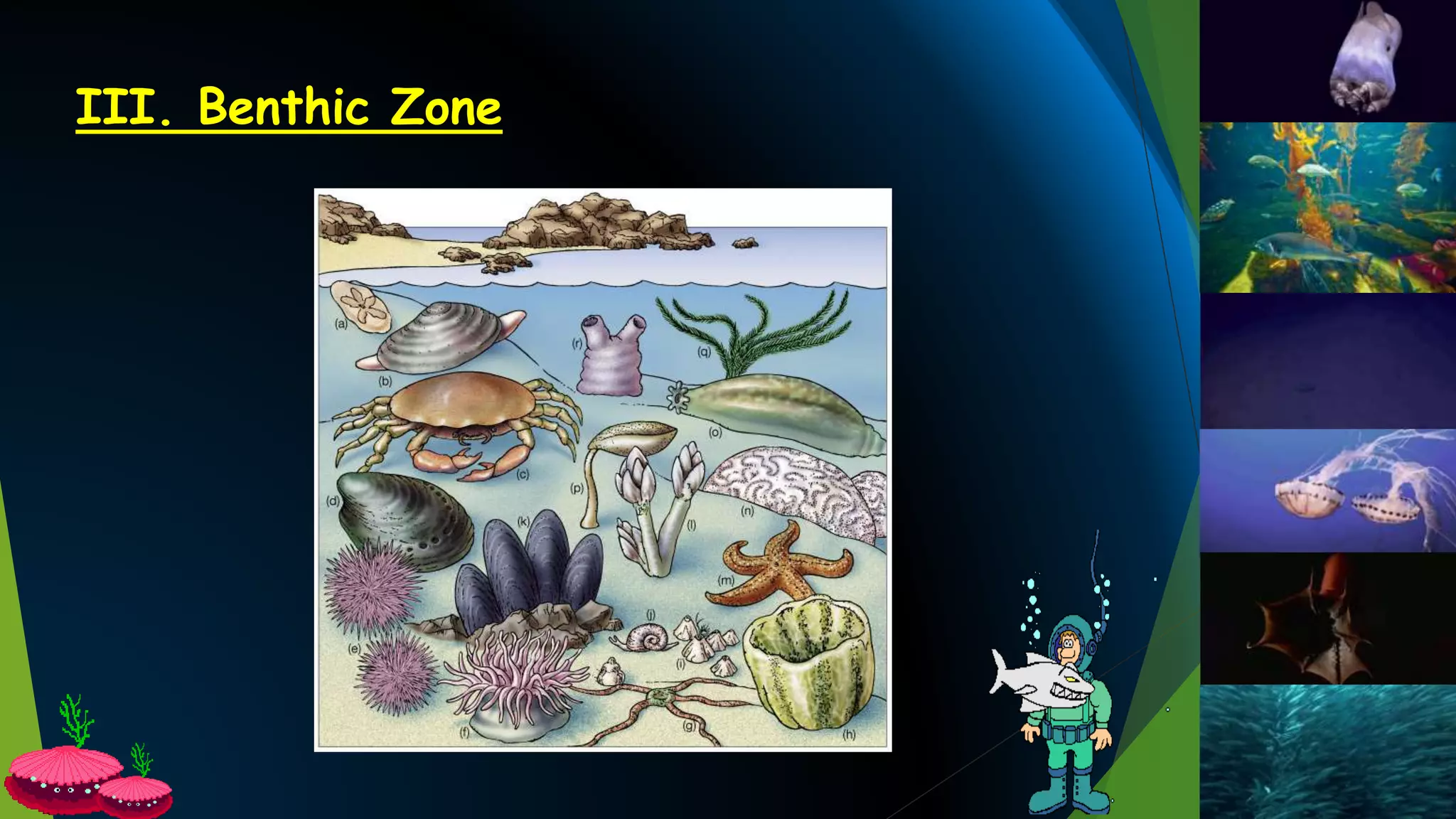
III. Benthic Zone
This zone contains all the habitats of the sea
bottom, whether in coastal, continental shelf,
or deep sea environments. Organisms may live
within the bottom material or on its surface.
Life Zones in the Ocean
III. Benthic Zone
Mangrove and Coral
Reefs
 Emergent land plants that tolerate the
salinities of the open sea.
Mangrove and Coral Reefs
 This ecosystem traps and cycles various
organic materials, chemical elements, and
important nutrients. Mangrove roots act not
only as physical traps but provide attachment
surfaces for various marine organisms.
 Many of them attached to organisms filter
water through their bodies and, in turn, trap
and cycle nutrients.
It provides:
- Protection
- Food
- Shelter
- Extension coast
- Building islands
- Major energy input into fisheries
 Florida’s mangroves are tropical species;
therefore, they are sensitive to extreme
temperature fluctuations as well as
subfreezing temperatures.
 Research indicates that salinity, water
temperature, tidal fluctuations, and soil also
affect their growth and distribution.
 Coral Reefs
- Widely distributed in swallow waters of
warm seas.
- Among the most biologically productive,
taxonomically diverse and aesthetically
celebrated of all communities.
 Three types of Reef according to Darwin
a.Barrier reefs along continents
b.Fringing reefs around islands
c.Atolls, which are horseshoe-shaped ridges of
reefs and islands with lagoon in the center.
 In certain conditions coral reefs develop far
from the continents, around small islands, or
towards the edge of the continental shelf.
 Here the reefs do not join up to the mainland,
but grow upwards on all sides. Large, elongated
structures far offshores are called barrier
reefs. They are separated from the land by a
lagoon. When barrier reefs grow up in remote
ocean areas, they are termed bank reefs.
Mooréa Fringing Reef
A fringing reef is a type of coral reef that
extends outward from the shore of an island
or mainland, with no body of water separating
land reef. The fringing reef pictured here
surrounds much of the Polynesian island of
Mooréa.
 By submarine volcanic activity
- Pacific reef developed into basaltic rock.
 Biological deposition of calcium carbonate
is the means by which the reef builds up
to sea level.
I.DEFINITION AND TYPES
ESTUARY
ESTUARY
 Semi-enclosed coastal body of water which has
a free connection with the open sea
 Strongly affected by tidal action
 Within it sea water mixed with fresh water
 Estuarine or blackish water is classified as
oligomeso or polyhaline according to average
salinity
 Physical condition in estuaries are stressful
with low species diversity
 The food conditions are also favorable that
the region is packed with life
 It belongs to the important class of
“fluctuating water-level ecosystems”
CLASSIFICATIONS WILL BE PRESENTED
BASED ON:
a) GEOMORPHOLOGY
b) WATER CIRCULATION AND
STRATIFICATION
c) SYSTEMS ENERGETICS
According to GEOMORPHOLOGY
1. DROWNED RIVER VALLEYS
are developed along coastlines with
relatively low and wide coastal plain
2. FJORD-TYPE ESTUARIES
are deep U-shaped coastal indentures
gouged out by glaciers and generally with a
shallow sill at their mouths formed by terminal
glacial deposits.
3. BAR-BUILT ESTUARIES
are shallow basins, often partly exposed at
low tide, enclosed by a chain of offshore bars
or barrier islands, broken at intervals by inlets.
4. ESTUARIES PRODUCED BY TECTONIC
PROCESSES
are coastal indentures formed by
geological faulting or by local subsidence often
with large inflow of fresh water.
RIVER DELTA ESTUARIES
 Found at the mouths of large rivers such as
the Mississippi or the Nile.
 Semi-enclosed bays, channels, and brackish
marshes are formed by shifting silt
deposits.
1. Highly stratified or “salt-edge” estuaries.
The river water is more dominant over tidal
actions. This will exhibit a salinity profile with a
“halocline” or zone of sharp change in salinity
from top to bottom.
CIRCULATION AND STRATIFICATION
2. The partially mixed or moderately
stratified estuary.
Fresh water and tidal inflow are more nearly
equal. Turbulence is the dominant mixing
agent. This create a complex pattern of layers
and water masses.
CIRCULATION AND STRATIFICATION
3. The completely mixed or vertically
homogenous estuary.
Tidal action is strongly dominant and
vigorous. The water tends to be well mixed
from top to bottom and the salinity relatively
high.
CIRCULATION AND STRATIFICATION
HYPERSALINE ESTUARY
 Flow of fresh water is small, the tidal
amplitude low, and the evaporation is very
high. Salinity may rise above that of the
ocean.
ECOSYSTEM ENERGETICS
1. Physically stressed systems of wide
latitudinal range.
Subjected to high energy breaking waves,
strong tidal currents, severe temperature or
salinity rocks, low nighttime oxygen, or high rates
of sedimentation.
2. Natural arctic ecosystems with ice stress.
Exemplified by glacial fjords, winters ice
stressed intertidal zones and under—ice
communities on arctic coast.
ECOSYSTEM ENERGETICS
3. Natural temperate coastal ecosystems with
seasonal programming.
The more subdued tides, waves and currents
in the semi-enclosed basins provide energy
subsidies rather than stresses.
ECOSYSTEM ENERGETICS
4. Natural tropical coastal ecosystems of high
diversity.
Temperature, salinity, and other physical
factor stresses are low so that much energy of
special adaptation can go into diversity rather
than into “anti-thermal maintenance”
ECOSYSTEM ENERGETICS
5. Emerging new systems associated with
man.
These are ecosystems developed for
adaptation for man-made wastes.
ECOSYSTEM ENERGETICS
 Biota of hypersaline estuaries is of marine
origin.
 Seafood population are observable in
estuaries.
 Estuaries are used as nursery grounds because
of protection and abundant of food.
II. BIOTA AND PRODUCTIVITY
Intertidal and adjacent shallow-water zones
--- most productive and most important part
of the estuaries.
 Estuaries are more productive than either
the sea on one-side or the freshwater
drainage on the other.

Marine Ecology

  • 1.
  • 2.
     Biologists earlybecame intrigued with the amazing variety of life to be found along the shores and among the coral reefs.  HMS Challenger (1872) – the first to be specifically equipped for the study of the sea.
  • 3.
  • 4.
    It is aninteractive science that studies the basic structural and functional relationships within and among living populations and their physical- chemical environments in marine ecosystem.
  • 5.
     Estuaries Subtopics: • Ecologicalfeatures of the sea Ecological features of the sea  Zonation  Mangroves and Coral Reefs  Marine Biota and Communities
  • 6.
  • 7.
    Features of MarineEcology 1. The sea is big – it covers 70% of the Earth’s surface. 2. The sea is deep and life extends to all its depths - Although apparently there are no abiotic zones in the ocean, life is much denser around the margin of continents and island.
  • 8.
    3. The seais continuous, not separated as our land and fresh water habitats. 4. The sea is in continuous circulation- air temperature differences between poles and equator set up strong winds such as the trade winds (blowing steadily in the same direction the year around) which, together with rotation of the Earth, create different currents. Features of Marine Ecology
  • 9.
    2 types ofwater movement that contributes to coastal fertility  Upwelling- occurs where the winds consistently move surface water away from precipitous coastal slopes, bringing to the surface cold water rich in nutrients which have been accumulating in the depths. -The most productive marine area is located in this region.
  • 10.
    Insert Figure The majorcurrents acts as giant pinwheel (gyres) which run clockwise in the northern hemisphere and counter clockwise in the southern hemisphere.
  • 11.
    Example: Peru Current- itcreates one of the richest fisheries in the world. It also support large population of seabirds that deposits countless tons of nitrate and phosphate- rich guano on coastal island.  Out-welling-occurs which nutrient-rich estuarine water move out the sea.
  • 12.
    5. The seais dominated by waves of many kind and by tides produced by the pull of moon and sun.  Tides are chiefly responsible for the mark periodicities. Tides have periodicity of about 121/2 hours.  High tides- occur in most localities twice daily, being about 50 minutes later on successive day.
  • 13.
    6. The seais salty- the average salinity or salt contents is 35 parts of salts by weight per 1000 parts of water, or 3.5%.  Sea water has the pH of 8.2
  • 14.
    7. The concentrationof dissolved nutrients is low and constitutes an important limiting factor in determining the size of marine population. Every two weeks when sun and moon are “working together” the amplitude of tides increased.
  • 15.
    Spring tides- whenhigh tides are very high and low tides are very low. Neap tides- when the sun and moon cancel one another. The tidal range varies from less than 1 foot in the open sea to 50 feet in the certain enclosed bays.
  • 16.
    8. The oceanand some groups of organisms that live in it are older than the ocean floor, which is constantly altered and renewed by tectonic and sedimentary processes. - the sea floor is apparently slowly spreading outward from mid-ocean ridges, pushing continents apart as it progresses. Example: continental drift
  • 17.
  • 18.
  • 19.
    Biota  The combinedflora and fauna of a region.  The animal or plant life of a particular region.
  • 20.
    The great richnessof the marine biota can be illustrated by comparing a sample of marine plankton with a comparable one taken from a large lake.
  • 21.
  • 22.
    What is zonation? Figure 2.2 Main division of the marine environment
  • 23.
    Zonation is abit of biological terminology that refers to the way an ecosystem can be divided up into zones based on a particular factor, such as altitude or latitude. Zonation
  • 24.
  • 25.
    Life Zones inthe Ocean I. Horizontal zones - Those extending from the sea.
  • 26.
    A.Coastal Zone: - regionin which tides expose the sea bottom for some part of each day. The habitats are alternately submerge under salt water and waterlogged for hours and then exposed to the air and dried out for hours. Also known as littoral, near shore, and intertidal zone.
  • 27.
    B. Pelagic Zone: -located seaward of the coastal zone’s low-tide mark, this contains the vast open waters of the ocean. Two subdivisions are recognized:
  • 28.
    b. Oceanic Zone -the region of the sea extending to the edge of the continental shelf, over the continental slope, and over ocean floor. It is characterized by darkness and tremendous pressure. Vertical line zones are significant here. a. Neretic Zone - the water underlying the continental shelf. With the exemption of Antarctica, these waters usually extend to a depth of 600 ft. Sunlight penetrates the entire water column.
  • 29.
    Life Zones inthe Ocean II. Vertical line zones of the oceanic zone
  • 30.
    A.Neustic zone: the thinfilm or “skin” formed by surface tension at the surface of the water. B. Euphotic zone: the top of the water column as far down as light is available for photosynthesis. Depending upon water clarity, the bottom of the euphotic zone is about 500 ft. below sea level. Also known as epipelagic zone.
  • 31.
    C. Aphotic zone: theremainder of the water column below the euphotic zone. Food chains usually begin with detritus or living algae and bacteria sinking from above. This zone is further subdivided by depth as follows:
  • 32.
    Mesopelagic zone: 500to 3,280 ft. below the sea surface. Bathypelagic zone: 3,280 to 13,000 ft. below the sea surface. Abyssopelagic zone: 13,000 to 20,000 ft. below the sea surface. Hadal zone: 20,000 to 35,000 ft. below the sea surface.
  • 33.
    III. Benthic Zone Thiszone contains all the habitats of the sea bottom, whether in coastal, continental shelf, or deep sea environments. Organisms may live within the bottom material or on its surface. Life Zones in the Ocean
  • 34.
  • 35.
  • 36.
     Emergent landplants that tolerate the salinities of the open sea. Mangrove and Coral Reefs
  • 37.
     This ecosystemtraps and cycles various organic materials, chemical elements, and important nutrients. Mangrove roots act not only as physical traps but provide attachment surfaces for various marine organisms.  Many of them attached to organisms filter water through their bodies and, in turn, trap and cycle nutrients.
  • 38.
    It provides: - Protection -Food - Shelter - Extension coast - Building islands - Major energy input into fisheries
  • 39.
     Florida’s mangrovesare tropical species; therefore, they are sensitive to extreme temperature fluctuations as well as subfreezing temperatures.  Research indicates that salinity, water temperature, tidal fluctuations, and soil also affect their growth and distribution.
  • 40.
     Coral Reefs -Widely distributed in swallow waters of warm seas. - Among the most biologically productive, taxonomically diverse and aesthetically celebrated of all communities.
  • 41.
     Three typesof Reef according to Darwin a.Barrier reefs along continents b.Fringing reefs around islands c.Atolls, which are horseshoe-shaped ridges of reefs and islands with lagoon in the center.
  • 42.
     In certainconditions coral reefs develop far from the continents, around small islands, or towards the edge of the continental shelf.  Here the reefs do not join up to the mainland, but grow upwards on all sides. Large, elongated structures far offshores are called barrier reefs. They are separated from the land by a lagoon. When barrier reefs grow up in remote ocean areas, they are termed bank reefs.
  • 43.
    Mooréa Fringing Reef Afringing reef is a type of coral reef that extends outward from the shore of an island or mainland, with no body of water separating land reef. The fringing reef pictured here surrounds much of the Polynesian island of Mooréa.
  • 44.
     By submarinevolcanic activity - Pacific reef developed into basaltic rock.  Biological deposition of calcium carbonate is the means by which the reef builds up to sea level.
  • 45.
  • 46.
    ESTUARY  Semi-enclosed coastalbody of water which has a free connection with the open sea  Strongly affected by tidal action  Within it sea water mixed with fresh water  Estuarine or blackish water is classified as oligomeso or polyhaline according to average salinity
  • 47.
     Physical conditionin estuaries are stressful with low species diversity  The food conditions are also favorable that the region is packed with life  It belongs to the important class of “fluctuating water-level ecosystems”
  • 48.
    CLASSIFICATIONS WILL BEPRESENTED BASED ON: a) GEOMORPHOLOGY b) WATER CIRCULATION AND STRATIFICATION c) SYSTEMS ENERGETICS
  • 49.
    According to GEOMORPHOLOGY 1.DROWNED RIVER VALLEYS are developed along coastlines with relatively low and wide coastal plain 2. FJORD-TYPE ESTUARIES are deep U-shaped coastal indentures gouged out by glaciers and generally with a shallow sill at their mouths formed by terminal glacial deposits.
  • 50.
    3. BAR-BUILT ESTUARIES areshallow basins, often partly exposed at low tide, enclosed by a chain of offshore bars or barrier islands, broken at intervals by inlets. 4. ESTUARIES PRODUCED BY TECTONIC PROCESSES are coastal indentures formed by geological faulting or by local subsidence often with large inflow of fresh water.
  • 51.
    RIVER DELTA ESTUARIES Found at the mouths of large rivers such as the Mississippi or the Nile.  Semi-enclosed bays, channels, and brackish marshes are formed by shifting silt deposits.
  • 52.
    1. Highly stratifiedor “salt-edge” estuaries. The river water is more dominant over tidal actions. This will exhibit a salinity profile with a “halocline” or zone of sharp change in salinity from top to bottom. CIRCULATION AND STRATIFICATION
  • 53.
    2. The partiallymixed or moderately stratified estuary. Fresh water and tidal inflow are more nearly equal. Turbulence is the dominant mixing agent. This create a complex pattern of layers and water masses. CIRCULATION AND STRATIFICATION
  • 54.
    3. The completelymixed or vertically homogenous estuary. Tidal action is strongly dominant and vigorous. The water tends to be well mixed from top to bottom and the salinity relatively high. CIRCULATION AND STRATIFICATION
  • 55.
    HYPERSALINE ESTUARY  Flowof fresh water is small, the tidal amplitude low, and the evaporation is very high. Salinity may rise above that of the ocean.
  • 56.
    ECOSYSTEM ENERGETICS 1. Physicallystressed systems of wide latitudinal range. Subjected to high energy breaking waves, strong tidal currents, severe temperature or salinity rocks, low nighttime oxygen, or high rates of sedimentation.
  • 57.
    2. Natural arcticecosystems with ice stress. Exemplified by glacial fjords, winters ice stressed intertidal zones and under—ice communities on arctic coast. ECOSYSTEM ENERGETICS
  • 58.
    3. Natural temperatecoastal ecosystems with seasonal programming. The more subdued tides, waves and currents in the semi-enclosed basins provide energy subsidies rather than stresses. ECOSYSTEM ENERGETICS
  • 59.
    4. Natural tropicalcoastal ecosystems of high diversity. Temperature, salinity, and other physical factor stresses are low so that much energy of special adaptation can go into diversity rather than into “anti-thermal maintenance” ECOSYSTEM ENERGETICS
  • 60.
    5. Emerging newsystems associated with man. These are ecosystems developed for adaptation for man-made wastes. ECOSYSTEM ENERGETICS
  • 61.
     Biota ofhypersaline estuaries is of marine origin.  Seafood population are observable in estuaries.  Estuaries are used as nursery grounds because of protection and abundant of food. II. BIOTA AND PRODUCTIVITY
  • 62.
    Intertidal and adjacentshallow-water zones --- most productive and most important part of the estuaries.  Estuaries are more productive than either the sea on one-side or the freshwater drainage on the other.