Altitude Training Steve Magness
Presentation goals Early Interest Theory behind Altitude Training Effects of Altitude Acute Effects Acclimatization Post Altitude Effects Does it work?  Why or why not? Types of Altitude Training Practical Applications for Altitude Training
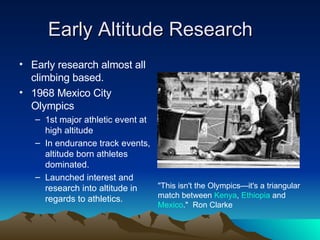
Early Altitude Research Early research almost all climbing based. 1968 Mexico City Olympics 1st major athletic event at high altitude In endurance track events, altitude born athletes dominated. Launched interest and research into altitude in regards to athletics. "This isn't the Olympics—it's a triangular match between  Kenya ,  Ethiopia  and  Mexico ."  Ron Clarke
Theory behind Altitude Training Fatigue Theory- Endurance events are limited by Oxygen supply to the working muscles. Increase the oxygen supply to the muscles and fatigue is delayed.
Theory behind Altitude Training Physiology of High Altitude: At altitude, the partial pressure of oxygen (P O2) is lower than at sea level.  Meaning there is less oxygen per volume of air. Rate of diffusion depends on the pressure difference, moving from an area of high concentration to low concentration. Oxygen cascade: Is the oxygen driving force (partial pressure of oxygen) from the ambient air to lungs, blood, and cells.  Driving force is diminished at altitude, thus rate of diffusion and oxygen cascade is slowed.
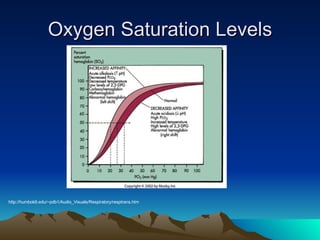
Oxygen Saturation Levels http://humboldt.edu/~pdb1/Audio_Visuals/Respiratory/resptrans.htm
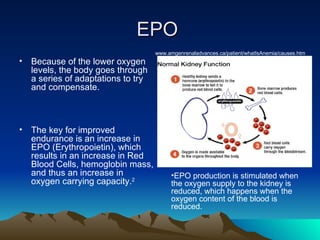
EPO  Because of the lower oxygen levels, the body goes through a series of adaptations to try and compensate. The key for improved endurance is an increase in EPO (Erythropoietin), which results in an increase in Red Blood Cells, hemoglobin mass, and thus an increase in oxygen carrying capacity. 2 EPO production is stimulated when the oxygen supply to the kidney is reduced, which happens when the oxygen content of the blood is reduced. www.amgenrenaladvances.ca/patient/whatIsAnemia/causes.htm
Cardiovascular Response to Altitude Heart Rate: Acute response: Increase Acclimatization response: Stays increased Stroke Volume Acute response: stays same Acclimatization response: Decreases Cardiac Output: Acute response: Increase Acclimatization Response: Decrease Brooks, G. (2005).  Exercise Physiology 4 th  Ed . New York: Mcgraw-Hill.
Ventilatory Response Ventilation increases at all intensities to increase oxygen pressure in lungs and force oxygen into the blood. driven by hypoxia because at altitude ventilatory stimulation occurs at a lower level of Carbon Dioxide than at sea level. Effect: Increased alveolar Po2.  Left shift of oxyhemoglobin dissociation curve Brooks, G. (2005). Exercise Physiology 4th Ed. New York: Mcgraw-Hill.
Post altitude effects: Blood Lactate Decreased blood lactate at submax intensities compared to pre-altitude. Hemoglobin Increases RBC mass Increases Hematocrit Increases Rusko, et al.(2004). Altitude and endurance training.  Journal of Sports Sciences,  22:10, 928 — 945
Post altitude effects: Ventilatory acclimatization Ventilation can stay elevated for several weeks VO2max May increase or stay the same, partly due to increased respiratory muscle use Running Economy Mixed results, may improve due to slow running improving RE, may decrease due to ventilatory increase. -Neuromuscular changes athletes routinely report  loss of turnover.  Depressed motor recruitment patterns Brooks, G. (2005).  Exercise Physiology 4th Ed . New York: Mcgraw-Hill. WILBER, R. L (2007). Application of Altitude/Hypoxic Training by Elite Athletes.  Medicine and  Science in  Sports and Exercise.  39 (9): 1610-1624 Rusko, et al.(2004). Altitude and endurance training.  Journal of Sports Sciences,  22:10, 928 — 945
Does it work? Athletes and Coaches Many swear by it. Out of the 215 performances by runners who have run under 13min for 5k, only one has come from an athletes who did NOT spend significant time training at altitude.
Types of Altitude Training
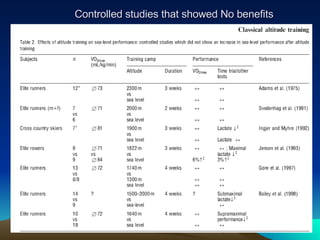
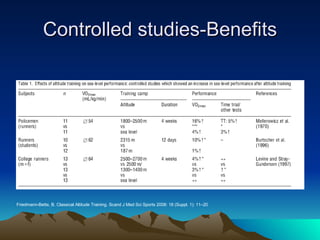
Traditional approach Athletes both live and train at high altitudes. Research: Most controlled , but not all, studies show no performance benefits Studies without controls showed mixed benefits.
Controlled studies that showed No benefits
Controlled studies-Benefits Friedmann-Bette, B. Classical Altitude Training. Scand J Med Sci Sports 2008: 18 (Suppl. 1): 11–20
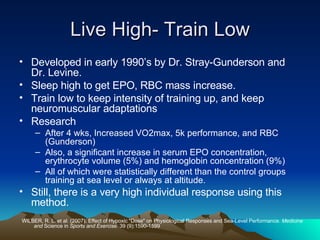
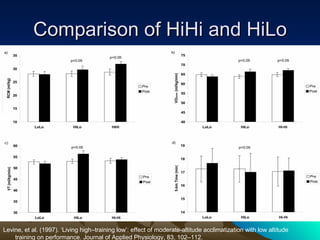
Live High- Train Low Developed in early 1990’s by Dr. Stray-Gunderson and Dr. Levine. Sleep high to get EPO, RBC mass increase.  Train low to keep intensity of training up, and keep neuromuscular adaptations Research After 4 wks, Increased VO2max, 5k performance, and RBC (Gunderson) Also, a significant increase in serum EPO concentration, erythrocyte volume (5%) and hemoglobin concentration (9%) All of which were statistically different than the control groups training at sea level or always at altitude. Still, there is a very high individual response using this method. WILBER, R. L. et al. (2007). Effect of Hypoxic "Dose" on Physiological Responses and Sea-Level Performance.  Medicine and  Science in  Sports and Exercise.  39 (9):1590-1599
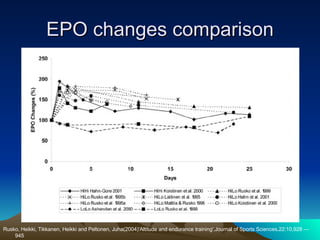
EPO changes comparison Rusko, Heikki, Tikkanen, Heikki and Peltonen, Juha(2004)'Altitude and endurance training',Journal of Sports Sciences,22:10,928 — 945
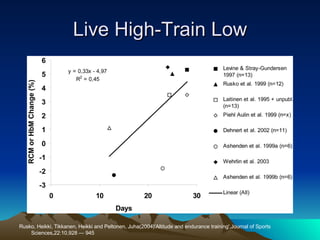
Live High-Train Low Rusko, Heikki, Tikkanen, Heikki and Peltonen, Juha(2004)'Altitude and endurance training',Journal of Sports Sciences,22:10,928 — 945
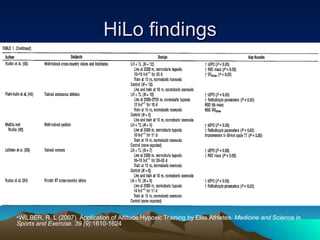
HiLo findings WILBER, R. L (2007). Application of Altitude/Hypoxic Training by Elite Athletes.  Medicine and  Science in  Sports and Exercise. 39 (9): 1610-1624
Comparison of HiHi and HiLo Levine, et al. (1997). ‘Living high–training low’: effect of moderate-altitude acclimatization with low altitude training on performance. Journal of Applied Physiology, 83, 102–112.
HiHiLo Instead of doing all of the training at Low altitudes, athletes live at high altitude, do easy to moderate work at high altitude, and only come down for hard workouts (1-3x per week). Almost identical results to live high, train low. Means that at high altitude, the inability to do hard workouts at same intensity as at low altitudes, may be deciding factor in whether performance improves or not Due to, at high altitude, depressed: Motor unit recruitment Cardiac output VO2max Rusko, Heikki, Tikkanen, Heikki and Peltonen, Juha(2004)'Altitude and endurance training',Journal of Sports Sciences,22:10,928 — 945 Stray-Gundersen, J., Chapman, R. and Levine, B.D. (2001). ‘Living high–training low’ altitude training improves sea level performance in male and female elite runners. Journal of Applied Physiology, 91, 1113–1120.
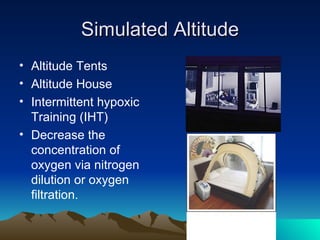
Simulated Altitude Altitude Tents Altitude House Intermittent hypoxic Training (IHT) Decrease the concentration of oxygen via nitrogen dilution or oxygen filtration.
Intermittent Hypoxic Training Athletes train at simulated high altitudes Most research has found that there was no increase in EPO or an improvement in endurance performance. Glyde-Julian  et al . (2004)  Intermittent normobaric hypoxia does not alter performance or erythropoietic markers in highly trained distance runners.  Journal of Applied Physiology  96(5): 1800-1807  Rodriquez,F. (2007). Performance of runners and swimmers after four weeks of intermittent hypobaric hypoxic exposure plus sea level training. J Appl Physiol. 103(5):1523-35  Roels, B. (2007). Effects of intermittent hypoxic training on cycling performance in well-trained athletes.  Eur J Appl Physiol. 101(3):359-68
Does it work? Reason’s for mixed results: Statistical Significance issue: A statistically insignificant improvement in studies might be substantial to an athlete.  For example a few seconds in a 5k is a BIG deal to a world class runner, but may not be significant scientifically. Responders vs. Non Responders Response to altitude seems to be highly individual Negative Consequences of altitude might overwhelm positive adaptations. Neural recruitment and CNS may play a bigger role in fatigue than oxygen supply model predicts.  Thus decrease in neural stimuli and recruitment at altitude may impair athletes with long term training at altitude.
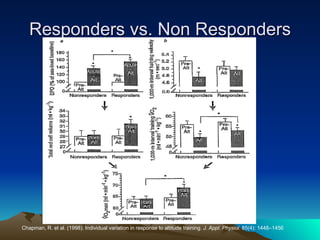
Responders vs. Non Responders Even with the same protocol in research the range of response varies widely to altitude. That led Dr. Robert Chapman to classify athletes as responders vs. non responders based on changes in sea level performance after altitude training stint. In this particular study, 17 out of 32 were responders, while 14 were non responders
Responders vs. Non Responders Chapman, R. et al. (1998). Individual variation in response to altitude training.  J. Appl. Physiol.  85(4): 1448–1456
Reason for these differences? A specific form of the EPO gene seems to help differentiate the athletes into responders vs. non responders. Questions Altitude not high enough to produce a stimulus on EPO production in some people? Oxygen delivery not as much of a limiter to some athletes, therefore less adaptation? WILBER, R. L. et al. (2007). Effect of Hypoxic "Dose" on Physiological Responses and Sea-Level Performance.  Medicine and  Science in  Sports and Exercise.  39 (9):1590-1599
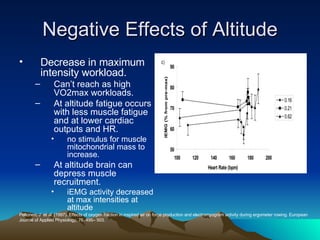
Negative Effects of Altitude Decrease in maximum intensity workload. Can’t reach as high VO2max workloads. At altitude fatigue occurs with less muscle fatigue and at lower cardiac outputs and HR.  no stimulus for muscle mitochondrial mass to increase. At altitude brain can depress muscle recruitment. iEMG activity decreased at max intensities at altitude Peltonen, J. et al. (1997). Effects of oxygen fraction in inspired air on force production and electromyogram activity during ergometer rowing. European Journal of Applied Physiology, 76, 495– 503.
Negative Effects of Altitude Decrease in plasma volume and increase in hematocrit (increases blood viscosity) Decrease in alkaline reserve. Increase in ventilatory response Can’t train as hard or recover as quickly.
Negative Effects of Altitude Negative effects could explain why the traditional (HiHi) approach does not  improve performance at sea level as often. HiLo provides the benefits of improved oxygen carrying capacity while allowing the athletes to train at a higher intensity at low elevations and not suffer neural consequences.
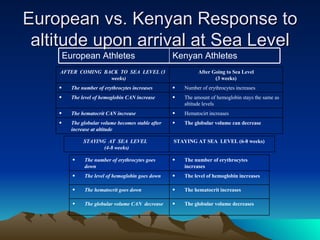
The Kenyan Problem Many athletes and coaches point to the fact that athletes who were born at altitude dominate distance running, as a reason to train at altitude. However, the response to altitude between athletes who were born at altitude compared to western athletes who were not is different. Thus, because of this different response, the anecdotal evidence suggesting that Western athletes should copy the African’s in training at altitude does not hold up.
European vs. Kenyan Response to altitude upon arrival at Sea Level The globular volume can decrease The globular volume becomes stable after increase at altitude Hematocirt increases The hematocrit CAN increase The amount of hemoglobin stays the same as altitude levels The level of hemoglobin CAN increase Number of erythrocytes increases The number of erythrocytes increases After Going to Sea Level (3 weeks) AFTER  COMING  BACK  TO  SEA  LEVEL (3 weeks) STAYING AT SEA  LEVEL (6-8 weeks) STAYING  AT  SEA  LEVEL  (4-8 weeks) The globular volume decreases The globular volume CAN  decrease The hematocrit increases The hematocrit goes down The level of hemoglobin increases The level of hemoglobin goes down The number of erythrocytes increases The number of erythrocytes goes down Kenyan Athletes European Athletes
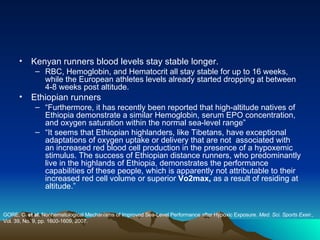
Kenyan runners blood levels stay stable longer. RBC, Hemoglobin, and Hematocrit all stay stable for up to 16 weeks, while the European athletes levels already started dropping at between 4-8 weeks post altitude. Ethiopian runners “ Furthermore, it has recently been reported that high-altitude natives of Ethiopia demonstrate a similar Hemoglobin, serum EPO concentration, and oxygen saturation within the normal sea-level range” “ It seems that Ethiopian highlanders, like Tibetans, have exceptional adaptations of oxygen uptake or delivery that are not  associated with an increased red blood cell production in the presence of a hypoxemic stimulus. The success of Ethiopian distance runners, who predominantly live in the highlands of Ethiopia, demonstrates the performance capabilities of these people, which is apparently not attributable to their increased red cell volume or superior  Vo2max,  as a result of residing at altitude.” GORE, C.  et al . Nonhematological Mechanisms of Improved Sea-Level Performance after Hypoxic Exposure.  Med. Sci. Sports Exeir.,  Vol. 39, No. 9, pp. 1600-1609, 2007.
Practical Applications of Altitude Training
Optimal Dose of Altitude Training How High? 2,000 to 2,500m Less than 1,800m too low More than 2,500m, no greater EPO response WILBER, R. L. et al. (2007). Effect of Hypoxic "Dose" on Physiological Responses and Sea-Level Performance.  Medicine and  Science in  Sports and Exercise.  39 (9):1590-1599
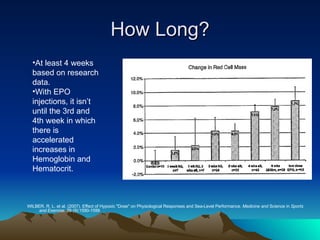
How Long? At least 4 weeks based on research data. With EPO injections, it isn’t until the 3rd and 4th week in which there is accelerated increases in Hemoglobin and Hematocrit. WILBER, R. L. et al. (2007). Effect of Hypoxic "Dose" on Physiological Responses and Sea-Level Performance.  Medicine and  Science in  Sports and Exercise.  39 (9):1590-1599
Training modifications Drop in Volume Drop in intensity Increase in Recovery
Training Phases
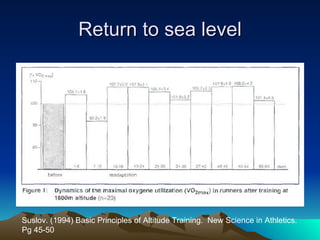
Return to sea level Best times to compete: For some 1 st - 3 rd  day down. For most, research varies but most suggest some time between 12-21 days down
Return to sea level Suslov. (1994) Basic Principles of Altitude Training.  New Science in Athletics. Pg 45-50
Summary Altitude Training has both positive and negative effects. Best approach seems to be to live high and train low to minimize the negative effects of altitude. For individual athletes, must find a high enough altitude to elicit significant EPO production to lead to increased RBC mass. Response to altitude is highly individualized Responders vs. Non Responders Future Considerations Could there be another reason for improved performance after altitude training besides increased oxygen delivery? Do results from altitude research show that neuromuscular mechanisms are more important for performance than previously thought? VO2max not be all end all.
Fatigue Theory Originally stated that: Endurance events are limited by Oxygen supply to the working muscles. Increase the oxygen supply to the muscles and fatigue is delayed. Exercise is Regulated, not limited “ Exercise performance and VO2max, as well as the training response at sea level and at altitude, may not be dependent only on oxygen delivery and utilization, but also on other factors linked to the ability of the central nervous system to recruit the muscles.” Rusko, Heikki, Tikkanen, Heikki and Peltonen, Juha(2004)'Altitude and endurance training',Journal of Sports Sciences,22:10,928 — 945
Brooks, G. (2005).  Exercise Physiology 4 th  Ed . New York: Mcgraw-Hill. WILBER, R. L. et al. (2007). Effect of Hypoxic "Dose" on Physiological Responses and Sea-Level Performance.  Medicine and  Science in  Sports and Exercise.  39 (9):1590-1599 Cormie, P. et al. (2005, Summer). ALTITUDE TRAINING - DOES IT WORK? Current trends and research.  Olympic Coach E-Magazine.  http://coaching.usolympicteam.com/coaching/kpub.nsf/v/4jun05 Glyde-Julian C, et al. (2004). Intermittent normobaric hypoxia does not alter performance or erythropoietic markers in highly trained distance runners.  Journal of Applied Physiology  96(5): 1800-1807 Rusko, et al.(2004). Altitude and endurance training.  Journal of Sports Sciences,  22:10, 928 — 945 WILBER, R. L (2007). Application of Altitude/Hypoxic Training by Elite Athletes.  Medicine and  Science in  Sports and Exercise. 39 (9): 1610-1624 GORE, C.  J.,  et al. (2007). Nonhematological Mechanisms of Improved Sea-Level Performance after Hypoxic Exposure.  Medicine and  Science in  Sports and Exercise.  39 (9):1600-1609 Chapman, R. et al. (1998). Individual variation in response to altitude training.  J. Appl. Physiol.  85(4): 1448–1456 Rodriquez,F. (2007). Performance of runners and swimmers after four weeks of intermittent hypobaric hypoxic exposure plus sea level training. J Appl Physiol. 103(5):1523-35  Roels, B. (2007). Effects of intermittent hypoxic training on cycling performance in well-trained athletes.  Eur J Appl Physiol. 101(3):359-68  Peltonen, J. et al. (1997). Effects of oxygen fraction in inspired air on force production and electromyogram activity during ergometer rowing. European Journal of Applied Physiology, 76, 495– 503. Friedmann-Bette, B. (2008) Classical Altitude Training. Scand J Med Sci Sports. 18 (Suppl. 1): 11–20 Levine, et al. (1997). ‘Living high–training low’: effect of moderate-altitude acclimatization with low altitude training on performance. Journal of Applied Physiology, 83, 102–112. GORE, C.  et al . Nonhematological Mechanisms of Improved Sea-Level Performance after Hypoxic Exposure.  Med. Sci. Sports Exeir.,  Vol. 39, No. 9, pp. 1600-1609, 2007.

Altitude Training

  • 1.
  • 2.
    Presentation goals EarlyInterest Theory behind Altitude Training Effects of Altitude Acute Effects Acclimatization Post Altitude Effects Does it work? Why or why not? Types of Altitude Training Practical Applications for Altitude Training
  • 3.
    Early Altitude ResearchEarly research almost all climbing based. 1968 Mexico City Olympics 1st major athletic event at high altitude In endurance track events, altitude born athletes dominated. Launched interest and research into altitude in regards to athletics. "This isn't the Olympics—it's a triangular match between Kenya , Ethiopia and Mexico ." Ron Clarke
  • 4.
    Theory behind AltitudeTraining Fatigue Theory- Endurance events are limited by Oxygen supply to the working muscles. Increase the oxygen supply to the muscles and fatigue is delayed.
  • 5.
    Theory behind AltitudeTraining Physiology of High Altitude: At altitude, the partial pressure of oxygen (P O2) is lower than at sea level. Meaning there is less oxygen per volume of air. Rate of diffusion depends on the pressure difference, moving from an area of high concentration to low concentration. Oxygen cascade: Is the oxygen driving force (partial pressure of oxygen) from the ambient air to lungs, blood, and cells. Driving force is diminished at altitude, thus rate of diffusion and oxygen cascade is slowed.
  • 6.
    Oxygen Saturation Levelshttp://humboldt.edu/~pdb1/Audio_Visuals/Respiratory/resptrans.htm
  • 7.
    EPO Becauseof the lower oxygen levels, the body goes through a series of adaptations to try and compensate. The key for improved endurance is an increase in EPO (Erythropoietin), which results in an increase in Red Blood Cells, hemoglobin mass, and thus an increase in oxygen carrying capacity. 2 EPO production is stimulated when the oxygen supply to the kidney is reduced, which happens when the oxygen content of the blood is reduced. www.amgenrenaladvances.ca/patient/whatIsAnemia/causes.htm
  • 8.
    Cardiovascular Response toAltitude Heart Rate: Acute response: Increase Acclimatization response: Stays increased Stroke Volume Acute response: stays same Acclimatization response: Decreases Cardiac Output: Acute response: Increase Acclimatization Response: Decrease Brooks, G. (2005). Exercise Physiology 4 th Ed . New York: Mcgraw-Hill.
  • 9.
    Ventilatory Response Ventilationincreases at all intensities to increase oxygen pressure in lungs and force oxygen into the blood. driven by hypoxia because at altitude ventilatory stimulation occurs at a lower level of Carbon Dioxide than at sea level. Effect: Increased alveolar Po2. Left shift of oxyhemoglobin dissociation curve Brooks, G. (2005). Exercise Physiology 4th Ed. New York: Mcgraw-Hill.
  • 10.
    Post altitude effects:Blood Lactate Decreased blood lactate at submax intensities compared to pre-altitude. Hemoglobin Increases RBC mass Increases Hematocrit Increases Rusko, et al.(2004). Altitude and endurance training. Journal of Sports Sciences, 22:10, 928 — 945
  • 11.
    Post altitude effects:Ventilatory acclimatization Ventilation can stay elevated for several weeks VO2max May increase or stay the same, partly due to increased respiratory muscle use Running Economy Mixed results, may improve due to slow running improving RE, may decrease due to ventilatory increase. -Neuromuscular changes athletes routinely report loss of turnover. Depressed motor recruitment patterns Brooks, G. (2005). Exercise Physiology 4th Ed . New York: Mcgraw-Hill. WILBER, R. L (2007). Application of Altitude/Hypoxic Training by Elite Athletes. Medicine and Science in Sports and Exercise. 39 (9): 1610-1624 Rusko, et al.(2004). Altitude and endurance training. Journal of Sports Sciences, 22:10, 928 — 945
  • 12.
    Does it work?Athletes and Coaches Many swear by it. Out of the 215 performances by runners who have run under 13min for 5k, only one has come from an athletes who did NOT spend significant time training at altitude.
  • 13.
  • 14.
    Traditional approach Athletesboth live and train at high altitudes. Research: Most controlled , but not all, studies show no performance benefits Studies without controls showed mixed benefits.
  • 15.
    Controlled studies thatshowed No benefits
  • 16.
    Controlled studies-Benefits Friedmann-Bette,B. Classical Altitude Training. Scand J Med Sci Sports 2008: 18 (Suppl. 1): 11–20
  • 17.
    Live High- TrainLow Developed in early 1990’s by Dr. Stray-Gunderson and Dr. Levine. Sleep high to get EPO, RBC mass increase. Train low to keep intensity of training up, and keep neuromuscular adaptations Research After 4 wks, Increased VO2max, 5k performance, and RBC (Gunderson) Also, a significant increase in serum EPO concentration, erythrocyte volume (5%) and hemoglobin concentration (9%) All of which were statistically different than the control groups training at sea level or always at altitude. Still, there is a very high individual response using this method. WILBER, R. L. et al. (2007). Effect of Hypoxic "Dose" on Physiological Responses and Sea-Level Performance. Medicine and Science in Sports and Exercise. 39 (9):1590-1599
  • 18.
    EPO changes comparisonRusko, Heikki, Tikkanen, Heikki and Peltonen, Juha(2004)'Altitude and endurance training',Journal of Sports Sciences,22:10,928 — 945
  • 19.
    Live High-Train LowRusko, Heikki, Tikkanen, Heikki and Peltonen, Juha(2004)'Altitude and endurance training',Journal of Sports Sciences,22:10,928 — 945
  • 20.
    HiLo findings WILBER,R. L (2007). Application of Altitude/Hypoxic Training by Elite Athletes. Medicine and Science in Sports and Exercise. 39 (9): 1610-1624
  • 21.
    Comparison of HiHiand HiLo Levine, et al. (1997). ‘Living high–training low’: effect of moderate-altitude acclimatization with low altitude training on performance. Journal of Applied Physiology, 83, 102–112.
  • 22.
    HiHiLo Instead ofdoing all of the training at Low altitudes, athletes live at high altitude, do easy to moderate work at high altitude, and only come down for hard workouts (1-3x per week). Almost identical results to live high, train low. Means that at high altitude, the inability to do hard workouts at same intensity as at low altitudes, may be deciding factor in whether performance improves or not Due to, at high altitude, depressed: Motor unit recruitment Cardiac output VO2max Rusko, Heikki, Tikkanen, Heikki and Peltonen, Juha(2004)'Altitude and endurance training',Journal of Sports Sciences,22:10,928 — 945 Stray-Gundersen, J., Chapman, R. and Levine, B.D. (2001). ‘Living high–training low’ altitude training improves sea level performance in male and female elite runners. Journal of Applied Physiology, 91, 1113–1120.
  • 23.
    Simulated Altitude AltitudeTents Altitude House Intermittent hypoxic Training (IHT) Decrease the concentration of oxygen via nitrogen dilution or oxygen filtration.
  • 24.
    Intermittent Hypoxic TrainingAthletes train at simulated high altitudes Most research has found that there was no increase in EPO or an improvement in endurance performance. Glyde-Julian et al . (2004) Intermittent normobaric hypoxia does not alter performance or erythropoietic markers in highly trained distance runners. Journal of Applied Physiology 96(5): 1800-1807 Rodriquez,F. (2007). Performance of runners and swimmers after four weeks of intermittent hypobaric hypoxic exposure plus sea level training. J Appl Physiol. 103(5):1523-35 Roels, B. (2007). Effects of intermittent hypoxic training on cycling performance in well-trained athletes. Eur J Appl Physiol. 101(3):359-68
  • 25.
    Does it work?Reason’s for mixed results: Statistical Significance issue: A statistically insignificant improvement in studies might be substantial to an athlete. For example a few seconds in a 5k is a BIG deal to a world class runner, but may not be significant scientifically. Responders vs. Non Responders Response to altitude seems to be highly individual Negative Consequences of altitude might overwhelm positive adaptations. Neural recruitment and CNS may play a bigger role in fatigue than oxygen supply model predicts. Thus decrease in neural stimuli and recruitment at altitude may impair athletes with long term training at altitude.
  • 26.
    Responders vs. NonResponders Even with the same protocol in research the range of response varies widely to altitude. That led Dr. Robert Chapman to classify athletes as responders vs. non responders based on changes in sea level performance after altitude training stint. In this particular study, 17 out of 32 were responders, while 14 were non responders
  • 27.
    Responders vs. NonResponders Chapman, R. et al. (1998). Individual variation in response to altitude training. J. Appl. Physiol. 85(4): 1448–1456
  • 28.
    Reason for thesedifferences? A specific form of the EPO gene seems to help differentiate the athletes into responders vs. non responders. Questions Altitude not high enough to produce a stimulus on EPO production in some people? Oxygen delivery not as much of a limiter to some athletes, therefore less adaptation? WILBER, R. L. et al. (2007). Effect of Hypoxic "Dose" on Physiological Responses and Sea-Level Performance. Medicine and Science in Sports and Exercise. 39 (9):1590-1599
  • 29.
    Negative Effects ofAltitude Decrease in maximum intensity workload. Can’t reach as high VO2max workloads. At altitude fatigue occurs with less muscle fatigue and at lower cardiac outputs and HR. no stimulus for muscle mitochondrial mass to increase. At altitude brain can depress muscle recruitment. iEMG activity decreased at max intensities at altitude Peltonen, J. et al. (1997). Effects of oxygen fraction in inspired air on force production and electromyogram activity during ergometer rowing. European Journal of Applied Physiology, 76, 495– 503.
  • 30.
    Negative Effects ofAltitude Decrease in plasma volume and increase in hematocrit (increases blood viscosity) Decrease in alkaline reserve. Increase in ventilatory response Can’t train as hard or recover as quickly.
  • 31.
    Negative Effects ofAltitude Negative effects could explain why the traditional (HiHi) approach does not improve performance at sea level as often. HiLo provides the benefits of improved oxygen carrying capacity while allowing the athletes to train at a higher intensity at low elevations and not suffer neural consequences.
  • 32.
    The Kenyan ProblemMany athletes and coaches point to the fact that athletes who were born at altitude dominate distance running, as a reason to train at altitude. However, the response to altitude between athletes who were born at altitude compared to western athletes who were not is different. Thus, because of this different response, the anecdotal evidence suggesting that Western athletes should copy the African’s in training at altitude does not hold up.
  • 33.
    European vs. KenyanResponse to altitude upon arrival at Sea Level The globular volume can decrease The globular volume becomes stable after increase at altitude Hematocirt increases The hematocrit CAN increase The amount of hemoglobin stays the same as altitude levels The level of hemoglobin CAN increase Number of erythrocytes increases The number of erythrocytes increases After Going to Sea Level (3 weeks) AFTER COMING BACK TO SEA LEVEL (3 weeks) STAYING AT SEA LEVEL (6-8 weeks) STAYING AT SEA LEVEL (4-8 weeks) The globular volume decreases The globular volume CAN decrease The hematocrit increases The hematocrit goes down The level of hemoglobin increases The level of hemoglobin goes down The number of erythrocytes increases The number of erythrocytes goes down Kenyan Athletes European Athletes
  • 34.
    Kenyan runners bloodlevels stay stable longer. RBC, Hemoglobin, and Hematocrit all stay stable for up to 16 weeks, while the European athletes levels already started dropping at between 4-8 weeks post altitude. Ethiopian runners “ Furthermore, it has recently been reported that high-altitude natives of Ethiopia demonstrate a similar Hemoglobin, serum EPO concentration, and oxygen saturation within the normal sea-level range” “ It seems that Ethiopian highlanders, like Tibetans, have exceptional adaptations of oxygen uptake or delivery that are not associated with an increased red blood cell production in the presence of a hypoxemic stimulus. The success of Ethiopian distance runners, who predominantly live in the highlands of Ethiopia, demonstrates the performance capabilities of these people, which is apparently not attributable to their increased red cell volume or superior Vo2max, as a result of residing at altitude.” GORE, C. et al . Nonhematological Mechanisms of Improved Sea-Level Performance after Hypoxic Exposure. Med. Sci. Sports Exeir., Vol. 39, No. 9, pp. 1600-1609, 2007.
  • 35.
    Practical Applications ofAltitude Training
  • 36.
    Optimal Dose ofAltitude Training How High? 2,000 to 2,500m Less than 1,800m too low More than 2,500m, no greater EPO response WILBER, R. L. et al. (2007). Effect of Hypoxic "Dose" on Physiological Responses and Sea-Level Performance. Medicine and Science in Sports and Exercise. 39 (9):1590-1599
  • 37.
    How Long? Atleast 4 weeks based on research data. With EPO injections, it isn’t until the 3rd and 4th week in which there is accelerated increases in Hemoglobin and Hematocrit. WILBER, R. L. et al. (2007). Effect of Hypoxic "Dose" on Physiological Responses and Sea-Level Performance. Medicine and Science in Sports and Exercise. 39 (9):1590-1599
  • 38.
    Training modifications Dropin Volume Drop in intensity Increase in Recovery
  • 39.
  • 40.
    Return to sealevel Best times to compete: For some 1 st - 3 rd day down. For most, research varies but most suggest some time between 12-21 days down
  • 41.
    Return to sealevel Suslov. (1994) Basic Principles of Altitude Training. New Science in Athletics. Pg 45-50
  • 42.
    Summary Altitude Traininghas both positive and negative effects. Best approach seems to be to live high and train low to minimize the negative effects of altitude. For individual athletes, must find a high enough altitude to elicit significant EPO production to lead to increased RBC mass. Response to altitude is highly individualized Responders vs. Non Responders Future Considerations Could there be another reason for improved performance after altitude training besides increased oxygen delivery? Do results from altitude research show that neuromuscular mechanisms are more important for performance than previously thought? VO2max not be all end all.
  • 43.
    Fatigue Theory Originallystated that: Endurance events are limited by Oxygen supply to the working muscles. Increase the oxygen supply to the muscles and fatigue is delayed. Exercise is Regulated, not limited “ Exercise performance and VO2max, as well as the training response at sea level and at altitude, may not be dependent only on oxygen delivery and utilization, but also on other factors linked to the ability of the central nervous system to recruit the muscles.” Rusko, Heikki, Tikkanen, Heikki and Peltonen, Juha(2004)'Altitude and endurance training',Journal of Sports Sciences,22:10,928 — 945
  • 44.
    Brooks, G. (2005). Exercise Physiology 4 th Ed . New York: Mcgraw-Hill. WILBER, R. L. et al. (2007). Effect of Hypoxic "Dose" on Physiological Responses and Sea-Level Performance. Medicine and Science in Sports and Exercise. 39 (9):1590-1599 Cormie, P. et al. (2005, Summer). ALTITUDE TRAINING - DOES IT WORK? Current trends and research. Olympic Coach E-Magazine. http://coaching.usolympicteam.com/coaching/kpub.nsf/v/4jun05 Glyde-Julian C, et al. (2004). Intermittent normobaric hypoxia does not alter performance or erythropoietic markers in highly trained distance runners. Journal of Applied Physiology 96(5): 1800-1807 Rusko, et al.(2004). Altitude and endurance training. Journal of Sports Sciences, 22:10, 928 — 945 WILBER, R. L (2007). Application of Altitude/Hypoxic Training by Elite Athletes. Medicine and Science in Sports and Exercise. 39 (9): 1610-1624 GORE, C. J., et al. (2007). Nonhematological Mechanisms of Improved Sea-Level Performance after Hypoxic Exposure. Medicine and Science in Sports and Exercise. 39 (9):1600-1609 Chapman, R. et al. (1998). Individual variation in response to altitude training. J. Appl. Physiol. 85(4): 1448–1456 Rodriquez,F. (2007). Performance of runners and swimmers after four weeks of intermittent hypobaric hypoxic exposure plus sea level training. J Appl Physiol. 103(5):1523-35 Roels, B. (2007). Effects of intermittent hypoxic training on cycling performance in well-trained athletes. Eur J Appl Physiol. 101(3):359-68 Peltonen, J. et al. (1997). Effects of oxygen fraction in inspired air on force production and electromyogram activity during ergometer rowing. European Journal of Applied Physiology, 76, 495– 503. Friedmann-Bette, B. (2008) Classical Altitude Training. Scand J Med Sci Sports. 18 (Suppl. 1): 11–20 Levine, et al. (1997). ‘Living high–training low’: effect of moderate-altitude acclimatization with low altitude training on performance. Journal of Applied Physiology, 83, 102–112. GORE, C. et al . Nonhematological Mechanisms of Improved Sea-Level Performance after Hypoxic Exposure. Med. Sci. Sports Exeir., Vol. 39, No. 9, pp. 1600-1609, 2007.