Physiological
changes During
Aerobic Exercise
-By AnandVaghasiya (FinalYear BPT)
• Exercise induces more activity in the whole
body almost every system of the body
affected by exercise.
• Incresing muscular activity demands the
more Oxygen and red blood cell supply to
the muscular tissue.
ThisCan be
Done with the
help of other
BodySystems.
 By increasing Heart rate
 By increasing blood pressure
 By increasingCardia output
 By increasing venous return
 By reducing blood flow to the inactive muscles and non-vital
organs
 Redistribution of Blood supply from non-vitals to vitals.
Topics to be
covered
Changes in Cardio-Vascular System
Changes in Respiration
Changes in Blood System
Endocrine functions
Changes in
Cardio-
Vascular
System
 Effects on heart : becomes enlarged. It is not disease, its just physiological change.
 Effects on heart rate: due to cerebral activation, athletes may have
decreased HR.
 Effect on cardiac output: increases up to 30liter per minute.
 Effect on venous return: increases.
 Effects on blood pressure: increases, due to vasoconstriction and
increased HR.
 Effects on circulation: increases.
• During physical activity several changes take place to increase blood flow to active
muscle.Greater blood flow to muscles increases delivery of things needed for
metabolism to occur (oxygen, glucose, triglyceride) and expedites the removal of
products generated during metabolism (carbon dioxide).
Oxygen Delivery toTissue
Oxygen delivery to tissue depends on two major factors:
• the amount of oxygen tissue takes out of a given amount of
blood, and
• the amount of blood flowing through the tissue.
Arterial venous oxygen difference (a-v O2 difference )
• It is the difference between the amount of oxygen in 100 mL
of arterial blood entering a tissue and the amount of oxygen
in 100 mL of venous blood leaving a tissue.
• During exercise, more oxygen is taken out of the blood by
metabolically active muscle, which increases the a-v O2 diff
Oxygen Delivery = Blood Flow × a-v O2 diff
• Oxygen delivery or oxygen consumption ( O2 ) is a product of
blood flow multiplied by a-v O2 diff.
• This calculation is termed the Fick equation.To determine
oxygen consumption for the entire body using the Fick
equation, cardiac output ( ) represents blood flow.
Oxygen delivery or oxygen consumption ( VO2 )
• The Fick principle
• “Oxygen Delivery = Blood Flow × a-v O2 difference for
the entire body or for a specifi c tissue or organ.
• In the case of oxygen consumption for the entire body,
the Fick principle results in the following equation:
VO2 = Q × a-v O2 diff
Redistribution
of Blood Flow
During
Exercise
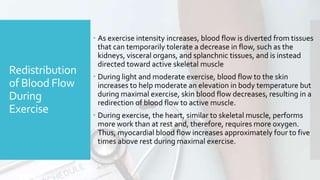
 As exercise intensity increases, blood flow is diverted from tissues
that can temporarily tolerate a decrease in flow, such as the
kidneys, visceral organs, and splanchnic tissues, and is instead
directed toward active skeletal muscle
 During light and moderate exercise, blood flow to the skin
increases to help moderate an elevation in body temperature but
during maximal exercise, skin blood flow decreases, resulting in a
redirection of blood flow to active muscle.
 During exercise, the heart, similar to skeletal muscle, performs
more work than at rest and, therefore, requires more oxygen.
Thus, myocardial blood flow increases approximately four to five
times above rest during maximal exercise.
Intrinsic
Control
Extrinsic
Control
ExtrinsicControl
of
Vasoconstriction
andVasodilation
 Adrenergic sympathetic neural stimulation is the basis
of extrinsic control of vasoconstriction and
vasodilation. Sympathetic nerves release
norepinephrine and epinephrine.
 Norepinephrine is the primary neurotransmitter
released by sympathetic nerves innervating peripheral
blood vessels, and affects primarily receptors (alpha
receptors), causing vasoconstriction.
 On the other hand, epinephrine affects receptors,
causing both vasoconstriction and vasodilation (beta 2
receptors).Thus, the amount of vasoconstriction and
vasodilation depends on a balance of these two stimuli.
IntrinsicControl
of
Vasoconstriction
andVasodilation
 Changes within skeletal muscle during exercise
stimulate muscle chemoreceptors, resulting in an
increase in vasodilation because of a reflex change in
neural sympathetic stimulation.
 This intrinsic control of vasoconstriction and
vasodilation is termed autoregulation.
Another is
Increasing
Venous Return
 during exercise, in order to help increase stroke volume
and cardiac output and, thus, blood flow to tissue.
These factors are venoconstriction, the muscle pump,
and the respiratory pump.
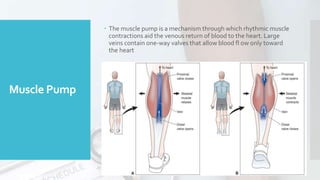
Muscle Pump
 The muscle pump is a mechanism through which rhythmic muscle
contractions aid the venous return of blood to the heart. Large
veins contain one-way valves that allow blood fl ow only toward
the heart
Venoconstriction
 At rest, venous vessels contain approximately 65% of
the body’s total blood volume. So, venous vessels can
be viewed as storage reservoirs or capacitance blood
vessels that contain a high volume of blood at a
relatively low pressure.
 sympathetic stimulation causing venoconstriction, or
constriction of veins, which would increase venous
return to the heart.
 However, the veins of skeletal muscle may not receive
suffi cient sympathetic stimulation to substantially
increase venous return.Thus, only the veins located in
tissues other than skeletal muscle may contribute to an
increase in venous return
Changes in
Respiration
System
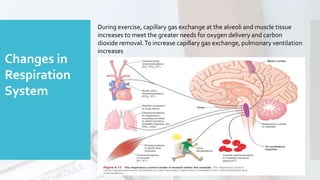
During exercise, capillary gas exchange at the alveoli and muscle tissue
increases to meet the greater needs for oxygen delivery and carbon
dioxide removal.To increase capillary gas exchange, pulmonary ventilation
increases
Effect on
Respiratory
rate
 The oxygen demand during exercise increses the
respiratory rate.
 There are factors which can cause this:
1. Incresed metabolic waste and carbon dioxide gas at
tissue level, which concentrates on both cell level
and vessel level.
2. Proprioceptive activation at joint level. Which
indicates body to work more to achive the demand.
3. Reflex effect by respiratory center at brain level.
4. Adrenaline secretion.Which is indicative as do or die.
Body itself increses activity under the effect of
adrenaline.
5. Incresed temperature due to exercise, autoregulation
effects respiration to maintain temperature of body
by increasing blood flow and sweating.
Thank you !
Refference book: Exercise Physiology- IntegratingTheory and Application
( William J. Kraemer, Steven J. Fleck, Michael R. Deschenes)
.

Physiological changes During Aerobic Exercise

  • 1.
  • 2.
    • Exercise inducesmore activity in the whole body almost every system of the body affected by exercise. • Incresing muscular activity demands the more Oxygen and red blood cell supply to the muscular tissue.
  • 3.
    ThisCan be Done withthe help of other BodySystems.  By increasing Heart rate  By increasing blood pressure  By increasingCardia output  By increasing venous return  By reducing blood flow to the inactive muscles and non-vital organs  Redistribution of Blood supply from non-vitals to vitals.
  • 4.
    Topics to be covered Changesin Cardio-Vascular System Changes in Respiration Changes in Blood System Endocrine functions
  • 5.
    Changes in Cardio- Vascular System  Effectson heart : becomes enlarged. It is not disease, its just physiological change.  Effects on heart rate: due to cerebral activation, athletes may have decreased HR.  Effect on cardiac output: increases up to 30liter per minute.  Effect on venous return: increases.  Effects on blood pressure: increases, due to vasoconstriction and increased HR.  Effects on circulation: increases. • During physical activity several changes take place to increase blood flow to active muscle.Greater blood flow to muscles increases delivery of things needed for metabolism to occur (oxygen, glucose, triglyceride) and expedites the removal of products generated during metabolism (carbon dioxide).
  • 6.
    Oxygen Delivery toTissue Oxygendelivery to tissue depends on two major factors: • the amount of oxygen tissue takes out of a given amount of blood, and • the amount of blood flowing through the tissue. Arterial venous oxygen difference (a-v O2 difference ) • It is the difference between the amount of oxygen in 100 mL of arterial blood entering a tissue and the amount of oxygen in 100 mL of venous blood leaving a tissue. • During exercise, more oxygen is taken out of the blood by metabolically active muscle, which increases the a-v O2 diff
  • 7.
    Oxygen Delivery =Blood Flow × a-v O2 diff • Oxygen delivery or oxygen consumption ( O2 ) is a product of blood flow multiplied by a-v O2 diff. • This calculation is termed the Fick equation.To determine oxygen consumption for the entire body using the Fick equation, cardiac output ( ) represents blood flow. Oxygen delivery or oxygen consumption ( VO2 )
  • 8.
    • The Fickprinciple • “Oxygen Delivery = Blood Flow × a-v O2 difference for the entire body or for a specifi c tissue or organ. • In the case of oxygen consumption for the entire body, the Fick principle results in the following equation: VO2 = Q × a-v O2 diff
  • 9.
    Redistribution of Blood Flow During Exercise As exercise intensity increases, blood flow is diverted from tissues that can temporarily tolerate a decrease in flow, such as the kidneys, visceral organs, and splanchnic tissues, and is instead directed toward active skeletal muscle  During light and moderate exercise, blood flow to the skin increases to help moderate an elevation in body temperature but during maximal exercise, skin blood flow decreases, resulting in a redirection of blood flow to active muscle.  During exercise, the heart, similar to skeletal muscle, performs more work than at rest and, therefore, requires more oxygen. Thus, myocardial blood flow increases approximately four to five times above rest during maximal exercise.
  • 10.
  • 11.
    ExtrinsicControl of Vasoconstriction andVasodilation  Adrenergic sympatheticneural stimulation is the basis of extrinsic control of vasoconstriction and vasodilation. Sympathetic nerves release norepinephrine and epinephrine.  Norepinephrine is the primary neurotransmitter released by sympathetic nerves innervating peripheral blood vessels, and affects primarily receptors (alpha receptors), causing vasoconstriction.  On the other hand, epinephrine affects receptors, causing both vasoconstriction and vasodilation (beta 2 receptors).Thus, the amount of vasoconstriction and vasodilation depends on a balance of these two stimuli.
  • 12.
    IntrinsicControl of Vasoconstriction andVasodilation  Changes withinskeletal muscle during exercise stimulate muscle chemoreceptors, resulting in an increase in vasodilation because of a reflex change in neural sympathetic stimulation.  This intrinsic control of vasoconstriction and vasodilation is termed autoregulation.
  • 13.
    Another is Increasing Venous Return during exercise, in order to help increase stroke volume and cardiac output and, thus, blood flow to tissue. These factors are venoconstriction, the muscle pump, and the respiratory pump.
  • 14.
    Muscle Pump  Themuscle pump is a mechanism through which rhythmic muscle contractions aid the venous return of blood to the heart. Large veins contain one-way valves that allow blood fl ow only toward the heart
  • 15.
    Venoconstriction  At rest,venous vessels contain approximately 65% of the body’s total blood volume. So, venous vessels can be viewed as storage reservoirs or capacitance blood vessels that contain a high volume of blood at a relatively low pressure.  sympathetic stimulation causing venoconstriction, or constriction of veins, which would increase venous return to the heart.  However, the veins of skeletal muscle may not receive suffi cient sympathetic stimulation to substantially increase venous return.Thus, only the veins located in tissues other than skeletal muscle may contribute to an increase in venous return
  • 17.
    Changes in Respiration System During exercise,capillary gas exchange at the alveoli and muscle tissue increases to meet the greater needs for oxygen delivery and carbon dioxide removal.To increase capillary gas exchange, pulmonary ventilation increases
  • 18.
    Effect on Respiratory rate  Theoxygen demand during exercise increses the respiratory rate.  There are factors which can cause this: 1. Incresed metabolic waste and carbon dioxide gas at tissue level, which concentrates on both cell level and vessel level. 2. Proprioceptive activation at joint level. Which indicates body to work more to achive the demand. 3. Reflex effect by respiratory center at brain level. 4. Adrenaline secretion.Which is indicative as do or die. Body itself increses activity under the effect of adrenaline. 5. Incresed temperature due to exercise, autoregulation effects respiration to maintain temperature of body by increasing blood flow and sweating.
  • 19.
    Thank you ! Refferencebook: Exercise Physiology- IntegratingTheory and Application ( William J. Kraemer, Steven J. Fleck, Michael R. Deschenes) .