EVOLUTION OF
MANAGEMENT THEORY
INTRODUCTION
• •Management is the discipline
which has not evolved out of
“magic box”, many people from
different backgrounds ranging
from engineers to
psychologists and from
academicians to practitioners
have contributed to the field of
management.
Why Study Management Theory?
•Coherent group of assumptions put forth
to explain the relationship between two or
more observable facts and to provide a
sound basis for predicting future events
•
Why Study Management Theory?
•It provide a stable focusfor understanding what we
experience
•Enable us to communicate efficiently and thus
move into more and more complex relationships
with other people (imagine the frustration you
would encounter with other people, you always had
to define even the most basic assumption you make
about the world in which you live.)
Why Study Management Theory?
•Theories Make it possible-indeed, challenge us-to
keep learning about our world
•By definition, theories have boundaries; there is
only so much that can be covered by any one
theory.
•Once we are aware of this, we are better able to ask
ourselves if there are alternative ways of looking at
the world.
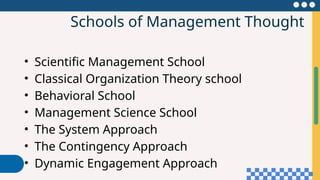
Schools of Management Thought
• Scientific Management School
• Classical Organization Theory school
• Behavioral School
• Management Science School
• The System Approach
• The Contingency Approach
• Dynamic Engagement Approach
Scientific Management Theory
•A management approach, formulated by Frederick W
Taylor and others between 1890 and 1930, that sought to
determine scientifically the best methods for performing
any task, and for selecting, training, and motivating
workers.
•The theory said that the only way to expand productivity
was to raise the efficiency of workers.
Frederick W Taylor (1856-1915)
• Time and Motion study
• The Development of a true science of management, so that the best
method for performing each task could be determine.
• The Scientific selection of workers, so that each worker would be given
responsibility for the task for which he or she was best suited.
• The Scientific education and development of the worker
• Intimate, friendly cooperation between management and labor
• Differential rate system : Frederick W. Taylor’s compensation system
involving the payment of higher wages to more efficient workers.
• Rather than quarrel over profits, both side should try to
increase production; by so doing, he believed, profits
would rise to such an extent that labor and
management would no longer have to fight over them.
• In short, Taylor believed that management and labor
had a common interest in increasing productivity.
The Gilbreths:
•Frank B. and Lillian M. Gilbreth (1868-1924 and 1878-
1972) made their contribution to the scientific
management movement as a husband and wife team.
•Lillian and Frank collaborated on Fatigue And Motion
Studies and focus on ways of promoting the individual
worker’s welfare.
•To them, the ultimate aim of scientific management
was to help workers reach their full potential as human
beings.
THERE CONTRIBUTION
• Fatigue And Motion Study
• Individual Workers Welfare
• To Raise Workers Morale
Henry L. Gantt (1861-1919)
• Limitation of Taylor’s incentive system
• DRS having less motivational impact
• New idea
Classical Organization
• To identify the Principles & skills that underlie
effective management.
• Scientific management was concerned with
increasing the productivity and individual
workers this theory provides guidelines for
managing such a complex organization.
ADMINISTRATIVE MANAGEMENT
FAYOL'S PRINCIPLES OF MANAGEMENT
• Began his career as an Engineer in a Mining Company.
• Later became the Managing Director of the company.
• He formulated fourteen principles of management.
• He has been rightly called the “Father of Modern
Management.”
Schools of Management Thought
• Scientific Management School
• Classical Organization Theory school
• Behavioral School
• Management Science School
• The System Approach
• The Contingency Approach
• Dynamic Engagement Approach
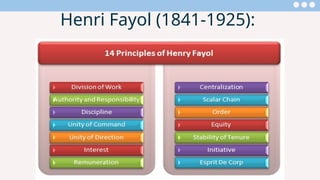
Henri Fayol (1841-1925):
Division of Work.
Work should be
divided into small
tasks. Each task
should be assigned
to a specific
employee.
Authority and Responsibility
Authority means RIGHT TO GIVE ORDERS to
the subordinates.
Responsibility means obligation to
perform the work in the manner desired and
directed by the authority.
Discipline
Discipline is essential for the
smooth running of all
organizations .It means
respect for authority.
Unity of Command
It states that an employee
should RECEIVE ORDERS
FROM ONE SUPERIOR only.
Unity of Direction
It states that the activities which have
a common objective must be grouped
together and must be under one
head.
Subordination of individual interest to
general interest.
The business enterprises is superior to
individuals. When individuals work in a
group ,group interest should prevail
over that of each individual.
Remuneration of Personnel
Remuneration of work done must
be FAIR AND REASONABLE.
Employees should be honest and
sincere.
• Centralization refers to CONCENTRATION OF
AUTHORITY AT ONE PLACE or one level in the
organization
• Decentralization means DISPERSAL OF
AUTHORITY TO THE LOWER LEVELS in the
organization.
Centralization and Decentralization
Scalar Chain
It refers to the line of authority
or the chain of superiors
starting from the highest and
moving towards the lowest rank.
Order
It means have a place for everything and keep everything in
its place.
Order has two components:
(i)Material order: It means having place for all materials
and keeping them in their right place.
(ii)Social order: It means right man is assigned for the
right job.
Equity
It implies BEING JUS AND LOYAL TO ALL
CONCERNS and superiors should be
impartial while dealing with their
subordinates.
Stability of tenure of the
Personnel
• This principle states
that EMPLOYEES SHOULD NOT BE
REMOVED FROM THEIR POSITIONS
frequently.
Initiative
• Employees at all levels should be
allowed to take initiative in work
related matters.
Espirit de corps
“Union is strength” is a well accepted
principle. The contribution of a team is
far better than that of individuals.
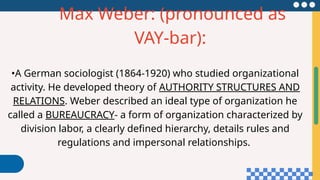
Max Weber: (pronounced as
VAY-bar):
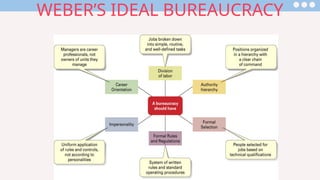
•A German sociologist (1864-1920) who studied organizational
activity. He developed theory of AUTHORITY STRUCTURES AND
RELATIONS. Weber described an ideal type of organization he
called a BUREAUCRACY- a form of organization characterized by
division labor, a clearly defined hierarchy, details rules and
regulations and impersonal relationships.
WEBER’S IDEAL BUREAUCRACY
Chester Barnard (1886-1961)
• An enterprise can operate efficiently and survive only when the
organization’s goal are kept in balance with the aims and needs
of the individuals working for it.
• According to him people come together in formal organizations
to achieve ends they can not accomplish working alone.
• Zone of indifference (area of acceptance)
• Individual and organizational purpose kept in balance if
manager understood an employee’s ZoI.
• What the employee can do without questioning the manager’s
authority.
MARY PARKER FOLLETT
• She introduce new element, specially in the new area of human relation
and organizational structure.
• Follett was convinced that no one could become a whole person except as
a member of a group;
• Human relationship with others in organization.
• She called Management as “art of getting things done through people”
• Follett’s “holistic” model of control took into account not just individuals
and groups, but the effect of such environment factors as politics,
economic, and biology.
• In her model she gave an idea that management meant more than just
what was happening inside a particular organization.
Behavioural School
•A group of management
scholars trained in
sociology, psychology, and
related fields, who use their
diverse knowledge to
propose more effective
ways to manage people in
organization.
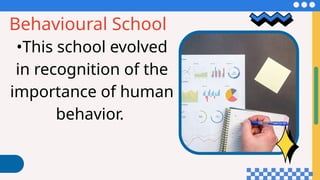
Behavioural School
•This school evolved
in recognition of the
importance of human
behavior.
Behavioural School
•How managers
interact with other
employees or
recruits.
Elton Mayo
• Hawthorne effect
• The possibility that workers who
receive special attention will perform
better because they received special
attention
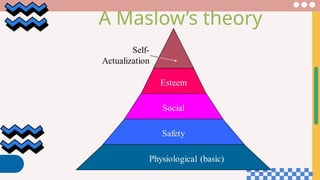
A Maslow’s theory
Douglas McGregor:
• McGregor’s argument was that
management had been ignoring the facts
about people. It believes the Theory X to
be truer while Theory Y is more truly
representative of most people.
• Models such as Theory X and Theory Y are
also called PARADIGMS.
Theory X
•According to McGregor, a traditional
view of motivation that holds that
work is distasteful to employee, who
must be motivated by force, money,
or praise.
Theory X assumptions
• The typical person dislikes work and will avoid it
if possible.
• The typical person lacks responsibility, has little
ambition, and seeks security above all.
• Most people must be forced, controlled and
threatened with punishment to get them to
work
Theory X assumptions
• According to McGregor, the assumption that
people are inherently motivated to work and do
a good job.
• Work is as natural as play or rest.
• People are not inherently lazy. They have
become that way as a result of experience.
Theory X assumptions
• People will exercise self-direction and self-
control in the service of objectives to which they
are committed.
• People have potential. Under proper conditions
they learn to accept and seek responsibility. They
have imagination, ingenuity, and creativity that
can be applied to work
SYSTEM
• A set of things working together as
parts of an interconnecting network.
• A system is a prescribed and usually
repetitious way of carrying out an
activity or a set of activities.
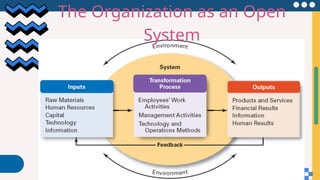
• A system may be defined as a goal-oriented
organism that is composed of interrelated in
such a way that the TOTAL SYSTEM IS GREATER
THAN THE SUM OF ITS PARTS. The system may
be viewed as consisting of four basic elements-
inputs, outputs, transformation process and
feedback. Inputs are processed to achieve the
desired output.
SYSTEM APPROACH
The Organization as an Open
System
The Contingency Approach
• The view that the management technique that
best contributes to the attainment of
organizational goals might vary in different types
of situations or circumstances; also called the
situational approach.
The Contingency Approach
• According to the contingency approach the
manager task is to identify which technique will
be “IN A PARTICULAR SITUTATION, UNDER
PARTICULAR CIRCUMSTANCES AND AT A
PARTICULAR TIME”, Best contribute to the
attainment of management goals.
Dynamic Engagement Approach
• The view that time and human
relationship are forcing management
to rethink tradition approach in the
face of constant, rapid change.
Dynamic Engagement Approach
• The term Dynamic Engagement best
expresses other vigorous way today’s most
successful managers focus on human a
relationship and quickly adjust to changing
conditions over time.
Thank
You!
www.reallygreatsite.com

EVOLUTION OF MANAGE....MENT THEORY .pptx

  • 1.
  • 2.
    INTRODUCTION • •Management isthe discipline which has not evolved out of “magic box”, many people from different backgrounds ranging from engineers to psychologists and from academicians to practitioners have contributed to the field of management.
  • 3.
    Why Study ManagementTheory? •Coherent group of assumptions put forth to explain the relationship between two or more observable facts and to provide a sound basis for predicting future events •
  • 4.
    Why Study ManagementTheory? •It provide a stable focusfor understanding what we experience •Enable us to communicate efficiently and thus move into more and more complex relationships with other people (imagine the frustration you would encounter with other people, you always had to define even the most basic assumption you make about the world in which you live.)
  • 5.
    Why Study ManagementTheory? •Theories Make it possible-indeed, challenge us-to keep learning about our world •By definition, theories have boundaries; there is only so much that can be covered by any one theory. •Once we are aware of this, we are better able to ask ourselves if there are alternative ways of looking at the world.
  • 6.
    Schools of ManagementThought • Scientific Management School • Classical Organization Theory school • Behavioral School • Management Science School • The System Approach • The Contingency Approach • Dynamic Engagement Approach
  • 7.
    Scientific Management Theory •Amanagement approach, formulated by Frederick W Taylor and others between 1890 and 1930, that sought to determine scientifically the best methods for performing any task, and for selecting, training, and motivating workers. •The theory said that the only way to expand productivity was to raise the efficiency of workers.
  • 8.
    Frederick W Taylor(1856-1915) • Time and Motion study • The Development of a true science of management, so that the best method for performing each task could be determine. • The Scientific selection of workers, so that each worker would be given responsibility for the task for which he or she was best suited. • The Scientific education and development of the worker • Intimate, friendly cooperation between management and labor • Differential rate system : Frederick W. Taylor’s compensation system involving the payment of higher wages to more efficient workers.
  • 9.
    • Rather thanquarrel over profits, both side should try to increase production; by so doing, he believed, profits would rise to such an extent that labor and management would no longer have to fight over them. • In short, Taylor believed that management and labor had a common interest in increasing productivity.
  • 10.
    The Gilbreths: •Frank B.and Lillian M. Gilbreth (1868-1924 and 1878- 1972) made their contribution to the scientific management movement as a husband and wife team. •Lillian and Frank collaborated on Fatigue And Motion Studies and focus on ways of promoting the individual worker’s welfare. •To them, the ultimate aim of scientific management was to help workers reach their full potential as human beings.
  • 11.
    THERE CONTRIBUTION • FatigueAnd Motion Study • Individual Workers Welfare • To Raise Workers Morale
  • 12.
    Henry L. Gantt(1861-1919) • Limitation of Taylor’s incentive system • DRS having less motivational impact • New idea
  • 13.
    Classical Organization • Toidentify the Principles & skills that underlie effective management. • Scientific management was concerned with increasing the productivity and individual workers this theory provides guidelines for managing such a complex organization.
  • 14.
    ADMINISTRATIVE MANAGEMENT FAYOL'S PRINCIPLESOF MANAGEMENT • Began his career as an Engineer in a Mining Company. • Later became the Managing Director of the company. • He formulated fourteen principles of management. • He has been rightly called the “Father of Modern Management.”
  • 15.
    Schools of ManagementThought • Scientific Management School • Classical Organization Theory school • Behavioral School • Management Science School • The System Approach • The Contingency Approach • Dynamic Engagement Approach
  • 16.
  • 17.
    Division of Work. Workshould be divided into small tasks. Each task should be assigned to a specific employee.
  • 18.
    Authority and Responsibility Authoritymeans RIGHT TO GIVE ORDERS to the subordinates. Responsibility means obligation to perform the work in the manner desired and directed by the authority.
  • 19.
    Discipline Discipline is essentialfor the smooth running of all organizations .It means respect for authority.
  • 20.
    Unity of Command Itstates that an employee should RECEIVE ORDERS FROM ONE SUPERIOR only.
  • 21.
    Unity of Direction Itstates that the activities which have a common objective must be grouped together and must be under one head.
  • 22.
    Subordination of individualinterest to general interest. The business enterprises is superior to individuals. When individuals work in a group ,group interest should prevail over that of each individual.
  • 23.
    Remuneration of Personnel Remunerationof work done must be FAIR AND REASONABLE. Employees should be honest and sincere.
  • 24.
    • Centralization refersto CONCENTRATION OF AUTHORITY AT ONE PLACE or one level in the organization • Decentralization means DISPERSAL OF AUTHORITY TO THE LOWER LEVELS in the organization. Centralization and Decentralization
  • 25.
    Scalar Chain It refersto the line of authority or the chain of superiors starting from the highest and moving towards the lowest rank.
  • 26.
    Order It means havea place for everything and keep everything in its place. Order has two components: (i)Material order: It means having place for all materials and keeping them in their right place. (ii)Social order: It means right man is assigned for the right job.
  • 27.
    Equity It implies BEINGJUS AND LOYAL TO ALL CONCERNS and superiors should be impartial while dealing with their subordinates.
  • 28.
    Stability of tenureof the Personnel • This principle states that EMPLOYEES SHOULD NOT BE REMOVED FROM THEIR POSITIONS frequently.
  • 29.
    Initiative • Employees atall levels should be allowed to take initiative in work related matters.
  • 30.
    Espirit de corps “Unionis strength” is a well accepted principle. The contribution of a team is far better than that of individuals.
  • 31.
    Max Weber: (pronouncedas VAY-bar): •A German sociologist (1864-1920) who studied organizational activity. He developed theory of AUTHORITY STRUCTURES AND RELATIONS. Weber described an ideal type of organization he called a BUREAUCRACY- a form of organization characterized by division labor, a clearly defined hierarchy, details rules and regulations and impersonal relationships.
  • 32.
  • 33.
    Chester Barnard (1886-1961) •An enterprise can operate efficiently and survive only when the organization’s goal are kept in balance with the aims and needs of the individuals working for it. • According to him people come together in formal organizations to achieve ends they can not accomplish working alone. • Zone of indifference (area of acceptance) • Individual and organizational purpose kept in balance if manager understood an employee’s ZoI. • What the employee can do without questioning the manager’s authority.
  • 34.
    MARY PARKER FOLLETT •She introduce new element, specially in the new area of human relation and organizational structure. • Follett was convinced that no one could become a whole person except as a member of a group; • Human relationship with others in organization. • She called Management as “art of getting things done through people” • Follett’s “holistic” model of control took into account not just individuals and groups, but the effect of such environment factors as politics, economic, and biology. • In her model she gave an idea that management meant more than just what was happening inside a particular organization.
  • 35.
    Behavioural School •A groupof management scholars trained in sociology, psychology, and related fields, who use their diverse knowledge to propose more effective ways to manage people in organization.
  • 36.
    Behavioural School •This schoolevolved in recognition of the importance of human behavior.
  • 37.
    Behavioural School •How managers interactwith other employees or recruits.
  • 38.
    Elton Mayo • Hawthorneeffect • The possibility that workers who receive special attention will perform better because they received special attention
  • 39.
  • 40.
    Douglas McGregor: • McGregor’sargument was that management had been ignoring the facts about people. It believes the Theory X to be truer while Theory Y is more truly representative of most people. • Models such as Theory X and Theory Y are also called PARADIGMS.
  • 41.
    Theory X •According toMcGregor, a traditional view of motivation that holds that work is distasteful to employee, who must be motivated by force, money, or praise.
  • 42.
    Theory X assumptions •The typical person dislikes work and will avoid it if possible. • The typical person lacks responsibility, has little ambition, and seeks security above all. • Most people must be forced, controlled and threatened with punishment to get them to work
  • 43.
    Theory X assumptions •According to McGregor, the assumption that people are inherently motivated to work and do a good job. • Work is as natural as play or rest. • People are not inherently lazy. They have become that way as a result of experience.
  • 44.
    Theory X assumptions •People will exercise self-direction and self- control in the service of objectives to which they are committed. • People have potential. Under proper conditions they learn to accept and seek responsibility. They have imagination, ingenuity, and creativity that can be applied to work
  • 45.
    SYSTEM • A setof things working together as parts of an interconnecting network. • A system is a prescribed and usually repetitious way of carrying out an activity or a set of activities.
  • 46.
    • A systemmay be defined as a goal-oriented organism that is composed of interrelated in such a way that the TOTAL SYSTEM IS GREATER THAN THE SUM OF ITS PARTS. The system may be viewed as consisting of four basic elements- inputs, outputs, transformation process and feedback. Inputs are processed to achieve the desired output. SYSTEM APPROACH
  • 47.
    The Organization asan Open System
  • 48.
    The Contingency Approach •The view that the management technique that best contributes to the attainment of organizational goals might vary in different types of situations or circumstances; also called the situational approach.
  • 49.
    The Contingency Approach •According to the contingency approach the manager task is to identify which technique will be “IN A PARTICULAR SITUTATION, UNDER PARTICULAR CIRCUMSTANCES AND AT A PARTICULAR TIME”, Best contribute to the attainment of management goals.
  • 50.
    Dynamic Engagement Approach •The view that time and human relationship are forcing management to rethink tradition approach in the face of constant, rapid change.
  • 51.
    Dynamic Engagement Approach •The term Dynamic Engagement best expresses other vigorous way today’s most successful managers focus on human a relationship and quickly adjust to changing conditions over time.
  • 52.