


Image retrieved from http://www.strategicmgtpartners.com/library/iceobenefits.html
MANAGEMENT
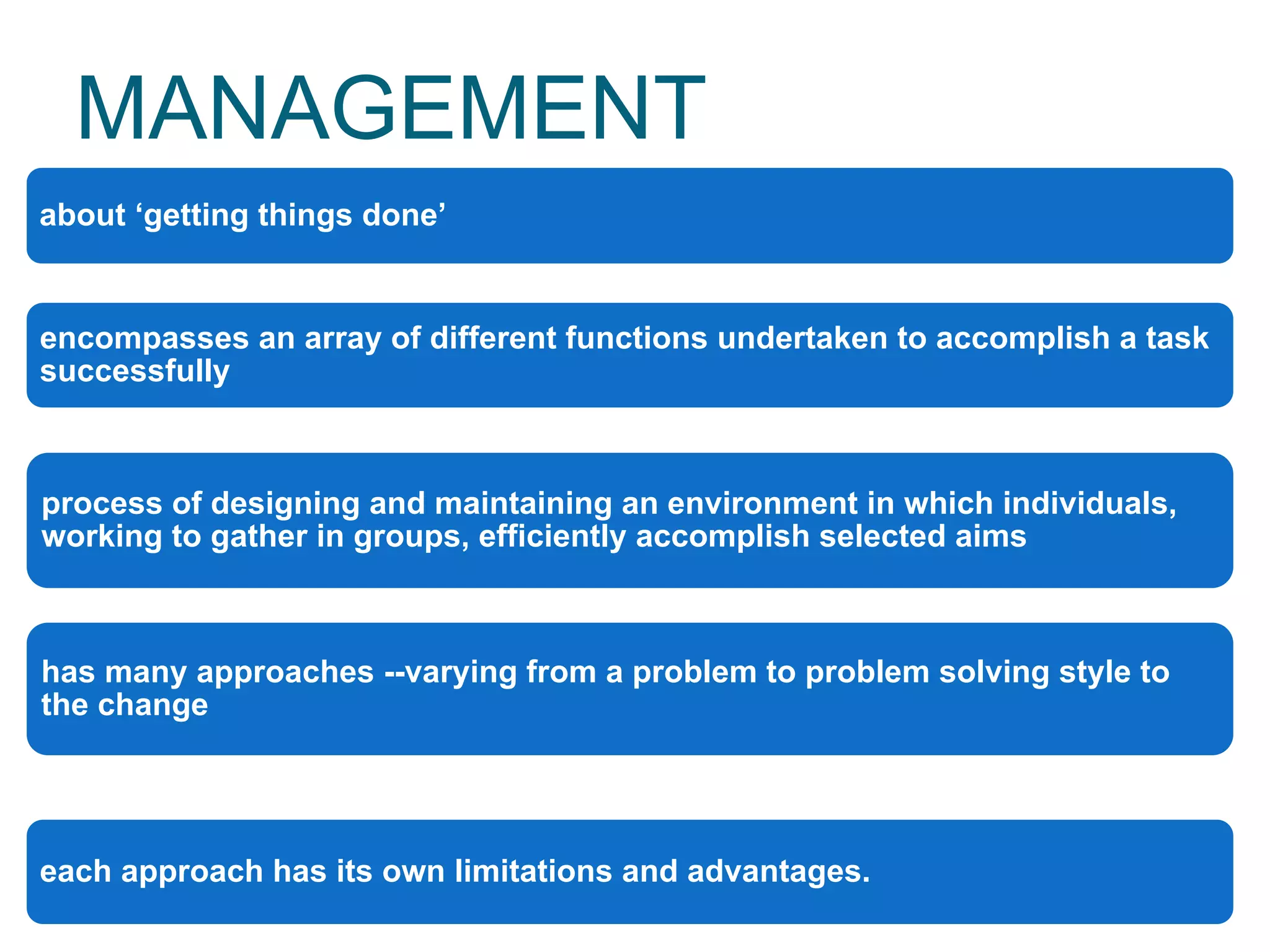
encompasses an array of different functions undertaken to accomplish a task
successfully
process of designing and maintaining an environment in which individuals,
working to gather in groups, efficiently accomplish selected aims
has many approaches --varying from a problem to problem solving style to
the change
each approach has its own limitations and advantages.
about „getting things done‟
MANAGEMENT
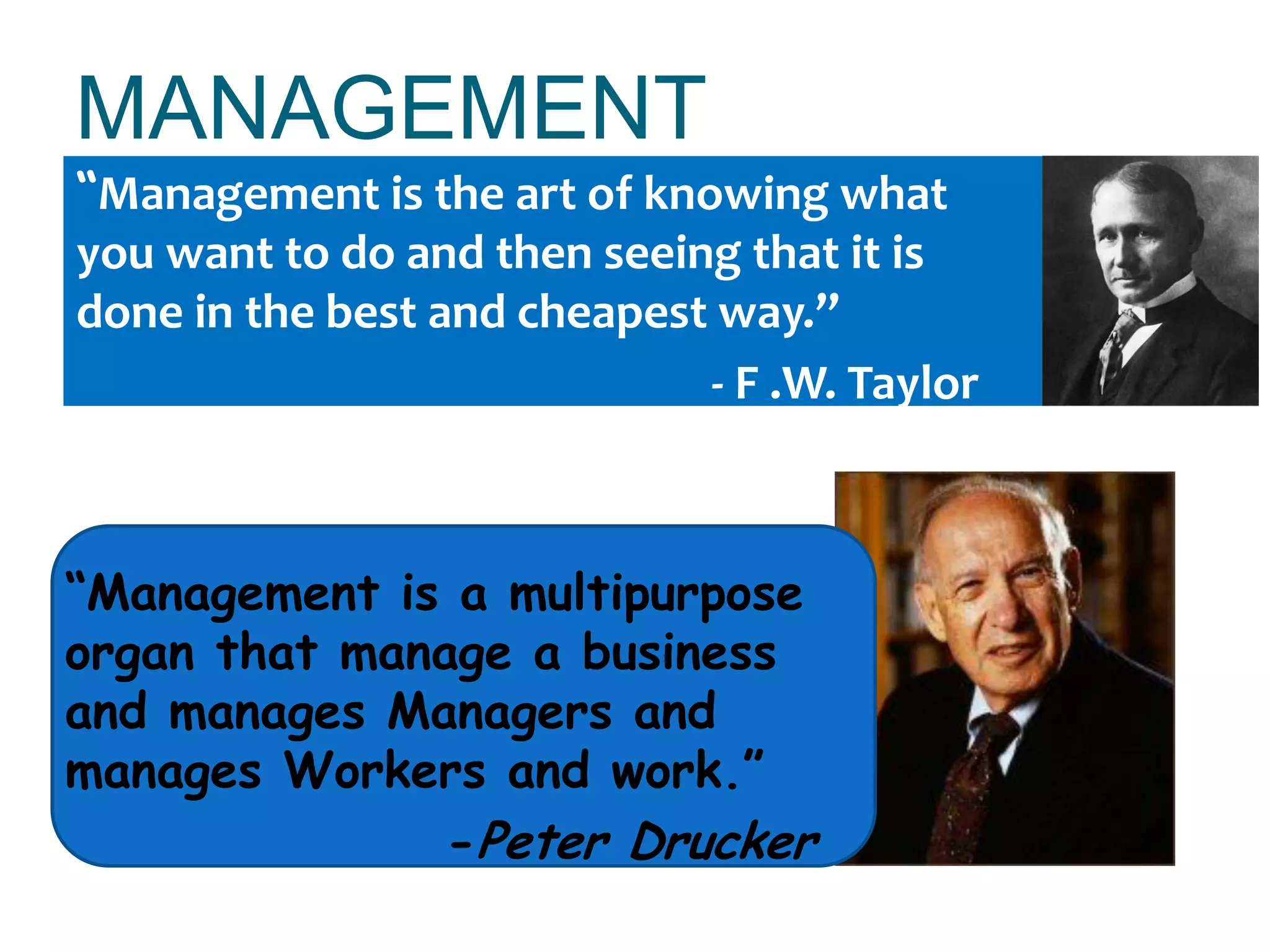
“Management is the art of knowing what
you want to do and then seeing that it is
done in the best and cheapest way.”
- F .W. Taylor
“Management is a multipurpose
organ that manage a business
and manages Managers and
manages Workers and work.”
-Peter Drucker
The Value of Studying
MANAGEMENT
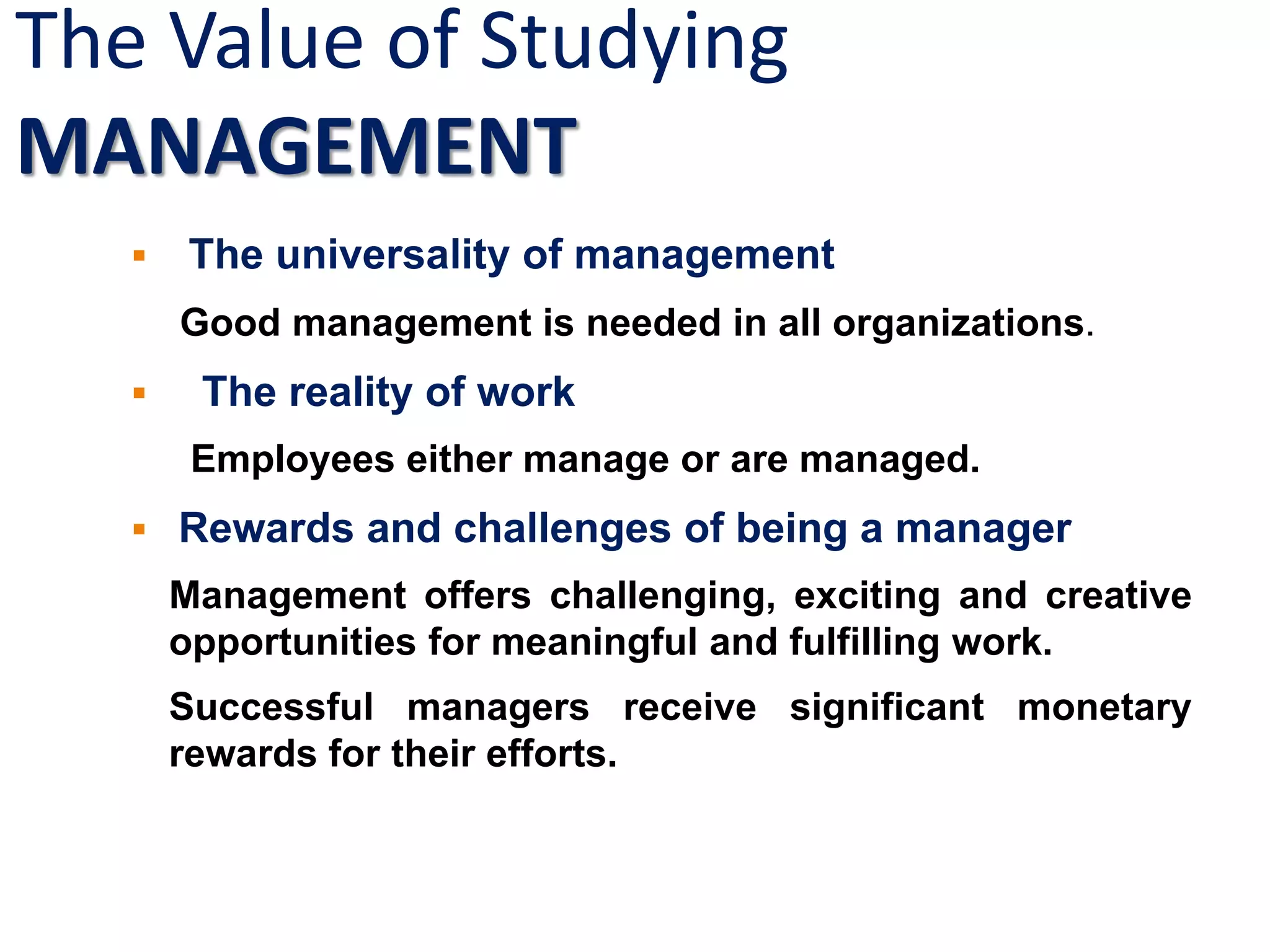
 The universality of management
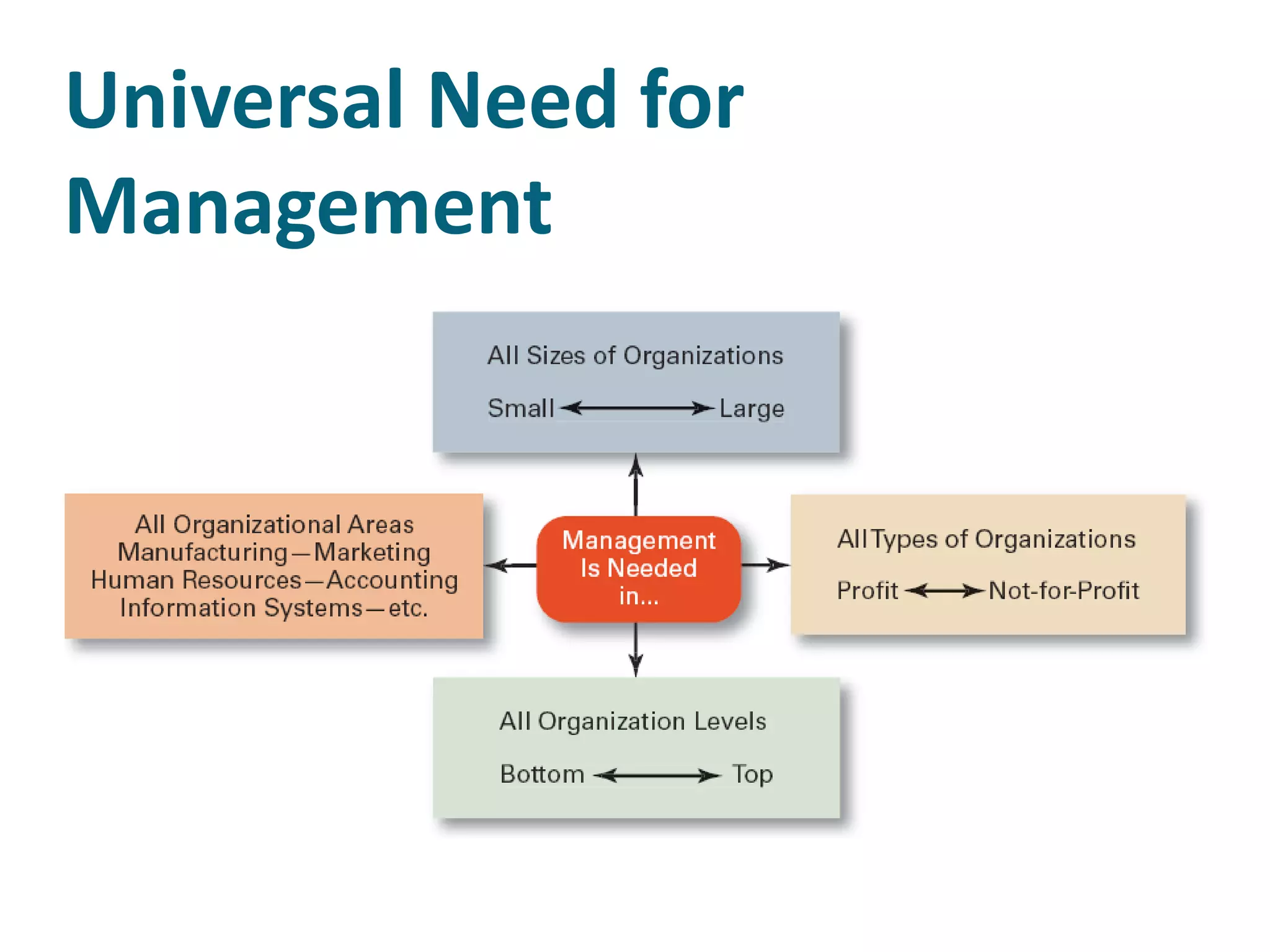
Good management is needed in all organizations.
 The reality of work
Employees either manage or are managed.
 Rewards and challenges of being a manager
Management offers challenging, exciting and creative
opportunities for meaningful and fulfilling work.
Successful managers receive significant monetary
rewards for their efforts.
Universal Need for
Management
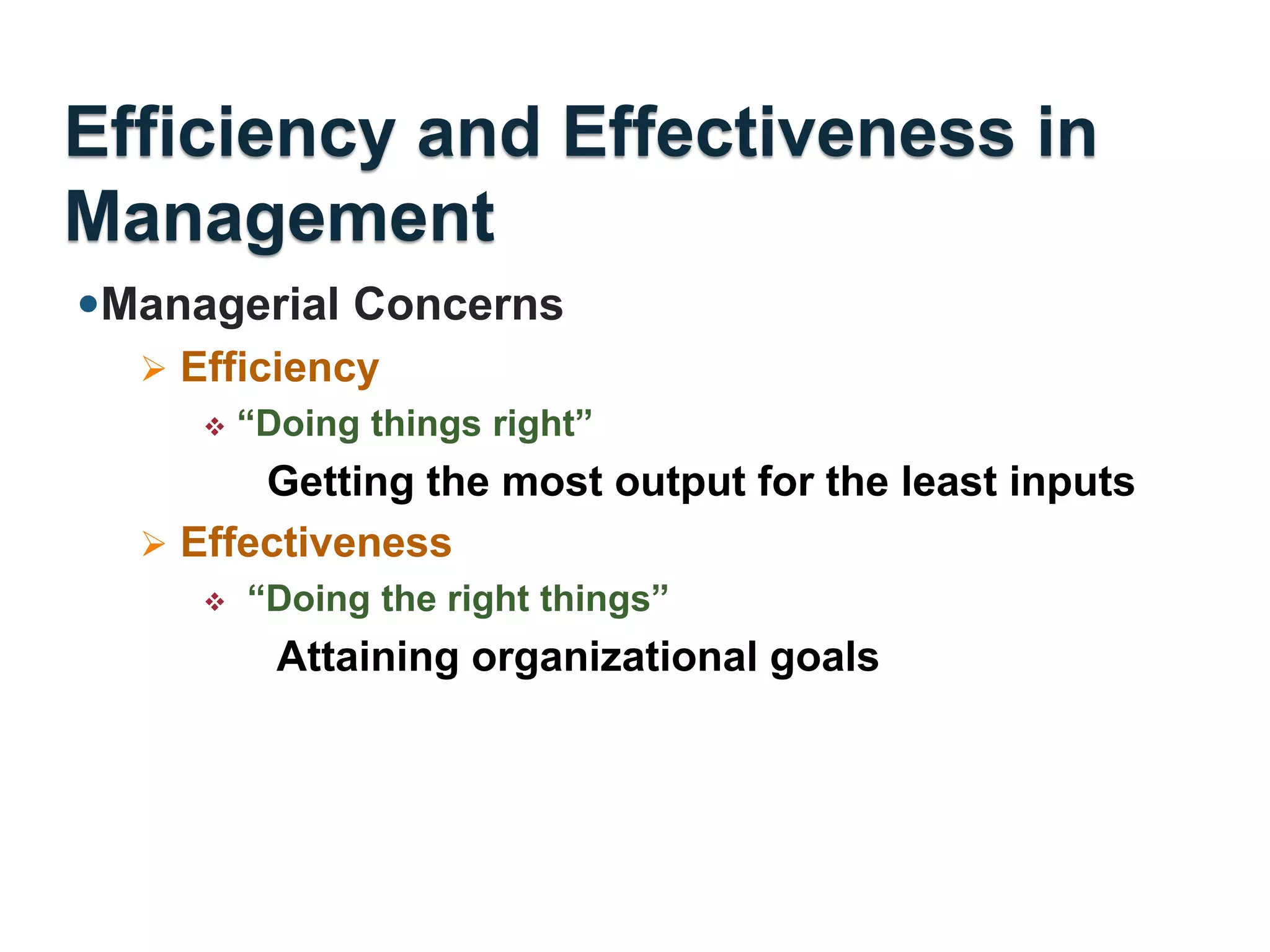
Efficiency and Effectiveness in
Management
Managerial Concerns
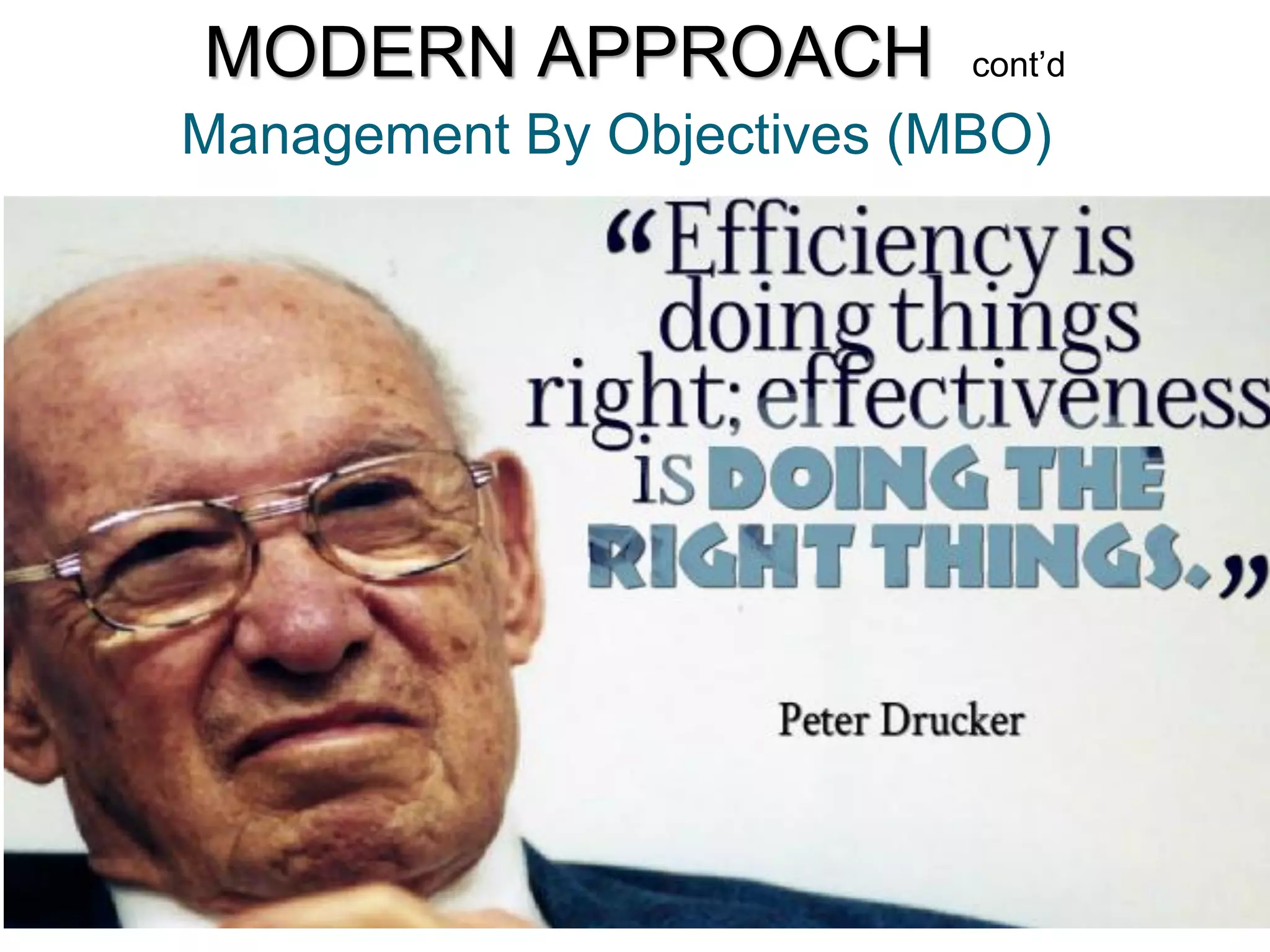
 Efficiency
 “Doing things right”
Getting the most output for the least inputs
 Effectiveness
 “Doing the right things”
Attaining organizational goals
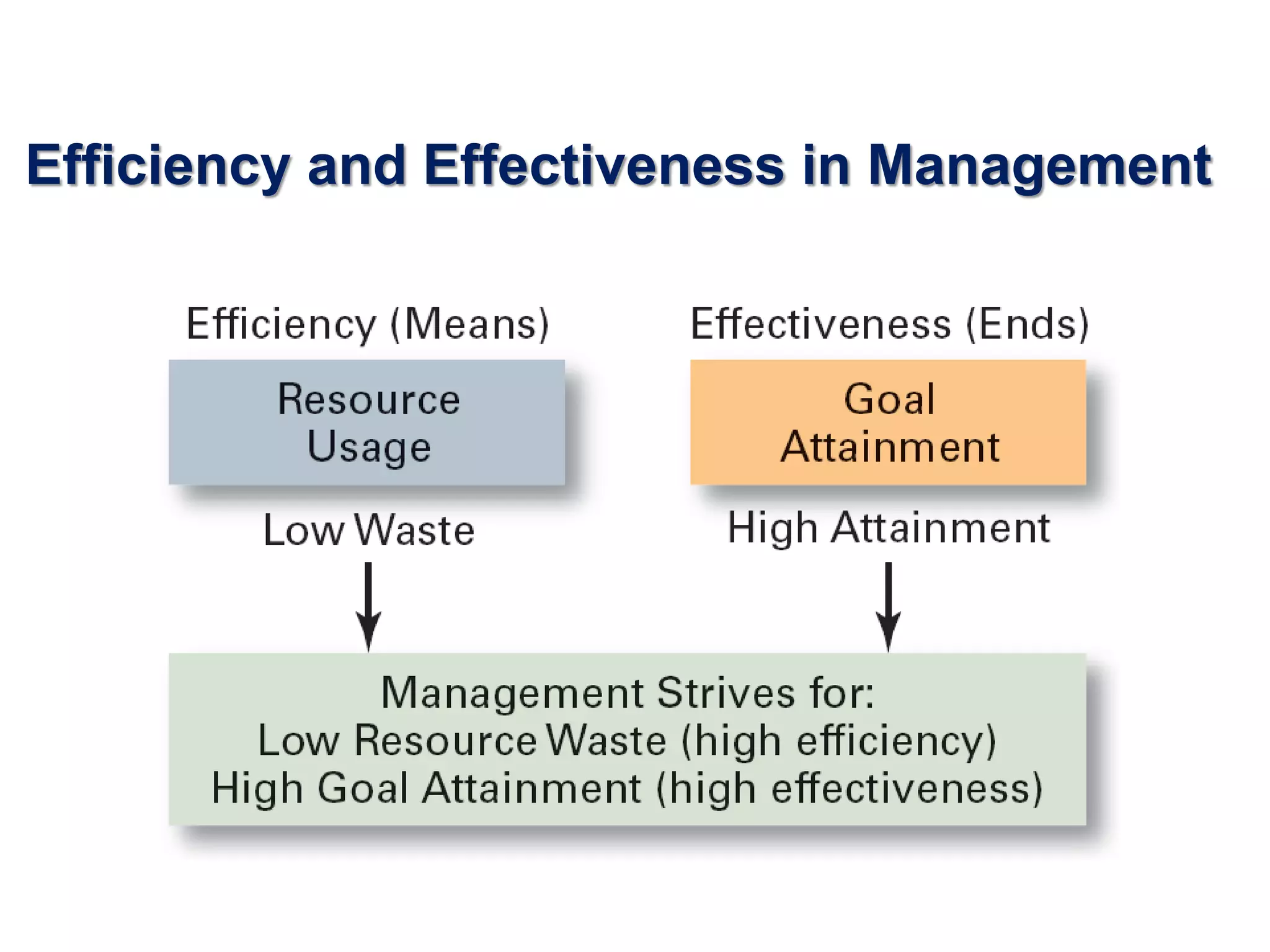
Efficiency and Effectiveness in Management
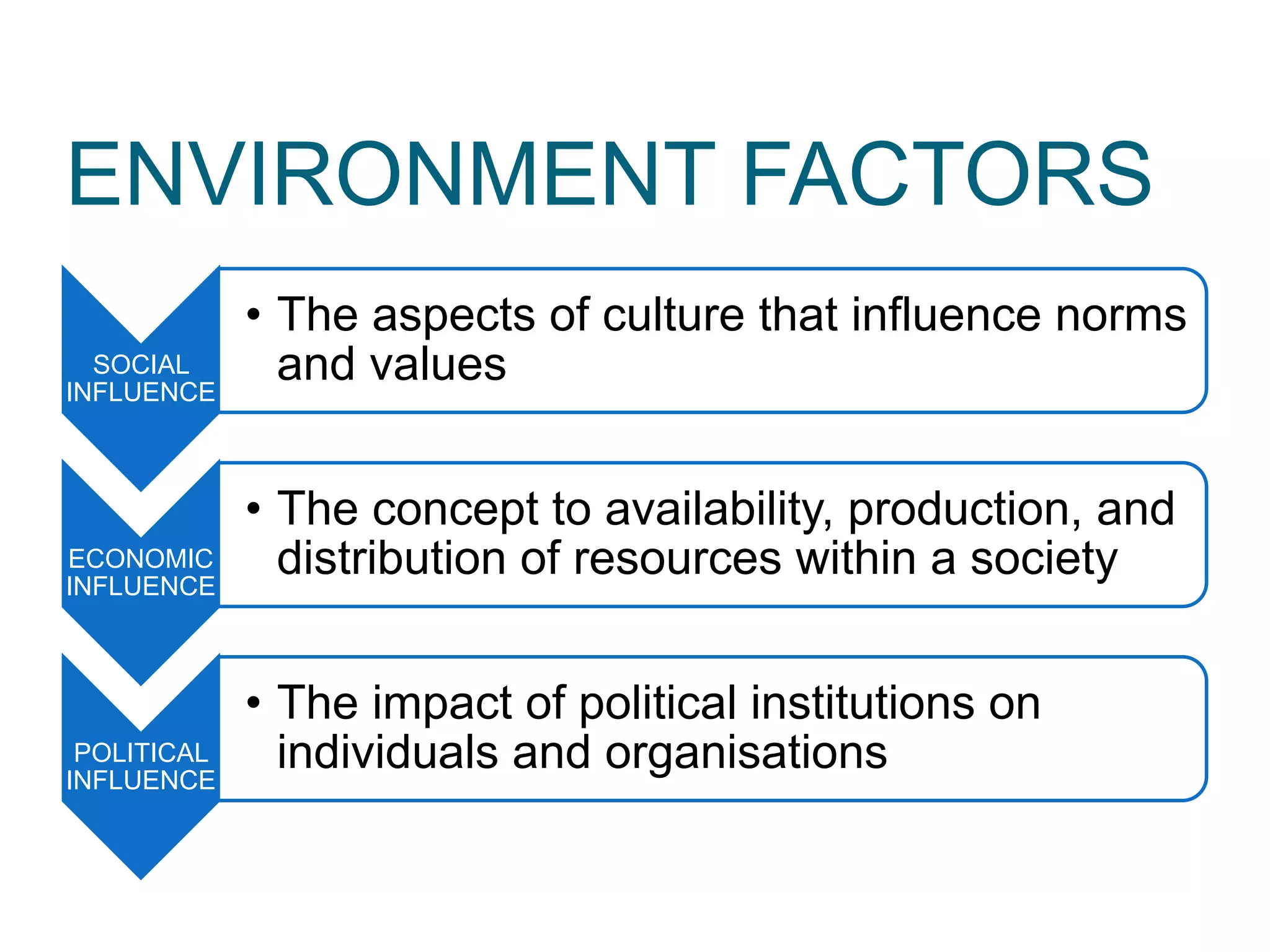
ENVIRONMENT FACTORS
SOCIAL
INFLUENCE
• The aspects of culture that influence norms
and values
ECONOMIC
INFLUENCE
• The concept to availability, production, and
distribution of resources within a society
POLITICAL
INFLUENCE
• The impact of political institutions on
individuals and organisations
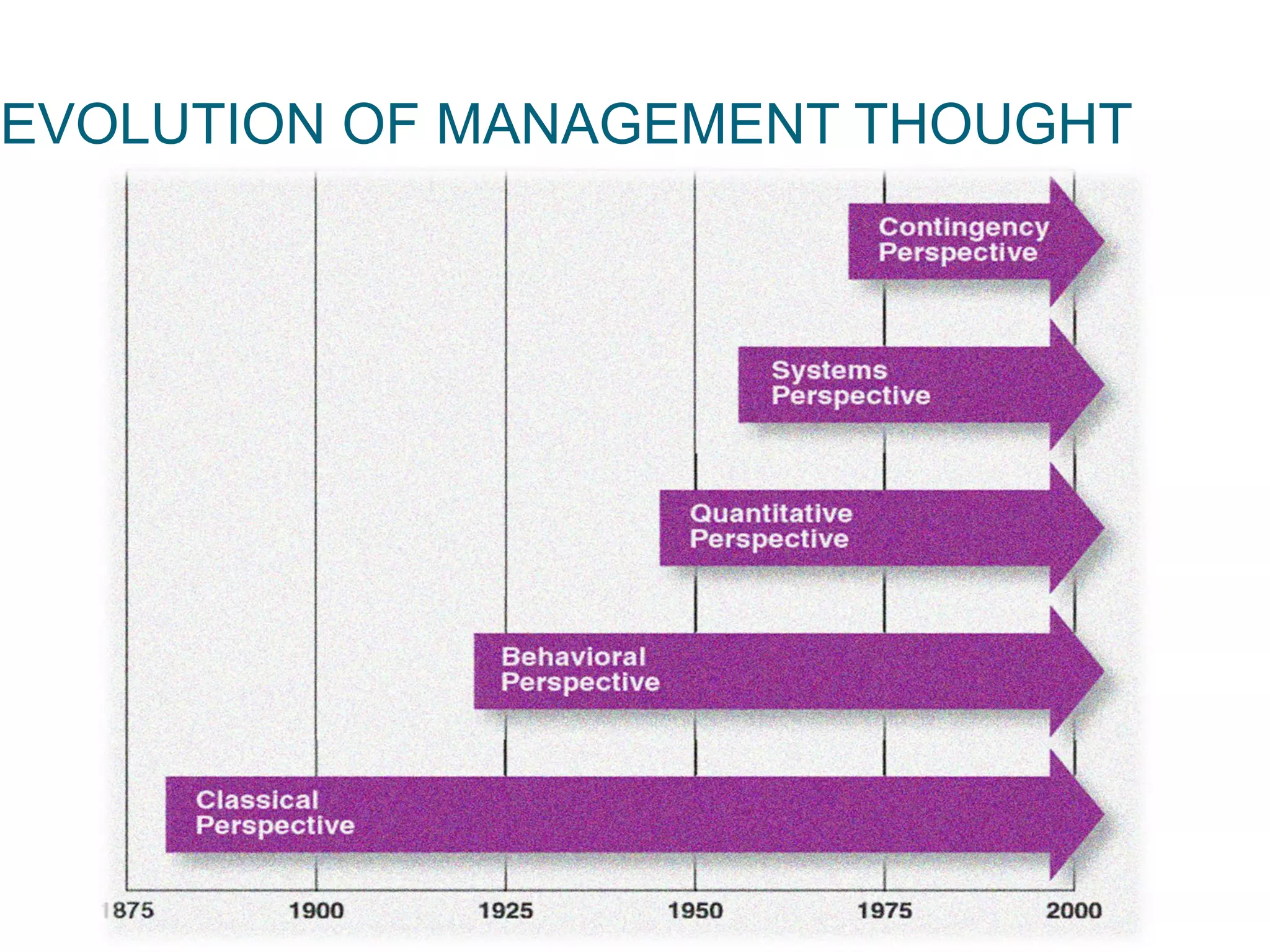
EVOLUTION OF MANAGEMENT THOUGHT
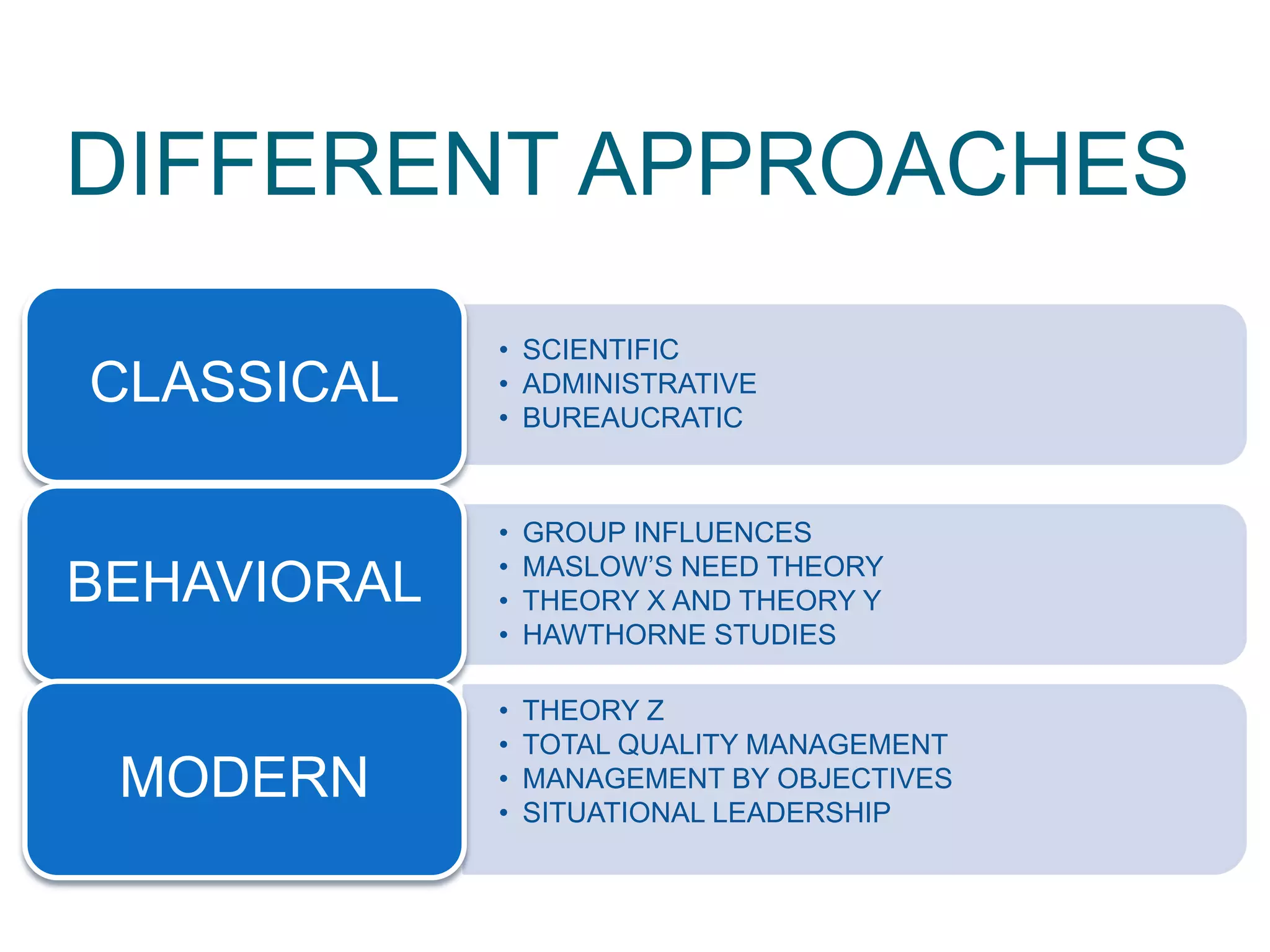
DIFFERENT APPROACHES
• SCIENTIFIC
• ADMINISTRATIVE
• BUREAUCRATIC
CLASSICAL
• GROUP INFLUENCES
• MASLOW’S NEED THEORY
• THEORY X AND THEORY Y
• HAWTHORNE STUDIES
BEHAVIORAL
• THEORY Z
• TOTAL QUALITY MANAGEMENT
• MANAGEMENT BY OBJECTIVES
• SITUATIONAL LEADERSHIP
MODERN
Focuses on the
individual worker‟s
productivity
Focuses on the
functions of
management
Focuses on the
overall
organizational
system
CLASSICAL APPROACH
CLASSICAL APPROACH
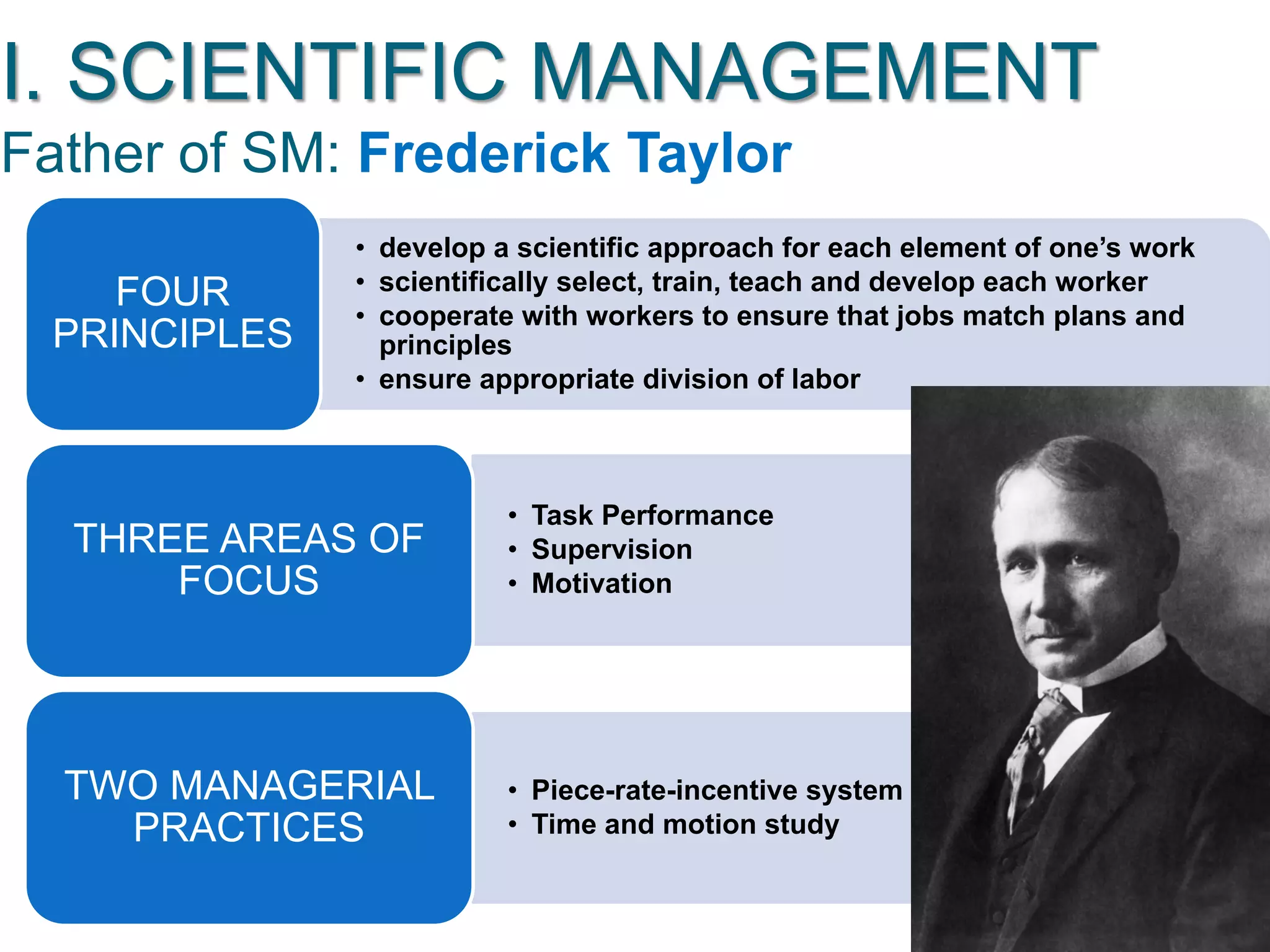
I. SCIENTIFIC MANAGEMENT
Father of SM: Frederick Taylor
• develop a scientific approach for each element of one‟s work
• scientifically select, train, teach and develop each worker
• cooperate with workers to ensure that jobs match plans and
principles
• ensure appropriate division of labor
FOUR
PRINCIPLES
• Task Performance
• Supervision
• Motivation
THREE AREAS OF
FOCUS
• Piece-rate-incentive system
• Time and motion study
TWO MANAGERIAL
PRACTICES
I. SCIENTIFIC MANAGEMENT
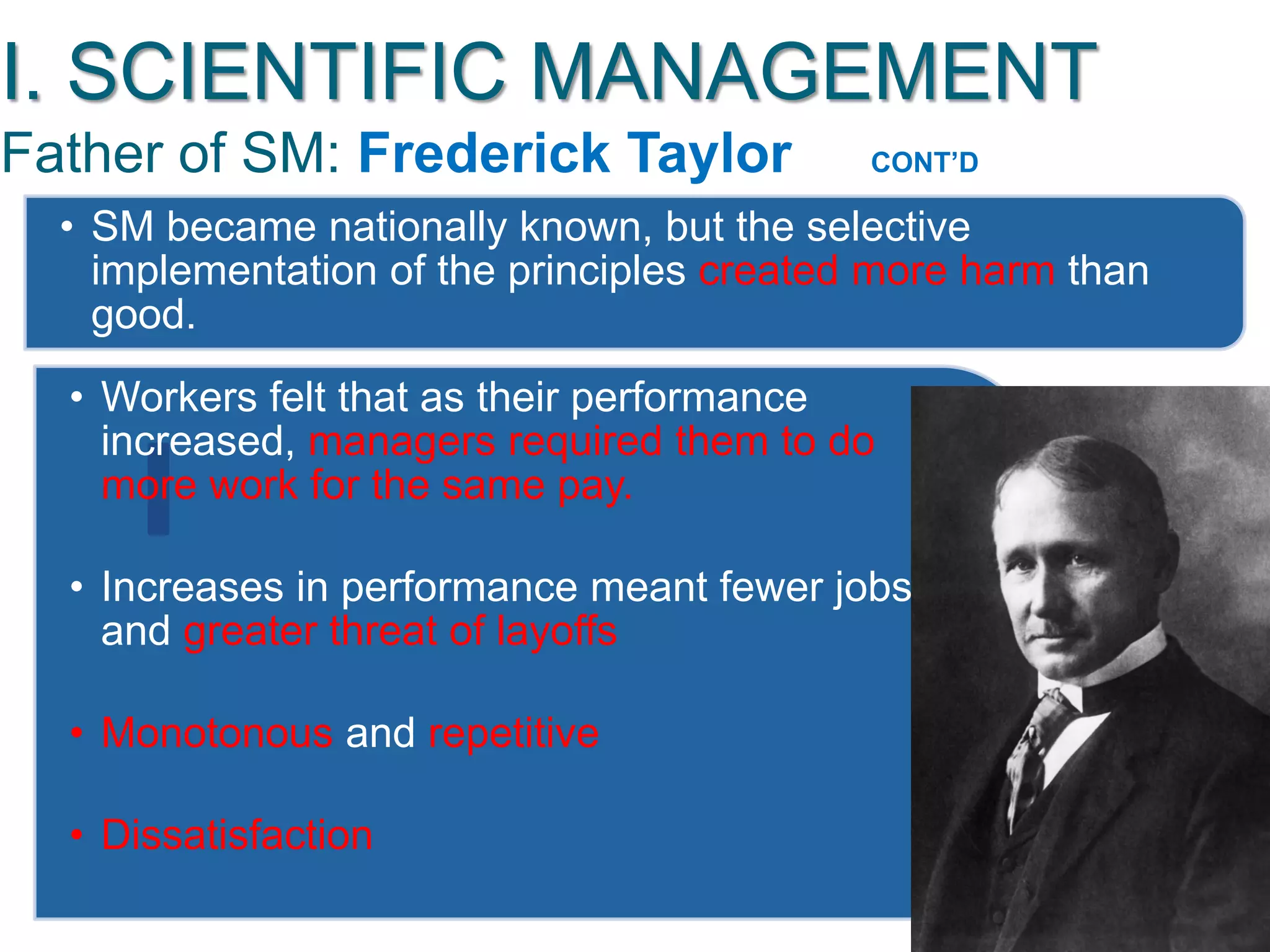
Father of SM: Frederick Taylor CONT‟D
• SM became nationally known, but the selective
implementation of the principles created more harm than
good.
• Workers felt that as their performance
increased, managers required them to do
more work for the same pay.
• Increases in performance meant fewer jobs
and greater threat of layoffs
• Monotonous and repetitive
• Dissatisfaction
I. SCIENTIFIC MANAGEMENT cont’d
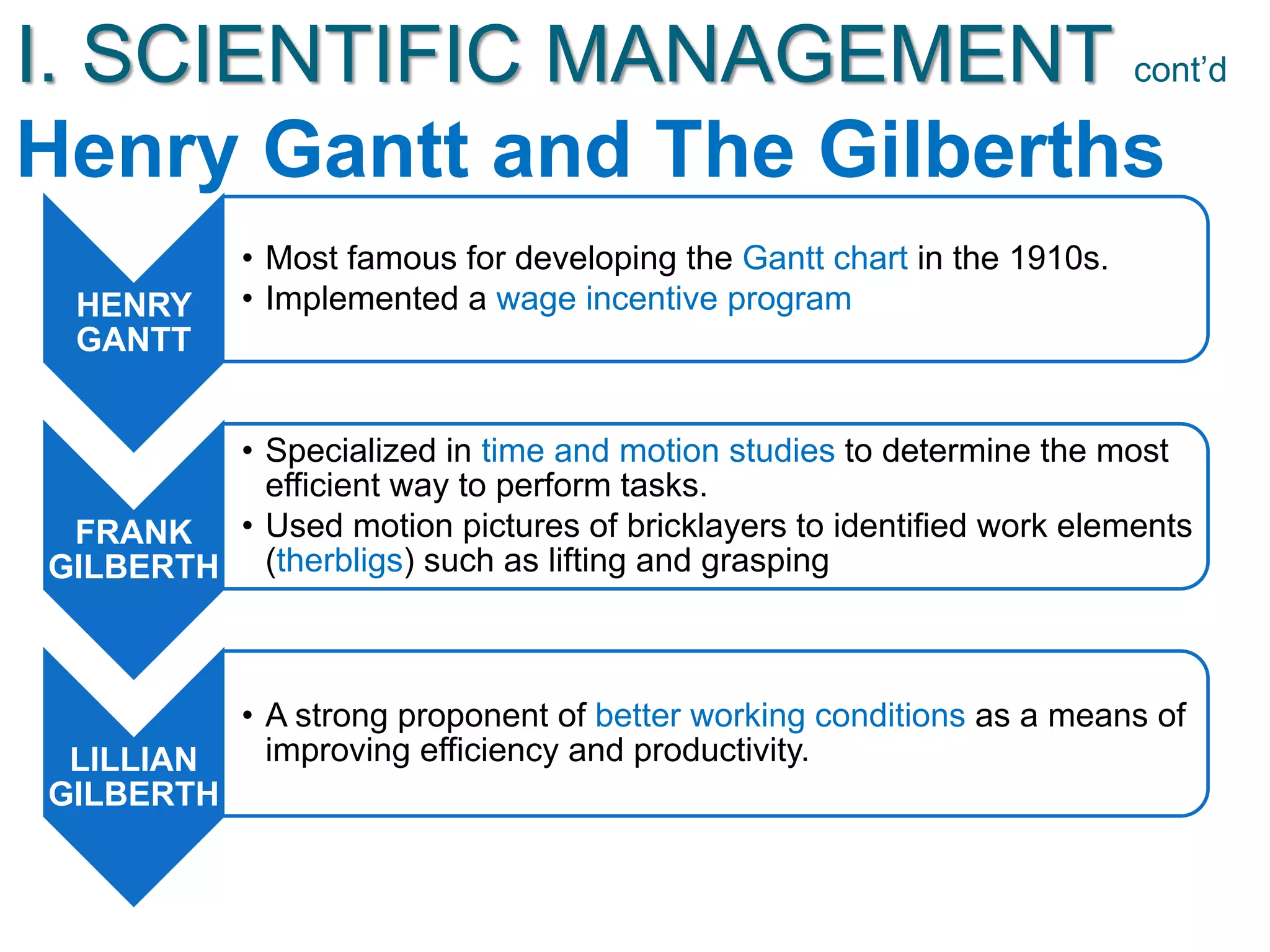
Henry Gantt and The Gilberths
HENRY
GANTT
• Most famous for developing the Gantt chart in the 1910s.
• Implemented a wage incentive program
FRANK
GILBERTH
• Specialized in time and motion studies to determine the most
efficient way to perform tasks.
• Used motion pictures of bricklayers to identified work elements
(therbligs) such as lifting and grasping
LILLIAN
GILBERTH
• A strong proponent of better working conditions as a means of
improving efficiency and productivity.
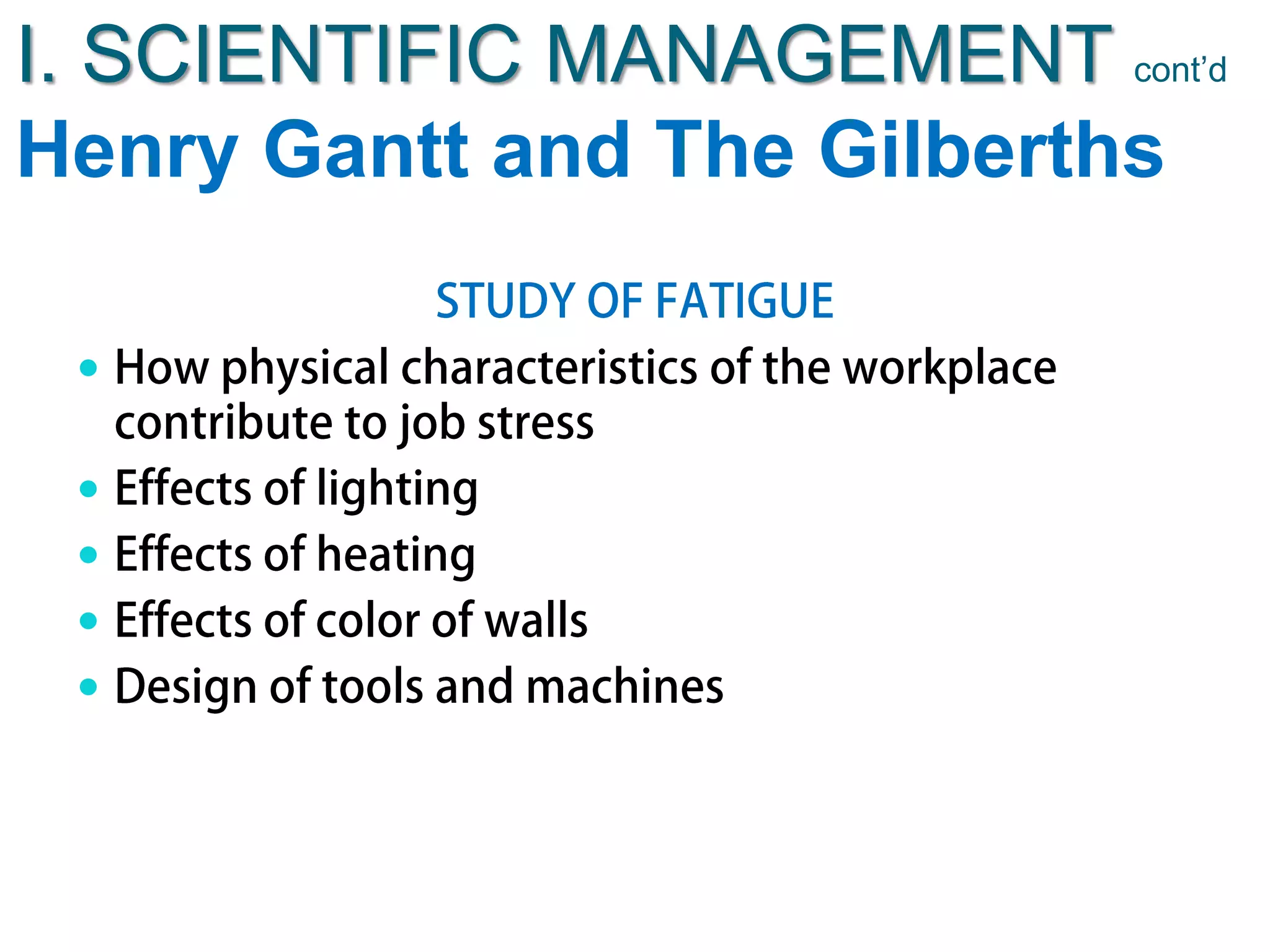
I. SCIENTIFIC MANAGEMENT cont’d
Henry Gantt and The Gilberths





I. SCIENTIFIC MANAGEMENT cont’d
Henry Gantt and The Gilberths

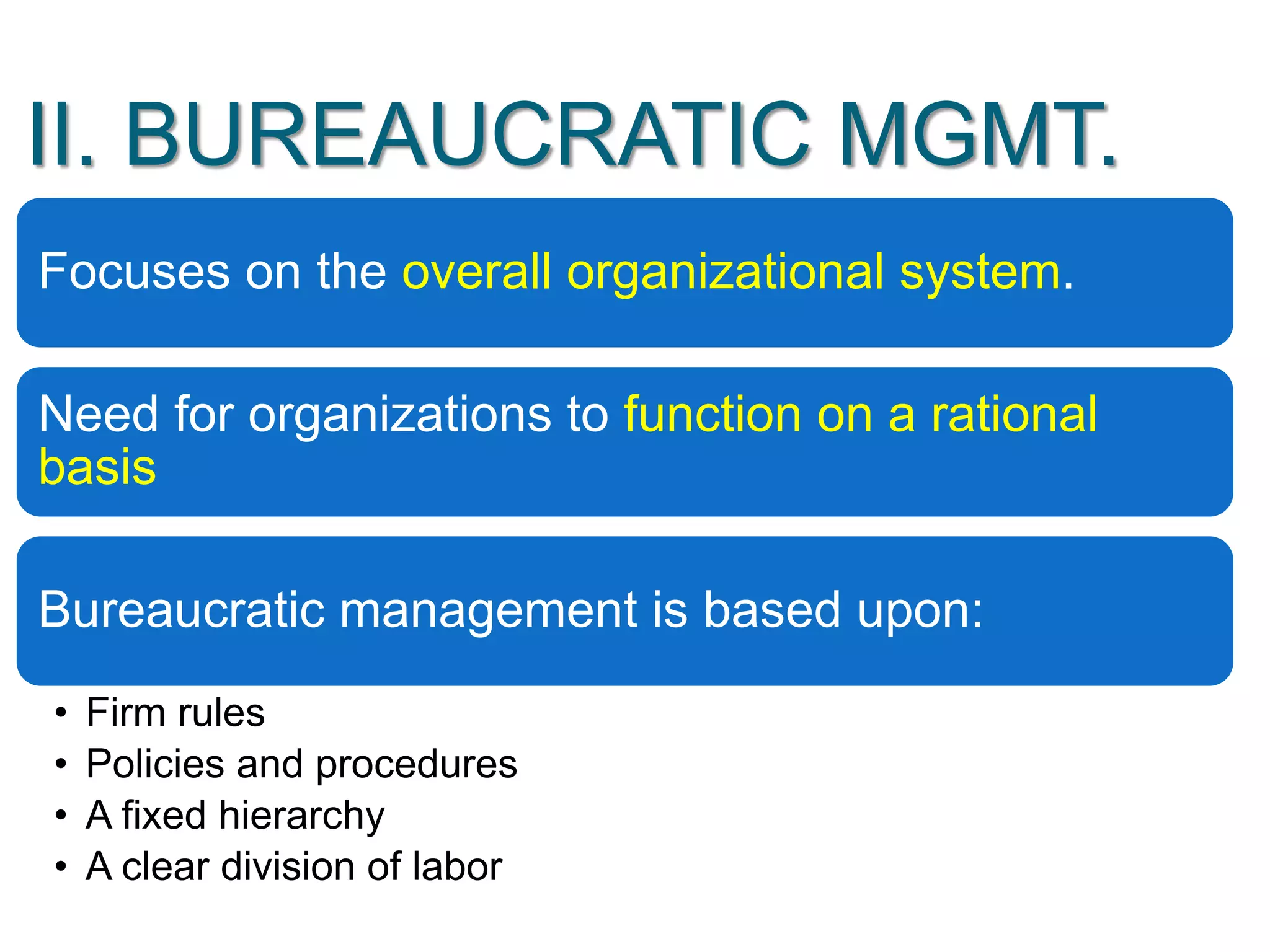
II. BUREAUCRATIC MGMT.
Focuses on the overall organizational system.
Need for organizations to function on a rational
basis
Bureaucratic management is based upon:
• Firm rules
• Policies and procedures
• A fixed hierarchy
• A clear division of labor
II. BUREAUCRATIC MGMT. cont’d
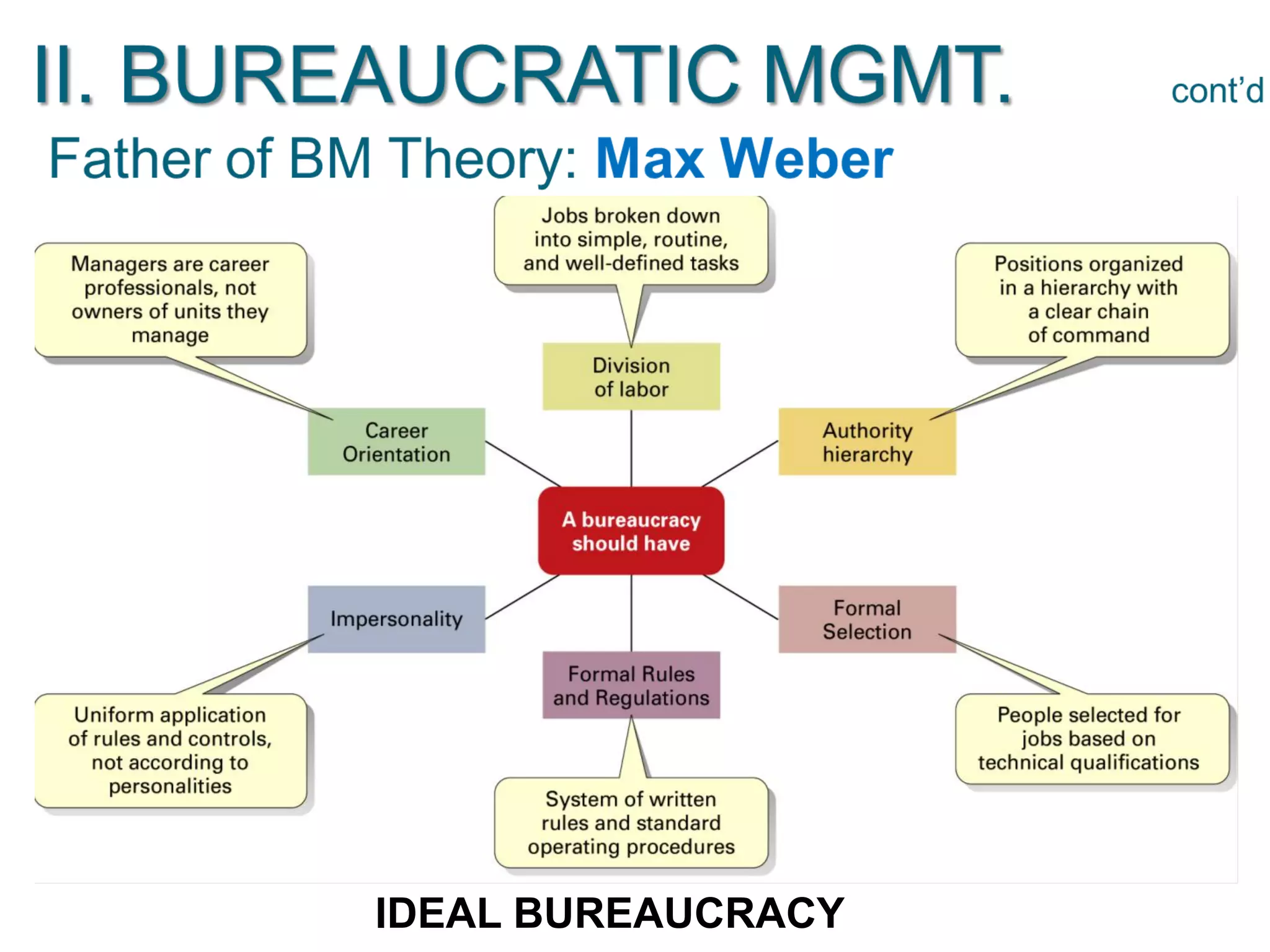
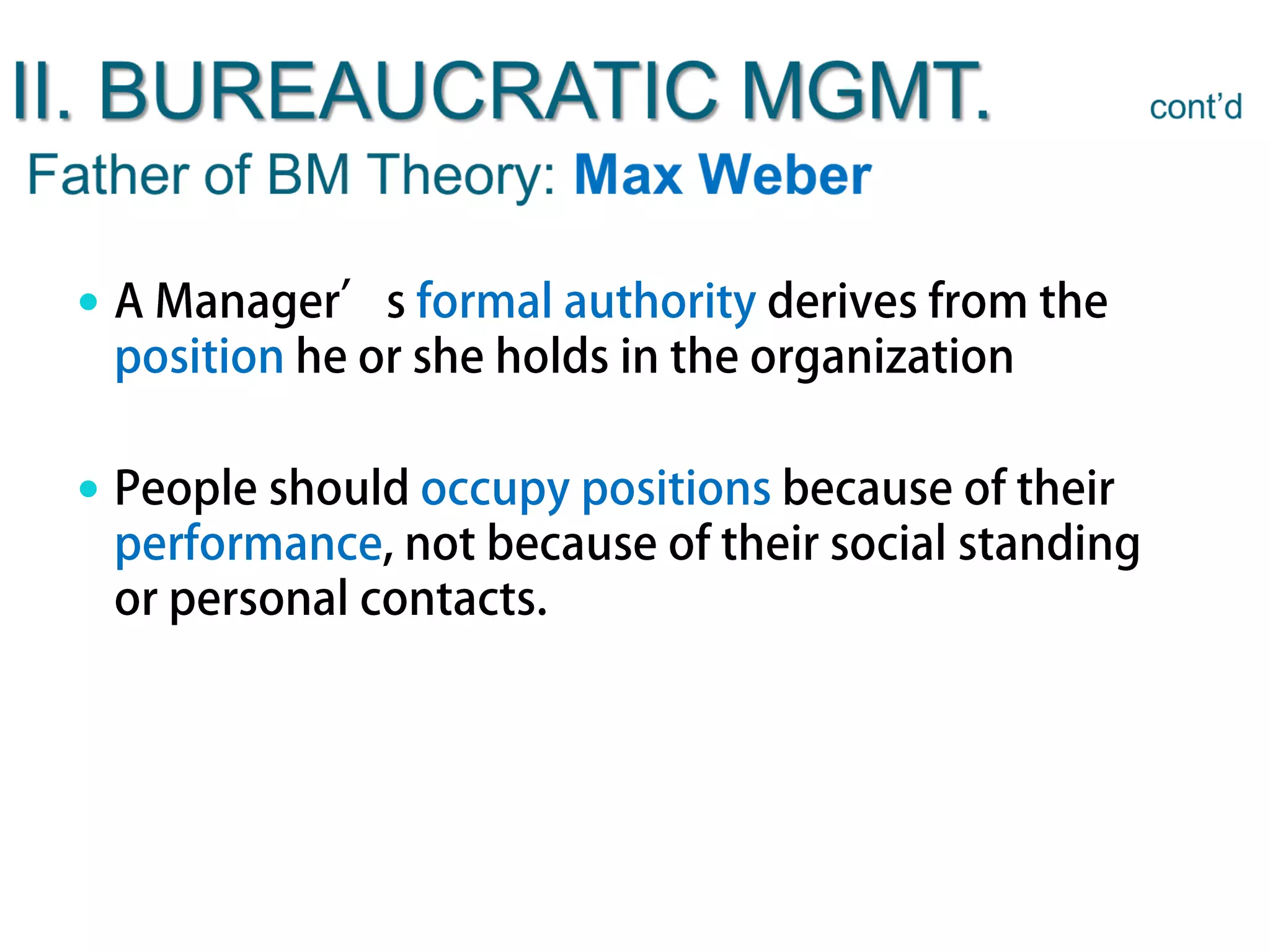
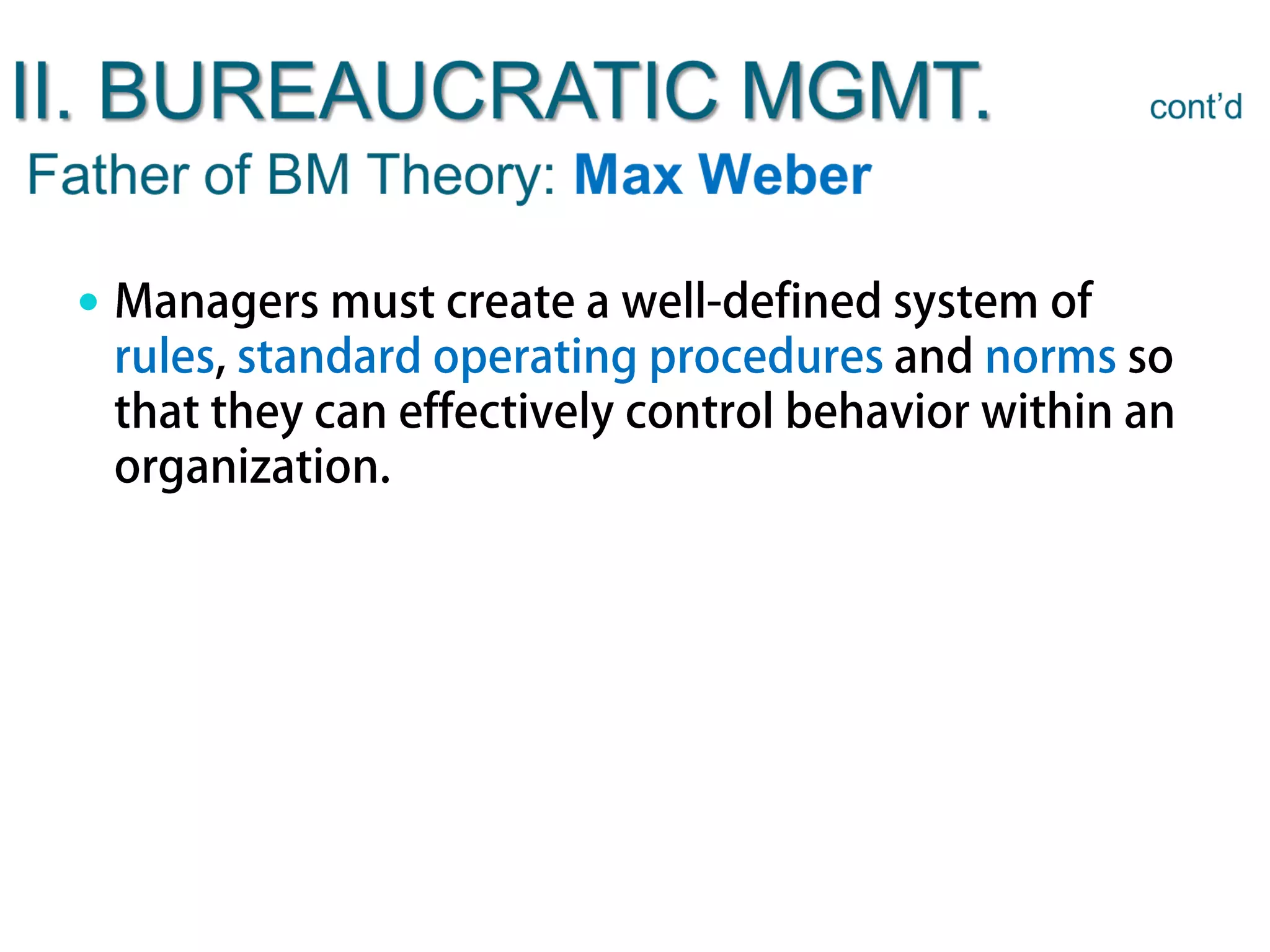
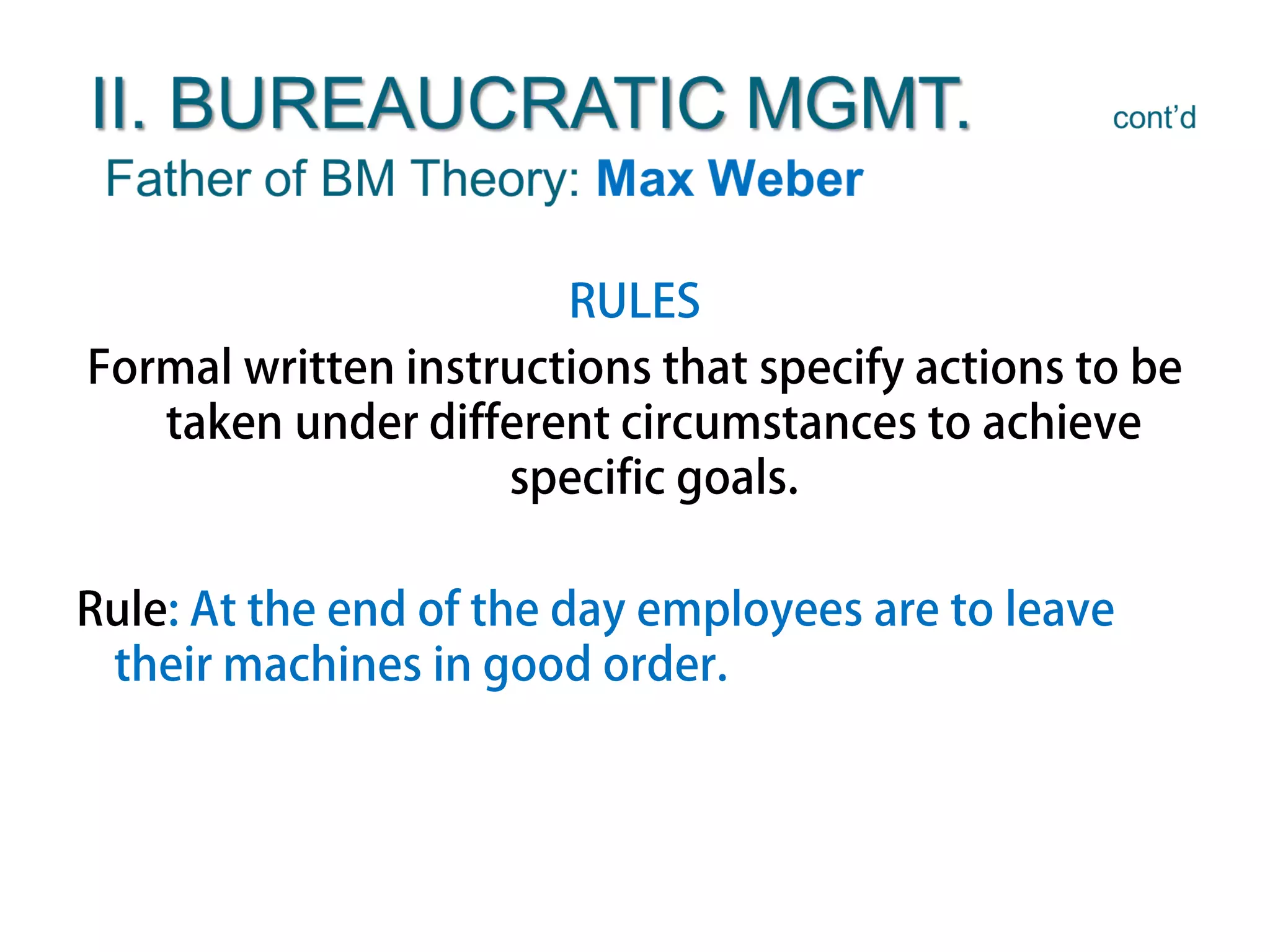
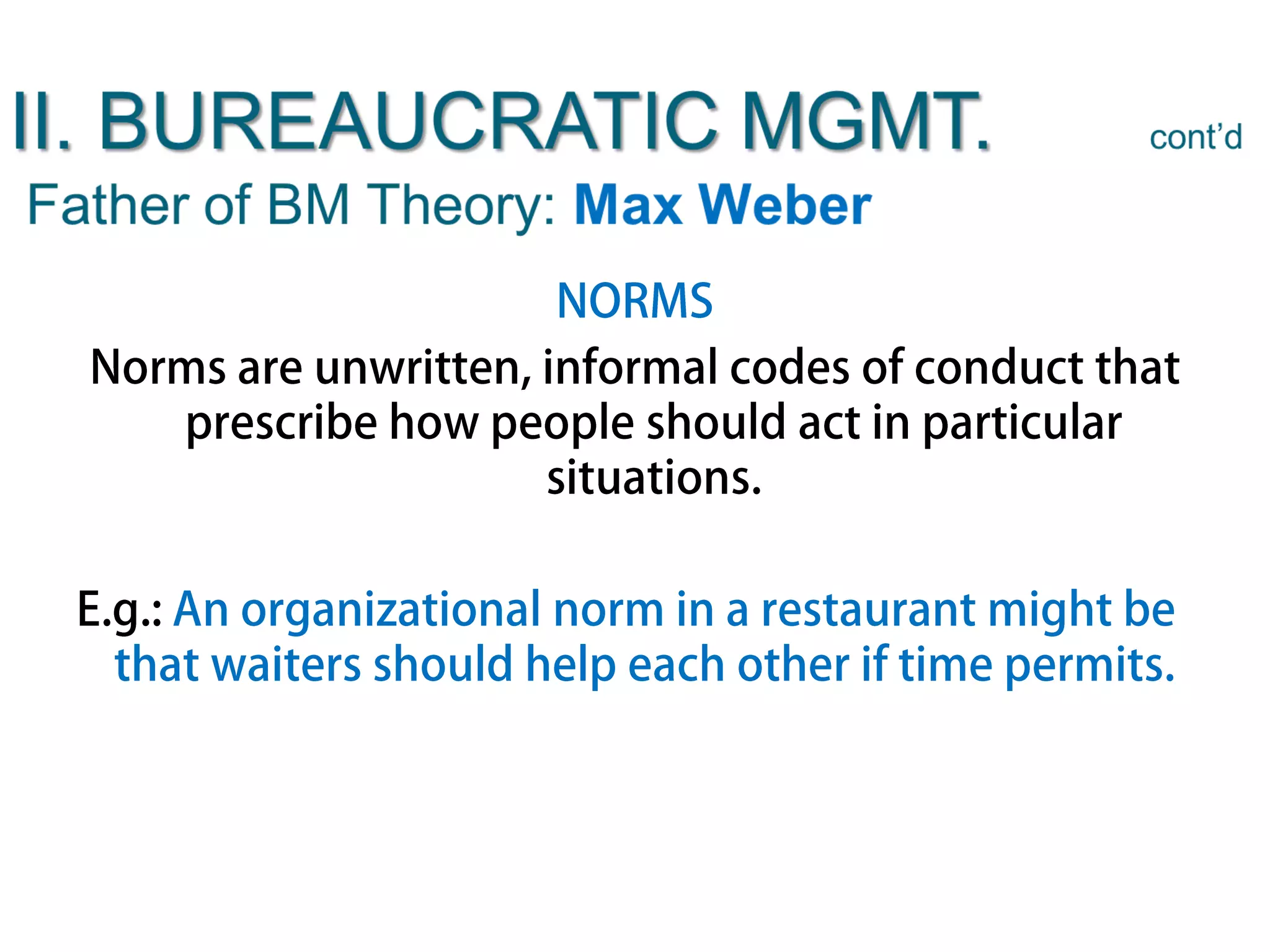
Father of BM Theory: Max Weber
• A German sociologist and historian who
envisioned a system of management
• “a bureaucracy is a highly structured,
formalized and impersonal organization.”
MAX WEBER
• Division of labor
• Hierarchy of authority
• Rules and procedures
• Impersonality
• Employee selection and promotion
FIVE
PRINCIPLES
IDEAL BUREAUCRACY





III. ADMINISTRATIVE MGMT.
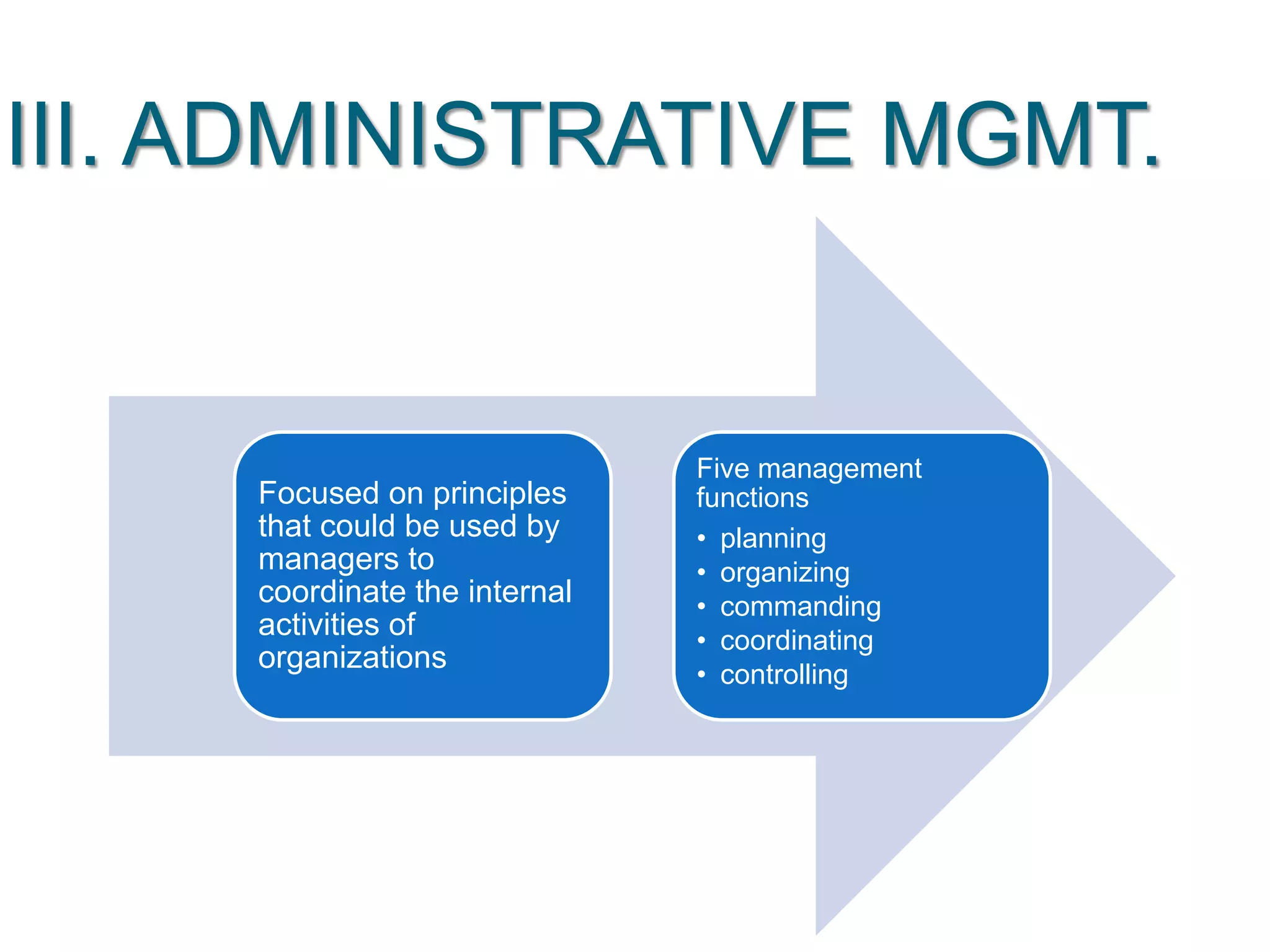
Focused on principles
that could be used by
managers to
coordinate the internal
activities of
organizations
Five management
functions
• planning
• organizing
• commanding
• coordinating
• controlling
III. ADMINISTRATIVE MANAGEMENT cont’d
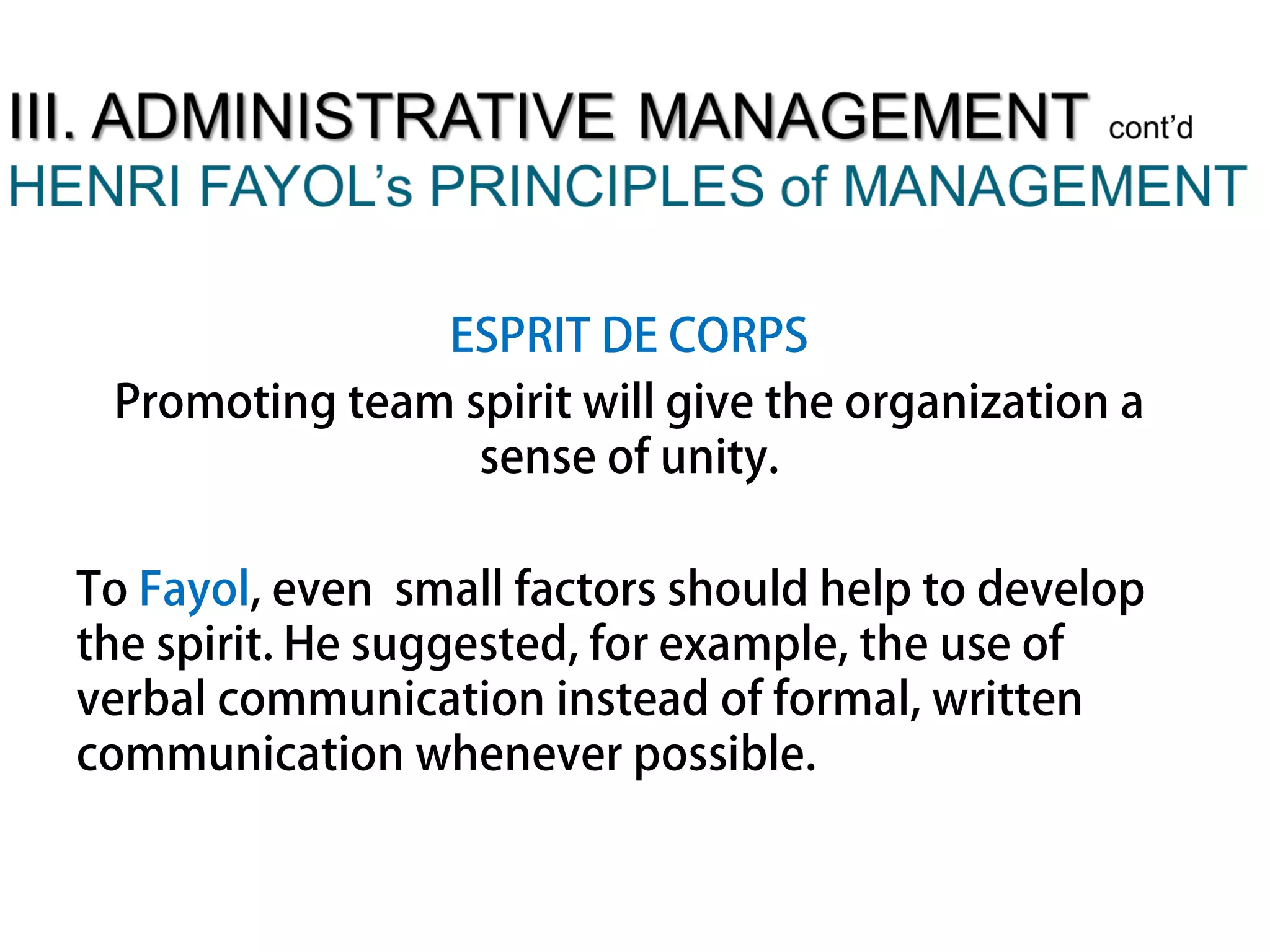
HENRI FAYOL’s PRINCIPLES of MANAGEMENT
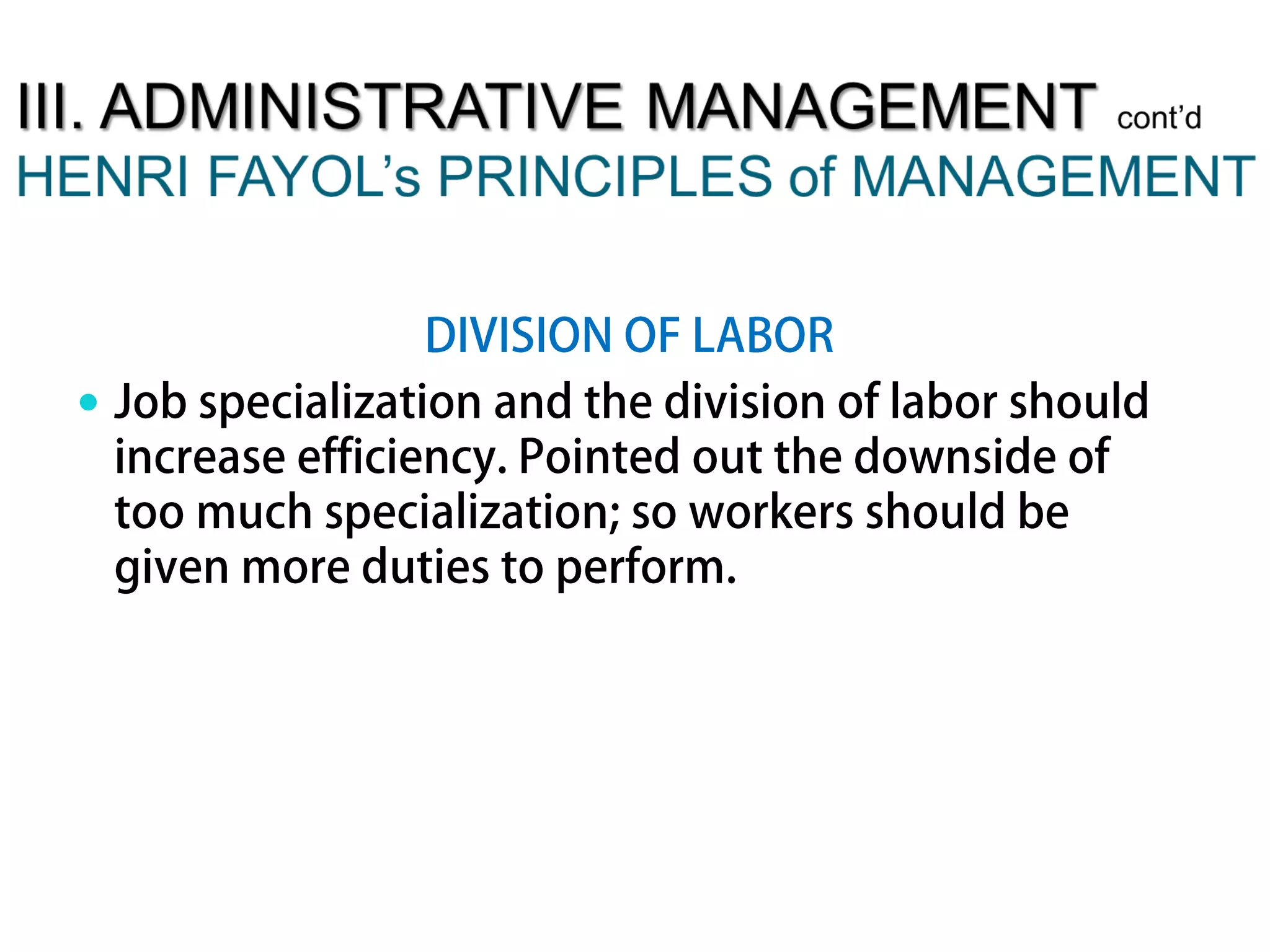
1. Division of labor
2. Authority and responsibility
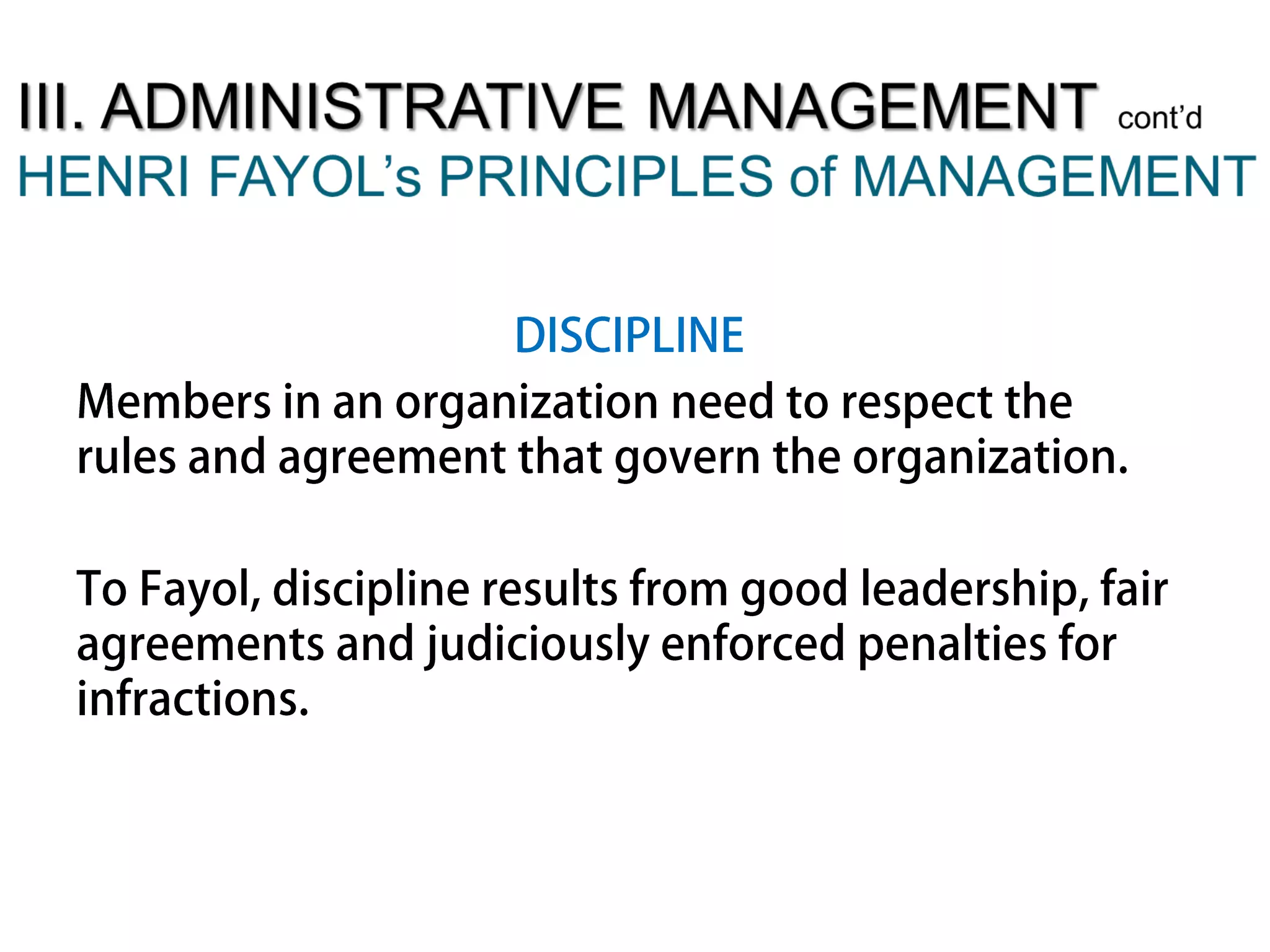
3. Discipline
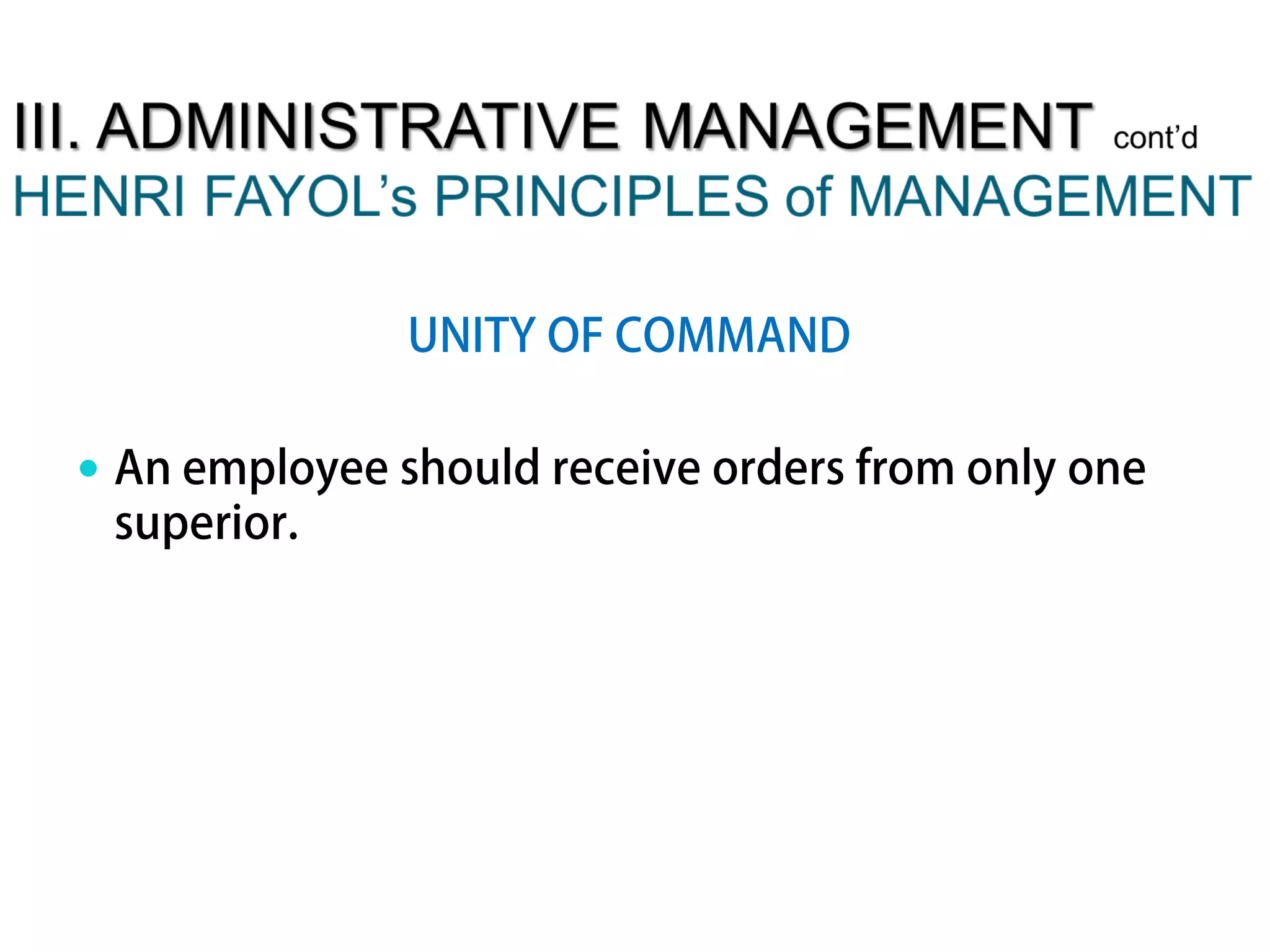
4. Unity of command
5. Unity of direction
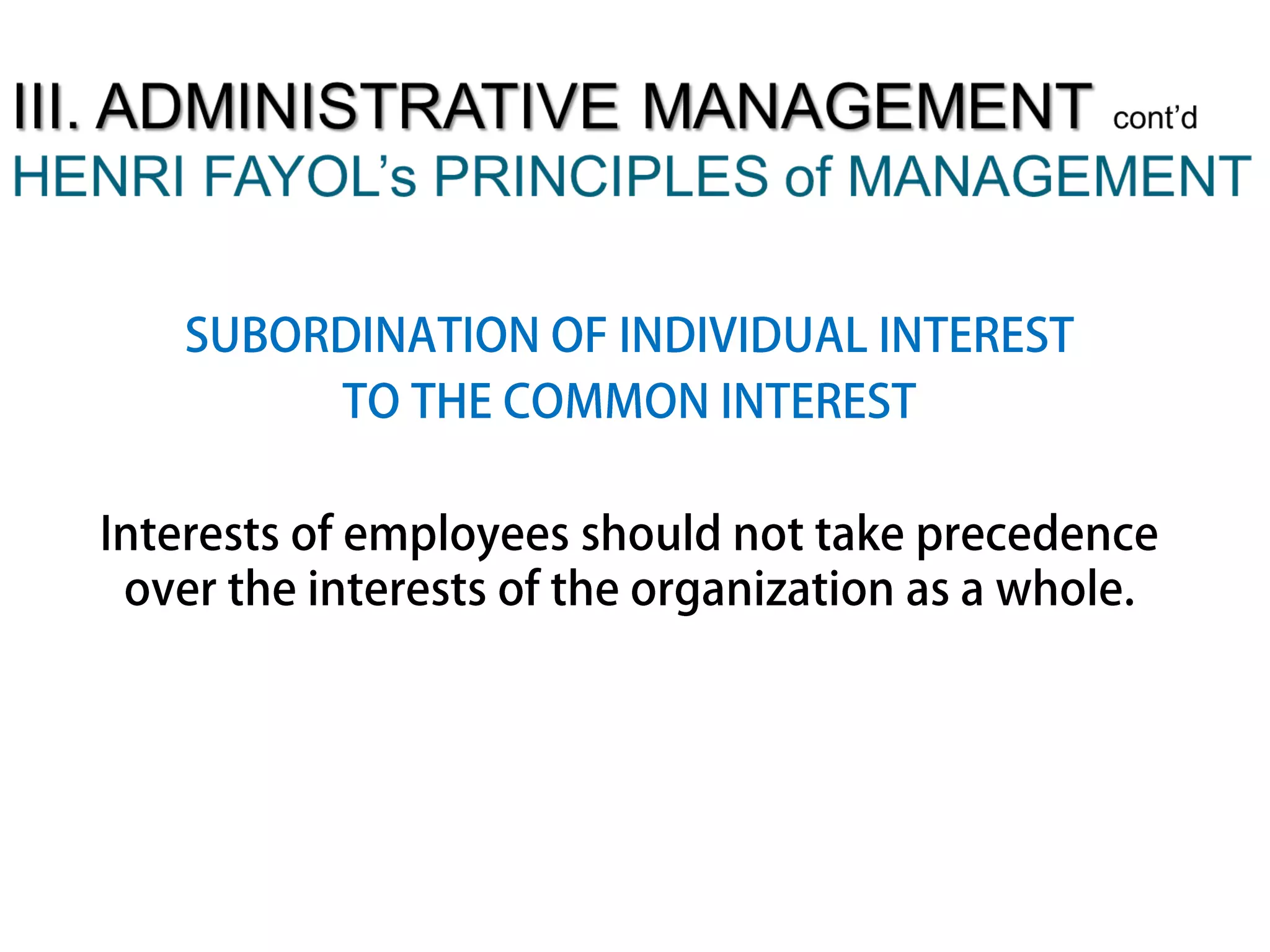
6. Subordination of individual interest to
the common good
7. Remuneration of personnel
8. Centralization
9. Scalar chain
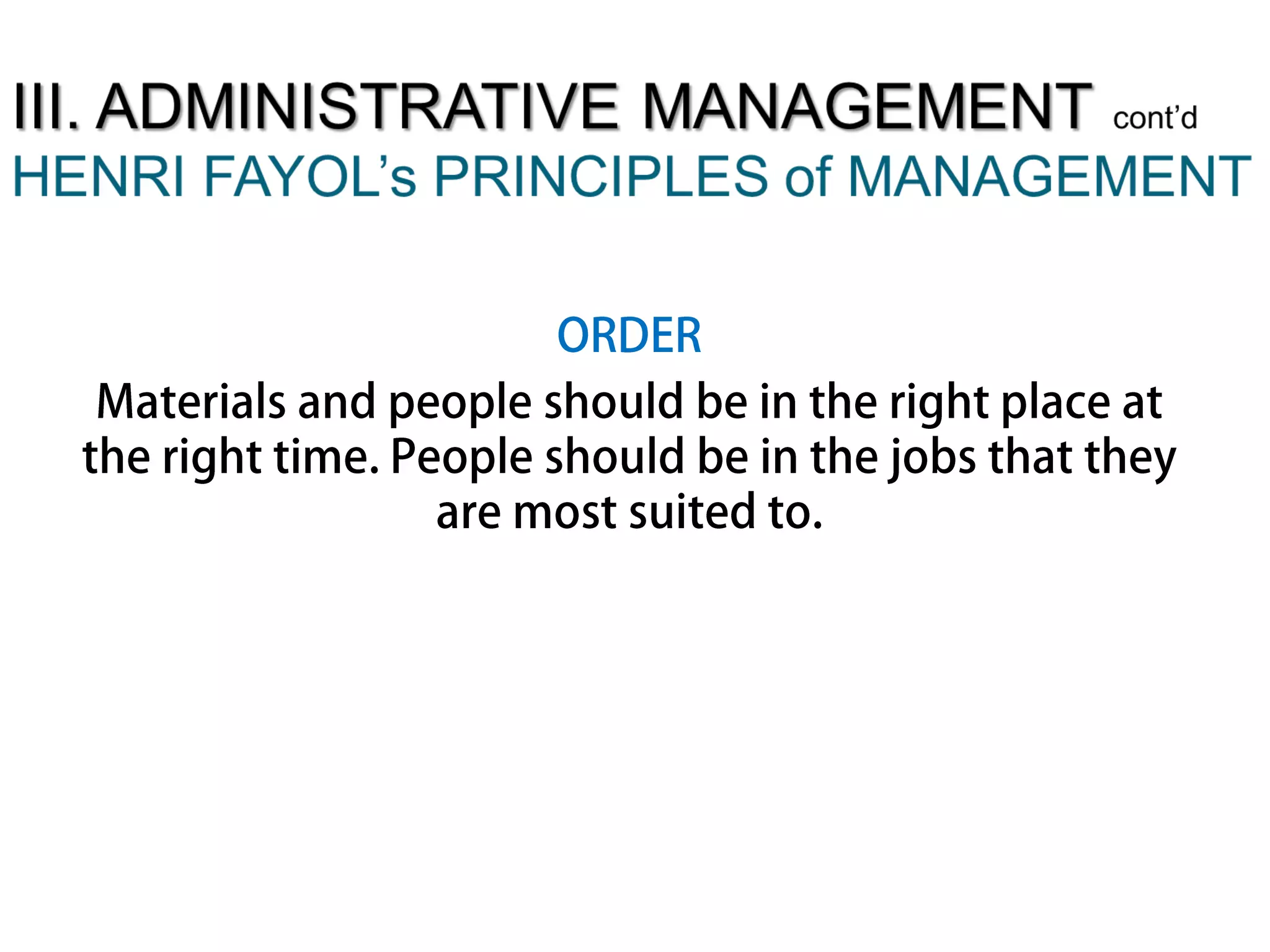
10. Order
11. Equity
12. Stability
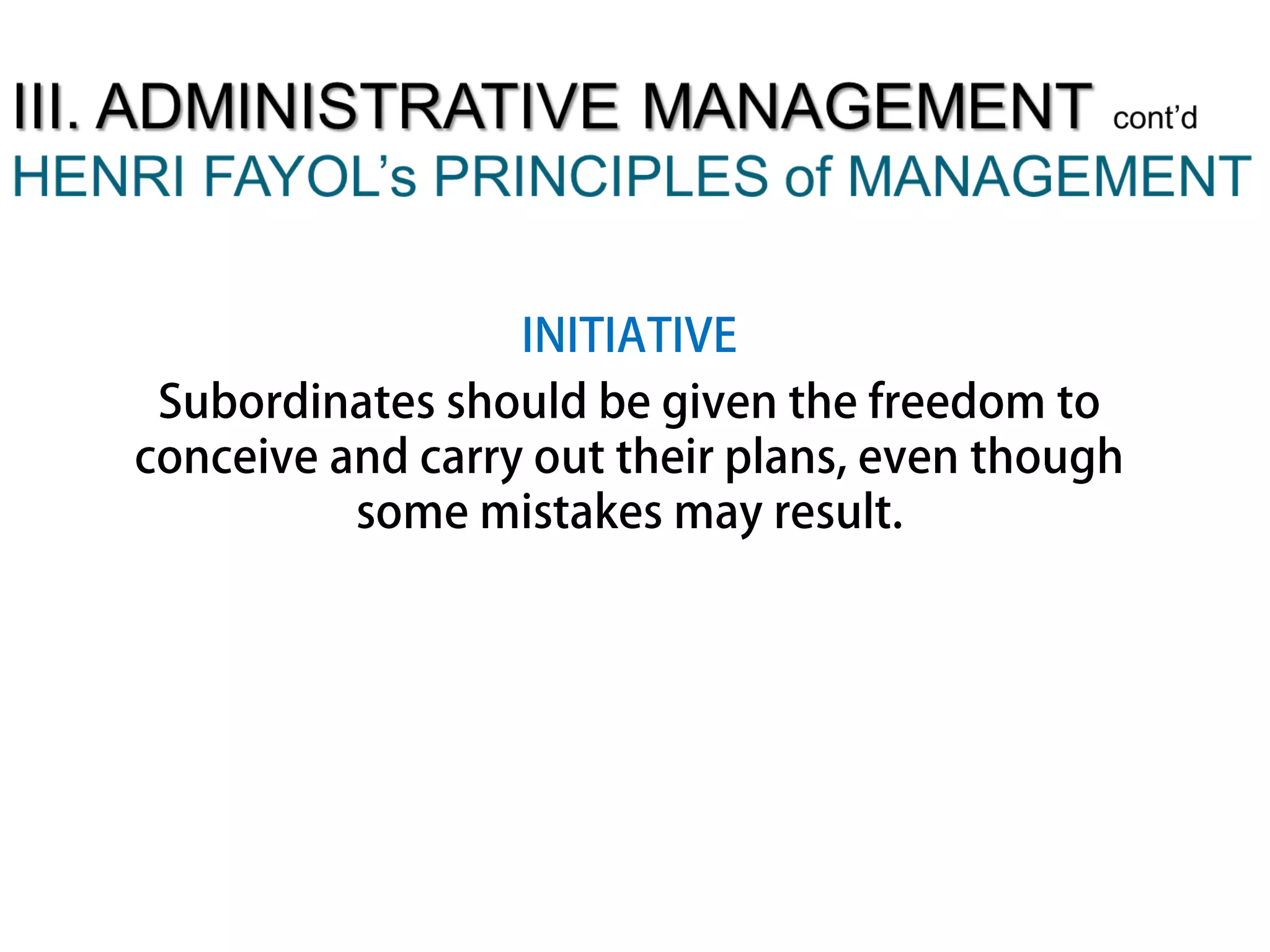
13. Initiative
14. Esprit de corps






CLASSICAL APPROACH Summary
BEHAVIORAL APPROACH
BEHAVIORAL APPROACH
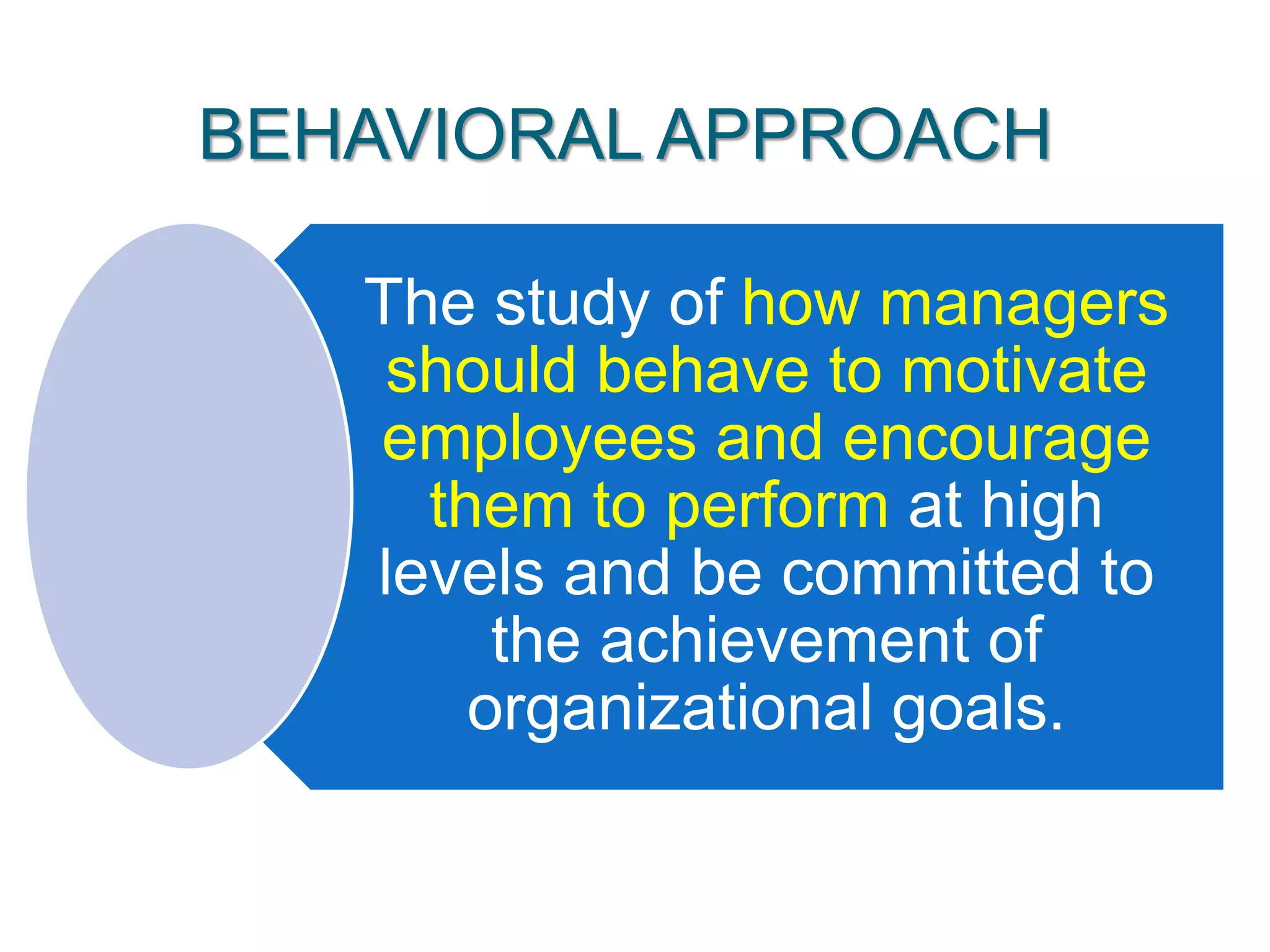
The study of how managers
should behave to motivate
employees and encourage
them to perform at high
levels and be committed to
the achievement of
organizational goals.
BEHAVIORAL APPROACH
The behavioral school of
management emphasized what
the classical theorists ignored.
Acknowledged the importance of
human behavior in shaping
management style.
Personalities
• Mary Parker Follett
• Douglas McGregor
• Chester Barnard
• Elton Mayo
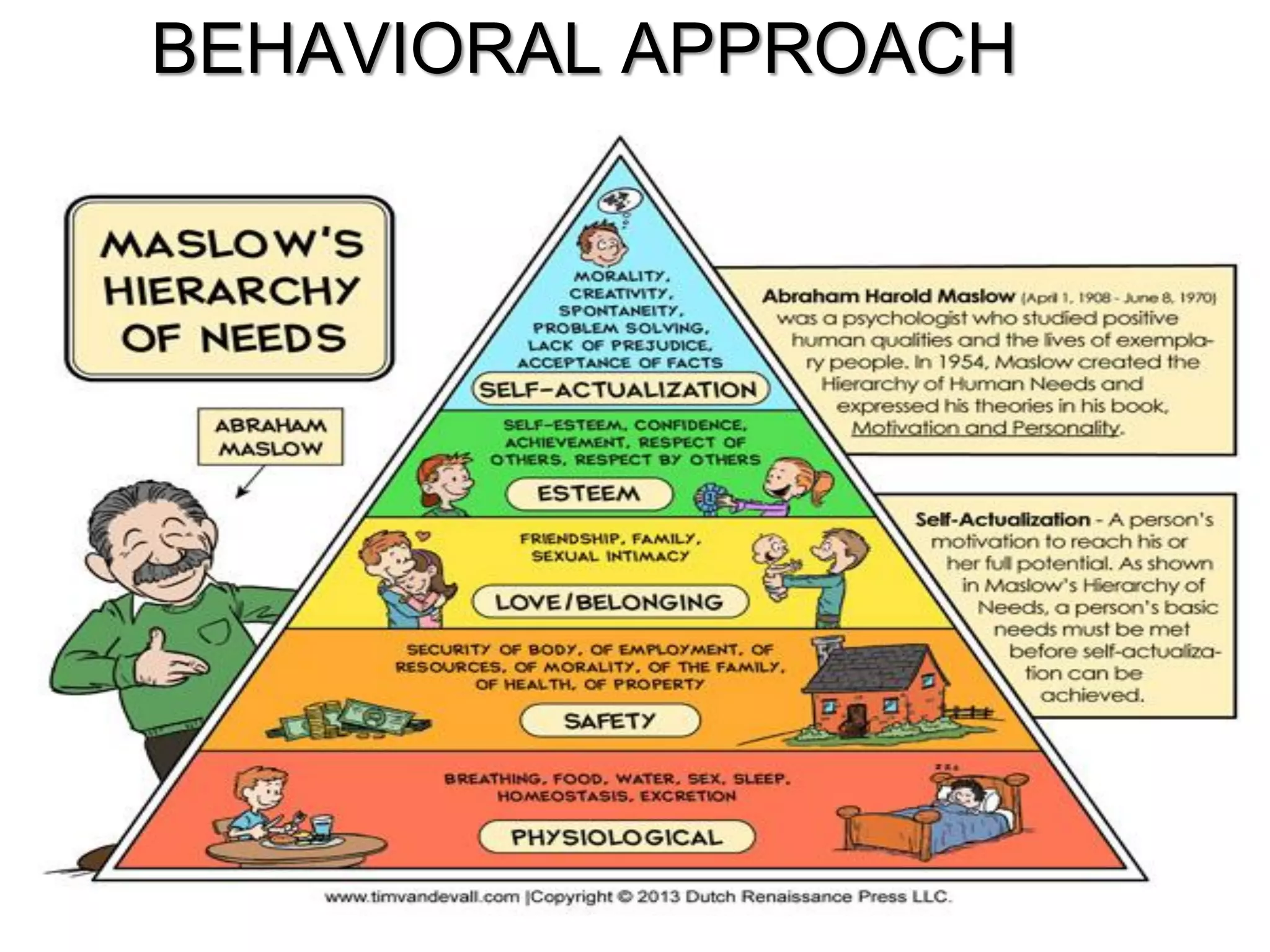
SELF
ACTUALIZATION
NEED FOR SELF
ESTEEM
NEED FOR SOCIAL
RELATIONS
NEED FOR SECURITY
PHYSIOLOGICAL NEEDS
Abraham Maslow‟s Hierarchy of Human Needs
BEHAVIORAL APPROACH
BEHAVIORAL APPROACH
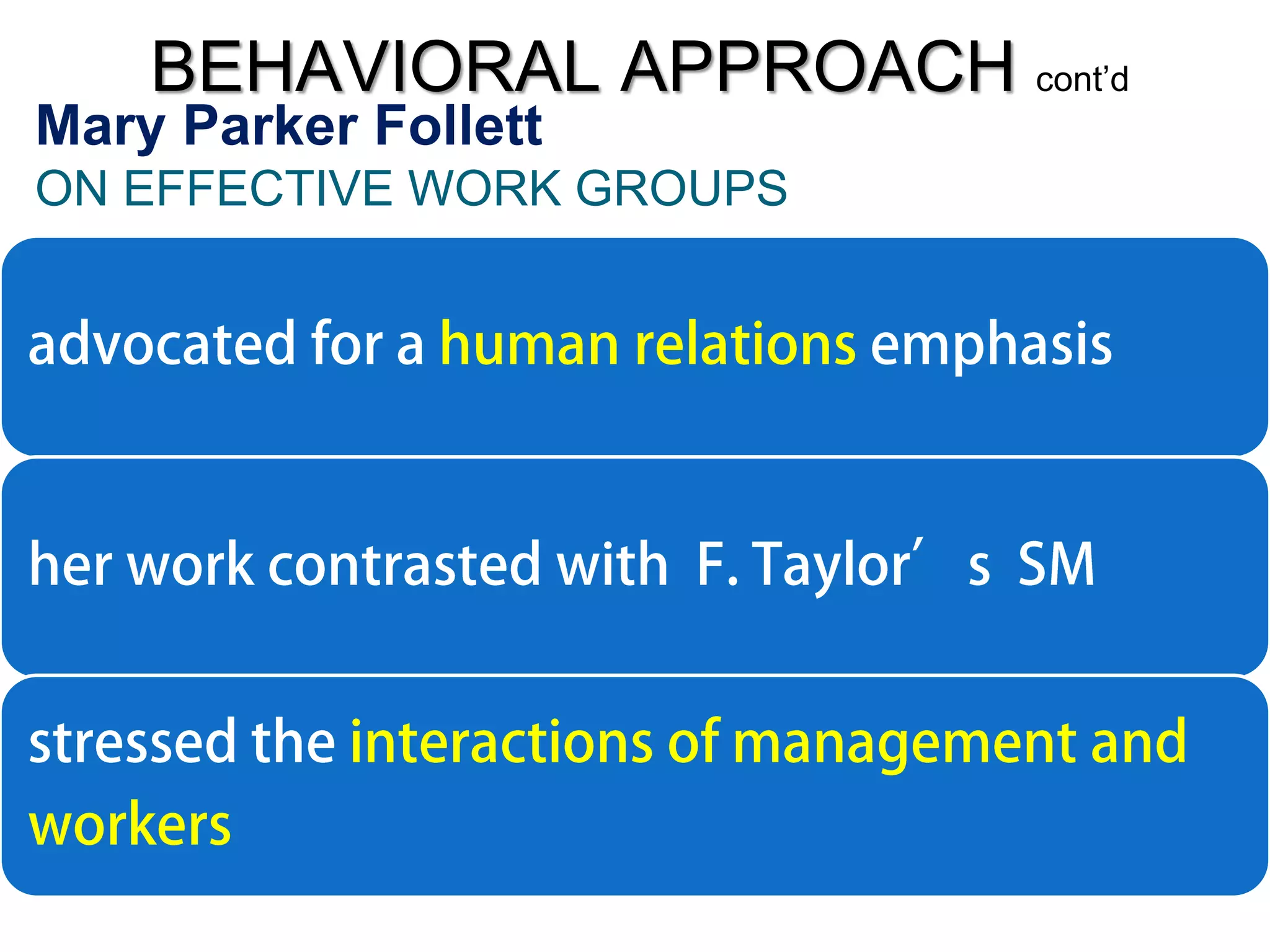
Mary Parker Follett
ON EFFECTIVE WORK GROUPS
FOUR PRINCIPLES OF COORDINATION
• Coordination requires that people be in direct contact
with one another.
• Coordination is essential during the initial stages of
any endeavor.
• Coordination must address all factors and phases of
any endeavor.
• Coordination is a continuous, ongoing process.
BEHAVIORAL APPROACH cont’d
Mary Parker Follett
ON EFFECTIVE WORK GROUPS
BEHAVIORAL APPROACH cont’d
Mary Parker Follett
ON EFFECTIVE WORK GROUPS
BEHAVIORAL APPROACH cont’d
Mary Parker Follett
ON EFFECTIVE WORK GROUPS
BEHAVIORAL APPROACH cont’d
Douglas McGregor's Proposed Styles
THEORY X
• Most people dislike work
and they avoid it when
they can.
• Coerced and threatened
with punishment before
they work.
• Avoid responsibility and
have little ambition.
THEORY Y
• Work is a natural activity
like play or rest.
• Capable of self direction
and self control.
• Committed to
organizational
objectives.
BEHAVIORAL APPROACH cont’d
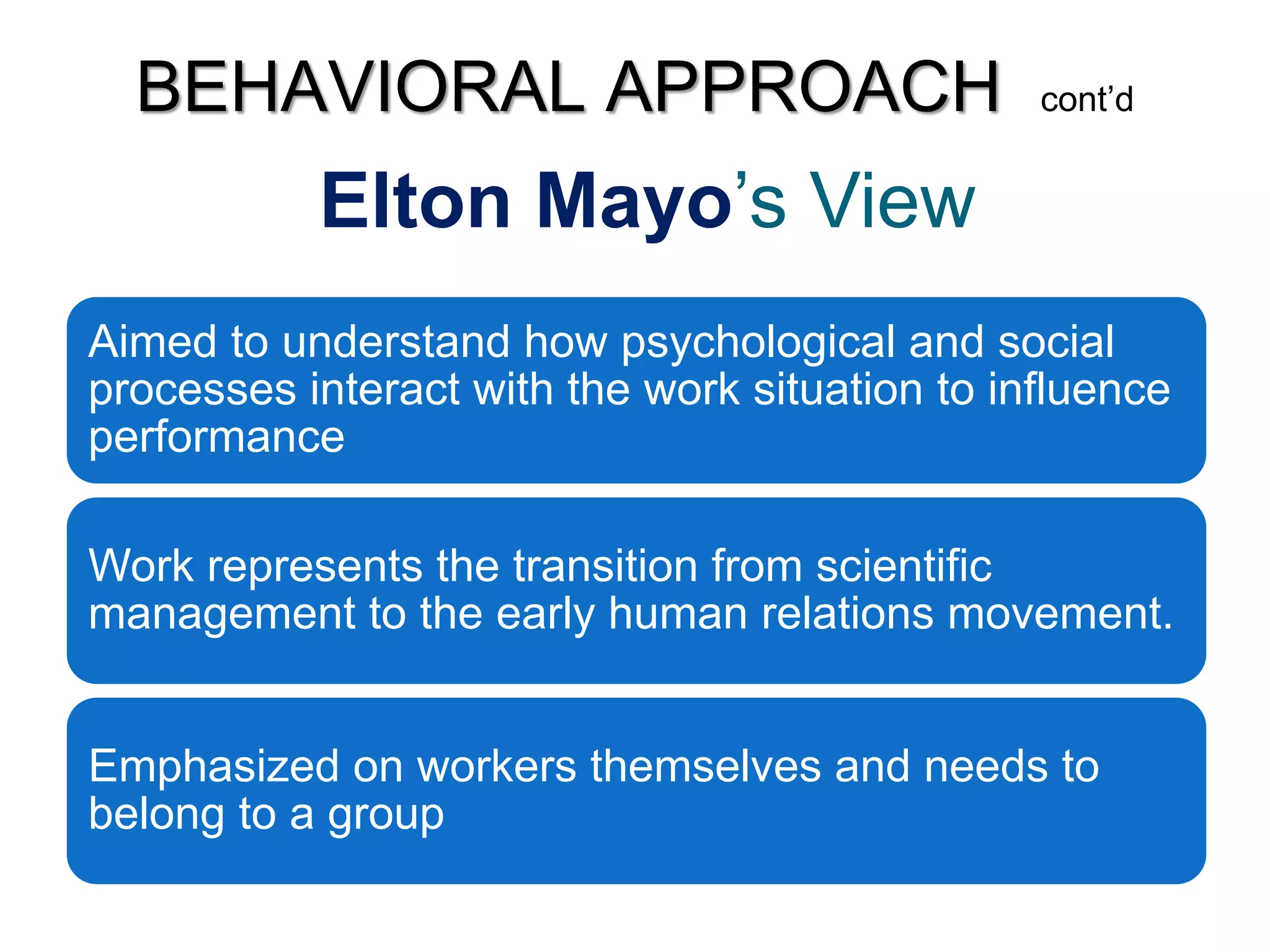
Elton Mayo’s View
Aimed to understand how psychological and social
processes interact with the work situation to influence
performance
Work represents the transition from scientific
management to the early human relations movement.
Emphasized on workers themselves and needs to
belong to a group
BEHAVIORAL APPROACH cont’d
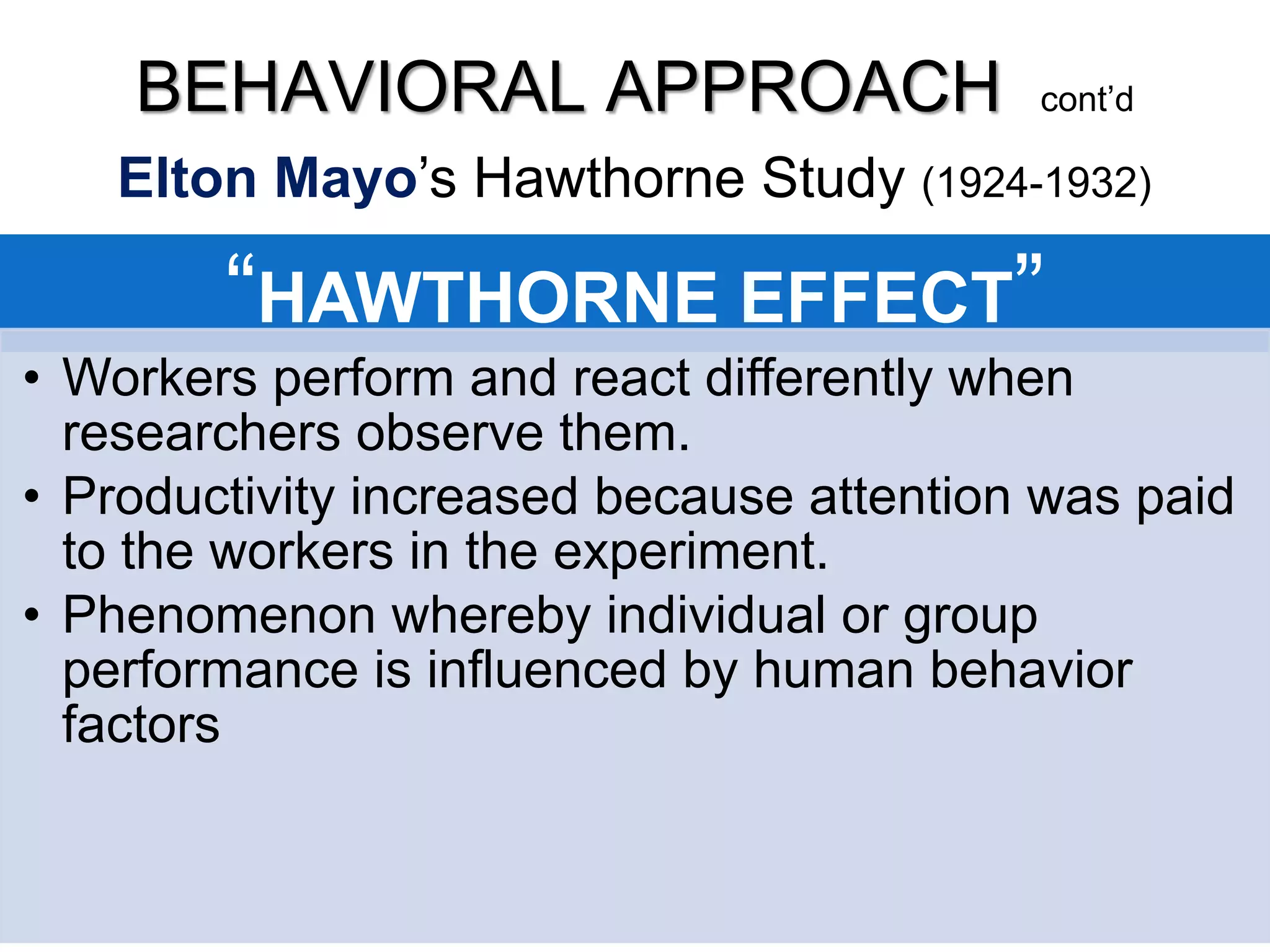
“HAWTHORNE EFFECT”
• Workers perform and react differently when
researchers observe them.
• Productivity increased because attention was paid
to the workers in the experiment.
• Phenomenon whereby individual or group
performance is influenced by human behavior
factors
BEHAVIORAL APPROACH cont’d
Elton Mayo’s Hawthorne Study (1924-1932)
“HAWTHORNE EFFECT”
• The finding that a manager’s behavior or
leadership approach can affect worker’s level of
performance.
BEHAVIORAL APPROACH cont’d
Elton Mayo’s Hawthorne Study (1924-1932)
MODERN APPROACH
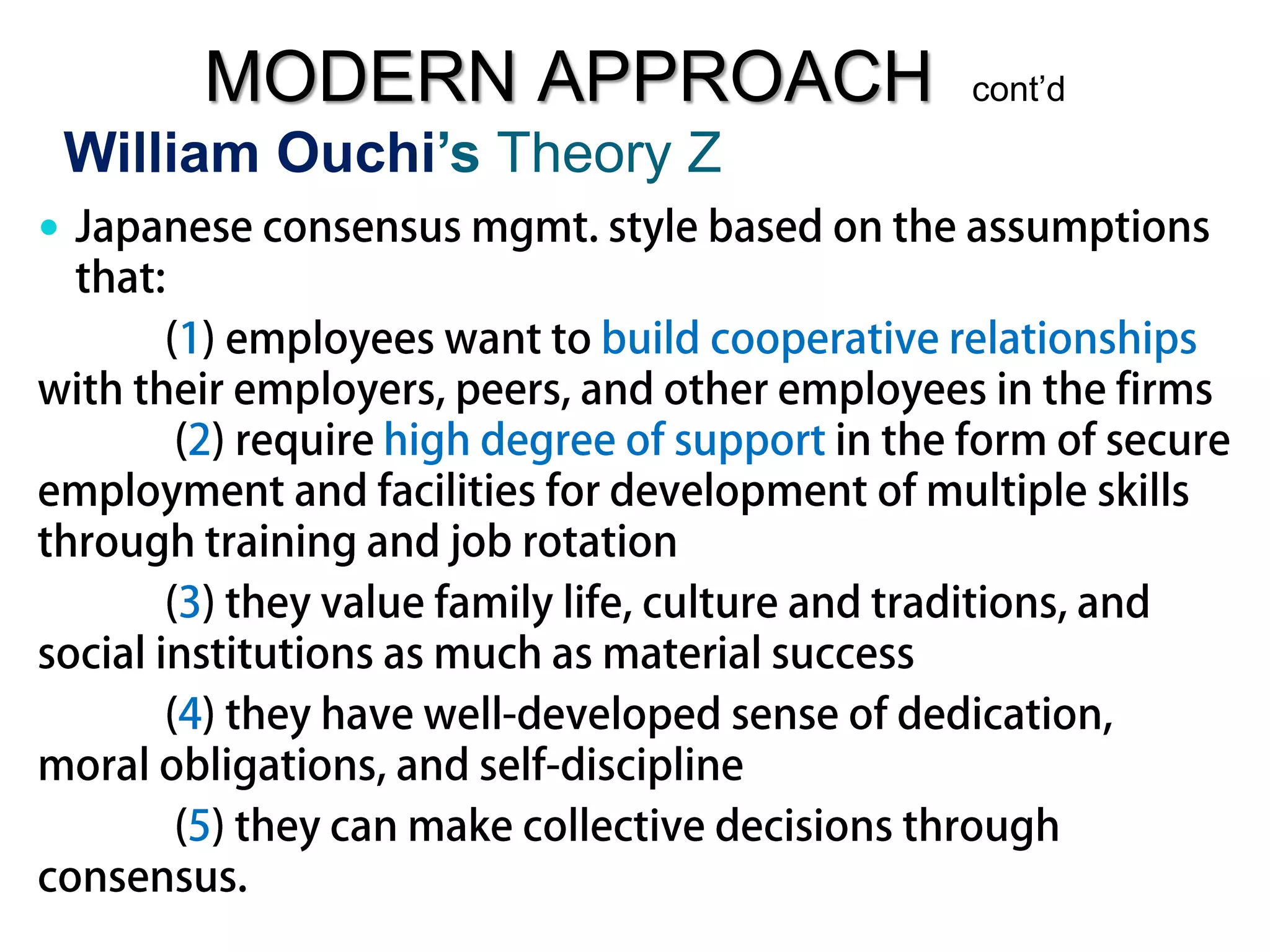
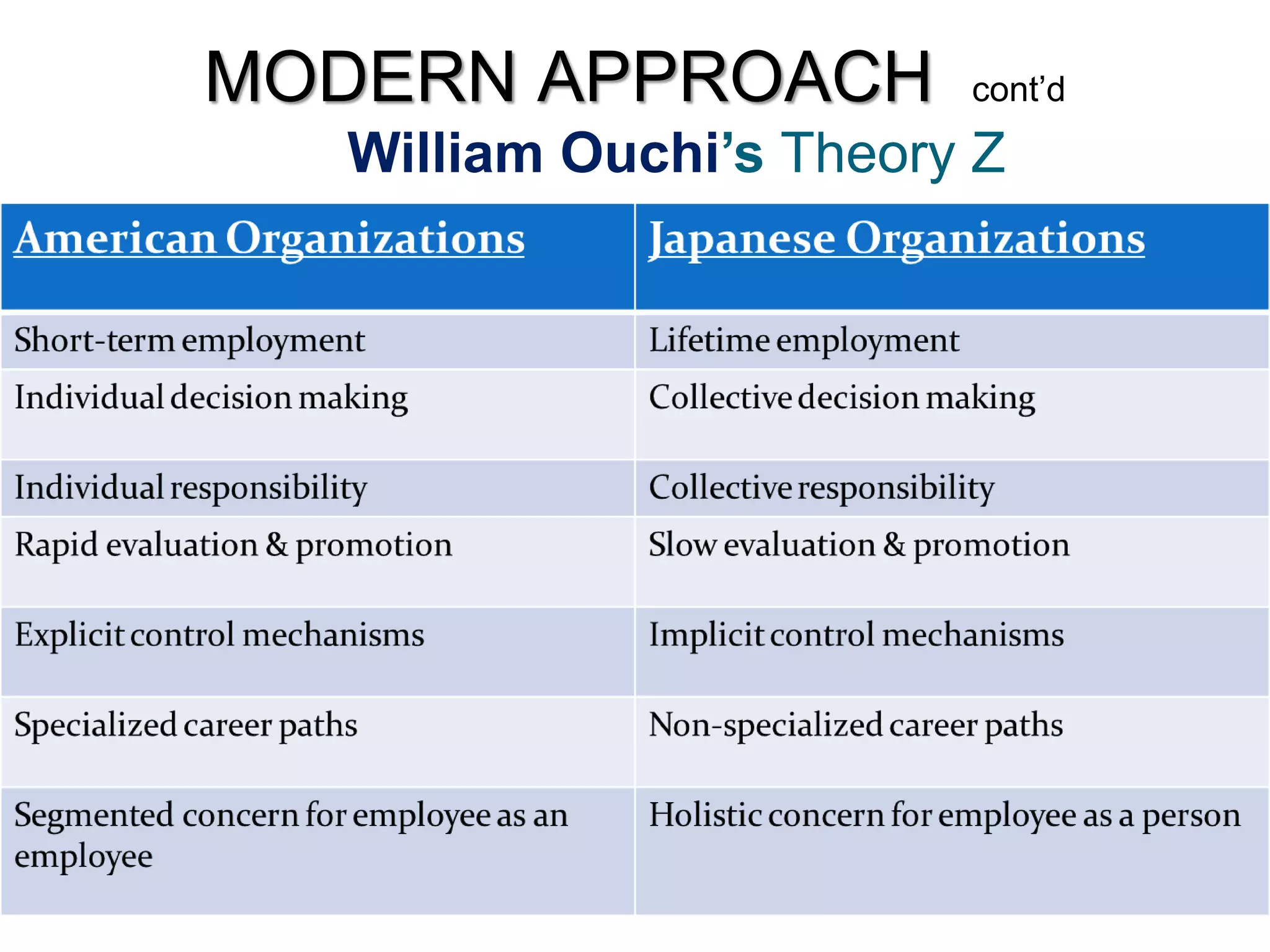
William Ouchi‟s Theory Z
 assumes employees have an
interest in good working
relationships with management
and other employees
MODERN APPROACH
William Ouchi‟s Theory Z
 Management generally has high
confidence in employees, who are
encouraged to participate in the
management decision making.
MODERN APPROACH cont’d
William Ouchi‟s Theory Z
Employees are viewed as long-term
assets who will stay with the same
firm throughout their careers.
MODERN APPROACH cont’d
William Ouchi‟s Theory Z

MODERN APPROACH cont’d
William Ouchi‟s Theory Z
MODERN APPROACH cont’d
William Ouchi‟s Theory Z
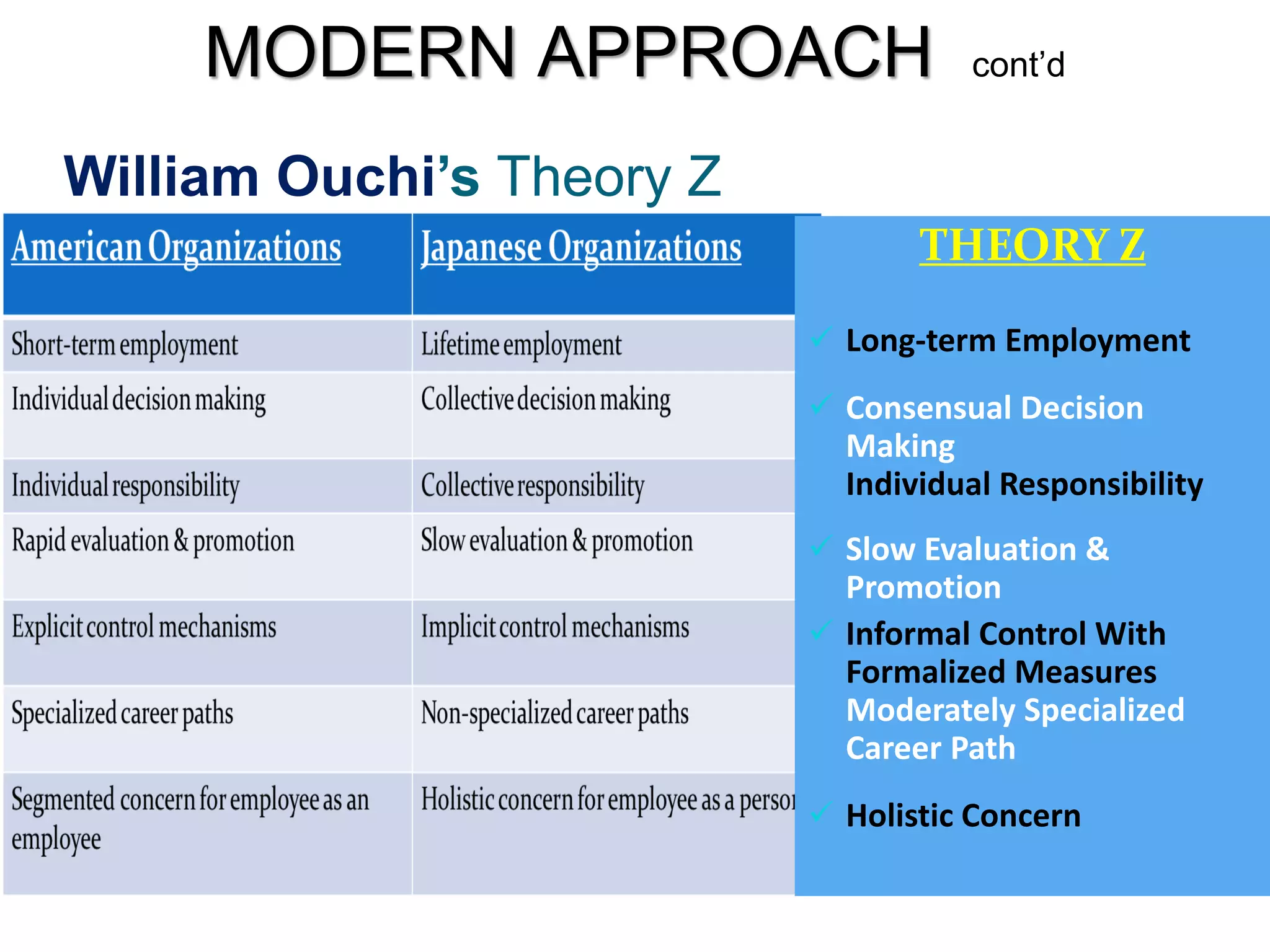
THEORY Z
 Long-term Employment
 Consensual Decision
Making
Individual Responsibility
 Slow Evaluation &
Promotion
 Informal Control With
Formalized Measures
Moderately Specialized
Career Path
 Holistic Concern
MODERN APPROACH cont’d
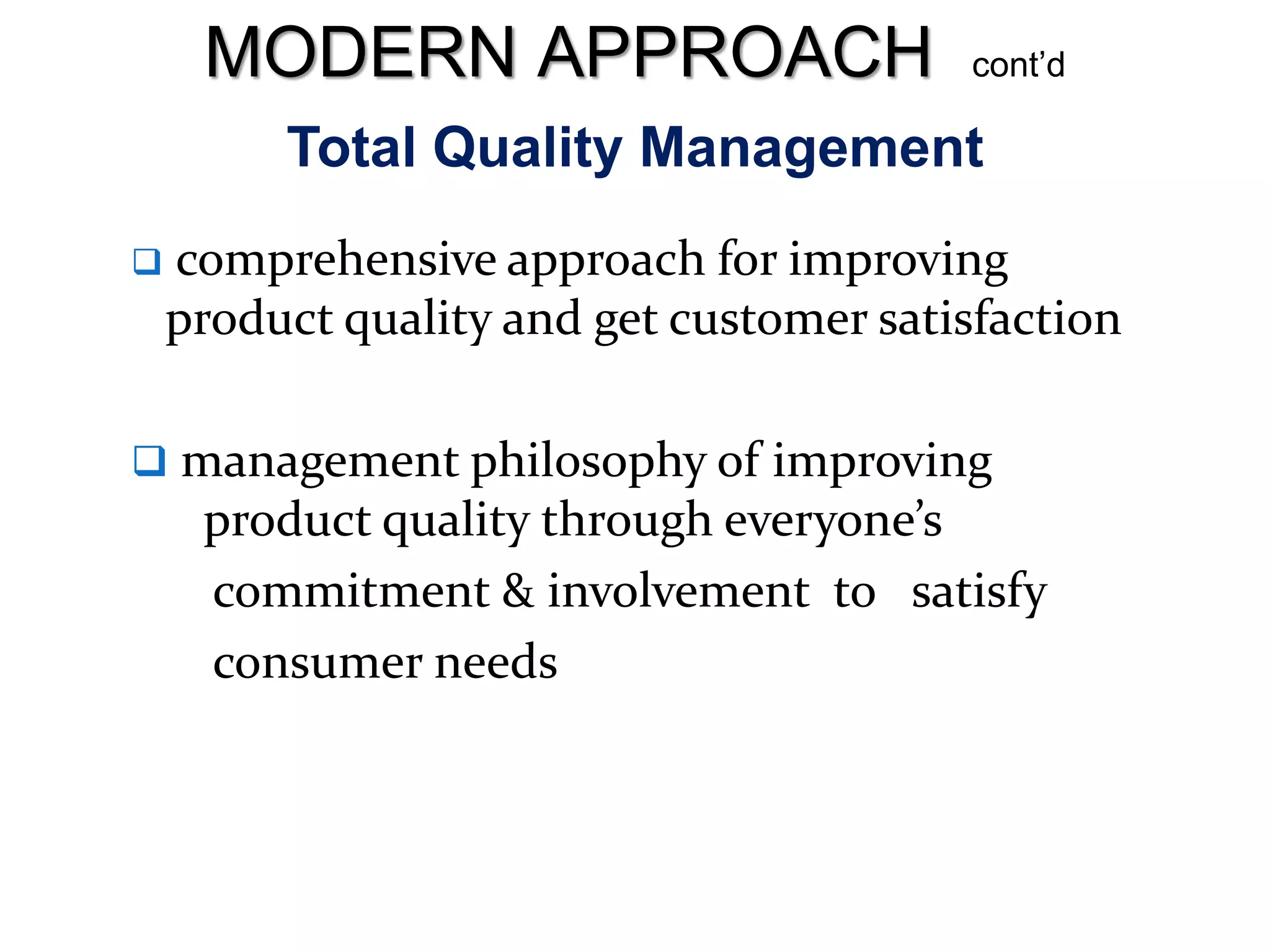
Total Quality Management
 comprehensive approach for improving
product quality and get customer satisfaction
 management philosophy of improving
product quality through everyone’s
commitment & involvement to satisfy
consumer needs
MODERN APPROACH cont’d
Total Quality Management
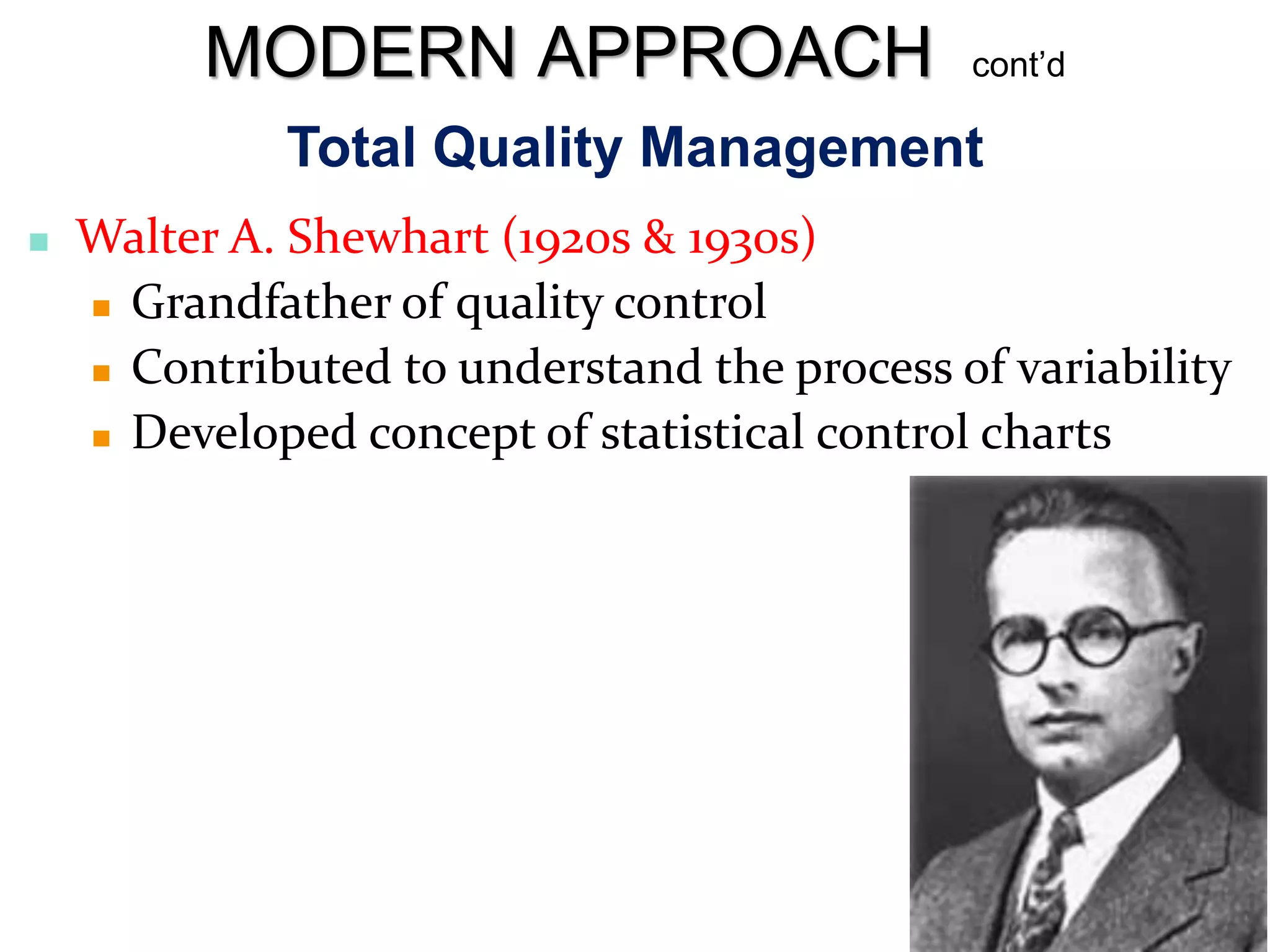
 Walter A. Shewhart (1920s & 1930s)
 Grandfather of quality control
 Contributed to understand the process of variability
 Developed concept of statistical control charts
MODERN APPROACH cont’d
Total Quality Management
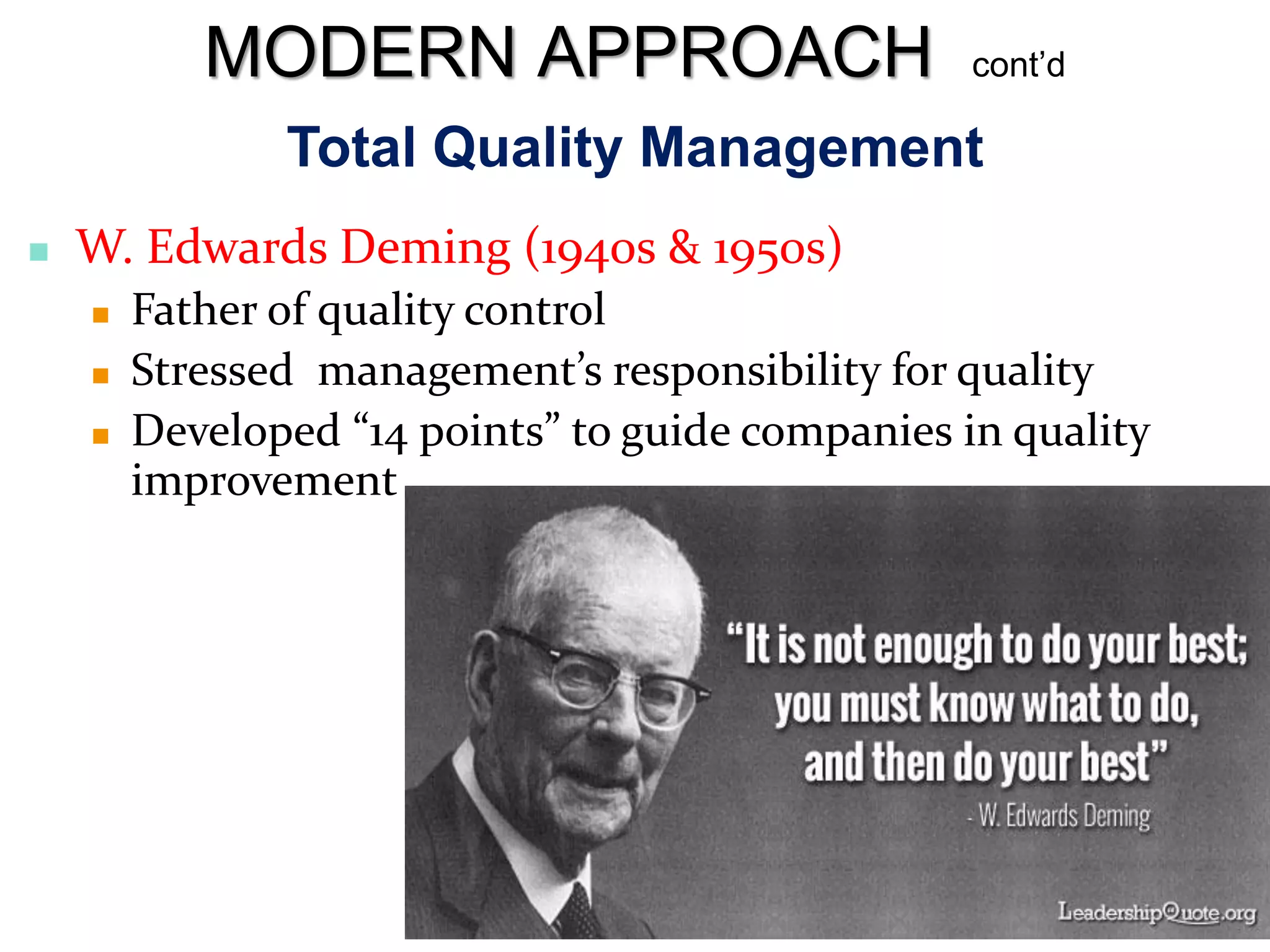
 W. Edwards Deming (1940s & 1950s)
 Father of quality control
 Stressed management’s responsibility for quality
 Developed “14 points” to guide companies in quality
improvement
MODERN APPROACH cont’d
Total Quality Management
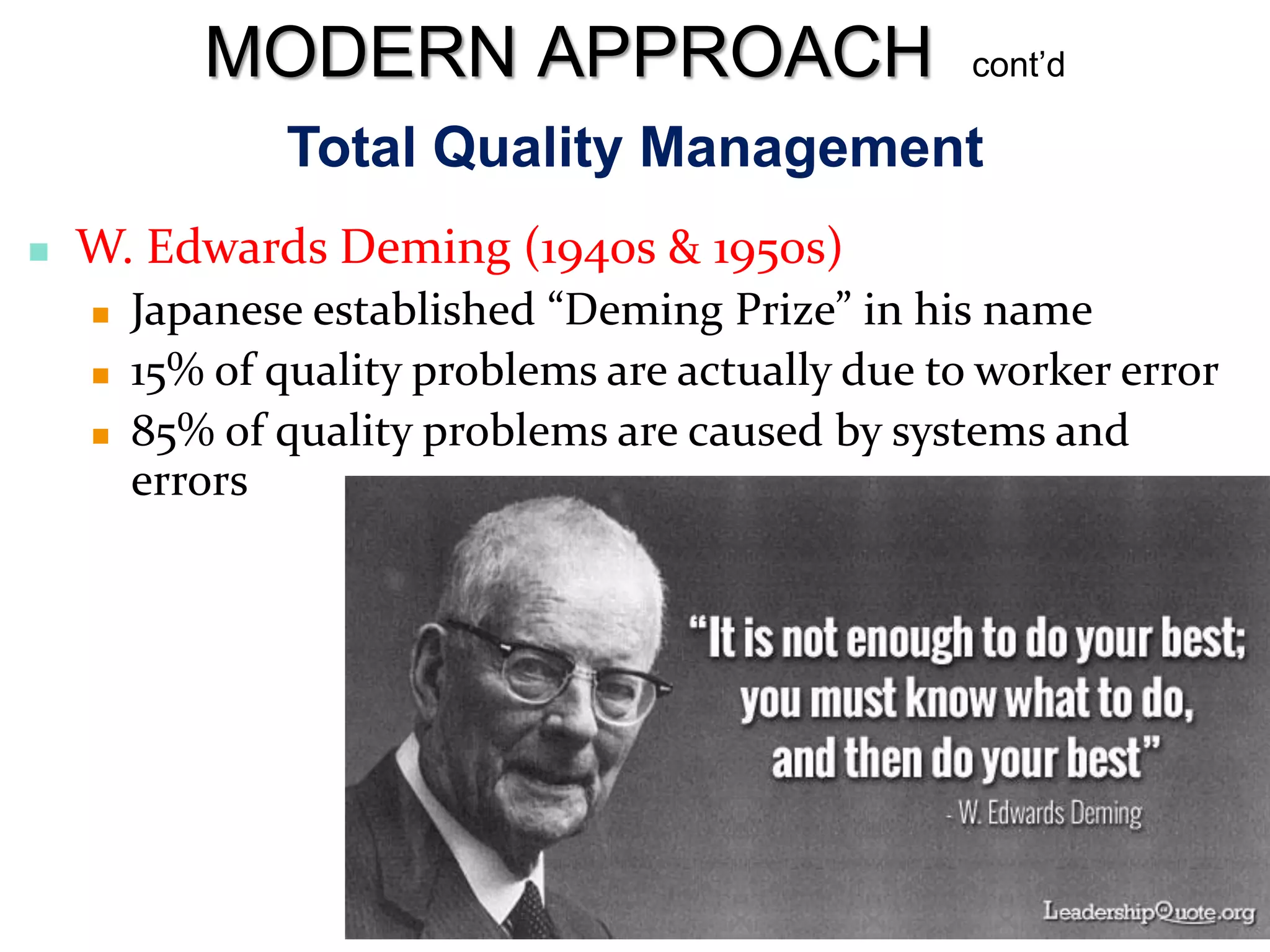
 W. Edwards Deming (1940s & 1950s)
 Japanese established “Deming Prize” in his name
 15% of quality problems are actually due to worker error
 85% of quality problems are caused by systems and
errors
MODERN APPROACH cont’d
Total Quality Management
 Joseph M. Juran (1950s)
 Defined quality as “fitness for use”
 Developed concept of cost of quality
 Originated idea of quality trilogy
 Quality planning
 Quality control
 Quality improvement
MODERN APPROACH cont’d
Total Quality Management
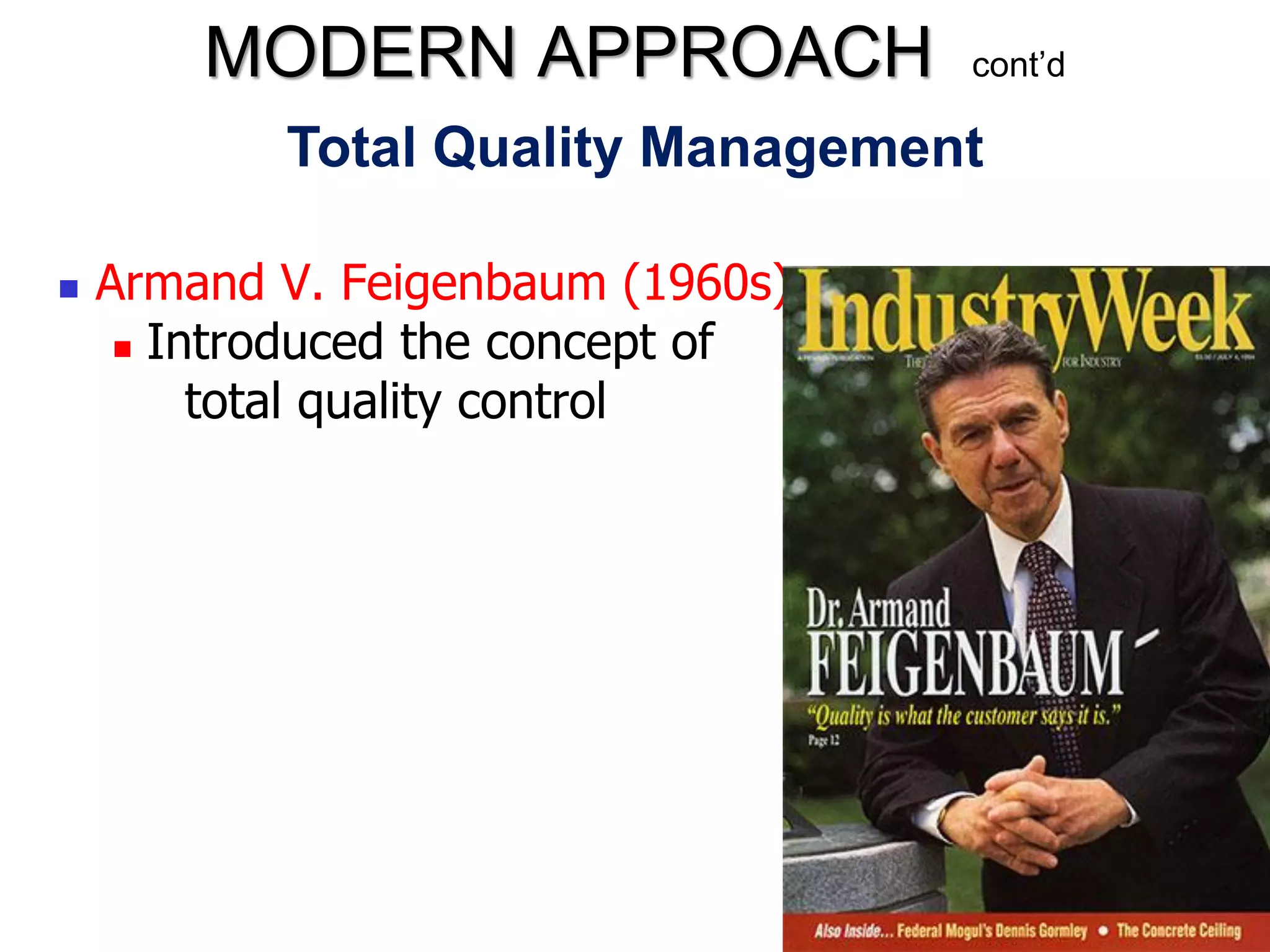
 Armand V. Feigenbaum (1960s)
 Introduced the concept of
total quality control
MODERN APPROACH cont’d
Total Quality Management
 Philip B. Crosby (1970s)
 Coined phrase “quality is free”
 Introduced concept of zero defects
 Developed the phrase “Do it right the first time”
MODERN APPROACH cont’d
Total Quality Management
 TQM focuses on serving the customer’s quality needs
MODERN APPROACH cont’d
Total Quality Management
 TQM uses continuous improvement, quality at
the source, employee empowerment, quality
tools, teams, benchmarking, and supplier
certification
MODERN APPROACH cont’d
Total Quality Management
 Four dimensions: product/service design,
conformance, easy of use, post-sale support
MODERN APPROACH cont’d
Total Quality Management
TQM Competitive Benefit
MODERN APPROACH cont’d
Total Quality Management
 It makes the company a
leader
 Fastens the team work
 Makes the company more
sensitive to customer
needs.
 Makes the company adapt
more readily to changes.
 Quality improves
 Increased productivity
 Staffs are more motivated
 Cost reduced
MODERN APPROACH cont’d
Management By Objectives (MBO)
MODERN APPROACH cont’d
 also known as Management By Results (MBR), is a
process of defining objectives within an organization so
that management and employees agree to the
objectives and understand what they need to do in the
organization in order to achieve them
Management By Objectives (MBO)
MODERN APPROACH cont’d
Management By Objectives (MBO)
MODERN APPROACH cont’d
Management By Objectives (MBO)
MODERN APPROACH cont’d
Management By Objectives (MBO)
MODERN APPROACH cont’d
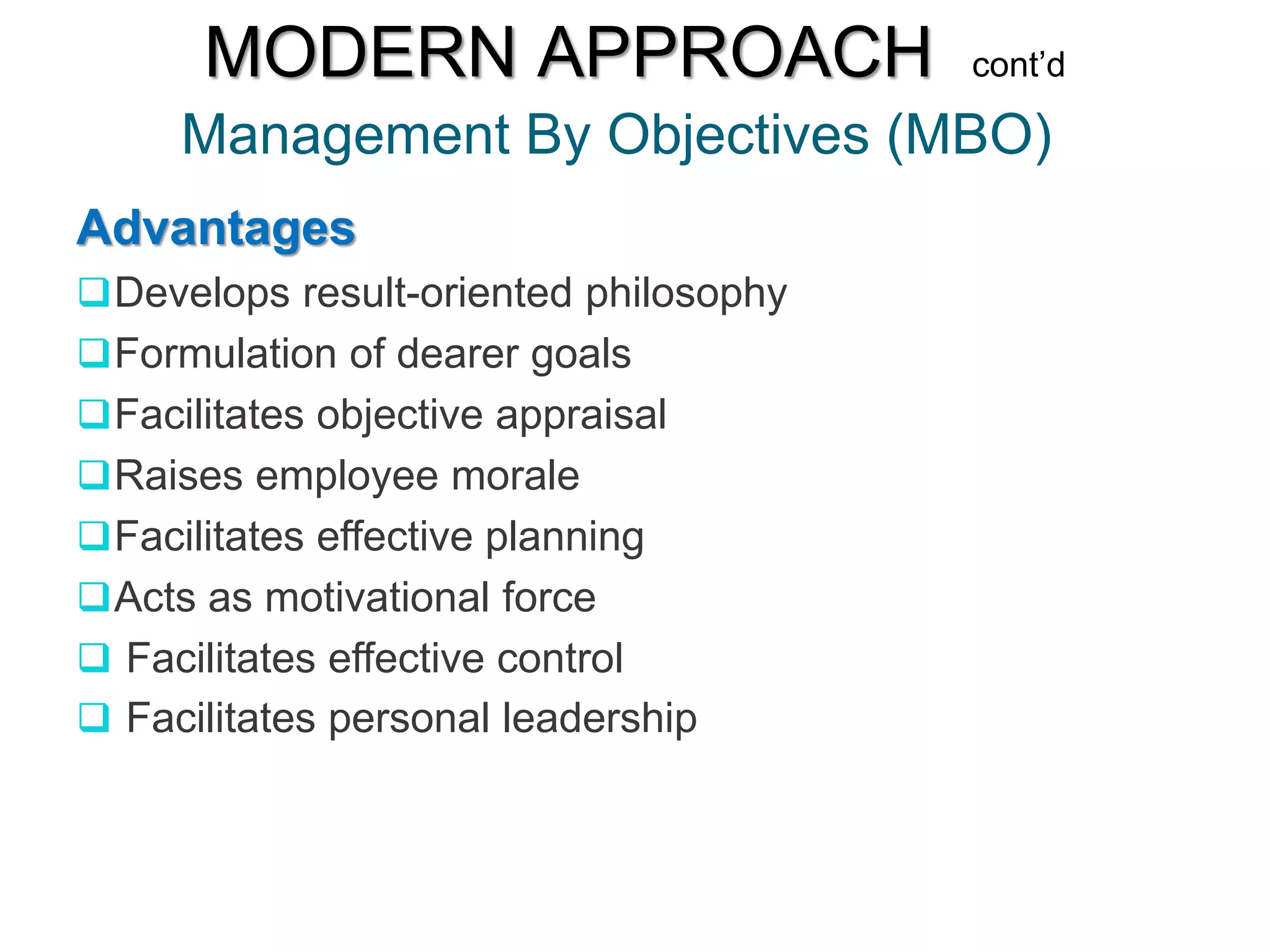
Advantages
Develops result-oriented philosophy
Formulation of dearer goals
Facilitates objective appraisal
Raises employee morale
Facilitates effective planning
Acts as motivational force
 Facilitates effective control
 Facilitates personal leadership
Management By Objectives (MBO)
MODERN APPROACH cont’d
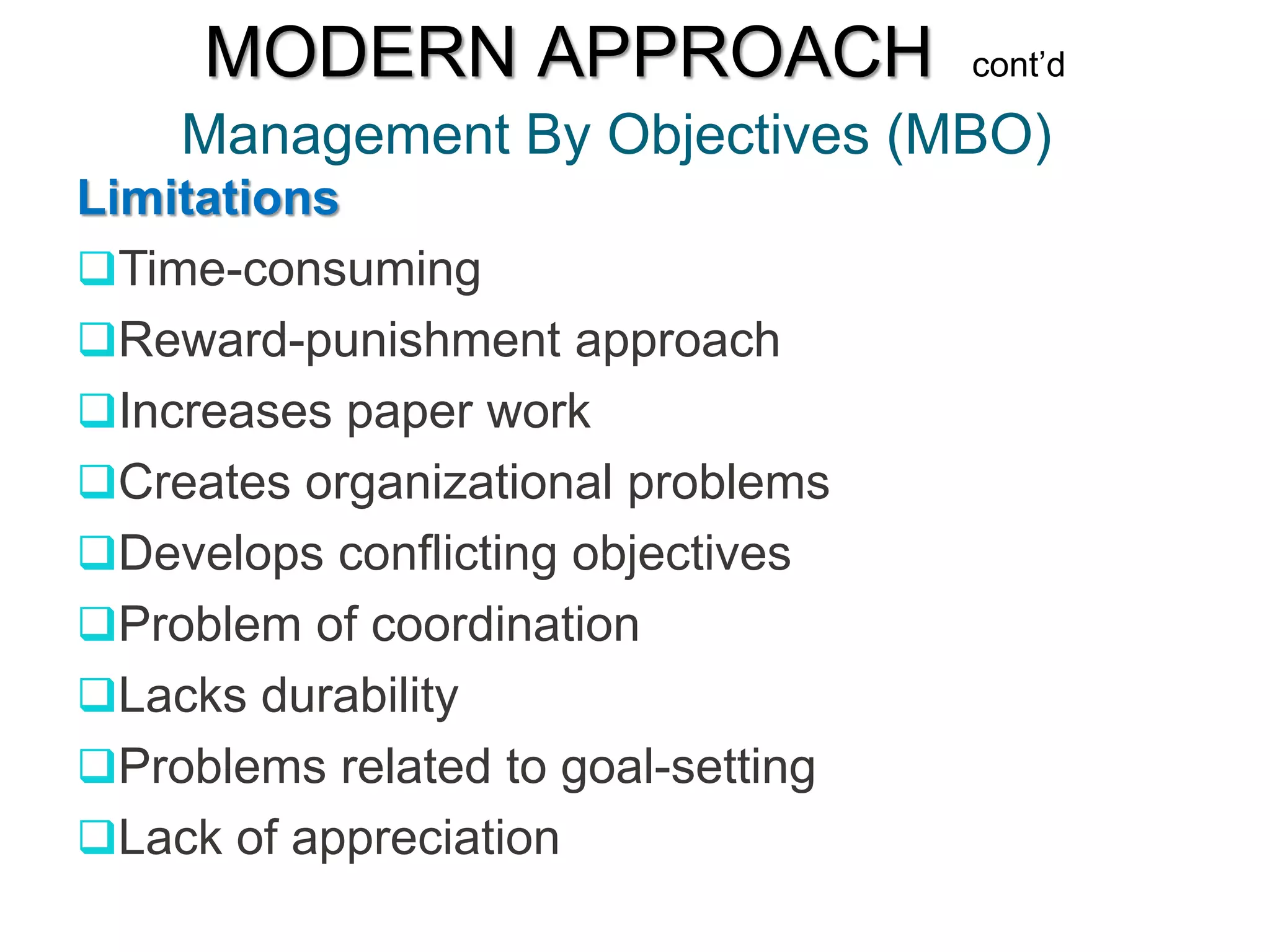
Limitations
Time-consuming
Reward-punishment approach
Increases paper work
Creates organizational problems
Develops conflicting objectives
Problem of coordination
Lacks durability
Problems related to goal-setting
Lack of appreciation
Management By Objectives (MBO)
MODERN APPROACH cont’d
Turning their aims into successful actions, forces
managers to master five basic operations:
1) setting objectives
2) organizing the group
3) motivating and communicating
4) measuring performance
5) developing people, including yourself
Situational Leadership
MODERN APPROACH
Key Reference
Evolution of Management Thought
by Bhavin Aswani, posted Nov. 26, 2012
http://www.slideshare.net/bhavinaswani/evolution-of-
management-thought-15357449?qid=61275941-4815-4988-87c1-
f57ba7fbfc1f&v=qf1&b=&from_search=4
Other References
The Evolution of Management Study Chapter 2
Posted by Management 2 on Apr. 11, 2009
http://www.slideshare.net/bsetm/chapter-2-the-evolution-of-
management-theory?qid=05f93aab-81b0-475e-954b-
c0aa2c6ceb2a&v=qf1&b=&from_search=1
Management Yesterday and Today
Posted by Management 2 on Apr. 11, 2009
http://www.slideshare.net/bsetm/chapter-2-the-evolution-of-
management-theory-written-in-different-manner?qid=606c7b90-
286a-4a98-95e2-613238e6f09c&v=qf1&b=&from_search=3
Other References
http://www.slideshare.net/sadhikakatiyar/meaningnaturescopeprocess-of-
management-approaches-of-a-system
http://wps.pearsoncustom.com/coco_principles_management/90/23041/
5898655.cw/index.html
http://www.strategicmgtpartners.com/library/iceobenefits.html
http://www.inc.com/leigh-buchanan/10-traits-of-a-drucker-like-
leader.html
http://www.slideshare.net/SarahWright/email-measurement-is-
evolvingare-you
Other References
https://encrypted-
tbn0.gstatic.com/images?q=tbn:ANd9GcRVCYztnUzMn2DPLRzV86OuLwl63
k32IBAb2t2qtGMpMRSCxFah
http://smartbusinesstrends.com/wp-content/uploads/2013/05/peter-
drucker-businsess-quotes2.png
http://dilipchandra12.hubpages.com/hub/Frederick-Winslow-Taylor
http://image.slidesharecdn.com/xyztheories-110717231933-
phpapp01/95/xyz-theories-of-management-5-728.jpg?cb=1310963416
http://en.wikipedia.org/wiki/Walter_A._Shewhart#/media/File:WalterShe
whart.gif
Other References
http://leaderquote.com/wp-content/uploads/2012/04/w-edwards-
deming-it-is-not-enough-to-do-your-best-you-must-know-what-to-do-and-
then-do-your-best.jpg
http://www.industryweek.com/site-
files/industryweek.com/files/uploads/2014/11/Feigenbaum-Cover.jpg
http://blog.proqc.com/remembering-philip-b-crosby-quality-is-free/
http://timvandevall.com/wp-content/uploads/2013/11/Maslows-
Hierarchy-of-Needs.jpg
Other References
http://www.johnwiley.net.au/highered/management/istudy/menu/historic
al_foundations_of_management/historical_and_contemporary_approache
s_to_management/content/page0002.jpg
http://img1.imagesbn.com/p/9780070340374_p0_v1_s260x420.jpg

Management Approaches