The Evolution of Management
Theory
Mala Sarat Chandra
Twitter: @malachandra
Learning Objectives
Explain what a management theory is.
Understand the evolution of management
theories and their major contributions.
9/13/2013 Mala Sarat Chandra 2
EVOLUTION OF MANAGEMENT
THEORY
9/13/2013 Mala Sarat Chandra 3
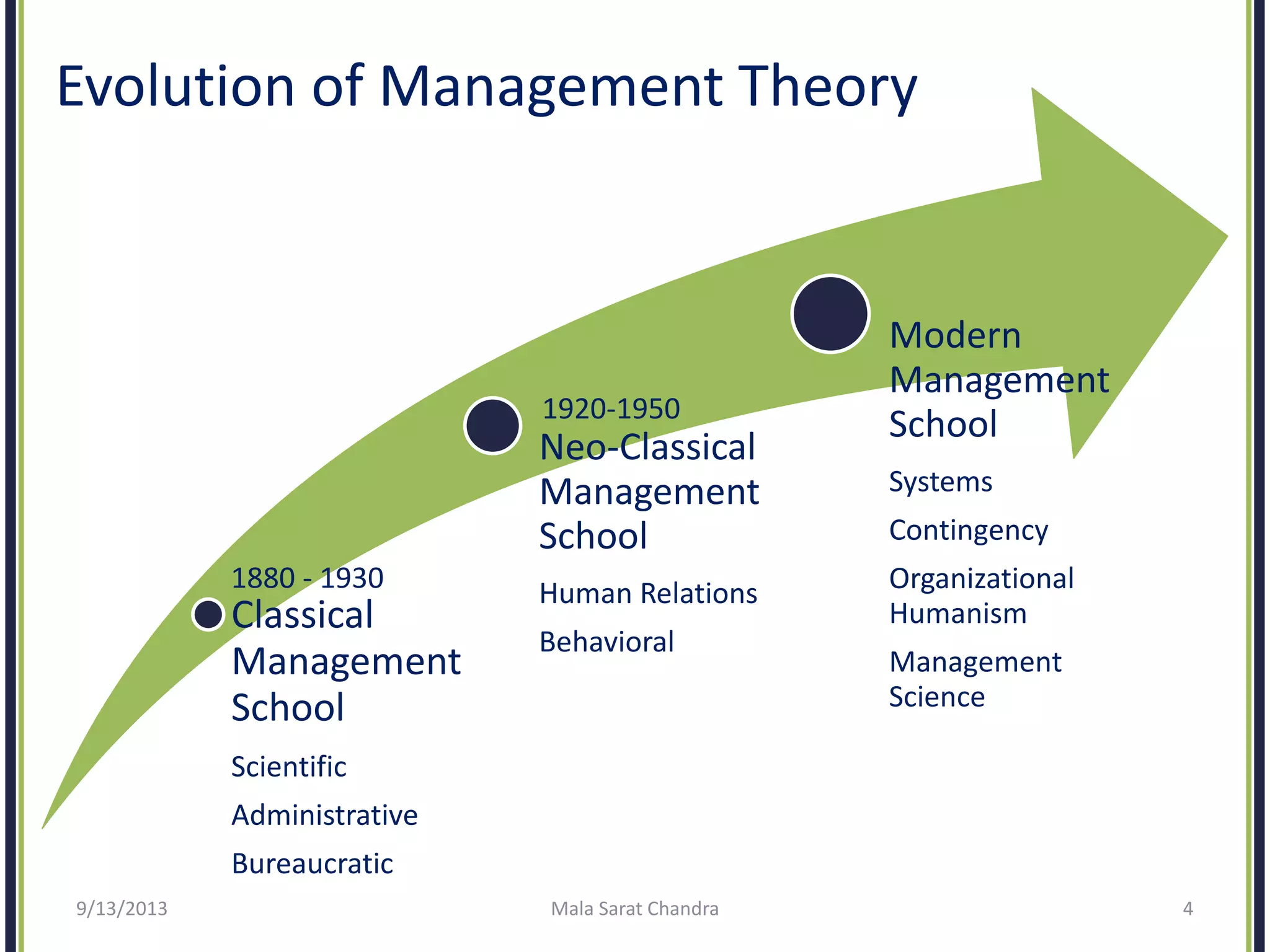
Classical
Management
School
Scientific
Administrative
Bureaucratic
Neo-Classical
Management
School
Human Relations
Behavioral
Modern
Management
School
Systems
Contingency
Organizational
Humanism
Management
Science
Evolution of Management Theory
1920-1950
1880 - 1930
9/13/2013 Mala Sarat Chandra 4
THE CLASSICAL SCHOOL OF
MANAGEMENT
1900 - 1930
9/13/2013 Mala Sarat Chandra 5
Core Ideas
1. Application of science to the practice of
management.
2. Development of basic management functions.
3. Articulation and application of specific principles
of management.
Evolved in response to the shift from handicraft to industrial
production.
Emphasis is on economic rationality of people and organizations;
motivated by economic incentives, they make choices that yield
the greatest monetary benefits.
9/13/2013 Mala Sarat Chandra 6
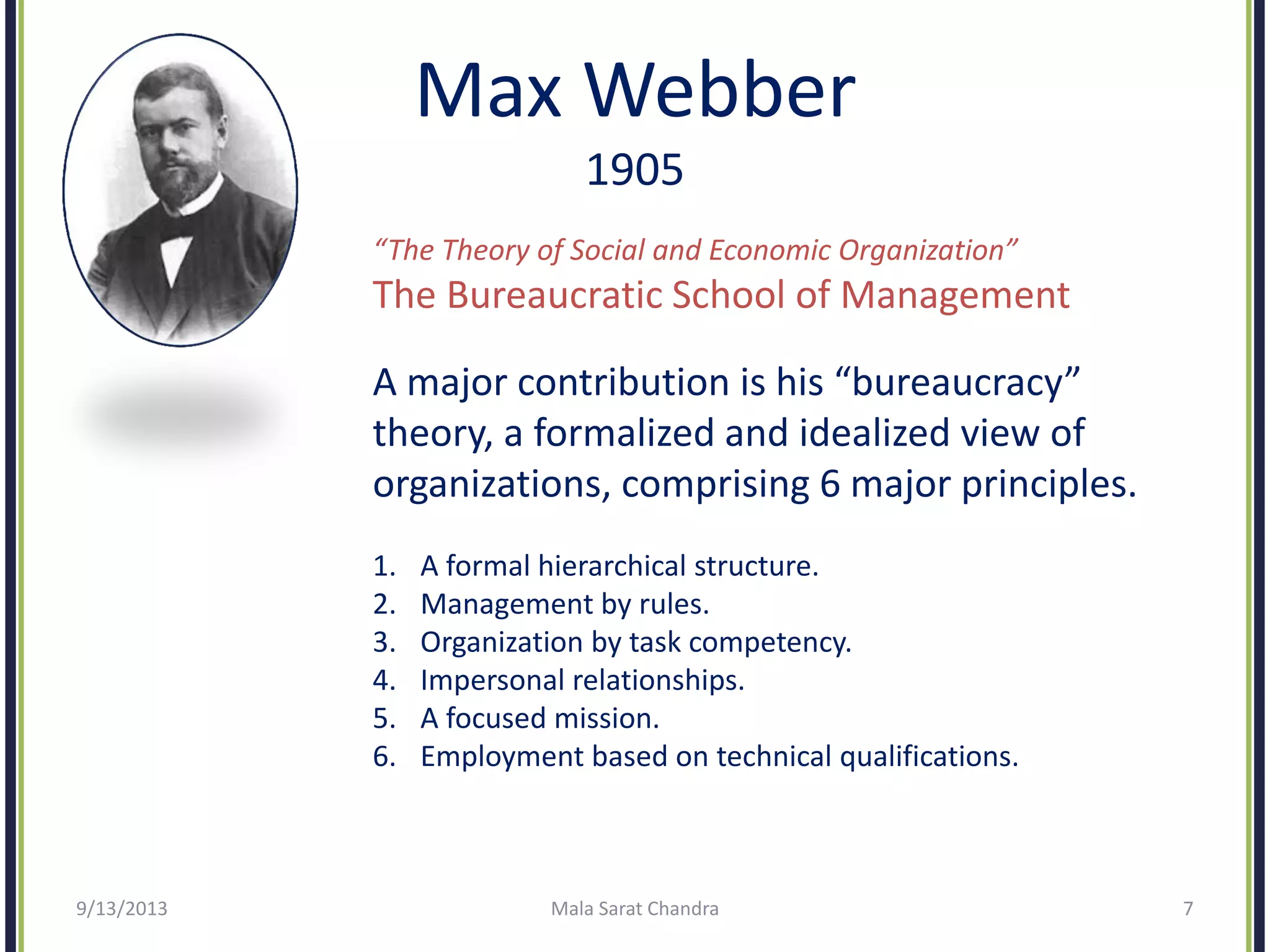
Max Webber
1905
“The Theory of Social and Economic Organization”
The Bureaucratic School of Management
A major contribution is his “bureaucracy”
theory, a formalized and idealized view of
organizations, comprising 6 major principles.
1. A formal hierarchical structure.
2. Management by rules.
3. Organization by task competency.
4. Impersonal relationships.
5. A focused mission.
6. Employment based on technical qualifications.
9/13/2013 Mala Sarat Chandra 7
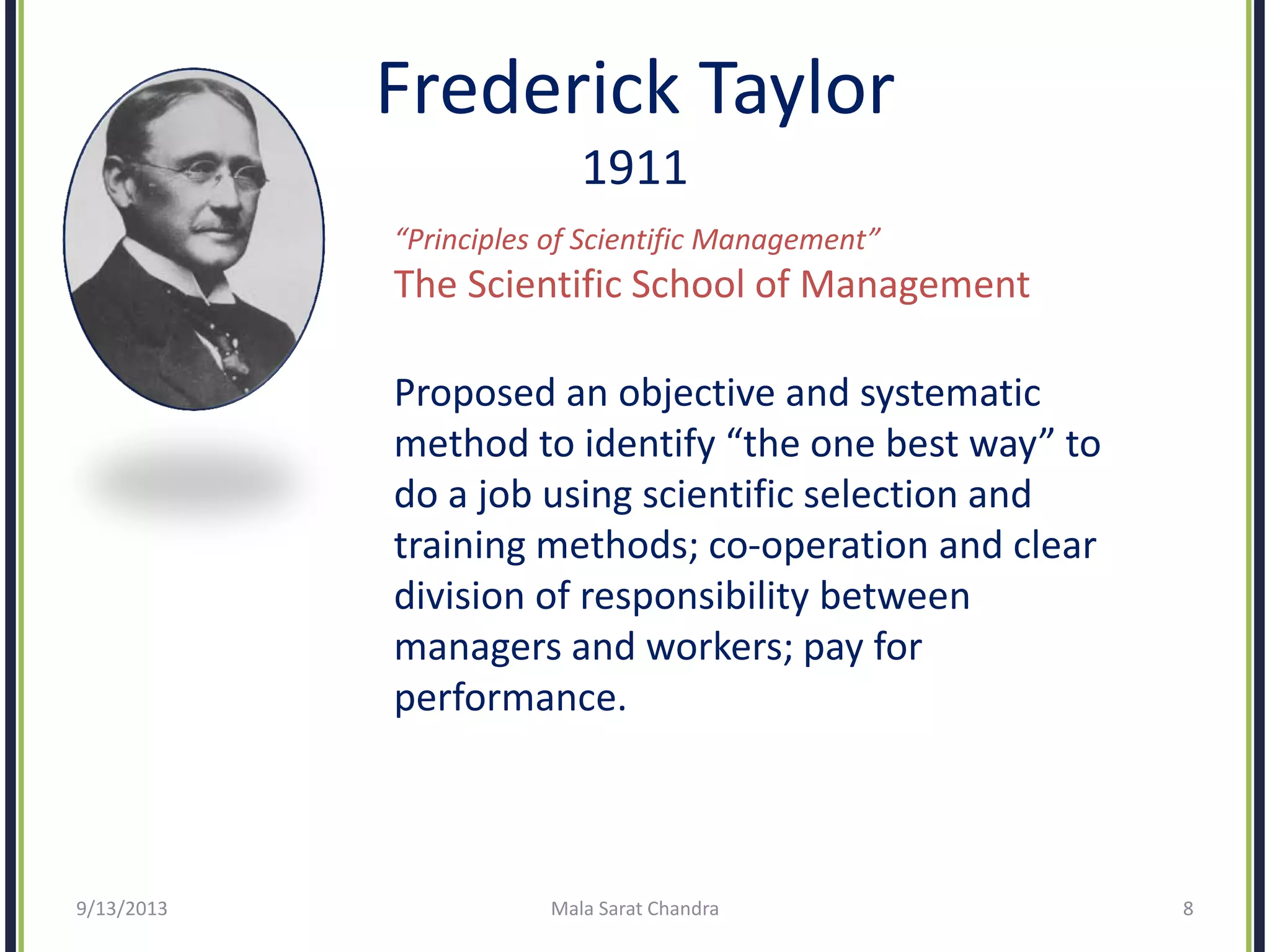
Frederick Taylor
1911
“Principles of Scientific Management”
The Scientific School of Management
Proposed an objective and systematic
method to identify “the one best way” to
do a job using scientific selection and
training methods; co-operation and clear
division of responsibility between
managers and workers; pay for
performance.
9/13/2013 Mala Sarat Chandra 8
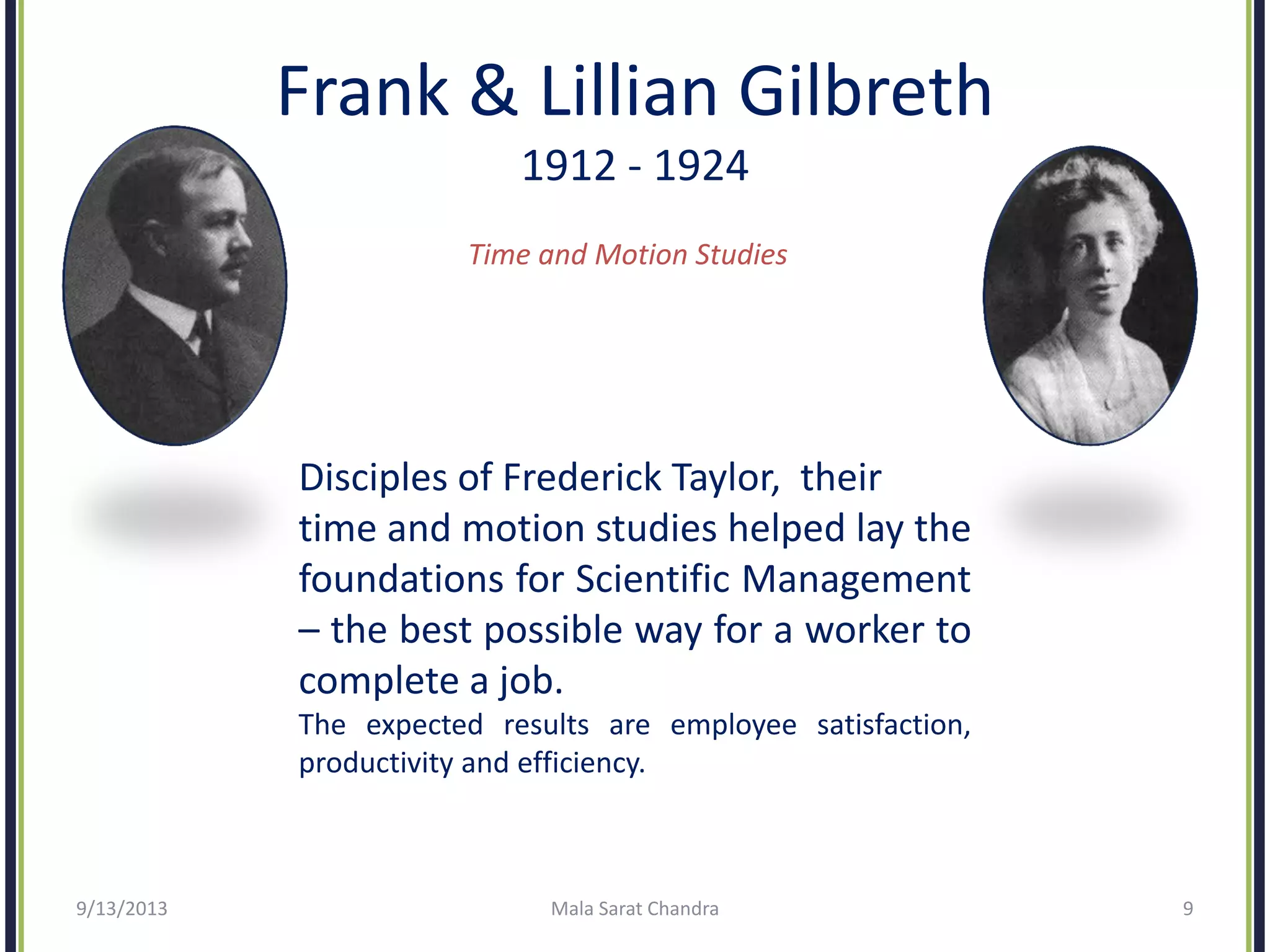
Frank & Lillian Gilbreth
1912 - 1924
Time and Motion Studies
Disciples of Frederick Taylor, their
time and motion studies helped lay the
foundations for Scientific Management
– the best possible way for a worker to
complete a job.
The expected results are employee satisfaction,
productivity and efficiency.
9/13/2013 Mala Sarat Chandra 9
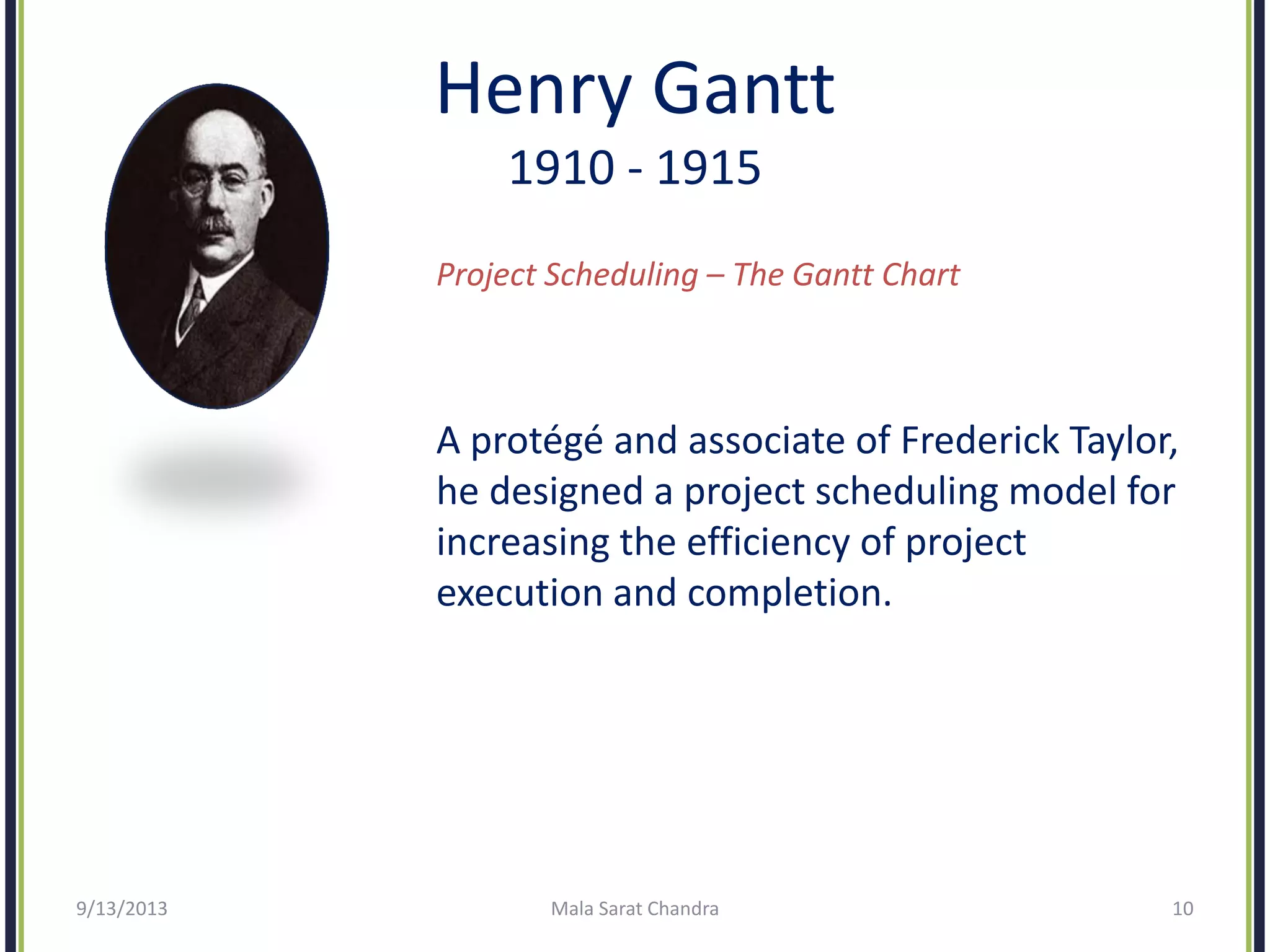
Henry Gantt
1910 - 1915
Project Scheduling – The Gantt Chart
A protégé and associate of Frederick Taylor,
he designed a project scheduling model for
increasing the efficiency of project
execution and completion.
9/13/2013 Mala Sarat Chandra 10
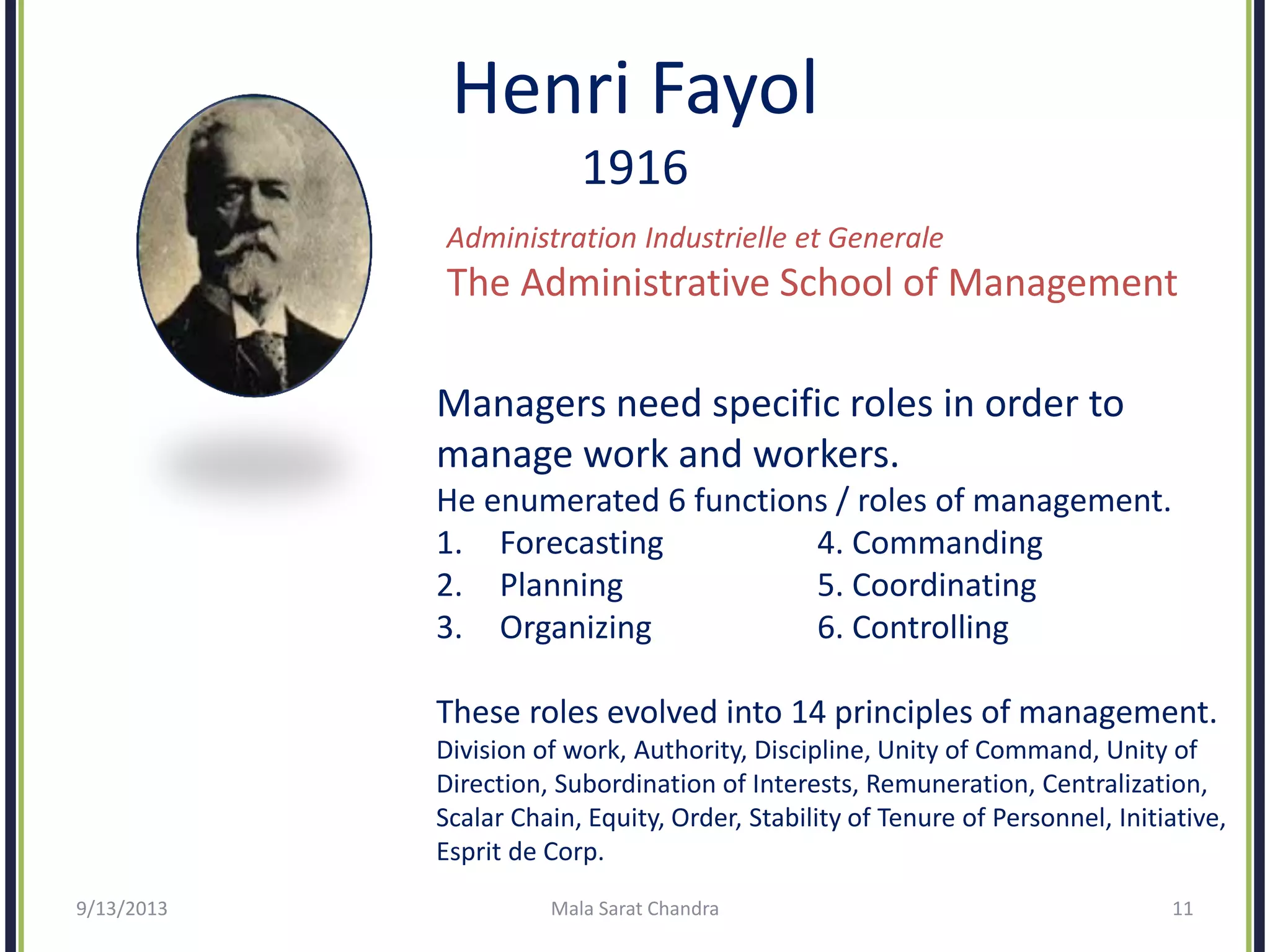
Henri Fayol
1916
Administration Industrielle et Generale
The Administrative School of Management
Managers need specific roles in order to
manage work and workers.
He enumerated 6 functions / roles of management.
1. Forecasting 4. Commanding
2. Planning 5. Coordinating
3. Organizing 6. Controlling
These roles evolved into 14 principles of management.
Division of work, Authority, Discipline, Unity of Command, Unity of
Direction, Subordination of Interests, Remuneration, Centralization,
Scalar Chain, Equity, Order, Stability of Tenure of Personnel, Initiative,
Esprit de Corp.
9/13/2013 Mala Sarat Chandra 11
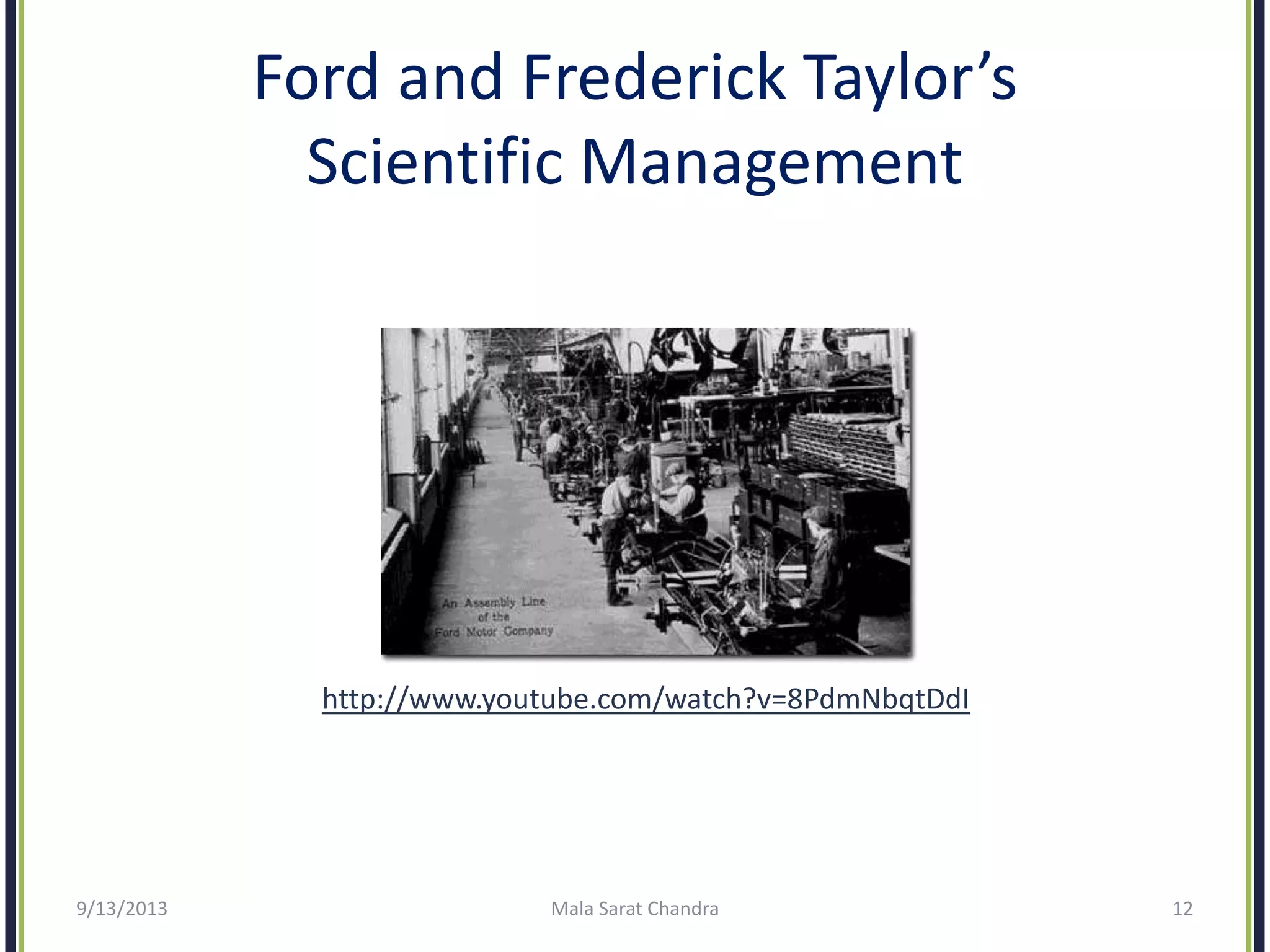
Ford and Frederick Taylor’s
Scientific Management
http://www.youtube.com/watch?v=8PdmNbqtDdI
9/13/2013 Mala Sarat Chandra 12
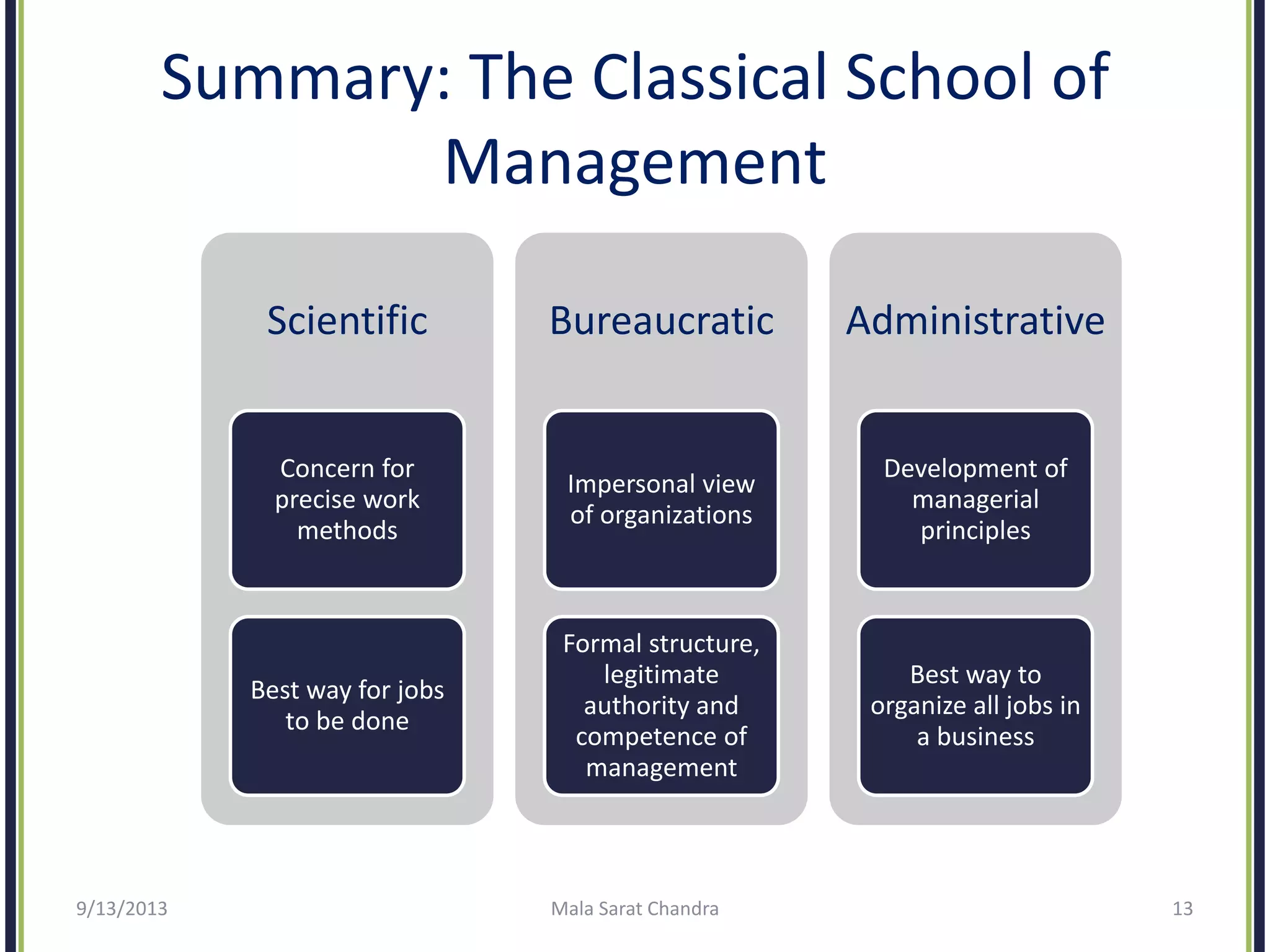
Summary: The Classical School of
Management
Scientific
Concern for
precise work
methods
Best way for jobs
to be done
Bureaucratic
Impersonal view
of organizations
Formal structure,
legitimate
authority and
competence of
management
Administrative
Development of
managerial
principles
Best way to
organize all jobs in
a business
9/13/2013 Mala Sarat Chandra 13
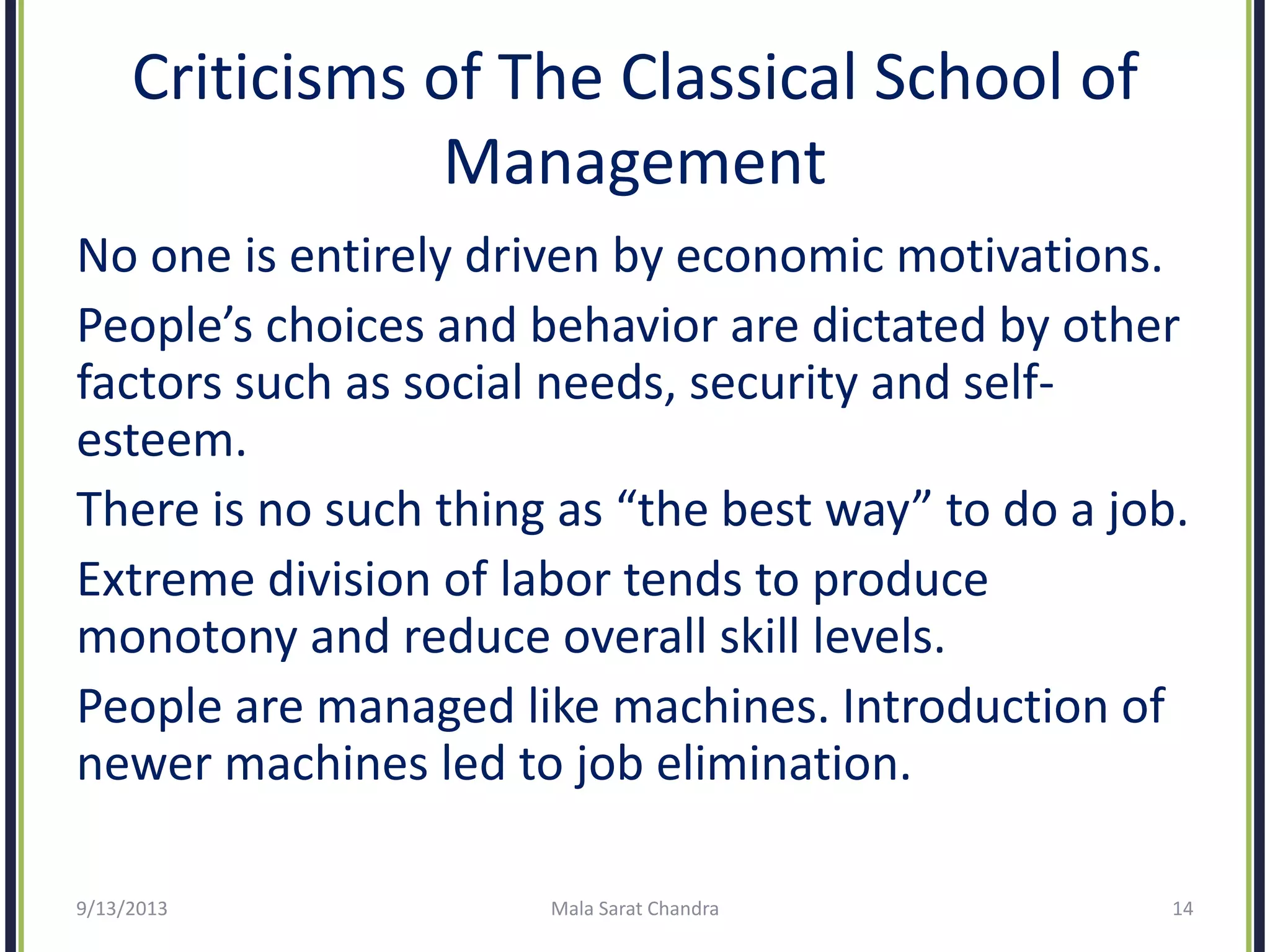
Criticisms of The Classical School of
Management
No one is entirely driven by economic motivations.
People’s choices and behavior are dictated by other
factors such as social needs, security and self-
esteem.
There is no such thing as “the best way” to do a job.
Extreme division of labor tends to produce
monotony and reduce overall skill levels.
People are managed like machines. Introduction of
newer machines led to job elimination.
9/13/2013 Mala Sarat Chandra 14
THE NEO-CLASSICAL SCHOOL OF
MANAGEMENT
1920 - 1950
9/13/2013 Mala Sarat Chandra 15
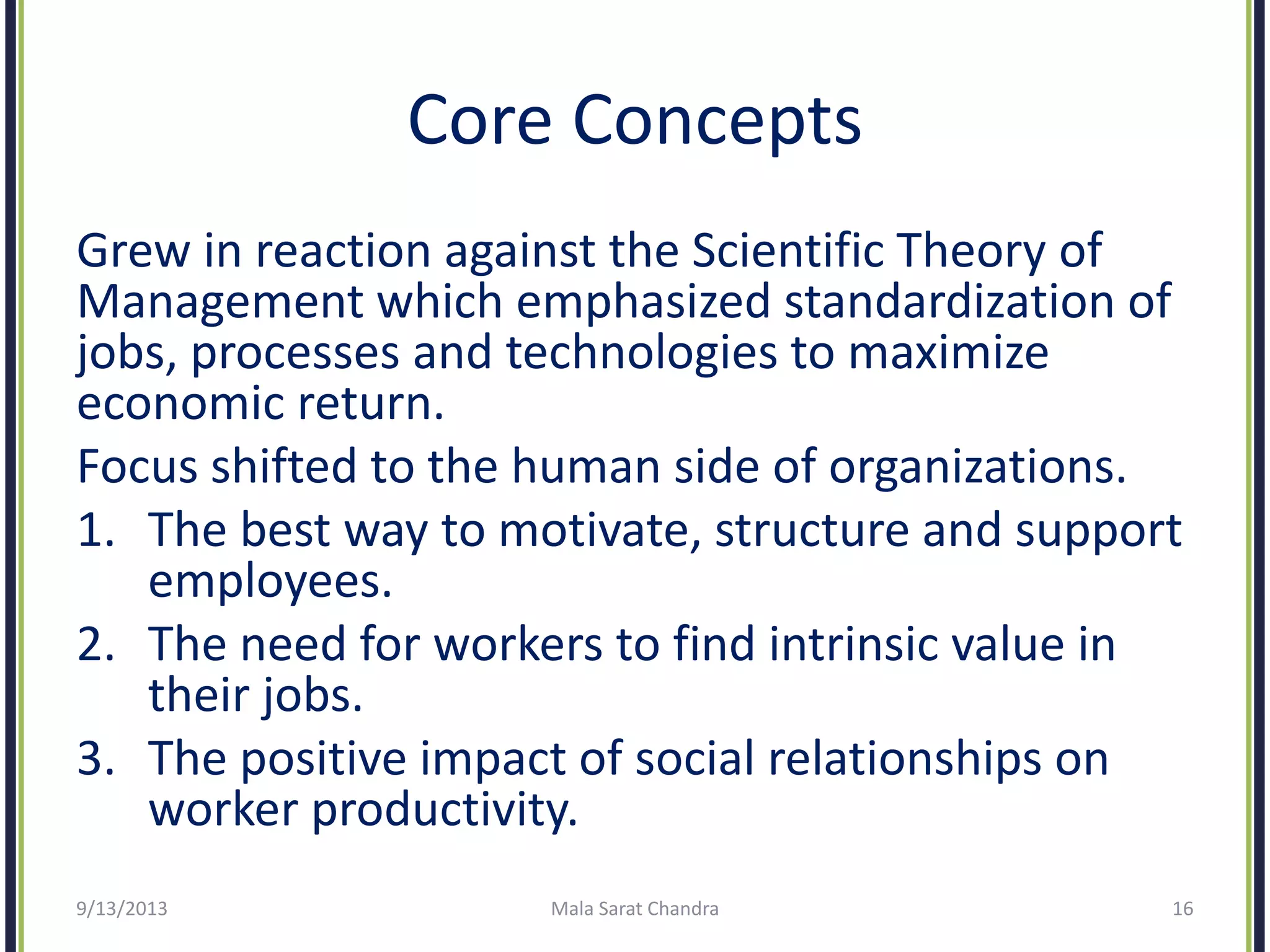
Core Concepts
Grew in reaction against the Scientific Theory of
Management which emphasized standardization of
jobs, processes and technologies to maximize
economic return.
Focus shifted to the human side of organizations.
1. The best way to motivate, structure and support
employees.
2. The need for workers to find intrinsic value in
their jobs.
3. The positive impact of social relationships on
worker productivity.
9/13/2013 Mala Sarat Chandra 16
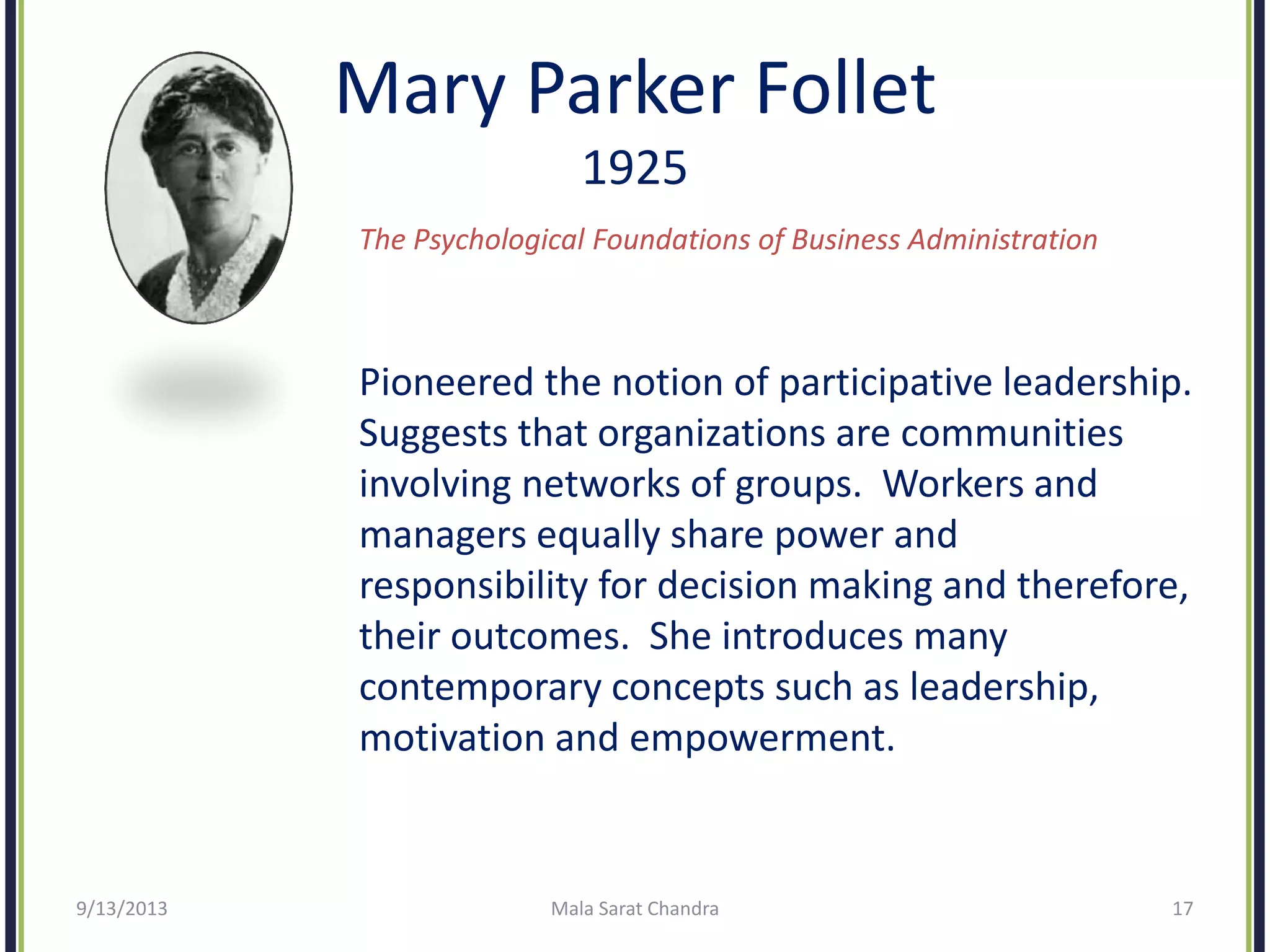
Mary Parker Follet
1925
The Psychological Foundations of Business Administration
Pioneered the notion of participative leadership.
Suggests that organizations are communities
involving networks of groups. Workers and
managers equally share power and
responsibility for decision making and therefore,
their outcomes. She introduces many
contemporary concepts such as leadership,
motivation and empowerment.
9/13/2013 Mala Sarat Chandra 17
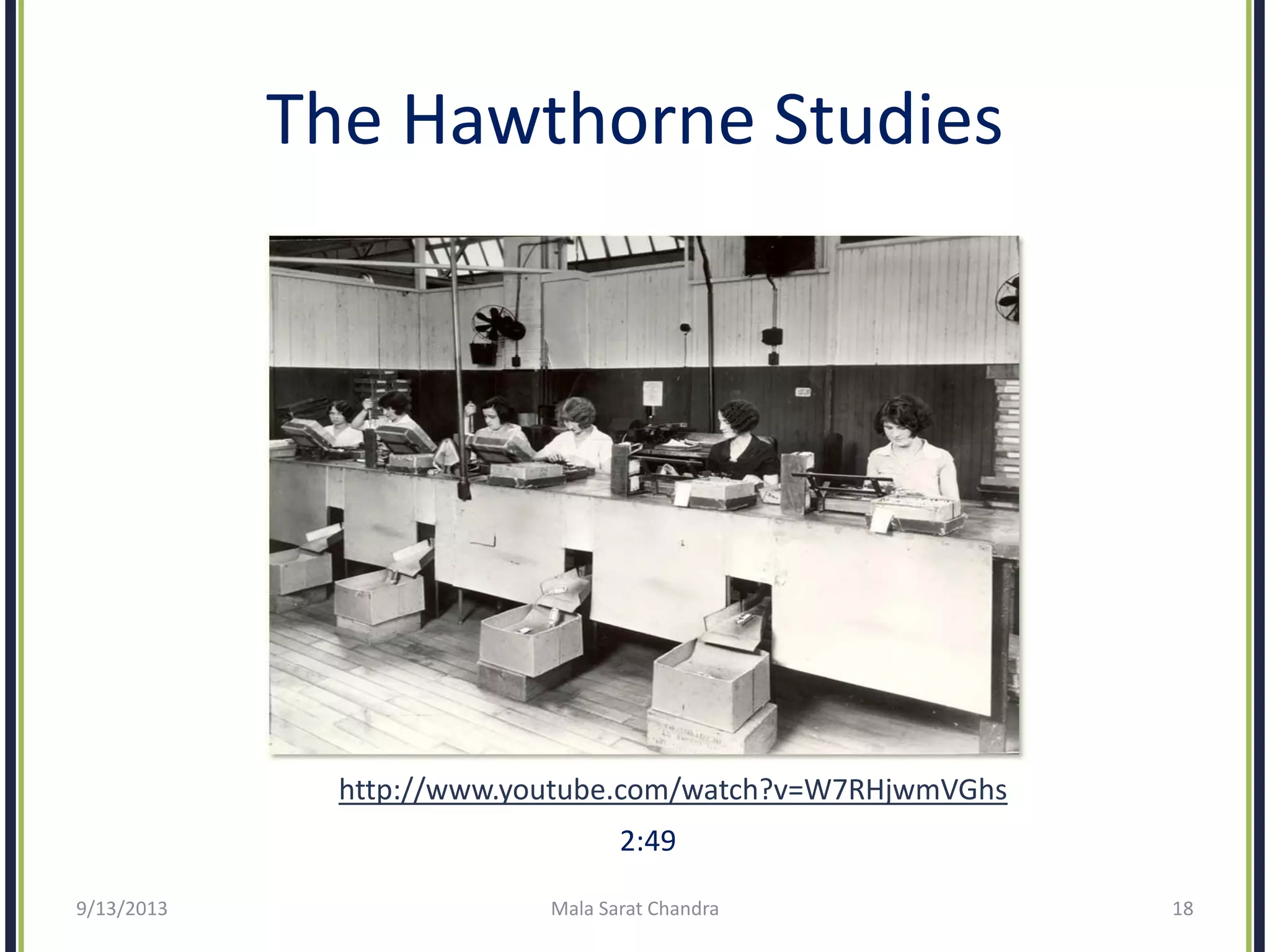
The Hawthorne Studies
http://www.youtube.com/watch?v=W7RHjwmVGhs
2:49
9/13/2013 Mala Sarat Chandra 18
The Hawthorne Effect
Productivity increases when workers believe
that they are being observed closely.
Employees perform better when managers and
co-workers make them feel valued.
Financial rewards are not necessarily conducive
to increasing worker productivity.
Workers care about self-fulfillment, autonomy,
empowerment, social status and personal
relationships with co-workers.
9/13/2013 Mala Sarat Chandra 19
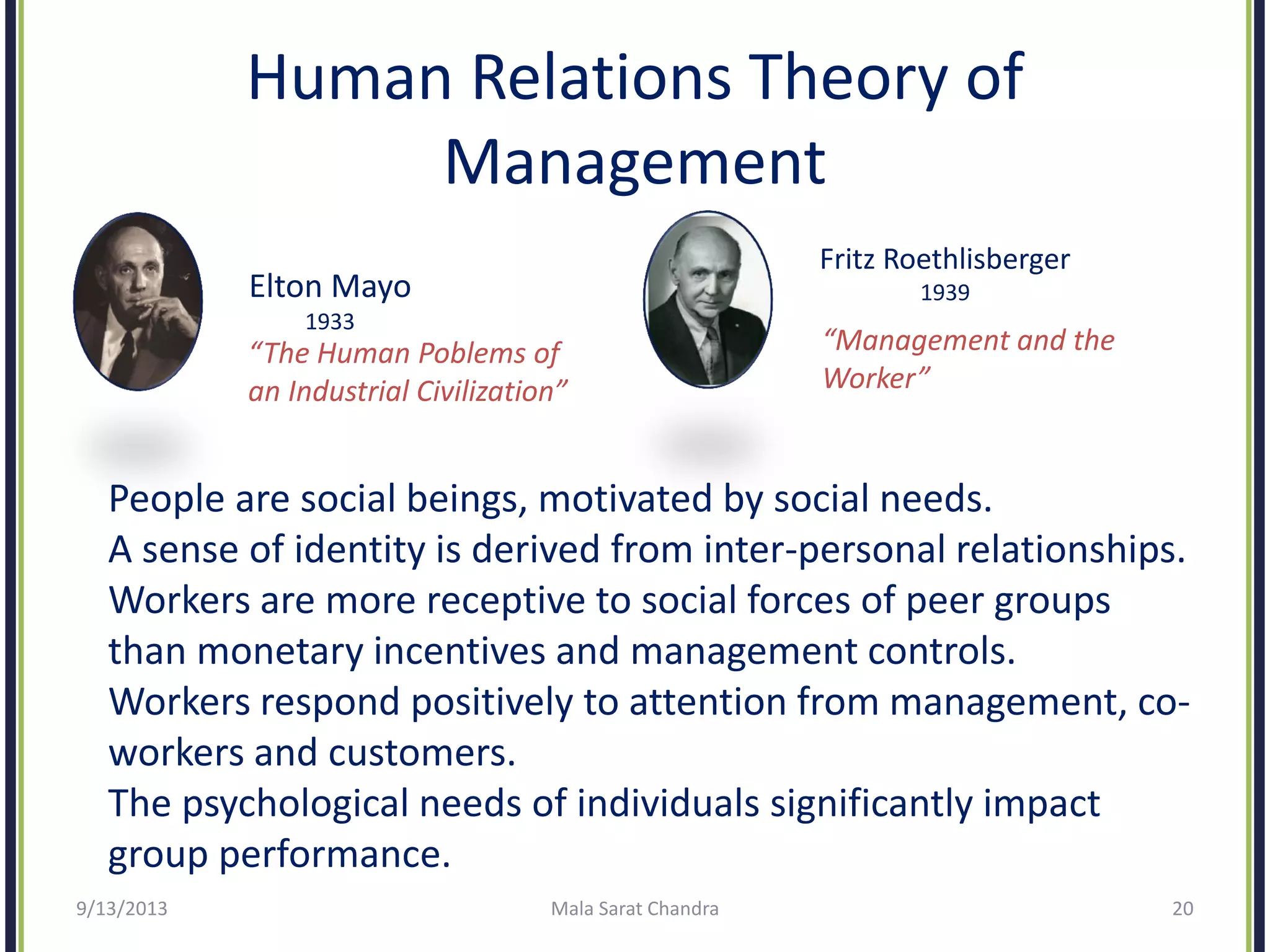
Human Relations Theory of
Management
Elton Mayo
1933
“The Human Poblems of
an Industrial Civilization”
Fritz Roethlisberger
1939
“Management and the
Worker”
People are social beings, motivated by social needs.
A sense of identity is derived from inter-personal relationships.
Workers are more receptive to social forces of peer groups
than monetary incentives and management controls.
Workers respond positively to attention from management, co-
workers and customers.
The psychological needs of individuals significantly impact
group performance.
9/13/2013 Mala Sarat Chandra 20
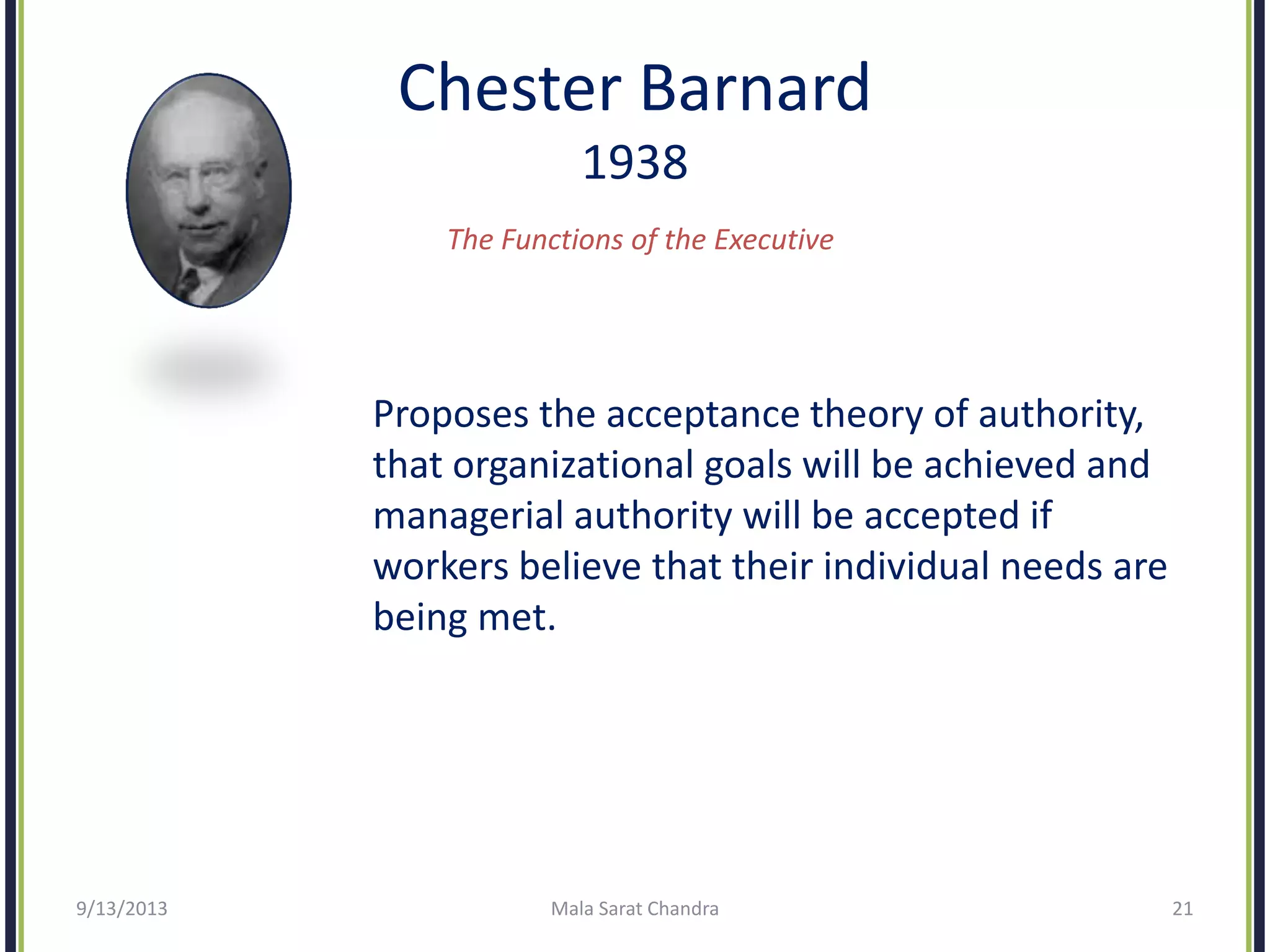
Chester Barnard
1938
The Functions of the Executive
Proposes the acceptance theory of authority,
that organizational goals will be achieved and
managerial authority will be accepted if
workers believe that their individual needs are
being met.
9/13/2013 Mala Sarat Chandra 21
Behavioral Theory of Management
The fulfillment of emotional needs of workers is important in
achieving economic goals.
Employee satisfaction and working conditions are important in
achieving worker productivity.
Workers are intrinsically motivated to work when they feel a
sense of belonging and participate in decision making.
Workers desire diverse and challenging work.
9/13/2013 Mala Sarat Chandra 22
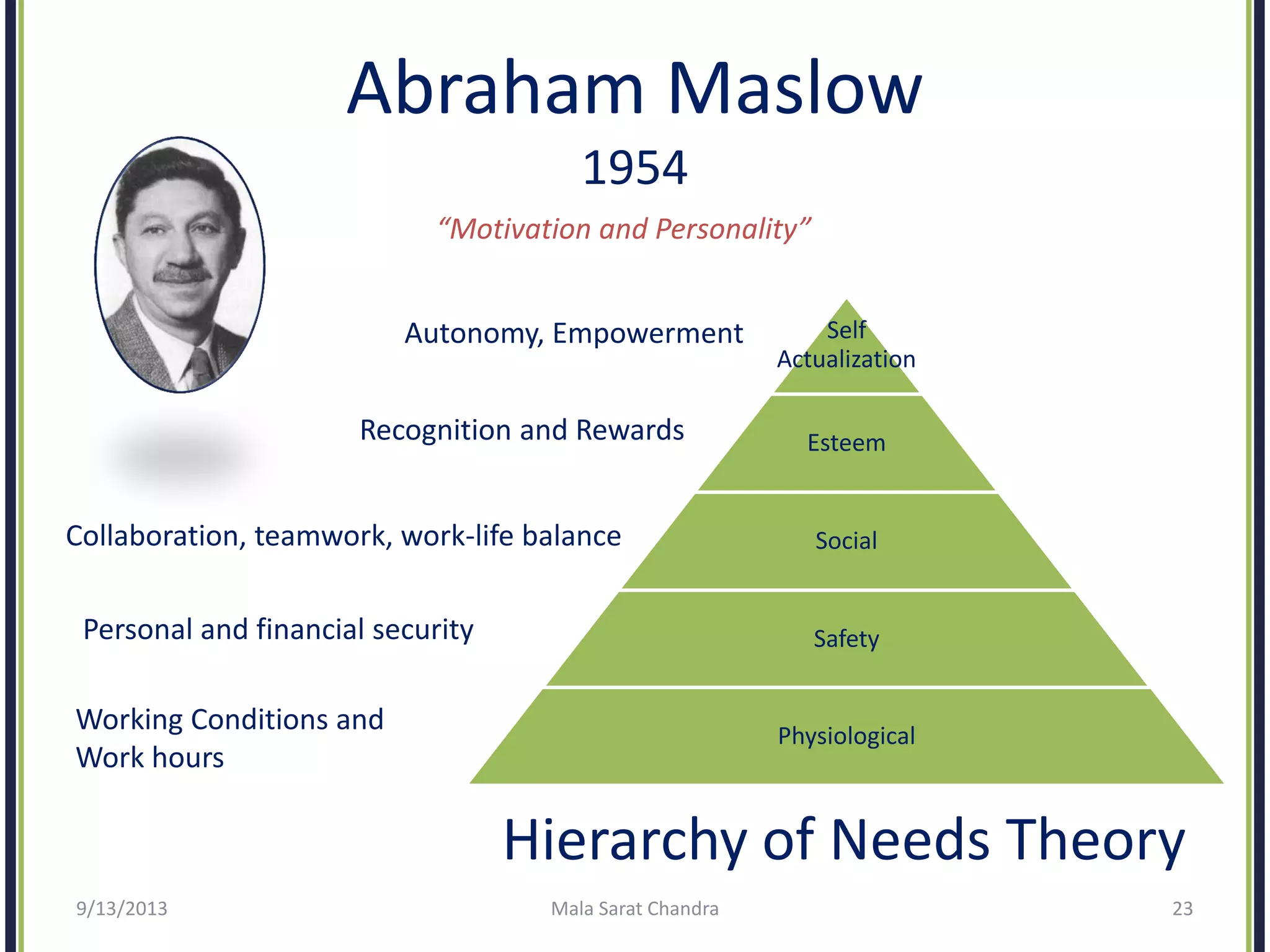
Abraham Maslow
1954
“Motivation and Personality”
Self
Actualization
Esteem
Social
Safety
Physiological
Hierarchy of Needs Theory
Working Conditions and
Work hours
Personal and financial security
Collaboration, teamwork, work-life balance
Recognition and Rewards
Autonomy, Empowerment
9/13/2013 Mala Sarat Chandra 23
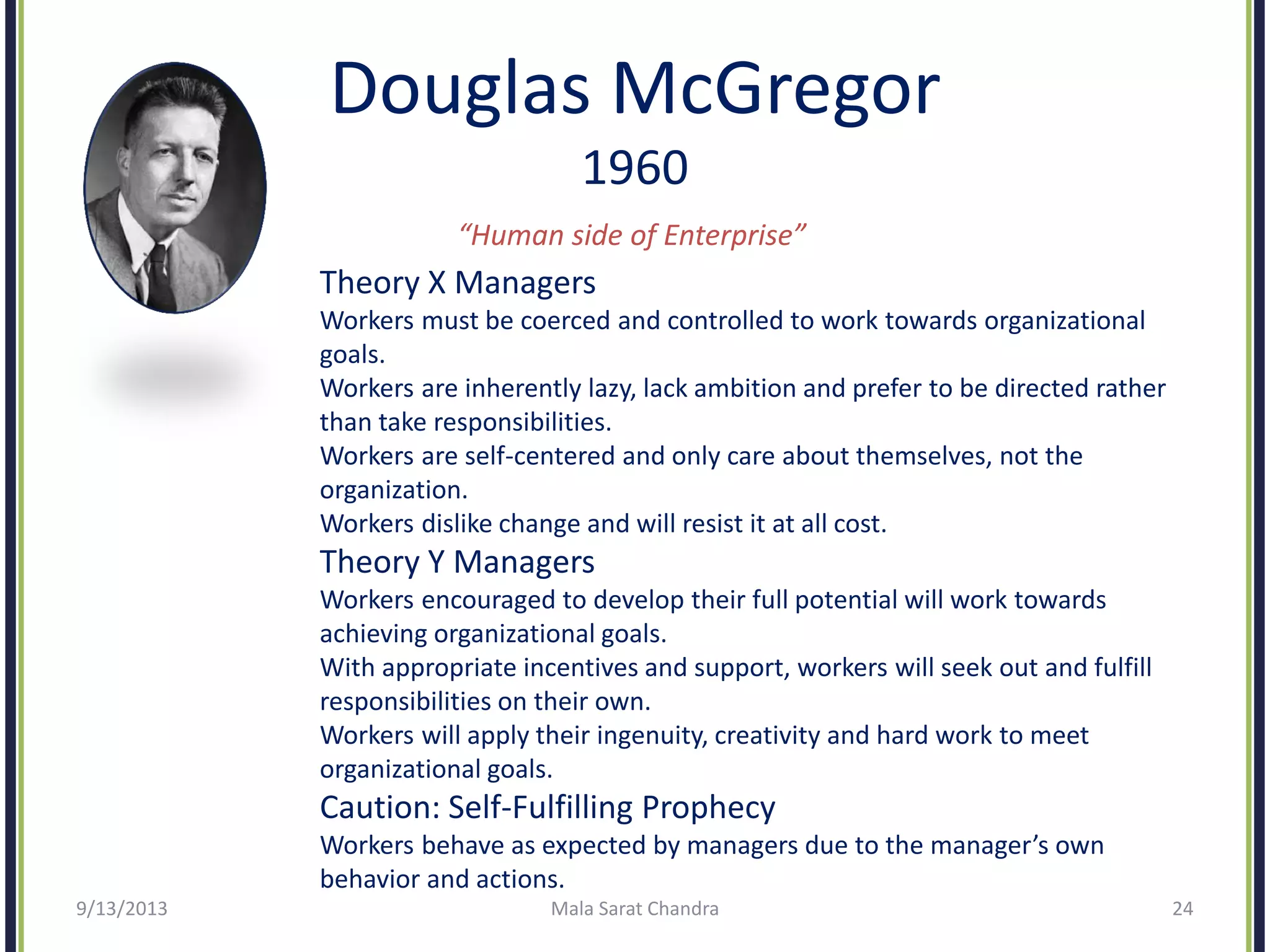
Douglas McGregor
1960
“Human side of Enterprise”
Theory X Managers
Workers must be coerced and controlled to work towards organizational
goals.
Workers are inherently lazy, lack ambition and prefer to be directed rather
than take responsibilities.
Workers are self-centered and only care about themselves, not the
organization.
Workers dislike change and will resist it at all cost.
Theory Y Managers
Workers encouraged to develop their full potential will work towards
achieving organizational goals.
With appropriate incentives and support, workers will seek out and fulfill
responsibilities on their own.
Workers will apply their ingenuity, creativity and hard work to meet
organizational goals.
Caution: Self-Fulfilling Prophecy
Workers behave as expected by managers due to the manager’s own
behavior and actions.
9/13/2013 Mala Sarat Chandra 24
Notable Contributors to the Behavioral
School of Management (1)
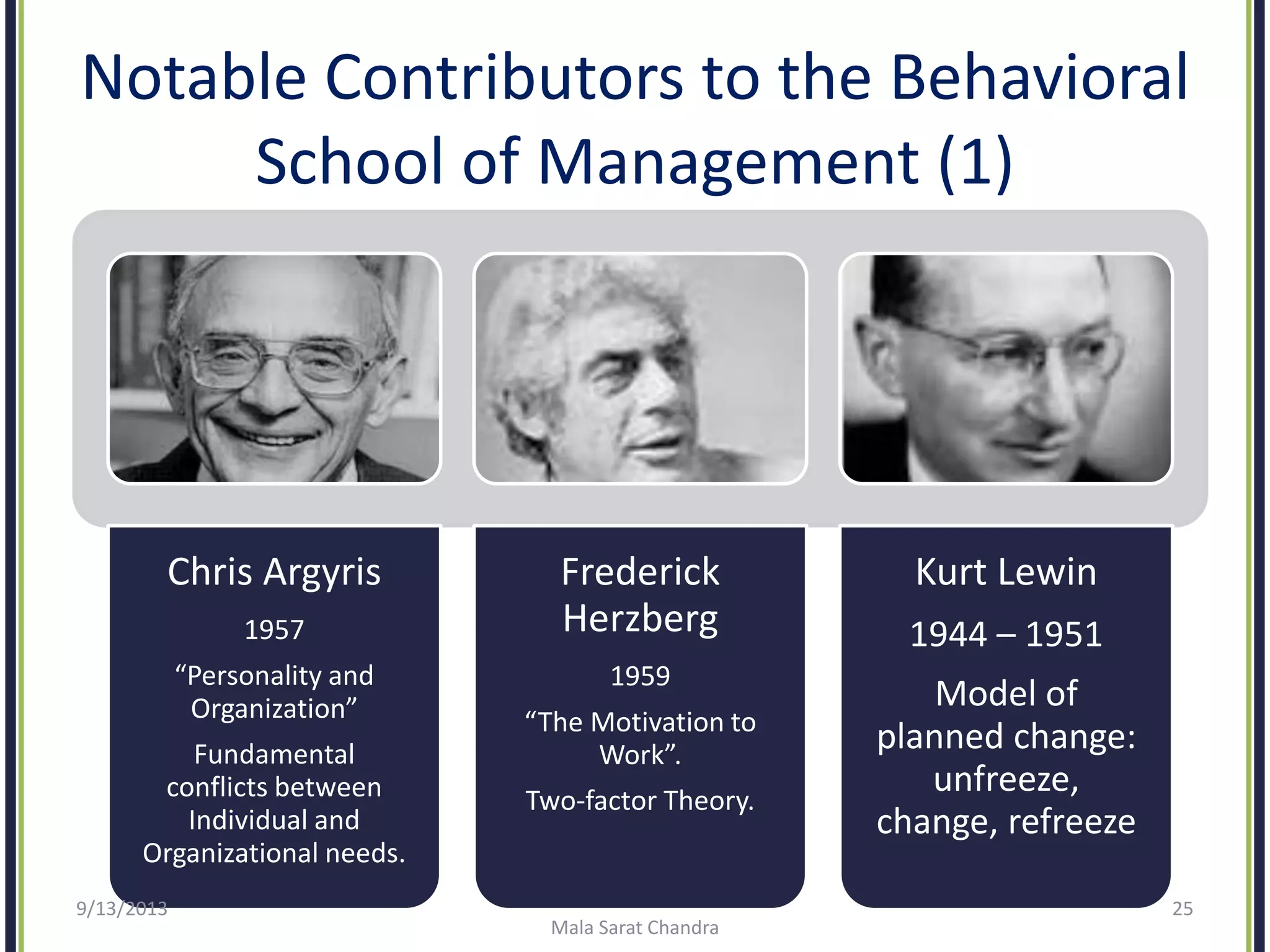
Chris Argyris
1957
“Personality and
Organization”
Fundamental
conflicts between
Individual and
Organizational needs.
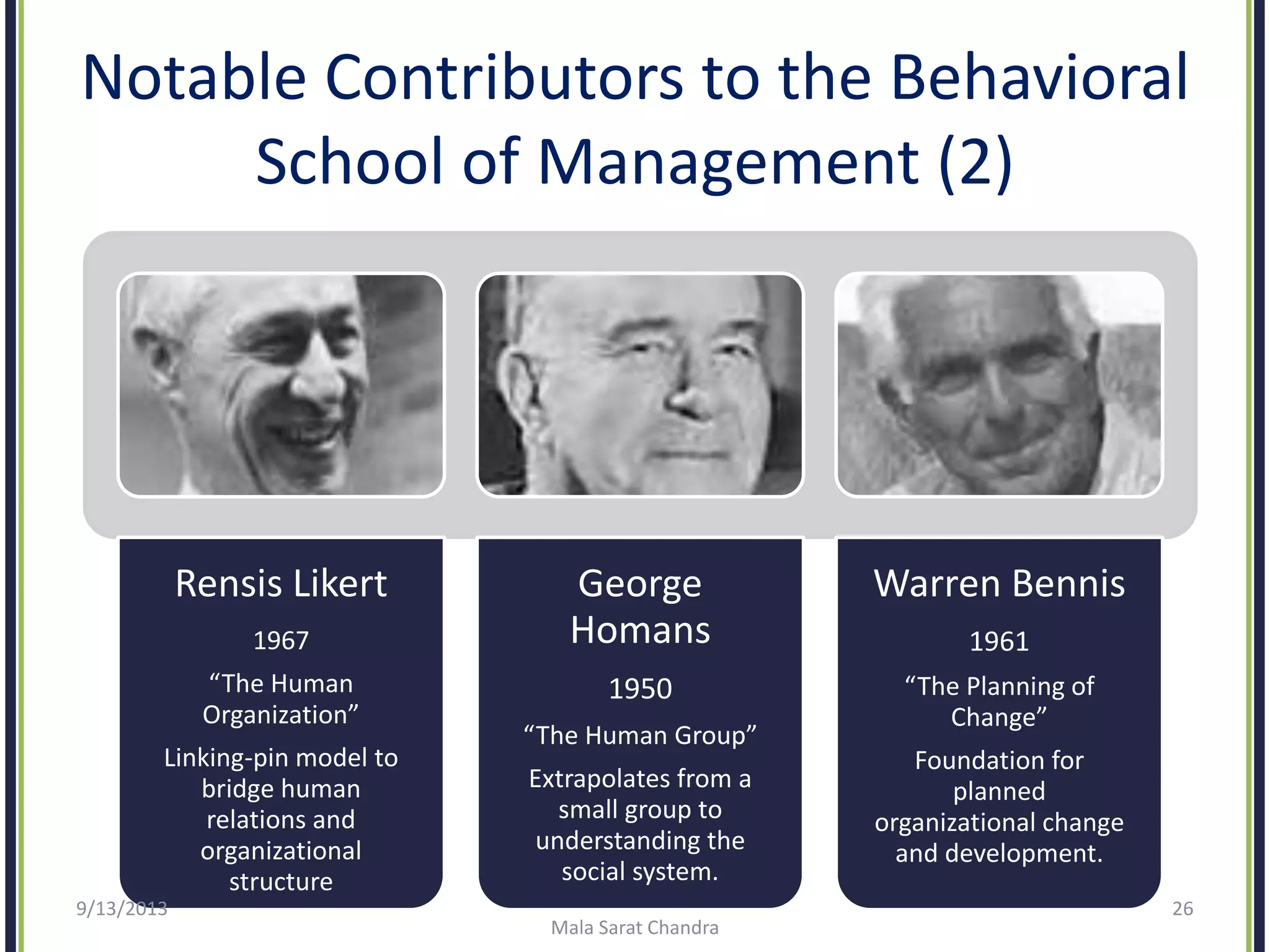
Frederick
Herzberg
1959
“The Motivation to
Work”.
Two-factor Theory.
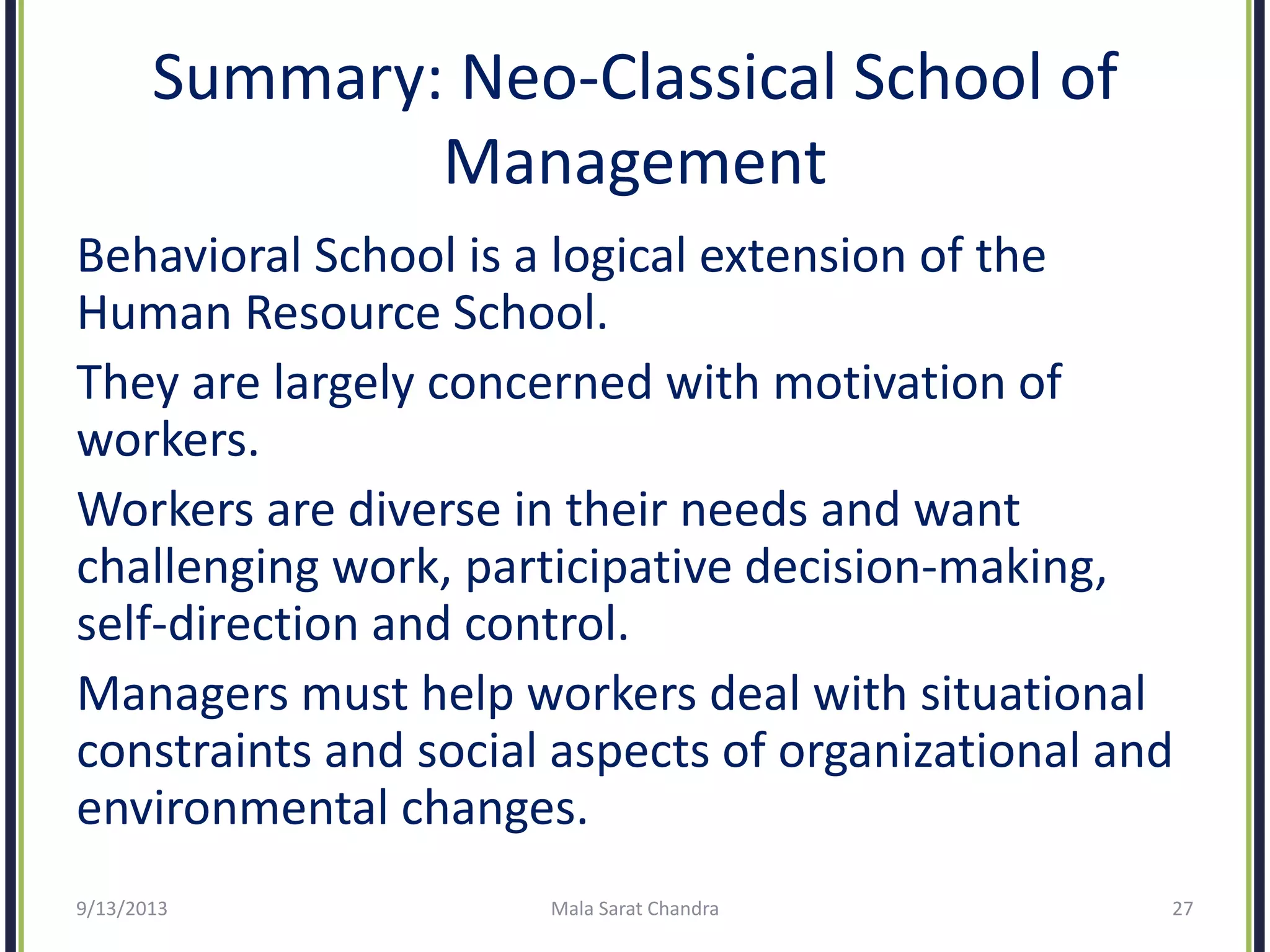
Kurt Lewin
1944 – 1951
Model of
planned change:
unfreeze,
change, refreeze
9/13/2013
Mala Sarat Chandra
25
Notable Contributors to the Behavioral
School of Management (2)
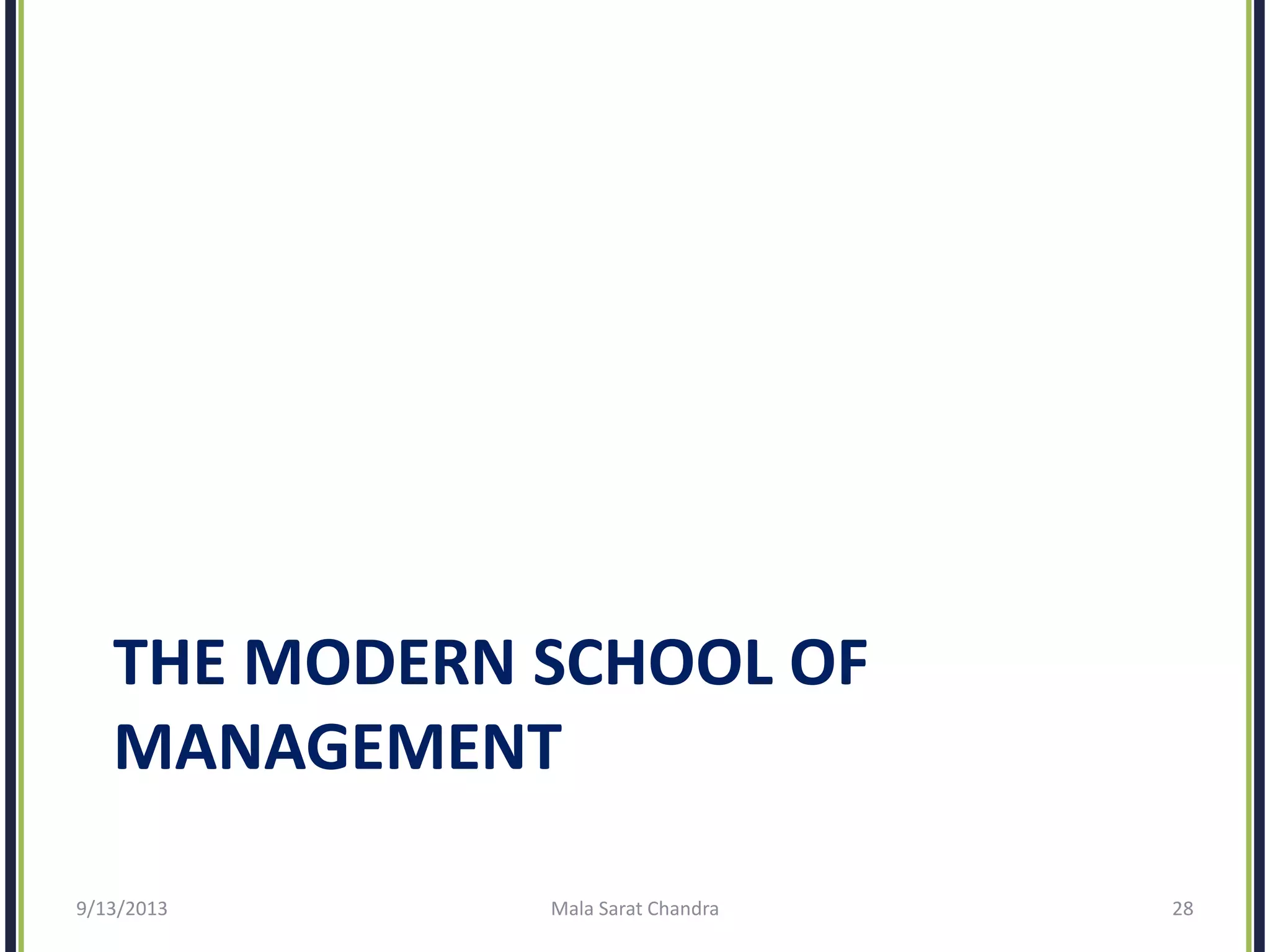
Rensis Likert
1967
“The Human
Organization”
Linking-pin model to
bridge human
relations and
organizational
structure
George
Homans
1950
“The Human Group”
Extrapolates from a
small group to
understanding the
social system.
Warren Bennis
1961
“The Planning of
Change”
Foundation for
planned
organizational change
and development.
9/13/2013
Mala Sarat Chandra
26
Summary: Neo-Classical School of
Management
Behavioral School is a logical extension of the
Human Resource School.
They are largely concerned with motivation of
workers.
Workers are diverse in their needs and want
challenging work, participative decision-making,
self-direction and control.
Managers must help workers deal with situational
constraints and social aspects of organizational and
environmental changes.
9/13/2013 Mala Sarat Chandra 27
THE MODERN SCHOOL OF
MANAGEMENT
9/13/2013 Mala Sarat Chandra 28
Core Concepts
Dealing with complexity is the core of modern management
theory.
Organizations, Workers, Environment and the interactions between them.
It is a synthesis of several theories.
Behavioral science, mathematics, statistics, operations / quantitative research and
computing technologies.
Management is an exercise in logic applied to situations.
Situations can be measured.
Computers have an increasing role to play.
Application of management knowledge is extended to non-
business areas.
Education, government, health care and others.
9/13/2013 Mala Sarat Chandra 29
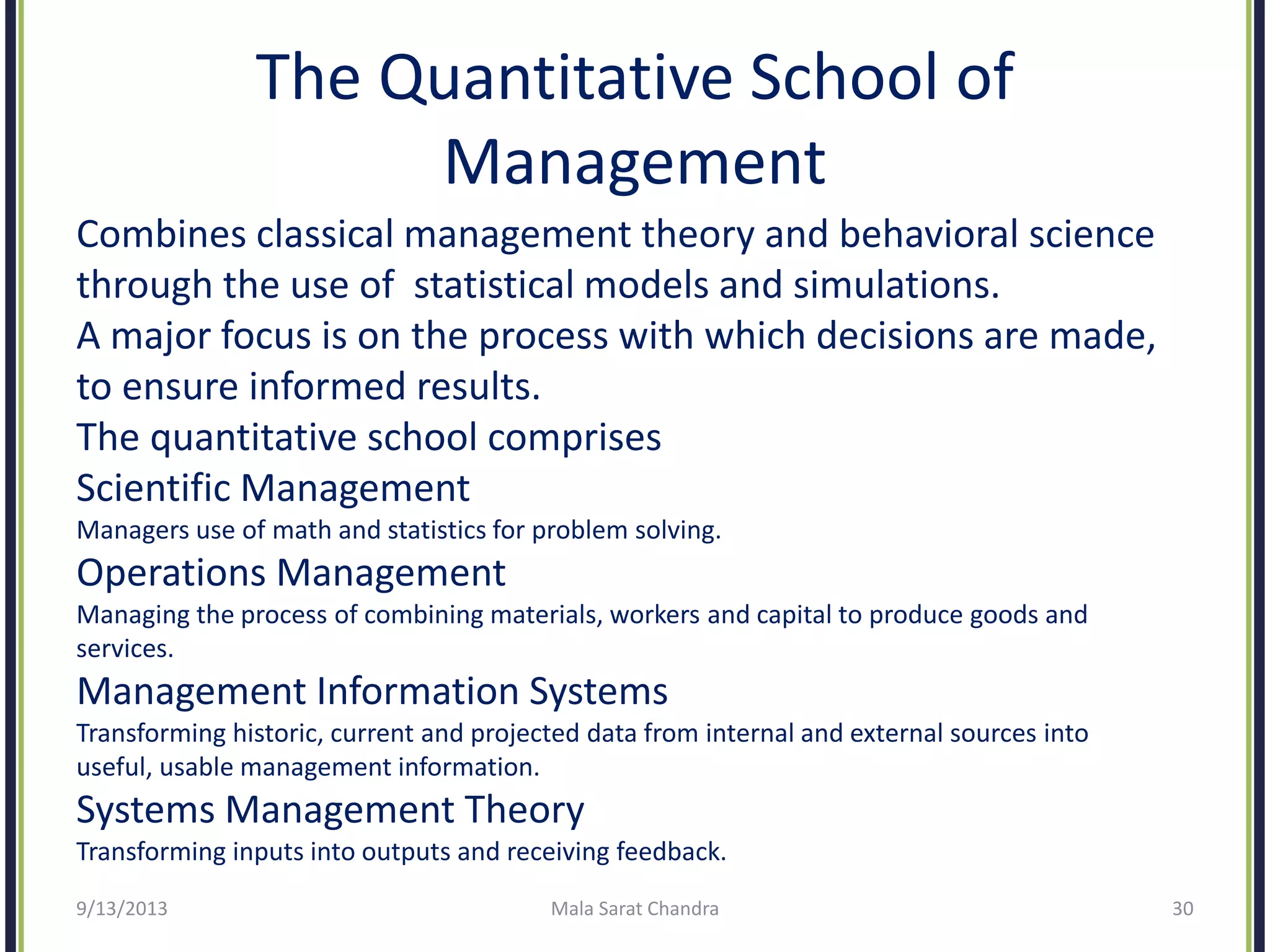
The Quantitative School of
Management
Combines classical management theory and behavioral science
through the use of statistical models and simulations.
A major focus is on the process with which decisions are made,
to ensure informed results.
The quantitative school comprises
Scientific Management
Managers use of math and statistics for problem solving.
Operations Management
Managing the process of combining materials, workers and capital to produce goods and
services.
Management Information Systems
Transforming historic, current and projected data from internal and external sources into
useful, usable management information.
Systems Management Theory
Transforming inputs into outputs and receiving feedback.
9/13/2013 Mala Sarat Chandra 30
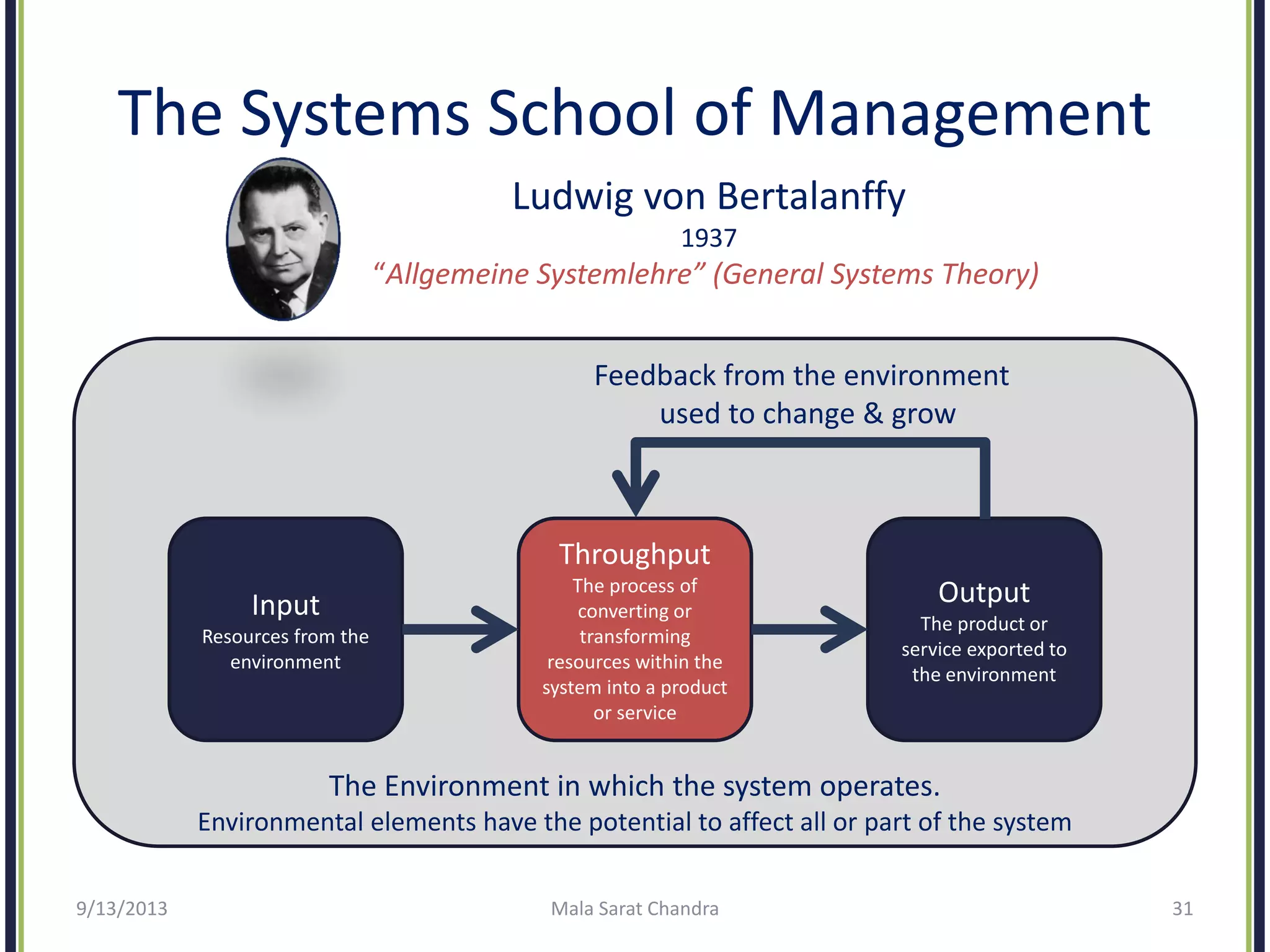
The Systems School of Management
9/13/2013 Mala Sarat Chandra 31
The Environment in which the system operates.
Environmental elements have the potential to affect all or part of the system
Throughput
The process of
converting or
transforming
resources within the
system into a product
or service
Input
Resources from the
environment
Output
The product or
service exported to
the environment
Feedback from the environment
used to change & grow
Ludwig von Bertalanffy
1937
“Allgemeine Systemlehre” (General Systems Theory)
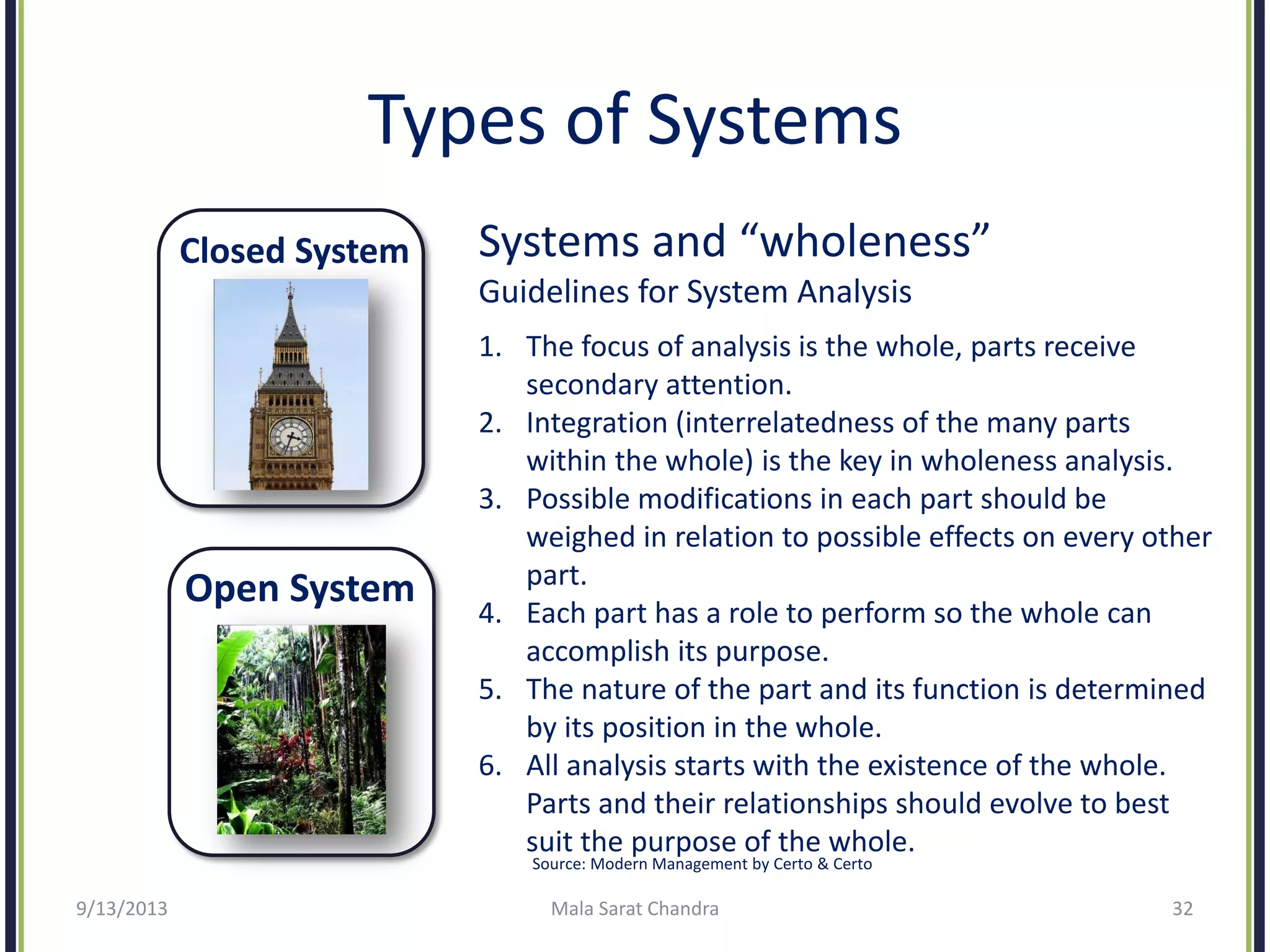
Types of Systems
Closed System
Open System
9/13/2013 Mala Sarat Chandra 32
Systems and “wholeness”
Guidelines for System Analysis
1. The focus of analysis is the whole, parts receive
secondary attention.
2. Integration (interrelatedness of the many parts
within the whole) is the key in wholeness analysis.
3. Possible modifications in each part should be
weighed in relation to possible effects on every other
part.
4. Each part has a role to perform so the whole can
accomplish its purpose.
5. The nature of the part and its function is determined
by its position in the whole.
6. All analysis starts with the existence of the whole.
Parts and their relationships should evolve to best
suit the purpose of the whole.
Source: Modern Management by Certo & Certo
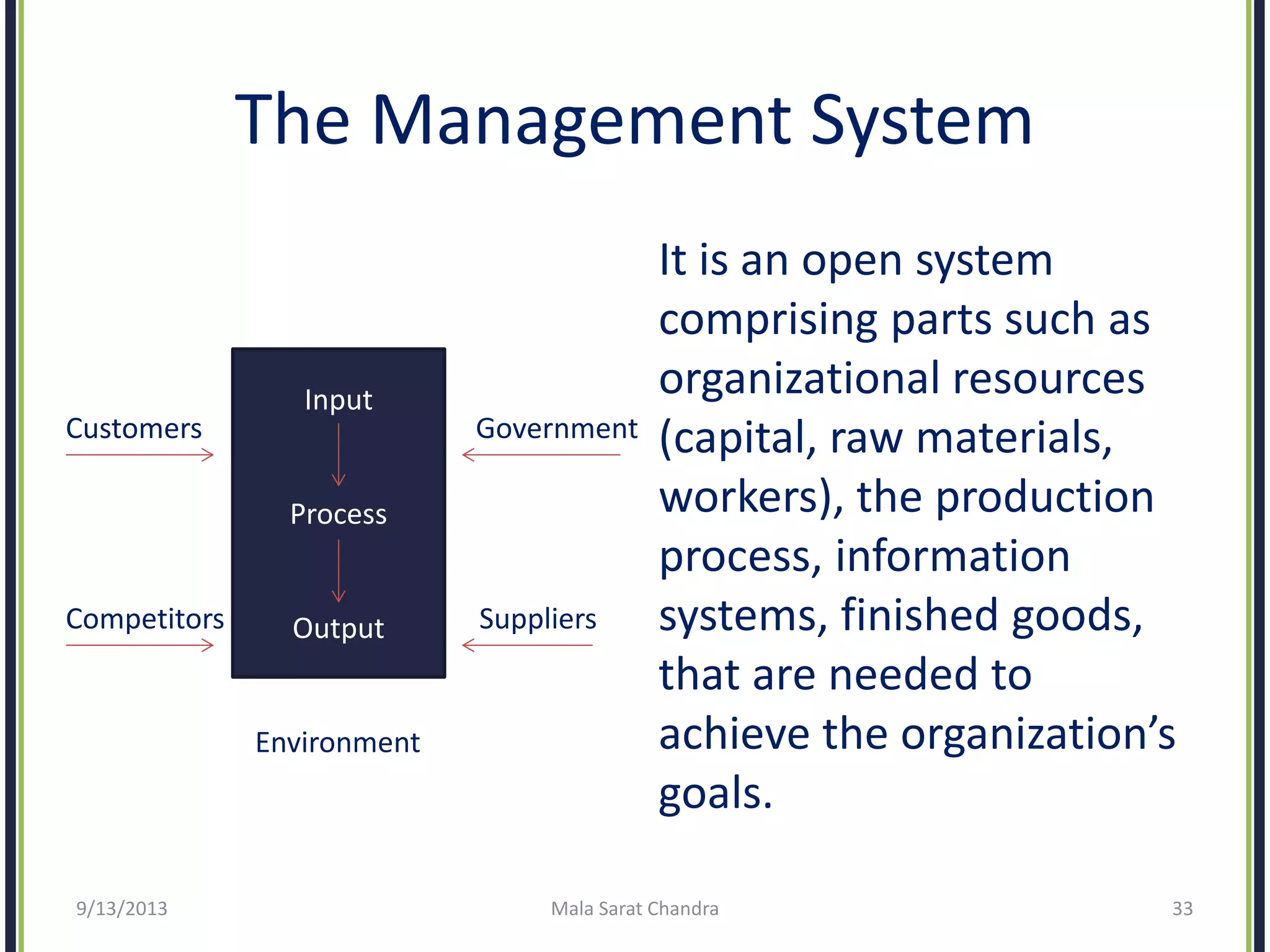
The Management System
It is an open system
comprising parts such as
organizational resources
(capital, raw materials,
workers), the production
process, information
systems, finished goods,
that are needed to
achieve the organization’s
goals.
9/13/2013 Mala Sarat Chandra 33
Input
Process
Output
Customers Government
Competitors Suppliers
Environment
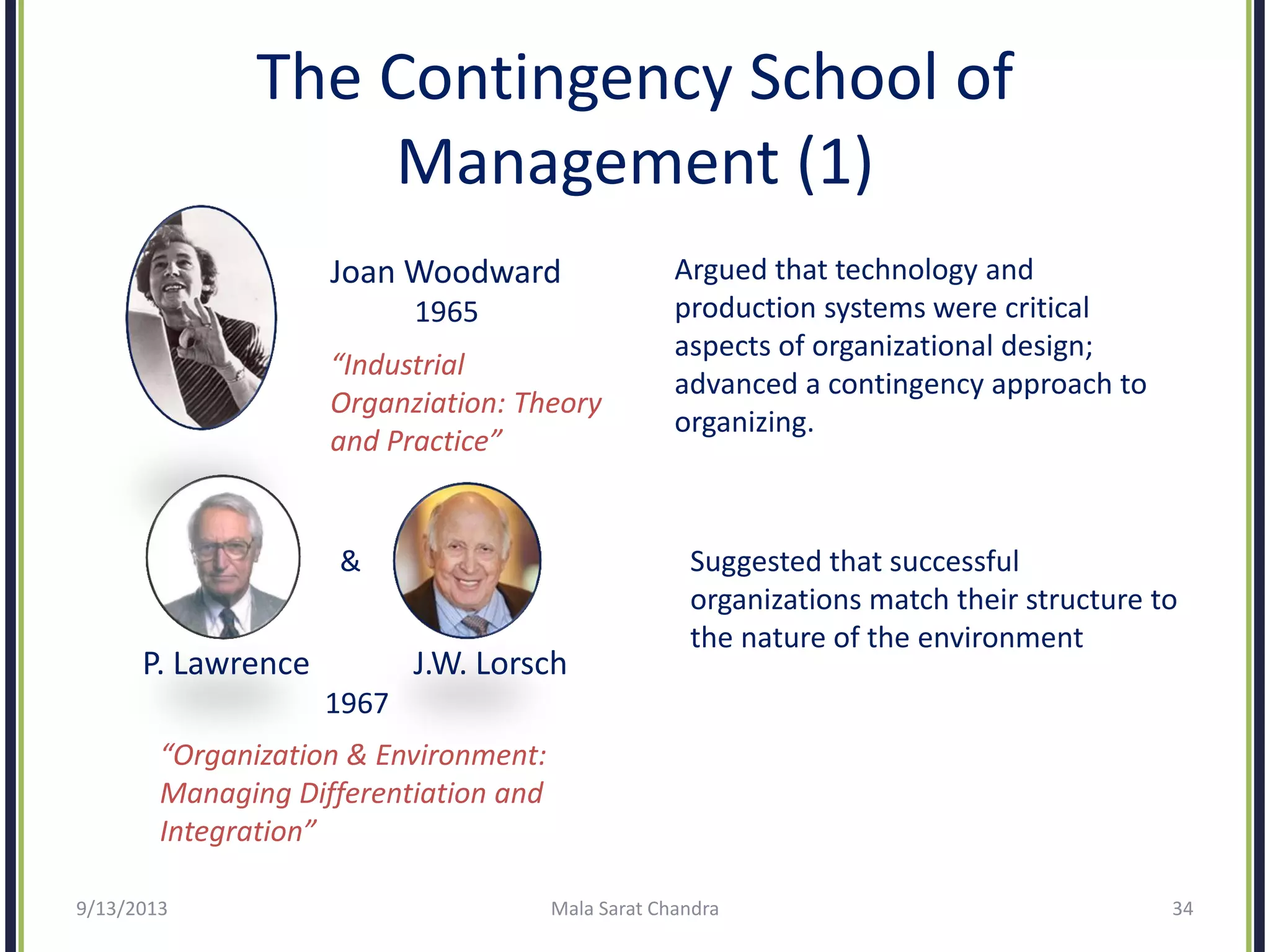
The Contingency School of
Management (1)
9/13/2013 Mala Sarat Chandra 34
Joan Woodward
1965
“Industrial
Organziation: Theory
and Practice”
&
P. Lawrence J.W. Lorsch
1967
“Organization & Environment:
Managing Differentiation and
Integration”
Argued that technology and
production systems were critical
aspects of organizational design;
advanced a contingency approach to
organizing.
Suggested that successful
organizations match their structure to
the nature of the environment
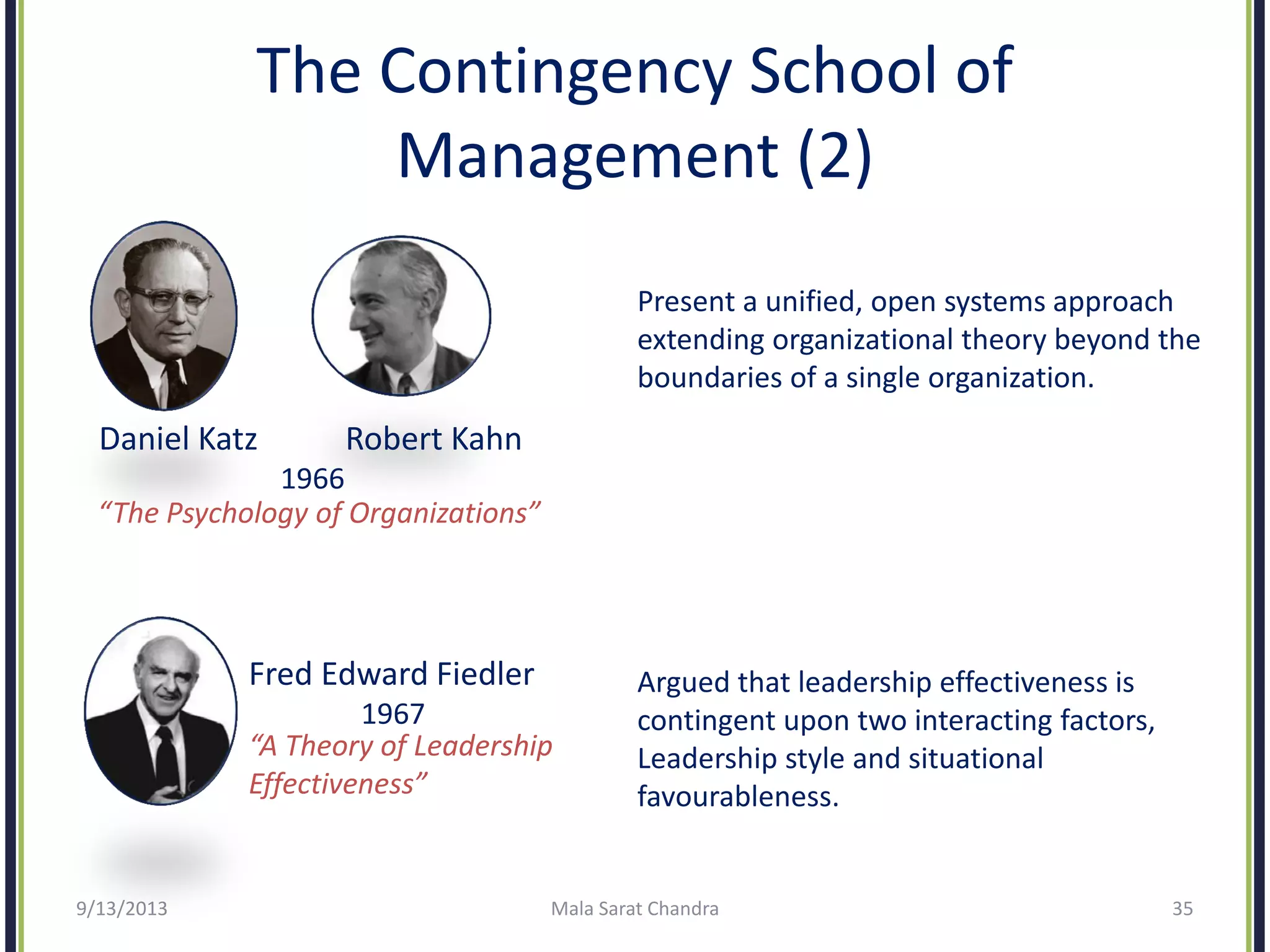
The Contingency School of
Management (2)
9/13/2013 Mala Sarat Chandra 35
Fred Edward Fiedler
1967
“A Theory of Leadership
Effectiveness”
Daniel Katz Robert Kahn
1966
“The Psychology of Organizations”
Present a unified, open systems approach
extending organizational theory beyond the
boundaries of a single organization.
Argued that leadership effectiveness is
contingent upon two interacting factors,
Leadership style and situational
favourableness.
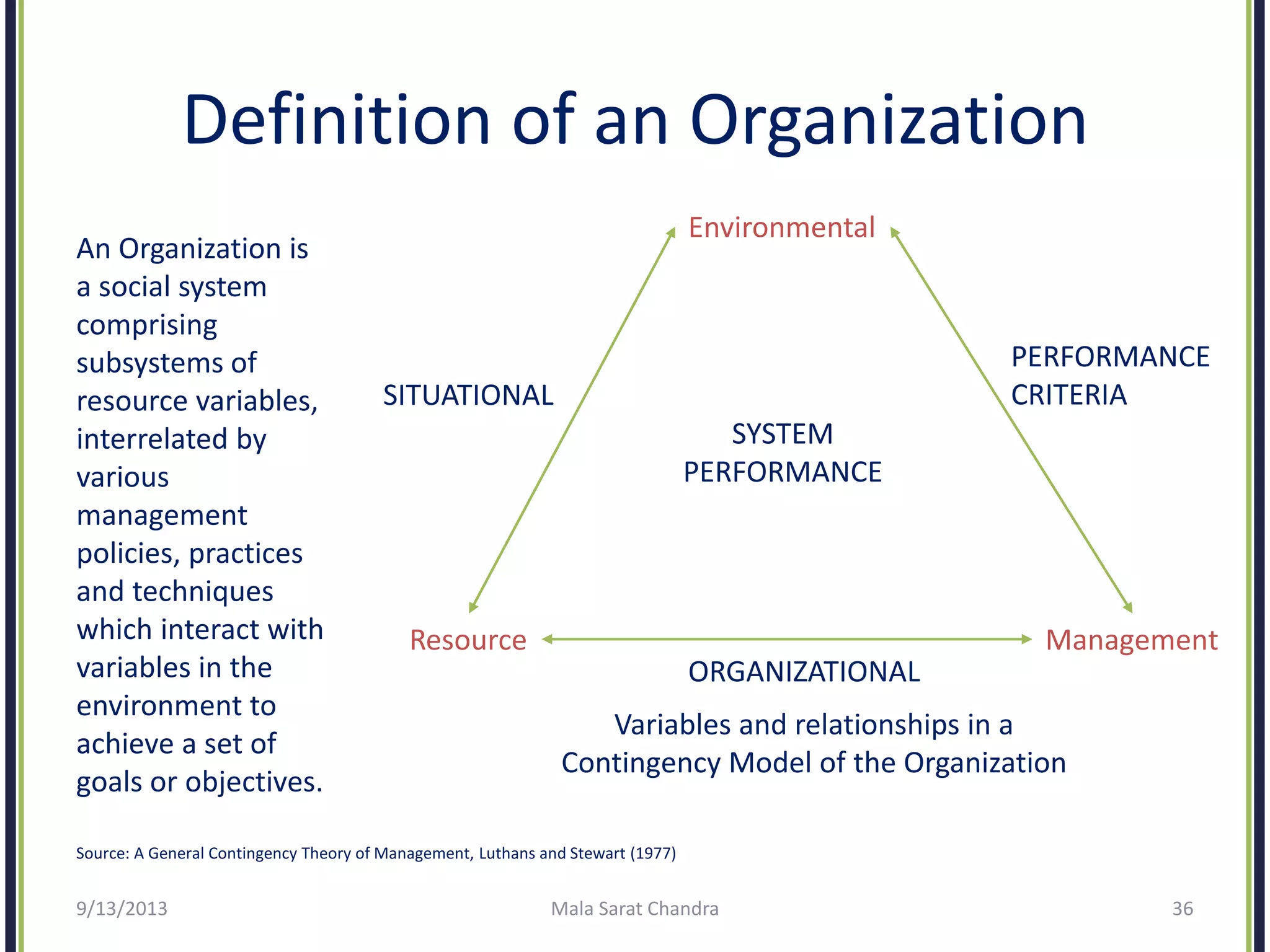
Definition of an Organization
An Organization is
a social system
comprising
subsystems of
resource variables,
interrelated by
various
management
policies, practices
and techniques
which interact with
variables in the
environment to
achieve a set of
goals or objectives.
9/13/2013 Mala Sarat Chandra 36
Source: A General Contingency Theory of Management, Luthans and Stewart (1977)
SYSTEM
PERFORMANCE
Environmental
ManagementResource
ORGANIZATIONAL
PERFORMANCE
CRITERIASITUATIONAL
Variables and relationships in a
Contingency Model of the Organization
Core Concepts
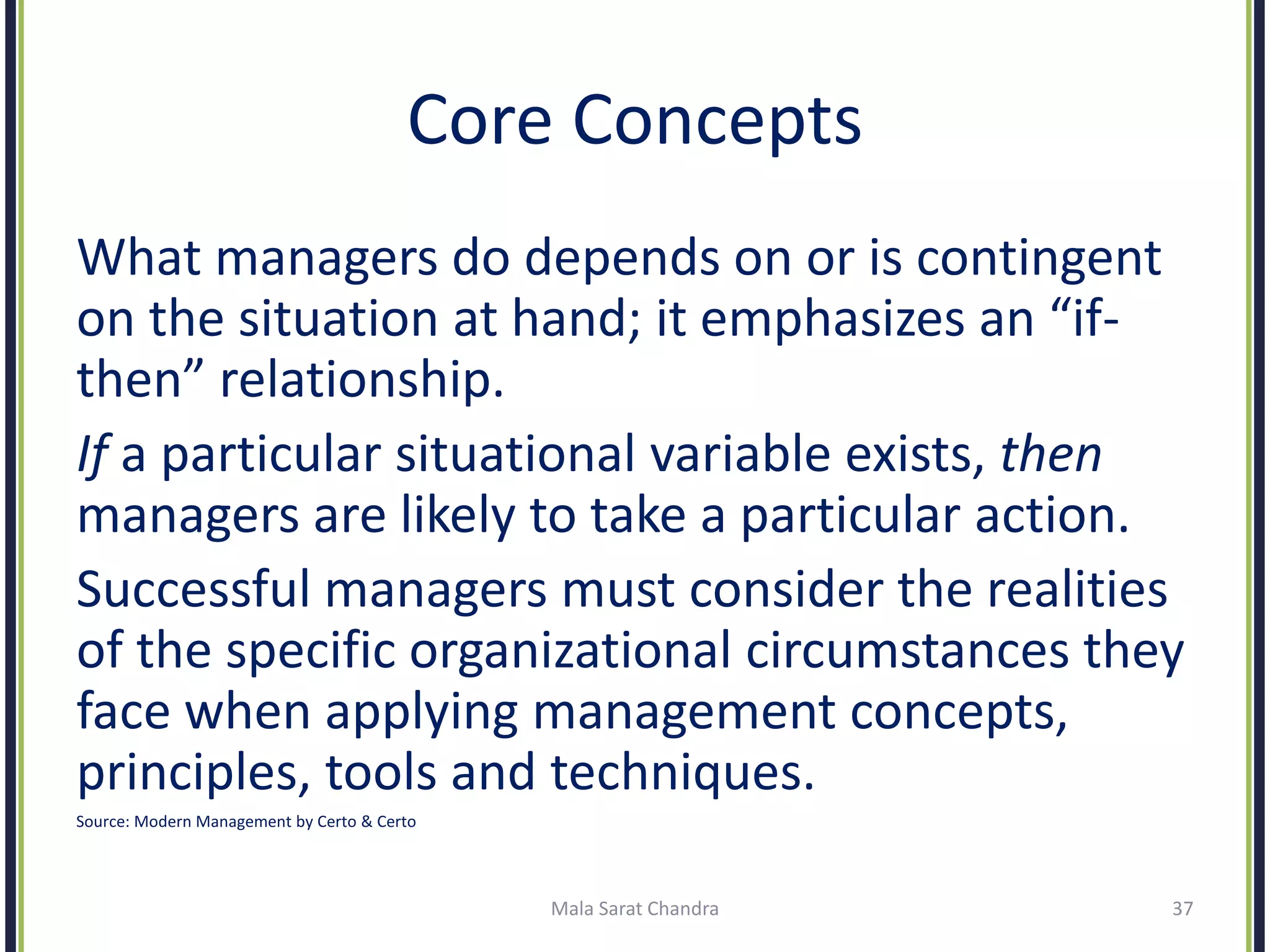
What managers do depends on or is contingent
on the situation at hand; it emphasizes an “if-
then” relationship.
If a particular situational variable exists, then
managers are likely to take a particular action.
Successful managers must consider the realities
of the specific organizational circumstances they
face when applying management concepts,
principles, tools and techniques.
Source: Modern Management by Certo & Certo
Mala Sarat Chandra 37
Challenges with the Contingency
Approach
1. Perceiving organizational situations as they
actually exist.
2. Choosing the management tactics best suited
to those situations.
3. Competently implementing those tasks.
9/13/2013 Mala Sarat Chandra 38
Source: Modern Management by Certo & Certo
Summary
Three distinct Schools of Management
Classical Process
Neo-Classical People
Modern Integrative - People, Process,
Environment
9/13/2013 Mala Sarat Chandra 39
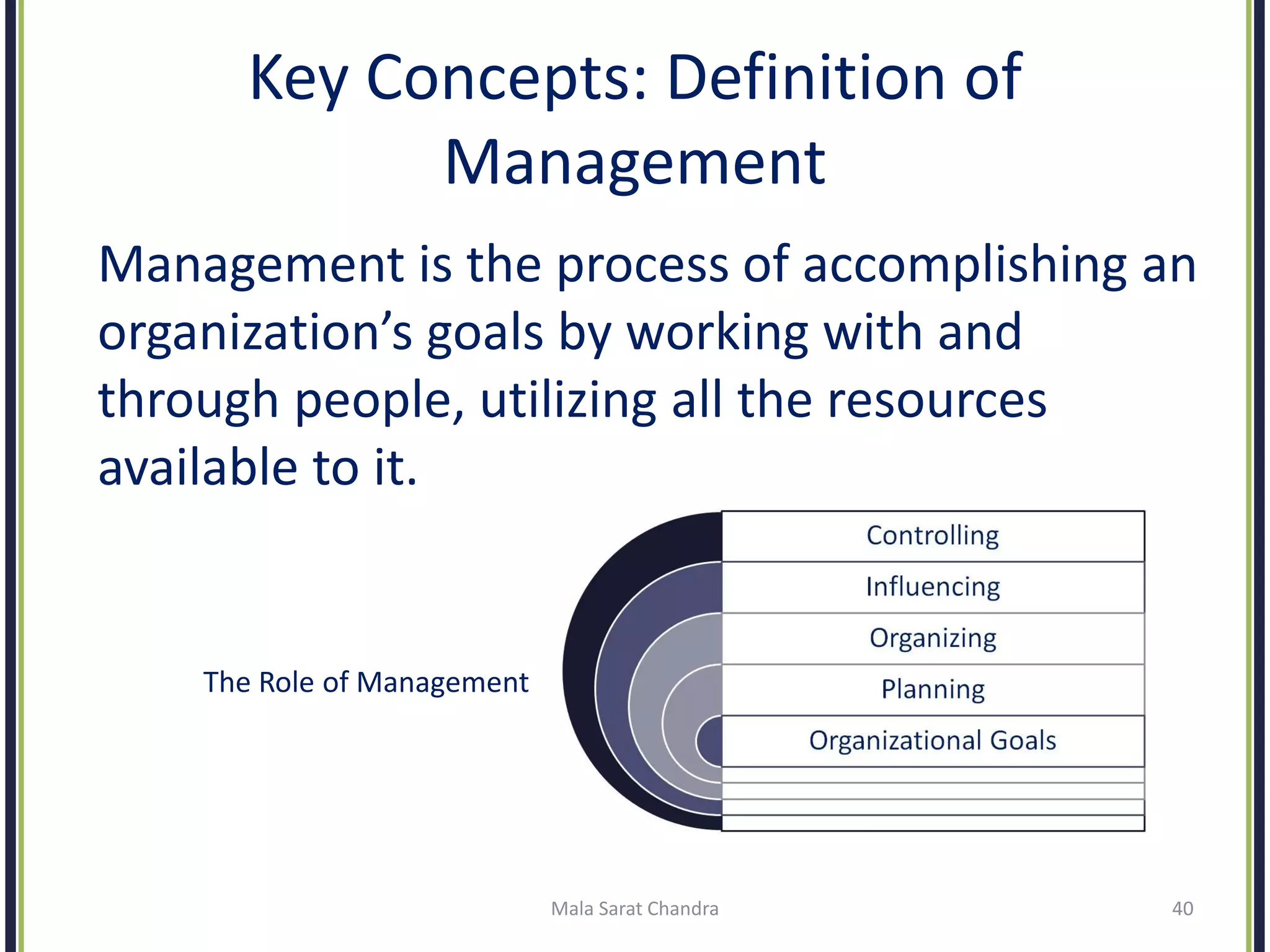
Key Concepts: Definition of
Management
Management is the process of accomplishing an
organization’s goals by working with and
through people, utilizing all the resources
available to it.
The Role of Management
Mala Sarat Chandra 40
Key Concepts: The Role of Management
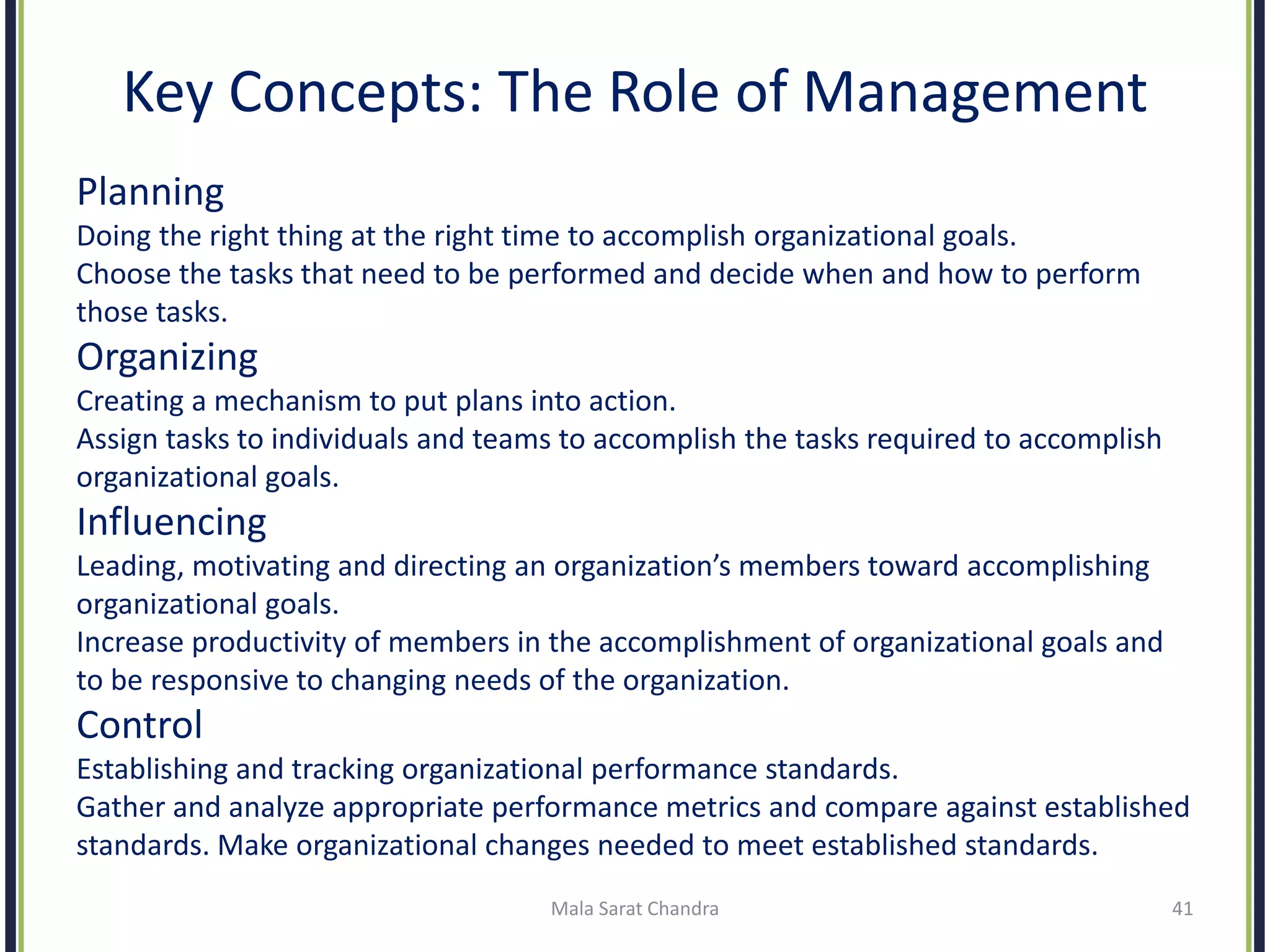
Planning
Doing the right thing at the right time to accomplish organizational goals.
Choose the tasks that need to be performed and decide when and how to perform
those tasks.
Organizing
Creating a mechanism to put plans into action.
Assign tasks to individuals and teams to accomplish the tasks required to accomplish
organizational goals.
Influencing
Leading, motivating and directing an organization’s members toward accomplishing
organizational goals.
Increase productivity of members in the accomplishment of organizational goals and
to be responsive to changing needs of the organization.
Control
Establishing and tracking organizational performance standards.
Gather and analyze appropriate performance metrics and compare against established
standards. Make organizational changes needed to meet established standards.
Mala Sarat Chandra 41
Common Mistakes of Management
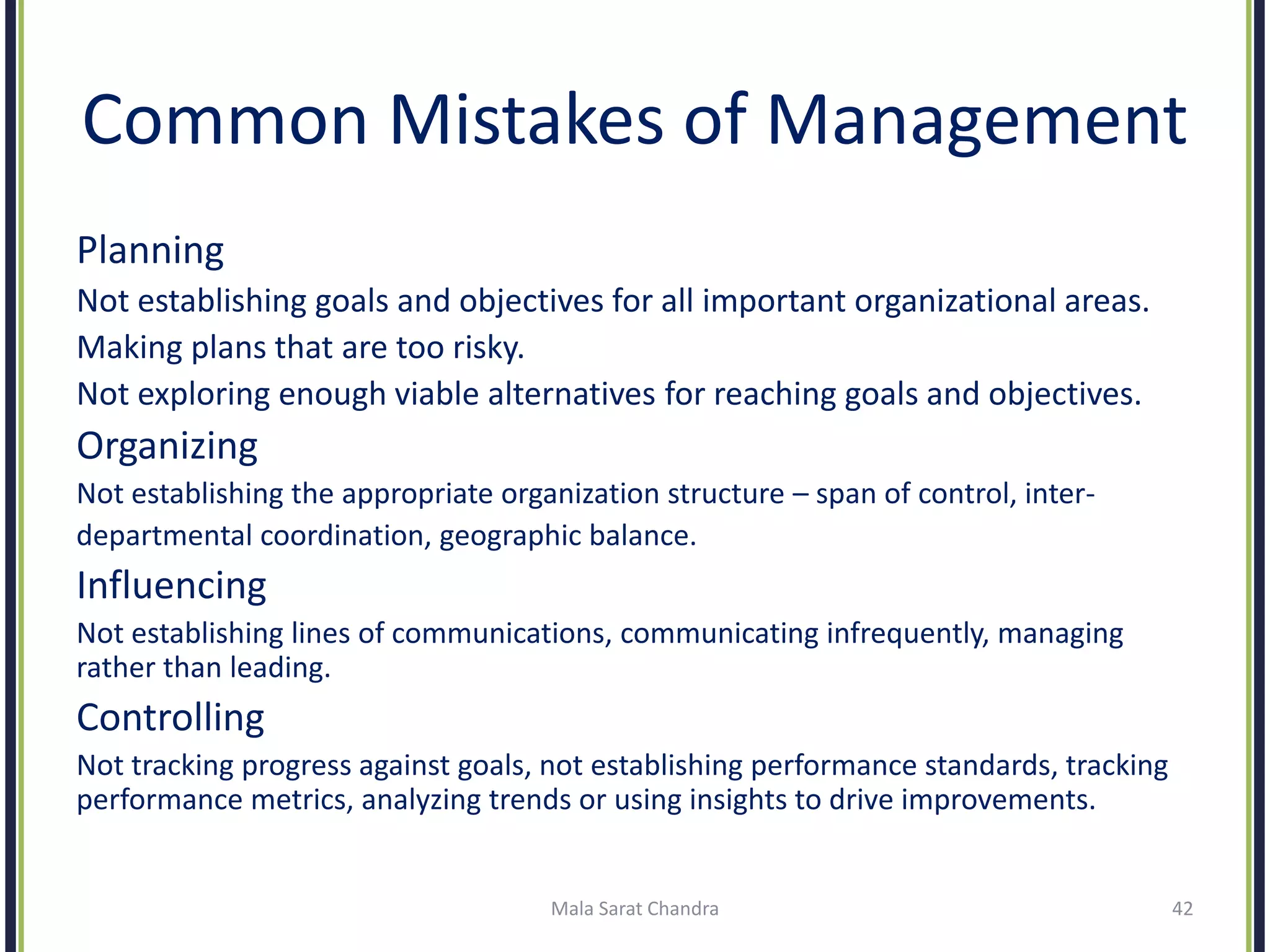
Planning
Not establishing goals and objectives for all important organizational areas.
Making plans that are too risky.
Not exploring enough viable alternatives for reaching goals and objectives.
Organizing
Not establishing the appropriate organization structure – span of control, inter-
departmental coordination, geographic balance.
Influencing
Not establishing lines of communications, communicating infrequently, managing
rather than leading.
Controlling
Not tracking progress against goals, not establishing performance standards, tracking
performance metrics, analyzing trends or using insights to drive improvements.
Mala Sarat Chandra 42
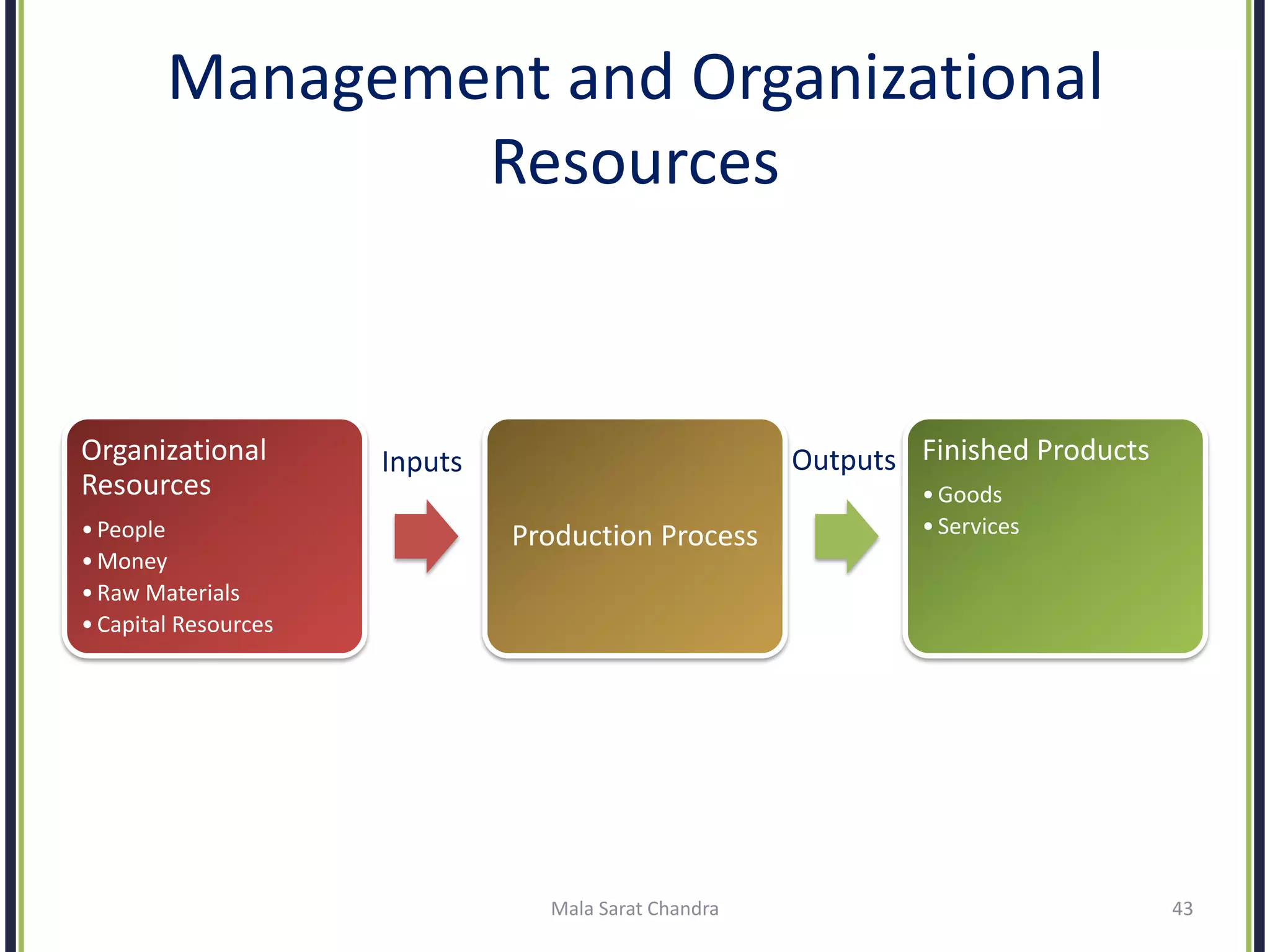
Management and Organizational
Resources
Organizational
Resources
•People
•Money
•Raw Materials
•Capital Resources
Production Process
Finished Products
•Goods
•Services
Inputs Outputs
Mala Sarat Chandra 43
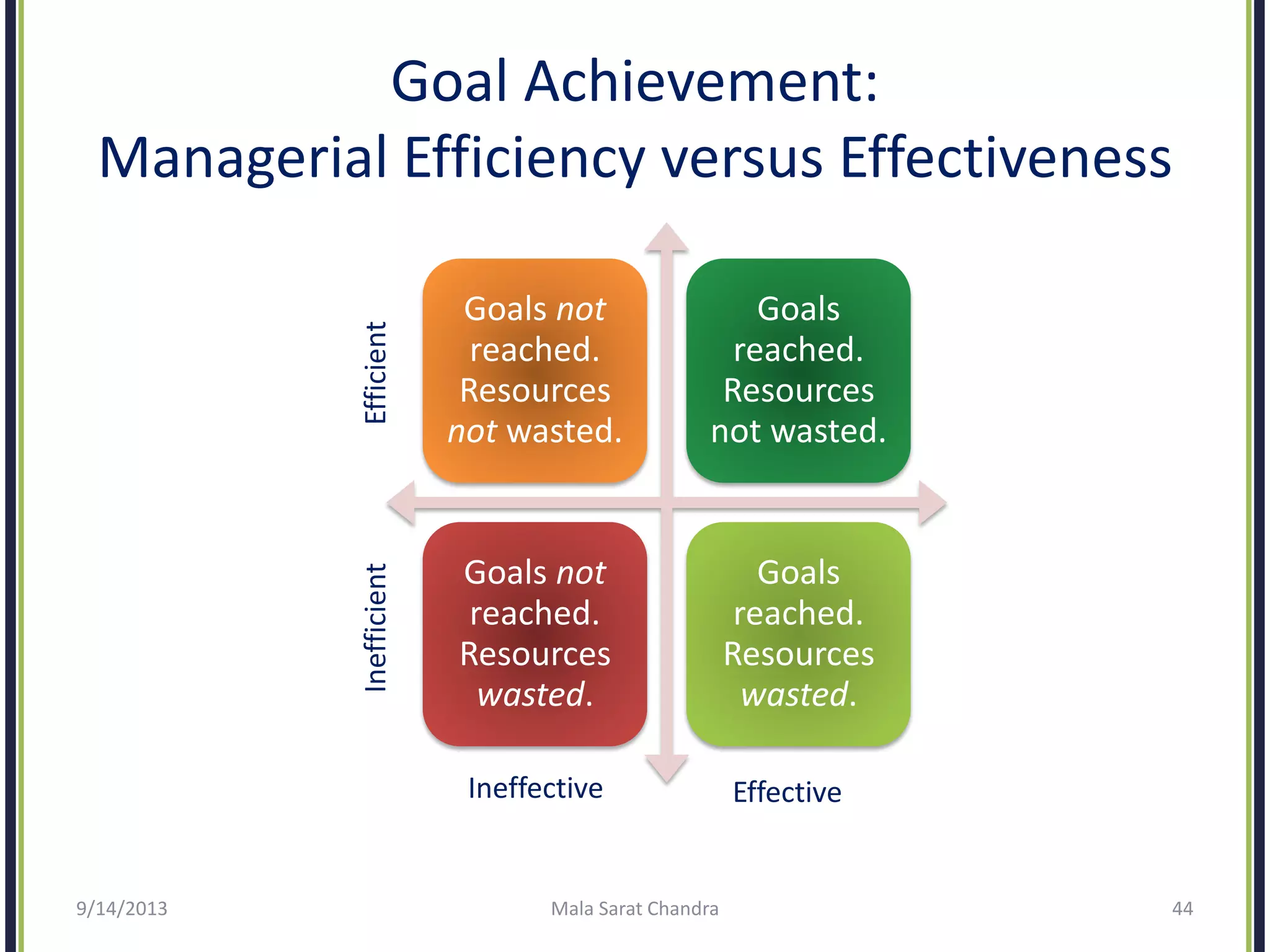
Goal Achievement:
Managerial Efficiency versus Effectiveness
Goals not
reached.
Resources
not wasted.
Goals
reached.
Resources
not wasted.
Goals not
reached.
Resources
wasted.
Goals
reached.
Resources
wasted.
9/14/2013 Mala Sarat Chandra 44
Ineffective Effective
InefficientEfficient
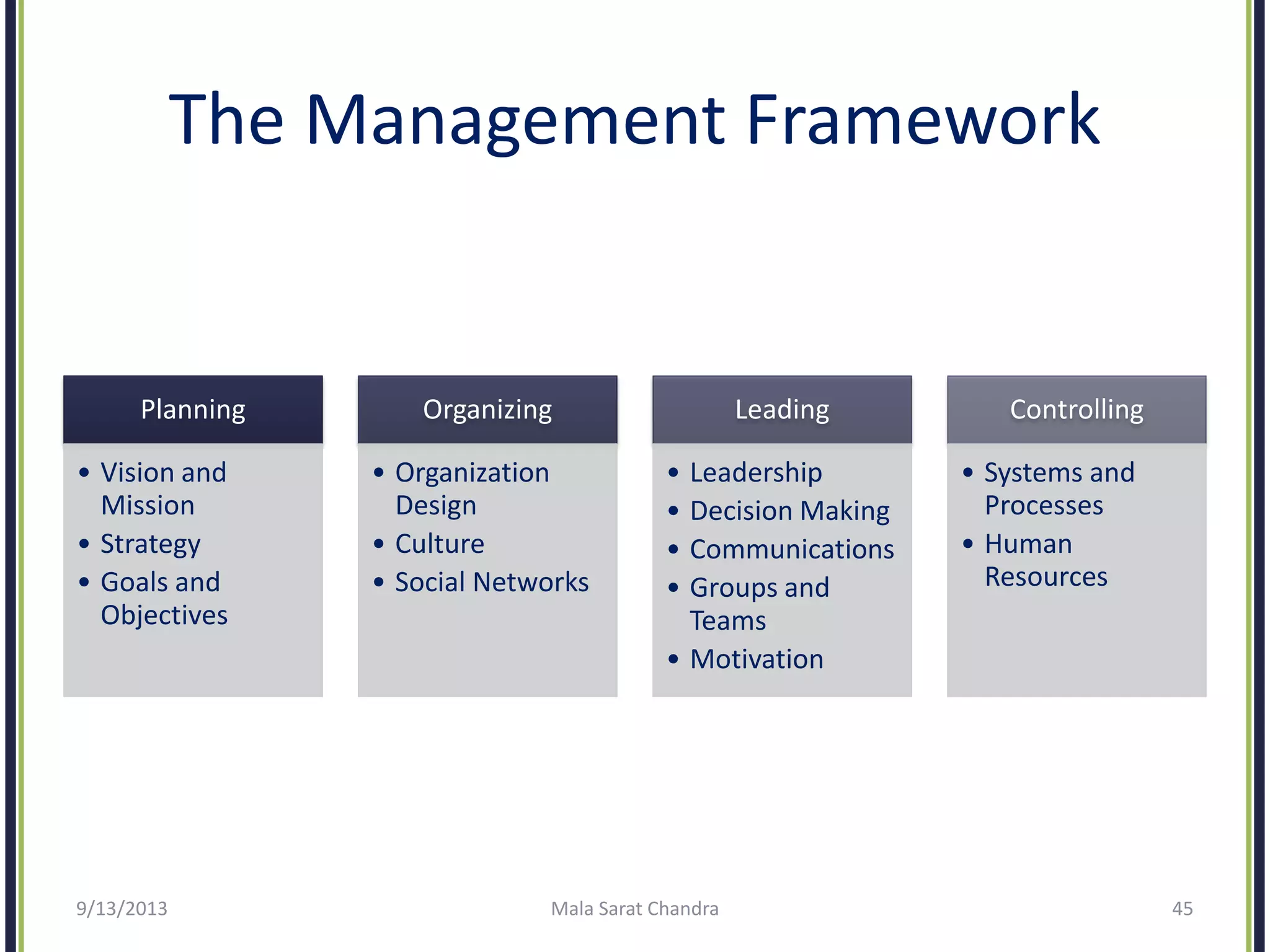
The Management Framework
Planning
• Vision and
Mission
• Strategy
• Goals and
Objectives
Organizing
• Organization
Design
• Culture
• Social Networks
Leading
• Leadership
• Decision Making
• Communications
• Groups and
Teams
• Motivation
Controlling
• Systems and
Processes
• Human
Resources
Mala Sarat Chandra 459/13/2013
The Future of Management
http://www.youtube.com/watch?v=K3-_IY66tpI
Mala Sarat Chandra 46

Evolution of management theory

  • 1.
    The Evolution ofManagement Theory Mala Sarat Chandra Twitter: @malachandra
  • 2.
    Learning Objectives Explain whata management theory is. Understand the evolution of management theories and their major contributions. 9/13/2013 Mala Sarat Chandra 2
  • 3.
  • 4.
  • 5.
    THE CLASSICAL SCHOOLOF MANAGEMENT 1900 - 1930 9/13/2013 Mala Sarat Chandra 5
  • 6.
    Core Ideas 1. Applicationof science to the practice of management. 2. Development of basic management functions. 3. Articulation and application of specific principles of management. Evolved in response to the shift from handicraft to industrial production. Emphasis is on economic rationality of people and organizations; motivated by economic incentives, they make choices that yield the greatest monetary benefits. 9/13/2013 Mala Sarat Chandra 6
  • 7.
    Max Webber 1905 “The Theoryof Social and Economic Organization” The Bureaucratic School of Management A major contribution is his “bureaucracy” theory, a formalized and idealized view of organizations, comprising 6 major principles. 1. A formal hierarchical structure. 2. Management by rules. 3. Organization by task competency. 4. Impersonal relationships. 5. A focused mission. 6. Employment based on technical qualifications. 9/13/2013 Mala Sarat Chandra 7
  • 8.
    Frederick Taylor 1911 “Principles ofScientific Management” The Scientific School of Management Proposed an objective and systematic method to identify “the one best way” to do a job using scientific selection and training methods; co-operation and clear division of responsibility between managers and workers; pay for performance. 9/13/2013 Mala Sarat Chandra 8
  • 9.
    Frank & LillianGilbreth 1912 - 1924 Time and Motion Studies Disciples of Frederick Taylor, their time and motion studies helped lay the foundations for Scientific Management – the best possible way for a worker to complete a job. The expected results are employee satisfaction, productivity and efficiency. 9/13/2013 Mala Sarat Chandra 9
  • 10.
    Henry Gantt 1910 -1915 Project Scheduling – The Gantt Chart A protégé and associate of Frederick Taylor, he designed a project scheduling model for increasing the efficiency of project execution and completion. 9/13/2013 Mala Sarat Chandra 10
  • 11.
    Henri Fayol 1916 Administration Industrielleet Generale The Administrative School of Management Managers need specific roles in order to manage work and workers. He enumerated 6 functions / roles of management. 1. Forecasting 4. Commanding 2. Planning 5. Coordinating 3. Organizing 6. Controlling These roles evolved into 14 principles of management. Division of work, Authority, Discipline, Unity of Command, Unity of Direction, Subordination of Interests, Remuneration, Centralization, Scalar Chain, Equity, Order, Stability of Tenure of Personnel, Initiative, Esprit de Corp. 9/13/2013 Mala Sarat Chandra 11
  • 12.
    Ford and FrederickTaylor’s Scientific Management http://www.youtube.com/watch?v=8PdmNbqtDdI 9/13/2013 Mala Sarat Chandra 12
  • 13.
    Summary: The ClassicalSchool of Management Scientific Concern for precise work methods Best way for jobs to be done Bureaucratic Impersonal view of organizations Formal structure, legitimate authority and competence of management Administrative Development of managerial principles Best way to organize all jobs in a business 9/13/2013 Mala Sarat Chandra 13
  • 14.
    Criticisms of TheClassical School of Management No one is entirely driven by economic motivations. People’s choices and behavior are dictated by other factors such as social needs, security and self- esteem. There is no such thing as “the best way” to do a job. Extreme division of labor tends to produce monotony and reduce overall skill levels. People are managed like machines. Introduction of newer machines led to job elimination. 9/13/2013 Mala Sarat Chandra 14
  • 15.
    THE NEO-CLASSICAL SCHOOLOF MANAGEMENT 1920 - 1950 9/13/2013 Mala Sarat Chandra 15
  • 16.
    Core Concepts Grew inreaction against the Scientific Theory of Management which emphasized standardization of jobs, processes and technologies to maximize economic return. Focus shifted to the human side of organizations. 1. The best way to motivate, structure and support employees. 2. The need for workers to find intrinsic value in their jobs. 3. The positive impact of social relationships on worker productivity. 9/13/2013 Mala Sarat Chandra 16
  • 17.
    Mary Parker Follet 1925 ThePsychological Foundations of Business Administration Pioneered the notion of participative leadership. Suggests that organizations are communities involving networks of groups. Workers and managers equally share power and responsibility for decision making and therefore, their outcomes. She introduces many contemporary concepts such as leadership, motivation and empowerment. 9/13/2013 Mala Sarat Chandra 17
  • 18.
  • 19.
    The Hawthorne Effect Productivityincreases when workers believe that they are being observed closely. Employees perform better when managers and co-workers make them feel valued. Financial rewards are not necessarily conducive to increasing worker productivity. Workers care about self-fulfillment, autonomy, empowerment, social status and personal relationships with co-workers. 9/13/2013 Mala Sarat Chandra 19
  • 20.
    Human Relations Theoryof Management Elton Mayo 1933 “The Human Poblems of an Industrial Civilization” Fritz Roethlisberger 1939 “Management and the Worker” People are social beings, motivated by social needs. A sense of identity is derived from inter-personal relationships. Workers are more receptive to social forces of peer groups than monetary incentives and management controls. Workers respond positively to attention from management, co- workers and customers. The psychological needs of individuals significantly impact group performance. 9/13/2013 Mala Sarat Chandra 20
  • 21.
    Chester Barnard 1938 The Functionsof the Executive Proposes the acceptance theory of authority, that organizational goals will be achieved and managerial authority will be accepted if workers believe that their individual needs are being met. 9/13/2013 Mala Sarat Chandra 21
  • 22.
    Behavioral Theory ofManagement The fulfillment of emotional needs of workers is important in achieving economic goals. Employee satisfaction and working conditions are important in achieving worker productivity. Workers are intrinsically motivated to work when they feel a sense of belonging and participate in decision making. Workers desire diverse and challenging work. 9/13/2013 Mala Sarat Chandra 22
  • 23.
    Abraham Maslow 1954 “Motivation andPersonality” Self Actualization Esteem Social Safety Physiological Hierarchy of Needs Theory Working Conditions and Work hours Personal and financial security Collaboration, teamwork, work-life balance Recognition and Rewards Autonomy, Empowerment 9/13/2013 Mala Sarat Chandra 23
  • 24.
    Douglas McGregor 1960 “Human sideof Enterprise” Theory X Managers Workers must be coerced and controlled to work towards organizational goals. Workers are inherently lazy, lack ambition and prefer to be directed rather than take responsibilities. Workers are self-centered and only care about themselves, not the organization. Workers dislike change and will resist it at all cost. Theory Y Managers Workers encouraged to develop their full potential will work towards achieving organizational goals. With appropriate incentives and support, workers will seek out and fulfill responsibilities on their own. Workers will apply their ingenuity, creativity and hard work to meet organizational goals. Caution: Self-Fulfilling Prophecy Workers behave as expected by managers due to the manager’s own behavior and actions. 9/13/2013 Mala Sarat Chandra 24
  • 25.
    Notable Contributors tothe Behavioral School of Management (1) Chris Argyris 1957 “Personality and Organization” Fundamental conflicts between Individual and Organizational needs. Frederick Herzberg 1959 “The Motivation to Work”. Two-factor Theory. Kurt Lewin 1944 – 1951 Model of planned change: unfreeze, change, refreeze 9/13/2013 Mala Sarat Chandra 25
  • 26.
    Notable Contributors tothe Behavioral School of Management (2) Rensis Likert 1967 “The Human Organization” Linking-pin model to bridge human relations and organizational structure George Homans 1950 “The Human Group” Extrapolates from a small group to understanding the social system. Warren Bennis 1961 “The Planning of Change” Foundation for planned organizational change and development. 9/13/2013 Mala Sarat Chandra 26
  • 27.
    Summary: Neo-Classical Schoolof Management Behavioral School is a logical extension of the Human Resource School. They are largely concerned with motivation of workers. Workers are diverse in their needs and want challenging work, participative decision-making, self-direction and control. Managers must help workers deal with situational constraints and social aspects of organizational and environmental changes. 9/13/2013 Mala Sarat Chandra 27
  • 28.
    THE MODERN SCHOOLOF MANAGEMENT 9/13/2013 Mala Sarat Chandra 28
  • 29.
    Core Concepts Dealing withcomplexity is the core of modern management theory. Organizations, Workers, Environment and the interactions between them. It is a synthesis of several theories. Behavioral science, mathematics, statistics, operations / quantitative research and computing technologies. Management is an exercise in logic applied to situations. Situations can be measured. Computers have an increasing role to play. Application of management knowledge is extended to non- business areas. Education, government, health care and others. 9/13/2013 Mala Sarat Chandra 29
  • 30.
    The Quantitative Schoolof Management Combines classical management theory and behavioral science through the use of statistical models and simulations. A major focus is on the process with which decisions are made, to ensure informed results. The quantitative school comprises Scientific Management Managers use of math and statistics for problem solving. Operations Management Managing the process of combining materials, workers and capital to produce goods and services. Management Information Systems Transforming historic, current and projected data from internal and external sources into useful, usable management information. Systems Management Theory Transforming inputs into outputs and receiving feedback. 9/13/2013 Mala Sarat Chandra 30
  • 31.
    The Systems Schoolof Management 9/13/2013 Mala Sarat Chandra 31 The Environment in which the system operates. Environmental elements have the potential to affect all or part of the system Throughput The process of converting or transforming resources within the system into a product or service Input Resources from the environment Output The product or service exported to the environment Feedback from the environment used to change & grow Ludwig von Bertalanffy 1937 “Allgemeine Systemlehre” (General Systems Theory)
  • 32.
    Types of Systems ClosedSystem Open System 9/13/2013 Mala Sarat Chandra 32 Systems and “wholeness” Guidelines for System Analysis 1. The focus of analysis is the whole, parts receive secondary attention. 2. Integration (interrelatedness of the many parts within the whole) is the key in wholeness analysis. 3. Possible modifications in each part should be weighed in relation to possible effects on every other part. 4. Each part has a role to perform so the whole can accomplish its purpose. 5. The nature of the part and its function is determined by its position in the whole. 6. All analysis starts with the existence of the whole. Parts and their relationships should evolve to best suit the purpose of the whole. Source: Modern Management by Certo & Certo
  • 33.
    The Management System Itis an open system comprising parts such as organizational resources (capital, raw materials, workers), the production process, information systems, finished goods, that are needed to achieve the organization’s goals. 9/13/2013 Mala Sarat Chandra 33 Input Process Output Customers Government Competitors Suppliers Environment
  • 34.
    The Contingency Schoolof Management (1) 9/13/2013 Mala Sarat Chandra 34 Joan Woodward 1965 “Industrial Organziation: Theory and Practice” & P. Lawrence J.W. Lorsch 1967 “Organization & Environment: Managing Differentiation and Integration” Argued that technology and production systems were critical aspects of organizational design; advanced a contingency approach to organizing. Suggested that successful organizations match their structure to the nature of the environment
  • 35.
    The Contingency Schoolof Management (2) 9/13/2013 Mala Sarat Chandra 35 Fred Edward Fiedler 1967 “A Theory of Leadership Effectiveness” Daniel Katz Robert Kahn 1966 “The Psychology of Organizations” Present a unified, open systems approach extending organizational theory beyond the boundaries of a single organization. Argued that leadership effectiveness is contingent upon two interacting factors, Leadership style and situational favourableness.
  • 36.
    Definition of anOrganization An Organization is a social system comprising subsystems of resource variables, interrelated by various management policies, practices and techniques which interact with variables in the environment to achieve a set of goals or objectives. 9/13/2013 Mala Sarat Chandra 36 Source: A General Contingency Theory of Management, Luthans and Stewart (1977) SYSTEM PERFORMANCE Environmental ManagementResource ORGANIZATIONAL PERFORMANCE CRITERIASITUATIONAL Variables and relationships in a Contingency Model of the Organization
  • 37.
    Core Concepts What managersdo depends on or is contingent on the situation at hand; it emphasizes an “if- then” relationship. If a particular situational variable exists, then managers are likely to take a particular action. Successful managers must consider the realities of the specific organizational circumstances they face when applying management concepts, principles, tools and techniques. Source: Modern Management by Certo & Certo Mala Sarat Chandra 37
  • 38.
    Challenges with theContingency Approach 1. Perceiving organizational situations as they actually exist. 2. Choosing the management tactics best suited to those situations. 3. Competently implementing those tasks. 9/13/2013 Mala Sarat Chandra 38 Source: Modern Management by Certo & Certo
  • 39.
    Summary Three distinct Schoolsof Management Classical Process Neo-Classical People Modern Integrative - People, Process, Environment 9/13/2013 Mala Sarat Chandra 39
  • 40.
    Key Concepts: Definitionof Management Management is the process of accomplishing an organization’s goals by working with and through people, utilizing all the resources available to it. The Role of Management Mala Sarat Chandra 40
  • 41.
    Key Concepts: TheRole of Management Planning Doing the right thing at the right time to accomplish organizational goals. Choose the tasks that need to be performed and decide when and how to perform those tasks. Organizing Creating a mechanism to put plans into action. Assign tasks to individuals and teams to accomplish the tasks required to accomplish organizational goals. Influencing Leading, motivating and directing an organization’s members toward accomplishing organizational goals. Increase productivity of members in the accomplishment of organizational goals and to be responsive to changing needs of the organization. Control Establishing and tracking organizational performance standards. Gather and analyze appropriate performance metrics and compare against established standards. Make organizational changes needed to meet established standards. Mala Sarat Chandra 41
  • 42.
    Common Mistakes ofManagement Planning Not establishing goals and objectives for all important organizational areas. Making plans that are too risky. Not exploring enough viable alternatives for reaching goals and objectives. Organizing Not establishing the appropriate organization structure – span of control, inter- departmental coordination, geographic balance. Influencing Not establishing lines of communications, communicating infrequently, managing rather than leading. Controlling Not tracking progress against goals, not establishing performance standards, tracking performance metrics, analyzing trends or using insights to drive improvements. Mala Sarat Chandra 42
  • 43.
    Management and Organizational Resources Organizational Resources •People •Money •RawMaterials •Capital Resources Production Process Finished Products •Goods •Services Inputs Outputs Mala Sarat Chandra 43
  • 44.
    Goal Achievement: Managerial Efficiencyversus Effectiveness Goals not reached. Resources not wasted. Goals reached. Resources not wasted. Goals not reached. Resources wasted. Goals reached. Resources wasted. 9/14/2013 Mala Sarat Chandra 44 Ineffective Effective InefficientEfficient
  • 45.
    The Management Framework Planning •Vision and Mission • Strategy • Goals and Objectives Organizing • Organization Design • Culture • Social Networks Leading • Leadership • Decision Making • Communications • Groups and Teams • Motivation Controlling • Systems and Processes • Human Resources Mala Sarat Chandra 459/13/2013
  • 46.
    The Future ofManagement http://www.youtube.com/watch?v=K3-_IY66tpI Mala Sarat Chandra 46