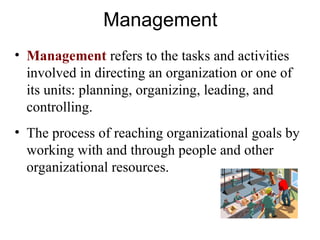
Management
• Management refersto the tasks and activities
involved in directing an organization or one of
its units: planning, organizing, leading, and
controlling.
• The process of reaching organizational goals by
working with and through people and other
organizational resources.
3.
MANAGEMENT:“ The processconcerned with the
implementation of plans through direction and
guidance of personnel, and the optimum use of
the required resources to attain the
predetermined objectives".
ADMINISTRATION: “ The process concerned with
determining goals, objectives, policies and plans
for operation of health organization”
What is "Management"?
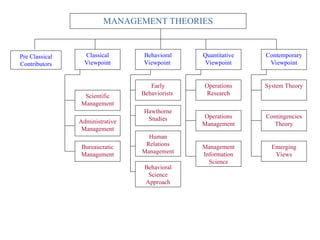
Management Theories
Pre-Classical
1. Pyramidsand Wall : 500 to 5000 years ago !
2. Adam Smith (1776)
• Scottish political economist
• Division of Labor !
Breakdown of jobs into narrow and repetitive
tasks increased productivity.
Pre-Classical (Industrial Revolution)
Robert Owen (1771 - 1858)
Entrepreneur (Scotland). Advocated concern for the
working and living conditions for the employee.
Organizations would responsible socially uplifts.
Charles Babbage (1792 - 1871)
Interest in operations of factories. Built 1st
mechanical
calculator, ideas on work (physical and mental)
specialization, production efficiency, costing, incentives
and profit – sharing plan.
Henry R. Towne (1844 - 1924)
Known as early systematizer of management.
Development of “Principles of Management
9.
Management Theories
Classical Viewpoint
1.Scientific Management
F. W. Taylor, Frank & Lillion Gilbreth
2. Bureaucratic Management
Max Weber
3. Administrative Management
Henry Fayol (France)
10.
Management Theories
Classical Viewpoint
ScientificManagement :Frederick. W. Taylor (1865 - 1915)
• Laborer to Chief Engineer (6 Year)
• Principles of Scientific Management Published (1911)
– The use of scientific methods to define “one best way”
for a job to be done!
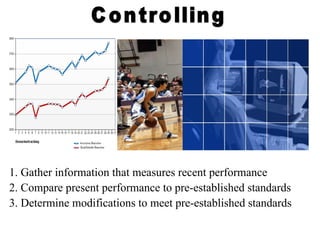
Or
An approach focusing on scientific study of work
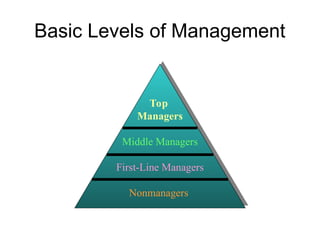
methods to improve worker’s efficiency
11.
Frederick Taylor fourPrinciples of Scientific Management
• Study of each part of a task scientifically, and develop
a best method to perform it.
• Carefully select workers and train them to perform a
task using the scientifically developed method.
• Cooperate fully with workers to ensure they use the
proper method.
• Divide work and responsibility so management is
responsible for planning work method using scientific
principles and workers are responsible for executing
work accordingly.
12.
Scientific Management :Frank &Lillion Gilbreth
Use of motion pictures to study hand-and-body
movements
Time and motion studies Human implications of
Scientific Management
Focused on increasing worker productivity through
the reduction of wasted motion
Classical Viewpoint
13.
How do Today'sManagers use
scientific management?
• Using time and motion studies
• Hiring best qualified workers
• Designing incentive systems based on output
14.
Administrative Management
• Seeksto create an organization that leads to both
efficiency and effectiveness.(effective is about
doing the right things, while being efficient is
about doing things right.)
• Max Weber developed the concept of bureaucracy.
– A formal system of organization and administration
to ensure effectiveness and efficiency.
– Weber developed the bureaucratic principles
15.
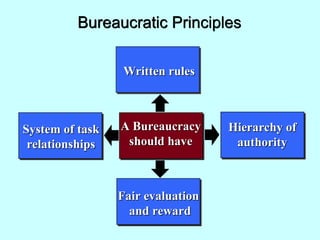
Bureaucratic Principles
A Bureaucracy
ABureaucracy
should have
should have
Written rules
Written rules
System of task
System of task
relationships
relationships
Hierarchy of
Hierarchy of
authority
authority
Fair evaluation
Fair evaluation
and reward
and reward
16.
Key points ofBureaucracy
Authority is the power to hold people accountable for
their actions.
Positions in the firm should be held based on
performance not social contacts.
Position duties are clearly identified. People should
know what is expected of them.
Lines of authority should be clearly identified. Workers
know who reports to who.
Rules, Standard Operating Procedures (SOPs), &
Norms used to determine how the firm operates.
17.
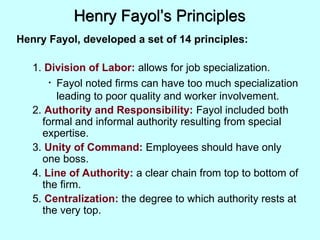
Henry Fayol’s Principles
HenryFayol, developed a set of 14 principles:
1. Division of Labor: allows for job specialization.
• Fayol noted firms can have too much specialization
leading to poor quality and worker involvement.
2. Authority and Responsibility: Fayol included both
formal and informal authority resulting from special
expertise.
3. Unity of Command: Employees should have only
one boss.
4. Line of Authority: a clear chain from top to bottom of
the firm.
5. Centralization: the degree to which authority rests at
the very top.
18.
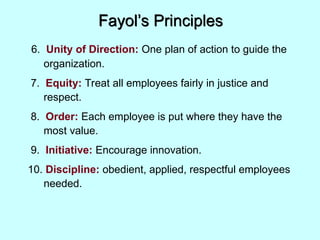
Fayol’s Principles
6. Unityof Direction: One plan of action to guide the
organization.
7. Equity: Treat all employees fairly in justice and
respect.
8. Order: Each employee is put where they have the
most value.
9. Initiative: Encourage innovation.
10. Discipline: obedient, applied, respectful employees
needed.
19.
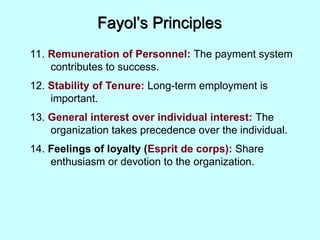
Fayol’s Principles
11. Remunerationof Personnel: The payment system
contributes to success.
12. Stability of Tenure: Long-term employment is
important.
13. General interest over individual interest: The
organization takes precedence over the individual.
14. Feelings of loyalty (Esprit de corps): Share
enthusiasm or devotion to the organization.
20.
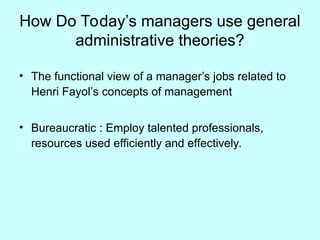
How Do Today’smanagers use general
administrative theories?
• The functional view of a manager’s jobs related to
Henri Fayol’s concepts of management
• Bureaucratic : Employ talented professionals,
resources used efficiently and effectively.
21.
Behavioral View PointManagement
• Focuses on the way a manager should personally
manage to motivate employees.
• Mary Parker Follett: an influential leader in early
managerial theory.
– Suggested workers help in analyzing their jobs
for improvements.
– The worker knows the best way to improve the
job.
– If workers have the knowledge of the task, then
they should control the task.
22.
The Hawthorne Studies
•Study of worker efficiency at the Hawthorne
Works of the Western Electric Co. during 1924-
1932.
– Worker productivity was measured at various
levels of light illumination.
– Researchers found that regardless of whether
the light levels were raised or lowered,
productivity rose.
• Actually, it appears that the workers enjoyed
the attention they received as part of the study
and were more productive.
23.
Human relations theory-1930s & 1940s
Principles of Human Relations Approach
The basic principles of human relations approach are :-
1. Need recognition and appreciation.
2. Workers are human beings.
3. Formal and informal relations
4. Workers need a high degree of job security and job
satisfaction.
5. Workers want good communication from the managers.
6. In any organisation, members do not like conflicts and
misunderstandings.
7. Workers want freedom.
8. Employees would like to participate in decision making
24.
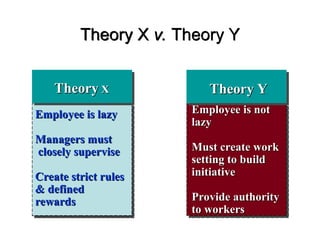
Theory X andY
Douglas McGregor proposed the two different sets of
worker assumptions.
Theory X: Assumes the average worker is lazy,
dislikes work and will do as little as possible.
• Managers must closely supervise and control
through reward and punishment.
Theory Y: Assumes workers are not lazy, want to do a
good job and the job itself will determine if the worker
likes the work.
• Managers should allow the worker great latitude,
and create an organization to stimulate the worker.
25.
Theory X v.Theory Y
Theory Y
Theory Y
Employee is not
Employee is not
lazy
lazy
Must create work
Must create work
setting to build
setting to build
initiative
initiative
Provide authority
Provide authority
to workers
to workers
Theory
Theory X
X
Employee is lazy
Employee is lazy
Managers must
Managers must
closely supervise
closely supervise
Create strict rules
Create strict rules
& defined
& defined
rewards
rewards
26.
How Do Today’sManagers use he
behavioral approach?
• Assists managers in designing jobs that motivates
workers
• Facilitating flow of communication
• Provides foundation of motivation, leadership and
group behaviour and development
27.
Quantitative Management Approach
•Originated during world war II –solution to military
problems through mathematics and statistics
• Know as operations research or management sciences.
• Used to improve decision making ( approaches includes
of statistics, optimization models, information model,
computer simulation)
28.
How Do Today’sManager Use the
Quantitative Approach?
• Managerial decision making, particularly
planning and controlling
• Computer software programme : use of
quantitative technique more feasible for
manager
Systems Thinking
• Viewsan organization as a system
• A system is a group of people working together
for a common purpose
• An organization can contain subsystems
(smaller groups working together for a
common purpose that serves the overall goals
of the larger system)
• Important to recognize an organization as an
open system, one that is affected by, and can
affect, its environment
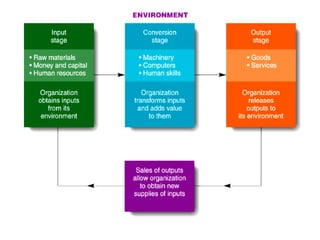
32.
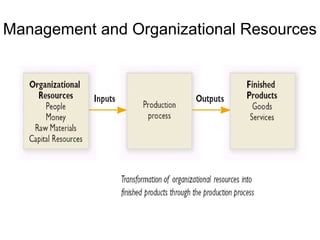
The Open-Systems View
–Inputs: the acquisition of external resources
to produce goods and services
– Conversion: transforms the inputs into
outputs of finished goods and services.
– Output: the release of finished goods and
services to its external environment.
33.
Closed System
• Aself-contained system that is not
affected by changes in its external
environment.
34.
Contingency Thinking
• Thereis no one single style of management
that suits all organizations/situations
• The most effective management style will
vary depending on the type of organization, its
size, its environment, and the particular
situation/problem it faces at the time
• Sometimes a bureaucratic organization is most
effective, sometimes a more loosely structured
one; sometimes a more classical approach is
best, sometimes a more modern one
35.
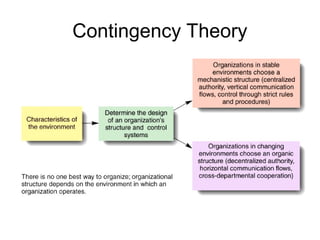
Contingency Theory
• Assumesthere is no one best way to manage.
– The environment impacts the organization and
managers must be flexible to react to
environmental changes.
– The way the organization is designed, control
systems selected, depend on the environment.
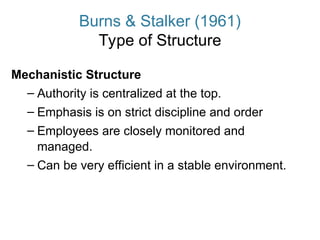
Burns & Stalker(1961)
Type of Structure
Mechanistic Structure
– Authority is centralized at the top.
– Emphasis is on strict discipline and order
– Employees are closely monitored and
managed.
– Can be very efficient in a stable environment.
38.
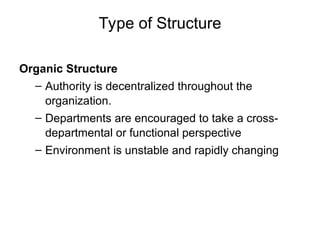
Type of Structure
OrganicStructure
– Authority is decentralized throughout the
organization.
– Departments are encouraged to take a cross-
departmental or functional perspective
– Environment is unstable and rapidly changing
39.
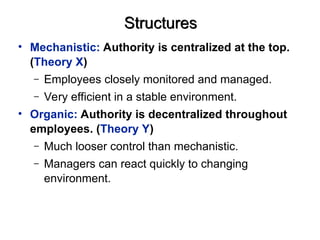
Structures
• Mechanistic: Authorityis centralized at the top.
(Theory X)
– Employees closely monitored and managed.
– Very efficient in a stable environment.
• Organic: Authority is decentralized throughout
employees. (Theory Y)
– Much looser control than mechanistic.
– Managers can react quickly to changing
environment.
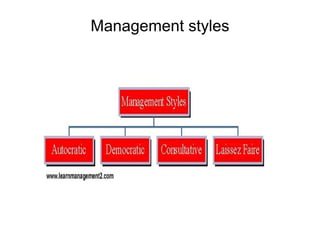
Democratic Management Style
A democratic manager delegates authority to his/her
staff, giving them responsibility to complete the task given
to them (also known as empowerment).
Staff will complete the tasks using their own work
methods. However, the task must be completed on time.
Employees are involved in decision making giving them a
sense of belonging and motivating individuals. Because
staff feel a sense of belonging and are motivated the
quality of decision making and work also improves.
42.
Autocratic Management Style
In contrast an autocratic manager dictates
orders to their staff and makes decisions without
any consultation.
The leader likes to control the situation they are
in.
Decisions are quick because staff are not
consulted and work is usually completed on
time.
43.
Consultative Management style
•A consultative management style can be viewed
as a combination of the previous two.
• The manager will ask views and opinions from
their staff, allowing them to feel involved, but will
ultimately make the final decision.
44.
Laissez Faire Managementstyle
• A laissez faire manager sets the tasks and
gives staff complete freedom to complete the
task as they see fit.
• There is minimal involvement from the
manager.
• The manager however does not sit idle and
watch them work! He or she is there to coach
or answer questions, supply information if
required.
NURSING MANAGEMENT: Isthe body of
knowledge related to performing the
functions of planning, organizing, staffing,
directing and controlling (evaluating) the
activities of a nursing in departmental
subunits.
47.
Nurse Manager:
Person whois responsible for translating the
administration's vision into operating plans and
acting in the middle and first-line levels of
hierarchy.
Organization:
It is a collection of people working together under a
division of labor and a hierarchy of authority to
achieve a common goal.
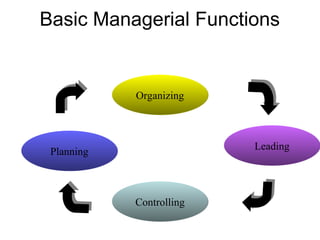
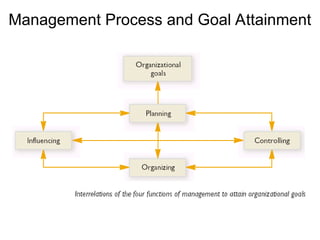
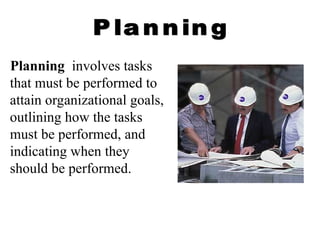
Planning involves tasks
thatmust be performed to
attain organizational goals,
outlining how the tasks
must be performed, and
indicating when they
should be performed.
52.
Chapter 1: PowerPoint1.11
Planning
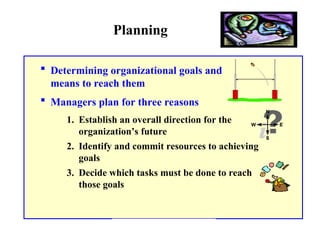
Determining organizational goals and
means to reach them
Managers plan for three reasons
1. Establish an overall direction for the
organization’s future
2. Identify and commit resources to achieving
goals
3. Decide which tasks must be done to reach
those goals
53.
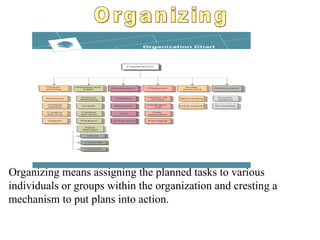
Organizing means assigningthe planned tasks to various
individuals or groups within the organization and cresting a
mechanism to put plans into action.
54.
Chapter 1: PowerPoint1.13
Organizing
Process of deciding where decisions will be made, who
will perform what jobs and tasks, and who will report
to whom in the company
Includes creating departments and job descriptions
55.
Leading (Influencing) meansguiding the activities of
the organization members in appropriate directions.
Objective is to improve productivity.
56.
Chapter 1: PowerPoint1.14
Leading
Getting others to perform the
necessary tasks by motivating them to
achieve the organization’s goals
Crucial element in all functions
Discussed throughout the book and in
depth in Chapter 15—Dynamics of
Leadership
57.
1. Gather informationthat measures recent performance
2. Compare present performance to pre-established standards
3. Determine modifications to meet pre-established standards
58.
Chapter 1: PowerPoint1.15
Controlling
Process by which a person, group,
or
organization consciously monitors
performance and takes corrective
action
59.
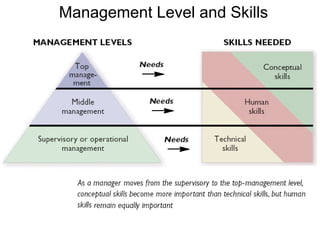
Basic Levels ofManagement
Top
Managers
Middle Managers
First-Line Managers
Nonmanagers
60.
Chapter 1: PowerPoint1.19
Top Managers
Responsible for providing the overall direction of an
organization
Develop goals and strategies for entire organization
Spend most of their time planning and leading
Communicate with key stakeholders—stockholders,
unions, governmental agencies, etc., company
policies
• Top Managers: provide the overall direction of an organization Chief
Executive Officer, President, Vice President
61.
Levels of Management
•Middle Managers:
– Coordinate employee activities
– Determine which goods or services to provide
– Decide how to market goods or services to
customers
Assistant Manager, Manager (Section Head)
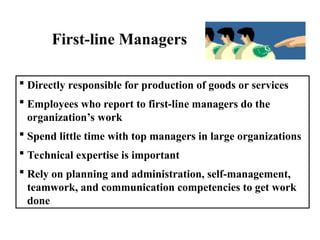
62.
Chapter 1: PowerPoint1.17
First-line Managers
Directly responsible for production of goods or services
Employees who report to first-line managers do the
organization’s work
Spend little time with top managers in large organizations
Technical expertise is important
Rely on planning and administration, self-management,
teamwork, and communication competencies to get work
done
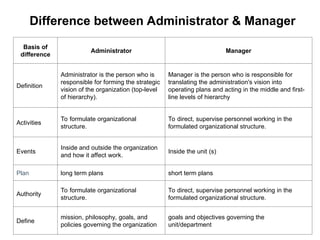
Difference between Administrator& Manager
Definition
• Administrator is the person who is responsible for
forming the strategic vision of the organization
(top-level of hierarchy).
• Manager is the person who is responsible for
translating the administration's vision into
operating plans and acting in the middle and first-
line levels of hierarchy
65.
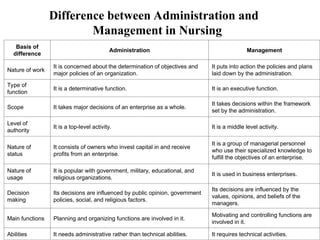
Difference between Administrationand
Management in Nursing
Basis of
difference
Administration Management
Nature of work
It is concerned about the determination of objectives and
major policies of an organization.
It puts into action the policies and plans
laid down by the administration.
Type of
function
It is a determinative function. It is an executive function.
Scope It takes major decisions of an enterprise as a whole.
It takes decisions within the framework
set by the administration.
Level of
authority
It is a top-level activity. It is a middle level activity.
Nature of
status
It consists of owners who invest capital in and receive
profits from an enterprise.
It is a group of managerial personnel
who use their specialized knowledge to
fulfill the objectives of an enterprise.
Nature of
usage
It is popular with government, military, educational, and
religious organizations.
It is used in business enterprises.
Decision
making
Its decisions are influenced by public opinion, government
policies, social, and religious factors.
Its decisions are influenced by the
values, opinions, and beliefs of the
managers.
Main functions Planning and organizing functions are involved in it.
Motivating and controlling functions are
involved in it.
Abilities It needs administrative rather than technical abilities. It requires technical activities.
66.
Difference between Administrator& Manager
Basis of
difference
Administrator Manager
Definition
Administrator is the person who is
responsible for forming the strategic
vision of the organization (top-level
of hierarchy).
Manager is the person who is responsible for
translating the administration's vision into
operating plans and acting in the middle and first-
line levels of hierarchy
Activities
To formulate organizational
structure.
To direct, supervise personnel working in the
formulated organizational structure.
Events
Inside and outside the organization
and how it affect work.
Inside the unit (s)
Plan long term plans short term plans
Authority
To formulate organizational
structure.
To direct, supervise personnel working in the
formulated organizational structure.
Define
mission, philosophy, goals, and
policies governing the organization
goals and objectives governing the
unit/department
67.
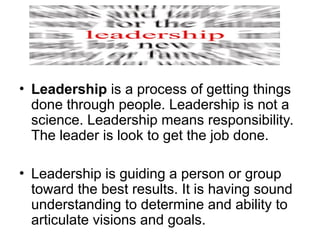
• Leadership isa process of getting things
done through people. Leadership is not a
science. Leadership means responsibility.
The leader is look to get the job done.
• Leadership is guiding a person or group
toward the best results. It is having sound
understanding to determine and ability to
articulate visions and goals.
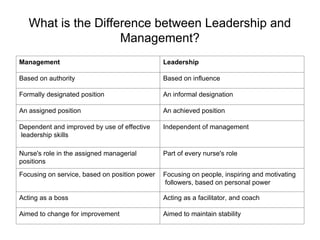
68.
Management Leadership
Based onauthority Based on influence
Formally designated position An informal designation
An assigned position An achieved position
Dependent and improved by use of effective
leadership skills
Independent of management
Nurse's role in the assigned managerial
positions
Part of every nurse's role
Focusing on service, based on position power Focusing on people, inspiring and motivating
followers, based on personal power
Acting as a boss Acting as a facilitator, and coach
Aimed to change for improvement Aimed to maintain stability
What is the Difference between Leadership and
Management?
69.
References
• Rigolosi, E.(2005). Management and leadership in
nursing and health care: An experiential approach. (2nd
ed.). New York: Springer Publishing Company, Inc.
• Whetten, D. A. & Cameron, K. S. (2005). Developing
management skills. Upper Saddle River,NJ: Pearson
Prentice Hall.
• Bertalananffy L. von 'Problems of General Systems
Theory : A New Approach to the Unity of Science'
Human Biology, vol 23,no 4, December 1951 Pgs 302-
312
70.
References
• Luhmann N.'Social Systems', Frankfurt, Suhrkamp,
1994
• Miller E.J and Rice A.K 'Systems of Organization',
Tavistock Publications (1967)
• Schein EH, Bennis WG. Personal and Organizational
change through Group Methods: The laboratory
approach. New York: John Wiley & Sons, 1965.
• Trist E.L et al 'Organizational Choice', Tavistock
Publications (1963)



![CTEV [ clubfoot] DR ARUN LAL ,DR MOHAMED ASHRAF travancore medical college k...](https://cdn.slidesharecdn.com/ss_thumbnails/ctevclubfootdrarunlaldrmohamedashraftravancoremedicalcollegekollamkeralaindia-260208063247-18fc466c-thumbnail.jpg?width=640&height=640&fit=bounds)


