Evolution Of
Management
Thought
Introduction
Introduction
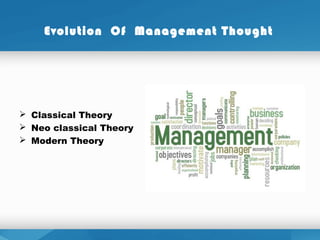
Evolution Of Management Thought
 Classical Theory
 Neo classical Theory
 Modern Theory
Definition of classical approach
 Classical approach is the oldest
formal school of thought which began
around 1900 and continued into the
1920s.
 Its mainly concerned with the
increasing the efficiency of workers
and organizations based on
management practices, which were
an outcome of careful observation.
 Classical approach mainly looks for
the universal principles of operation in
the striving for economic efficiency.
 Classical approach includes scientific.
Administrative & bureaucratic
management.
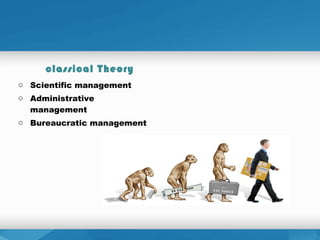
classical Theory
o Scientific management
o Administrative
management
o Bureaucratic management
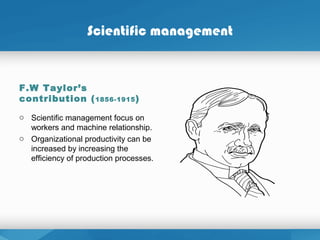
Scientific management
F.W Taylor’s
contribution (1856-1915)
o Scientific management focus on
workers and machine relationship.
o Organizational productivity can be
increased by increasing the
efficiency of production processes.
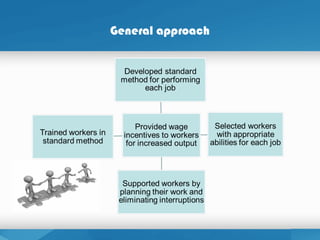
General approach
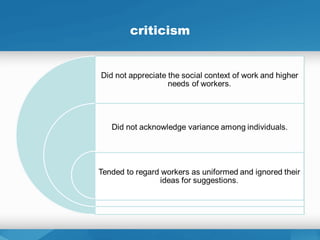
criticism
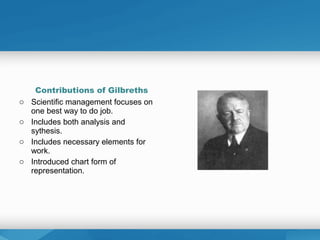
Contributions of Gilbreths
o Scientific management focuses on
one best way to do job.
o Includes both analysis and
sythesis.
o Includes necessary elements for
work.
o Introduced chart form of
representation.
Administrative management
Administrative management focuses on the managers and
the use or principles and functions for improving organizational functioning.
The administrative management school treated as management as a
process get work done through and with people.
Henri Fayol, James D Mooney, Alan C Reilly are the pioneer
contributors to the administrative management though.
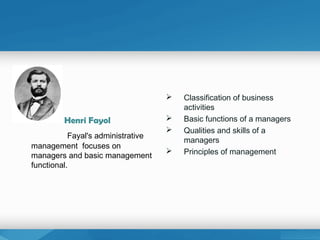
Henri Fayol
Fayal's administrative
management focuses on
managers and basic management
functional.
 Classification of business
activities
 Basic functions of a managers
 Qualities and skills of a
managers
 Principles of management
Classification of business
activities
Fayol divided activities into following
six groups
 Technical activities
 Commercial activities
 Financial activities
 Security activities
 Accounting activities
 Managerial activities
Basic functions of a
manager
o Planning
o Organising
o Commanding
o Coordinating
o Controlling
Qualities and skills of a
manager
o Physical quality
o Mental quality
o Moral education
o Special knowledge
o Experience
Basic principles of
management
o Division of work
o Authority and responsibility
o Discipline
o Unity of command
o Unity of direction
o Remuneration
o Centralisation
o Scalar chain
o Order
o Equity
o Initiative
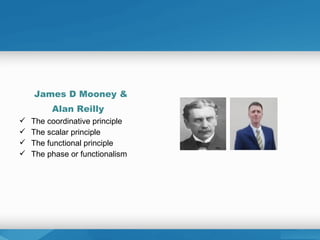
James D Mooney &
Alan Reilly
 The coordinative principle
 The scalar principle
 The functional principle
 The phase or functionalism
Evolution
Let us evaluate administrative
mgt approach in terms of it’s
strength and limitations from the
view point of development mgt
though Theory of authority
structures
 Charismatic authority structure
 Traditional authority structure
 Rational legal authority structure
BUREAUCRATIC MANAGEMENT
 Max Weber [1864-1920 ].
 Rules and regulations to eliminate managerial inconsistencies.
 Authority is the power to hold people accountable for their actions.
 Positions in the firm should be held based on performance not social
contacts.
 Position duties are clearly identified. People should know what is expected
of them.
 Lines of authority should be clearly identified. Workers know who reports to
who.
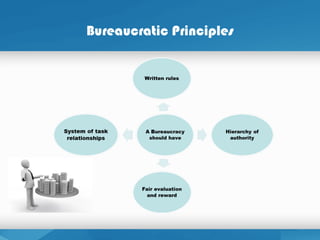
Bureaucratic Principles
o Division of work
o Hierarchy of position
o Rules and regulations
o Impersonal conduct
o Staffing
o Technical competence
o Official records
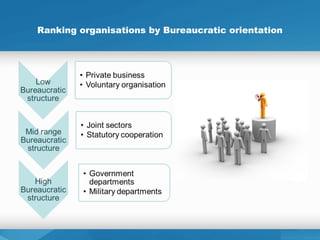
Ranking organisations by Bureaucratic orientation
Contribution of classical management
o The identification of mgt functions such as planning, decision making,
organising and controlling provide.
o The contributions of the classical school go beyond the important work and
identifying mgt field and its functions and principles.
Limitations
The classical school of mgt throught heavily on the concept or economic
man, which placed emphasis on an individuals related pursuit or economic
objective. However the social needs or employees were neglected.
Neoclassical Theory
o Also known as “Behavioural science approach to modifying and improving
the classical theory”.
o Neoclassical theory gives importance to human and social aspects of the
water and his relations in the organization.
Elements of Neoclassical theory
 Hawthorne Experiment
 Human Relations Management
 Behavioural science approach
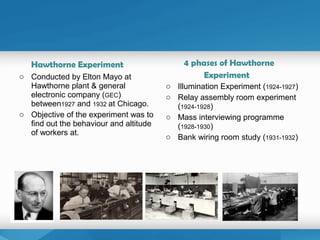
Hawthorne Experiment
o Conducted by Elton Mayo at
Hawthorne plant & general
electronic company (GEC)
between1927 and 1932 at Chicago.
o Objective of the experiment was to
find out the behaviour and altitude
of workers at.
4 phases of Hawthorne
Experiment
o Illumination Experiment (1924-1927)
o Relay assembly room experiment
(1924-1928)
o Mass interviewing programme
(1928-1930)
o Bank wiring room study (1931-1932)
Critiesms of Hawthorne
experiment
o Lack validity
o More importance to human
aspects
o Emphasising on group decision
making
o It was not concluded scientifically
o Over importance to freedom of
workers
Human Relation Movement
Human relation is involving people in org in order to develop
team work which effectively fulfils their needs and achieve org goals.
Features are :
 Positive work environment
 Focus in on people
 Sound human relations
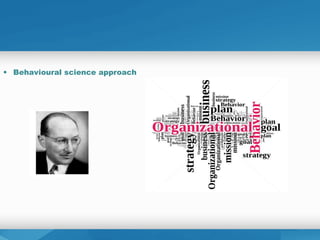
• Behavioural science approach
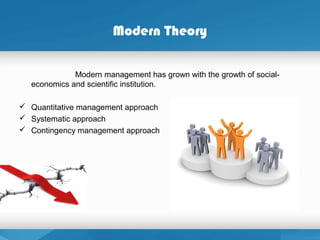
Modern Theory
Modern management has grown with the growth of social-
economics and scientific institution.
 Quantitative management approach
 Systematic approach
 Contingency management approach
Quantitative Approach
o Quantitative approach also called Operation Research
o Scientific Method
o Decision Making
Major contributors in Quantitative approach are : Johan MacDonald,
George R Terry, Andrew Szilagyi.
Systematic approach
 The system approach to management is essentially a way of thinking about
organizations and management problems
 From the system perspective management should focus on efficiency and
effectiveness in each part of the organization affect other parts of the
organization
Advantages
o Good basis of control.
o Develops coordination on
specialized activities.
o Efficient plan of action.
o It concentrates on end results
rather than means.
o Abstract approach.
o Lack of universality.
Disadvantages
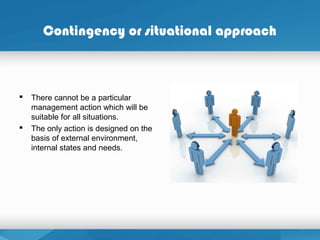
Contingency or situational approach
 There cannot be a particular
management action which will be
suitable for all situations.
 The only action is designed on the
basis of external environment,
internal states and needs.
Advantages
o Enables management to change
employee roles to meet individual
needs.
o Reactive model of business
management.
Disadvantages
o Inadequate literature.
o Complex.
o Difficult empirical testing.
o Reactive not proactive.
Recent Developments in Management Thought
 Total quality management (TQM)
 Search for excellence
Search for Excellence
o A bias for action
o Closeness to the customer
o Autonomy and entrepreneurship
o Productivity through people
o Hands on, value drive
o Stick to knitting
o Simple form, learn staff
o Simultaneous loose-tight properties
o Leadership-Management by Wandering Around
Let us sum up
Evolution of  management thought

Evolution of management thought

  • 1.
  • 2.
  • 3.
  • 4.
    Evolution Of ManagementThought  Classical Theory  Neo classical Theory  Modern Theory
  • 5.
    Definition of classicalapproach  Classical approach is the oldest formal school of thought which began around 1900 and continued into the 1920s.  Its mainly concerned with the increasing the efficiency of workers and organizations based on management practices, which were an outcome of careful observation.  Classical approach mainly looks for the universal principles of operation in the striving for economic efficiency.  Classical approach includes scientific. Administrative & bureaucratic management.
  • 6.
    classical Theory o Scientificmanagement o Administrative management o Bureaucratic management
  • 7.
    Scientific management F.W Taylor’s contribution(1856-1915) o Scientific management focus on workers and machine relationship. o Organizational productivity can be increased by increasing the efficiency of production processes.
  • 8.
  • 9.
  • 10.
    Contributions of Gilbreths oScientific management focuses on one best way to do job. o Includes both analysis and sythesis. o Includes necessary elements for work. o Introduced chart form of representation.
  • 11.
    Administrative management Administrative managementfocuses on the managers and the use or principles and functions for improving organizational functioning. The administrative management school treated as management as a process get work done through and with people. Henri Fayol, James D Mooney, Alan C Reilly are the pioneer contributors to the administrative management though.
  • 12.
    Henri Fayol Fayal's administrative managementfocuses on managers and basic management functional.  Classification of business activities  Basic functions of a managers  Qualities and skills of a managers  Principles of management
  • 13.
    Classification of business activities Fayoldivided activities into following six groups  Technical activities  Commercial activities  Financial activities  Security activities  Accounting activities  Managerial activities
  • 14.
    Basic functions ofa manager o Planning o Organising o Commanding o Coordinating o Controlling Qualities and skills of a manager o Physical quality o Mental quality o Moral education o Special knowledge o Experience
  • 15.
    Basic principles of management oDivision of work o Authority and responsibility o Discipline o Unity of command o Unity of direction o Remuneration o Centralisation o Scalar chain o Order o Equity o Initiative
  • 16.
    James D Mooney& Alan Reilly  The coordinative principle  The scalar principle  The functional principle  The phase or functionalism
  • 17.
    Evolution Let us evaluateadministrative mgt approach in terms of it’s strength and limitations from the view point of development mgt though Theory of authority structures  Charismatic authority structure  Traditional authority structure  Rational legal authority structure
  • 18.
    BUREAUCRATIC MANAGEMENT  MaxWeber [1864-1920 ].  Rules and regulations to eliminate managerial inconsistencies.  Authority is the power to hold people accountable for their actions.  Positions in the firm should be held based on performance not social contacts.  Position duties are clearly identified. People should know what is expected of them.  Lines of authority should be clearly identified. Workers know who reports to who.
  • 19.
  • 20.
    Bureaucratic Principles o Divisionof work o Hierarchy of position o Rules and regulations o Impersonal conduct o Staffing o Technical competence o Official records
  • 21.
    Ranking organisations byBureaucratic orientation
  • 22.
    Contribution of classicalmanagement o The identification of mgt functions such as planning, decision making, organising and controlling provide. o The contributions of the classical school go beyond the important work and identifying mgt field and its functions and principles. Limitations The classical school of mgt throught heavily on the concept or economic man, which placed emphasis on an individuals related pursuit or economic objective. However the social needs or employees were neglected.
  • 23.
    Neoclassical Theory o Alsoknown as “Behavioural science approach to modifying and improving the classical theory”. o Neoclassical theory gives importance to human and social aspects of the water and his relations in the organization. Elements of Neoclassical theory  Hawthorne Experiment  Human Relations Management  Behavioural science approach
  • 24.
    Hawthorne Experiment o Conductedby Elton Mayo at Hawthorne plant & general electronic company (GEC) between1927 and 1932 at Chicago. o Objective of the experiment was to find out the behaviour and altitude of workers at. 4 phases of Hawthorne Experiment o Illumination Experiment (1924-1927) o Relay assembly room experiment (1924-1928) o Mass interviewing programme (1928-1930) o Bank wiring room study (1931-1932)
  • 25.
    Critiesms of Hawthorne experiment oLack validity o More importance to human aspects o Emphasising on group decision making o It was not concluded scientifically o Over importance to freedom of workers
  • 26.
    Human Relation Movement Humanrelation is involving people in org in order to develop team work which effectively fulfils their needs and achieve org goals. Features are :  Positive work environment  Focus in on people  Sound human relations
  • 27.
  • 28.
    Modern Theory Modern managementhas grown with the growth of social- economics and scientific institution.  Quantitative management approach  Systematic approach  Contingency management approach
  • 29.
    Quantitative Approach o Quantitativeapproach also called Operation Research o Scientific Method o Decision Making Major contributors in Quantitative approach are : Johan MacDonald, George R Terry, Andrew Szilagyi.
  • 30.
    Systematic approach  Thesystem approach to management is essentially a way of thinking about organizations and management problems  From the system perspective management should focus on efficiency and effectiveness in each part of the organization affect other parts of the organization
  • 31.
    Advantages o Good basisof control. o Develops coordination on specialized activities. o Efficient plan of action. o It concentrates on end results rather than means. o Abstract approach. o Lack of universality. Disadvantages
  • 32.
    Contingency or situationalapproach  There cannot be a particular management action which will be suitable for all situations.  The only action is designed on the basis of external environment, internal states and needs.
  • 33.
    Advantages o Enables managementto change employee roles to meet individual needs. o Reactive model of business management. Disadvantages o Inadequate literature. o Complex. o Difficult empirical testing. o Reactive not proactive.
  • 34.
    Recent Developments inManagement Thought  Total quality management (TQM)  Search for excellence
  • 35.
    Search for Excellence oA bias for action o Closeness to the customer o Autonomy and entrepreneurship o Productivity through people o Hands on, value drive o Stick to knitting o Simple form, learn staff o Simultaneous loose-tight properties o Leadership-Management by Wandering Around
  • 36.