EVALUATION
By M.Ed. Maria Luisa Mu
Why
• To improve capabilities
in the evaluation of
students achievement.
• To help our students to
learn how to learn
• To be more accountable
to students
• To improve the
expertise in students’
evaluation.
Definition
• Activity 1:
• Rearrange the following words to complete the
definition of Evaluation.
Evaluation
“Evaluation is considered a critical element
that influences teacher decision making
and guides student learning.”
Guiding Principles
• Activity 2:
Use the words provided to complete the sentences
specifying the guiding principles behind
evaluation.
Useful Words
Concepts
• Norm-referenced standards:
• We need to compare assessment data
with typical data collected from
comparable people.
• Criterion-referenced standards:
• We need to compare the measurement to
some absolute standard.
Concept
• Self-referenced:
• Compare one’s performance today with one’s
performance earlier.
Deciding on the appropriate blend of
students’ evaluation standards can be a
complex matter but can help you construct
a more comprehensive student evaluation
inventory.
Types of Evaluation
• Formative evaluation:
• provides information about the
students’ progress to take corrective
action.
• Diagnostic evaluation:
• provides information about students’
readiness and background for what is
about to be taught
Types of Evaluation
• Summative evaluation:
• provides information to be used in making
judgments about students’ achievement
Important terms
• Measurement
• Assessment
• Evaluation
Important terms
• Measurement: Collecting information on the
frequency or extent of something
• Assessment: Collecting information on the
progress of students’ learning
• Evaluation: making a judgment about the degree
of worth of the information
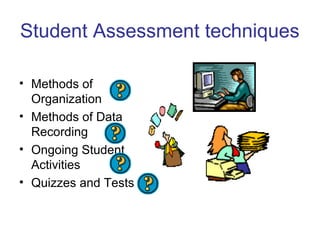
Student Assessment techniques
• Methods of
Organization
• Methods of Data
Recording
• Ongoing Student
Activities
• Quizzes and Tests
Student Assessment techniques
• Activity 3:
• Group the techniques according to the category
Student Assessment techniques
Methods of Organization
• Assessment stations
• Individual
assessments
• Group assessments
• Contracts
• Self and Peer
Assessments
• Portfolios
Methods of Data Recording
• Anecdotal Records (Worksheet 2 a)
• Observation Checklists (Worksheet 2b)
• Rating scales
Ongoing Student Activities
• Written
Assignments
• Presentations
• Performance
Assessments
• Homework
Quizzes and Tests
• Oral Assessment
Items
• Performance Test
Items
• Extended Open-
Response Items
• Short-Answer Items
• Matching Items
• Multiple Choice Items
• True/ False items
Guidelines for use of homework
• Students should receive clear,
instructions on the task prior to
assigning it as homework.
• Students should receive guidelines
related to the completion of the task
and how it will be assessed.
Guidelines for use of homework
• The length of time given for the
completion assignment must take
into consideration the many other
tasks students often have assigned at
the same time.
• Be consistent about how the
homework assignments are
assessed.
Guidelines for use of homework
• Never assign homework as
punishment.
• Do not use homework as a way of
regaining lost work time due to
interruptions or faulty timing
• Try to assign tasks that are of interest
to the students.
Reflections
• Reflecting on the present student
evaluation program (Worksheet 3)
• Time management
• Adaptation of assessment techniques
• Making Quality Tests
Your current student evaluation
programme
• Activity 4:
• Go over worksheet 3
• Write your comments
• Compare your answers with your
colleagues
• Decide on actions to be taken
Time management
• Appropriate frequency
• What assessment activities can take place on a
regular schedule?
• Value
• How much does this particular assessment
instrument or activity contribute?
Time management
• Standardization
• Can I create master copies of assessment
formats that can be completed as
needed?
• Quiet time
• Is there a time of the day that I can set
aside to devote to creating, organizing and
recording assessment information?
Adaptation of assessment
techniques
• Demonstrate skills or knowledge
• Allow more time to complete tests
• Adjust the type of criteria used for
expected responses
• Focus on a smaller number of assessment
techniques
• Change the frequency of gathering
assessment information
Adaptation of assessment
techniques
• Adjust the degree of accuracy required in
the expected responses
• Require above average students to
provide more than one solution to a
problem
• Reduce student anxiety providing practice
in test-taking.
Conclusion
• To improve capabilities in the
evaluation of students achievement.
• To help our students to learn how to
learn
• To be more accountable to students
• To improve the expertise in students’
evaluation.
Different kinds of evaluation

Different kinds of evaluation

  • 1.
  • 2.
    Why • To improvecapabilities in the evaluation of students achievement. • To help our students to learn how to learn • To be more accountable to students • To improve the expertise in students’ evaluation.
  • 3.
    Definition • Activity 1: •Rearrange the following words to complete the definition of Evaluation.
  • 4.
    Evaluation “Evaluation is considereda critical element that influences teacher decision making and guides student learning.”
  • 5.
    Guiding Principles • Activity2: Use the words provided to complete the sentences specifying the guiding principles behind evaluation.
  • 6.
  • 7.
    Concepts • Norm-referenced standards: •We need to compare assessment data with typical data collected from comparable people. • Criterion-referenced standards: • We need to compare the measurement to some absolute standard.
  • 8.
    Concept • Self-referenced: • Compareone’s performance today with one’s performance earlier. Deciding on the appropriate blend of students’ evaluation standards can be a complex matter but can help you construct a more comprehensive student evaluation inventory.
  • 9.
    Types of Evaluation •Formative evaluation: • provides information about the students’ progress to take corrective action. • Diagnostic evaluation: • provides information about students’ readiness and background for what is about to be taught
  • 10.
    Types of Evaluation •Summative evaluation: • provides information to be used in making judgments about students’ achievement
  • 11.
    Important terms • Measurement •Assessment • Evaluation
  • 12.
    Important terms • Measurement:Collecting information on the frequency or extent of something • Assessment: Collecting information on the progress of students’ learning • Evaluation: making a judgment about the degree of worth of the information
  • 13.
    Student Assessment techniques •Methods of Organization • Methods of Data Recording • Ongoing Student Activities • Quizzes and Tests
  • 14.
    Student Assessment techniques •Activity 3: • Group the techniques according to the category
  • 15.
  • 16.
    Methods of Organization •Assessment stations • Individual assessments • Group assessments • Contracts • Self and Peer Assessments • Portfolios
  • 17.
    Methods of DataRecording • Anecdotal Records (Worksheet 2 a) • Observation Checklists (Worksheet 2b) • Rating scales
  • 18.
    Ongoing Student Activities •Written Assignments • Presentations • Performance Assessments • Homework
  • 19.
    Quizzes and Tests •Oral Assessment Items • Performance Test Items • Extended Open- Response Items • Short-Answer Items • Matching Items • Multiple Choice Items • True/ False items
  • 20.
    Guidelines for useof homework • Students should receive clear, instructions on the task prior to assigning it as homework. • Students should receive guidelines related to the completion of the task and how it will be assessed.
  • 21.
    Guidelines for useof homework • The length of time given for the completion assignment must take into consideration the many other tasks students often have assigned at the same time. • Be consistent about how the homework assignments are assessed.
  • 22.
    Guidelines for useof homework • Never assign homework as punishment. • Do not use homework as a way of regaining lost work time due to interruptions or faulty timing • Try to assign tasks that are of interest to the students.
  • 23.
    Reflections • Reflecting onthe present student evaluation program (Worksheet 3) • Time management • Adaptation of assessment techniques • Making Quality Tests
  • 24.
    Your current studentevaluation programme • Activity 4: • Go over worksheet 3 • Write your comments • Compare your answers with your colleagues • Decide on actions to be taken
  • 25.
    Time management • Appropriatefrequency • What assessment activities can take place on a regular schedule? • Value • How much does this particular assessment instrument or activity contribute?
  • 26.
    Time management • Standardization •Can I create master copies of assessment formats that can be completed as needed? • Quiet time • Is there a time of the day that I can set aside to devote to creating, organizing and recording assessment information?
  • 27.
    Adaptation of assessment techniques •Demonstrate skills or knowledge • Allow more time to complete tests • Adjust the type of criteria used for expected responses • Focus on a smaller number of assessment techniques • Change the frequency of gathering assessment information
  • 28.
    Adaptation of assessment techniques •Adjust the degree of accuracy required in the expected responses • Require above average students to provide more than one solution to a problem • Reduce student anxiety providing practice in test-taking.
  • 29.
    Conclusion • To improvecapabilities in the evaluation of students achievement. • To help our students to learn how to learn • To be more accountable to students • To improve the expertise in students’ evaluation.