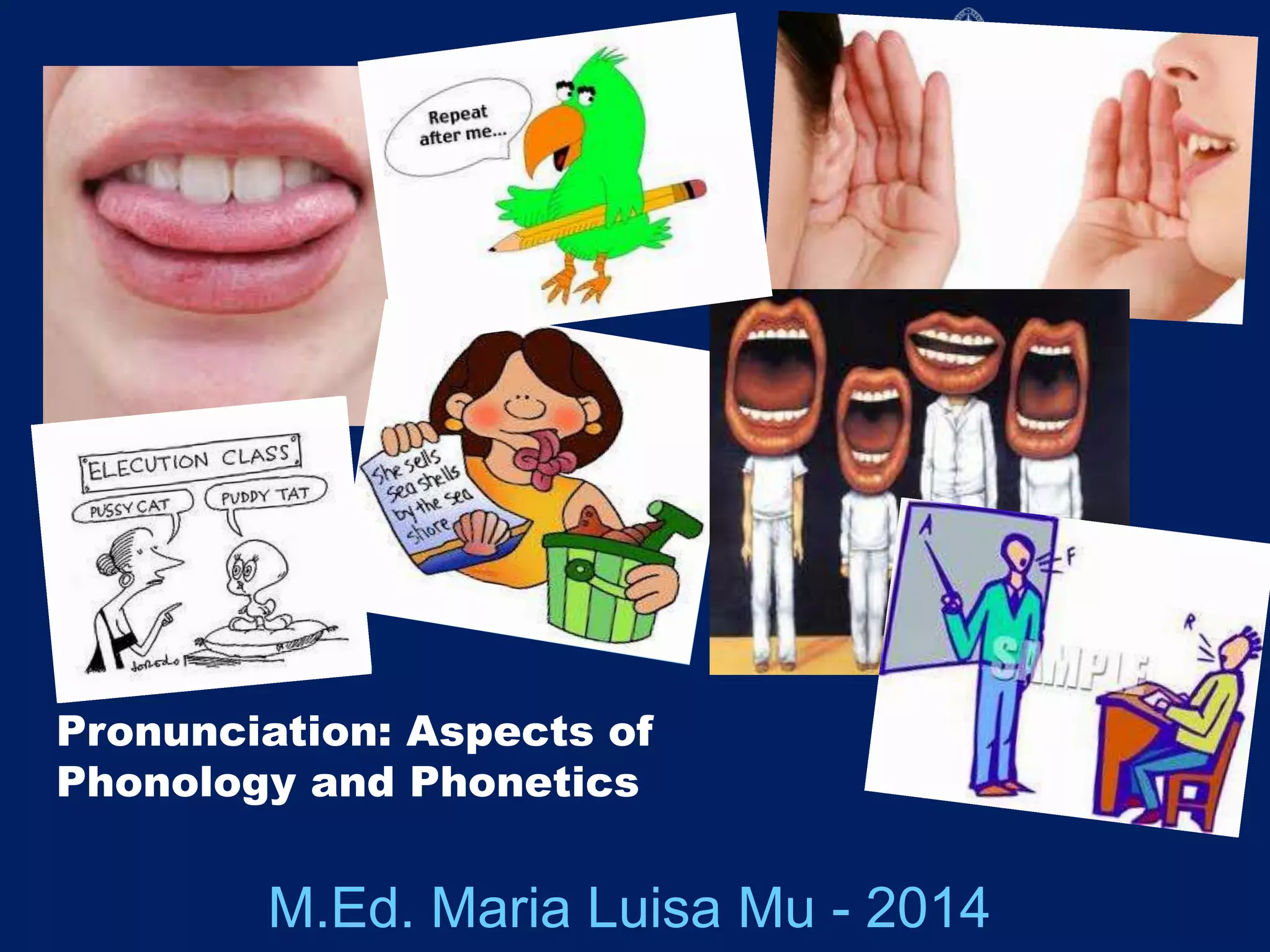
Pronunciation: Aspects of
Phonology and Phonetics
M.Ed. Maria Luisa Mu - 2014
Contents
• Part 1: Aspects of Phonology and
Phonetics
• Part 2: Teaching Pronunciation
WHY teach pronunciation?
• English is not pronounced as
it is written: vowels and
consonants can be
pronounced in different ways
and there are no accents to
help you with stress
• Incorrect pronunciation is one
of the main reasons for
breakdown in communication
• The more help SS are given
with their pronunciation, the
more confident they feel when
speaking
• There’s no point in teaching
SS new words or phrases if
they can’t pronounce them
comprehensibly
• Despite many irregularities,
there are also many rules
which can help
pronunciation. About 70% of
words in English follow a
regular pronunciation pattern
• If SS are taught to recognize
phonemic script, this will
enable them to check
pronunciation for themselves
4
Observing a lesson
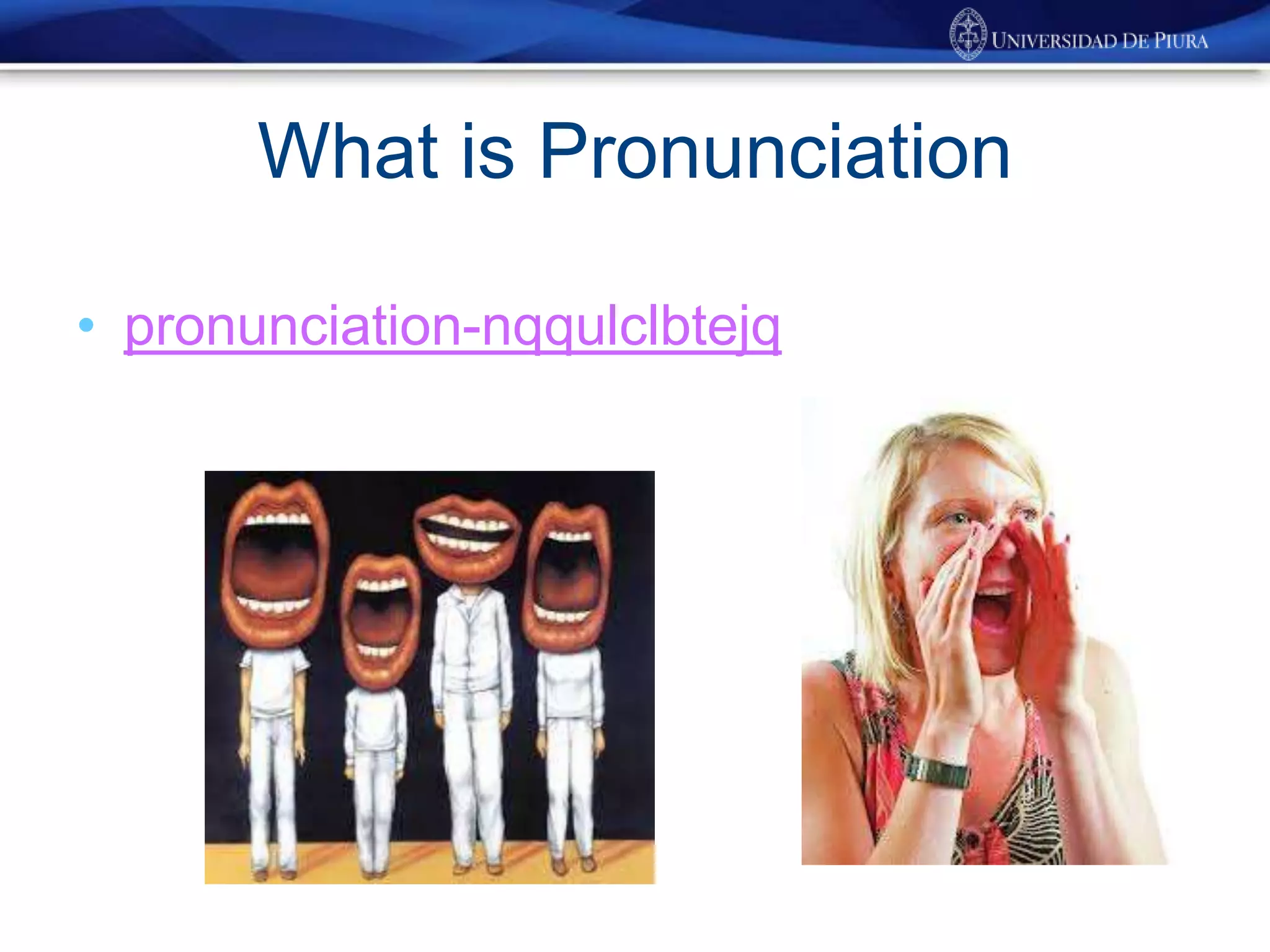
What is Pronunciation
• pronunciation-nqqulclbtejq
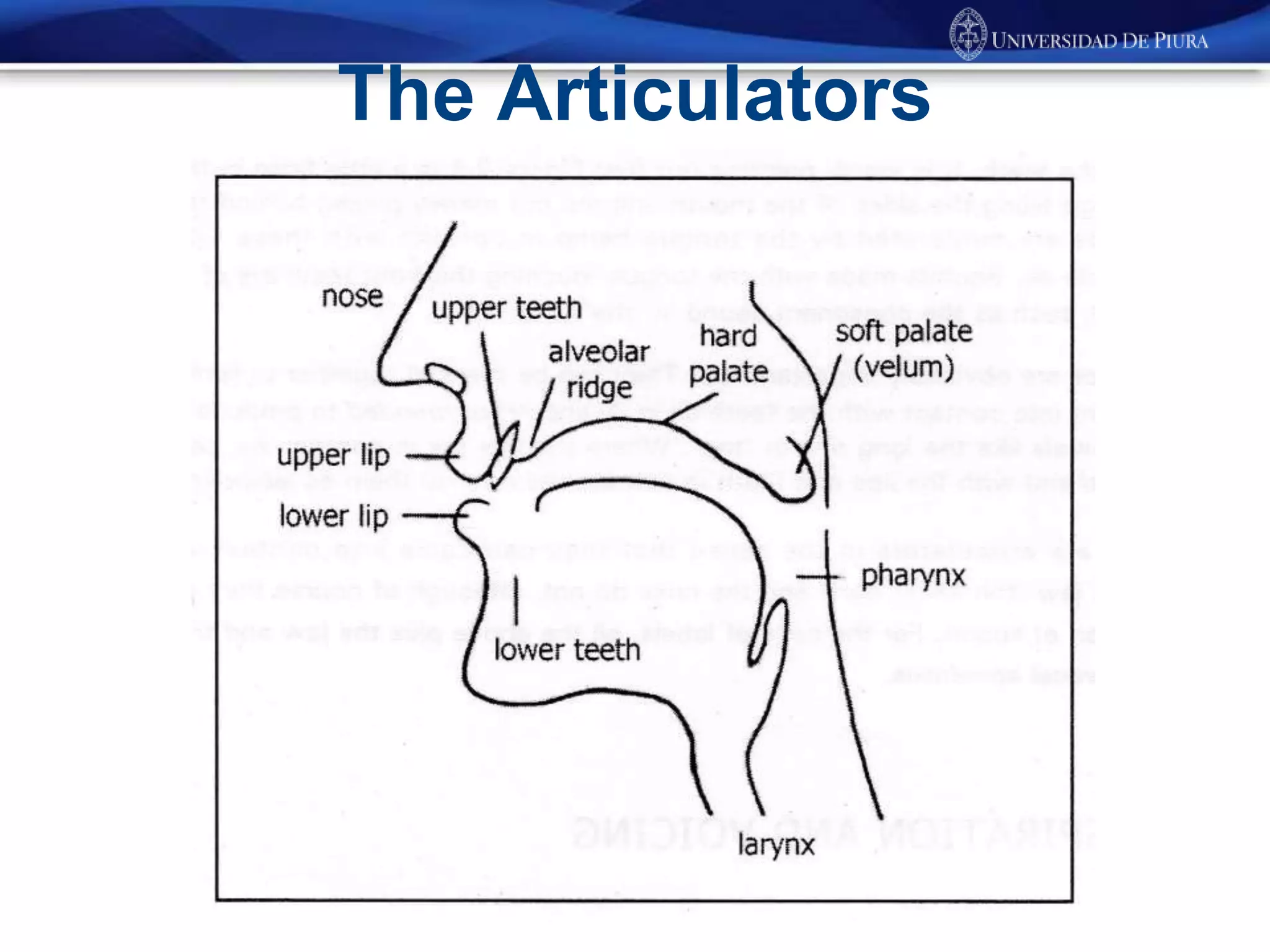
The Articulators
The Phonemic Chart
• Introducing the chart and its sounds to
students.
• Recognizing and producing sounds
• One or two-syllable words:
• Produce each sound aloud
• Connect the sounds with a single flow so it
becomes a word.
• Repeat the procedure for phrases
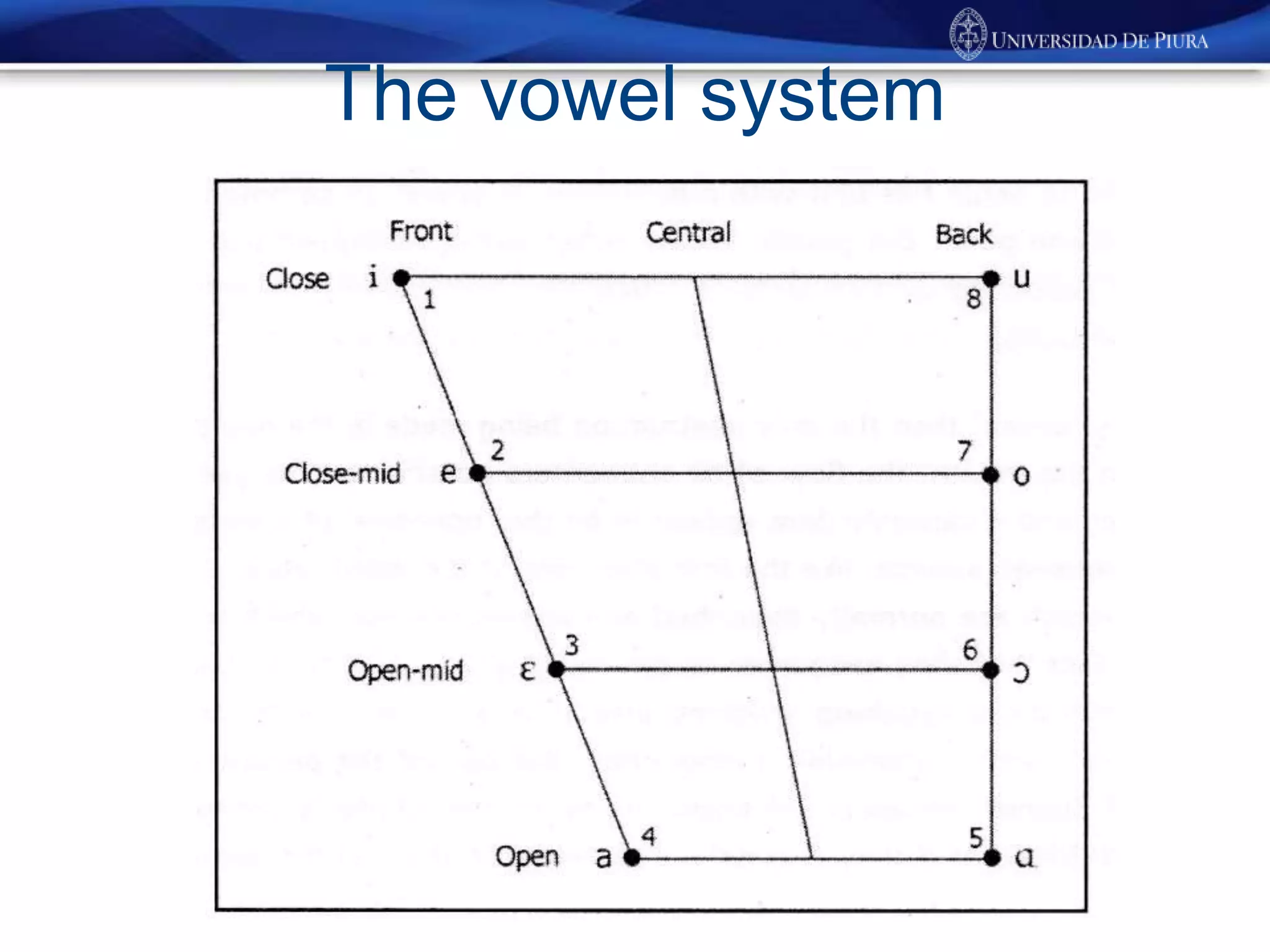
The vowel system
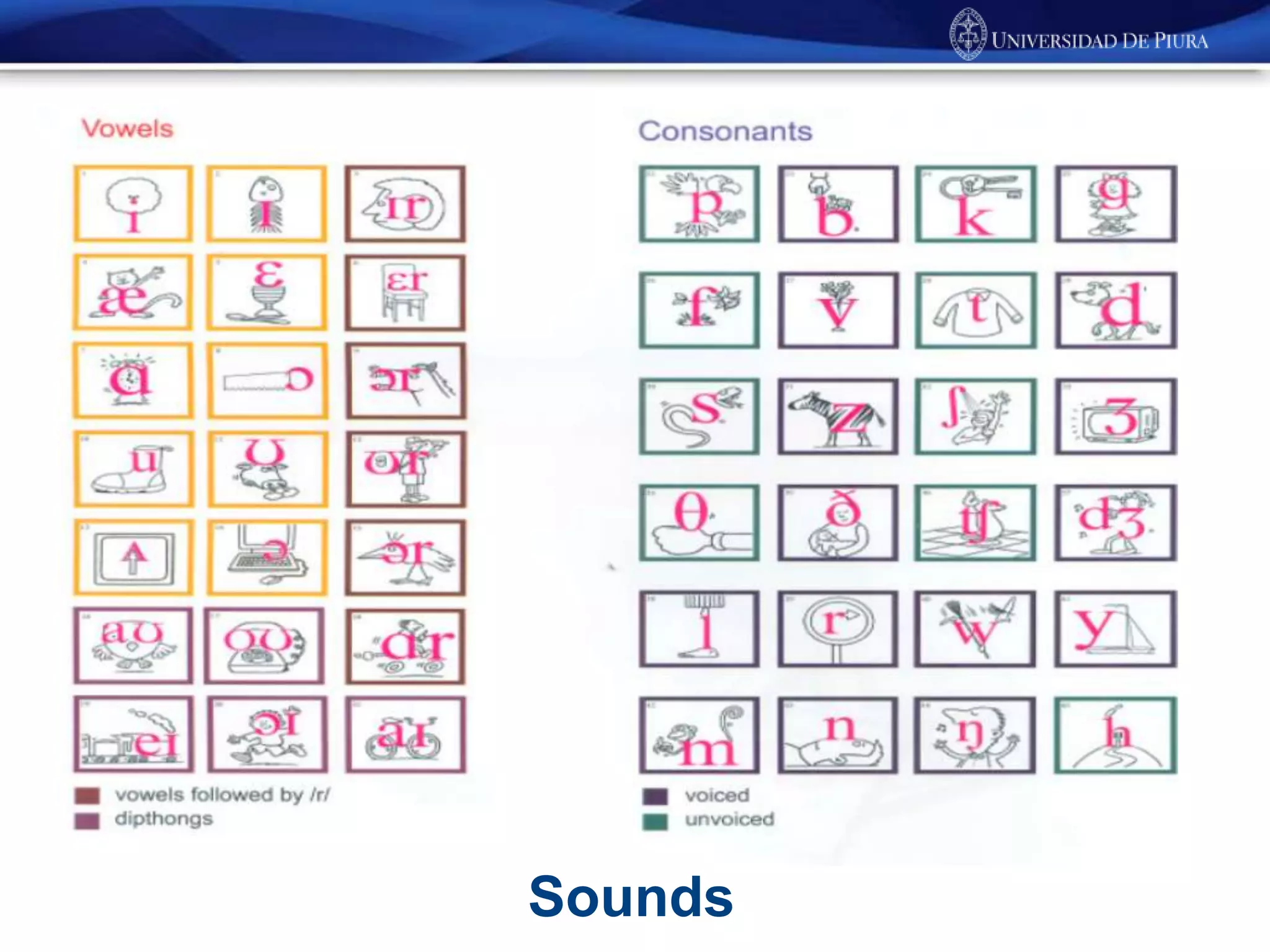
Sounds
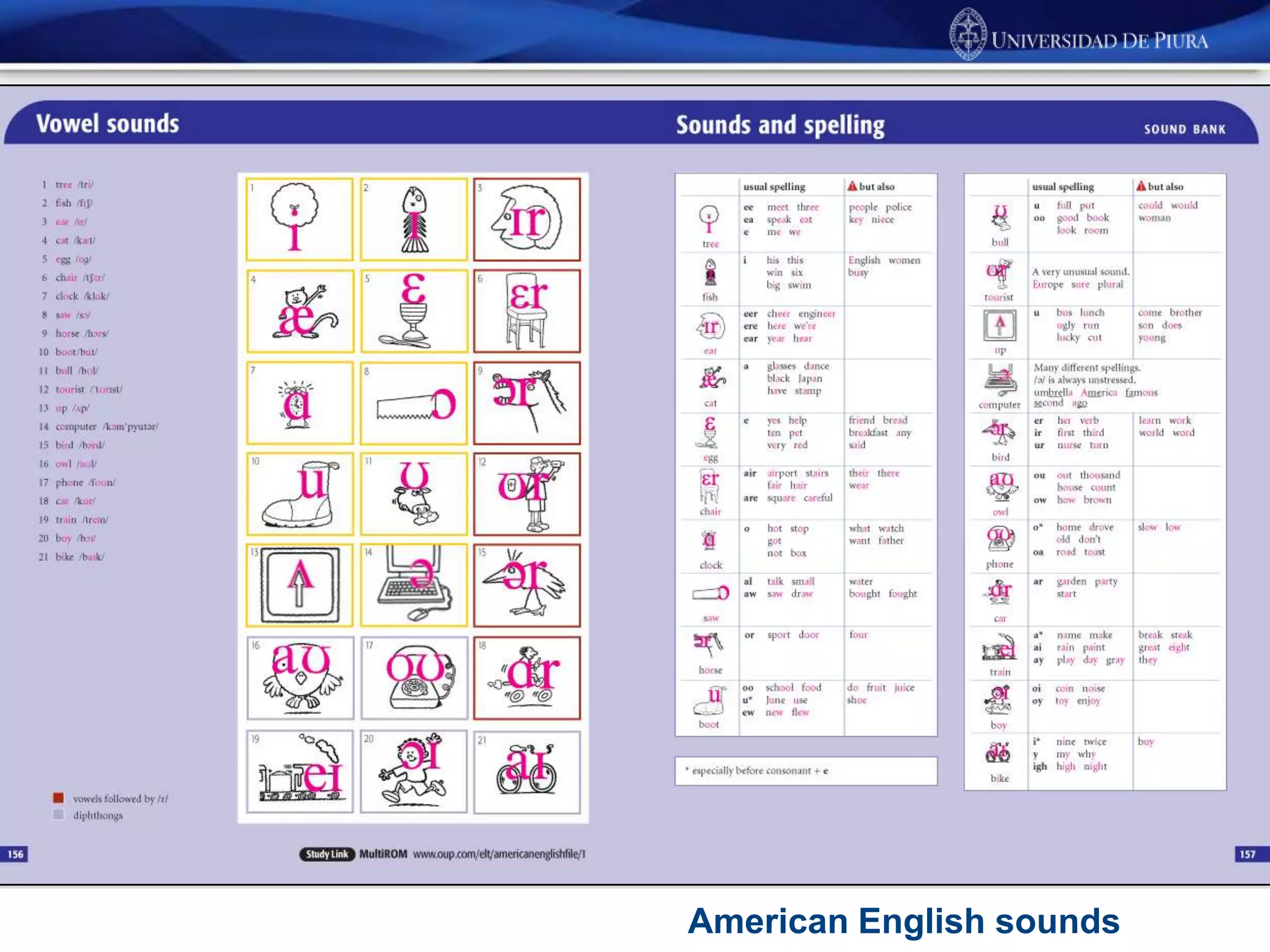
American English sounds
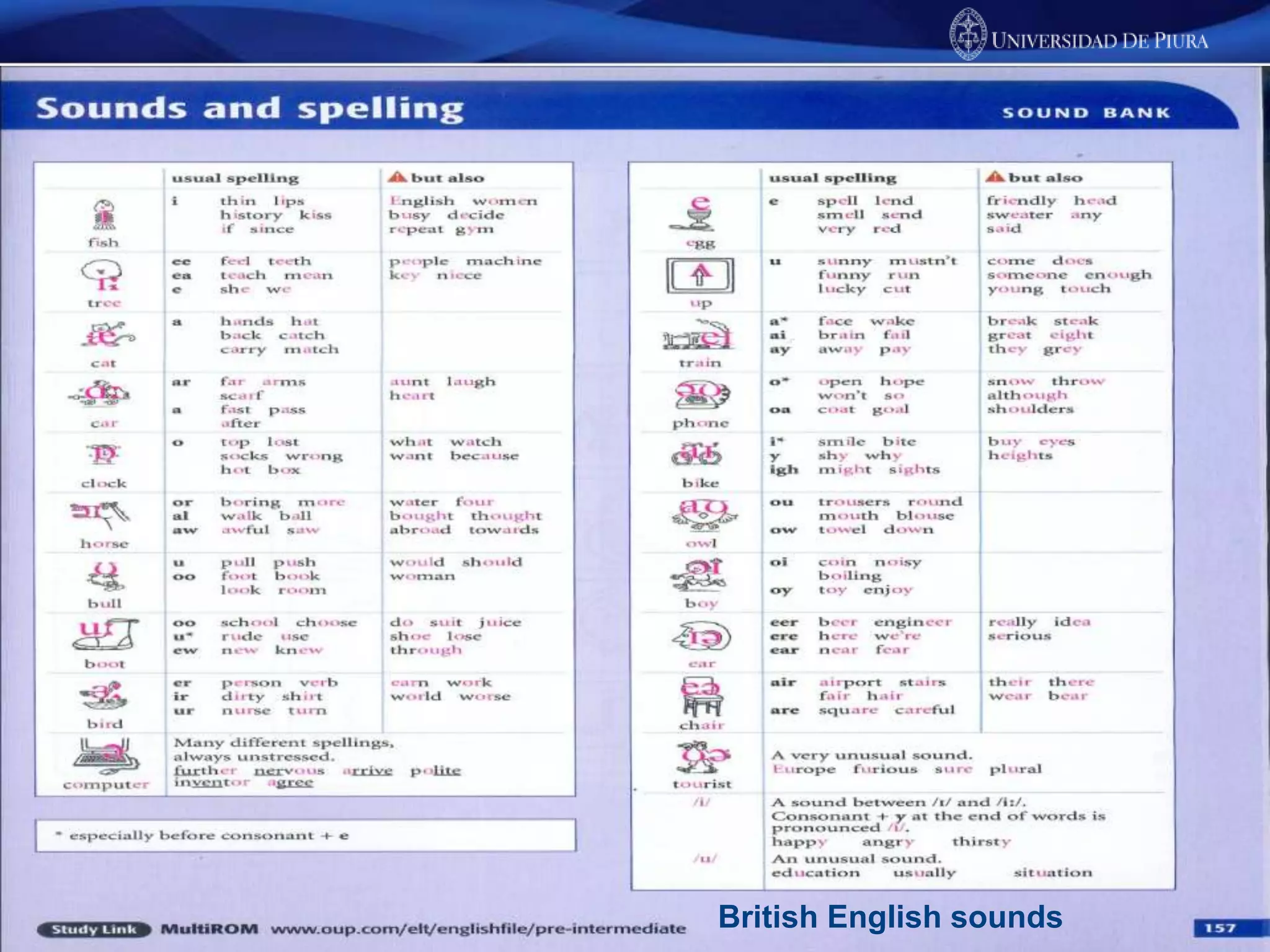
British English sounds
How are consonants produced?
• Plosives (Stops):
• When a complete closure is made
somewhere in the vocal tract.
• Fricatives:
• Produced with some obstruction but
without any stop so the sound can be
extended.
How are consonants produced?
• Affricates:
• A combination of plosives and fricatives.
They begin as a plosive and then released
slowly into a period of fricative noise.
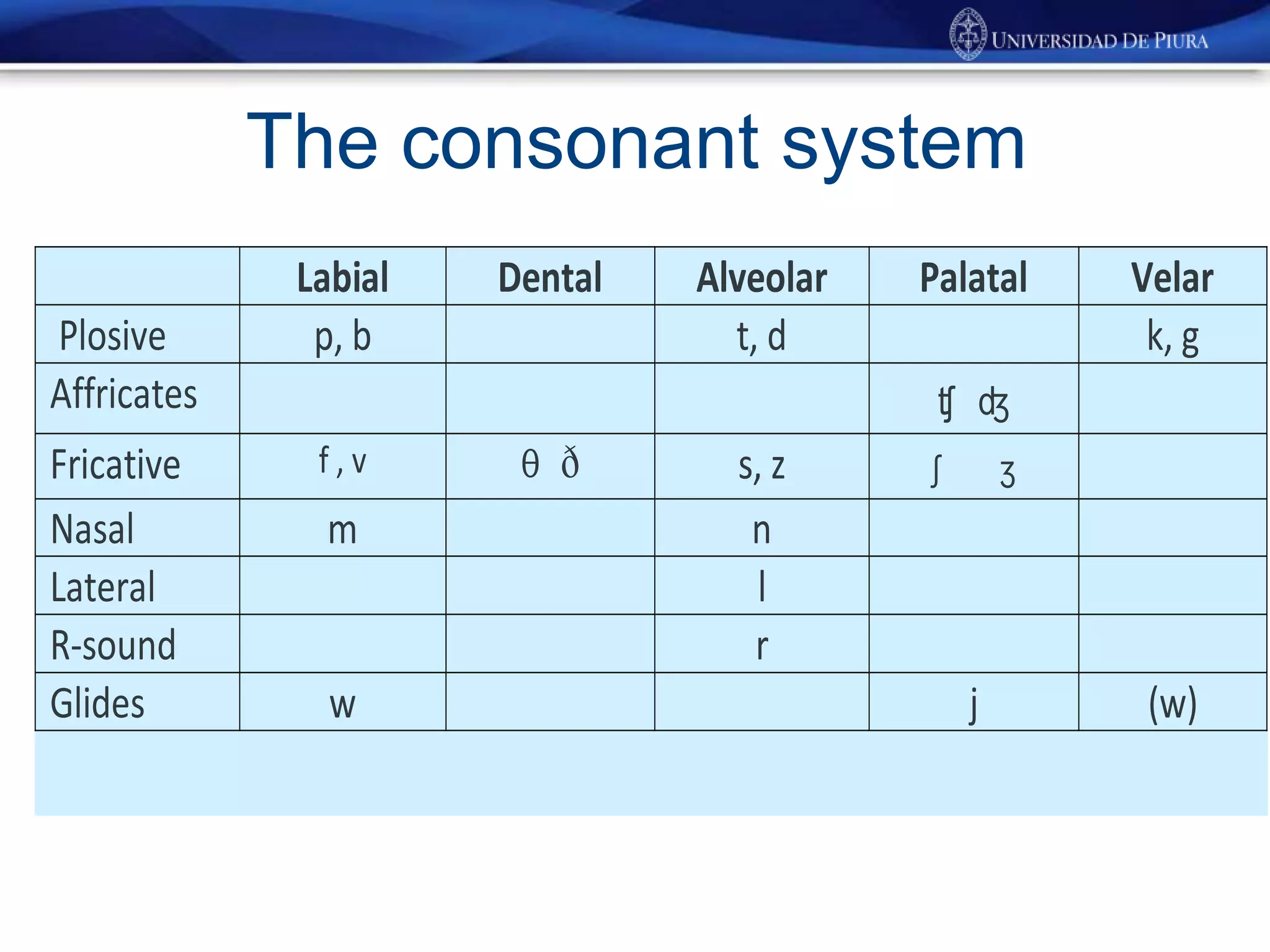
The consonant system
Labial Dental Alveolar Palatal Velar
Plosive p, b t, d k, g
Affricates ʧ ʤ
Fricative f , v θ ð s, z ʃ ʒ
Nasal m n
Lateral l
R-sound r
Glides w j (w)
Classroom Task
• Form two groups. One group will present the
vowel sounds and their characteristics. The
other group will present the consonant sounds.
• Think of different ways of presenting your tasks
so your students will understand how to produce
the sounds.
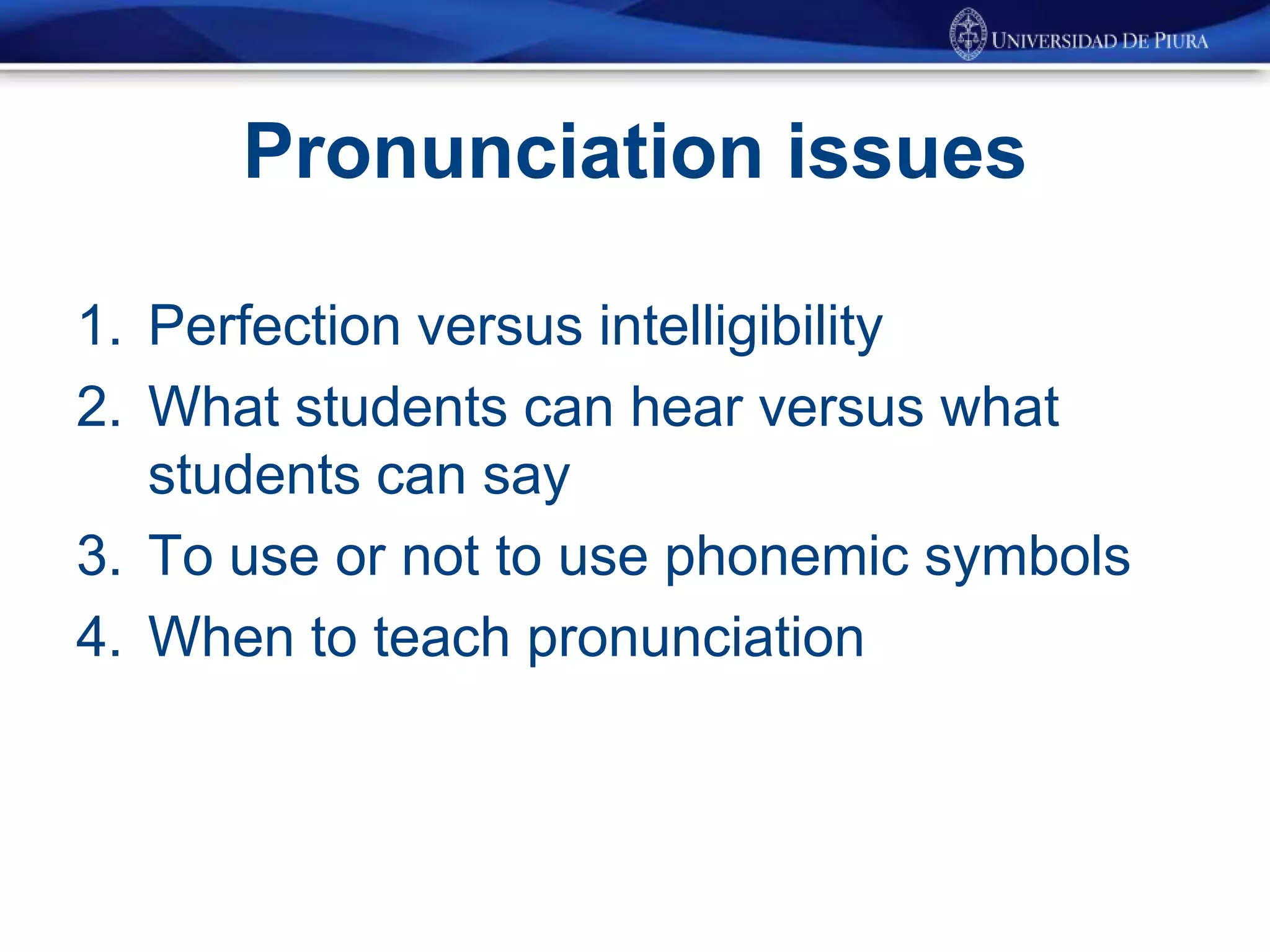
Pronunciation issues
1. Perfection versus intelligibility
2. What students can hear versus what
students can say
3. To use or not to use phonemic symbols
4. When to teach pronunciation
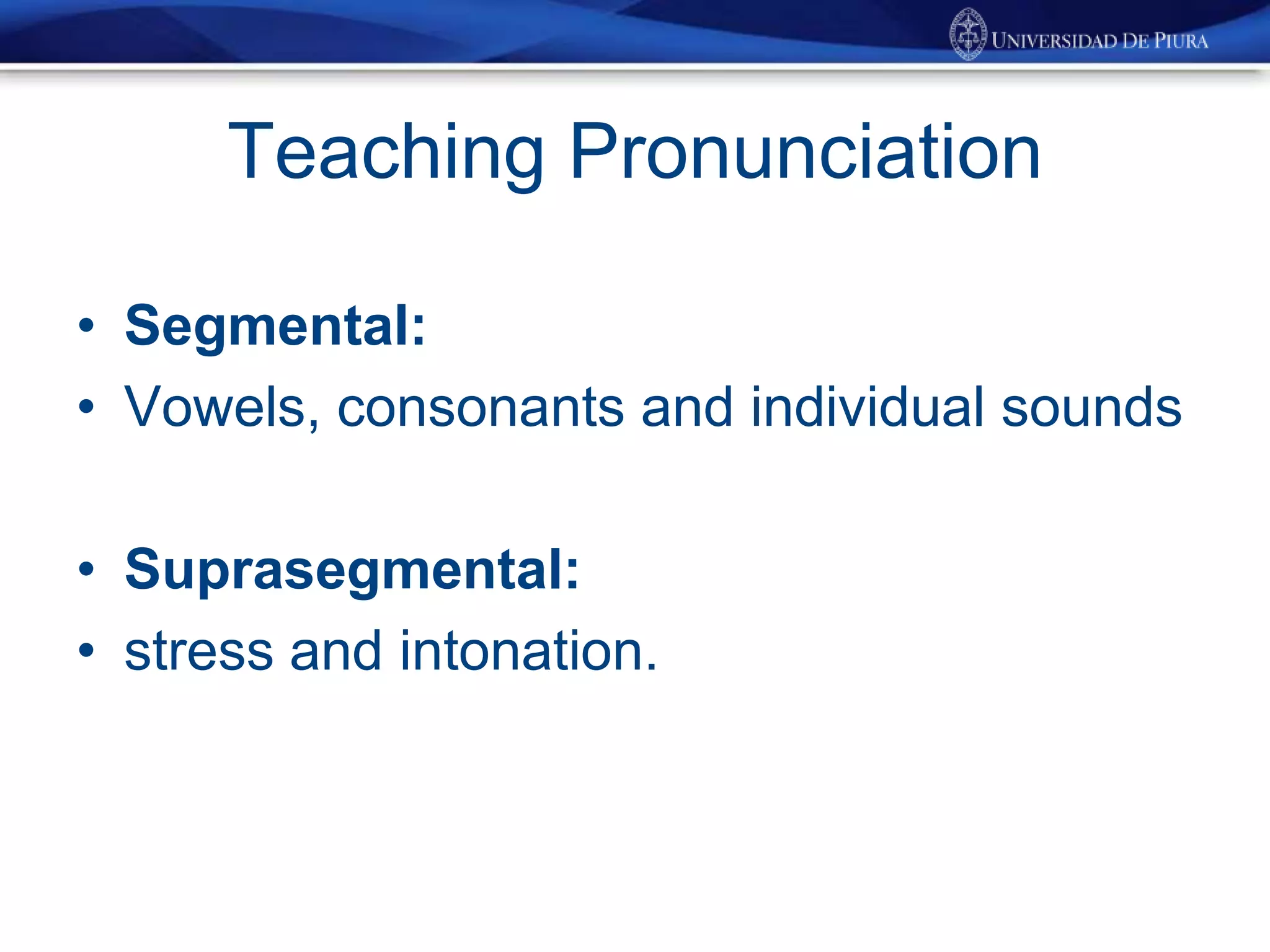
Teaching Pronunciation
• Segmental:
• Vowels, consonants and individual sounds
• Suprasegmental:
• stress and intonation.
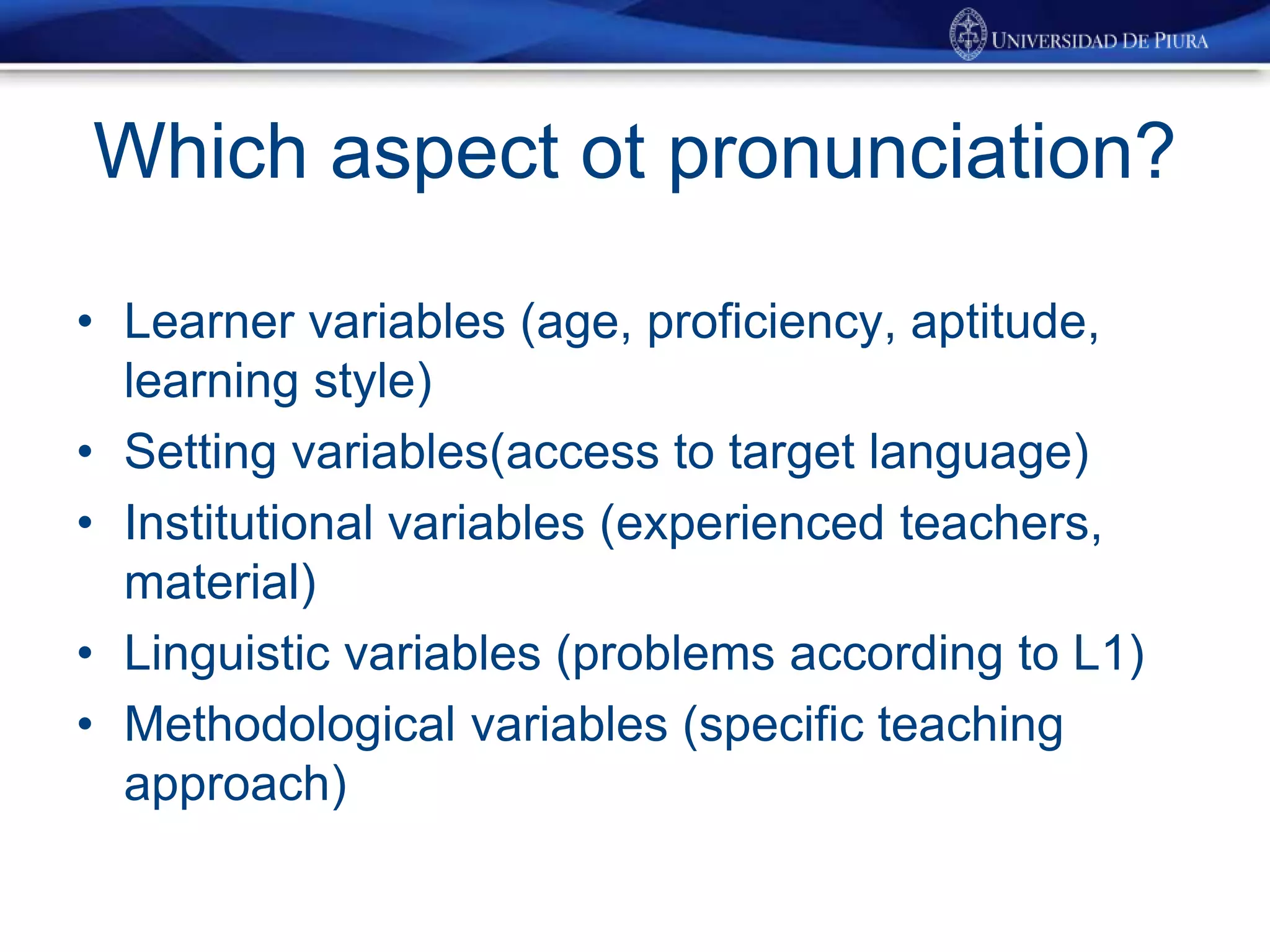
Which aspect ot pronunciation?
• Learner variables (age, proficiency, aptitude,
learning style)
• Setting variables(access to target language)
• Institutional variables (experienced teachers,
material)
• Linguistic variables (problems according to L1)
• Methodological variables (specific teaching
approach)
Connected speech
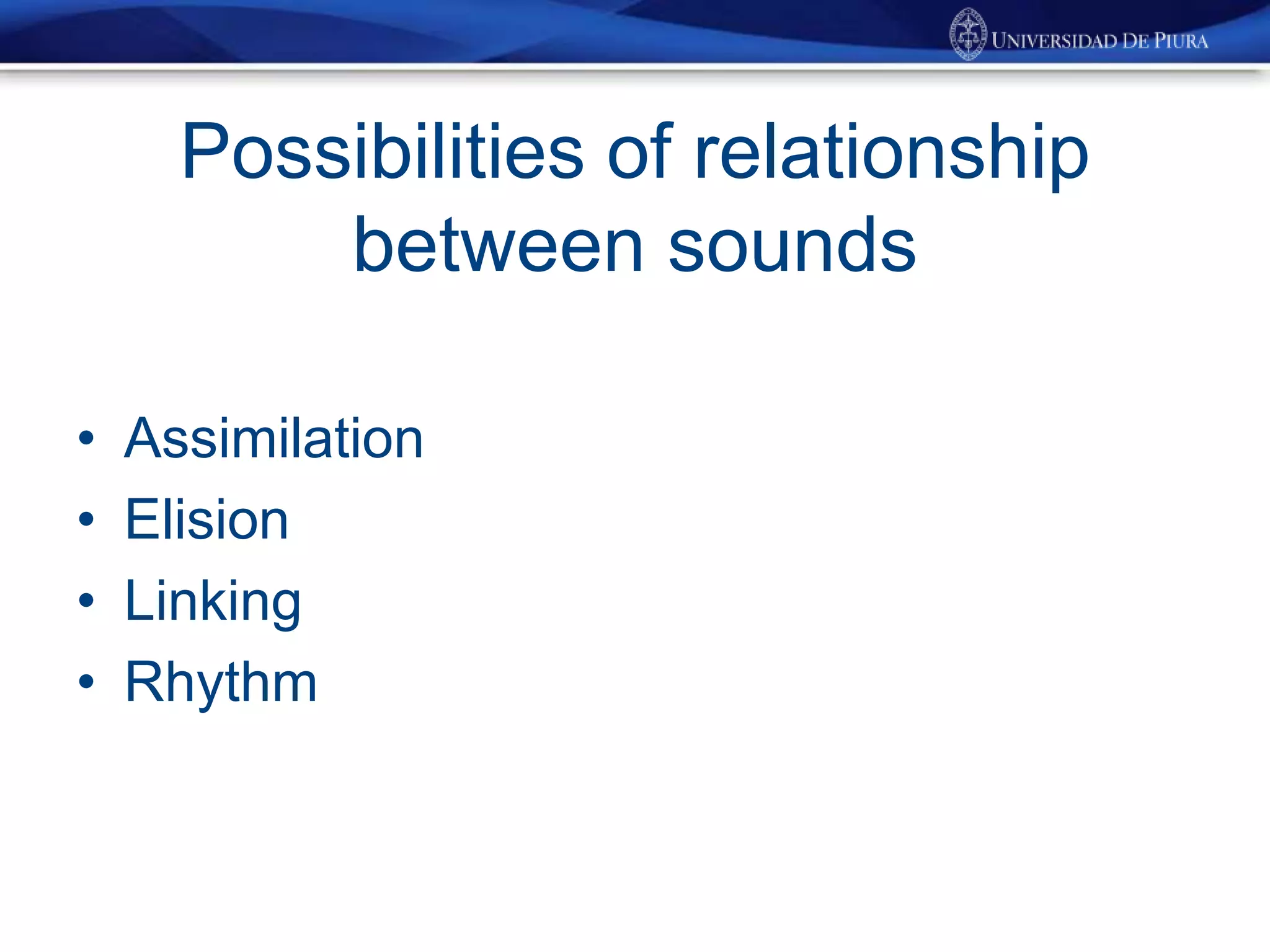
Possibilities of relationship
between sounds
• Assimilation
• Elision
• Linking
• Rhythm
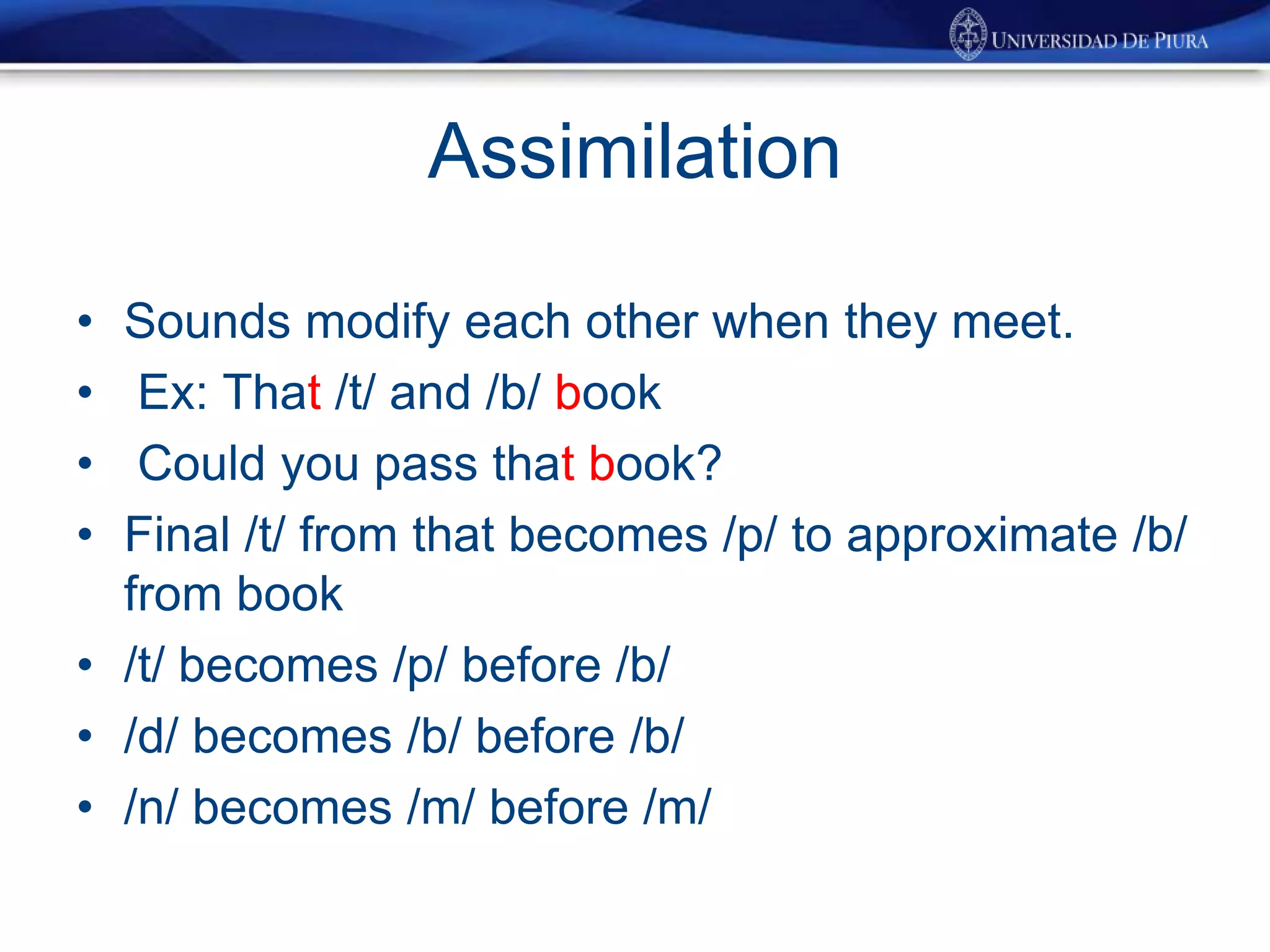
Assimilation
• Sounds modify each other when they meet.
• Ex: That /t/ and /b/ book
• Could you pass that book?
• Final /t/ from that becomes /p/ to approximate /b/
from book
• /t/ becomes /p/ before /b/
• /d/ becomes /b/ before /b/
• /n/ becomes /m/ before /m/
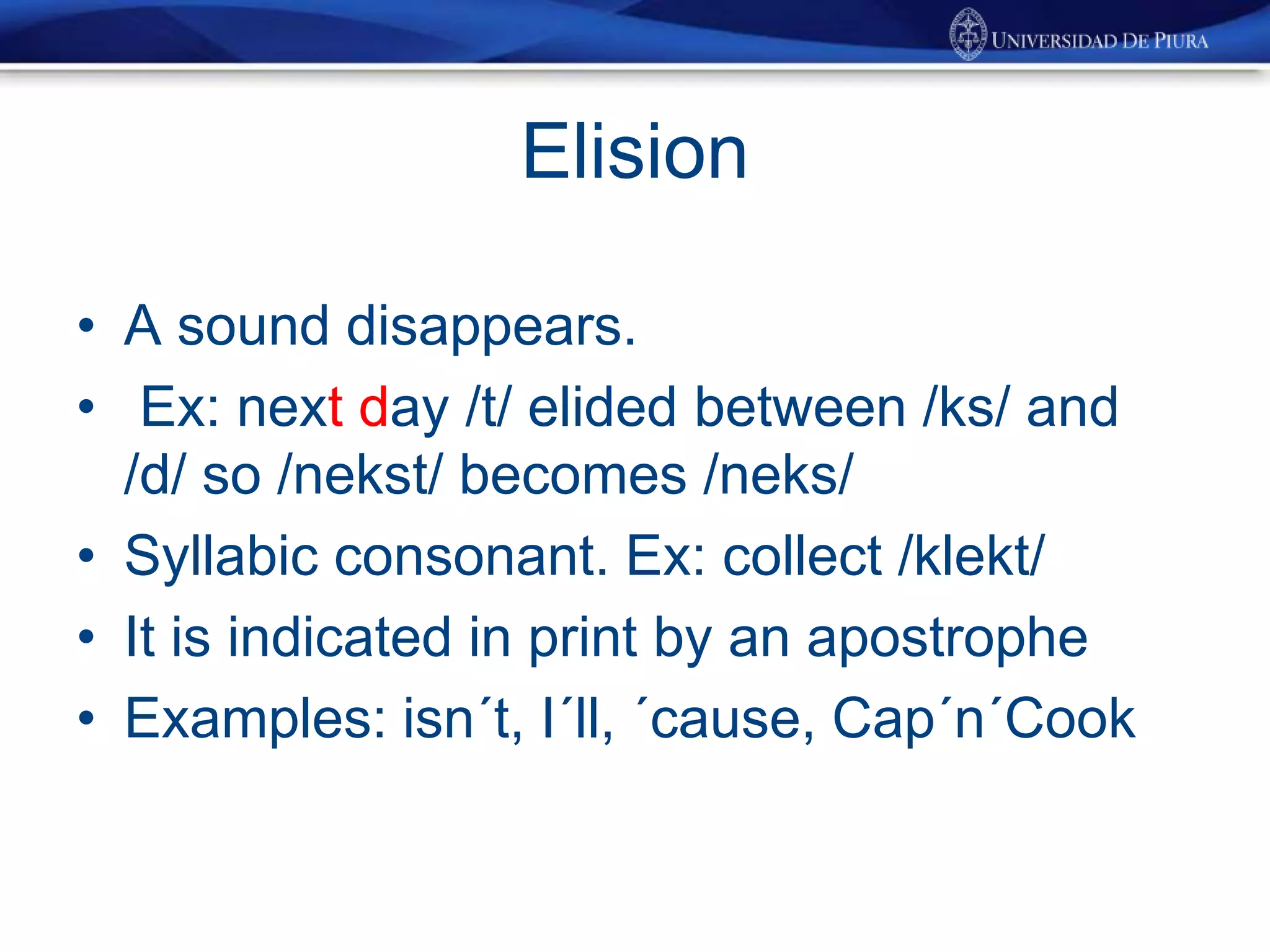
Elision
• A sound disappears.
• Ex: next day /t/ elided between /ks/ and
/d/ so /nekst/ becomes /neks/
• Syllabic consonant. Ex: collect /klekt/
• It is indicated in print by an apostrophe
• Examples: isn´t, I´ll, ´cause, Cap´n´Cook
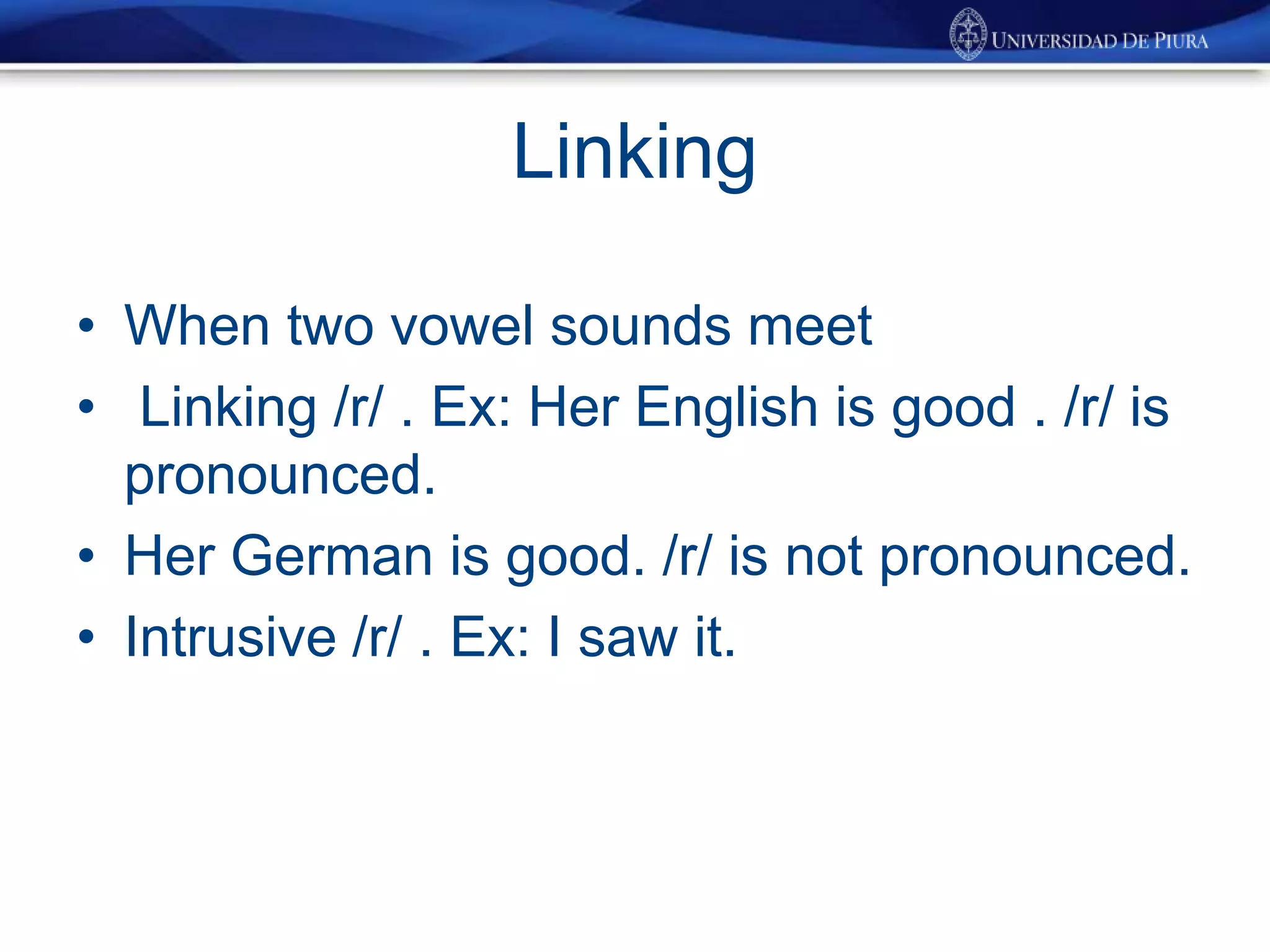
Linking
• When two vowel sounds meet
• Linking /r/ . Ex: Her English is good . /r/ is
pronounced.
• Her German is good. /r/ is not pronounced.
• Intrusive /r/ . Ex: I saw it.
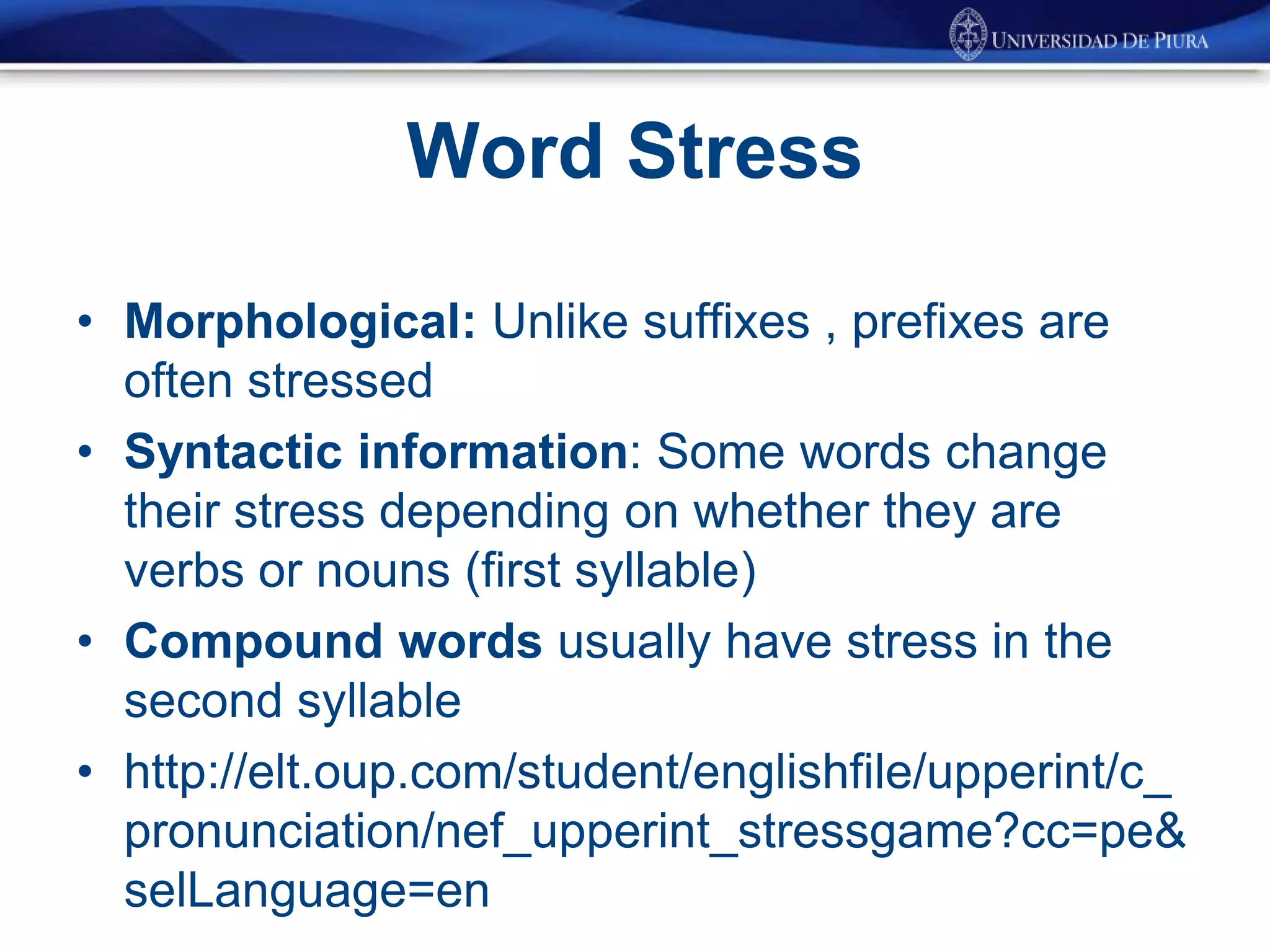
Word Stress
• Morphological: Unlike suffixes , prefixes are
often stressed
• Syntactic information: Some words change
their stress depending on whether they are
verbs or nouns (first syllable)
• Compound words usually have stress in the
second syllable
• http://elt.oup.com/student/englishfile/upperint/c_
pronunciation/nef_upperint_stressgame?cc=pe&
selLanguage=en
Sentence stress
• Content words (also called 'lexical words'),
namely nouns, adjectives, adverbs, and main
verbs because they carry a high information
load.
• Function words (also called 'grammar words' or
'form words'), i.e. determiners (e.g. the, a),
conjunctions (e.g. and, but), pronouns (e.g. she,
them), prepositions (e.g. at, from), auxiliary
verbs (e.g. do, be, can), are not stressed.
Functions of intonation
• Emotional: attitude
• Grammatical: questions vs. Statements
• Information structure: what is known vs.
what is new
• Textual: larger stretches of discourse
• Psychological: easier to percieve or
memorize
• Indexical: markers of group membership
Intonation and sentence rhtyhm
• Short answers are normally stressed
• Auxiliaries in echo questions used to show
interest
• Emphatic use of an auxiliary
• So do I, Neither do I ( auxiliary is not stressed,
the stress falls on the other two words
• Question tags
Rhythm
• Rhythm is the way a language sounds as
a result of the pattern of stressed and
unstressed syllables in speech.
• A stress-time language has the stressed
syllable in speech at more or less equal
intervals.
• Ring Jack soon,
• Telephone Alison afterwards
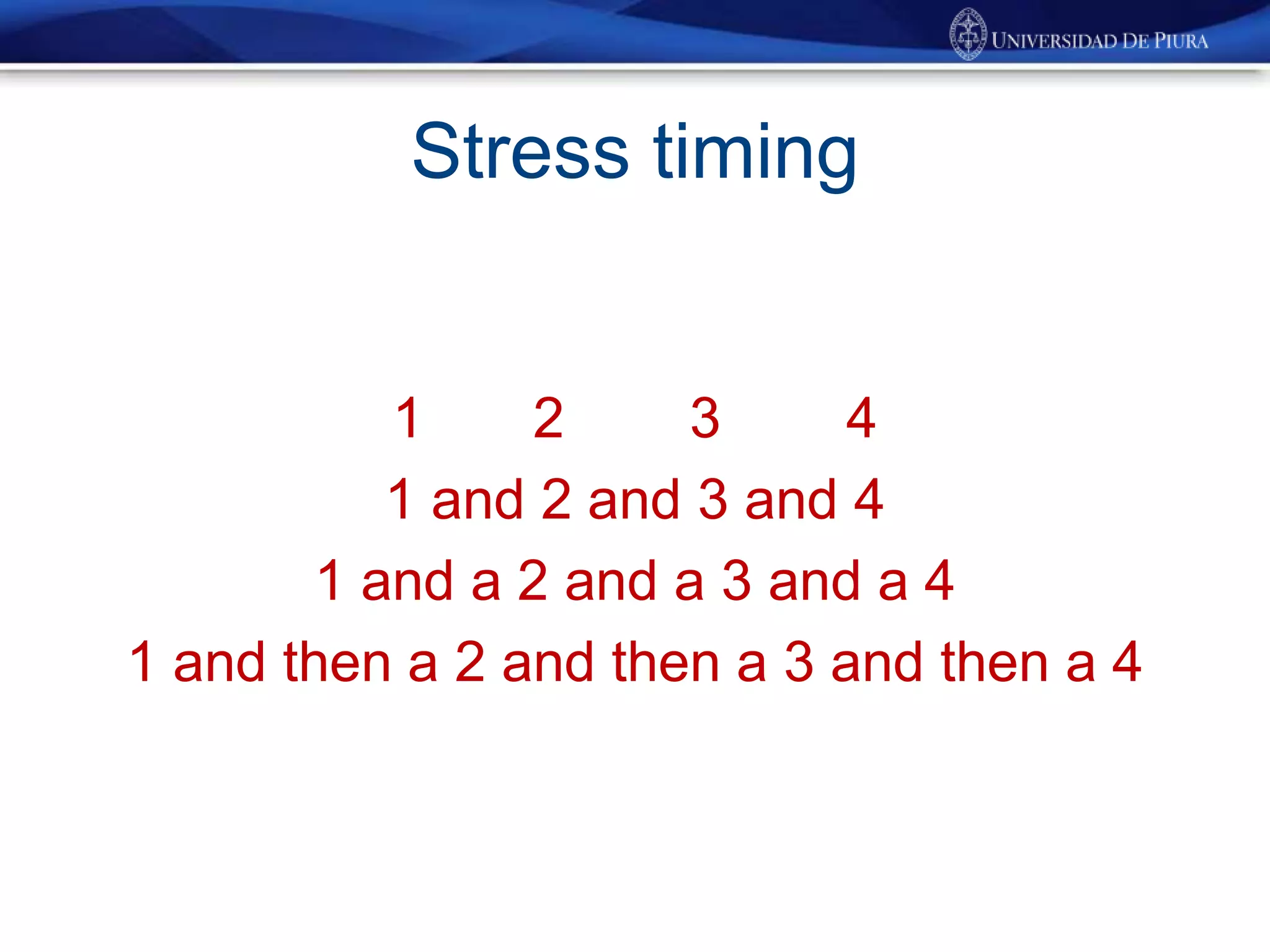
Stress timing
1 2 3 4
1 and 2 and 3 and 4
1 and a 2 and a 3 and a 4
1 and then a 2 and then a 3 and then a 4

Aspects of phonetics and phonology in pronunciation

  • 1.
    Pronunciation: Aspects of Phonologyand Phonetics M.Ed. Maria Luisa Mu - 2014
  • 3.
    Contents • Part 1:Aspects of Phonology and Phonetics • Part 2: Teaching Pronunciation
  • 4.
    WHY teach pronunciation? •English is not pronounced as it is written: vowels and consonants can be pronounced in different ways and there are no accents to help you with stress • Incorrect pronunciation is one of the main reasons for breakdown in communication • The more help SS are given with their pronunciation, the more confident they feel when speaking • There’s no point in teaching SS new words or phrases if they can’t pronounce them comprehensibly • Despite many irregularities, there are also many rules which can help pronunciation. About 70% of words in English follow a regular pronunciation pattern • If SS are taught to recognize phonemic script, this will enable them to check pronunciation for themselves 4
  • 5.
  • 6.
    What is Pronunciation •pronunciation-nqqulclbtejq
  • 7.
  • 8.
    The Phonemic Chart •Introducing the chart and its sounds to students. • Recognizing and producing sounds • One or two-syllable words: • Produce each sound aloud • Connect the sounds with a single flow so it becomes a word. • Repeat the procedure for phrases
  • 9.
  • 10.
  • 11.
  • 12.
  • 13.
    How are consonantsproduced? • Plosives (Stops): • When a complete closure is made somewhere in the vocal tract. • Fricatives: • Produced with some obstruction but without any stop so the sound can be extended.
  • 14.
    How are consonantsproduced? • Affricates: • A combination of plosives and fricatives. They begin as a plosive and then released slowly into a period of fricative noise.
  • 15.
    The consonant system LabialDental Alveolar Palatal Velar Plosive p, b t, d k, g Affricates ʧ ʤ Fricative f , v θ ð s, z ʃ ʒ Nasal m n Lateral l R-sound r Glides w j (w)
  • 16.
    Classroom Task • Formtwo groups. One group will present the vowel sounds and their characteristics. The other group will present the consonant sounds. • Think of different ways of presenting your tasks so your students will understand how to produce the sounds.
  • 17.
    Pronunciation issues 1. Perfectionversus intelligibility 2. What students can hear versus what students can say 3. To use or not to use phonemic symbols 4. When to teach pronunciation
  • 18.
    Teaching Pronunciation • Segmental: •Vowels, consonants and individual sounds • Suprasegmental: • stress and intonation.
  • 19.
    Which aspect otpronunciation? • Learner variables (age, proficiency, aptitude, learning style) • Setting variables(access to target language) • Institutional variables (experienced teachers, material) • Linguistic variables (problems according to L1) • Methodological variables (specific teaching approach)
  • 20.
  • 21.
    Possibilities of relationship betweensounds • Assimilation • Elision • Linking • Rhythm
  • 22.
    Assimilation • Sounds modifyeach other when they meet. • Ex: That /t/ and /b/ book • Could you pass that book? • Final /t/ from that becomes /p/ to approximate /b/ from book • /t/ becomes /p/ before /b/ • /d/ becomes /b/ before /b/ • /n/ becomes /m/ before /m/
  • 23.
    Elision • A sounddisappears. • Ex: next day /t/ elided between /ks/ and /d/ so /nekst/ becomes /neks/ • Syllabic consonant. Ex: collect /klekt/ • It is indicated in print by an apostrophe • Examples: isn´t, I´ll, ´cause, Cap´n´Cook
  • 24.
    Linking • When twovowel sounds meet • Linking /r/ . Ex: Her English is good . /r/ is pronounced. • Her German is good. /r/ is not pronounced. • Intrusive /r/ . Ex: I saw it.
  • 25.
    Word Stress • Morphological:Unlike suffixes , prefixes are often stressed • Syntactic information: Some words change their stress depending on whether they are verbs or nouns (first syllable) • Compound words usually have stress in the second syllable • http://elt.oup.com/student/englishfile/upperint/c_ pronunciation/nef_upperint_stressgame?cc=pe& selLanguage=en
  • 26.
    Sentence stress • Contentwords (also called 'lexical words'), namely nouns, adjectives, adverbs, and main verbs because they carry a high information load. • Function words (also called 'grammar words' or 'form words'), i.e. determiners (e.g. the, a), conjunctions (e.g. and, but), pronouns (e.g. she, them), prepositions (e.g. at, from), auxiliary verbs (e.g. do, be, can), are not stressed.
  • 27.
    Functions of intonation •Emotional: attitude • Grammatical: questions vs. Statements • Information structure: what is known vs. what is new • Textual: larger stretches of discourse • Psychological: easier to percieve or memorize • Indexical: markers of group membership
  • 28.
    Intonation and sentencerhtyhm • Short answers are normally stressed • Auxiliaries in echo questions used to show interest • Emphatic use of an auxiliary • So do I, Neither do I ( auxiliary is not stressed, the stress falls on the other two words • Question tags
  • 29.
    Rhythm • Rhythm isthe way a language sounds as a result of the pattern of stressed and unstressed syllables in speech. • A stress-time language has the stressed syllable in speech at more or less equal intervals. • Ring Jack soon, • Telephone Alison afterwards
  • 30.
    Stress timing 1 23 4 1 and 2 and 3 and 4 1 and a 2 and a 3 and a 4 1 and then a 2 and then a 3 and then a 4