DIAGNOSTIC EVALUATION TEST
By
Dr. Ravindra V.Kshirsagar
Progressive Education Society’s
Modern College Ganeshkhind Pune
 Diagnostic assessment or Evaluation is a
form of pre-assessment that allows a teacher to
determine students' individual strengths,
weaknesses, knowledge, and skills prior to
instruction.
 It is primarily used to diagnose student difficulties
and to guide lesson and curriculum planning.
 It is primarily used to diagnose student and find
out slow learner and Advanced learner
 Diagnostic evaluation helps to guide lesson and
curriculum planning.
 Diagnostic assessments can come in many
different forms.
 A couple common uses of this tool include unit
pretests and diagnostic assessments prior to
individual instruction.
 Diagnostic evaluation test can be conducted at the
beginning of course instruction
 It creates a baseline for assessing future learning.
 Teacher can provide remediation or enrichment
as needed for slow learner.
 Teacher can design activities that allow that group
to go beyond the standard curriculum for that topic
through independent or small group study for
advanced learner.
 . Identify the causes of slow learning
 . Identification of the slow leaner in the class
 . Problems of slow learner
 . Explorer the method of effective teaching for
slow learner
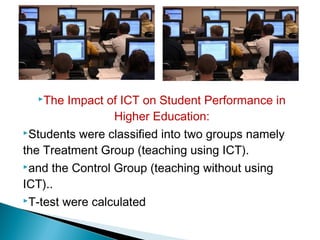
The Impact of ICT on Student Performance in
Higher Education:
Students were classified into two groups namely
the Treatment Group (teaching using ICT).
and the Control Group (teaching without using
ICT)..
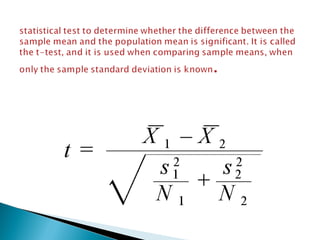
T-test were calculated
 The t-test showed higher value for the
Treatment Group as compared to the
Control Group.
 The result indicated that ICT use in
teaching and learning increased the
students’ achievement in the subject
Thank you
Technology will never replace
great teachers, but technology in
the hands of great teachers is
transformational .
George Couros

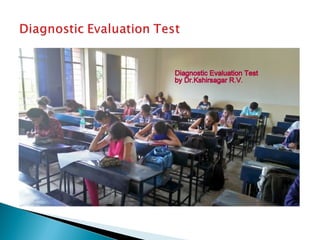
Diagnostic evaluation Test by Dr.kshirsagar Ravindra

  • 1.
    DIAGNOSTIC EVALUATION TEST By Dr.Ravindra V.Kshirsagar Progressive Education Society’s Modern College Ganeshkhind Pune
  • 2.
     Diagnostic assessmentor Evaluation is a form of pre-assessment that allows a teacher to determine students' individual strengths, weaknesses, knowledge, and skills prior to instruction.  It is primarily used to diagnose student difficulties and to guide lesson and curriculum planning.
  • 3.
     It isprimarily used to diagnose student and find out slow learner and Advanced learner  Diagnostic evaluation helps to guide lesson and curriculum planning.
  • 6.
     Diagnostic assessmentscan come in many different forms.  A couple common uses of this tool include unit pretests and diagnostic assessments prior to individual instruction.  Diagnostic evaluation test can be conducted at the beginning of course instruction
  • 7.
     It createsa baseline for assessing future learning.  Teacher can provide remediation or enrichment as needed for slow learner.  Teacher can design activities that allow that group to go beyond the standard curriculum for that topic through independent or small group study for advanced learner.
  • 8.
     . Identify thecauses of slow learning  . Identification of the slow leaner in the class  . Problems of slow learner  . Explorer the method of effective teaching for slow learner
  • 9.
    The Impact ofICT on Student Performance in Higher Education: Students were classified into two groups namely the Treatment Group (teaching using ICT). and the Control Group (teaching without using ICT).. T-test were calculated
  • 11.
     The t-testshowed higher value for the Treatment Group as compared to the Control Group.  The result indicated that ICT use in teaching and learning increased the students’ achievement in the subject
  • 12.
    Thank you Technology willnever replace great teachers, but technology in the hands of great teachers is transformational . George Couros