



STANDARDIZED
TESTING
Standardized Test
It presupposes certain standard objectives, or
criteria, that are held constant across one form of
the test to another.
It measurers the children’s mastery of the
standards or competencies that have ben
prescribed for specific grade levels.
Advantages of Standardized Test
It is a ready-made previously validated product
that frees the teacher from having to spend hours
creating a test.
Administration to large groups can be
accomplished within reasonable time limits.
In the case of multiple-choice formats, scoring
procedures are streamlined for either scannable
computerized scoring or hand-scoring with a hole-
punched grid for fast turnaround time.
Disadvantages of Standardized
Test
Inappropriate use of such tests.
Example: using an overall proficiency test as an
achievement test simply because of the
convenience of the standardization.
Developing a Standardized Test
Legend:
TOEFL – The Test Of English as a Foreign
Language
ESLPT – The English as a Second Language
Placement Test
GET – The Graduate Essay Test
1. Determine the purpose and
objectives of the Test
 It is important for the test’s purpose and objectives to
be stated specifically.
 Example:
 TOEFL – its purpose is to evaluate English proficiency
of people whose native language is not English.
 ESLPT – designed to place already admitted students
in an appropriate course in academic writing, with the
secondary goal of placing students into courses in oral
production and grammar-editing.
The content of test must be designed to
accomplish those particular ends.
Each test has a specific gate-keeping function to
perform; therefore the criteria before entering
those gates must be specified accurately.
2. Design Test Specifications
 This is the step of laying the foundation stones of the
test.
 Example:
 TOEFL – Specifications: 1. Listening Section
2. Structure Section
3. Reading Section
4. Writing Section
 Each specs are not just stated that way, it should
include what does it measures, what does it covers,
and what material it uses.
3. Design, select and arrange test
tasks/items
Once specifications for a standardized test have
been stipulated, the task of designing, selecting
and arranging test tasks/items begins.
The specs act much like a blueprint in determining
the number and types of items to be created.
4. Make appropriate evaluations of
different kinds of items.
Item facility (IF) – % of people who give the right
answer
Item Discrimination (IDis) – indicates the extent to
which success on an item corresponds to success
on the whole test.
Item Difficulty (ID) - finding out the % of people
who get the item right in the try-out group.
4. Make appropriate evaluations of
different kinds of items.
Performing them may not be practical especially if
the classroom-based test is a one-time test. But for
a standardized multiple-choice test that is
designed to be marketed commercially, or
administered a number of times, and administered
in different form, these indices are a must.
4. Make appropriate evaluations of
different kinds of items.
There are different form of evaluation for
other types of response formats. (ex.
Production responses)
Practicality -
Clarity of directions
Timing of the test
Ease of administration
Time required to score responses.
4. Make appropriate evaluations of
different kinds of items.
Reliability – is the degree to which an assessment
tool produces stable and consistent results.
Facility –
Unclear directions
Complex language
Obscure topics
Fuzzy data
Culturally biased information.
5. Specify scoring procedures or
formats
A systematic assembly of test items in pre-selected
arrangements and sequences, all of which are
validated to conform to an expected level of
difficulty, should yield a test that can then be
scored accurately and reported back to test-
takers and institutions efficiently.
6. Perform on going construct
validation studies
No standardized instrument is expected to be used
repeatedly without a rigorous program of on going
construct validation.
Any standardized test, once developed, must be
accompanied by systematic corroboration of its
effectiveness and by steps towards its
improvement.
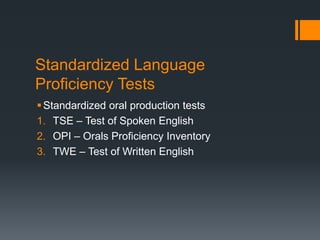
Standardized Language
Proficiency Tests
Standardized oral production tests
1. TSE – Test of Spoken English
2. OPI – Orals Proficiency Inventory
3. TWE – Test of Written English
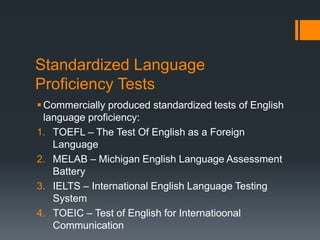
Standardized Language
Proficiency Tests
 Commercially produced standardized tests of English
language proficiency:
1. TOEFL – The Test Of English as a Foreign
Language
2. MELAB – Michigan English Language Assessment
Battery
3. IELTS – International English Language Testing
System
4. TOEIC – Test of English for Internatioonal
Communication
End

Standardized testing.pptx 2

  • 1.
  • 2.
    Standardized Test It presupposescertain standard objectives, or criteria, that are held constant across one form of the test to another. It measurers the children’s mastery of the standards or competencies that have ben prescribed for specific grade levels.
  • 3.
    Advantages of StandardizedTest It is a ready-made previously validated product that frees the teacher from having to spend hours creating a test. Administration to large groups can be accomplished within reasonable time limits. In the case of multiple-choice formats, scoring procedures are streamlined for either scannable computerized scoring or hand-scoring with a hole- punched grid for fast turnaround time.
  • 4.
    Disadvantages of Standardized Test Inappropriateuse of such tests. Example: using an overall proficiency test as an achievement test simply because of the convenience of the standardization.
  • 5.
    Developing a StandardizedTest Legend: TOEFL – The Test Of English as a Foreign Language ESLPT – The English as a Second Language Placement Test GET – The Graduate Essay Test
  • 6.
    1. Determine thepurpose and objectives of the Test  It is important for the test’s purpose and objectives to be stated specifically.  Example:  TOEFL – its purpose is to evaluate English proficiency of people whose native language is not English.  ESLPT – designed to place already admitted students in an appropriate course in academic writing, with the secondary goal of placing students into courses in oral production and grammar-editing.
  • 7.
    The content oftest must be designed to accomplish those particular ends. Each test has a specific gate-keeping function to perform; therefore the criteria before entering those gates must be specified accurately.
  • 8.
    2. Design TestSpecifications  This is the step of laying the foundation stones of the test.  Example:  TOEFL – Specifications: 1. Listening Section 2. Structure Section 3. Reading Section 4. Writing Section  Each specs are not just stated that way, it should include what does it measures, what does it covers, and what material it uses.
  • 9.
    3. Design, selectand arrange test tasks/items Once specifications for a standardized test have been stipulated, the task of designing, selecting and arranging test tasks/items begins. The specs act much like a blueprint in determining the number and types of items to be created.
  • 10.
    4. Make appropriateevaluations of different kinds of items. Item facility (IF) – % of people who give the right answer Item Discrimination (IDis) – indicates the extent to which success on an item corresponds to success on the whole test. Item Difficulty (ID) - finding out the % of people who get the item right in the try-out group.
  • 11.
    4. Make appropriateevaluations of different kinds of items. Performing them may not be practical especially if the classroom-based test is a one-time test. But for a standardized multiple-choice test that is designed to be marketed commercially, or administered a number of times, and administered in different form, these indices are a must.
  • 12.
    4. Make appropriateevaluations of different kinds of items. There are different form of evaluation for other types of response formats. (ex. Production responses) Practicality - Clarity of directions Timing of the test Ease of administration Time required to score responses.
  • 13.
    4. Make appropriateevaluations of different kinds of items. Reliability – is the degree to which an assessment tool produces stable and consistent results. Facility – Unclear directions Complex language Obscure topics Fuzzy data Culturally biased information.
  • 14.
    5. Specify scoringprocedures or formats A systematic assembly of test items in pre-selected arrangements and sequences, all of which are validated to conform to an expected level of difficulty, should yield a test that can then be scored accurately and reported back to test- takers and institutions efficiently.
  • 15.
    6. Perform ongoing construct validation studies No standardized instrument is expected to be used repeatedly without a rigorous program of on going construct validation. Any standardized test, once developed, must be accompanied by systematic corroboration of its effectiveness and by steps towards its improvement.
  • 16.
    Standardized Language Proficiency Tests Standardizedoral production tests 1. TSE – Test of Spoken English 2. OPI – Orals Proficiency Inventory 3. TWE – Test of Written English
  • 17.
    Standardized Language Proficiency Tests Commercially produced standardized tests of English language proficiency: 1. TOEFL – The Test Of English as a Foreign Language 2. MELAB – Michigan English Language Assessment Battery 3. IELTS – International English Language Testing System 4. TOEIC – Test of English for Internatioonal Communication
  • 18.