Page 1
FCE for Teachers: Study Skills
M.Ed. Maria Luisa Mu
Adapted from: Global Intermediate and Upper-Intermediate by Lindsay
Clandfield & Rebecca Robb Benne. Macmillan Publishers. 2010
Page 2
Being a Good Language Learner:
How often are these statements true for you? Give yourself a score
for each question. Not usually= 0 Sometimes= 1 Usually = 2
• I try to practise using English as often as I can
outside the classroom. ____
• I am willing to take risks and am not afraid of
making mistakes. ____
• I am organised in the way I manage my learning.
____
• I think about how I learn best. ____
• If I don´t understand something, I try to guess. ____
Page 3
Being a Good Language Learner:
How often are these statements true for you? Give yourself a score for
each question. Not usually= 0 Sometimes= 1 Usually = 2
• I notice my mistakes and try to learn from them.
____
• I set goals and monitor my progress. ____
• If I am not sure about something, I ask for help.
____
• I regularly review what I have learnt. ____
• I try to use English to communicate my ideas. ____
Page 4
Add up your total score:
• 16-20 Congratulations! You are already an excellent
language learner. Keep up the good work!
• 11-15 You already have some very good language
learning strategies. Now think how you can improve
even more.
• 6-10 You are starting to use the right strategies but
need to be more consistent.
• 0-5 Maybe you are finding it difficult to make
progress. Try some of the strategies of the quiz and
you could see a big difference.
Page 5
Understanding your Learning Style
• People learn languages in different
ways because of their past learning
experiences or their personality.
• Understanding your learning style is
important because it can help you
study more effectively.
Page 6
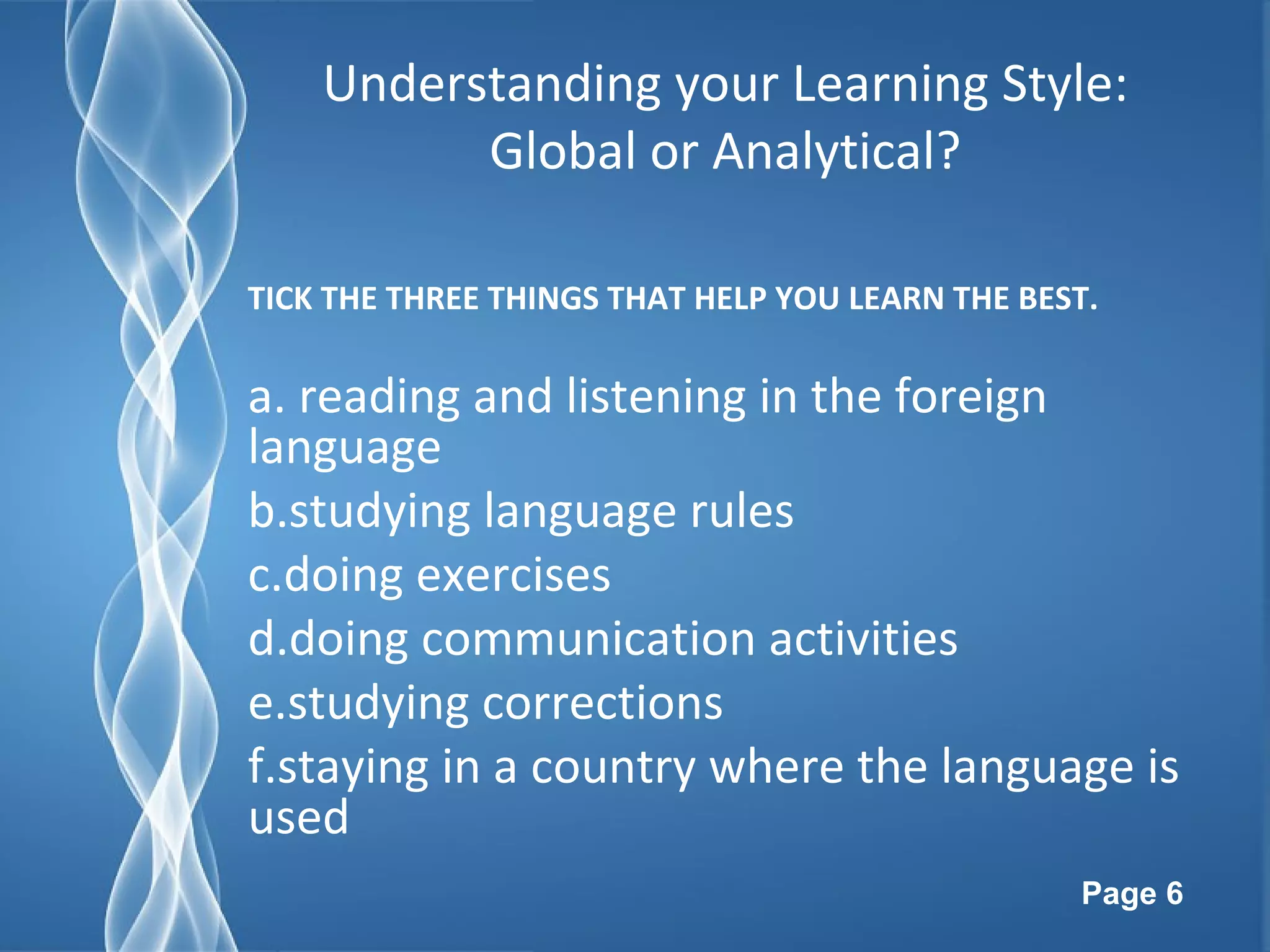
Understanding your Learning Style:
Global or Analytical?
TICK THE THREE THINGS THAT HELP YOU LEARN THE BEST.
a. reading and listening in the foreign
language
b.studying language rules
c.doing exercises
d.doing communication activities
e.studying corrections
f.staying in a country where the language is
used
Page 7
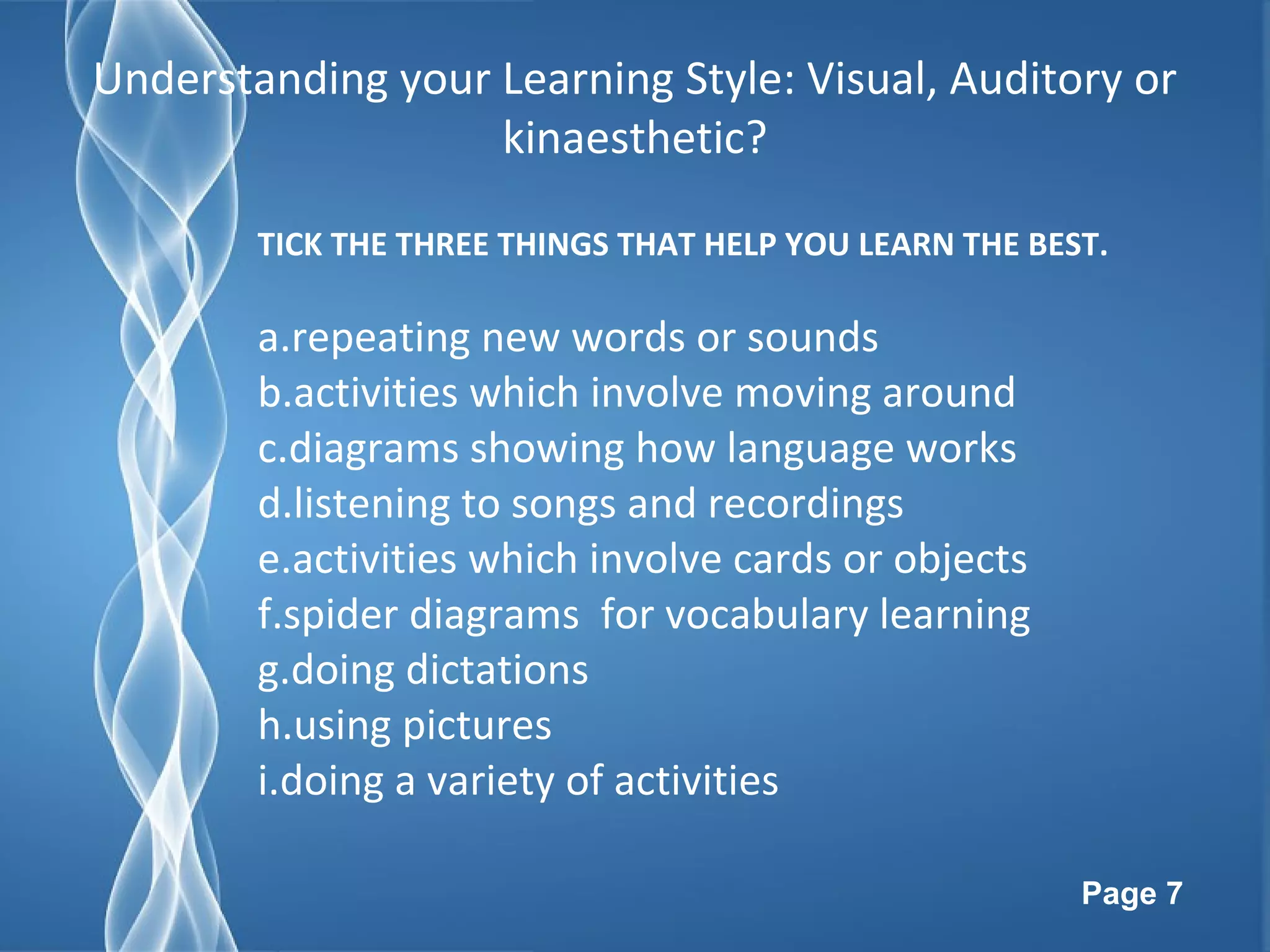
Understanding your Learning Style: Visual, Auditory or
kinaesthetic?
TICK THE THREE THINGS THAT HELP YOU LEARN THE BEST.
a.repeating new words or sounds
b.activities which involve moving around
c.diagrams showing how language works
d.listening to songs and recordings
e.activities which involve cards or objects
f.spider diagrams for vocabulary learning
g.doing dictations
h.using pictures
i.doing a variety of activities
Page 8
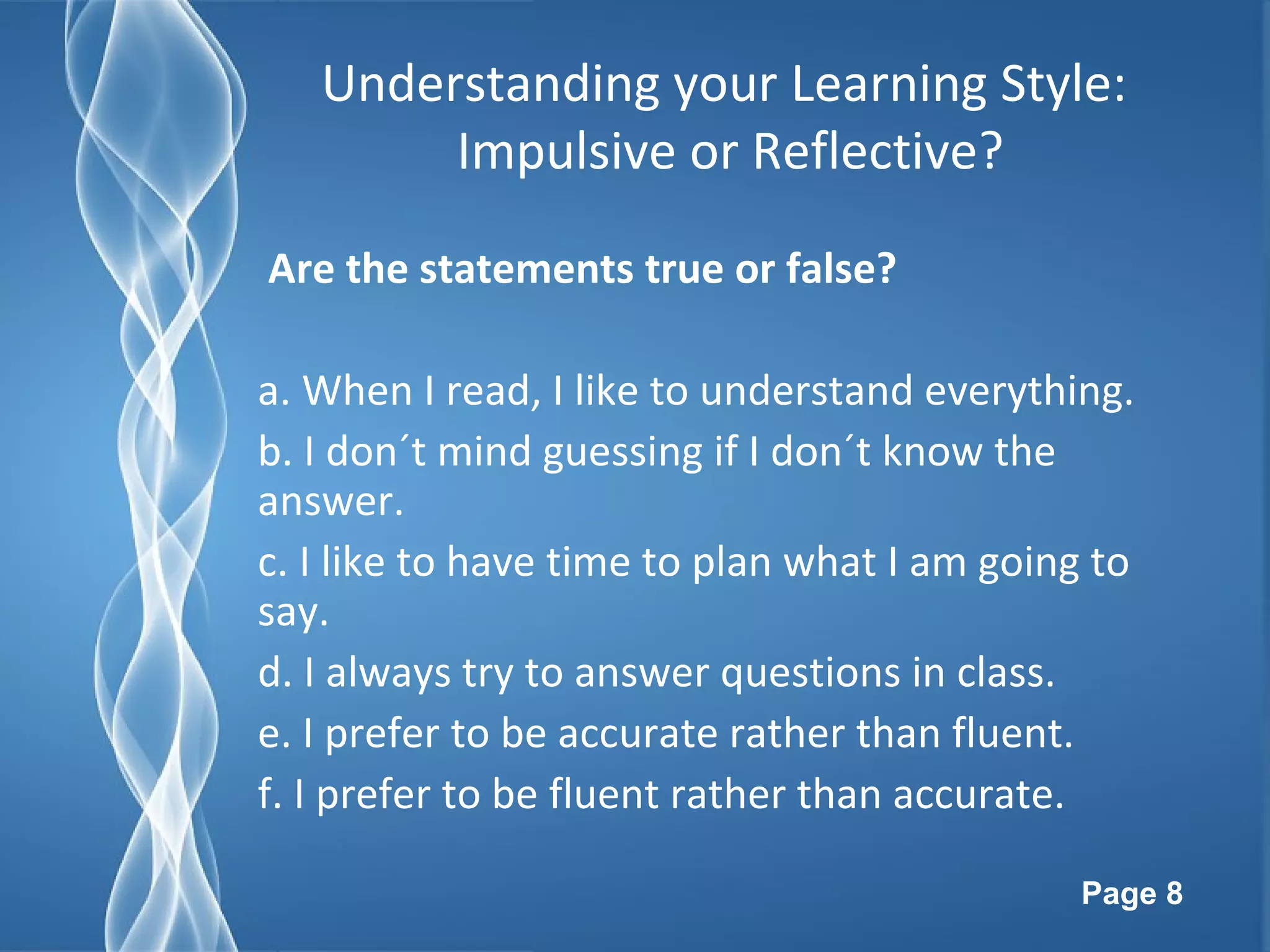
Understanding your Learning Style:
Impulsive or Reflective?
Are the statements true or false?
a. When I read, I like to understand everything.
b. I don´t mind guessing if I don´t know the
answer.
c. I like to have time to plan what I am going to
say.
d. I always try to answer questions in class.
e. I prefer to be accurate rather than fluent.
f. I prefer to be fluent rather than accurate.
Page 9
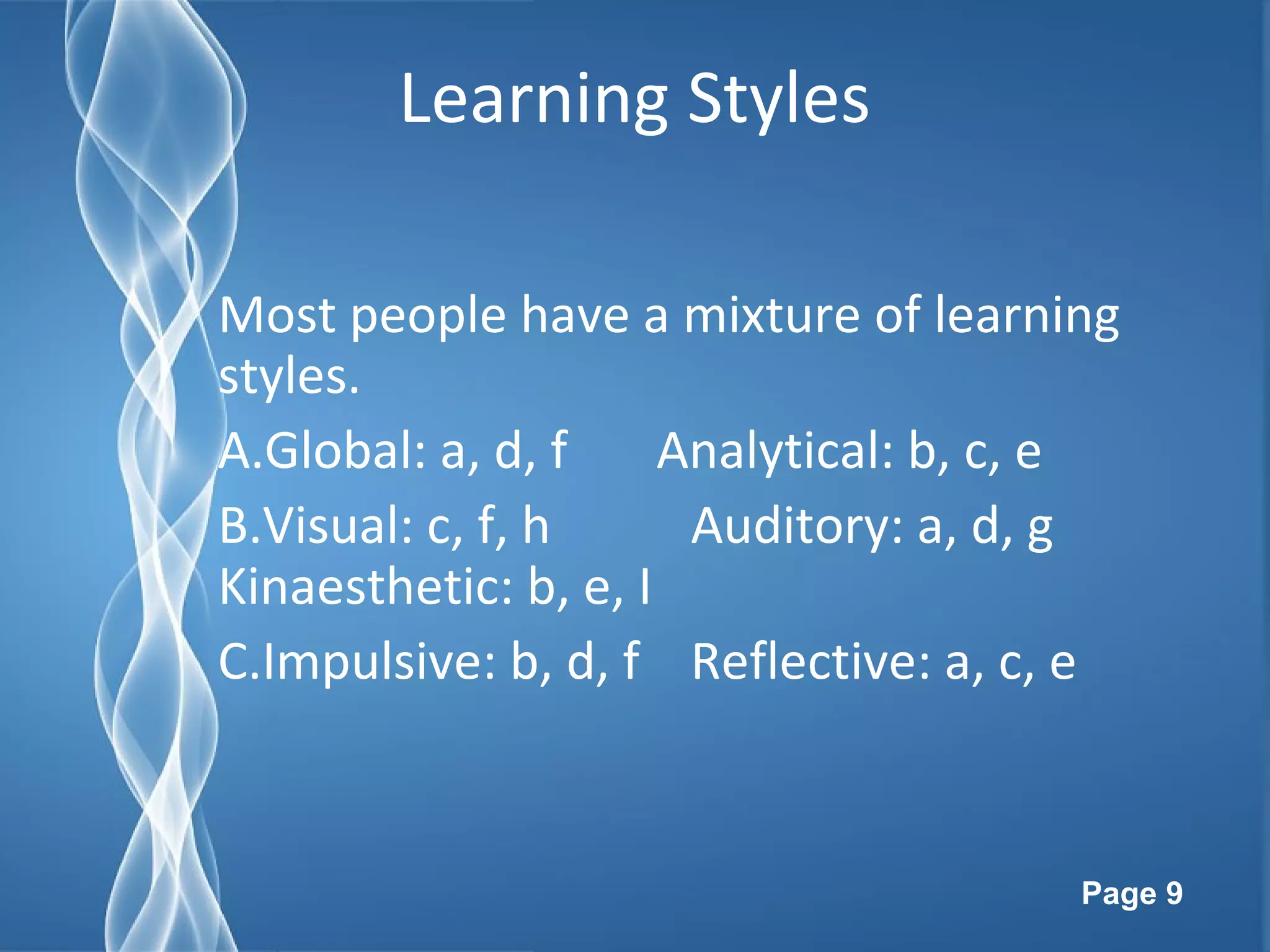
Learning Styles
Most people have a mixture of learning
styles.
A.Global: a, d, f Analytical: b, c, e
B.Visual: c, f, h Auditory: a, d, g
Kinaesthetic: b, e, I
C.Impulsive: b, d, f Reflective: a, c, e
Page 10
Managing your study time
WHEN DO YOU STUDY
BEST?
a.In the morning.
b.In the afternoon or evening.
WHAT DO YOU DO WITH
HOMEWORK?
a.Do it straight away.
b.Do it when you are ready.
c.Do it at the last minute.
HOW DO YOU STUDY
OUTSIDE CLASS?
a.Just do your homework.
b.Re-read the work done in
class.
c.Do other work as well.
WHEN DO YOU RE-READ
YOUR NOTES?
a.Before meals.
b.Travelling to work.
c.Before going to sleep.
Page 11
Top tips for study time
• Find the time when you work best, and study then.
• Re-read the work you have studied in class. Little
and often is best, e.g. ten minutes a day.
• Use spare moments to re-read your class work, e.g.
before meals, between classes, on the bus or
waiting for an appointment.
• Decide what is most important.
• Make a work plan and follow it.
• Don´t waste time thinking about work- do it straight
away!
When
preparing for
the FCE exam
you should
study
at least one
hour every
day.
Page 12
Examination strategies: Revision strategies
Preparing for the exam Doing the exam
• Read the instructions slowly, at least twice.
• Do practice papers in timed conditions.
• Always check both sides of the exam paper.
• Keep an eye on the clock.
• Leave enough time at the end to check your answers.
• Do some revision every day.
• Get plenty of sleep the night before the exam.
• Find out what exactly the exam is designed to test.
• Arrange revision sessions with friends.
• Divide your time equally between questions that
have the same marks.

FCE for Teachers Course: Study skills

  • 1.
    Page 1 FCE forTeachers: Study Skills M.Ed. Maria Luisa Mu Adapted from: Global Intermediate and Upper-Intermediate by Lindsay Clandfield & Rebecca Robb Benne. Macmillan Publishers. 2010
  • 2.
    Page 2 Being aGood Language Learner: How often are these statements true for you? Give yourself a score for each question. Not usually= 0 Sometimes= 1 Usually = 2 • I try to practise using English as often as I can outside the classroom. ____ • I am willing to take risks and am not afraid of making mistakes. ____ • I am organised in the way I manage my learning. ____ • I think about how I learn best. ____ • If I don´t understand something, I try to guess. ____
  • 3.
    Page 3 Being aGood Language Learner: How often are these statements true for you? Give yourself a score for each question. Not usually= 0 Sometimes= 1 Usually = 2 • I notice my mistakes and try to learn from them. ____ • I set goals and monitor my progress. ____ • If I am not sure about something, I ask for help. ____ • I regularly review what I have learnt. ____ • I try to use English to communicate my ideas. ____
  • 4.
    Page 4 Add upyour total score: • 16-20 Congratulations! You are already an excellent language learner. Keep up the good work! • 11-15 You already have some very good language learning strategies. Now think how you can improve even more. • 6-10 You are starting to use the right strategies but need to be more consistent. • 0-5 Maybe you are finding it difficult to make progress. Try some of the strategies of the quiz and you could see a big difference.
  • 5.
    Page 5 Understanding yourLearning Style • People learn languages in different ways because of their past learning experiences or their personality. • Understanding your learning style is important because it can help you study more effectively.
  • 6.
    Page 6 Understanding yourLearning Style: Global or Analytical? TICK THE THREE THINGS THAT HELP YOU LEARN THE BEST. a. reading and listening in the foreign language b.studying language rules c.doing exercises d.doing communication activities e.studying corrections f.staying in a country where the language is used
  • 7.
    Page 7 Understanding yourLearning Style: Visual, Auditory or kinaesthetic? TICK THE THREE THINGS THAT HELP YOU LEARN THE BEST. a.repeating new words or sounds b.activities which involve moving around c.diagrams showing how language works d.listening to songs and recordings e.activities which involve cards or objects f.spider diagrams for vocabulary learning g.doing dictations h.using pictures i.doing a variety of activities
  • 8.
    Page 8 Understanding yourLearning Style: Impulsive or Reflective? Are the statements true or false? a. When I read, I like to understand everything. b. I don´t mind guessing if I don´t know the answer. c. I like to have time to plan what I am going to say. d. I always try to answer questions in class. e. I prefer to be accurate rather than fluent. f. I prefer to be fluent rather than accurate.
  • 9.
    Page 9 Learning Styles Mostpeople have a mixture of learning styles. A.Global: a, d, f Analytical: b, c, e B.Visual: c, f, h Auditory: a, d, g Kinaesthetic: b, e, I C.Impulsive: b, d, f Reflective: a, c, e
  • 10.
    Page 10 Managing yourstudy time WHEN DO YOU STUDY BEST? a.In the morning. b.In the afternoon or evening. WHAT DO YOU DO WITH HOMEWORK? a.Do it straight away. b.Do it when you are ready. c.Do it at the last minute. HOW DO YOU STUDY OUTSIDE CLASS? a.Just do your homework. b.Re-read the work done in class. c.Do other work as well. WHEN DO YOU RE-READ YOUR NOTES? a.Before meals. b.Travelling to work. c.Before going to sleep.
  • 11.
    Page 11 Top tipsfor study time • Find the time when you work best, and study then. • Re-read the work you have studied in class. Little and often is best, e.g. ten minutes a day. • Use spare moments to re-read your class work, e.g. before meals, between classes, on the bus or waiting for an appointment. • Decide what is most important. • Make a work plan and follow it. • Don´t waste time thinking about work- do it straight away! When preparing for the FCE exam you should study at least one hour every day.
  • 12.
    Page 12 Examination strategies:Revision strategies Preparing for the exam Doing the exam • Read the instructions slowly, at least twice. • Do practice papers in timed conditions. • Always check both sides of the exam paper. • Keep an eye on the clock. • Leave enough time at the end to check your answers. • Do some revision every day. • Get plenty of sleep the night before the exam. • Find out what exactly the exam is designed to test. • Arrange revision sessions with friends. • Divide your time equally between questions that have the same marks.