Etching Processes for
Microsystems
Fabrication
1
 Micro Systems
 Micro Devices
 Etching Process
 Etching Parameters
 Qualitative Reasoning
2
Arman Ur Rashid
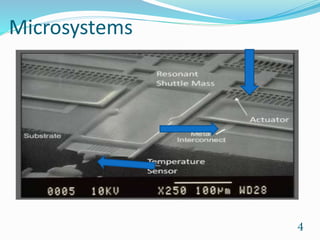
Microsystems
4
Micro devices: Neural Probes
10nm
100um
5
Micro Devices:Microgear and Alignment Pin
[Courtesy of Sandia National Laboratories]
Alignment Pin
Gear
Substrate
6
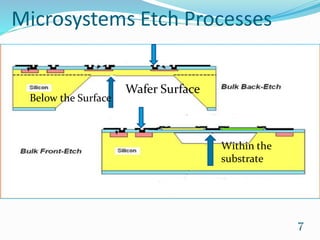
Microsystems Etch Processes
Within the
substrate
Wafer Surface
Below the Surface
7
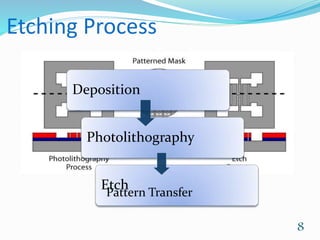
Etching Process
Deposition
Photolithography
EtchPattern Transfer
8
Etch Parameters
9
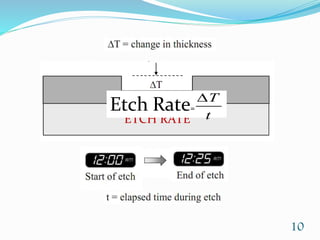
ETCH RATE
Etch Rate=
T
t

10
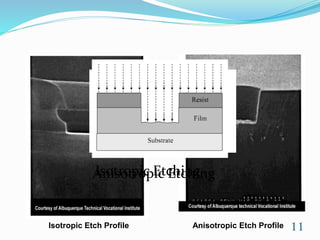
Etch Profile
Isotropic Etch Profile Anisotropic Etch Profile
Isotropic EtchingAnisotropic Etching
11
SELECTIVITY
Ef = etch rate of the film undergoing etch
Er = etch rate of the photoresist
Poor selectivity -> 1:1
Good selectivity -> 100:1
f
r
E
S
E

12
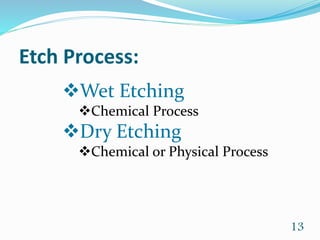
Etch Process:
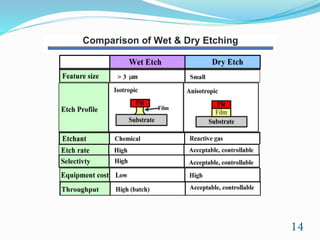
Wet Etching
Chemical Process
Dry Etching
Chemical or Physical Process
13
14
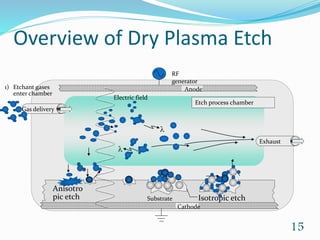
Overview of Dry Plasma Etch
Substrate
Etch process chamber
Exhaust
Gas delivery
RF
generator
Cathode
Anode
l
l
Anisotro
pic etch Isotropic etch
1) Etchant gases
enter chamber
Electric field
15
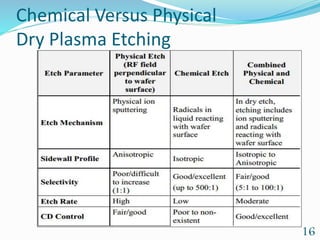
Chemical Versus Physical
Dry Plasma Etching
16
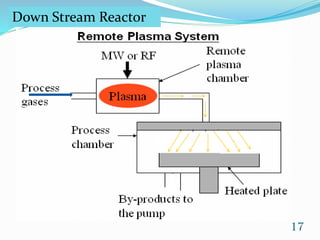
Down Stream Reactor
17
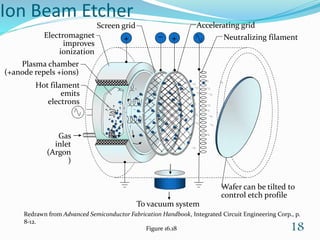
Ion Beam Etcher
+
+
+
+
+ +
_
Hot filament
emits
electrons
Gas
inlet
(Argon
)
To vacuum system
Neutralizing filament
Accelerating gridScreen grid
Electromagnet
improves
ionization
Plasma chamber
(+anode repels +ions)
Wafer can be tilted to
control etch profile
Redrawn from Advanced Semiconductor Fabrication Handbook, Integrated Circuit Engineering Corp., p.
8-12.
Figure 16.18
+
+
+
+
+
+
+
+
+
+
+
+
+
+
+
+
+
+
+
+
+
+
+
+
+
+
+
+
+
+
18
Deep Reactive-Ion Etching (DRIE):
1. The Bosch Process
2. The Cryogenic Process
19
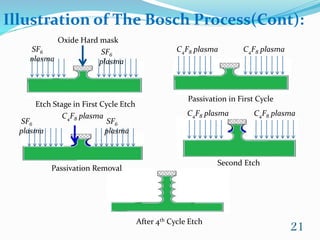
Illustration of The Bosch Process:
SF6
plasma
SiF4
F+ions
Si Substrate
Mask
C4F8
plasma
SF6 plasma
20
SF6
plasma
C4F8 plasma
SF6
plasma
Oxide Hard mask
Etch Stage in First Cycle Etch
Passivation in First Cycle
C4F8 plasmaSF6
plasma
SF6
plasma
Passivation Removal
C4F8 plasma C4F8 plasma
Second Etch
After 4th Cycle Etch
C4F8 plasma
Illustration of The Bosch Process(Cont):
21
SEM Graph:
22
Characteristics of The Bosch Process:
Roughness
of Sidewall
Aspect Ratio
90DegreeEdge
23
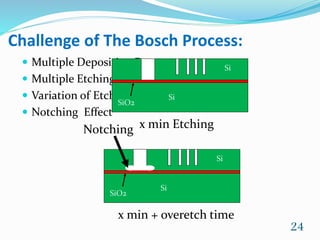
Challenge of The Bosch Process:
 Multiple Deposition Parameters
 Multiple Etching Parameters
 Variation of Etch Rate depth
 Notching Effect
Si
Si
SiO2
x min Etching
Si
Si
SiO2
x min + overetch time
Notching
24
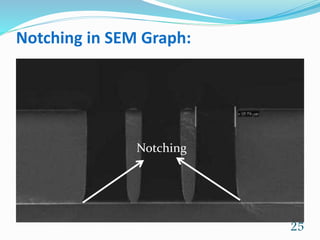
Notching in SEM Graph:
Notching
25
Illustration of The Cryogenic process:
SF6
plasma
SiF4F+ions Mask
Si
Ultra thin
layer of
SiO2
26
SEM Graph:
27
Characteristics of The Cryogenic
Process:
 Low Ion Energies
 Little Physical Etching on The Mask Surface
 High Selectivity.
 Low Sidewall Roughness
 High Etch Rate
28
Why Cryogenic Temperature:
 Condensation on Surfaces
 Spontaneous Chemical Reaction
 Etch Rate of the Mask Material
29
Challenges of The Cryogenic
Process:
 Cracking of Masks
 Sensitive to Heat Path Variations
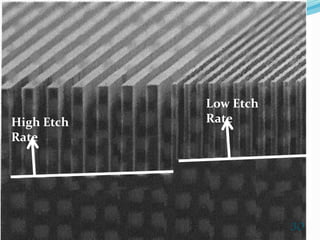
 Etch Rate Varies with Depth
 Shape and Depth Depends on Multiple Parameter
 Notching effect
 Reduction in Etch Rate Due to Aspect Ratio
High Etch
Rate
Low Etch
Rate
30
Comparison of The Bosch and
Cryogenic Process:
 Sidewall
 Etch Rate
 Selectivity
 Cracking of Mask
31
Summary
Etching Process
Parameters
Dry Plasma Etching Techniques
Deep Reactive Ion Etching
DRIE Procedures and Challenges
32
33

Etching processes for microsystems fabrication