PLAR - Nanotechnology Nanotechnology –  an overview PL. Arunachalam,  Diploma in Computer Engineering  Thiagarajar polytechnic college Salem.
Synopsis Introduction Applications Synthesis of nanomaterials Characterization and detection techniques Concluding remarks PLAR - Nanotechnology
Nanotechnology is the creation of functional materials, devices, and systems through control of matter on an atomic or molecular scale. The creation and use of structures, devices and systems that have novel properties and functions because of their small and/or intermediate size. DEFINITION OF NANOTECHNOLOGY PLAR - Nanotechnology
BEST COMPARSION PLAR - Nanotechnology
PLAR - Nanotechnology “  I can hardly doubt that when we have some control of the arrangement of things  ON A SMALL SCALE we will get an  enormously greater range of possible properties  that substances can have.” … .. R. FEYNMAN California Institute of Technology, December 26, 1959 atom by atom. maneuvering
Atomic domains (grains, layers or phases) spatially confined to 100nm in at least one dimension Zero dimension – clusters of aspect ratio 1 to infinity – Quantum dots One dimension – Multilayers – Nanowires, CNT (Carbon nano tubes) Two dimension – Ultrafine-grained over layers (coatings) Three dimension – Nanophase materials  NANOMATERIALS – DEFN. &  CLASSIFICATION PLAR - Nanotechnology
UNIQUENESS OF NANOMATERIALS Grains, pores, interface thickness and defects are of similar dimensions. Nanomaterials have a large surface area but their volume is very small. Improve mechanical properties (increased strength, toughness etc.,) High melting point compounds. PLAR - Nanotechnology
INTERDISCIPLINARY APPROACH REQUIRED PLAR - Nanotechnology Engineering Physical Sciences Bioscience NANOTECHNOLOGY
FIELDS OF NANOTECHNOLOGY PLAR - Nanotechnology Nanotechnology   Nanomedicine  Nanobiotechnology  Nanolithography  Nanoelectronics  Nanomagnetics  Nano Biodevices  NEMS (nano electro mechanical sys) Nano Biomimetic materials  Nano Pulp & Paper Technology
Applications of Nanomaterial Based Products  PLAR - Nanotechnology Automotive industry Engineering Medicine  Cosmetics Textile  Sports Chemical industry Electronic industry
PLAR - Nanotechnology LOTUS – SELF CLEANING Water lily Super hydrophobicity - Self cleaning SEM  Surface roughness – Self cleaning Rinsing with water Water drops – clean surface Applications  -
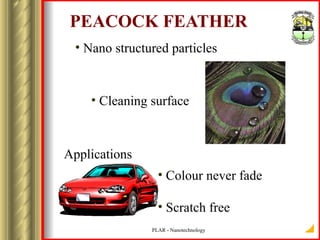
PEACOCK FEATHER PLAR - Nanotechnology Nano structured particles Applications Colour never fade Scratch free Cleaning surface
PLAR - Nanotechnology Atlantic – Aprilia fuel cell bike Photovoltaic cell  Fuel Cell NANOTECHNOLOGY –  FUEL CELL Hydrogen
PLAR - Nanotechnology NANOTECHNOLOGY – COSMETIC APPLICATIONS Acne treatment Herbal liposome for cosmetic applications Before treatment After treatment Titanium oxide
NANO MATERIAL - OPTICAL PROPERTIES PLAR - Nanotechnology Gold (Bulk) Nano Gold colloids Au – Cancer Treatments Applications
PLAR - Nanotechnology NANO- TEXTILE APPLICATIONS Nano Jacket Student’s uniform Nano tie and scarf
PLAR - Nanotechnology Synthesis of Nanomaterials Synthesis of  Nanomaterials Top - down method (Destruction)   Bottom-up   method (Construction)
Synthesis of Nanomaterials PLAR - Nanotechnology Top - Down  method High energy  Ball Milling Lithography Gas  condensation   Severe plastic  deformation
SYNTHESIS  OF NANOMATERIALS PLAR - Nanotechnology Bottom  Up method Physical   Vapor  Deposition Chemical Vapor Deposition Plasma  Processes Sol-gel Processing Soft- Lithography Self- Assembly
CHARACTERIZATION AND DETECTION TECHNIQUES Essential requirements for the development, manufacturing and commercialization of nanomaterials is their physical, chemical and biological properties on a nanoscale level For determination of atomic structure and chemical composition of solid or liquid nanomaterials – spectroscopic methods, X-ray and Neutron diffraction  For determination of size and shape –  Electron microcopies (SEM or TEM) PLAR - Nanotechnology
PLAR - Nanotechnology Optical Microscope Scanning Electron Microscope HIGH DEPTH OF FIELD NANOMATERIAL
PLAR - Nanotechnology JEM-2100F TRANSMISSION ELECTRON MICROSCOPE
PLAR - Nanotechnology WORKING PRINCIPLE OF AFM www.shef.ac.uk/~htsl/afm.htm   Atomic Force Microscope Force Surface Atoms Tip Atoms Photo detector Laser Beam Tip Cantilever Line Scan Surface
CONCLUDING REMARKS PLAR - Nanotechnology Choice of nanocrystalline or nanostrucured material   Application Final property requirement Grain sizes Density Porosity Choice of a suitable process Top down or bottom up approach Economics or viability Nano resisters are like papers. . . . . .
PLAR - Nanotechnology Thanking You pl_arun

Nano Technology

  • 1.
    PLAR - NanotechnologyNanotechnology – an overview PL. Arunachalam, Diploma in Computer Engineering Thiagarajar polytechnic college Salem.
  • 2.
    Synopsis Introduction ApplicationsSynthesis of nanomaterials Characterization and detection techniques Concluding remarks PLAR - Nanotechnology
  • 3.
    Nanotechnology is thecreation of functional materials, devices, and systems through control of matter on an atomic or molecular scale. The creation and use of structures, devices and systems that have novel properties and functions because of their small and/or intermediate size. DEFINITION OF NANOTECHNOLOGY PLAR - Nanotechnology
  • 4.
    BEST COMPARSION PLAR- Nanotechnology
  • 5.
    PLAR - Nanotechnology“ I can hardly doubt that when we have some control of the arrangement of things ON A SMALL SCALE we will get an enormously greater range of possible properties that substances can have.” … .. R. FEYNMAN California Institute of Technology, December 26, 1959 atom by atom. maneuvering
  • 6.
    Atomic domains (grains,layers or phases) spatially confined to 100nm in at least one dimension Zero dimension – clusters of aspect ratio 1 to infinity – Quantum dots One dimension – Multilayers – Nanowires, CNT (Carbon nano tubes) Two dimension – Ultrafine-grained over layers (coatings) Three dimension – Nanophase materials NANOMATERIALS – DEFN. & CLASSIFICATION PLAR - Nanotechnology
  • 7.
    UNIQUENESS OF NANOMATERIALSGrains, pores, interface thickness and defects are of similar dimensions. Nanomaterials have a large surface area but their volume is very small. Improve mechanical properties (increased strength, toughness etc.,) High melting point compounds. PLAR - Nanotechnology
  • 8.
    INTERDISCIPLINARY APPROACH REQUIREDPLAR - Nanotechnology Engineering Physical Sciences Bioscience NANOTECHNOLOGY
  • 9.
    FIELDS OF NANOTECHNOLOGYPLAR - Nanotechnology Nanotechnology Nanomedicine Nanobiotechnology Nanolithography Nanoelectronics Nanomagnetics Nano Biodevices NEMS (nano electro mechanical sys) Nano Biomimetic materials Nano Pulp & Paper Technology
  • 10.
    Applications of NanomaterialBased Products PLAR - Nanotechnology Automotive industry Engineering Medicine Cosmetics Textile Sports Chemical industry Electronic industry
  • 11.
    PLAR - NanotechnologyLOTUS – SELF CLEANING Water lily Super hydrophobicity - Self cleaning SEM Surface roughness – Self cleaning Rinsing with water Water drops – clean surface Applications -
  • 12.
    PEACOCK FEATHER PLAR- Nanotechnology Nano structured particles Applications Colour never fade Scratch free Cleaning surface
  • 13.
    PLAR - NanotechnologyAtlantic – Aprilia fuel cell bike Photovoltaic cell Fuel Cell NANOTECHNOLOGY – FUEL CELL Hydrogen
  • 14.
    PLAR - NanotechnologyNANOTECHNOLOGY – COSMETIC APPLICATIONS Acne treatment Herbal liposome for cosmetic applications Before treatment After treatment Titanium oxide
  • 15.
    NANO MATERIAL -OPTICAL PROPERTIES PLAR - Nanotechnology Gold (Bulk) Nano Gold colloids Au – Cancer Treatments Applications
  • 16.
    PLAR - NanotechnologyNANO- TEXTILE APPLICATIONS Nano Jacket Student’s uniform Nano tie and scarf
  • 17.
    PLAR - NanotechnologySynthesis of Nanomaterials Synthesis of Nanomaterials Top - down method (Destruction) Bottom-up method (Construction)
  • 18.
    Synthesis of NanomaterialsPLAR - Nanotechnology Top - Down method High energy Ball Milling Lithography Gas condensation Severe plastic deformation
  • 19.
    SYNTHESIS OFNANOMATERIALS PLAR - Nanotechnology Bottom Up method Physical Vapor Deposition Chemical Vapor Deposition Plasma Processes Sol-gel Processing Soft- Lithography Self- Assembly
  • 20.
    CHARACTERIZATION AND DETECTIONTECHNIQUES Essential requirements for the development, manufacturing and commercialization of nanomaterials is their physical, chemical and biological properties on a nanoscale level For determination of atomic structure and chemical composition of solid or liquid nanomaterials – spectroscopic methods, X-ray and Neutron diffraction For determination of size and shape – Electron microcopies (SEM or TEM) PLAR - Nanotechnology
  • 21.
    PLAR - NanotechnologyOptical Microscope Scanning Electron Microscope HIGH DEPTH OF FIELD NANOMATERIAL
  • 22.
    PLAR - NanotechnologyJEM-2100F TRANSMISSION ELECTRON MICROSCOPE
  • 23.
    PLAR - NanotechnologyWORKING PRINCIPLE OF AFM www.shef.ac.uk/~htsl/afm.htm Atomic Force Microscope Force Surface Atoms Tip Atoms Photo detector Laser Beam Tip Cantilever Line Scan Surface
  • 24.
    CONCLUDING REMARKS PLAR- Nanotechnology Choice of nanocrystalline or nanostrucured material Application Final property requirement Grain sizes Density Porosity Choice of a suitable process Top down or bottom up approach Economics or viability Nano resisters are like papers. . . . . .
  • 25.
    PLAR - NanotechnologyThanking You pl_arun