CHEMICAL VAPOUR DEPOSITION &
 PHYSICAL VAPOUR DEPOSITION


           Presented by;
           Shreya M. Modi
           M.Phil/P.hD in NanoScience &
           Nanotechnology,
           Central University of Gujrat
OUTLINE
 Introduction
 Types of CVD
 CVD apparatus
 CVD process
 Advantages & Disadvantages
 Application of CVD
 PVD Process
 Varients of PVD
 Advantages & Disadvantages
 Application of PVD
 Difference Between PVD & CVD
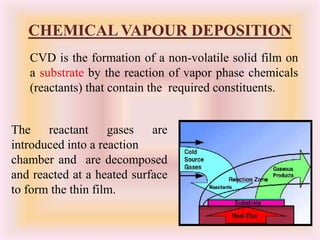
CHEMICAL VAPOUR DEPOSITION
   CVD is the formation of a non-volatile solid film on
   a substrate by the reaction of vapor phase chemicals
   (reactants) that contain the required constituents.


The reactant gases are
introduced into a reaction
chamber and are decomposed
and reacted at a heated surface
to form the thin film.
TYPES OF CVD
 Hot-wall thermal CVD (batch operation type)
 Plasma assisted CVD
 Atmospheric pressure CVD (APCVD) – CVD process at
  atmospheric pressure.
 Low-pressure CVD (LPCVD) – CVD process at sub-
  atmospheric pressures.[1] Reduced pressures tend to reduce
  unwanted gas-phase reactions and improve film uniformity
  across the wafer.
 Ultrahigh vacuum CVD (UHVCVD) – CVD process at
  very low pressure, typically below 10−6 Pa (~10−8 torr).
  Note that in other fields, a lower division between high and
  ultra-high vacuum is common, often 10−7 Pa.
CONTI….
 Aerosol assisted CVD (AACVD)
 Direct liquid injection CVD (DLICVD)
 Microwave plasma-assisted CVD (MPCVD)
 Plasma-Enhanced CVD (PECVD)
 Remote plasma-enhanced CVD (RPECVD)
 Atomic layer CVD (ALCVD)
 Combustion Chemical Vapor Deposition (CCVD)
 Hot wire CVD (HWCVD) –
 Hybrid Physical-Chemical Vapor Deposition (HPCVD)
 Metalorganic chemical vapor deposition (MOCVD)
 Rapid thermal CVD (RTCVD)
CVD APPARATUS
 Gas delivery system – For the supply of precursors to
  the reactor chamber
 Reactor chamber – Chamber within which deposition
  takes place
 Substrate loading mechanism – A system for
  introducing and removing substrates, mandrels etc.
 Energy source – Provide the energy/heat that is
  required to get the precursors to react/decompose.
 Vacuum system – A system for removal of all other
  gaseous species other than those required for the
  reaction/deposition.
CONTI…
 Exhaust system – System for removal of volatile by-
  products from the reaction chamber.
 Exhaust treatment systems – In some instances,
  exhaust gases may not be suitable for release into
  the atmosphere and may require treatment or
  conversion to safe/harmless compounds.
 Process control equipment – Gauges, controls etc..
  to monitor process parameters such as pressure,
  temperature and time. Alarms and safety devices
  would also be included in this category.
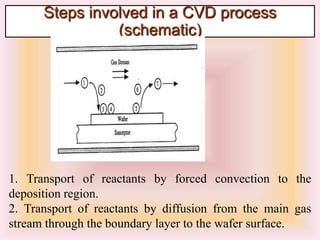
Steps involved in a CVD process
                (schematic)


1. Transport of reactants by forced convection to the
deposition region.
2. Transport of reactants by diffusion from the main gas
stream through the boundary layer to the wafer surface.
Conti…..
3. Adsorption of reactants on the wafer surface.

4. Surface processes, including chemical decomposition
or reaction, surface migration to attachment sites (such as
atomic-level ledges and kinks), site incorporation, and
other surface reactions.

5. Desorption of byproducts from the surface.

6. Transport of byproducts by diffusion through the
boundary layer and back to the main gas stream.

7. Transport of byproducts by forced convection away
from the deposition region.
Conti………….
Advantages:
 High growth rates possible
 Can deposit materials which are hard to evaporate
 Good reproducibility
 Can grow epitaxial films
Conti

Disadvantages
high temperatures
complex processes
toxic and corrosive gasses
APPLICATION
 Coatings –
 Such as wear resistance,
 Corrosion resistance,
 High temperature protection,
 Erosion protection and
 Combinations thereof.

 Semiconductors and related devices –
 Integrated circuits,
 Sensors and
 Optoelectronic devices
Conti….
 Dense structural parts – CVD can be used to
  produce components that are difficult or
  uneconomical to produce using conventional
  fabrication techniques.
 Dense parts produced via CVD are generally
  thin walled and maybe deposited onto a
  mandrel or former.

 Optical Fibers – For telecommunications.
Conti ………………
 Composites – Preforms can be infiltrated using CVD
  techniques to produce ceramic matrix composites
  such as carbon-carbon, carbon-silicon carbide and
  silicon carbide-silicon carbide composites. This
  process is sometimes called chemical vapour
  infiltration or CVI.
 Powder production – Production of novel powders
  and fibers
 Catalysts
 Nano machines
Physical Vapour Déposition(PVD)
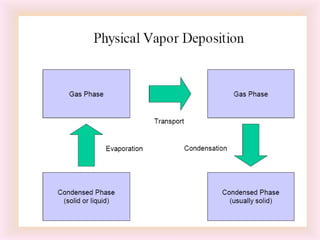
 Physical vapour deposition (PVD) is fundamentally a
  vaporization coating technique, involving transfer of
  material on an atomic level.

 It is an alternative process to electroplating

 The process is similar to chemical vapour deposition (CVD)
  except that the raw materials/precursors,

 i.e. the material that is going to be deposited starts out in
  solid form, whereas in CVD, the precursors are introduced
  to the reaction chamber in the gaseous state.
Conti …….
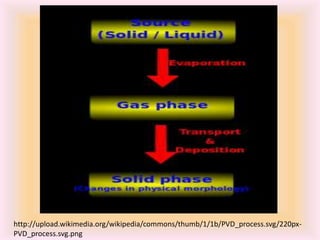
• Working Concept
  PVD processes are carried out under vacuum
  conditions. The process involved four steps:
  1.Evaporation
  2.Transportation
  3.Reaction
  4.Deposition
Evaporation
During this stage, a target, consisting of the material to
be is bombarded by a high energy source such as a
beam of electrons or ions. This dislodges atoms from
the surface of the target, ‘vaporizing’ them.

                    Transport
This process simply consists of the movement of
‘vaporized’ atoms from the target to the substrate to be
coated and will generally be a straight line affair.


                        UNIT IV LECTURE 3               17
Conti…
                        Reaction

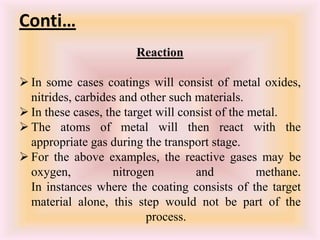
 In some cases coatings will consist of metal oxides,
  nitrides, carbides and other such materials.
 In these cases, the target will consist of the metal.
 The atoms of metal will then react with the
  appropriate gas during the transport stage.
 For the above examples, the reactive gases may be
  oxygen,           nitrogen         and          methane.
  In instances where the coating consists of the target
  material alone, this step would not be part of the
                           process.
Deposition

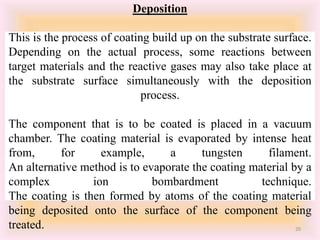
This is the process of coating build up on the substrate surface.
Depending on the actual process, some reactions between
target materials and the reactive gases may also take place at
the substrate surface simultaneously with the deposition
                             process.

The component that is to be coated is placed in a vacuum
chamber. The coating material is evaporated by intense heat
from,      for     example,      a      tungsten      filament.
An alternative method is to evaporate the coating material by a
complex          ion          bombardment           technique.
The coating is then formed by atoms of the coating material
being deposited onto the surface of the component being
treated.                                                    20
http://upload.wikimedia.org/wikipedia/commons/thumb/1/1b/PVD_process.svg/220px-
PVD_process.svg.png
VARIENTS OF PVD
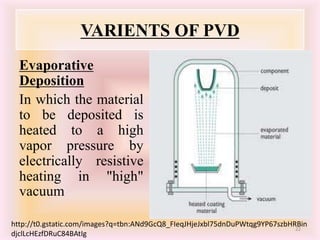
  Evaporative
  Deposition
  In which the material
  to be deposited is
  heated to a high
  vapor pressure by
  electrically resistive
  heating in "high"
  vacuum

http://t0.gstatic.com/images?q=tbn:ANd9GcQ8_FIeqJHjeJxbl75dnDuPWtqg9YP67szbHRBin
                                                                             22
djclLcHEzfDRuC84BAtIg
ELECTRON BEAM PHYSICAL
       VAPOR DEPOSITION
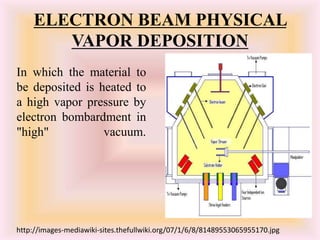
In which the material to
be deposited is heated to
a high vapor pressure by
electron bombardment in
"high"           vacuum.


http://images-mediawiki-sites.thefullwiki.org/07/1/6/8/81489553065955170.jpg
SPUTTER DEPOSITION
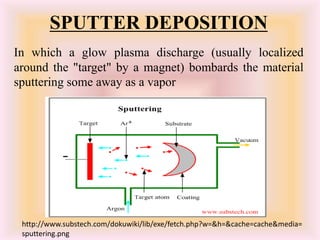
In which a glow plasma discharge (usually localized
around the "target" by a magnet) bombards the material
sputtering some away as a vapor


 http://www.substech.com/dokuwiki/lib/exe/fetch.php?w=&h=&cache=cache&media=
 sputtering.png
CATHODIC ARC DEPOSITION

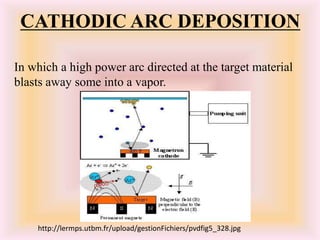
In which a high power arc directed at the target material
blasts away some into a vapor.


    http://lermps.utbm.fr/upload/gestionFichiers/pvdfig5_328.jpg
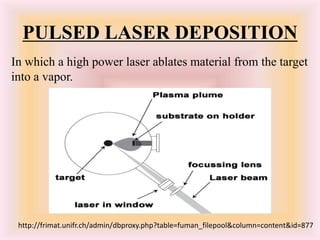
PULSED LASER DEPOSITION
In which a high power laser ablates material from the target
into a vapor.


 http://frimat.unifr.ch/admin/dbproxy.php?table=fuman_filepool&column=content&id=877
Importance of PVD Coatings

 PVD coatings are deposited for numerous reasons.
  Some of the main ones are:
 Improved hardness and wear resistance
 Reduced friction
 Improved Oxidation resistance
 The use of such coatings is aimed at improving
  efficiency through improved performance and longer
  component life.
 They may also allow coated components to operate in
  environments that the uncoated component would not
  otherwise have been able to perform.
                                                    27
Advantages

 Materials can be deposited with improved properties
  compared to the substrate material

 Almost any type of inorganic material can be used
  as well as some kinds of organic materials

 The process is more environmentally friendly than
  processes such as electroplating.

                                                   28
DISADVANTAGES

 It is a line of sight technique meaning that it is
  extremely difficult to coat undercuts and similar
  surface features
 High capital cost
 Some processes operate at high vacuums and
  temperatures requiring skilled operators
 Processes requiring large amounts of heat require
  appropriate cooling systems
 The rate of coating deposition is usually quite slow
Applications

 PVD coatings are generally used to improve
  Hardness, Wear Resistance And Oxidation
  Resistance.
 Thus, such coatings use in a wide range of
  applications such as:
 Aerospace
 Automotive
 Surgical/Medical
 Dies and moulds for all manner of material
  processing
 Cutting tools
 Fire arms 3030        UNIT IV LECTURE 3      30
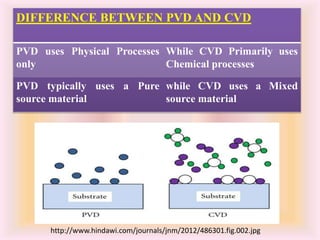
DIFFERENCE BETWEEN PVD AND CVD

PVD uses Physical Processes While CVD Primarily uses
only                        Chemical processes

PVD typically uses a Pure while CVD uses a Mixed
source material           source material


      http://www.hindawi.com/journals/jnm/2012/486301.fig.002.jpg
Thank You