11
Epigenetics
Dr. Nilesh Chandra
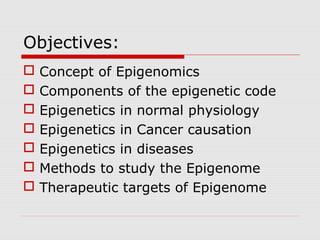
Objectives:
 Concept of Epigenomics
 Components of the epigenetic code
 Epigenetics in normal physiology
 Epigenetics in Cancer causation
 Epigenetics in diseases
 Methods to study the Epigenome
 Therapeutic targets of Epigenome
3
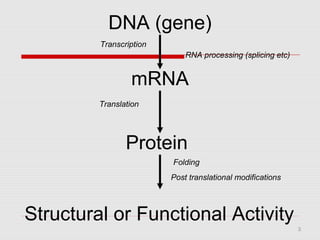
DNA (gene)
mRNA
Protein
Transcription
RNA processing (splicing etc)
Translation
Folding
Post translational modifications
Structural or Functional Activity
4
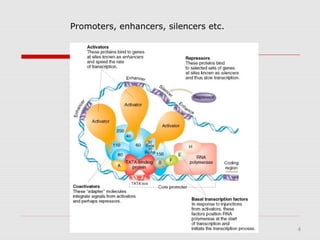
Promoters, enhancers, silencers etc.
555
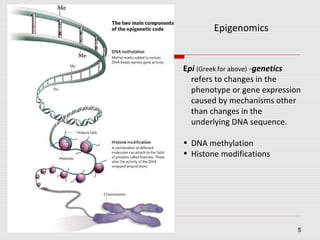
Epigenomics
Epi (Greek for above) -genetics
refers to changes in the
phenotype or gene expression
caused by mechanisms other
than changes in the
underlying DNA sequence.
• DNA methylation
• Histone modifications
6
Epigenetic chromatin regulation
A. Modification at the DNA level
1. Cytosine methylation
B. Histone modification - the histone code
1. Histone acetylation
2. Histone methylation
3. Histone phosphorylation
4. Histone ubiquitination
7
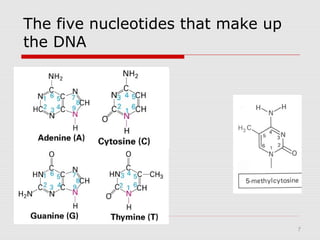
The five nucleotides that make up
the DNA
DNA methylation
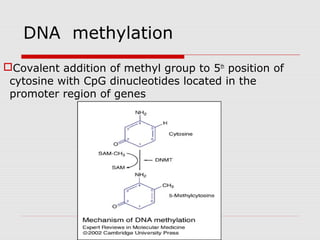
Covalent addition of methyl group to 5th
position of
cytosine with CpG dinucleotides located in the
promoter region of genes
9
DNA methylation
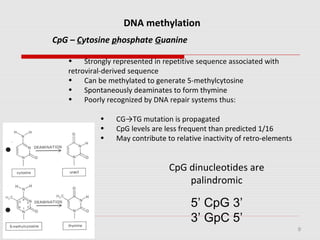
CpG – Cytosine phosphate Guanine
• Strongly represented in repetitive sequence associated with
retroviral-derived sequence
• Can be methylated to generate 5-methylcytosine
• Spontaneously deaminates to form thymine
• Poorly recognized by DNA repair systems thus:
• CG→TG mutation is propagated
• CpG levels are less frequent than predicted 1/16
• May contribute to relative inactivity of retro-elements
CpG dinucleotides are
palindromic
5’ CpG 3’
3’ GpC 5’
10
DNA methylation
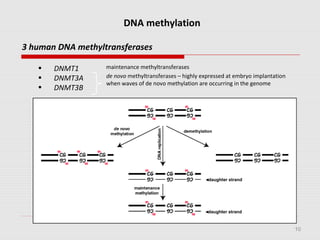
3 human DNA methyltransferases
• DNMT1
• DNMT3A
• DNMT3B
◄daughter strand
◄daughter strand
de novo methyltransferases – highly expressed at embryo implantation
when waves of de novo methylation are occurring in the genome
maintenance methyltransferases
11
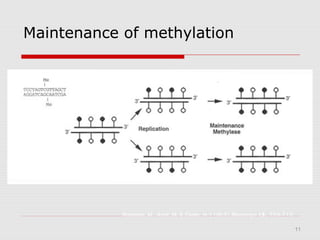
Maintenance of methylation
Brandeis, M., Ariel, M. & Cedar, H. ( 199 3) Bioessays 15, 709-713.
12
DNA methylation
CpG–island methylation – how does it affect transcription?
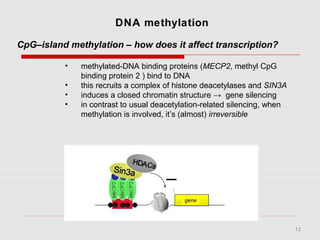
• methylated-DNA binding proteins (MECP2, methyl CpG
binding protein 2 ) bind to DNA
• this recruits a complex of histone deacetylases and SIN3A
• induces a closed chromatin structure → gene silencing
• in contrast to usual deacetylation-related silencing, when
methylation is involved, it’s (almost) irreversible
gene
13
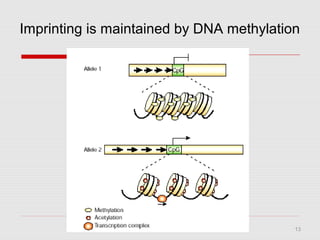
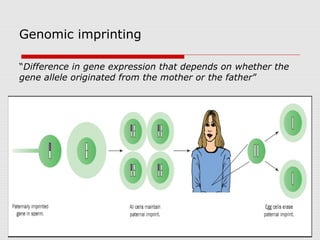
Imprinting is maintained by DNA methylation
Transcription factors sensitive
to methylation:
 E2F
 CREB
 AP2
 NF-KB
 c -myc.
15
Roles of DNA methylation
 Transcriptional silencing
 Protecting the genome from
transposition
 Genomic imprinting
 X inactivation
 Tissue specific gene expression
Genomic imprinting
“Difference in gene expression that depends on whether the
gene allele originated from the mother or the father”
17
Neoplastic Transformation
It is a complex multi-event and multi-stage process
The process can be divided into two requisite
sequences:
1- Neoplastic conversion 2- Neoplastic
development
18
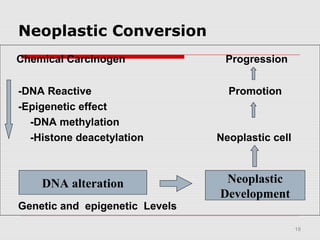
Neoplastic Conversion
Chemical Carcinogen Progression
-DNA Reactive Promotion
-Epigenetic effect
-DNA methylation
-Histone deacetylation Neoplastic cell
Genetic and epigenetic Levels
DNA alteration Neoplastic
Development
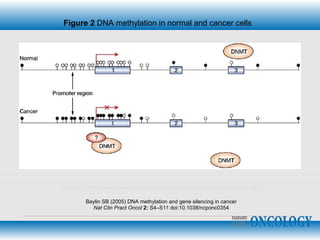
Baylin SB (2005) DNA methylation and gene silencing in cancer
Nat Clin Pract Oncol 2: S4–S11 doi:10.1038/ncponc0354
Figure 2 DNA methylation in normal and cancer cells
Copyright © (2003) Massachusetts Medical Society. All rights reserved. Adapted with permission 2005.
20
Genes promote hypermethylation in human cancers
The list of genes that are found to be
inactivated by DNA methylation events
includes genes involved in:
A- Signal transduction cascade pathways.
B- Cell cycle regulation. C-Angiogenesis.
D-Apoptosis. E- DNA repair.
21
P 15/P16 Methylation in cancer
- Aberrant methylation of cyclin dependent kinase
inhibitor P16INK4a has been frequently detected in
many human cancers.
- Hematological malignancies and head and neck
squamous cell carcinoma.
- The differential levels of methylated P16 and P15 in
plasma might be useful markers in screening high risk
population for an early detection of cancer.
22
Lung cancer
 It has been shown that a panel of markers, for
aberrant methylation that detects lung cancer at
the early stages of development has been
observed.
 This panel includes the following genes:
-P 16 -APC
-G-ST -E-cadherin
23
Breast cancer
 BRCA gene is a breast cancer susceptibility gene,
that is tumor suppressor gene responsible for both
normal development and carcinogenesis in breast.
 BRCA1, reveals multi functional protein involved in
DNA repair. Cell cycle regulation, transcription and
apoptosis
 Aberrant methylation of BRCA1 CPG island Promoter
is associated with decreased BRCA1 mRNA in
sporadic breast cancer cells.
24
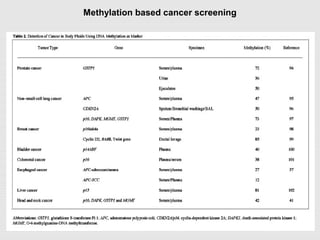
Methylation based cancer screening
25
Epigenetic chromatin regulation
A. Modification at the DNA level
1. cytosine methylation
B. Histone modification - the histone code
1. Histone acetylation
2. Histone methylation
3. Histone phosphorylation
4. Histone ubiquitination
26
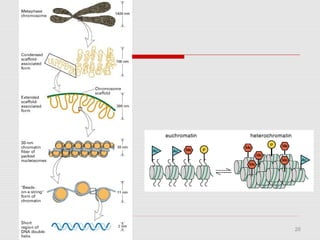
27
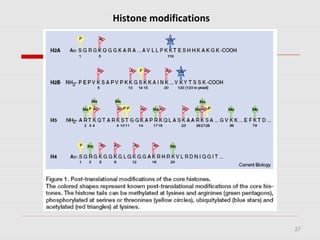
Histone modifications
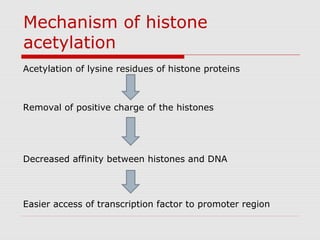
Mechanism of histone
acetylation
Acetylation of lysine residues of histone proteins
Removal of positive charge of the histones
Decreased affinity between histones and DNA
Easier access of transcription factor to promoter region
29
Histone acetylation
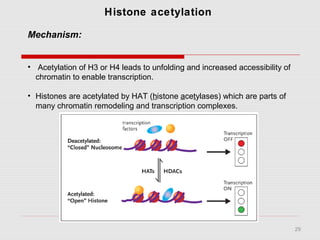
Mechanism:
• Acetylation of H3 or H4 leads to unfolding and increased accessibility of
chromatin to enable transcription.
• Histones are acetylated by HAT (histone acetylases) which are parts of
many chromatin remodeling and transcription complexes.
30
31
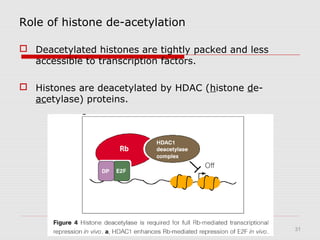
Role of histone de-acetylation
 Deacetylated histones are tightly packed and less
accessible to transcription factors.
 Histones are deacetylated by HDAC (histone de-
acetylase) proteins.
32
Histone phosphorylation (H3)
1. Histones are phosphorylated during
mitosis.
2. Histones are also phosphorylated by signal
transduction pathways like the ERK
pathway in response to external signals. It
is not known how (and if) this
phosphorylation contributes to gene
expression.
33
Epigenetic chromatin regulation
A. Modification at the DNA level
1. cytosine methylation
B. Histone modification - the histone code
1. Histone acetylation
2. Histone methylation
3. Histone phosphorylation
4. Histone ubiquitination
34
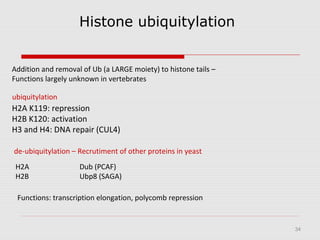
Addition and removal of Ub (a LARGE moiety) to histone tails –
Functions largely unknown in vertebrates
H2A K119: repression
H2B K120: activation
H3 and H4: DNA repair (CUL4)
ubiquitylation
H2A Dub (PCAF)
H2B Ubp8 (SAGA)
de-ubiquitylation – Recrutiment of other proteins in yeast
Histone ubiquitylation
Functions: transcription elongation, polycomb repression
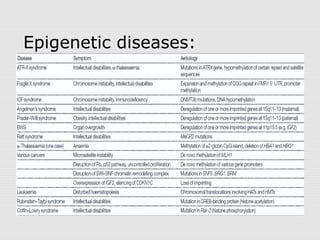
Epigenetic diseases:
Methods to Study The Epigenome
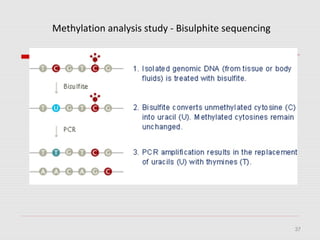
 Bisulphite sequencing
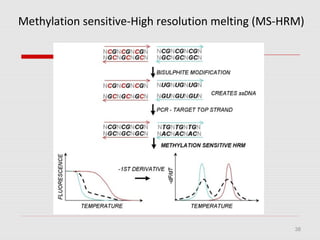
 Methylation sensitive-High resolution
melting (MS-HRM)
 Microarray-based genome-wide analysis
 Chromatin immunoprecipitation (ChIP) on
Chip assays
37
Methylation analysis study - Bisulphite sequencing
38
Methylation sensitive-High resolution melting (MS-HRM)
39
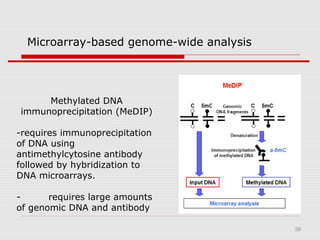
Microarray-based genome-wide analysis
Methylated DNA
immunoprecipitation (MeDIP)
-requires immunoprecipitation
of DNA using
antimethylcytosine antibody
followed by hybridization to
DNA microarrays.
- requires large amounts
of genomic DNA and antibody
404040
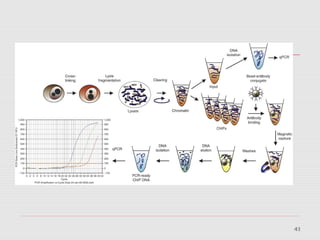
Study of histone modifications
•Histone modifications are studied using the chromatin
immunoprecipitation (ChIP) assay.
•ChIP on chip is the high throughput form of the ChIP
assay wherein the immunoprecipitated DNA, instead of
being subject to the usual PCR, is hybridized to a
microarray chip with printed oligonucleotides
corresponding to various regions of the genome.
•This helps to study the localization of a specific histone
modification to various parts of the genome.
4141
42
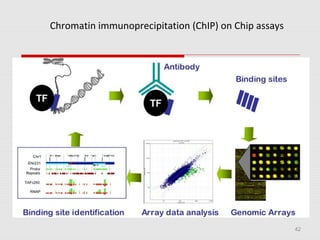
Chromatin immunoprecipitation (ChIP) on Chip assays
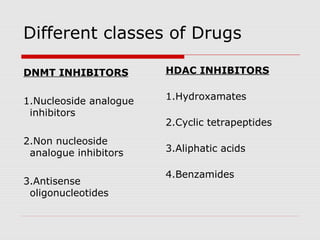
Different classes of Drugs
DNMT INHIBITORS
1.Nucleoside analogue
inhibitors
2.Non nucleoside
analogue inhibitors
3.Antisense
oligonucleotides
HDAC INHIBITORS
1.Hydroxamates
2.Cyclic tetrapeptides
3.Aliphatic acids
4.Benzamides
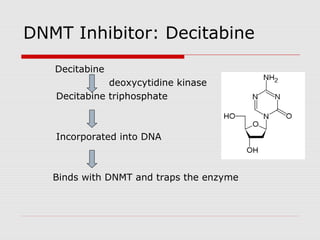
DNMT Inhibitor: Decitabine
Decitabine
deoxycytidine kinase
Decitabine triphosphate
Incorporated into DNA
Binds with DNMT and traps the enzyme
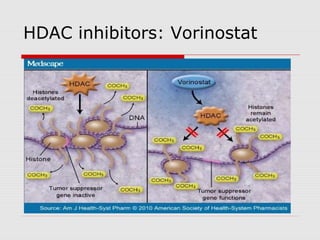
HDAC inhibitors: Vorinostat
46
 Intrinsic and acquired drug resistance remain the
most unpredictable factors affecting chemotherapy.
 DNA hypermethylation has been found to be
associated with drug resistance acquired during
cancer chemotherapy and therefore, re-expression of
methylation-silenced genes resulted in increased
sensitivity to existing chemotherapy.
47
SUMMARY:
• Types of DNA modification and Histone modifications
• Mechanism of their actions and maintenance
• Their effects on transcription, growth and development,
differentiation, tumorigenesis
• Markers of various tumors
• Experimental procedures of their study
• Therapeutic possibilities
REFERENCES:
 Harper's Illustrated Biochemistry, Twenty-Eighth
Edition.
 Lehninger’s Principles of Biochemistry, Fifth Edition.
 Stryer’s Biochemistry, Seventh Edition.
 Epigenetics and gene expression. Gibney ER, Nolan CM.
Heredity (Edinb). 2010 Jul;105(1):4-13
 When food meets man: the contribution of epigenetics to
health. De Fabiani E, Mitro N, Gilardi F, Galmozzi A,
Caruso D, Crestani M. Nutrients. 2010 May;2(5):551-71.
 Environmental epigenetics. Bollati V, Baccarelli A.
Heredity (Edinb). 2010 Jul;105(1):105-12. Epub 2010
Feb 24.
THANK YOU

Epigenetics final

  • 1.
  • 2.
    Objectives:  Concept ofEpigenomics  Components of the epigenetic code  Epigenetics in normal physiology  Epigenetics in Cancer causation  Epigenetics in diseases  Methods to study the Epigenome  Therapeutic targets of Epigenome
  • 3.
    3 DNA (gene) mRNA Protein Transcription RNA processing(splicing etc) Translation Folding Post translational modifications Structural or Functional Activity
  • 4.
  • 5.
    555 Epigenomics Epi (Greek forabove) -genetics refers to changes in the phenotype or gene expression caused by mechanisms other than changes in the underlying DNA sequence. • DNA methylation • Histone modifications
  • 6.
    6 Epigenetic chromatin regulation A.Modification at the DNA level 1. Cytosine methylation B. Histone modification - the histone code 1. Histone acetylation 2. Histone methylation 3. Histone phosphorylation 4. Histone ubiquitination
  • 7.
    7 The five nucleotidesthat make up the DNA
  • 8.
    DNA methylation Covalent additionof methyl group to 5th position of cytosine with CpG dinucleotides located in the promoter region of genes
  • 9.
    9 DNA methylation CpG –Cytosine phosphate Guanine • Strongly represented in repetitive sequence associated with retroviral-derived sequence • Can be methylated to generate 5-methylcytosine • Spontaneously deaminates to form thymine • Poorly recognized by DNA repair systems thus: • CG→TG mutation is propagated • CpG levels are less frequent than predicted 1/16 • May contribute to relative inactivity of retro-elements CpG dinucleotides are palindromic 5’ CpG 3’ 3’ GpC 5’
  • 10.
    10 DNA methylation 3 humanDNA methyltransferases • DNMT1 • DNMT3A • DNMT3B ◄daughter strand ◄daughter strand de novo methyltransferases – highly expressed at embryo implantation when waves of de novo methylation are occurring in the genome maintenance methyltransferases
  • 11.
    11 Maintenance of methylation Brandeis,M., Ariel, M. & Cedar, H. ( 199 3) Bioessays 15, 709-713.
  • 12.
    12 DNA methylation CpG–island methylation– how does it affect transcription? • methylated-DNA binding proteins (MECP2, methyl CpG binding protein 2 ) bind to DNA • this recruits a complex of histone deacetylases and SIN3A • induces a closed chromatin structure → gene silencing • in contrast to usual deacetylation-related silencing, when methylation is involved, it’s (almost) irreversible gene
  • 13.
    13 Imprinting is maintainedby DNA methylation
  • 14.
    Transcription factors sensitive tomethylation:  E2F  CREB  AP2  NF-KB  c -myc.
  • 15.
    15 Roles of DNAmethylation  Transcriptional silencing  Protecting the genome from transposition  Genomic imprinting  X inactivation  Tissue specific gene expression
  • 16.
    Genomic imprinting “Difference ingene expression that depends on whether the gene allele originated from the mother or the father”
  • 17.
    17 Neoplastic Transformation It isa complex multi-event and multi-stage process The process can be divided into two requisite sequences: 1- Neoplastic conversion 2- Neoplastic development
  • 18.
    18 Neoplastic Conversion Chemical CarcinogenProgression -DNA Reactive Promotion -Epigenetic effect -DNA methylation -Histone deacetylation Neoplastic cell Genetic and epigenetic Levels DNA alteration Neoplastic Development
  • 19.
    Baylin SB (2005)DNA methylation and gene silencing in cancer Nat Clin Pract Oncol 2: S4–S11 doi:10.1038/ncponc0354 Figure 2 DNA methylation in normal and cancer cells Copyright © (2003) Massachusetts Medical Society. All rights reserved. Adapted with permission 2005.
  • 20.
    20 Genes promote hypermethylationin human cancers The list of genes that are found to be inactivated by DNA methylation events includes genes involved in: A- Signal transduction cascade pathways. B- Cell cycle regulation. C-Angiogenesis. D-Apoptosis. E- DNA repair.
  • 21.
    21 P 15/P16 Methylationin cancer - Aberrant methylation of cyclin dependent kinase inhibitor P16INK4a has been frequently detected in many human cancers. - Hematological malignancies and head and neck squamous cell carcinoma. - The differential levels of methylated P16 and P15 in plasma might be useful markers in screening high risk population for an early detection of cancer.
  • 22.
    22 Lung cancer  Ithas been shown that a panel of markers, for aberrant methylation that detects lung cancer at the early stages of development has been observed.  This panel includes the following genes: -P 16 -APC -G-ST -E-cadherin
  • 23.
    23 Breast cancer  BRCAgene is a breast cancer susceptibility gene, that is tumor suppressor gene responsible for both normal development and carcinogenesis in breast.  BRCA1, reveals multi functional protein involved in DNA repair. Cell cycle regulation, transcription and apoptosis  Aberrant methylation of BRCA1 CPG island Promoter is associated with decreased BRCA1 mRNA in sporadic breast cancer cells.
  • 24.
  • 25.
    25 Epigenetic chromatin regulation A.Modification at the DNA level 1. cytosine methylation B. Histone modification - the histone code 1. Histone acetylation 2. Histone methylation 3. Histone phosphorylation 4. Histone ubiquitination
  • 26.
  • 27.
  • 28.
    Mechanism of histone acetylation Acetylationof lysine residues of histone proteins Removal of positive charge of the histones Decreased affinity between histones and DNA Easier access of transcription factor to promoter region
  • 29.
    29 Histone acetylation Mechanism: • Acetylationof H3 or H4 leads to unfolding and increased accessibility of chromatin to enable transcription. • Histones are acetylated by HAT (histone acetylases) which are parts of many chromatin remodeling and transcription complexes.
  • 30.
  • 31.
    31 Role of histonede-acetylation  Deacetylated histones are tightly packed and less accessible to transcription factors.  Histones are deacetylated by HDAC (histone de- acetylase) proteins.
  • 32.
    32 Histone phosphorylation (H3) 1.Histones are phosphorylated during mitosis. 2. Histones are also phosphorylated by signal transduction pathways like the ERK pathway in response to external signals. It is not known how (and if) this phosphorylation contributes to gene expression.
  • 33.
    33 Epigenetic chromatin regulation A.Modification at the DNA level 1. cytosine methylation B. Histone modification - the histone code 1. Histone acetylation 2. Histone methylation 3. Histone phosphorylation 4. Histone ubiquitination
  • 34.
    34 Addition and removalof Ub (a LARGE moiety) to histone tails – Functions largely unknown in vertebrates H2A K119: repression H2B K120: activation H3 and H4: DNA repair (CUL4) ubiquitylation H2A Dub (PCAF) H2B Ubp8 (SAGA) de-ubiquitylation – Recrutiment of other proteins in yeast Histone ubiquitylation Functions: transcription elongation, polycomb repression
  • 35.
  • 36.
    Methods to StudyThe Epigenome  Bisulphite sequencing  Methylation sensitive-High resolution melting (MS-HRM)  Microarray-based genome-wide analysis  Chromatin immunoprecipitation (ChIP) on Chip assays
  • 37.
    37 Methylation analysis study- Bisulphite sequencing
  • 38.
  • 39.
    39 Microarray-based genome-wide analysis MethylatedDNA immunoprecipitation (MeDIP) -requires immunoprecipitation of DNA using antimethylcytosine antibody followed by hybridization to DNA microarrays. - requires large amounts of genomic DNA and antibody
  • 40.
    404040 Study of histonemodifications •Histone modifications are studied using the chromatin immunoprecipitation (ChIP) assay. •ChIP on chip is the high throughput form of the ChIP assay wherein the immunoprecipitated DNA, instead of being subject to the usual PCR, is hybridized to a microarray chip with printed oligonucleotides corresponding to various regions of the genome. •This helps to study the localization of a specific histone modification to various parts of the genome.
  • 41.
  • 42.
  • 43.
    Different classes ofDrugs DNMT INHIBITORS 1.Nucleoside analogue inhibitors 2.Non nucleoside analogue inhibitors 3.Antisense oligonucleotides HDAC INHIBITORS 1.Hydroxamates 2.Cyclic tetrapeptides 3.Aliphatic acids 4.Benzamides
  • 44.
    DNMT Inhibitor: Decitabine Decitabine deoxycytidinekinase Decitabine triphosphate Incorporated into DNA Binds with DNMT and traps the enzyme
  • 45.
  • 46.
    46  Intrinsic andacquired drug resistance remain the most unpredictable factors affecting chemotherapy.  DNA hypermethylation has been found to be associated with drug resistance acquired during cancer chemotherapy and therefore, re-expression of methylation-silenced genes resulted in increased sensitivity to existing chemotherapy.
  • 47.
    47 SUMMARY: • Types ofDNA modification and Histone modifications • Mechanism of their actions and maintenance • Their effects on transcription, growth and development, differentiation, tumorigenesis • Markers of various tumors • Experimental procedures of their study • Therapeutic possibilities
  • 48.
    REFERENCES:  Harper's IllustratedBiochemistry, Twenty-Eighth Edition.  Lehninger’s Principles of Biochemistry, Fifth Edition.  Stryer’s Biochemistry, Seventh Edition.  Epigenetics and gene expression. Gibney ER, Nolan CM. Heredity (Edinb). 2010 Jul;105(1):4-13  When food meets man: the contribution of epigenetics to health. De Fabiani E, Mitro N, Gilardi F, Galmozzi A, Caruso D, Crestani M. Nutrients. 2010 May;2(5):551-71.  Environmental epigenetics. Bollati V, Baccarelli A. Heredity (Edinb). 2010 Jul;105(1):105-12. Epub 2010 Feb 24.
  • 49.

Editor's Notes

  • #4 Missing from picture is regulation of gene expression,i.e., transcription.
  • #5 We all know that there are a myriad no. of regulators. What was not actually known is that these regulations are inherited faithfully among daughter cells after mitosis, and, in some cases, even meiotically. This new knowledge has revolutionised the field of molecular biology and has given rise to a new branch called epigenetics.
  • #6 Those components of molecular information which are over and above the information coded in the DNA. As with genetic code, the epigenetic code also affects the phenotype of the individual, primarily by regulating the expression of the genetic information.
  • #7 Acetylation of H3 & H4 decreases histone-DNA interaction, improves the accessibility of DNA to transcriptional activation. Methylation of 9th A.A, Lysine, on H3, generates binding site for HP1 (heterochromatin protein 1) Phosphorylation of 10th A.A, serine on H3 is important for chromosome condensation & mitosis.
  • #8 By DNA methyltransferases (DNMT)
  • #9 the cytosine must be linked to guanine, with the guanine occurring at the 3’ end of the DNA molecule, in a formation that, in scientific notation, is expressed as 5’-CG-3’ and is referred to as a CpG dinucleotide The methyl groups do not affect base pairing but can influence protein–DNA interactions by protruding into the major groove thus inhibiting transcription
  • #12 DNMT1 has high affinity for hemimethylated DNA, hence helps in maintenance of methylation after replication of DNA.
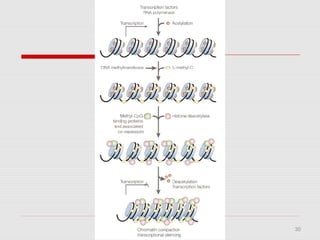
  • #14 Methylation causes the nucleosomes to be packed close together, thus hindering transcription. On the other hand, acetylation of the histone tails increases nucleosome distances, thus promoting transcription.
  • #15 Activating protein 2, cAMP regulatory binding protein,