Ifrah Ishaq
University Of The Punjab,
Lahore.
Directed Evolution
outline
Directed Evolution
Historical View Of Directed Evolution
Process Of Directed Evolution
Why Use This Approach?
Types Of Mutations
Naturally Evolutionary Processes
o Random Mutagenesis Methods
o Gene Recombination Methods
Library Size
Selection & Screening Strategies
Applications Of Directed Evolution
Advantages Of Directed Evolution
Future Directions
Conclusion
Protein engineering APProAches
There are two approaches of protein engineering.
1.Rational design
Used detailed knowledge of structure & function of
the protein to make desired changes.
2. Directed evolution
Random mutagenesis is applied to protein, a
selection of mutant variant of desired
characteristics.
Definition of natural selection & directed
evolution?
Natural Selection
Random genetic mutation in the genetic code from
which beneficial mutations are preserved because
they are beneficial for survival of organism.
Directed Evolution
A method used in protein engineering that mimics
natural selection to evolve proteins or nucleic acids
towards user defined goal.
Similarities Between Directed Evolution &
Natural Selection
•Diversification
•Selection
•amplification
DirecteD evolution
 Is first used in 70’s.
 Around 0.01-1% of all random mutations
estimated to be beneficial. This technique
involve randomly introducing mutations at
the genetic level followed by selection for
the desired characteristics at the protein
level.
Reason To Use The Word Evolution
Evolution is a walk from one functional
protein to another in the landscape of all
possible sequences.
Takes inspiration from natural process of
evolution.
historicAl view of DirecteD evolution
 1967- in vitro Drawian experiment
 1971- theory of evolution at molecular
level
 1980- rational mutagenesis approaches
 1986- succeed in first directed evolution
 1997- use directed evolution; improve
enantiselectivity of enzyme.
and the progress continues in this
field……..
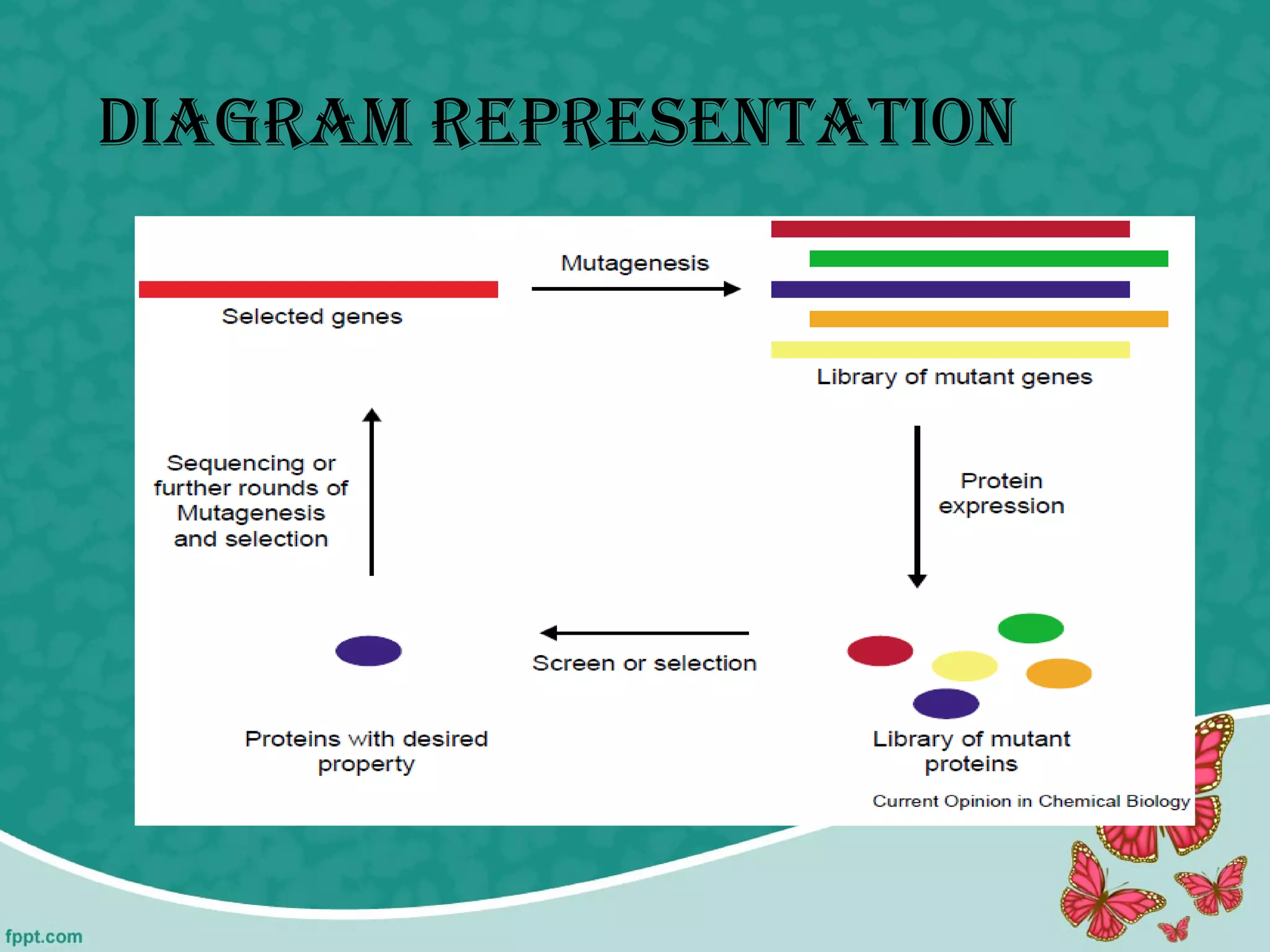
Process of DirecteD evolution
The progress begins by determining a target
biomolecule, metabolic pathway or organism and a
desired phenotypic goal.
Steps Of Directed Evolution
1.Selection of gene of interest
2.Generation of mutant gene library
3.Expression of mutant genes
4.Screening & selecting of beneficial gene
5.Further rounds of mutagenesis to achieve
phenotypic goal.
DiAgrAm rePresentAtion
why use this APProAch?
To achieve same goals as other methods of
protein engineering:
Understanding protein function
Improving protein properties for industry,
medicine….
To improve existing proteins functionally.
Improve the working of enzymes: substrate
specificity, improve stability over a range of
temperature and pH.
requirements of DirecteD
evolution
There are four pre-requistics for directed
evolution:
1.Availability of genes of interest
2.Suitable expression system
3.Method to create mutant libraries
4.Screening and selection system
genetic coDe
The genetic code is the set of rules by which
information encoded in genetic code ( DNA or
RNA sequence) is translated into proteins.
Degeneracy of genetic code.
Example: GAA & GAG both specify glutamic
acid(redundancy). Neither of them specifies other
amino acid ( no ambiguity).
 Crick Wobble hypothesis.
tyPes of mutAtion
“ Mutation is permanent alteration of the
nucleotide sequence of the genome of an
organism, virus or extra chromosomal DNA
or other genetic material.”
_ normal sequence AGC ( serine)
Silent mutation- AGT serine
Missence mutation- GGC proline
Non-sense mutation- ATC terminator
Frame Shift Mutation: Deletion &
Insertion
Suppressor Mutation
Second mutation cancels the effect of first
mutation. May occur in same gene or in
different.
1.Intragenic (same gene)
2.Intergenic (different gene)
Transition & Tranversion Mutation
Naturally EvolutioNary
ProcEssEs
There are two natural evolutionary
processes which have been adapted for in-
vitro evolution are:
1.Gene Recombination
2.Random Mutagenesis
GENE rEcombiNatioN
Recombination can be divided into four
categories:-
Homologous Recombination
Non- Homologous Recombination
Reciprocal Recombination
Site- Specific Recombination
raNdom mutaGENEsis
Random mutagenesis can be divided into
five categories:-
1.Transitions
2.Transversions
3.Deletions
4.Insertion
5.Inversion
raNdom mutaGENEsis mEthods
1. Chemical Mutagenesis
Agents include ethyl methanesulfonate(EMS),
deaminating compounds such as nitrous
acid, base analogous such as 2-
aminopurine and ultra violet irradiation.
2. Mutagenic Strains
Mutator strains of E.coli are deficient in one or
more DNA repair genes, leading to single base
substitutions at a rate of approximately 1 mutation
per 1000 base pairs.
Generate mutant libraries
Gene of interest cloned in plasmid
Process Is simple
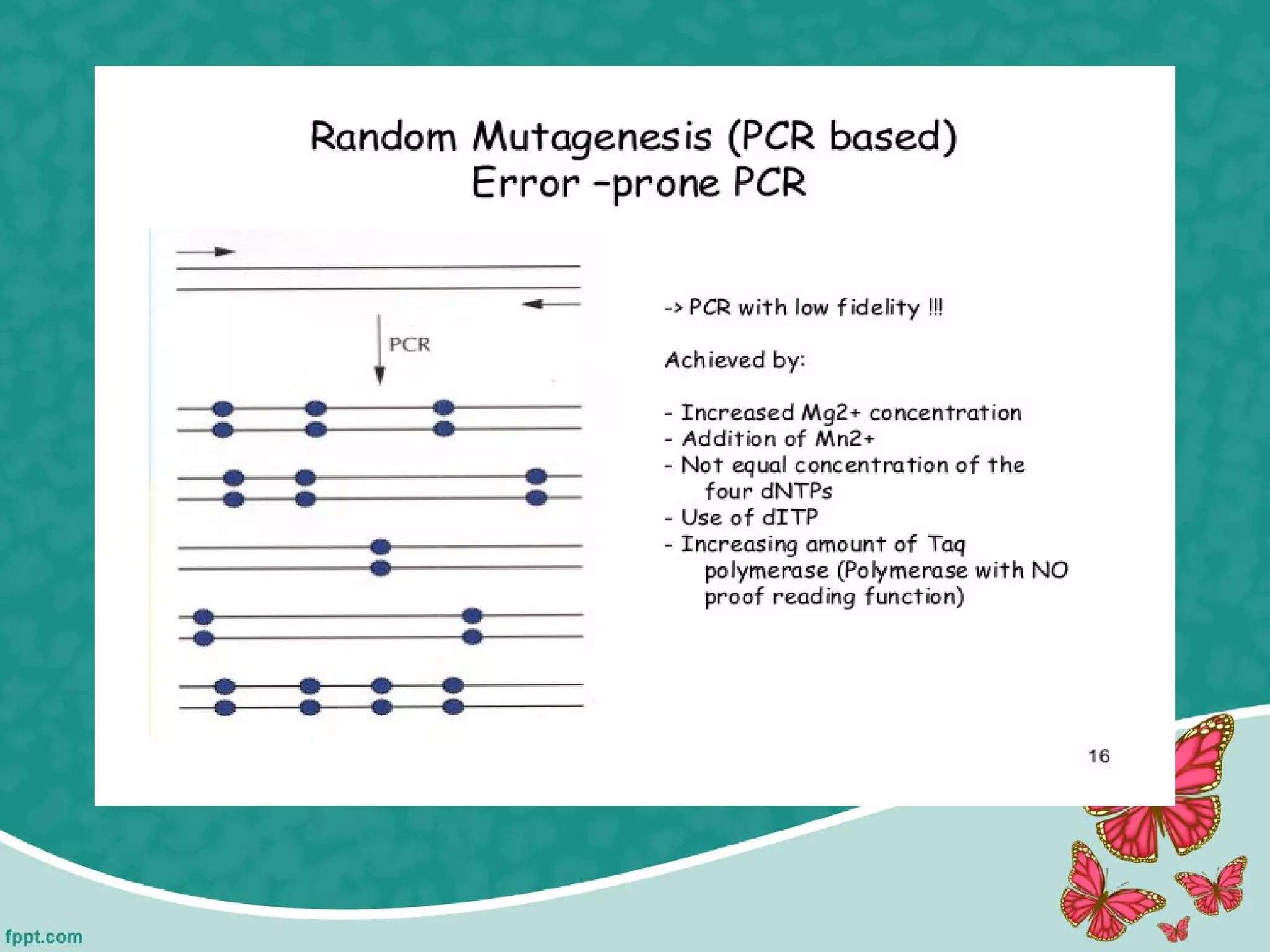
3. Error- prone PCR
Error prone PCR relies on misincorporationof
nucleotides by DNA polymerase to generate point
mutations.
 Increased magnesium concentration
 Supplementation with manganese
 Use mutagenic dNTR analogous
 Role to increase mutation rate
4. Saturation Mutagenesis
Site-directed mutagenesis uses an oligonucleotide
primer to introduce a single base pair substitution at
specified position in gene.
Saturation mutagenesis involve substitution of all
possibly a.a at pre-determined residue or continuous
series of residue in protein of interest.
5. Sequence Saturation Mutagenesis
This strategy is able to randomize a DNA
sequence at every nucleotide position through the
use of universal base. Universal base is
enzymatically inserted.
6.Random Insertion/Deletion Mutagenesis
Allow the deletion of up to 16 bases from random
sites and subsequent insertion of bases( random)
at the same position.
homoloGous rEcombiNatioN
mEthods
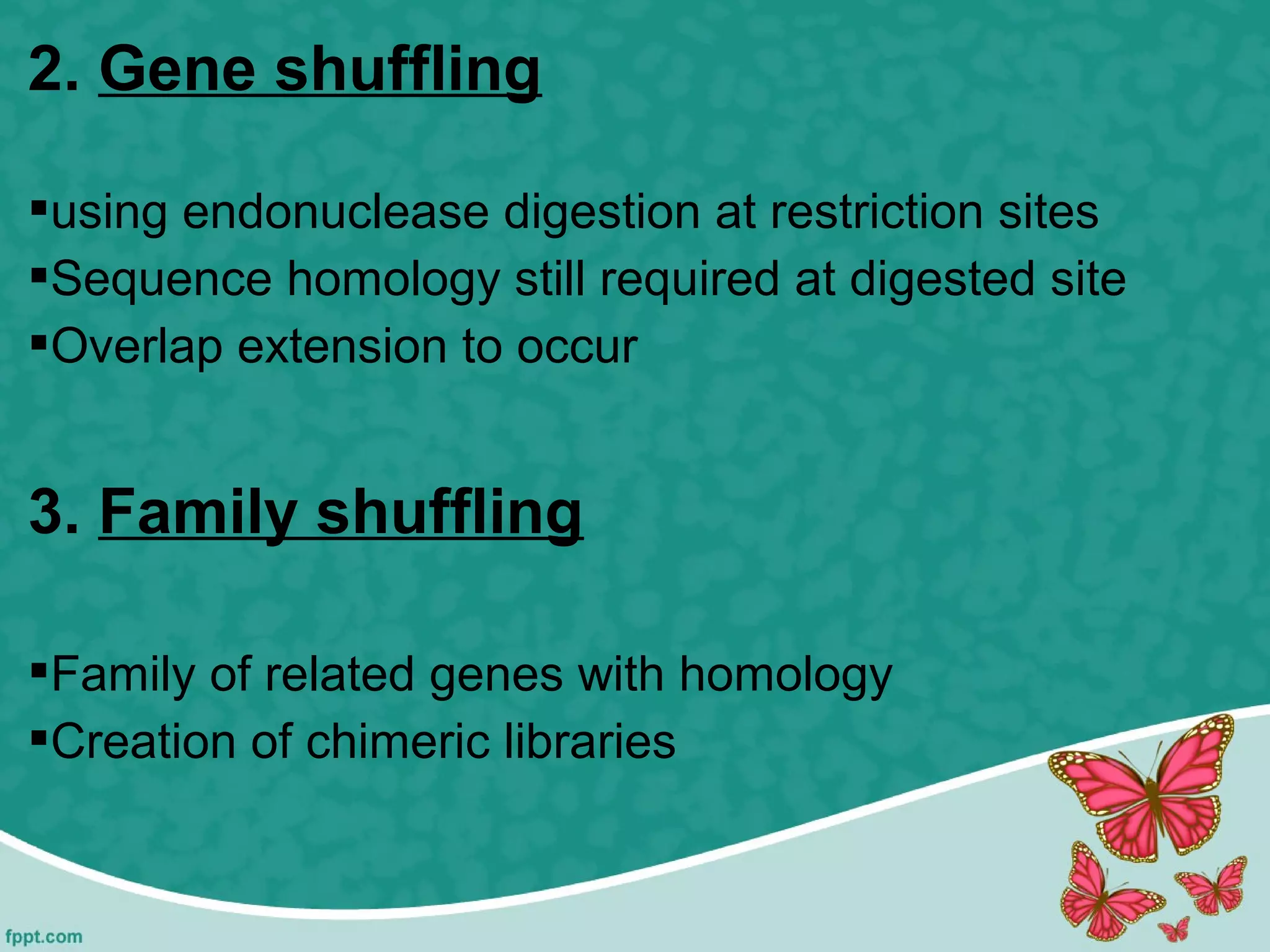
1. DNA Shuffling
2. Gene shuffling
using endonuclease digestion at restriction sites
Sequence homology still required at digested site
Overlap extension to occur
3. Family shuffling
Family of related genes with homology
Creation of chimeric libraries
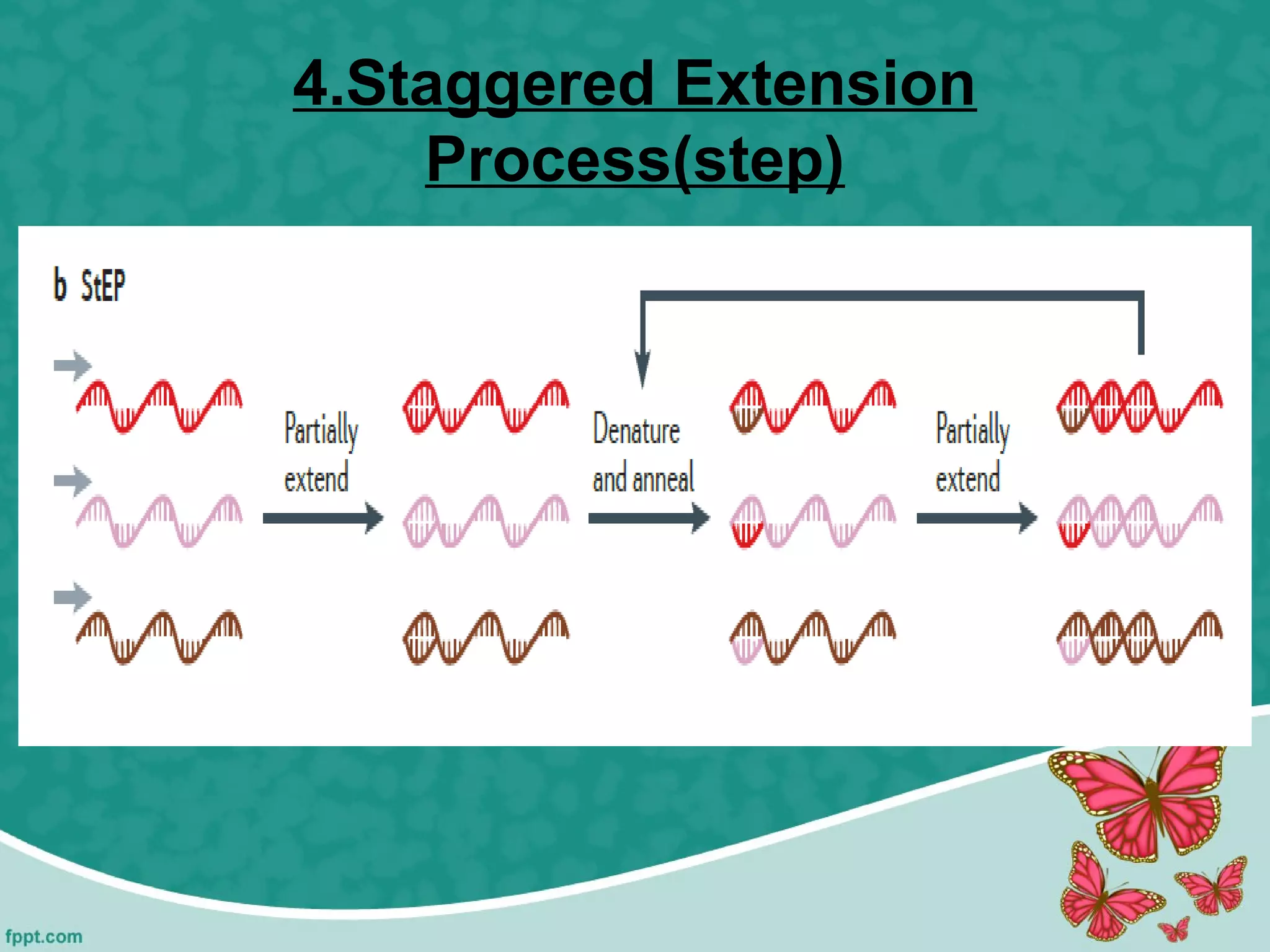
4.Staggered Extension
Process(step)
5. Random Chimeragenesis On Transient
Templates( RACHITT)
6.Degenerate Oligonucleotides Gene
Shuffling (DOGS)
Utilizes a PCR reaction with degenerate ends
Complementary primers pairs to shuffle genes
Limited sequence similarity & G+C content.
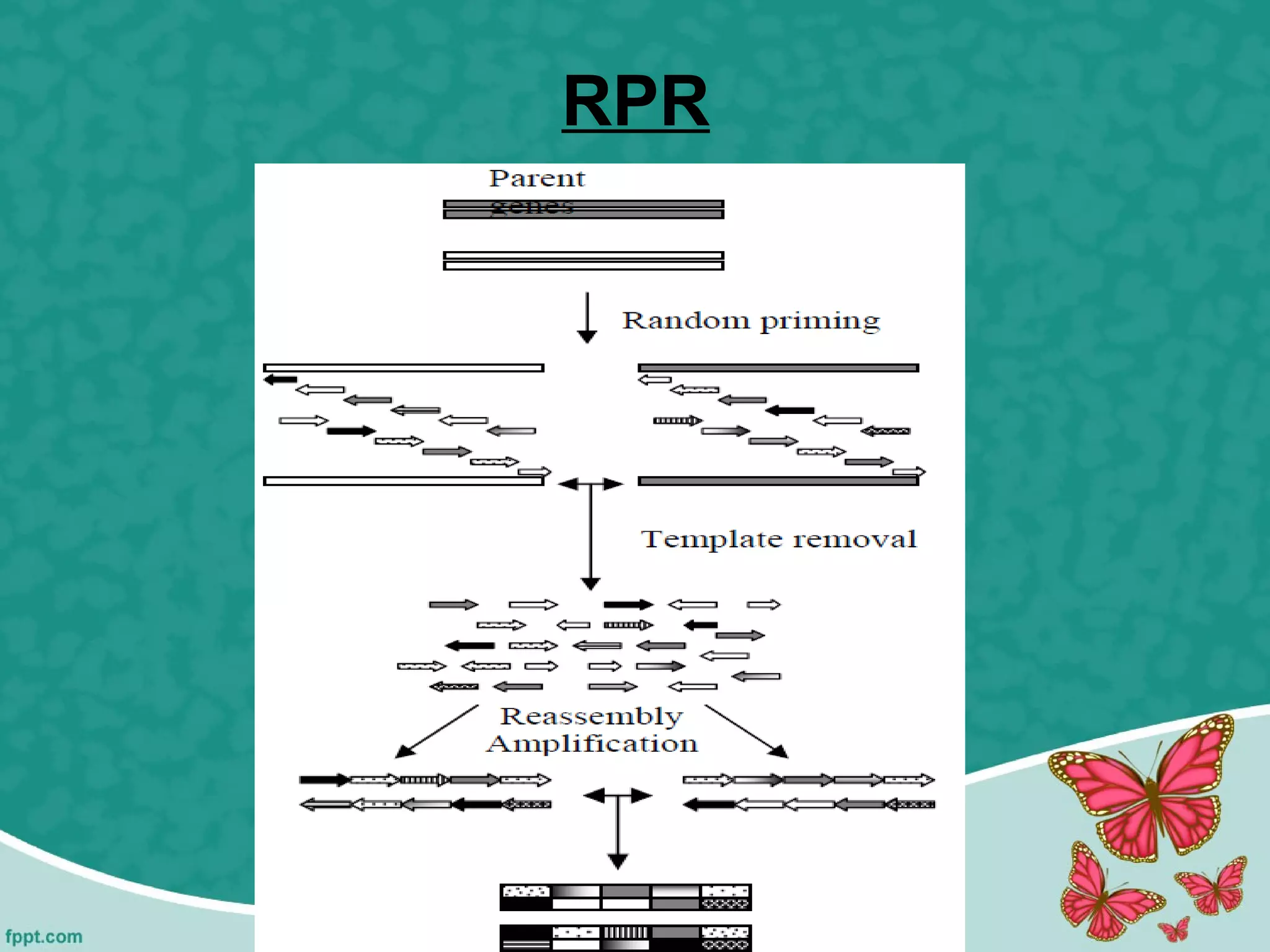
7.Recombination By Random Priming In
Vitro Recombination (RPR)
Generate of small DNA fragments
Utilizes elongation from random sequence primers
RPR
8.Assembly PCR or synthetic
shuffling
NoN-homologous RecombiNatioN
methods
1. Incremental truncation hybrid (ITCHY)
2.Non-homologous random
recombination (NRR)
3. Sequence Homology-independent Protein
Recombination (SHIPREC)
4.SCRATCHY
Additional diversity can also be created by
shuffling of two ITCHY libraries. This method,
termed SCRATCHY.
Two initial ITCHY libraries serve as starting
material for DNA shuffling.
libRaRy size
Number of possible variants of a protein
that can be created by introducing M
mutations simultaneously over N amino
acids.
The number of sequence variants for M
substitutions in a given protein of N a.a:-
19M.N!/(N-M)!M!
methods of isolatiNg
fuNctioNal VaRiaNts
There are two main categories:
1.Selection
2.screening
scReeNiNg & selectioN
stRategies
1. Phage Display
2. mRNA Display
3. Ribosome Display
4.In-vitro Compartmentalization
ApplicAtions of DirecteD
evolution
Some of the examples explained below:
 Cephalosporins: class of antibiotic
produced via the intermediate 7-
aminocephalosporanic acid (7-ACA).
Directed evolution has been used to improve the
activity of cephalosporin acylases to produce these
intermediates from adipyl-7-ACA or
cephalosporin C.
• Atorvastatin
• Is A Cholesterol Lowering Drug
• Enzyme:2-deoxyribose- 5-phosphate Aldolase
(DERA)
• Enzyme Target By Directed Evolution.
AtorvAstAtin Drug
goAl: better luciferAse
ADvAntAges of DirecteD
evolution
Frequently used in Protein Engineering:-
Improving protein stability
Improving binding affinity of antibiotics
Alerting substrate specificity
Application in genetic engineering, functional
genomics & gene therapy.
Applied to improve polymerases, nucleases,
transposases, integrases & recombinase etc.
 can modify pH or temperature dependence
enzymes
vaccines – improve effectiveness; less side
effects
In agriculture field, modify plants for tolerance
for herbicides & toxins.
Golden rice express elevated beta-
carotene.
compArison of DirecteD evolution
AnD rAtionAl Design
conclusion
 Directed evolution can be a powerful tool
taking advantage of nature’s power to improve
upon itself
 Used in a wide variety of applications for
protein improvement – stability, activity,
substrate specificity, etc
 Potential for genetically engineering improved
drugs or crops
 Ultimately, combining tools will lead to better
understanding and applications.
future Directions
o Directed evolution is an integral tool in the
development of synthetic enzymes, ensuring
they are suitable for use.
o The past success of this approach indicates that
it will continue to provide many examples of safe
and efficient production of chemical products.
references
 Sen, S., Venkata Dasu, V. and Mandal, B. (2007)
Developments in directed evolution for improving
enzyme functions. Applied Biochemistry and
Biotechnology, 143, 212–223.
 Yuan, L., Kurek, I., English, J. and Keenan, R. (2005)
Laboratory-directed protein evolution. Microbiology and
Molecular Biology Reviews, 69, 373–392.
 Hibbert, E.G., Baganz, F., Hailes, H.C. et al. (2005)
Directed evolution of biocatalytic processes.
Biomolecular Engineering, 22, 11–19.
Directed Evolution