ENVIRONMENTAL IMPACT ASSESSMENT
By
Mr. Biplob Das
(Assistant Prof. OF Civil Engineering Department)
MITM
1
CONTENTS
 EIA Definition
 History of EIA
 Types of EIA
 Stages of EIA
 Conclusion
 References
2
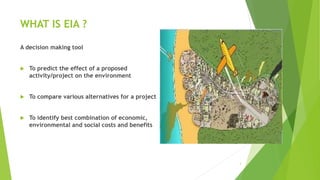
WHAT IS EIA ?
A decision making tool
 To predict the effect of a proposed
activity/project on the environment
 To compare various alternatives for a project
 To identify best combination of economic,
environmental and social costs and benefits
3
HISTORY OF EIA IN INDIA
 In India, EIAs of development projects were first started in 1977-78 when the
Department of Science and Technology took up environmental appraisal of
river valley projects.
 In 1994 when EIA was made mandatory in India under the Environmental
Protection Act of 1986. Establishment of EIA Authority under the MOEFCC.
 public consultation have been made compulsory component of EIA by an
amendment dated April 10, 1997.
 In September, 2006 new EIA Notifications was drafted.
4
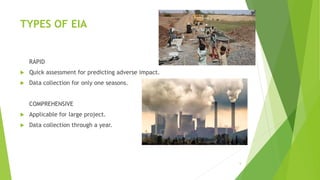
TYPES OF EIA
RAPID
 Quick assessment for predicting adverse impact.
 Data collection for only one seasons.
COMPREHENSIVE
 Applicable for large project.
 Data collection through a year.
5
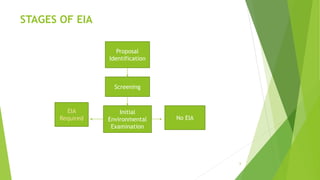
STAGES OF EIA
6
Proposal
Identification
Screening
Initial
Environmental
Examination
EIA
Required No EIA
7
EIA required
scoping
Impact analysis
Mitigation and management
EIA report
Review
Decision makings
Not approved Approved
Redesign
Resubmit
Implementation
and follow up
Public involvement
Public involvement
STAGES OF EIA
SCREENING
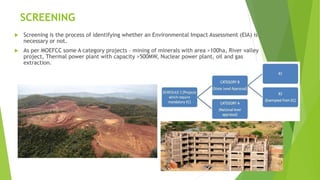
 Screening is the process of identifying whether an Environmental Impact Assessment (EIA) is
necessary or not.
 As per MOEFCC some A category projects – mining of minerals with area >100ha, River valley
project, Thermal power plant with capacity >500MW, Nuclear power plant, oil and gas
extraction.
8
SCOPING
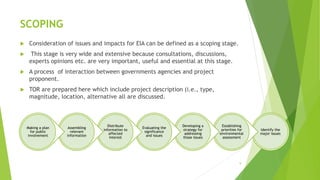
 Consideration of issues and impacts for EIA can be defined as a scoping stage.
 This stage is very wide and extensive because consultations, discussions,
experts opinions etc. are very important, useful and essential at this stage.
 A process of interaction between governments agencies and project
proponent.
 TOR are prepared here which include project description (i.e., type,
magnitude, location, alternative all are discussed.
9
Identify the
major issues
Establishing
priorities for
environmental
assessment
Developing a
strategy for
addressing
those issues
Evaluating the
significance
and issues
Distribute
information to
affected
interest
Assembling
relevant
information
Making a plan
for public
involvement
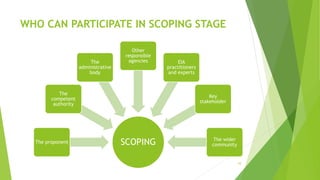
WHO CAN PARTICIPATE IN SCOPING STAGE
10
SCOPING
The proponent
The
competent
authority
The
administrative
body
Other
responsible
agencies EIA
practitioners
and experts
Key
stakeholder
The wider
community
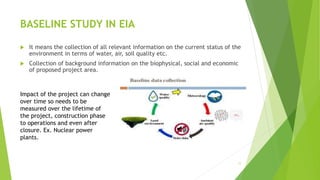
BASELINE STUDY IN EIA
 It means the collection of all relevant information on the current status of the
environment in terms of water, air, soil quality etc.
 Collection of background information on the biophysical, social and economic
of proposed project area.
11
Impact of the project can change
over time so needs to be
measured over the lifetime of
the project, construction phase
to operations and even after
closure. Ex. Nuclear power
plants.
IMPACT PREDICTION
 It involves forecasting the likely changes in the environment that will occur as
a result of the development.
Several techniques can be used in predicting the impacts.
 Professional judgment with adequate reasoning and supporting data.
 Experiments or tests.
 Past experience.
 Numerical calculations & mathematical models.
 Physical or visual analysis.
 Geographical information systems.
12
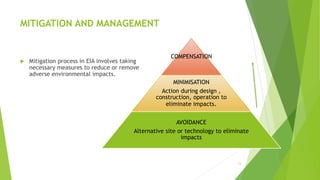
MITIGATION AND MANAGEMENT
 Mitigation process in EIA involves taking
necessary measures to reduce or remove
adverse environmental impacts.
13
COMPENSATION
MINIMISATION
Action during design ,
construction, operation to
eliminate impacts.
AVOIDANCE
Alternative site or technology to eliminate
impacts
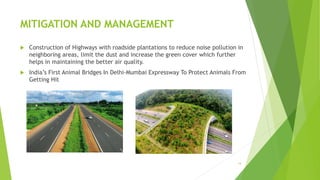
MITIGATION AND MANAGEMENT
 Construction of Highways with roadside plantations to reduce noise pollution in
neighboring areas, limit the dust and increase the green cover which further
helps in maintaining the better air quality.
 India’s First Animal Bridges In Delhi-Mumbai Expressway To Protect Animals From
Getting Hit
14
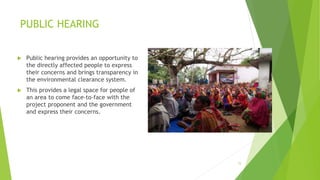
PUBLIC HEARING
15
 Public hearing provides an opportunity to
the directly affected people to express
their concerns and brings transparency in
the environmental clearance system.
 This provides a legal space for people of
an area to come face-to-face with the
project proponent and the government
and express their concerns.
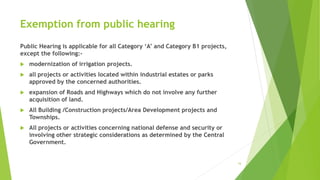
Exemption from public hearing
Public Hearing is applicable for all Category ‘A’ and Category B1 projects,
except the following:-
 modernization of irrigation projects.
 all projects or activities located within industrial estates or parks
approved by the concerned authorities.
 expansion of Roads and Highways which do not involve any further
acquisition of land.
 All Building /Construction projects/Area Development projects and
Townships.
 All projects or activities concerning national defense and security or
involving other strategic considerations as determined by the Central
Government.
16
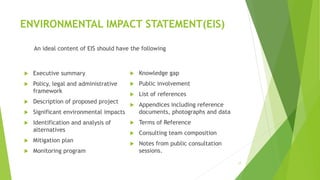
ENVIRONMENTAL IMPACT STATEMENT(EIS)
 Knowledge gap
 Public involvement
 List of references
 Appendices including reference
documents, photographs and data
 Terms of Reference
 Consulting team composition
 Notes from public consultation
sessions.
17
 Executive summary
 Policy, legal and administrative
framework
 Description of proposed project
 Significant environmental impacts
 Identification and analysis of
alternatives
 Mitigation plan
 Monitoring program
An ideal content of EIS should have the following
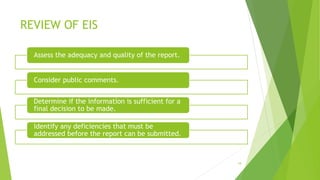
REVIEW OF EIS
18
Assess the adequacy and quality of the report.
Consider public comments.
Determine if the information is sufficient for a
final decision to be made.
Identify any deficiencies that must be
addressed before the report can be submitted.
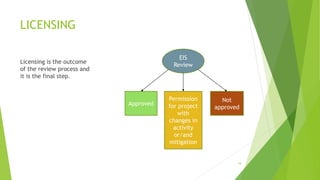
LICENSING
Licensing is the outcome
of the review process and
it is the final step.
19
EIS
Review
Permission
for project
with
changes in
activity
or/and
mitigation
Not
approved
Approved
CONCLUSION
 An EIA process balances developmental and environmental aspects.
 In absence of EIA process, many harm could be done to environment and
indigenous population. An EIA ensures right protection to society and
environment.
 A proper implementation of EIA process, identifying impacts and following
suitable mitigation measures ensures sustainable growth and benefits to
community.
20
REFERENCE
 Published in the Gazette of India, Extraordinary, Part-II, and Section 3, Sub-
section(ii)
MINISTRY OF ENVIRONMENT, FOREST AND CLIMATE CHANGE.
 Ogola (2007). Environmental Impact Assessment General Procedures. Lake
Naivasha: UNU-GTP and KenGen.
 H. Naber. Environmental Impact Assessment. Washington, DC: World Bank,
2012.
 J. Glasson, R. Therival and A. Chadwick. Introduction to Environmental
Impact Assessment. London: London UCL Press, 1994.
 WB. (2006). Bangladesh: Country Environmental Analysis. Washington, DC:
World Bank.
 Encyclopedia. (2015, August 9). Retrieved August 9, 2015, from
https://en.wikipedia.org/wiki/Environmental_impact_assessment
21
Thank you!
22

Environmental impact assessment

  • 1.
    ENVIRONMENTAL IMPACT ASSESSMENT By Mr.Biplob Das (Assistant Prof. OF Civil Engineering Department) MITM 1
  • 2.
    CONTENTS  EIA Definition History of EIA  Types of EIA  Stages of EIA  Conclusion  References 2
  • 3.
    WHAT IS EIA? A decision making tool  To predict the effect of a proposed activity/project on the environment  To compare various alternatives for a project  To identify best combination of economic, environmental and social costs and benefits 3
  • 4.
    HISTORY OF EIAIN INDIA  In India, EIAs of development projects were first started in 1977-78 when the Department of Science and Technology took up environmental appraisal of river valley projects.  In 1994 when EIA was made mandatory in India under the Environmental Protection Act of 1986. Establishment of EIA Authority under the MOEFCC.  public consultation have been made compulsory component of EIA by an amendment dated April 10, 1997.  In September, 2006 new EIA Notifications was drafted. 4
  • 5.
    TYPES OF EIA RAPID Quick assessment for predicting adverse impact.  Data collection for only one seasons. COMPREHENSIVE  Applicable for large project.  Data collection through a year. 5
  • 6.
  • 7.
    7 EIA required scoping Impact analysis Mitigationand management EIA report Review Decision makings Not approved Approved Redesign Resubmit Implementation and follow up Public involvement Public involvement STAGES OF EIA
  • 8.
    SCREENING  Screening isthe process of identifying whether an Environmental Impact Assessment (EIA) is necessary or not.  As per MOEFCC some A category projects – mining of minerals with area >100ha, River valley project, Thermal power plant with capacity >500MW, Nuclear power plant, oil and gas extraction. 8
  • 9.
    SCOPING  Consideration ofissues and impacts for EIA can be defined as a scoping stage.  This stage is very wide and extensive because consultations, discussions, experts opinions etc. are very important, useful and essential at this stage.  A process of interaction between governments agencies and project proponent.  TOR are prepared here which include project description (i.e., type, magnitude, location, alternative all are discussed. 9 Identify the major issues Establishing priorities for environmental assessment Developing a strategy for addressing those issues Evaluating the significance and issues Distribute information to affected interest Assembling relevant information Making a plan for public involvement
  • 10.
    WHO CAN PARTICIPATEIN SCOPING STAGE 10 SCOPING The proponent The competent authority The administrative body Other responsible agencies EIA practitioners and experts Key stakeholder The wider community
  • 11.
    BASELINE STUDY INEIA  It means the collection of all relevant information on the current status of the environment in terms of water, air, soil quality etc.  Collection of background information on the biophysical, social and economic of proposed project area. 11 Impact of the project can change over time so needs to be measured over the lifetime of the project, construction phase to operations and even after closure. Ex. Nuclear power plants.
  • 12.
    IMPACT PREDICTION  Itinvolves forecasting the likely changes in the environment that will occur as a result of the development. Several techniques can be used in predicting the impacts.  Professional judgment with adequate reasoning and supporting data.  Experiments or tests.  Past experience.  Numerical calculations & mathematical models.  Physical or visual analysis.  Geographical information systems. 12
  • 13.
    MITIGATION AND MANAGEMENT Mitigation process in EIA involves taking necessary measures to reduce or remove adverse environmental impacts. 13 COMPENSATION MINIMISATION Action during design , construction, operation to eliminate impacts. AVOIDANCE Alternative site or technology to eliminate impacts
  • 14.
    MITIGATION AND MANAGEMENT Construction of Highways with roadside plantations to reduce noise pollution in neighboring areas, limit the dust and increase the green cover which further helps in maintaining the better air quality.  India’s First Animal Bridges In Delhi-Mumbai Expressway To Protect Animals From Getting Hit 14
  • 15.
    PUBLIC HEARING 15  Publichearing provides an opportunity to the directly affected people to express their concerns and brings transparency in the environmental clearance system.  This provides a legal space for people of an area to come face-to-face with the project proponent and the government and express their concerns.
  • 16.
    Exemption from publichearing Public Hearing is applicable for all Category ‘A’ and Category B1 projects, except the following:-  modernization of irrigation projects.  all projects or activities located within industrial estates or parks approved by the concerned authorities.  expansion of Roads and Highways which do not involve any further acquisition of land.  All Building /Construction projects/Area Development projects and Townships.  All projects or activities concerning national defense and security or involving other strategic considerations as determined by the Central Government. 16
  • 17.
    ENVIRONMENTAL IMPACT STATEMENT(EIS) Knowledge gap  Public involvement  List of references  Appendices including reference documents, photographs and data  Terms of Reference  Consulting team composition  Notes from public consultation sessions. 17  Executive summary  Policy, legal and administrative framework  Description of proposed project  Significant environmental impacts  Identification and analysis of alternatives  Mitigation plan  Monitoring program An ideal content of EIS should have the following
  • 18.
    REVIEW OF EIS 18 Assessthe adequacy and quality of the report. Consider public comments. Determine if the information is sufficient for a final decision to be made. Identify any deficiencies that must be addressed before the report can be submitted.
  • 19.
    LICENSING Licensing is theoutcome of the review process and it is the final step. 19 EIS Review Permission for project with changes in activity or/and mitigation Not approved Approved
  • 20.
    CONCLUSION  An EIAprocess balances developmental and environmental aspects.  In absence of EIA process, many harm could be done to environment and indigenous population. An EIA ensures right protection to society and environment.  A proper implementation of EIA process, identifying impacts and following suitable mitigation measures ensures sustainable growth and benefits to community. 20
  • 21.
    REFERENCE  Published inthe Gazette of India, Extraordinary, Part-II, and Section 3, Sub- section(ii) MINISTRY OF ENVIRONMENT, FOREST AND CLIMATE CHANGE.  Ogola (2007). Environmental Impact Assessment General Procedures. Lake Naivasha: UNU-GTP and KenGen.  H. Naber. Environmental Impact Assessment. Washington, DC: World Bank, 2012.  J. Glasson, R. Therival and A. Chadwick. Introduction to Environmental Impact Assessment. London: London UCL Press, 1994.  WB. (2006). Bangladesh: Country Environmental Analysis. Washington, DC: World Bank.  Encyclopedia. (2015, August 9). Retrieved August 9, 2015, from https://en.wikipedia.org/wiki/Environmental_impact_assessment 21
  • 22.