ENVIRONMENT IMPACT
            ASSESSMENT


Submitted by:-
HARSH YADAV ( IIT ROORKEE )
VINOD KUMAR BURDAK ( IIT ROORKEE )
INTRODUCTION
• An environmental impact assessment
  (EIA) is an assessment of the possible
  positive or negative impact that a
  proposed project may have on the
  environment, considering natural, Social
  and Economic aspects.
According to The International Association of
Impact Assessment (IAIA)-

      The process of identifying, predicting,
evaluating and mitigating the biophysical, social,
and other relevant effects of development
proposals prior to major decisions being taken
and commitments made.
• EIAs began to be used in the 1960s as
  part of a rational decision making process.
• It involved a technical evaluation that
  would lead to objective decision making.
• EIA was made legislation in the US in the
  National Environmental Policy Act (NEPA)
  1969.
The main steps in EIAs process:-

 • Screening
 • Scoping
 • Prediction and Mitigation
 • Management and Monitoring
 • Audit
• Screening often results in a categorization of
  the project and from this a decision is made on
  whether or not a full EIA is to be carried out.
• Scoping is the process of determining which
  are the most critical issues to study and will
  involve community participation to some
  degree. It is at this early stage that EIA can
  most strongly influence the outline proposal.
• Detailed prediction and mitigation studies
  follow scoping and are carried out in parallel
  with feasibility studies.
• The main output report is called
  an Environmental Impact Statement, and
  contains a detailed plan for managing and
  monitoring environmental impacts both during
  and after implementation.
• Finally, an audit of the EIA process is carried
  out some time after implementation. The
  audit serves a useful feedback and learning
  function.
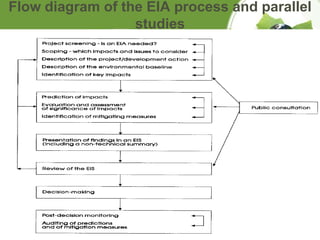
Flow diagram of the EIA process and parallel
                  studies
Data Requirements
• Project
     »Type
     »Size
     »Location
• Area of potential impact
     »Physical resources
     »Biological resources
     »Economic development resources
     »Quality of life
     »Other existing and planned projects
Externalities of EIA
Positive Externalities:
   1. New jobs generated, economic growth
      stimulated.
   2. Growth of local business enterprises
       supported.
   3. Development of supporting and
      complementary industries.
   4. Influx of capital and disposable income.
Cont’d…
 Negative Externalities:
• Social impacts:
  1. Impacts on health of local population.
  2. Increase in crime and deviant behaviour.
  3. Additional pressure on the existing physical
      infrastructure (sewage, water supply etc.).
  4. Decline in community cohesion.
  5. Changed cultural values.
Cont’d…
• Environmental impacts:
 1. Depletion of natural resources.
 2. Destruction of habitats.
 3. Change in ph, oxygen level, toxicity of
    water.
 4. Increase in toxicity of air.
 5. Global warming.
 6. Ozone depletion.
EIA in India
• The MOEF(Ministry of Environments and forests)
  is the agency for environmental clearance. If
  necessary, it may consult a committee of experts
  with a composition specified in schedule III of
  notification.
• The main laws in India:
   1. Water Act (1974)
   2. Indian Wildlife Protection Act (1972)
   3. Air (Prevention and control of Pollution) Act
     (1981)
   4. Environment (Protection) Act (1981)
Cont’d…
• The responsible body for this is the Central
  Pollution Control Board.
• The project proponent is responsible for the
  preparation of the EIA statement, with the help
  of external consultant or institution.
• The amount allocated and spent for preparation
  of EIA by the project proponents are usually
  abysmally low compared to the overall project
  costs (often less than 1% of over all projects).
Drawback in India system:
• The lack of timely availability of reliable
  and authentic environmental data has
  been a major bottle neck in achieving the
  full benefits of EIA.
• The environment being a multi-disciplinary
  subject, a multitude of agencies is involved
  in collection of environmental data.
• Now, to provide reliable data, Environmental
  Information Centre (EIC) has been set up to serve as
  a professionally managed clearing house of
  environmental information that can be used by MoEF,
  project proponents, consultants, NGOs and other
  stakeholders involved in the process of environmental
  impact assessment in India.
• EIC stores data in GIS format and makes it available
  to all environmental impact assessment studies and to
  EIA stakeholders in a cost effective and timely
  manner.
Benefits of conducting EIA

• Facilitates informed decision making by providing
  clear, well structured dispassionate analysis of the
  effect and consequences of proposed projects.
• Pre-emption or early withdrawal of unsound
  proposals.
• Assists in the selection of alternatives, including the
  selection of the best practicable and most
  environmentally friendly option.
• Results in best practice prediction and mitigation of
  adverse effects of projects.
Cont’d…
• Influences both project selection and design by screening
  out environmentally unsound projects, as well as
  modifying feasible projects - Mitigation of negative
  environmental and social impacts.
• Guides formal approval, including the establishment of
  terms and conditions of project implementation and follow-
  up.
• Mitigation of negative environmental and social impacts.
• Serves as an adaptive, organizational learning process, in
  which the lessons of experience are feedback into
  policy, institutional and project design - Enhancement of
  positive aspects
Conclusion
• Environment Impact Assessment is a very
  beneficial step to check, whether the project is
  environment friendly or not.
• Since economic development is result of
  interaction between natural resources and
  technology supported by designed for people,
  so all human activity should be economic,
  social and environment friendly.
THANK YOU

Environment impact assessment

  • 1.
    ENVIRONMENT IMPACT ASSESSMENT Submitted by:- HARSH YADAV ( IIT ROORKEE ) VINOD KUMAR BURDAK ( IIT ROORKEE )
  • 2.
    INTRODUCTION • An environmentalimpact assessment (EIA) is an assessment of the possible positive or negative impact that a proposed project may have on the environment, considering natural, Social and Economic aspects.
  • 3.
    According to TheInternational Association of Impact Assessment (IAIA)- The process of identifying, predicting, evaluating and mitigating the biophysical, social, and other relevant effects of development proposals prior to major decisions being taken and commitments made.
  • 4.
    • EIAs beganto be used in the 1960s as part of a rational decision making process. • It involved a technical evaluation that would lead to objective decision making. • EIA was made legislation in the US in the National Environmental Policy Act (NEPA) 1969.
  • 5.
    The main stepsin EIAs process:- • Screening • Scoping • Prediction and Mitigation • Management and Monitoring • Audit
  • 6.
    • Screening oftenresults in a categorization of the project and from this a decision is made on whether or not a full EIA is to be carried out. • Scoping is the process of determining which are the most critical issues to study and will involve community participation to some degree. It is at this early stage that EIA can most strongly influence the outline proposal.
  • 7.
    • Detailed predictionand mitigation studies follow scoping and are carried out in parallel with feasibility studies. • The main output report is called an Environmental Impact Statement, and contains a detailed plan for managing and monitoring environmental impacts both during and after implementation.
  • 8.
    • Finally, anaudit of the EIA process is carried out some time after implementation. The audit serves a useful feedback and learning function.
  • 9.
    Flow diagram ofthe EIA process and parallel studies
  • 10.
    Data Requirements • Project »Type »Size »Location • Area of potential impact »Physical resources »Biological resources »Economic development resources »Quality of life »Other existing and planned projects
  • 11.
    Externalities of EIA PositiveExternalities: 1. New jobs generated, economic growth stimulated. 2. Growth of local business enterprises supported. 3. Development of supporting and complementary industries. 4. Influx of capital and disposable income.
  • 12.
    Cont’d…  Negative Externalities: •Social impacts: 1. Impacts on health of local population. 2. Increase in crime and deviant behaviour. 3. Additional pressure on the existing physical infrastructure (sewage, water supply etc.). 4. Decline in community cohesion. 5. Changed cultural values.
  • 13.
    Cont’d… • Environmental impacts: 1. Depletion of natural resources. 2. Destruction of habitats. 3. Change in ph, oxygen level, toxicity of water. 4. Increase in toxicity of air. 5. Global warming. 6. Ozone depletion.
  • 14.
    EIA in India •The MOEF(Ministry of Environments and forests) is the agency for environmental clearance. If necessary, it may consult a committee of experts with a composition specified in schedule III of notification. • The main laws in India: 1. Water Act (1974) 2. Indian Wildlife Protection Act (1972) 3. Air (Prevention and control of Pollution) Act (1981) 4. Environment (Protection) Act (1981)
  • 15.
    Cont’d… • The responsiblebody for this is the Central Pollution Control Board. • The project proponent is responsible for the preparation of the EIA statement, with the help of external consultant or institution. • The amount allocated and spent for preparation of EIA by the project proponents are usually abysmally low compared to the overall project costs (often less than 1% of over all projects).
  • 16.
    Drawback in Indiasystem: • The lack of timely availability of reliable and authentic environmental data has been a major bottle neck in achieving the full benefits of EIA. • The environment being a multi-disciplinary subject, a multitude of agencies is involved in collection of environmental data.
  • 17.
    • Now, toprovide reliable data, Environmental Information Centre (EIC) has been set up to serve as a professionally managed clearing house of environmental information that can be used by MoEF, project proponents, consultants, NGOs and other stakeholders involved in the process of environmental impact assessment in India. • EIC stores data in GIS format and makes it available to all environmental impact assessment studies and to EIA stakeholders in a cost effective and timely manner.
  • 18.
    Benefits of conductingEIA • Facilitates informed decision making by providing clear, well structured dispassionate analysis of the effect and consequences of proposed projects. • Pre-emption or early withdrawal of unsound proposals. • Assists in the selection of alternatives, including the selection of the best practicable and most environmentally friendly option. • Results in best practice prediction and mitigation of adverse effects of projects.
  • 19.
    Cont’d… • Influences bothproject selection and design by screening out environmentally unsound projects, as well as modifying feasible projects - Mitigation of negative environmental and social impacts. • Guides formal approval, including the establishment of terms and conditions of project implementation and follow- up. • Mitigation of negative environmental and social impacts. • Serves as an adaptive, organizational learning process, in which the lessons of experience are feedback into policy, institutional and project design - Enhancement of positive aspects
  • 20.
    Conclusion • Environment ImpactAssessment is a very beneficial step to check, whether the project is environment friendly or not. • Since economic development is result of interaction between natural resources and technology supported by designed for people, so all human activity should be economic, social and environment friendly.
  • 21.