NATIONAL INSTITUTE OF TECHNOLOGY,
HAMIRPUR
Civil Engineering Department
Presentation on
Presented by:
Navsal Kumar
Roll: 15M150
M. Tech. 1st Year (WRE)
Civil Engineering Department
NIT Hamirpur (HP)
CONTENTS
i • Introduction
ii • Background Study
1 • Environmental Impact Assessment – Definition
2 • History of EIA
3 • Purpose & Objectives of EIA
4 • Process of EIA
5 • Concept of EIA in Water Resources Project
6 • Environmental Discourse on DAM construction
7 • Case study – THREE GORGES DAM
8 • Conclusion
• References
9
PROJECT/
ACTIVITIES
ENVIRONMENT ECONOMIC
SOCIAL
INTRODUCTION
BACKGROUND STUDY
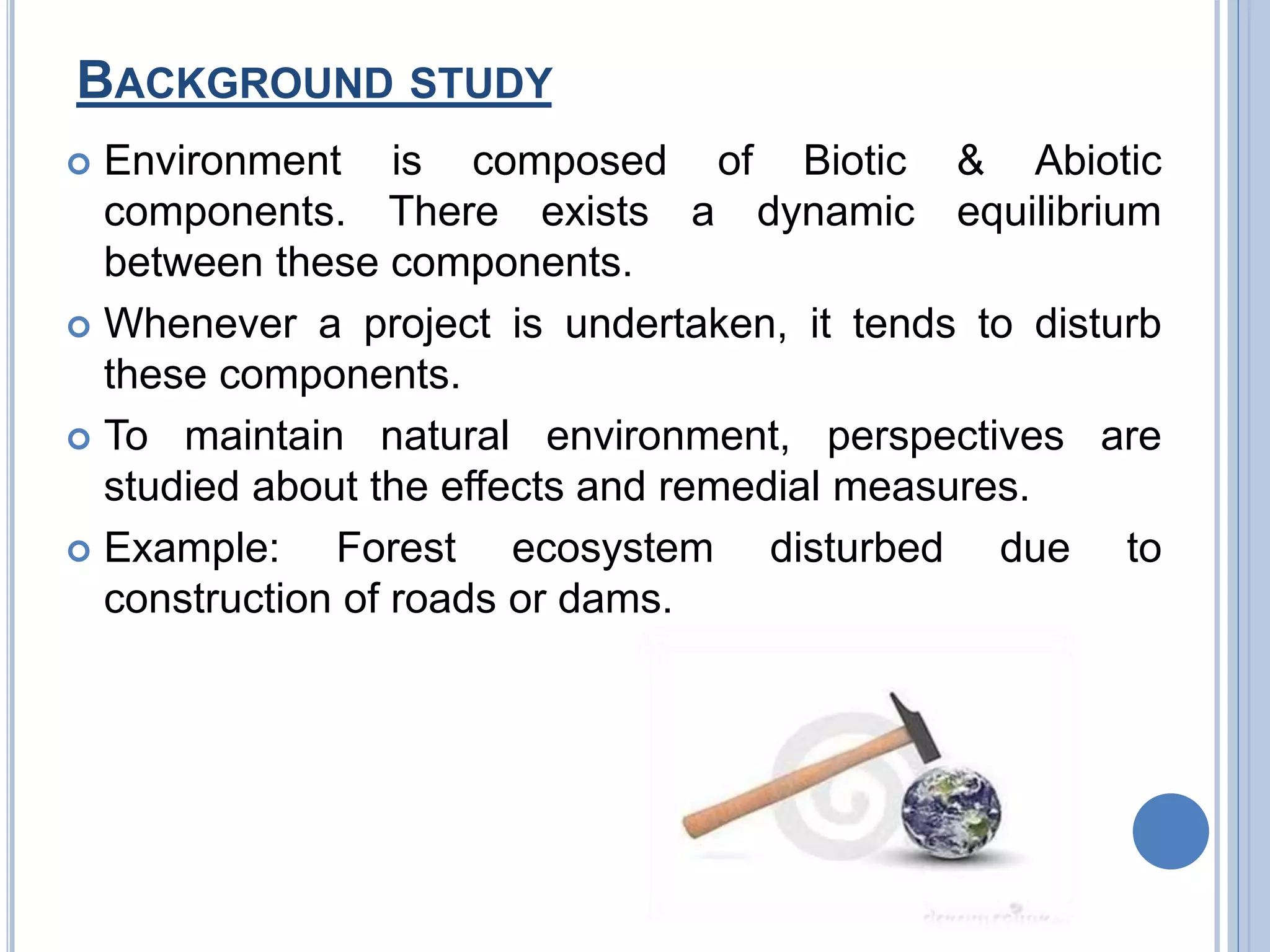
 Environment is composed of Biotic & Abiotic
components. There exists a dynamic equilibrium
between these components.
 Whenever a project is undertaken, it tends to disturb
these components.
 To maintain natural environment, perspectives are
studied about the effects and remedial measures.
 Example: Forest ecosystem disturbed due to
construction of roads or dams.
 The impact of an activity is a deviation (a change) from
the baseline situation that is caused by the activity.
 Types of impact: Ecological, Physico-chemical & on
Human interests
 Environmental impact assessment (EIA) is a decision-
making process that systematically evaluates the
possible significant (negative or positive) effects that a
proposed project action may exert on the natural, social
and human environment of a particular geographic area
(Lei and Hilton, 2013).
ENVIRONMENTAL IMPACT ASSESSMENT
– DEFINITION
HISTORY & DEVELOPMENT OF EIA
 EIA was first developed in the US as a result of the
National Environmental Policy Act of 1969(NEPA), for
considering possible impacts prior to a decision being
taken on whether or not a proposal should be given
approval to proceed.
 Environmental Impact Assessment concept in India
came in the year 1994.
 There have been 3 amendments in the notification.
 Recognition of EIA consultant and organization through
“Quality Council of India“ is also one step ahead to stop
entry of unethical people mushrooming as EIA
consultant.
PURPOSE & OBJECTIVES OF EIA
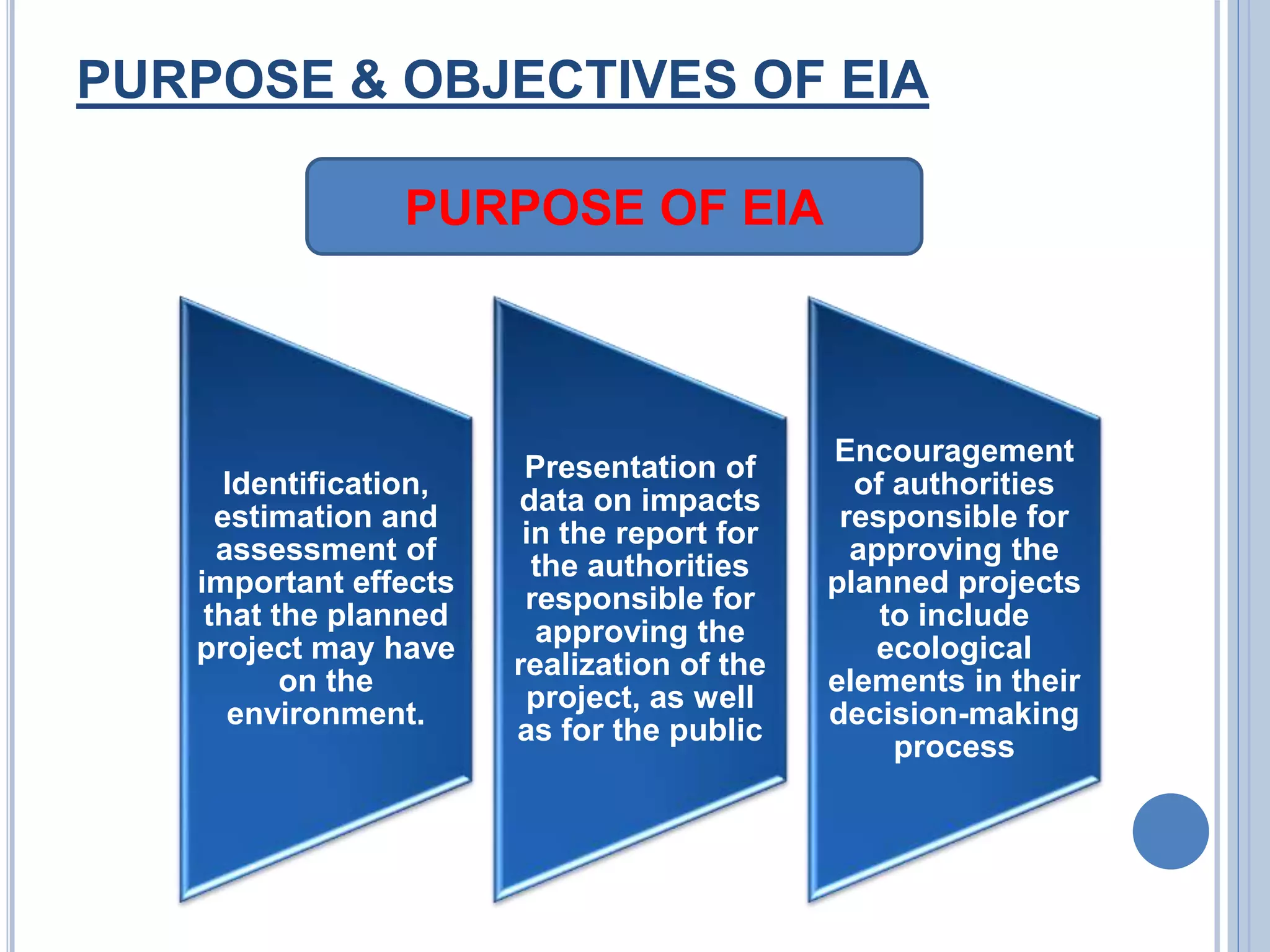
Identification,
estimation and
assessment of
important effects
that the planned
project may have
on the
environment.
Presentation of
data on impacts
in the report for
the authorities
responsible for
approving the
realization of the
project, as well
as for the public
Encouragement
of authorities
responsible for
approving the
planned projects
to include
ecological
elements in their
decision-making
process
PURPOSE OF EIA
OBJECTIVES OF EIA
To ensure that eventual effects on the
environment are considered before the
approval of project
To encourage implementation of relevant
procedures before finalizing the project
To encourage the creation of procedures
for information exchange, reporting and
consultation amongst countries
PROCESS OF EIA
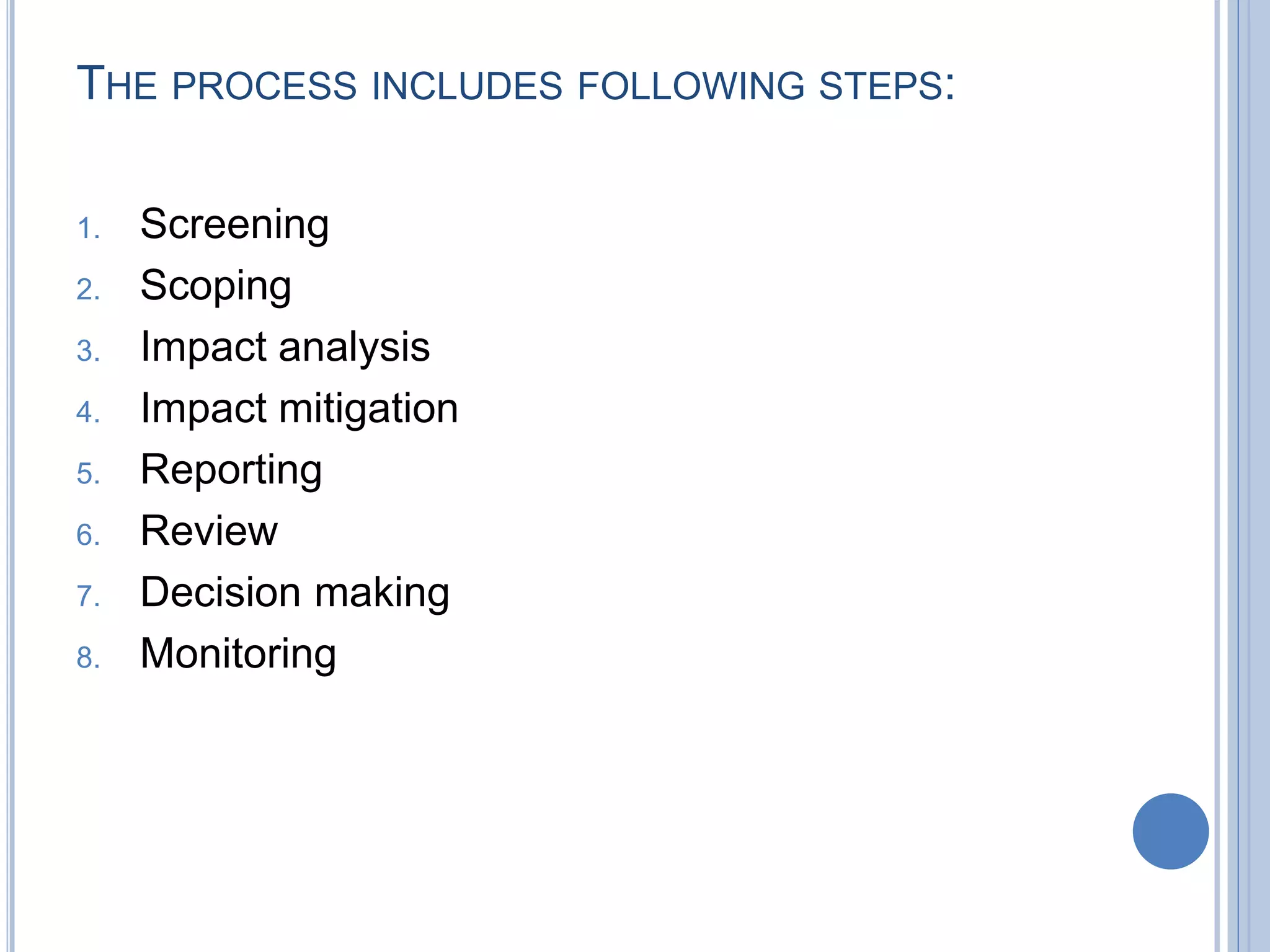
THE PROCESS INCLUDES FOLLOWING STEPS:
1. Screening
2. Scoping
3. Impact analysis
4. Impact mitigation
5. Reporting
6. Review
7. Decision making
8. Monitoring
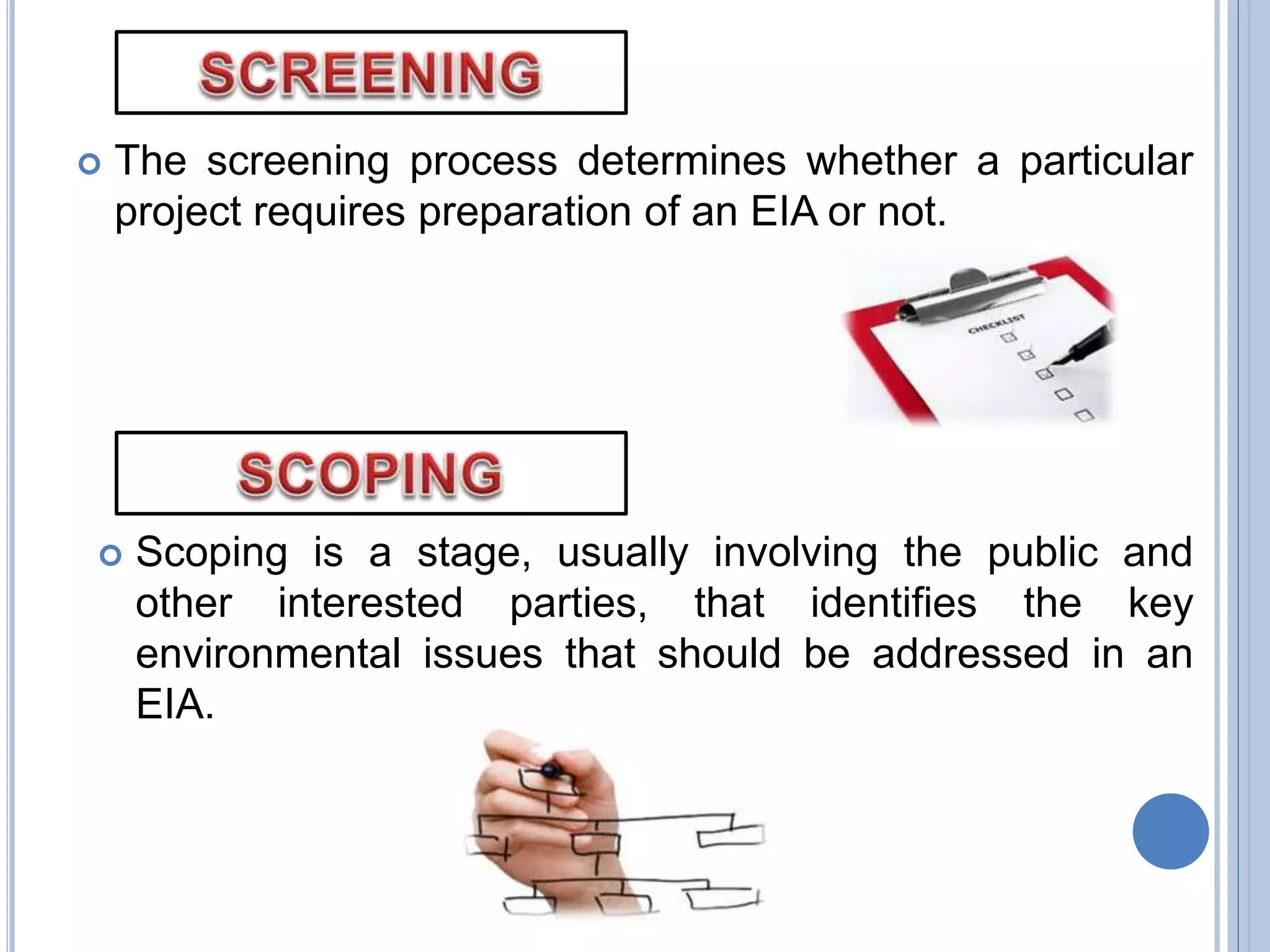
 The screening process determines whether a particular
project requires preparation of an EIA or not.
 Scoping is a stage, usually involving the public and
other interested parties, that identifies the key
environmental issues that should be addressed in an
EIA.
 The type, extent, duration, timing, severity and
significance of the impact is analyzed.
 Ensuring that residual impacts are within
acceptable levels and to enhance environmental and
social benefits.
 It is the implementation of measures designed to
reduce the undesirable effects of a proposed action
on the environment
 Report of EIA is prepared and submitted to the
concerned authority.
A description of the project
An outline of the main alternatives studied by the developer, and an
indication of the main reasons for this choice
A description of the aspects of the environment likely to be
significantly affected by the proposed project
Measures to prevent, reduce and possibly offset adverse
environmental effects
A non-technical summary
An indication of any difficulties (technical deficiencies or
lack of know-how) encountered while compiling the required
information
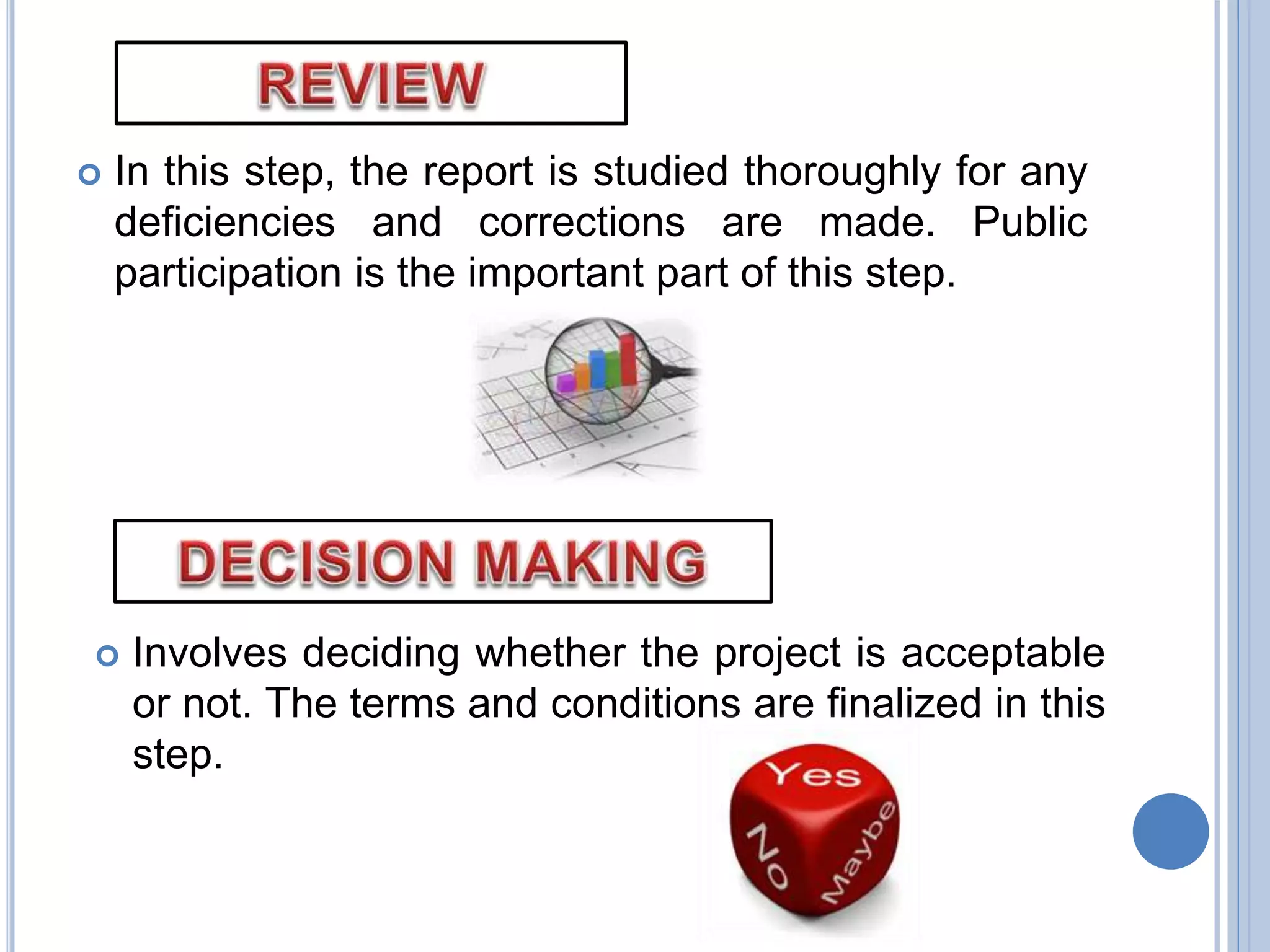
 In this step, the report is studied thoroughly for any
deficiencies and corrections are made. Public
participation is the important part of this step.
 Involves deciding whether the project is acceptable
or not. The terms and conditions are finalized in this
step.
 Involves ensuring the implementation of conditions
attached to a decision, verification of impacts are as
predicted or permitted, confirming the mitigation
measures are working as expected, taking action to
manage any unforeseen changes.
CONCEPT OF EIA IN WATER RESOURCE
PROJECTS
What are these Projects?
Why do we need these projects?
Why is there a need of EIA in
these projects?
WATER RESOURCE PROJECTS
 Multipurpose river valley projects
 Major irrigation projects / canals
 Inter-linking of rivers
WHY DO WE NEED THESE PROJECTS?
Our population is growing
The country’s population which was over 1028 million in 2001
is expected to reach a level of around 1400 million by 2025.
Our water demand is growing.
Agriculture
Production of food grains has increased from around 50
million tons in the fifties to about 208 million tons in 1999-
2000. This will have to be raised to around 350 million tons
by the year 2025.
Domestic & Industry
Domestic and industrial water needs have largely been
concentrated in or near major cities. However, the demand in
rural areas is expected to increase sharply as the
development programmes improve economic conditions of
the rural masses.
Power generation
Demand for water for hydro and thermal power generation is
also increasing substantially.
WHAT IS THE NEED OF E.I.A. IN THESE PROJECTS?
 As a result, water, which is already a scarce
resource, will become even scarcer in future.
 These water resource projects have both beneficial
and adverse effects on environment as well as
socio-economic factors.
 To attain sustainability in water resource
developments.
 Although there is no global water scarcity as such,
an increasing number of regions are chronically
short of water.
WATER RESOURCE PROJECTS
ENVIRONMENTAL
IMPACTS
CONSTRUCTION
PHASE
BENEFICIAL
IMPACTS
ADVERSE
IMPACTS
OPERATIONAL
PHASE
BENEFICIAL
IMPACTS
ADVERSE
IMPACTS
CONSTRUCTION PHASE
 SOCIO-ECONOMIC
 Employment generated
 Lesser migration to cities
 Development of infrastructure
 Compensation given to people
who lose their lands
 BIOTIC
 Compensatory afforestation
(green belt created on the
periphery of reservoir in the case
of multi-purpose river valley
projects)
 SOCIO-ECONOMIC
 Displacement of people
 Loss of livelihood that they
have been used to
 Loss of monuments (some
cases)
 BIOTIC
 Submergence of forest land (in
the case of multi-purpose river
valley projects)
 Effects on flora and fauna due
to construction activity
OPERATIONAL PHASE
 SOCIO-ECONOMIC
 Irrigation allows for improved
crop production
 Increased power generation
 Improved water supply
throughout the year
 Flood moderation
 Improved groundwater
recharge
 Tourism
 BIOTIC
 Increased aquatic life in
reservoir
 Increase in migratory birds
 SOCIO-ECONOMIC
 Water logging and salinity
 Greenhouse gas emissions
(methane emissions from
submerged forests)
 Increase in production of water
intensive crops
 Change in sediment loads
through the course of the river
and at the delta
 BIOTIC
 Aquatic life affected due to
differential temperature and flow
rates
 Change in natural ecosystem
MAJOR CHALLENGES IN EIA AND ENVIRONMENTAL
PLANNING IN WATER RESOURCES DEVELOPMENT
 Increase in Population
 Climate change
 Ill conceived planning
 Policies and institutions
TOOLS FOR ASSESSMENT AND MANAGEMENT
 Environmental flows assessment.
 Allocation of water for ecological water demand
 Dam breach analysis
 GIS & RS with Simulation models
 IWRM integrated with EIA
ENVIRONMENTAL DISCOURSE ON
DAM CONSTRUCTION
 In 1947, there were 300 dams.
 In 2000, there were 4000 dams.
 Currently, there are more than 4500 dams in India.
 Large dams in India are estimated to have submerged
around 37500 km2 land area.
 About 10 million people have been displaced or affected.
 Adverse impacts of dams have spawned resistance
movements, especially after 1980’s.
Negative impacts of river valley projects
CASE STUDY – THREE GORGES DAM
 The three gorges dam is built on the Yangtze river which is the
world’s 3rd longest river.
 It is the biggest reinforced concrete structure in the world.
 It is the world’s largest power station in terms of installed
capacity(22500 MW).
 Affected the rotation of earth by 1 sec.
 Height – 181 m
 Length – 2335 m
 Reservoir capacity- 39.3 km2
Sr.
no.
Environmental issues Evidence
1 Displacement 120,000 more resettlers were displaced than the
estimated number in the EIS Report.
2 Sedimentation The volume of sediments averaged 142 million tons (Mt)
per year, being equivalent to 40% of the estimated 355 Mt
per year in the EIS Report.
3 Soil erosion in reservoir
area
Both the extent and severity of soil erosion in the TGRA
are smaller than the estimates of the EIA Report.
4 Water quality
(Eutrophication)
Eutrophication and algal bloom in many bays of the
reservoir has become a prominent issue
5 Downstream river bed
erosion
The annual erosion rate from October 2002 to October
2010 averaged at 108.8 million m³, which was much
greater than the average 6.25 million m³ per annum in
1975-2002.
6 4 major domestic fish
species
The stock of four major domestic fish species dropped
dramatically between 2005 and 2010, reducing by 78.2%
on the 1981 level, compared to the estimated reduction of
50-60% in the EIS Report.
7 Reservoir bank stability On average, 31 bank collapses occurred per year in the
reservoir in 2003-2007, compared to 19 bank collapses in
the Jing jiang section of the middle Yangzi in 2001-2003.
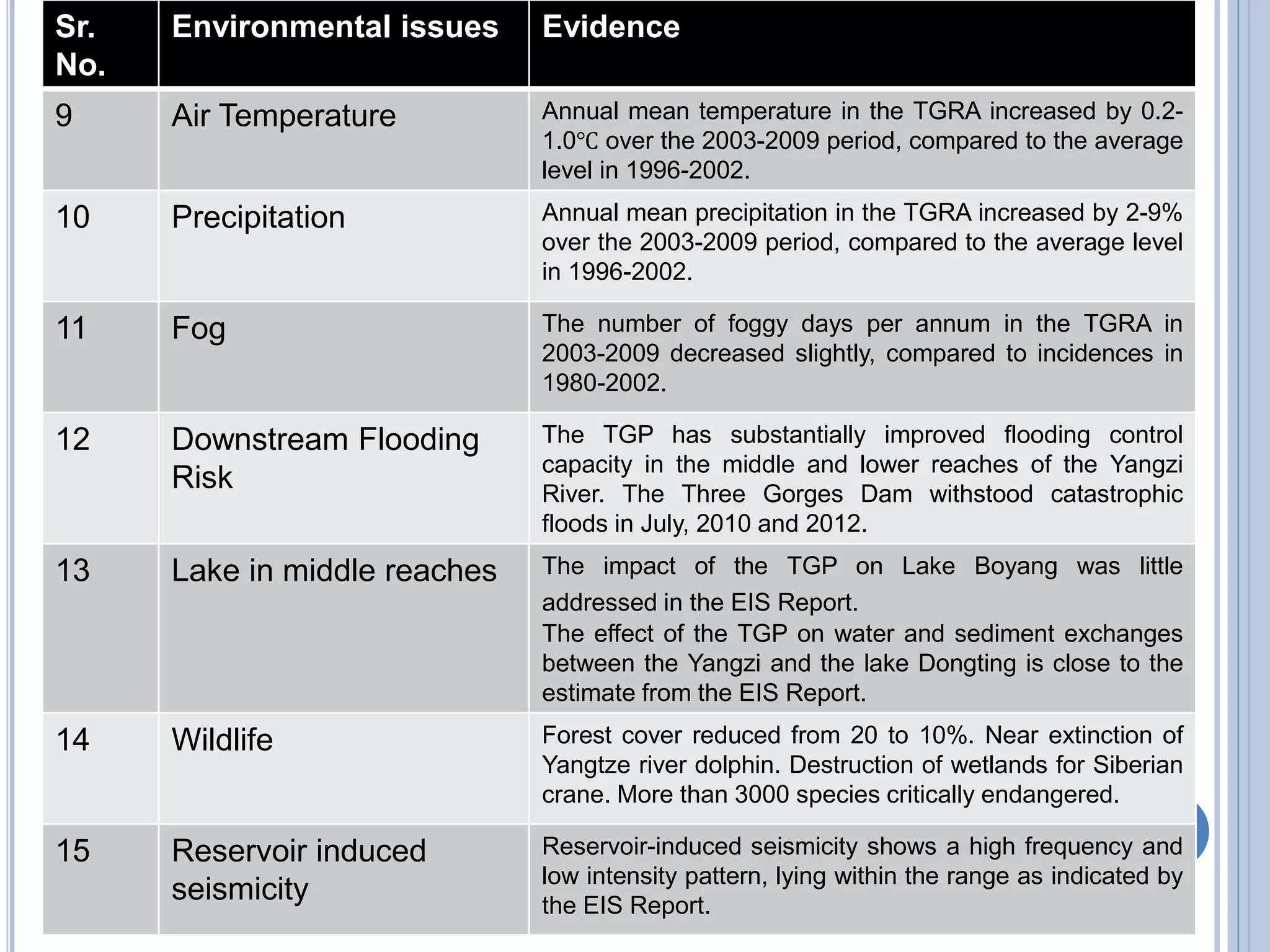
Sr.
No.
Environmental issues Evidence
9 Air Temperature Annual mean temperature in the TGRA increased by 0.2-
1.0℃ over the 2003-2009 period, compared to the average
level in 1996-2002.
10 Precipitation Annual mean precipitation in the TGRA increased by 2-9%
over the 2003-2009 period, compared to the average level
in 1996-2002.
11 Fog The number of foggy days per annum in the TGRA in
2003-2009 decreased slightly, compared to incidences in
1980-2002.
12 Downstream Flooding
Risk
The TGP has substantially improved flooding control
capacity in the middle and lower reaches of the Yangzi
River. The Three Gorges Dam withstood catastrophic
floods in July, 2010 and 2012.
13 Lake in middle reaches The impact of the TGP on Lake Boyang was little
addressed in the EIS Report.
The effect of the TGP on water and sediment exchanges
between the Yangzi and the lake Dongting is close to the
estimate from the EIS Report.
14 Wildlife Forest cover reduced from 20 to 10%. Near extinction of
Yangtze river dolphin. Destruction of wetlands for Siberian
crane. More than 3000 species critically endangered.
15 Reservoir induced
seismicity
Reservoir-induced seismicity shows a high frequency and
low intensity pattern, lying within the range as indicated by
the EIS Report.
CONCLUSION
 Environmental impact assessment must be made
mandatory for all water resources projects so as to
ensure sustainability in development.
 EIA should be incorporated in Integrated water resource
management.
 Public Participation must be encouraged at all levels in
the implementation of EIA for a project.
 Use of advanced techniques like GIS & RS and
Simulation Models as a component of EIA for effective
and efficient data collection
 Proper policies and institutions must be drafted and
formed for quick and firm decision making.
REFERENCES
 Lei, L., and Hilton, B. (2013). A Spatially Intelligent Public Participation System for the
Environmental Impact Assessment Process. ISPRS International Journal of Geo-
Information 2: 480-506
 NA. Siddiqui, R.N. Shukla and Akbar Ziauddin(2008). Environmental Impact Assessment
(EIA) for a Water Resource Project. Ecology, Environment and Conservation Paper,
Vol.14, Issue 04, Page No.(707-711).
 Presentation by Mr. Pradeep Kumar, ex-Director, National Water Academy, Pune
 Water Supply Engineering; Prof. S.K. Garg; Khanna Publishers.
 S.K. Sharma, A. Kaushik (2007). Impacts of Water Resources Development Project with
Special Reference to Dams and Reservoirs. International Conference on Small
Hydropower - Hydro Sri Lanka
 Tena Bekele Adgolign and Srinivasa Rao GVR(2014). Environmental Impact Assessment
in Sustainable Water Resources Development: Major Issues of Consideration. Science,
Technology and Arts Research Journal, April-June 2014, 3(2): 180-189
 Xu, Xibao; Tan, Yan; Yang, Guishan(2013). Environmental impact assessments of the
Three Gorges Project in China: issues and interventions, Earth-Science Reviews, 2013;
124:115-125
 Three gorges dam (Wikipedia Article)
Environmental Impact Assessment in Water Resources Projects

Environmental Impact Assessment in Water Resources Projects

  • 1.
    NATIONAL INSTITUTE OFTECHNOLOGY, HAMIRPUR Civil Engineering Department Presentation on Presented by: Navsal Kumar Roll: 15M150 M. Tech. 1st Year (WRE) Civil Engineering Department NIT Hamirpur (HP)
  • 2.
    CONTENTS i • Introduction ii• Background Study 1 • Environmental Impact Assessment – Definition 2 • History of EIA 3 • Purpose & Objectives of EIA 4 • Process of EIA 5 • Concept of EIA in Water Resources Project 6 • Environmental Discourse on DAM construction 7 • Case study – THREE GORGES DAM 8 • Conclusion • References 9
  • 3.
  • 4.
    BACKGROUND STUDY  Environmentis composed of Biotic & Abiotic components. There exists a dynamic equilibrium between these components.  Whenever a project is undertaken, it tends to disturb these components.  To maintain natural environment, perspectives are studied about the effects and remedial measures.  Example: Forest ecosystem disturbed due to construction of roads or dams.
  • 5.
     The impactof an activity is a deviation (a change) from the baseline situation that is caused by the activity.  Types of impact: Ecological, Physico-chemical & on Human interests  Environmental impact assessment (EIA) is a decision- making process that systematically evaluates the possible significant (negative or positive) effects that a proposed project action may exert on the natural, social and human environment of a particular geographic area (Lei and Hilton, 2013). ENVIRONMENTAL IMPACT ASSESSMENT – DEFINITION
  • 6.
    HISTORY & DEVELOPMENTOF EIA  EIA was first developed in the US as a result of the National Environmental Policy Act of 1969(NEPA), for considering possible impacts prior to a decision being taken on whether or not a proposal should be given approval to proceed.  Environmental Impact Assessment concept in India came in the year 1994.  There have been 3 amendments in the notification.  Recognition of EIA consultant and organization through “Quality Council of India“ is also one step ahead to stop entry of unethical people mushrooming as EIA consultant.
  • 7.
    PURPOSE & OBJECTIVESOF EIA Identification, estimation and assessment of important effects that the planned project may have on the environment. Presentation of data on impacts in the report for the authorities responsible for approving the realization of the project, as well as for the public Encouragement of authorities responsible for approving the planned projects to include ecological elements in their decision-making process PURPOSE OF EIA
  • 8.
    OBJECTIVES OF EIA Toensure that eventual effects on the environment are considered before the approval of project To encourage implementation of relevant procedures before finalizing the project To encourage the creation of procedures for information exchange, reporting and consultation amongst countries
  • 9.
  • 10.
    THE PROCESS INCLUDESFOLLOWING STEPS: 1. Screening 2. Scoping 3. Impact analysis 4. Impact mitigation 5. Reporting 6. Review 7. Decision making 8. Monitoring
  • 11.
     The screeningprocess determines whether a particular project requires preparation of an EIA or not.  Scoping is a stage, usually involving the public and other interested parties, that identifies the key environmental issues that should be addressed in an EIA.
  • 12.
     The type,extent, duration, timing, severity and significance of the impact is analyzed.  Ensuring that residual impacts are within acceptable levels and to enhance environmental and social benefits.  It is the implementation of measures designed to reduce the undesirable effects of a proposed action on the environment
  • 13.
     Report ofEIA is prepared and submitted to the concerned authority. A description of the project An outline of the main alternatives studied by the developer, and an indication of the main reasons for this choice A description of the aspects of the environment likely to be significantly affected by the proposed project Measures to prevent, reduce and possibly offset adverse environmental effects A non-technical summary An indication of any difficulties (technical deficiencies or lack of know-how) encountered while compiling the required information
  • 14.
     In thisstep, the report is studied thoroughly for any deficiencies and corrections are made. Public participation is the important part of this step.  Involves deciding whether the project is acceptable or not. The terms and conditions are finalized in this step.
  • 15.
     Involves ensuringthe implementation of conditions attached to a decision, verification of impacts are as predicted or permitted, confirming the mitigation measures are working as expected, taking action to manage any unforeseen changes.
  • 16.
    CONCEPT OF EIAIN WATER RESOURCE PROJECTS What are these Projects? Why do we need these projects? Why is there a need of EIA in these projects?
  • 17.
    WATER RESOURCE PROJECTS Multipurpose river valley projects  Major irrigation projects / canals  Inter-linking of rivers
  • 18.
    WHY DO WENEED THESE PROJECTS? Our population is growing The country’s population which was over 1028 million in 2001 is expected to reach a level of around 1400 million by 2025. Our water demand is growing. Agriculture Production of food grains has increased from around 50 million tons in the fifties to about 208 million tons in 1999- 2000. This will have to be raised to around 350 million tons by the year 2025. Domestic & Industry Domestic and industrial water needs have largely been concentrated in or near major cities. However, the demand in rural areas is expected to increase sharply as the development programmes improve economic conditions of the rural masses. Power generation Demand for water for hydro and thermal power generation is also increasing substantially.
  • 19.
    WHAT IS THENEED OF E.I.A. IN THESE PROJECTS?  As a result, water, which is already a scarce resource, will become even scarcer in future.  These water resource projects have both beneficial and adverse effects on environment as well as socio-economic factors.  To attain sustainability in water resource developments.  Although there is no global water scarcity as such, an increasing number of regions are chronically short of water.
  • 20.
  • 21.
    CONSTRUCTION PHASE  SOCIO-ECONOMIC Employment generated  Lesser migration to cities  Development of infrastructure  Compensation given to people who lose their lands  BIOTIC  Compensatory afforestation (green belt created on the periphery of reservoir in the case of multi-purpose river valley projects)  SOCIO-ECONOMIC  Displacement of people  Loss of livelihood that they have been used to  Loss of monuments (some cases)  BIOTIC  Submergence of forest land (in the case of multi-purpose river valley projects)  Effects on flora and fauna due to construction activity
  • 22.
    OPERATIONAL PHASE  SOCIO-ECONOMIC Irrigation allows for improved crop production  Increased power generation  Improved water supply throughout the year  Flood moderation  Improved groundwater recharge  Tourism  BIOTIC  Increased aquatic life in reservoir  Increase in migratory birds  SOCIO-ECONOMIC  Water logging and salinity  Greenhouse gas emissions (methane emissions from submerged forests)  Increase in production of water intensive crops  Change in sediment loads through the course of the river and at the delta  BIOTIC  Aquatic life affected due to differential temperature and flow rates  Change in natural ecosystem
  • 23.
    MAJOR CHALLENGES INEIA AND ENVIRONMENTAL PLANNING IN WATER RESOURCES DEVELOPMENT  Increase in Population  Climate change  Ill conceived planning  Policies and institutions
  • 24.
    TOOLS FOR ASSESSMENTAND MANAGEMENT  Environmental flows assessment.  Allocation of water for ecological water demand  Dam breach analysis  GIS & RS with Simulation models  IWRM integrated with EIA
  • 25.
    ENVIRONMENTAL DISCOURSE ON DAMCONSTRUCTION  In 1947, there were 300 dams.  In 2000, there were 4000 dams.  Currently, there are more than 4500 dams in India.  Large dams in India are estimated to have submerged around 37500 km2 land area.  About 10 million people have been displaced or affected.  Adverse impacts of dams have spawned resistance movements, especially after 1980’s.
  • 26.
    Negative impacts ofriver valley projects
  • 27.
    CASE STUDY –THREE GORGES DAM  The three gorges dam is built on the Yangtze river which is the world’s 3rd longest river.  It is the biggest reinforced concrete structure in the world.  It is the world’s largest power station in terms of installed capacity(22500 MW).  Affected the rotation of earth by 1 sec.  Height – 181 m  Length – 2335 m  Reservoir capacity- 39.3 km2
  • 28.
    Sr. no. Environmental issues Evidence 1Displacement 120,000 more resettlers were displaced than the estimated number in the EIS Report. 2 Sedimentation The volume of sediments averaged 142 million tons (Mt) per year, being equivalent to 40% of the estimated 355 Mt per year in the EIS Report. 3 Soil erosion in reservoir area Both the extent and severity of soil erosion in the TGRA are smaller than the estimates of the EIA Report. 4 Water quality (Eutrophication) Eutrophication and algal bloom in many bays of the reservoir has become a prominent issue 5 Downstream river bed erosion The annual erosion rate from October 2002 to October 2010 averaged at 108.8 million m³, which was much greater than the average 6.25 million m³ per annum in 1975-2002. 6 4 major domestic fish species The stock of four major domestic fish species dropped dramatically between 2005 and 2010, reducing by 78.2% on the 1981 level, compared to the estimated reduction of 50-60% in the EIS Report. 7 Reservoir bank stability On average, 31 bank collapses occurred per year in the reservoir in 2003-2007, compared to 19 bank collapses in the Jing jiang section of the middle Yangzi in 2001-2003.
  • 29.
    Sr. No. Environmental issues Evidence 9Air Temperature Annual mean temperature in the TGRA increased by 0.2- 1.0℃ over the 2003-2009 period, compared to the average level in 1996-2002. 10 Precipitation Annual mean precipitation in the TGRA increased by 2-9% over the 2003-2009 period, compared to the average level in 1996-2002. 11 Fog The number of foggy days per annum in the TGRA in 2003-2009 decreased slightly, compared to incidences in 1980-2002. 12 Downstream Flooding Risk The TGP has substantially improved flooding control capacity in the middle and lower reaches of the Yangzi River. The Three Gorges Dam withstood catastrophic floods in July, 2010 and 2012. 13 Lake in middle reaches The impact of the TGP on Lake Boyang was little addressed in the EIS Report. The effect of the TGP on water and sediment exchanges between the Yangzi and the lake Dongting is close to the estimate from the EIS Report. 14 Wildlife Forest cover reduced from 20 to 10%. Near extinction of Yangtze river dolphin. Destruction of wetlands for Siberian crane. More than 3000 species critically endangered. 15 Reservoir induced seismicity Reservoir-induced seismicity shows a high frequency and low intensity pattern, lying within the range as indicated by the EIS Report.
  • 30.
    CONCLUSION  Environmental impactassessment must be made mandatory for all water resources projects so as to ensure sustainability in development.  EIA should be incorporated in Integrated water resource management.  Public Participation must be encouraged at all levels in the implementation of EIA for a project.  Use of advanced techniques like GIS & RS and Simulation Models as a component of EIA for effective and efficient data collection  Proper policies and institutions must be drafted and formed for quick and firm decision making.
  • 31.
    REFERENCES  Lei, L.,and Hilton, B. (2013). A Spatially Intelligent Public Participation System for the Environmental Impact Assessment Process. ISPRS International Journal of Geo- Information 2: 480-506  NA. Siddiqui, R.N. Shukla and Akbar Ziauddin(2008). Environmental Impact Assessment (EIA) for a Water Resource Project. Ecology, Environment and Conservation Paper, Vol.14, Issue 04, Page No.(707-711).  Presentation by Mr. Pradeep Kumar, ex-Director, National Water Academy, Pune  Water Supply Engineering; Prof. S.K. Garg; Khanna Publishers.  S.K. Sharma, A. Kaushik (2007). Impacts of Water Resources Development Project with Special Reference to Dams and Reservoirs. International Conference on Small Hydropower - Hydro Sri Lanka  Tena Bekele Adgolign and Srinivasa Rao GVR(2014). Environmental Impact Assessment in Sustainable Water Resources Development: Major Issues of Consideration. Science, Technology and Arts Research Journal, April-June 2014, 3(2): 180-189  Xu, Xibao; Tan, Yan; Yang, Guishan(2013). Environmental impact assessments of the Three Gorges Project in China: issues and interventions, Earth-Science Reviews, 2013; 124:115-125  Three gorges dam (Wikipedia Article)