Environmental Impact
Assessment
Course Code: WSEE – 5193
Credit Hour:2-0-2
Prepared by: Yetnayet A. (Msc.)
4/4/2022 1
Course Learning Objectives
At the end of this course students should be able to:
 Become familiar with the concept and principles of EIA
 Define and state the purpose of EIA
 Specify the benefit of EIA
 Understand the need for environmental assessment
 Know mitigation measure for environmental impacts
 Prepare an impact assessment of a given project proposal
4/4/2022 2
Introduction
 Water Resources Projects are modern temples of the country and the sign
posts of development.
 Even in the ancient days the prosperity of any kingdom was measured in
terms of its wealth of water resources structures.
 By providing assured water supply for irrigation, municipal and industrial
requirements, production of hydroelectric power and many more purposes,
the water resources projects contributed significantly towards the
improvement in the standard of living and quality of life for millions of the
country.
4/4/2022 3
Cont….
 Water resources projects bring in an immense benefits with an adverse
impacts on environment.
 Environmental problems can vary from the direct effects of the
pollution of waterways and the air, through to indirect effects such as
health problems caused by changes.
4/4/2022 4
Cont….
 Some environmental problems may appear to be insignificant when
considered within an individual proposal but might have adverse
consequences if the effects of all such proposals are added together
(cumulative effects).
 Many of these impacts are manageable if proper measures are taken at
the planning and implementing stage.
4/4/2022 5
Introduction
 In order to manage such large scale environmental problems and to
provide an opportunity to mitigate against negative impacts and
enhance positive impacts, the environmental impact assessment
(EIA) procedure was developed.
4/4/2022 6
Introduction
 Definitions: EIA may be defined as:
 A formal process to predict the environmental consequences of
human development activities and to plan appropriate measures to
eliminate or reduce adverse effects and to augment positive
effects. (FAO definition)
 A process used to identify and predict the impact on the
environment and on man's health and wellbeing of legislative
proposals, policies, programs, projects and operational procedures,
and to interpret and communicate information about the impacts.
(Munn,1979)
4/4/2022 7
Cont…
• A technique and a process by which information about the
environmental effects of a project is collected, both by the developer
and from other sources, and taken into account by the planning
authority in forming their judgments on whether the development
should go ahead. (UK DoE,1989)
• Based on the above definitions, one can observe that EIA has three
basic functions:
• To predict problems,
• To find ways to avoid them, and
• To enhance positive effects.
4/4/2022 8
Cont….
 Environmental Impact Assessment (EIA): is a tool used to identify
the environmental, social, and economic impacts of a project prior to
decision making.
 It aims to:-
‣ Predict environmental impacts at an early stage in project planning and
design,
‣ Find ways and means to reduce adverse impacts,
‣ Shape projects to suit the local environment, and
‣ Present the predictions and options to decision makers.
4/4/2022 9
Cont…
 In an updated view, EIA is understood as an integrated part of the
planning process devoted to the identification, quantification and
qualification of environmental impacts due to the development of a
plan or a project as well as the definition of policies and strategies
required to monitor and control such impacts.
As a planning tool, EIA serves
largely to inform interested parties of the likely
environmental impacts
of a project and its proposed alternatives.
4/4/2022 10
Cont…
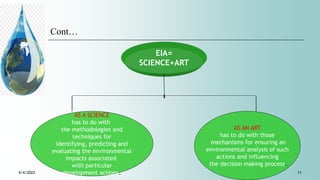
EIA=
SCIENCE+ART
AS A SCIENCE
has to do with
the methodologies and
techniques for
identifying, predicting and
evaluating the environmental
impacts associated
with particular
development actions.
AS AN ART
has to do with those
mechanisms for ensuring an
environmental analysis of such
actions and influencing
the decision making process.
4/4/2022 11
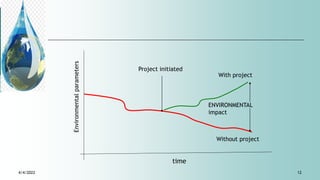
Environmental
parameters
time
Project initiated
ENVIRONMENTAL
impact
Without project
With project
4/4/2022 12
Introduction
 Evolution of EIA:
 Initial Belief:
Initially EIA was seen by some project promoters as a constraint to
development but this view is gradually disappearing.
 Present day understanding:
Environment and development are complementary and interdependent and
EIA is a technique for ensuring that the two are mutually reinforcing.
 Origin:
The contemporary usage of “environmental impact assessment” has its
origins in the US National Policy act of 1969 (NEPA)
 Cause of Law Enforcement:
The wide spread recognition that some environmental problems in the US
resulted from actions by the US government itself.
4/4/2022 13
Introduction
 The most widely known of the law enforcement provisions:
“All agencies of the federal government shall include in every
recommendation and report on proposals for legislations and other major
federal actions significantly affecting the quality of human environment, a
detailed statement by the responsible official.”
 This detailed statement comes to be called as an ‘Environmental impact
statement (EIS)
 Power of an EIA recommendation:
‣ Redesigning some project components
‣ Suggest change affecting project viability/practicality
‣ Causing delay in project implementation
4/4/2022 14
Purpose and objectives of EIA
 From World Bank Guidelines the main purposes of EIA are as
follows:
 Identify and forecast the possible positive and negative
impacts to the environment resulting from a proposed
project.
 Provide for a plan, which up on implementation will reduce
the negative impacts of the project resulting in acceptable
environmental changes.
 Assure the level of plan implementation and the degree of
effectiveness of the above environmental protection
provisions.
4/4/2022 15
Significance of EIA:
 It is an aid to decision-making. For the decision-maker, it provides a
systematic examination of the environmental implications of a proposed
action, and sometimes alternatives, before a decision is taken.
 It can be an aid to the formulation of development actions, indicating areas
where the project can be modified to minimize or eliminate altogether the
adverse impacts on the environment.
 Underlying such purposes is of course the central role of EIA as one of the
instruments to be used to achieve sustainable development.
4/4/2022 16
Significance of EIA:
 Sustainable development: is development that meets the needs of the
present, without compromising the ability of future generations to meet
their own needs.
 EIA as a means to:
 Protect and improve the environmental quality of life
 to discover and evaluate the effects of activities of humans on the
environment- natural and social.
 It should be treated as, an integral part of project planning
 EIA does not make decisions, but its findings should be considered in
policy and decision making and should be reflected in final choices.
4/4/2022 17
Projects, Environment and Impact
 EIA is relevant to a broad spectrum of development actions, including
policies, plans, programs and projects.
 Characteristics of major projects
⁃ Substantial capital investment
⁃ Cover large areas; employ large numbers (construction and operation)
⁃ Complex array of organizational links
⁃ Wide-ranging impacts (geographical and by type)
⁃ Significant environmental impacts
⁃ Require special procedures
4/4/2022 18
Projects, Environment and Impact
 The following are ranges of positive influences of EIA on projects:
⁃ Withdrawal of unsound projects
⁃ Legitimation of sound projects
⁃ Selection of improved project locations
⁃ Reformulation of plans
⁃ Redefinitions of goals and responsibilities of project proponents.
4/4/2022 19
Projects, Environment and Impact
 The most common positive outcomes of EIA are suggestions for measures
needed to mitigate the adverse effects of a proposed plan.
 ‘To mitigate’ is to avoid having the damage take place.
 It is more common to say that mitigation involves one or more of the
following:
⁃ Minimizing adverse effects by scaling down or redesigning projects.
(e.g. adding fish ladder to allow fish to reach spawning ground
upstream of a proposed dam).
4/4/2022 20
Projects, Environment and Impact
⁃ Repairing, rehabilitating, or restoring those parts of the environment
that are adversely affected by a project. (e.g replanting native vegetation
in area cleared for pipeline installation).
⁃ Creating or acquiring environments similar to those adversely affected
by an action. (e.g. donation of wetlands to a public land trust to
compensate for wet lands destroyed by a project)
4/4/2022 21
Definitions of Terminology
 Environment
The physical, biological, social, economic, cultural, historical and political
factors that surround human beings. It includes both the natural and built
environments. It also includes human health and welfare.
 Impact
Any change to the environment or its component that may affect human
health or safety, biophysical conditions, or cultural heritage, other physical
structure with positive or negative consequences.
4/4/2022 22
Definitions of Terminology
 Cumulative Impact
An impact that may in itself not be significant but the combination of
one or more impacts that can have a greater effect than the sum of
the individual impacts.
 Environmental Assessment
The methodology of identifying and evaluating in advance, any
impact positive or negative, which results from the implementation
of a proposed action.
4/4/2022 23
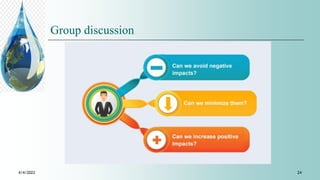
Group discussion
4/4/2022 24

Introduction to Environmental Impact Assessment.pptx

  • 1.
    Environmental Impact Assessment Course Code:WSEE – 5193 Credit Hour:2-0-2 Prepared by: Yetnayet A. (Msc.) 4/4/2022 1
  • 2.
    Course Learning Objectives Atthe end of this course students should be able to:  Become familiar with the concept and principles of EIA  Define and state the purpose of EIA  Specify the benefit of EIA  Understand the need for environmental assessment  Know mitigation measure for environmental impacts  Prepare an impact assessment of a given project proposal 4/4/2022 2
  • 3.
    Introduction  Water ResourcesProjects are modern temples of the country and the sign posts of development.  Even in the ancient days the prosperity of any kingdom was measured in terms of its wealth of water resources structures.  By providing assured water supply for irrigation, municipal and industrial requirements, production of hydroelectric power and many more purposes, the water resources projects contributed significantly towards the improvement in the standard of living and quality of life for millions of the country. 4/4/2022 3
  • 4.
    Cont….  Water resourcesprojects bring in an immense benefits with an adverse impacts on environment.  Environmental problems can vary from the direct effects of the pollution of waterways and the air, through to indirect effects such as health problems caused by changes. 4/4/2022 4
  • 5.
    Cont….  Some environmentalproblems may appear to be insignificant when considered within an individual proposal but might have adverse consequences if the effects of all such proposals are added together (cumulative effects).  Many of these impacts are manageable if proper measures are taken at the planning and implementing stage. 4/4/2022 5
  • 6.
    Introduction  In orderto manage such large scale environmental problems and to provide an opportunity to mitigate against negative impacts and enhance positive impacts, the environmental impact assessment (EIA) procedure was developed. 4/4/2022 6
  • 7.
    Introduction  Definitions: EIAmay be defined as:  A formal process to predict the environmental consequences of human development activities and to plan appropriate measures to eliminate or reduce adverse effects and to augment positive effects. (FAO definition)  A process used to identify and predict the impact on the environment and on man's health and wellbeing of legislative proposals, policies, programs, projects and operational procedures, and to interpret and communicate information about the impacts. (Munn,1979) 4/4/2022 7
  • 8.
    Cont… • A techniqueand a process by which information about the environmental effects of a project is collected, both by the developer and from other sources, and taken into account by the planning authority in forming their judgments on whether the development should go ahead. (UK DoE,1989) • Based on the above definitions, one can observe that EIA has three basic functions: • To predict problems, • To find ways to avoid them, and • To enhance positive effects. 4/4/2022 8
  • 9.
    Cont….  Environmental ImpactAssessment (EIA): is a tool used to identify the environmental, social, and economic impacts of a project prior to decision making.  It aims to:- ‣ Predict environmental impacts at an early stage in project planning and design, ‣ Find ways and means to reduce adverse impacts, ‣ Shape projects to suit the local environment, and ‣ Present the predictions and options to decision makers. 4/4/2022 9
  • 10.
    Cont…  In anupdated view, EIA is understood as an integrated part of the planning process devoted to the identification, quantification and qualification of environmental impacts due to the development of a plan or a project as well as the definition of policies and strategies required to monitor and control such impacts. As a planning tool, EIA serves largely to inform interested parties of the likely environmental impacts of a project and its proposed alternatives. 4/4/2022 10
  • 11.
    Cont… EIA= SCIENCE+ART AS A SCIENCE hasto do with the methodologies and techniques for identifying, predicting and evaluating the environmental impacts associated with particular development actions. AS AN ART has to do with those mechanisms for ensuring an environmental analysis of such actions and influencing the decision making process. 4/4/2022 11
  • 12.
  • 13.
    Introduction  Evolution ofEIA:  Initial Belief: Initially EIA was seen by some project promoters as a constraint to development but this view is gradually disappearing.  Present day understanding: Environment and development are complementary and interdependent and EIA is a technique for ensuring that the two are mutually reinforcing.  Origin: The contemporary usage of “environmental impact assessment” has its origins in the US National Policy act of 1969 (NEPA)  Cause of Law Enforcement: The wide spread recognition that some environmental problems in the US resulted from actions by the US government itself. 4/4/2022 13
  • 14.
    Introduction  The mostwidely known of the law enforcement provisions: “All agencies of the federal government shall include in every recommendation and report on proposals for legislations and other major federal actions significantly affecting the quality of human environment, a detailed statement by the responsible official.”  This detailed statement comes to be called as an ‘Environmental impact statement (EIS)  Power of an EIA recommendation: ‣ Redesigning some project components ‣ Suggest change affecting project viability/practicality ‣ Causing delay in project implementation 4/4/2022 14
  • 15.
    Purpose and objectivesof EIA  From World Bank Guidelines the main purposes of EIA are as follows:  Identify and forecast the possible positive and negative impacts to the environment resulting from a proposed project.  Provide for a plan, which up on implementation will reduce the negative impacts of the project resulting in acceptable environmental changes.  Assure the level of plan implementation and the degree of effectiveness of the above environmental protection provisions. 4/4/2022 15
  • 16.
    Significance of EIA: It is an aid to decision-making. For the decision-maker, it provides a systematic examination of the environmental implications of a proposed action, and sometimes alternatives, before a decision is taken.  It can be an aid to the formulation of development actions, indicating areas where the project can be modified to minimize or eliminate altogether the adverse impacts on the environment.  Underlying such purposes is of course the central role of EIA as one of the instruments to be used to achieve sustainable development. 4/4/2022 16
  • 17.
    Significance of EIA: Sustainable development: is development that meets the needs of the present, without compromising the ability of future generations to meet their own needs.  EIA as a means to:  Protect and improve the environmental quality of life  to discover and evaluate the effects of activities of humans on the environment- natural and social.  It should be treated as, an integral part of project planning  EIA does not make decisions, but its findings should be considered in policy and decision making and should be reflected in final choices. 4/4/2022 17
  • 18.
    Projects, Environment andImpact  EIA is relevant to a broad spectrum of development actions, including policies, plans, programs and projects.  Characteristics of major projects ⁃ Substantial capital investment ⁃ Cover large areas; employ large numbers (construction and operation) ⁃ Complex array of organizational links ⁃ Wide-ranging impacts (geographical and by type) ⁃ Significant environmental impacts ⁃ Require special procedures 4/4/2022 18
  • 19.
    Projects, Environment andImpact  The following are ranges of positive influences of EIA on projects: ⁃ Withdrawal of unsound projects ⁃ Legitimation of sound projects ⁃ Selection of improved project locations ⁃ Reformulation of plans ⁃ Redefinitions of goals and responsibilities of project proponents. 4/4/2022 19
  • 20.
    Projects, Environment andImpact  The most common positive outcomes of EIA are suggestions for measures needed to mitigate the adverse effects of a proposed plan.  ‘To mitigate’ is to avoid having the damage take place.  It is more common to say that mitigation involves one or more of the following: ⁃ Minimizing adverse effects by scaling down or redesigning projects. (e.g. adding fish ladder to allow fish to reach spawning ground upstream of a proposed dam). 4/4/2022 20
  • 21.
    Projects, Environment andImpact ⁃ Repairing, rehabilitating, or restoring those parts of the environment that are adversely affected by a project. (e.g replanting native vegetation in area cleared for pipeline installation). ⁃ Creating or acquiring environments similar to those adversely affected by an action. (e.g. donation of wetlands to a public land trust to compensate for wet lands destroyed by a project) 4/4/2022 21
  • 22.
    Definitions of Terminology Environment The physical, biological, social, economic, cultural, historical and political factors that surround human beings. It includes both the natural and built environments. It also includes human health and welfare.  Impact Any change to the environment or its component that may affect human health or safety, biophysical conditions, or cultural heritage, other physical structure with positive or negative consequences. 4/4/2022 22
  • 23.
    Definitions of Terminology Cumulative Impact An impact that may in itself not be significant but the combination of one or more impacts that can have a greater effect than the sum of the individual impacts.  Environmental Assessment The methodology of identifying and evaluating in advance, any impact positive or negative, which results from the implementation of a proposed action. 4/4/2022 23
  • 24.