MODULE- III


HYDROELECTRIC
   POWER

           Prepared by
      Bibhabasu Mohanty
    Dept. of Civil Engineering
     SALITER, Ahmedabad
Contents
• Low, Medium and High head plants, Power
  house components, Hydel schemes.
Introduction
• Hydroelectric power (hydropower) systems
  convert the kinetic energy in flowing water
  into electric energy.

• Falling or flowing water turns a propeller
  like piece called a turbine.

• The turbine turns a metal shaft in an
  electric generator which produces
  electricity.
Advantages
• No fuel required

• No air pollution

• Can easily work during high peak daily
  loads

• Prevents floods
Disadvantages
• Disrupts the aquatic ecosystems

• Disruption of surrounding areas

• Requires large areas

• Large scale human displacement
How a Hydroelectric Power System Works?

                     • Flowing water is
                     directed at a turbine.
                     • The flowing water
                     causes the turbine
                     to rotate, converting
                     the water’s kinetic
                     energy into
                     mechanical energy.
• The mechanical energy produced by the
  turbine is converted into electric energy
  using a turbine generator.
• Inside the generator, the shaft of the
  turbine spins a magnet inside coils of
  copper wire.
• It is a fact of nature that moving a magnet
  near a conductor causes an electric
  current.
Hydel scheme
1 .Run-off Plants without Poundage:
  As name indicates this type of plant doesn’t
  store water, the plant uses as water comes.
2. Run-0ff plants with Poundage:
  Poundage permits storage of water during the
  off –peak period and use of this water during
  peak periods.
3. Reservoir Plants: A reservoir plant is that
  which has reservoir of such size as
  to permit carrying over storage from wet season
  to the next dry season.
4 .Low head plants: In this case small dam is built
  across the river to provide the necessary head.
  In such plants Francis type of turbines are used.


5. Medium head plants: The fore bay provided at
  the beginning of Penstock serves as water
  reservoir for such plants. In these plants water
  is generally carried out in open canals from
  reservoir to the Fore bay and then to the
  penstock.
6. High head Plant: This plants works above
  500mtrs and Pelton wheel turbines are
  commonly used. In this plant water is carried out
  from the main reservoir by a tunnel up to
  surge tank and then from the surge tank to the
  power house in penstock.

7. Base Load Plants: These Plants are mainly
  depending on the nature of load. Is demand is
  more, this plants are used regularly and load
  factor of this plants are high.
8. Peak load Plants: These plants are mainly
  used during the peak load. Run-off river plants
  with poundage can be used as peak-load plants.
  reservoir plants with enough storage behind the
  dam can be used either as base load or as peak
  load plants as required.
9. Pumped storage plants: These plants are
  used when quantity of water available for
  generation is insufficient. If it is possible to pond
  at head water and tail water locations after
  passing through the turbine is stored in the tail
  race pond from where it may be pumped back to
  the Head water pond.
Low head plants
• In this case a small dam is built across the
  river to provide the necessary head.
• The excess water is allowed to flow over
  the dam itself.
• In such plants Francis, Propeller or Kaplan
  types of turbines are used.
• Also no surge tank is required.
• These plants are constructed where the
  water head available less then 30mtrs.
• The production of electricity will be less
  due to low head.
Medium head plants
• Mainly forebay provided before the
  Penstock, acts as water reservoir for
  medium head plants.
• In this plants mainly water is carried
  through main reservoir to forebay and then
  to the penstock.
• The forebay acts as surge tank for these
  plants.
• The turbines used will be Francis type of
  the steel encased variety.
High head plants
• Mainly in these plants pressure tunnel is
  provided before the surge tank, which
  inturn connected to penstock.
• A pressure tunnel is taken off from the
  reservoir and water brought to the valve
  house at the start of the penstocks.
• The penstocks are huge steel pipes which
  take large quantity of water from the valve
  house to the power house.
• The valve house contains main sluice
  gates and in addition automatic isolating
  valves which come into operation when
  the penstock bursts, cutting
  further supply of water.
• Surge tank is an open tank and is built just
  in between the beginning of the penstocks
  and the valve house.
• In absence of surge tank, the water
  hammer can damage the fixed gates.
• In Majority of dams Sluice gates are
  provided.
• The sluice gates are opened when dam
  level is below level and there is shortage
  water for irrigation.
• Normally the high head plants are 500
  meters above and for heads above 500
  meters Pelton wheels are used.
Components of hydel scheme
  The principal components are:
1. Forebay
2. Intake structure
3. Penstocks
4. Surge tank
5. Turbines
6. Power house
7. Draft tube
8. Tail race
Forebay
• Enlarged body of water provided in front of
  penstock.
• Provided in case of run off river plants and
  storage plants.
• Main function to store water which is
  rejected by plant.
• Power house located closed to dam
  penstock directly take water from
  reservoir, reservoir act as forebay.
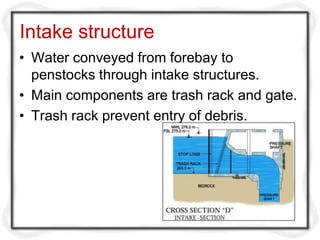
Intake structure
• Water conveyed from forebay to
  penstocks through intake structures.
• Main components are trash rack and gate.
• Trash rack prevent entry of debris.
Penstocks
• open or closed conduits which carry water
  to the turbines.
• made of reinforced concrete or steel.
  Concrete penstocks are suitable for low
  heads less then 30mtrs.
• steel penstocks are designed for any
  head.
• thickness of penstocks increases with
  head or water pressure
• penstocks gates are fixed to initial of
  penstocks, and flow of water is controlled
  by operating penstock gates.

• Either buried in ground or kept exposed.
Surge tank
• additional storage for near to
  turbine, usually provided in high head
  plants.
• located near the beginning of the
  penstock.
• As the load on the turbine decreases or
  during load rejection by the turbine the
  surge tank provides space for holding
  water.
• surge tank over comes the
  abnormal pressure
   in the conduit when load on the turbine falls
  and acts as a reservoir during increase of
  load
   on the turbine.
Turbines

• turbines are used to convert the energy
  water of falling water into mechanical
  energy.

• water turbine is a rotary engine that takes
  energy from moving water.

• flowing water is directed on to the blades
  of a turbine runner, creating a force on the
• Since the runner is spinning, the force acts
  through a distance n this way, energy is
  transferred from the water flow to the
  turbine.
• The principal types of turbines are:
  1) Impulse turbine
  2) Reaction Turbine
Impulse turbines: mainly used in high head
  plants.
• the entire pressure of water is converted into
  kinetic energy in a nozzle and the velocity of
  the jet drives the blades of turbine.
• The nozzle consist of a needle, and quantity
  of water jet falling on the turbine is controlled
  this needle placed in the tip of the nozzle.
• If the load on the turbine decreases, the
  governor pushes the needle into the
  nozzle, thereby reducing the quantity of water
  striking the turbine.
•   Examples of Impulse turbines are:
•   Pelton Wheel.
•   Turgo
•   Michell-Banki (also known as the Cross
    flow or Ossberger turbine.
Reaction turbines : are mainly for low and
  medium head plants.
• In reaction turbine the water enters the runner
  partly with pressure energy and partly with
  velocity head.
• Most water turbines in use are reaction turbines
  and are used in low (<30m/98 ft) and medium
  (30-300m/98–984 ft)head applications.
• In reaction turbine pressure drop occurs in both
  fixed and moving blades.
• In this turbine the runner blades changed
  with respect to guide vane opening.
• As the sudden decrease of load takes
  place, the guide vane limit decreases
  according to that runner blade closes.

• Examples of reaction turbines are:
  Francis turbine
  Kaplan turbine
Kaplan


Francis
Draft tube
• is a pipe or passage of gradually
  increasing cross sectional area, which
  connect to the exit to tail race.
• it reduces high velocity of water
  discharged by the turbine.
• draft tube permits turbines to be installed
  at a higher level than the tail race
  level, which help the maintaince and repair
  of turbines.
Power house
• Power house contains the electro
  mechanical equipment i.e. hydro power
  turbine, Generator, excitation
  system, main inlet
  valves, transformers, Switchyard, DC
  systems, governor, bus duct, step up
  transformers, step down
  transformers, high voltages switch
  gears, control metering for protection of
  systems.
Tail race
• tail race tunnel or channel are provided to
  direct the used water coming out of draft
  tube back to the river.
• important criteria of designing the tail race
  is kind of draft tube, the gross head and
  geographical situation of the area.
• Tail race is designed in such a way that
  water hammer is minimizes when water
  leaves the draft tube.
Power generation
The amount of electricity that can be generated by a
hydropower plant depends on two factors:
• flow rate - the quantity of water flowing in a given
time; and
• head - the height from which the water falls.
The greater the flow and head, the more electricity
produced.

Flow Rate = the quantity of water flowing
Head = the height from which water falls
A standard equation for calculating energy production:

      Power = (Head) x (Flow) x (Efficiency)
                           11.8
Power = the electric power in kilowatts or kW
Head = the distance the water falls (measured in feet)
Flow = the amount of water flowing (measured in cubic feet
per second or cfs)
Efficiency = How well the turbine and generator convert the
power of falling water into electric power. This can range
from 60% (0.60) for older, poorly maintained hydroplants to
90% (0.90) for newer, well maintained plants.
11.8 = Index that converts units of feet and seconds into
kilowatts
As an example, let’s see how much power can be generated
by the power plant.
The dam is 357 feet high, the head (distance the water falls)
is 235 feet. The typical flow rate is 2200 cfs. Let’s say the
turbine and generator are 80% efficient.


 Power = (Head) x (Flow) x (Efficiency)
                         11.8
Power = 235ft. x 2200 cfs x .80
                      11.8
Power = 517,000 x .80
             11.8


Power = 413,600
            11.8

Power = 35,051 kilowatts (kW)
Hydroelectric power

Hydroelectric power

  • 1.
    MODULE- III HYDROELECTRIC POWER Prepared by Bibhabasu Mohanty Dept. of Civil Engineering SALITER, Ahmedabad
  • 2.
    Contents • Low, Mediumand High head plants, Power house components, Hydel schemes.
  • 3.
    Introduction • Hydroelectric power(hydropower) systems convert the kinetic energy in flowing water into electric energy. • Falling or flowing water turns a propeller like piece called a turbine. • The turbine turns a metal shaft in an electric generator which produces electricity.
  • 5.
    Advantages • No fuelrequired • No air pollution • Can easily work during high peak daily loads • Prevents floods
  • 6.
    Disadvantages • Disrupts theaquatic ecosystems • Disruption of surrounding areas • Requires large areas • Large scale human displacement
  • 8.
    How a HydroelectricPower System Works? • Flowing water is directed at a turbine. • The flowing water causes the turbine to rotate, converting the water’s kinetic energy into mechanical energy.
  • 9.
    • The mechanicalenergy produced by the turbine is converted into electric energy using a turbine generator. • Inside the generator, the shaft of the turbine spins a magnet inside coils of copper wire. • It is a fact of nature that moving a magnet near a conductor causes an electric current.
  • 11.
    Hydel scheme 1 .Run-offPlants without Poundage: As name indicates this type of plant doesn’t store water, the plant uses as water comes. 2. Run-0ff plants with Poundage: Poundage permits storage of water during the off –peak period and use of this water during peak periods. 3. Reservoir Plants: A reservoir plant is that which has reservoir of such size as to permit carrying over storage from wet season to the next dry season.
  • 12.
    4 .Low headplants: In this case small dam is built across the river to provide the necessary head. In such plants Francis type of turbines are used. 5. Medium head plants: The fore bay provided at the beginning of Penstock serves as water reservoir for such plants. In these plants water is generally carried out in open canals from reservoir to the Fore bay and then to the penstock.
  • 13.
    6. High headPlant: This plants works above 500mtrs and Pelton wheel turbines are commonly used. In this plant water is carried out from the main reservoir by a tunnel up to surge tank and then from the surge tank to the power house in penstock. 7. Base Load Plants: These Plants are mainly depending on the nature of load. Is demand is more, this plants are used regularly and load factor of this plants are high.
  • 14.
    8. Peak loadPlants: These plants are mainly used during the peak load. Run-off river plants with poundage can be used as peak-load plants. reservoir plants with enough storage behind the dam can be used either as base load or as peak load plants as required. 9. Pumped storage plants: These plants are used when quantity of water available for generation is insufficient. If it is possible to pond at head water and tail water locations after passing through the turbine is stored in the tail race pond from where it may be pumped back to the Head water pond.
  • 15.
    Low head plants •In this case a small dam is built across the river to provide the necessary head. • The excess water is allowed to flow over the dam itself. • In such plants Francis, Propeller or Kaplan types of turbines are used. • Also no surge tank is required. • These plants are constructed where the water head available less then 30mtrs. • The production of electricity will be less due to low head.
  • 17.
    Medium head plants •Mainly forebay provided before the Penstock, acts as water reservoir for medium head plants. • In this plants mainly water is carried through main reservoir to forebay and then to the penstock. • The forebay acts as surge tank for these plants. • The turbines used will be Francis type of the steel encased variety.
  • 19.
    High head plants •Mainly in these plants pressure tunnel is provided before the surge tank, which inturn connected to penstock. • A pressure tunnel is taken off from the reservoir and water brought to the valve house at the start of the penstocks. • The penstocks are huge steel pipes which take large quantity of water from the valve house to the power house.
  • 20.
    • The valvehouse contains main sluice gates and in addition automatic isolating valves which come into operation when the penstock bursts, cutting further supply of water. • Surge tank is an open tank and is built just in between the beginning of the penstocks and the valve house. • In absence of surge tank, the water hammer can damage the fixed gates.
  • 21.
    • In Majorityof dams Sluice gates are provided. • The sluice gates are opened when dam level is below level and there is shortage water for irrigation. • Normally the high head plants are 500 meters above and for heads above 500 meters Pelton wheels are used.
  • 23.
    Components of hydelscheme The principal components are: 1. Forebay 2. Intake structure 3. Penstocks 4. Surge tank 5. Turbines 6. Power house 7. Draft tube 8. Tail race
  • 25.
    Forebay • Enlarged bodyof water provided in front of penstock. • Provided in case of run off river plants and storage plants. • Main function to store water which is rejected by plant. • Power house located closed to dam penstock directly take water from reservoir, reservoir act as forebay.
  • 27.
    Intake structure • Waterconveyed from forebay to penstocks through intake structures. • Main components are trash rack and gate. • Trash rack prevent entry of debris.
  • 28.
    Penstocks • open orclosed conduits which carry water to the turbines. • made of reinforced concrete or steel. Concrete penstocks are suitable for low heads less then 30mtrs. • steel penstocks are designed for any head. • thickness of penstocks increases with head or water pressure
  • 29.
    • penstocks gatesare fixed to initial of penstocks, and flow of water is controlled by operating penstock gates. • Either buried in ground or kept exposed.
  • 30.
    Surge tank • additionalstorage for near to turbine, usually provided in high head plants. • located near the beginning of the penstock. • As the load on the turbine decreases or during load rejection by the turbine the surge tank provides space for holding water.
  • 31.
    • surge tankover comes the abnormal pressure in the conduit when load on the turbine falls and acts as a reservoir during increase of load on the turbine.
  • 32.
    Turbines • turbines areused to convert the energy water of falling water into mechanical energy. • water turbine is a rotary engine that takes energy from moving water. • flowing water is directed on to the blades of a turbine runner, creating a force on the
  • 33.
    • Since therunner is spinning, the force acts through a distance n this way, energy is transferred from the water flow to the turbine. • The principal types of turbines are: 1) Impulse turbine 2) Reaction Turbine
  • 34.
    Impulse turbines: mainlyused in high head plants. • the entire pressure of water is converted into kinetic energy in a nozzle and the velocity of the jet drives the blades of turbine. • The nozzle consist of a needle, and quantity of water jet falling on the turbine is controlled this needle placed in the tip of the nozzle. • If the load on the turbine decreases, the governor pushes the needle into the nozzle, thereby reducing the quantity of water striking the turbine.
  • 35.
    Examples of Impulse turbines are: • Pelton Wheel. • Turgo • Michell-Banki (also known as the Cross flow or Ossberger turbine.
  • 37.
    Reaction turbines :are mainly for low and medium head plants. • In reaction turbine the water enters the runner partly with pressure energy and partly with velocity head. • Most water turbines in use are reaction turbines and are used in low (<30m/98 ft) and medium (30-300m/98–984 ft)head applications. • In reaction turbine pressure drop occurs in both fixed and moving blades.
  • 38.
    • In thisturbine the runner blades changed with respect to guide vane opening. • As the sudden decrease of load takes place, the guide vane limit decreases according to that runner blade closes. • Examples of reaction turbines are: Francis turbine Kaplan turbine
  • 39.
  • 40.
    Draft tube • isa pipe or passage of gradually increasing cross sectional area, which connect to the exit to tail race. • it reduces high velocity of water discharged by the turbine. • draft tube permits turbines to be installed at a higher level than the tail race level, which help the maintaince and repair of turbines.
  • 42.
    Power house • Powerhouse contains the electro mechanical equipment i.e. hydro power turbine, Generator, excitation system, main inlet valves, transformers, Switchyard, DC systems, governor, bus duct, step up transformers, step down transformers, high voltages switch gears, control metering for protection of systems.
  • 43.
    Tail race • tailrace tunnel or channel are provided to direct the used water coming out of draft tube back to the river. • important criteria of designing the tail race is kind of draft tube, the gross head and geographical situation of the area. • Tail race is designed in such a way that water hammer is minimizes when water leaves the draft tube.
  • 45.
    Power generation The amountof electricity that can be generated by a hydropower plant depends on two factors: • flow rate - the quantity of water flowing in a given time; and • head - the height from which the water falls. The greater the flow and head, the more electricity produced. Flow Rate = the quantity of water flowing Head = the height from which water falls
  • 46.
    A standard equationfor calculating energy production: Power = (Head) x (Flow) x (Efficiency) 11.8 Power = the electric power in kilowatts or kW Head = the distance the water falls (measured in feet) Flow = the amount of water flowing (measured in cubic feet per second or cfs) Efficiency = How well the turbine and generator convert the power of falling water into electric power. This can range from 60% (0.60) for older, poorly maintained hydroplants to 90% (0.90) for newer, well maintained plants. 11.8 = Index that converts units of feet and seconds into kilowatts
  • 47.
    As an example,let’s see how much power can be generated by the power plant. The dam is 357 feet high, the head (distance the water falls) is 235 feet. The typical flow rate is 2200 cfs. Let’s say the turbine and generator are 80% efficient. Power = (Head) x (Flow) x (Efficiency) 11.8 Power = 235ft. x 2200 cfs x .80 11.8
  • 48.
    Power = 517,000x .80 11.8 Power = 413,600 11.8 Power = 35,051 kilowatts (kW)