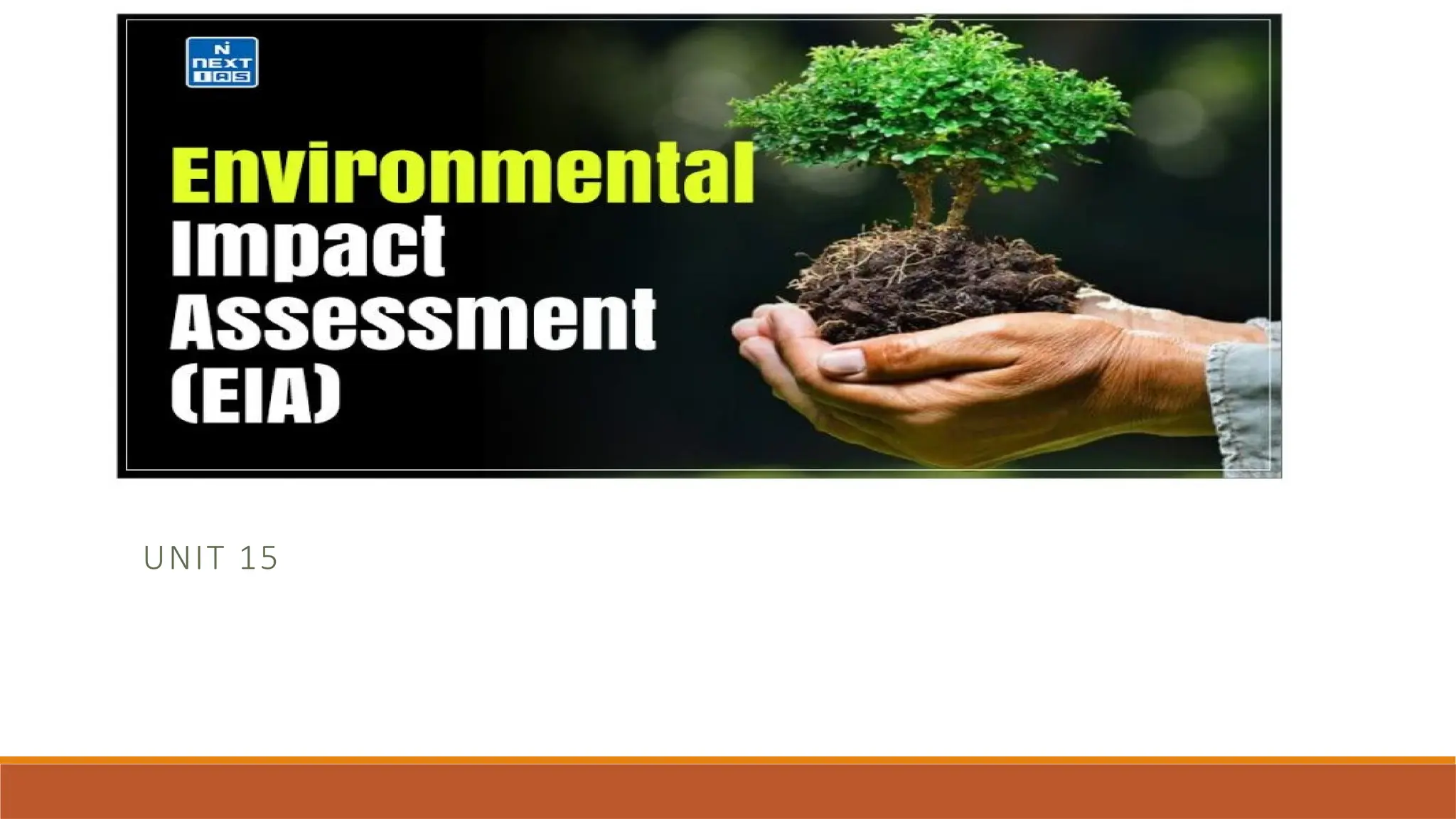
ENVIRONMENTAL
IMPACT ASSESSMENT
UNIT 15
WHAT IS ENVIRONMENTAL IMPACT
ASSESSMENT (EIA)?
Environmental Impact Assessment (EIA) evaluates the likely ecological impacts of a proposed
project or development, considering inter-related socio-economic, cultural and human-health
impacts, both beneficial and adverse.
In other words, it is the formal process used to predict the environmental consequences
(positive or negative) of a plan, policy, program, or project before deciding whether to proceed
with the proposed action.
UNEP defines Environmental Impact Assessment (EIA) as a tool used to identify a project’s
environmental, social, and economic impacts prior to decision-making.
Environmental Impact Assessment (EIA) aims to predict environmental impacts early in project
planning and design, find ways to reduce adverse impacts, shape projects to suit the local
environment, and present the predictions and options to decision-makers.
EVOLUTION AND HISTORY OF EIA AT
GLOBAL LEVEL
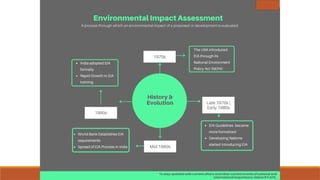
The need for a formalised analysis process was realised when rapid natural resource
development after World War II collided with budding environmental awareness in the 1960s.
Environmental Impact Assessment (EIA) is currently practised in more than 100 countries as a
mandatory regulatory procedure.
The United States of America was the first country to assign mandatory status to
Environmental Impact Assessments through its National Environmental Protection Act (NEPA)
of 1969.A host of industrialised countries have since implemented EIA procedures.
Canada, Australia, the Netherlands, and Japan adopted EIA legislation in 1973, 1974, 1981, and
1984, respectively.
In July 1985, the European Community (EC) issued a directive making environmental
assessments mandatory for certain categories of projects.
EVOLUTION AND HISTORY OF EIA AT
NATIONAL LEVEL
The Indian experience with Environmental Impact Assessment began over 20 years back. It
started in 1976-77 when the Planning Commission asked the Department of Science and
Technology to examine the river-valley projects from an environmental angle.
In 1982, the Ministry of Environment, Forest and Climate Change set up the Environmental
Information System (ENVIS) to collect, collate, storing, retrieving and disseminating information
related to the environment sector.
This serves as a web-based distributed network of subject-specific databases. The chief purpose
of the ENVIS is to integrate all countrywide efforts to collect, store, disseminate, and use
environment-information for better managing environmental assessment activities.
Later, on 23rd May 1986, the Government of India enacted the Environment (Protection) Act,
after which the decision was made to make EIA statutory.
EVOLUTION AND HISTORY OF EIA AT
NATIONAL LEVEL
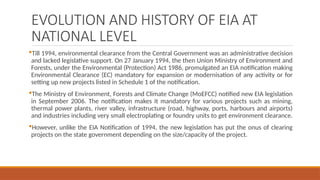
Till 1994, environmental clearance from the Central Government was an administrative decision
and lacked legislative support. On 27 January 1994, the then Union Ministry of Environment and
Forests, under the Environmental (Protection) Act 1986, promulgated an EIA notification making
Environmental Clearance (EC) mandatory for expansion or modernisation of any activity or for
setting up new projects listed in Schedule 1 of the notification.
The Ministry of Environment, Forests and Climate Change (MoEFCC) notified new EIA legislation
in September 2006. The notification makes it mandatory for various projects such as mining,
thermal power plants, river valley, infrastructure (road, highway, ports, harbours and airports)
and industries including very small electroplating or foundry units to get environment clearance.
However, unlike the EIA Notification of 1994, the new legislation has put the onus of clearing
projects on the state government depending on the size/capacity of the project.
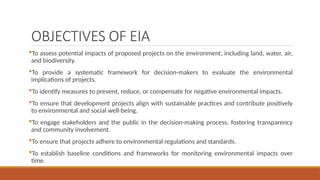
OBJECTIVES OF EIA
To assess potential impacts of proposed projects on the environment, including land, water, air,
and biodiversity.
To provide a systematic framework for decision-makers to evaluate the environmental
implications of projects.
To identify measures to prevent, reduce, or compensate for negative environmental impacts.
To ensure that development projects align with sustainable practices and contribute positively
to environmental and social well-being.
To engage stakeholders and the public in the decision-making process, fostering transparency
and community involvement.
To ensure that projects adhere to environmental regulations and standards.
To establish baseline conditions and frameworks for monitoring environmental impacts over
time.
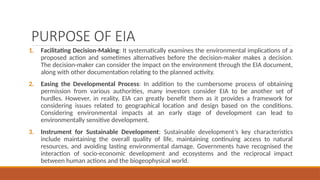
PURPOSE OF EIA
1. Facilitating Decision-Making: It systematically examines the environmental implications of a
proposed action and sometimes alternatives before the decision-maker makes a decision.
The decision-maker can consider the impact on the environment through the EIA document,
along with other documentation relating to the planned activity.
2. Easing the Developmental Process: In addition to the cumbersome process of obtaining
permission from various authorities, many investors consider EIA to be another set of
hurdles. However, in reality, EIA can greatly benefit them as it provides a framework for
considering issues related to geographical location and design based on the conditions.
Considering environmental impacts at an early stage of development can lead to
environmentally sensitive development.
3. Instrument for Sustainable Development: Sustainable development’s key characteristics
include maintaining the overall quality of life, maintaining continuing access to natural
resources, and avoiding lasting environmental damage. Governments have recognised the
interaction of socio-economic development and ecosystems and the reciprocal impact
between human actions and the biogeophysical world.
COMPONENTS OF EIA
1. Air Environment – Determination of impact zone.
◦ Monitoring the existing status of ambient air quality, site-specific meteorological data, viz. wind speed and direction, humidity, ambient
temperature and environmental lapse rate within the impacted region of the proposed project site.
2. Noise Environment – Identification and Monitoring the present status of noise levels within the impact zone, and prediction of
future noise levels.
◦ Recommendations on mitigation measures for noise pollution.
3. Water Environment – Study of existing ground and surface water resources with respect to quantity and quality within the
proposed project’s impact zone.
◦ Prediction of impacts on water resources due to the proposed water use/pumping on account of the project.
4. Biological Environment – Survey and assessment of flora and fauna clearly delineating season and duration within the impact
zone.
◦ Assessment of potential damage to terrestrial and aquatic flora and fauna (including commercial fishing) due to discharge of effluents, gaseous
emissions, land use, and landscape changes arising from the project.
◦ Delineation of mitigation measures to prevent and/or reduce the damage.
5. Land Environment – Studies on soil characteristics, existing land use and topography, landscape and drainage patterns within
the impact zone.
◦ Identification of potential utility of treated effluent in land application and subsequent impacts.
◦ Estimation and Characterisation of solid wastes and delineation of management options for minimising waste and environmentally compatible
disposal.
Socio-economic and Health Environment – Collection of demographic and related socio-
economic data.
◦ Projection of anticipated changes in the socio-economic and health due to the project and related
activities, including traffic congestion and delineation of measures to minimise adverse impacts.
Risk Assessment – Hazard identification using hazard indices, inventory analysis, dam break
probability, Natural Hazard Probability, etc.
◦ Maximum Credible Accident (MCA) analysis to identify potential hazardous scenarios.
Environment Management Plan – Delineation of mitigation measures, including prevention and
control for each environmental component and rehabilitation and resettlement plans.
◦ Delineation of a monitoring scheme for compliance of conditions.
◦ Delineation of implementation plan, including scheduling and resource allocation.
PROCESS OF EIA
1. SSA views EIA as a continuing source of information throughout the project cycle.
2. The potential environmental impact must be identified during the EIA using various methods
and techniques.
3. Once the assessment is complete, mitigative measures are prescribed to prevent or reduce
the potential changes.
4. Project design may be altered. It also emphasises monitoring the environmental impacts
once the project is implemented.
STEPS IN EIA PROCESS
1. Screening: The screening process determines whether a particular project warrants the preparation of an EIA. To determine
which projects or developments require a full or partial impact assessment study. Category ‘A’ projects are exempt from
Screening.
2. Scoping: To identify, at an early stage, the key, significant environmental issues from among a host of possible impacts of a
project and all the available alternatives (based on legislative requirements, international conventions, expert knowledge and
public involvement).
3. Collection of Baseline Data: It describes the environmental status of the identified study area. Primary Data collected for
terms of reference should not be more than 3 years old.
4. Impact Prediction: It involves studying the potential impacts in a multi-disciplinary (environmental, social, and economic
systems) manner.
5. Mitigation Measurement and EIA Report: Mitigation measures can be drawn out to reduce or ameliorate the adverse impacts
of the project. It can include incorporating safeguards in the design of the project, changing industrial processes, introduction
of pollution abatement technology etc.
6. Public Hearing: It includes a non-technical summary for the general audience. It applies to Category ‘A’ and ‘B1’ projects,
except the following:
◦ Modernization of irrigation projects
◦ All projects located within industrial estates
◦ Expansion of Roads and Highways does not involve any further land acquisition.
STEPS IN EIA PROCESS
7. Decision-making: It is done by MoEF or SEIAA, depending on the project category, under
certain conditions.
◦ Both Category A and Category B projects shall make Information regarding the grant of EC along with
conditions available in the public domain through newspaper advertisement.
8. Monitoring and Implementation of Environmental Management Plan: Monitor whether the
predicted impacts and proposed mitigation measures occur as defined in the approved project.
◦ Verify the compliance of proponent, to ensure that unpredictable impacts or failed mitigation measures
are identified and addressed in a timely fashion.
9. Risk Assessment: Risks such as occupational hazards, life cycle of pollutants, technology
assessment, and hazard analysis are taken into account and measures suggested for mitigation.
STAKEHOLDERS IN EIA PROCESS
1. Those who propose the project
2. The environmental consultant who prepare EIA on behalf of project proponent
3. Pollution Control Board (State or National)
4. Public has the right to express their opinion
5. The Impact Assessment Agency
6. Regional centre of the MoEFCC
Environment Impact Assessment (EIA) Notification, 2006
The Environment Impact Assessment (EIA) Notification, 2006, is the governing legal instrument to grant green
clearance for the establishment or expansion of an industry on the basis of the potential environmental impact
of the project. The notification in recent times has been revised several times since its introduction in 1994.
Background:
While the 2006 notification is flexible and can adjust to the changing times, it has been exploited by
governments, who have made efforts to dilute its provisions and norms to make it easier to establish and
expand industries that generate pollution.
This has been achieved through the introduction of office memorandums, which are changes to the notification
that do not require public consultation.
In the past five years, 110 such changes have been introduced, some of which have been challenged in the
National Green Tribunal.
The year 2022-23 saw the highest number of changes introduced in the 2006 notification in the last five years.
Salient Features of 2006 Amendments to
EIA Notification
Environment Impact Assessment Notification of 2006 has decentralized the environmental clearance
projects by categorizing the developmental projects in two categories, i.e., Category A (national level
appraisal) and Category B (state level appraisal).
 Category A projects are appraised at national level by Impact Assessment Agency (IAA) and the
Expert Appraisal Committee (EAC) and Category B projects are apprised at state level.
 State Level Environment Impact Assessment Authority (SEIAA) and State Level Expert Appraisal
Committee (SEAC) are constituted to provide clearance to Category B process.
After 2006 Amendment the EIA cycle comprises of four stages: Screening Scoping Public hearing
Appraisal Category A projects require mandatory environmental clearance and thus they do not
undergo the screening process.
Category B projects undergoes screening process and they are classified into two types. Category B1
projects (Mandatorily requires EIA). Category B2 projects (Do not require EIA).
Thus, Category A projects and Category B, projects undergo the complete EIA process whereas
Category B2 projects are excluded from complete EIA process.
EIA NOTIFICATION , 2020
The Ministry of Environment, Forest and Climate Change (MoEF&CC) has published Environment
Impact Assessment (EIA) Notification 2020, which replaces the existing EIA Notification, 2006,
under the Environment (Protection) Act, 1986. The key features of the 2020 amendment include:
1. Reduced Time for Public Hearings: The notice period for public hearings would be reduced from
30 days to 20 days.
2. Post-clearance Compliance: It implies that once the concerned authority approves a project, the
proponent projects must adhere to certain rules laid down in the EIA report to ensure that no
further environmental damages occur.
3. No Public Reporting for Non-Compliance: Instead, the government will consider reports only
from the violator-promoter, government authority, Appraisal Committee, or Regulatory Authority.
4. Penalty for Firms: If firms are found violating the terms of their establishment, they will have to
pay a penalty to get clearance finally.
EIA NOTIFICATION , 2020
5. Exemption of Projects: A host of projects are exempted from public scrutiny.
◦ Unlike the Category A and B1 projects, Category B2 projects do not require mandatory environmental clearance
(EC).
◦ This exempted category includes irrigation projects with command areas between 2,000 and 10,000 hectares.
◦ Small and medium cement plants.
◦ Offshore and onshore oil, gas and shale exploration.
◦ Hydroelectric projects up to 25 MW.
6. Increased Time Period for Submission of Compliance Reports: The new draft of the EIA proposes
submitting compliance reports annually, whereas, as per the 2006 notification, they were to be
submitted every six months.
7. Preparation of Report: The report will be prepared solely by project proponents.
8. Provision for Post-facto Clearance: It proposes to grant ‘post-facto clearance’ where a project
operating without environmental clearance can be regularised or allowed to apply for clearance.
SOME MAJOR CHANGES OVER THE
YEARS
The Indian government introduced a star-rating system for state environment impact assessment
authorities (SEIAAs) to improve their efficiency and accountability.
However, the system seems to penalize them for following the 2006 EIA notification, which regulates
the clearance of projects.
The MoEFCC released a notification on June 14, 2022, introducing a compliance module for projects
that have received environmental clearance under the 2006 EIA notification.
The module aims to simplify the compliance and monitoring process and prevent delays in the
submission of compliance reports to regulatory authorities.
However, it is unclear whether the reports and supporting documents will be accessible to the public.
Proponents upload the information on MoEFCC’s Parivesh portal using their unique credentials, which
may not be publicly available.
Undermining the public hearing process:
The process of public hearing involves public consultation, where comments on the draft EIA
report are considered, and a gathering presided over by district officials to hear the concerns of
stakeholders.
However, the Ministry of Environment, Forest and Climate Change issued an office
memorandum in October 2021 allowing for a 20% expansion in production in the mining of
minor minerals based only on public consultation, undermining the public hearing process.
In addition, legacy mining cases granted environmental clearance under the 1994 EIA
notification now only have to conduct public consultation, not follow the entire process of a
public hearing.
The public consultation process does not mandate the proponent to inform stakeholders via
popular media about the project, its expansion or modification.
Extra details sought viewed as a burden:
According to the 2006 EIA notification, the Central and state authorities responsible for granting
environmental clearance to projects have the right to seek additional details from project
proponents if necessary.
However, an office memorandum issued by the MoEFCC in June 2021 directed authorities to
refrain from asking for Extra Details Sought (EDS) and Additional Details Sought (ADS) that are
not relevant to the project appraisal.
This direction undermines the legitimacy of the experts nominated by the ministry for project
appraisal.
Change in coal source without
amendment:
The ministry allowed coal thermal power plants to change their coal source without considering
the potential increase in emissions resulting from the long-distance transport of coal from mines
to the plants.
The government’s directive aimed to increase India’s reliance on domestic coal and allowed
power plants to change from one domestic source of coal to another without considering the
environmental impact of long-distance transport of coal.
Additionally, the ministry allowed for road transport of coal until the railway lines are laid in the
area, diminishing the urgency to build railways to reduce emissions from coal transport.
IMPORTANCE OF EIA
1. EIA intends to avoid or mitigate environmental degradation by informing the public and decision-makers of the
likely consequences of a proposed action. It also examines the beneficial components of the proposal.
2. Economic benefits can be achieved, such as reduced cost and time of project implementation and design and
avoided treatment/clean-up costs.
3. EIA can create alternatives, including redrawing the project area around sensitive areas, employing technology
to minimise impacts, planting vegetation to stabilise disturbed soils, or abandoning the proposed project
altogether.
4. The public nature of the EIA process means that experts and interest groups can contribute their expertise or
raise concerns and have them addressed.
5. Impact monitoring tracks changes in the environment that are attributed to the project.
6. It is an important management tool for ensuring optimal use of natural resources for sustainable development.
7. It lessens conflicts by ensuring community participation.
BENEFITS OF EIA
1. Potentially screens out environmentally unsound projects.
2. Proposes modified designs to reduce environmental impacts.
3. Identifies feasible alternatives.
4. Predicts significant adverse impacts.
5. Identifies mitigation measures to reduce, offset, or eliminate major impacts.
6. Engages and informs potentially affected communities and individuals.
LIMITATIONS OF EIA
1. Many projects capable of impacting the Environment are exempted from EIA notification either because
they are not listed in Schedule I or their investments are less than what is mentioned in the notification.
2. Environmental Impact Assessment is a specialised task that requires a specific skill set.
3. While doing the Environmental Impact Assessment, comments from the native people and other
stakeholders are often ignored at an early stage which often leads to conflict at a later stage.
4. Many a times, reports are prepared with incomplete and incorrect data which makes the quality of
assessment poor. Also, use of technical language makes it difficult for all the stakeholders to understand
the report.
5. As the project proponent is responsible for commissioning the preparation of the EIA for its project, there
are high chances of the report being biased in favour of the investors.
6. With no standard accreditation of EIA consultants, there is no accountability for such consultants to be
held liable for discrepancies.
WAY FORWARD
1. Independent EIA Authority. Sector wide EIAs needed. Creation of a centralized baseline data bank.
Dissemination of all information related to projects from notification to clearance to local communities and
the general public.
2. Applicability: All those projects where there is likely to be a significant alteration of ecosystems need to go
through the process of environmental clearance, without exception.No industrial developmental activity
should be permitted in ecologically sensitive areas.
3. Public hearing: Public hearings should be applicable to all hitherto exempt categories of projects which have
environmental impacts. The focus of EIA needs to shift from utilization and exploitation of natural resources
to conservation of natural resources. It is critical that the preparation of an EIA is completely independent of
the project proponent.
4. Grant of clearance: The notification needs to make it clear that the provision for site clearance does not
imply any commitment on the part of the impact Assessment agency to grant full environmental clearance.
5. Composition of expert committees: The present executive committees should be replaced by expert people
from various stakeholder groups, who are reputed in environmental and other relevant fields
6. Monitoring, compliance and institutional arrangements: The EIA notification needs to build
within it an automatic withdrawal of clearance if the conditions of clearance are being violated
and introduce more stringent punishment for noncompliance. At present the EIA notification
limits itself to the stage when environmental clearance is granted. The composition of the NGT
needs to be changed to include more judicial persons from the field of environment. Citizen
should be able to access the authority for redressal of all violation of the EIA notification as well
as issues relating to non-compliance.
7. Capacity building: NGOs, civil society groups and local communities need to build their
capacities to use the EIA notification towards better decision making on projects.

UNIT 15 ENVIRONMENTAL ASSESSMENT INDEX.pptx

  • 1.
  • 2.
    WHAT IS ENVIRONMENTALIMPACT ASSESSMENT (EIA)? Environmental Impact Assessment (EIA) evaluates the likely ecological impacts of a proposed project or development, considering inter-related socio-economic, cultural and human-health impacts, both beneficial and adverse. In other words, it is the formal process used to predict the environmental consequences (positive or negative) of a plan, policy, program, or project before deciding whether to proceed with the proposed action. UNEP defines Environmental Impact Assessment (EIA) as a tool used to identify a project’s environmental, social, and economic impacts prior to decision-making. Environmental Impact Assessment (EIA) aims to predict environmental impacts early in project planning and design, find ways to reduce adverse impacts, shape projects to suit the local environment, and present the predictions and options to decision-makers.
  • 3.
    EVOLUTION AND HISTORYOF EIA AT GLOBAL LEVEL The need for a formalised analysis process was realised when rapid natural resource development after World War II collided with budding environmental awareness in the 1960s. Environmental Impact Assessment (EIA) is currently practised in more than 100 countries as a mandatory regulatory procedure. The United States of America was the first country to assign mandatory status to Environmental Impact Assessments through its National Environmental Protection Act (NEPA) of 1969.A host of industrialised countries have since implemented EIA procedures. Canada, Australia, the Netherlands, and Japan adopted EIA legislation in 1973, 1974, 1981, and 1984, respectively. In July 1985, the European Community (EC) issued a directive making environmental assessments mandatory for certain categories of projects.
  • 4.
    EVOLUTION AND HISTORYOF EIA AT NATIONAL LEVEL The Indian experience with Environmental Impact Assessment began over 20 years back. It started in 1976-77 when the Planning Commission asked the Department of Science and Technology to examine the river-valley projects from an environmental angle. In 1982, the Ministry of Environment, Forest and Climate Change set up the Environmental Information System (ENVIS) to collect, collate, storing, retrieving and disseminating information related to the environment sector. This serves as a web-based distributed network of subject-specific databases. The chief purpose of the ENVIS is to integrate all countrywide efforts to collect, store, disseminate, and use environment-information for better managing environmental assessment activities. Later, on 23rd May 1986, the Government of India enacted the Environment (Protection) Act, after which the decision was made to make EIA statutory.
  • 5.
    EVOLUTION AND HISTORYOF EIA AT NATIONAL LEVEL Till 1994, environmental clearance from the Central Government was an administrative decision and lacked legislative support. On 27 January 1994, the then Union Ministry of Environment and Forests, under the Environmental (Protection) Act 1986, promulgated an EIA notification making Environmental Clearance (EC) mandatory for expansion or modernisation of any activity or for setting up new projects listed in Schedule 1 of the notification. The Ministry of Environment, Forests and Climate Change (MoEFCC) notified new EIA legislation in September 2006. The notification makes it mandatory for various projects such as mining, thermal power plants, river valley, infrastructure (road, highway, ports, harbours and airports) and industries including very small electroplating or foundry units to get environment clearance. However, unlike the EIA Notification of 1994, the new legislation has put the onus of clearing projects on the state government depending on the size/capacity of the project.
  • 7.
    OBJECTIVES OF EIA Toassess potential impacts of proposed projects on the environment, including land, water, air, and biodiversity. To provide a systematic framework for decision-makers to evaluate the environmental implications of projects. To identify measures to prevent, reduce, or compensate for negative environmental impacts. To ensure that development projects align with sustainable practices and contribute positively to environmental and social well-being. To engage stakeholders and the public in the decision-making process, fostering transparency and community involvement. To ensure that projects adhere to environmental regulations and standards. To establish baseline conditions and frameworks for monitoring environmental impacts over time.
  • 8.
    PURPOSE OF EIA 1.Facilitating Decision-Making: It systematically examines the environmental implications of a proposed action and sometimes alternatives before the decision-maker makes a decision. The decision-maker can consider the impact on the environment through the EIA document, along with other documentation relating to the planned activity. 2. Easing the Developmental Process: In addition to the cumbersome process of obtaining permission from various authorities, many investors consider EIA to be another set of hurdles. However, in reality, EIA can greatly benefit them as it provides a framework for considering issues related to geographical location and design based on the conditions. Considering environmental impacts at an early stage of development can lead to environmentally sensitive development. 3. Instrument for Sustainable Development: Sustainable development’s key characteristics include maintaining the overall quality of life, maintaining continuing access to natural resources, and avoiding lasting environmental damage. Governments have recognised the interaction of socio-economic development and ecosystems and the reciprocal impact between human actions and the biogeophysical world.
  • 9.
    COMPONENTS OF EIA 1.Air Environment – Determination of impact zone. ◦ Monitoring the existing status of ambient air quality, site-specific meteorological data, viz. wind speed and direction, humidity, ambient temperature and environmental lapse rate within the impacted region of the proposed project site. 2. Noise Environment – Identification and Monitoring the present status of noise levels within the impact zone, and prediction of future noise levels. ◦ Recommendations on mitigation measures for noise pollution. 3. Water Environment – Study of existing ground and surface water resources with respect to quantity and quality within the proposed project’s impact zone. ◦ Prediction of impacts on water resources due to the proposed water use/pumping on account of the project. 4. Biological Environment – Survey and assessment of flora and fauna clearly delineating season and duration within the impact zone. ◦ Assessment of potential damage to terrestrial and aquatic flora and fauna (including commercial fishing) due to discharge of effluents, gaseous emissions, land use, and landscape changes arising from the project. ◦ Delineation of mitigation measures to prevent and/or reduce the damage. 5. Land Environment – Studies on soil characteristics, existing land use and topography, landscape and drainage patterns within the impact zone. ◦ Identification of potential utility of treated effluent in land application and subsequent impacts. ◦ Estimation and Characterisation of solid wastes and delineation of management options for minimising waste and environmentally compatible disposal.
  • 10.
    Socio-economic and HealthEnvironment – Collection of demographic and related socio- economic data. ◦ Projection of anticipated changes in the socio-economic and health due to the project and related activities, including traffic congestion and delineation of measures to minimise adverse impacts. Risk Assessment – Hazard identification using hazard indices, inventory analysis, dam break probability, Natural Hazard Probability, etc. ◦ Maximum Credible Accident (MCA) analysis to identify potential hazardous scenarios. Environment Management Plan – Delineation of mitigation measures, including prevention and control for each environmental component and rehabilitation and resettlement plans. ◦ Delineation of a monitoring scheme for compliance of conditions. ◦ Delineation of implementation plan, including scheduling and resource allocation.
  • 11.
    PROCESS OF EIA 1.SSA views EIA as a continuing source of information throughout the project cycle. 2. The potential environmental impact must be identified during the EIA using various methods and techniques. 3. Once the assessment is complete, mitigative measures are prescribed to prevent or reduce the potential changes. 4. Project design may be altered. It also emphasises monitoring the environmental impacts once the project is implemented.
  • 12.
    STEPS IN EIAPROCESS 1. Screening: The screening process determines whether a particular project warrants the preparation of an EIA. To determine which projects or developments require a full or partial impact assessment study. Category ‘A’ projects are exempt from Screening. 2. Scoping: To identify, at an early stage, the key, significant environmental issues from among a host of possible impacts of a project and all the available alternatives (based on legislative requirements, international conventions, expert knowledge and public involvement). 3. Collection of Baseline Data: It describes the environmental status of the identified study area. Primary Data collected for terms of reference should not be more than 3 years old. 4. Impact Prediction: It involves studying the potential impacts in a multi-disciplinary (environmental, social, and economic systems) manner. 5. Mitigation Measurement and EIA Report: Mitigation measures can be drawn out to reduce or ameliorate the adverse impacts of the project. It can include incorporating safeguards in the design of the project, changing industrial processes, introduction of pollution abatement technology etc. 6. Public Hearing: It includes a non-technical summary for the general audience. It applies to Category ‘A’ and ‘B1’ projects, except the following: ◦ Modernization of irrigation projects ◦ All projects located within industrial estates ◦ Expansion of Roads and Highways does not involve any further land acquisition.
  • 13.
    STEPS IN EIAPROCESS 7. Decision-making: It is done by MoEF or SEIAA, depending on the project category, under certain conditions. ◦ Both Category A and Category B projects shall make Information regarding the grant of EC along with conditions available in the public domain through newspaper advertisement. 8. Monitoring and Implementation of Environmental Management Plan: Monitor whether the predicted impacts and proposed mitigation measures occur as defined in the approved project. ◦ Verify the compliance of proponent, to ensure that unpredictable impacts or failed mitigation measures are identified and addressed in a timely fashion. 9. Risk Assessment: Risks such as occupational hazards, life cycle of pollutants, technology assessment, and hazard analysis are taken into account and measures suggested for mitigation.
  • 14.
    STAKEHOLDERS IN EIAPROCESS 1. Those who propose the project 2. The environmental consultant who prepare EIA on behalf of project proponent 3. Pollution Control Board (State or National) 4. Public has the right to express their opinion 5. The Impact Assessment Agency 6. Regional centre of the MoEFCC
  • 15.
    Environment Impact Assessment(EIA) Notification, 2006 The Environment Impact Assessment (EIA) Notification, 2006, is the governing legal instrument to grant green clearance for the establishment or expansion of an industry on the basis of the potential environmental impact of the project. The notification in recent times has been revised several times since its introduction in 1994. Background: While the 2006 notification is flexible and can adjust to the changing times, it has been exploited by governments, who have made efforts to dilute its provisions and norms to make it easier to establish and expand industries that generate pollution. This has been achieved through the introduction of office memorandums, which are changes to the notification that do not require public consultation. In the past five years, 110 such changes have been introduced, some of which have been challenged in the National Green Tribunal. The year 2022-23 saw the highest number of changes introduced in the 2006 notification in the last five years.
  • 16.
    Salient Features of2006 Amendments to EIA Notification Environment Impact Assessment Notification of 2006 has decentralized the environmental clearance projects by categorizing the developmental projects in two categories, i.e., Category A (national level appraisal) and Category B (state level appraisal).  Category A projects are appraised at national level by Impact Assessment Agency (IAA) and the Expert Appraisal Committee (EAC) and Category B projects are apprised at state level.  State Level Environment Impact Assessment Authority (SEIAA) and State Level Expert Appraisal Committee (SEAC) are constituted to provide clearance to Category B process. After 2006 Amendment the EIA cycle comprises of four stages: Screening Scoping Public hearing Appraisal Category A projects require mandatory environmental clearance and thus they do not undergo the screening process. Category B projects undergoes screening process and they are classified into two types. Category B1 projects (Mandatorily requires EIA). Category B2 projects (Do not require EIA). Thus, Category A projects and Category B, projects undergo the complete EIA process whereas Category B2 projects are excluded from complete EIA process.
  • 17.
    EIA NOTIFICATION ,2020 The Ministry of Environment, Forest and Climate Change (MoEF&CC) has published Environment Impact Assessment (EIA) Notification 2020, which replaces the existing EIA Notification, 2006, under the Environment (Protection) Act, 1986. The key features of the 2020 amendment include: 1. Reduced Time for Public Hearings: The notice period for public hearings would be reduced from 30 days to 20 days. 2. Post-clearance Compliance: It implies that once the concerned authority approves a project, the proponent projects must adhere to certain rules laid down in the EIA report to ensure that no further environmental damages occur. 3. No Public Reporting for Non-Compliance: Instead, the government will consider reports only from the violator-promoter, government authority, Appraisal Committee, or Regulatory Authority. 4. Penalty for Firms: If firms are found violating the terms of their establishment, they will have to pay a penalty to get clearance finally.
  • 18.
    EIA NOTIFICATION ,2020 5. Exemption of Projects: A host of projects are exempted from public scrutiny. ◦ Unlike the Category A and B1 projects, Category B2 projects do not require mandatory environmental clearance (EC). ◦ This exempted category includes irrigation projects with command areas between 2,000 and 10,000 hectares. ◦ Small and medium cement plants. ◦ Offshore and onshore oil, gas and shale exploration. ◦ Hydroelectric projects up to 25 MW. 6. Increased Time Period for Submission of Compliance Reports: The new draft of the EIA proposes submitting compliance reports annually, whereas, as per the 2006 notification, they were to be submitted every six months. 7. Preparation of Report: The report will be prepared solely by project proponents. 8. Provision for Post-facto Clearance: It proposes to grant ‘post-facto clearance’ where a project operating without environmental clearance can be regularised or allowed to apply for clearance.
  • 19.
    SOME MAJOR CHANGESOVER THE YEARS The Indian government introduced a star-rating system for state environment impact assessment authorities (SEIAAs) to improve their efficiency and accountability. However, the system seems to penalize them for following the 2006 EIA notification, which regulates the clearance of projects. The MoEFCC released a notification on June 14, 2022, introducing a compliance module for projects that have received environmental clearance under the 2006 EIA notification. The module aims to simplify the compliance and monitoring process and prevent delays in the submission of compliance reports to regulatory authorities. However, it is unclear whether the reports and supporting documents will be accessible to the public. Proponents upload the information on MoEFCC’s Parivesh portal using their unique credentials, which may not be publicly available.
  • 20.
    Undermining the publichearing process: The process of public hearing involves public consultation, where comments on the draft EIA report are considered, and a gathering presided over by district officials to hear the concerns of stakeholders. However, the Ministry of Environment, Forest and Climate Change issued an office memorandum in October 2021 allowing for a 20% expansion in production in the mining of minor minerals based only on public consultation, undermining the public hearing process. In addition, legacy mining cases granted environmental clearance under the 1994 EIA notification now only have to conduct public consultation, not follow the entire process of a public hearing. The public consultation process does not mandate the proponent to inform stakeholders via popular media about the project, its expansion or modification.
  • 21.
    Extra details soughtviewed as a burden: According to the 2006 EIA notification, the Central and state authorities responsible for granting environmental clearance to projects have the right to seek additional details from project proponents if necessary. However, an office memorandum issued by the MoEFCC in June 2021 directed authorities to refrain from asking for Extra Details Sought (EDS) and Additional Details Sought (ADS) that are not relevant to the project appraisal. This direction undermines the legitimacy of the experts nominated by the ministry for project appraisal.
  • 22.
    Change in coalsource without amendment: The ministry allowed coal thermal power plants to change their coal source without considering the potential increase in emissions resulting from the long-distance transport of coal from mines to the plants. The government’s directive aimed to increase India’s reliance on domestic coal and allowed power plants to change from one domestic source of coal to another without considering the environmental impact of long-distance transport of coal. Additionally, the ministry allowed for road transport of coal until the railway lines are laid in the area, diminishing the urgency to build railways to reduce emissions from coal transport.
  • 23.
    IMPORTANCE OF EIA 1.EIA intends to avoid or mitigate environmental degradation by informing the public and decision-makers of the likely consequences of a proposed action. It also examines the beneficial components of the proposal. 2. Economic benefits can be achieved, such as reduced cost and time of project implementation and design and avoided treatment/clean-up costs. 3. EIA can create alternatives, including redrawing the project area around sensitive areas, employing technology to minimise impacts, planting vegetation to stabilise disturbed soils, or abandoning the proposed project altogether. 4. The public nature of the EIA process means that experts and interest groups can contribute their expertise or raise concerns and have them addressed. 5. Impact monitoring tracks changes in the environment that are attributed to the project. 6. It is an important management tool for ensuring optimal use of natural resources for sustainable development. 7. It lessens conflicts by ensuring community participation.
  • 24.
    BENEFITS OF EIA 1.Potentially screens out environmentally unsound projects. 2. Proposes modified designs to reduce environmental impacts. 3. Identifies feasible alternatives. 4. Predicts significant adverse impacts. 5. Identifies mitigation measures to reduce, offset, or eliminate major impacts. 6. Engages and informs potentially affected communities and individuals.
  • 25.
    LIMITATIONS OF EIA 1.Many projects capable of impacting the Environment are exempted from EIA notification either because they are not listed in Schedule I or their investments are less than what is mentioned in the notification. 2. Environmental Impact Assessment is a specialised task that requires a specific skill set. 3. While doing the Environmental Impact Assessment, comments from the native people and other stakeholders are often ignored at an early stage which often leads to conflict at a later stage. 4. Many a times, reports are prepared with incomplete and incorrect data which makes the quality of assessment poor. Also, use of technical language makes it difficult for all the stakeholders to understand the report. 5. As the project proponent is responsible for commissioning the preparation of the EIA for its project, there are high chances of the report being biased in favour of the investors. 6. With no standard accreditation of EIA consultants, there is no accountability for such consultants to be held liable for discrepancies.
  • 26.
    WAY FORWARD 1. IndependentEIA Authority. Sector wide EIAs needed. Creation of a centralized baseline data bank. Dissemination of all information related to projects from notification to clearance to local communities and the general public. 2. Applicability: All those projects where there is likely to be a significant alteration of ecosystems need to go through the process of environmental clearance, without exception.No industrial developmental activity should be permitted in ecologically sensitive areas. 3. Public hearing: Public hearings should be applicable to all hitherto exempt categories of projects which have environmental impacts. The focus of EIA needs to shift from utilization and exploitation of natural resources to conservation of natural resources. It is critical that the preparation of an EIA is completely independent of the project proponent. 4. Grant of clearance: The notification needs to make it clear that the provision for site clearance does not imply any commitment on the part of the impact Assessment agency to grant full environmental clearance. 5. Composition of expert committees: The present executive committees should be replaced by expert people from various stakeholder groups, who are reputed in environmental and other relevant fields
  • 27.
    6. Monitoring, complianceand institutional arrangements: The EIA notification needs to build within it an automatic withdrawal of clearance if the conditions of clearance are being violated and introduce more stringent punishment for noncompliance. At present the EIA notification limits itself to the stage when environmental clearance is granted. The composition of the NGT needs to be changed to include more judicial persons from the field of environment. Citizen should be able to access the authority for redressal of all violation of the EIA notification as well as issues relating to non-compliance. 7. Capacity building: NGOs, civil society groups and local communities need to build their capacities to use the EIA notification towards better decision making on projects.