Environmental Impact Assessment
Prepared by :- (B.PLAN)
Limbachiya Shivani 08
Parth Patel 11
Abhishek Vyas 18
Preet Jariwala 06
Guidance by :-
Dhruvita Mahida
What is EIA?
 Environmental Impact Assessment (EIA) is a process which ensures that all environmental
matters are taken into account quite early in the project at planning process itself.
 It takes into consideration not only technical and economic considerations but also,
traditional aspects like impact on local people, biodiversity etc.
 An environmental impact assessment (EIA) is an assessment of the
possible positive or negative impact that a proposed project may have
on the environment, considering natural, Social and Economic aspects.
 Why We Need EIA?
o EIA is intended to prevent or minimize potentially adverse environmental impacts
and enhance the overall quality of a project. The main benefits and advantages of
EIA are:
Lower project costs in the long-term
Increased project acceptance
Improved project design
Environment Impact Assesment
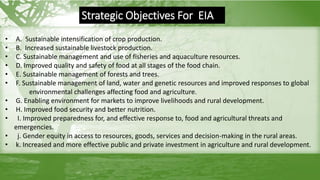
• A. Sustainable intensification of crop production.
• B. Increased sustainable livestock production.
• C. Sustainable management and use of fisheries and aquaculture resources.
• D. Improved quality and safety of food at all stages of the food chain.
• E. Sustainable management of forests and trees.
• F. Sustainable management of land, water and genetic resources and improved responses to global
environmental challenges affecting food and agriculture.
• G. Enabling environment for markets to improve livelihoods and rural development.
• H. Improved food security and better nutrition.
• I. Improved preparedness for, and effective response to, food and agricultural threats and
emergencies.
• j. Gender equity in access to resources, goods, services and decision-making in the rural areas.
• k. Increased and more effective public and private investment in agriculture and rural development.
Strategic Objectives For EIA
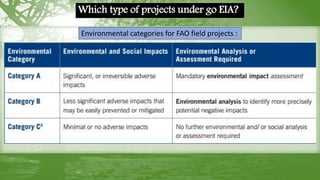
Environmental categories for FAO field projects :
Which type of projects under go EIA?
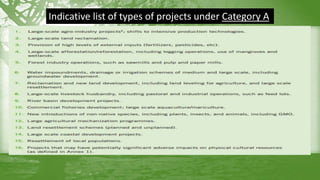
Indicative list of types of projects under Category A
Indicative list of types of projects under Category B
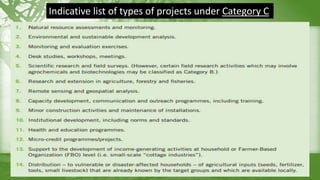
Indicative list of types of projects under Category C
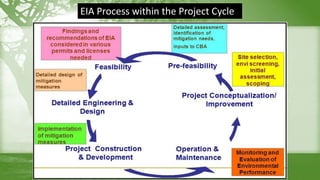
EIA Process within the Project Cycle
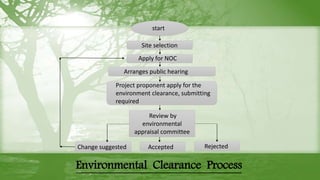
Environmental Clearance Process
start
Review by
environmental
appraisal committee
Accepted RejectedChange suggested
Site selection
Apply for NOC
Arranges public hearing
Project proponent apply for the
environment clearance, submitting
required
The main steps in EIAs process
o Screening
o Scoping
o Prediction and Mitigation
o Management and Monitoring
o Audit
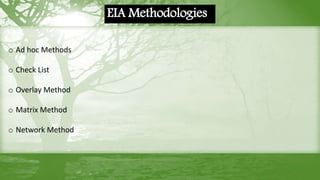
EIA Methodologies
o Ad hoc Methods
o Check List
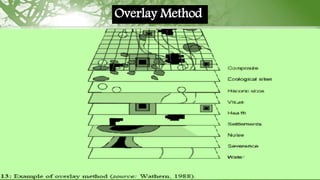
o Overlay Method
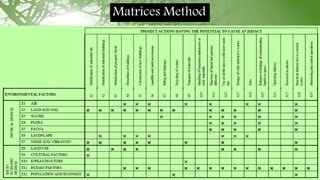
o Matrix Method
o Network Method
Ad hoc Methods
o A good example of an ad hoc method is a team of experts assembled for a short time
to conduct an EIA.
o Each expert's conclusions are based on a unique combination of experience, training
and intuition.
ADVANTAGE
Specialists on a particular
area will provide guidance.
DISADVANTAGE
It require expert.
Short/long term impact are merely examined
on guess basis.
 Identification , prediction and interpretation of
impacts are quite poor
Check List
o Simple Checklist: a list of environmental parameters with no guidelines on how they
are to be measured and interpreted.
o Descriptive Checklist: includes an identification of environmental parameters and
guidelines on how to measure data on particular parameters.
o Scaling Checklist: similar to a descriptive checklist, but with additional information
on subjective scaling of the parameters.
o Scaling Weighting Checklist: similar to a scaling checklist, with additional
information for the subjective evaluation of each parameter with respect to all the
other parameters.
Check List
ADVANTAGES
Simple to understand and
use.
Good for site selection
and priority setting.
DISADVANTAGES
Do not distinguish
between direct and
indirect impacts.
Do not link action and
impact.
Sometime it is a
cumbersome task.
Overlay Method
Matrices Method
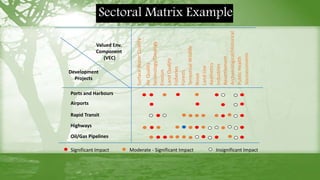
Ports and Harbours
Airports
Rapid Transit
Highways
Oil/Gas Pipelines
Development
Projects
Valued Env.
Component
(VEC)
Insignificant ImpactSignificant Impact Moderate - Significant Impact
Sectoral Matrix Example
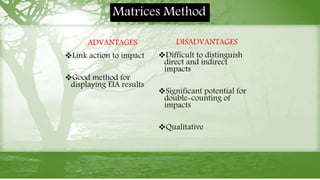
ADVANTAGES
Link action to impact
Good method for
displaying EIA results
DISADVANTAGES
Difficult to distinguish
direct and indirect
impacts
Significant potential for
double-counting of
impacts
Qualitative
Matrices Method
Environmental Management Plan
The environmental management plan (EMP) includes the mitigation, monitoring, and institutional measures to be taken
during project implementation in order to prevent, minimize, or eliminate adverse environmental and social impacts. The EMP
is part of, and costed in project design, and will include the following:
• Mitigation: Feasible and cost-effective measures to address significant adverse environmental impacts. Specifically, the
EMP identifies and summarizes all anticipated significant adverse environmental impacts and describes each mitigation
measure and the conditions under which it is required.
• Monitoring: Monitoring of the environmental impacts during project implementation and of the effectiveness of
mitigation measures.
• Capacity Development: The assessment of CD requirements should be a country-led process with participation of
stakeholders involved in, or affected by the potential environmental impact. The sustainability of the mitigation and
adaptation measures should be fully considered in the assessment. The following dimensions should be assessed:
• enabling environment including for the formulation and implementation of policies, processes, laws, regulations,
incentives and partnerships;
• capacities of organizations such as government agencies, NGOs, civil society, communities, and private sector;
• capacities of individuals in communities, of research organizations and policy-makers.
• Implementation Schedule and Cost Estimates: i.e. for mitigation, monitoring, and capacity development
measures that must be carried out as part of the project, including capital and recurrent cost estimates and
sources of funds for implementation.
• Integration of EMP with Project: For the EMP to be executed effectively, it must be integrated into the
project’s overall planning, design, budget, and implementation.
1. Land Use :
Existing land use in the catchment u to the source of the river or 100 km upstream of the structure, whichever is less.
(i) Agricultural land (ha)
(ii) Forests
(a) Reserved
(b) Unreserved
(iii) Barren land, fallow land, etc.
(iv) Waste land
(v) Total
2. . Submerged Area (ha.) :
(i) Cultivated land,(ii) Forests,(iii ) Shrubs, and (iv)fallow ; (v)) Wetlands, (vi) Area under ponds,(vi ) Other uses,
(vii) Total
3..Forests Types
(i) catchment
(ii) submerged areas
Extent and nature of forest in the area proposed to be cleared for construction of roads, colonies and other uses
of the project.
Environmental land use classification
4. Labor :
(i) Estimated strength (peak)I
(a) Skilled and Semi-skilled
(b) Unskill(((
(ii) Availability of labour from the affected area
(a) Skilled and Semi-skilled
(b) Unskilled I
( ( ({ (c) Total
5.Population density (per sq.km) :
(i) Catchment area, (ii) Submerged area, (iii) Command area
6.Village affected and population displaced :
(i) Number of villages
(ii) Population
(a) Scheduled Castes,(b ) Scheduled Tribes,(c ) Others,( d) Occupation of the affected people
- Agriculturists
- Agricultural labour - Industrial Labour - Forest Labour - Artisans - Others
(e) Land ownership (as per holding size)
- Marginal farmers (0-1.0 ha) - Small farmers (1-2.5 ha)
- Medium farmers (2.5-5.0 ha) - Big farmers (over 5.0 ha)
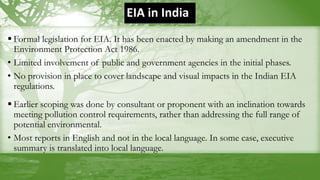
EIA in India
 Formal legislation for EIA. It has been enacted by making an amendment in the
Environment Protection Act 1986.
• Limited involvement of public and government agencies in the initial phases.
• No provision in place to cover landscape and visual impacts in the Indian EIA
regulations.
 Earlier scoping was done by consultant or proponent with an inclination towards
meeting pollution control requirements, rather than addressing the full range of
potential environmental.
• Most reports in English and not in the local language. In some case, executive
summary is translated into local language.
Thank You.

Eia - environmental impact assessment

  • 1.
    Environmental Impact Assessment Preparedby :- (B.PLAN) Limbachiya Shivani 08 Parth Patel 11 Abhishek Vyas 18 Preet Jariwala 06 Guidance by :- Dhruvita Mahida
  • 2.
    What is EIA? Environmental Impact Assessment (EIA) is a process which ensures that all environmental matters are taken into account quite early in the project at planning process itself.  It takes into consideration not only technical and economic considerations but also, traditional aspects like impact on local people, biodiversity etc.  An environmental impact assessment (EIA) is an assessment of the possible positive or negative impact that a proposed project may have on the environment, considering natural, Social and Economic aspects.
  • 5.
     Why WeNeed EIA? o EIA is intended to prevent or minimize potentially adverse environmental impacts and enhance the overall quality of a project. The main benefits and advantages of EIA are: Lower project costs in the long-term Increased project acceptance Improved project design Environment Impact Assesment
  • 6.
    • A. Sustainableintensification of crop production. • B. Increased sustainable livestock production. • C. Sustainable management and use of fisheries and aquaculture resources. • D. Improved quality and safety of food at all stages of the food chain. • E. Sustainable management of forests and trees. • F. Sustainable management of land, water and genetic resources and improved responses to global environmental challenges affecting food and agriculture. • G. Enabling environment for markets to improve livelihoods and rural development. • H. Improved food security and better nutrition. • I. Improved preparedness for, and effective response to, food and agricultural threats and emergencies. • j. Gender equity in access to resources, goods, services and decision-making in the rural areas. • k. Increased and more effective public and private investment in agriculture and rural development. Strategic Objectives For EIA
  • 7.
    Environmental categories forFAO field projects : Which type of projects under go EIA?
  • 8.
    Indicative list oftypes of projects under Category A
  • 9.
    Indicative list oftypes of projects under Category B
  • 10.
    Indicative list oftypes of projects under Category C
  • 11.
    EIA Process withinthe Project Cycle
  • 12.
    Environmental Clearance Process start Reviewby environmental appraisal committee Accepted RejectedChange suggested Site selection Apply for NOC Arranges public hearing Project proponent apply for the environment clearance, submitting required
  • 13.
    The main stepsin EIAs process o Screening o Scoping o Prediction and Mitigation o Management and Monitoring o Audit
  • 14.
    EIA Methodologies o Adhoc Methods o Check List o Overlay Method o Matrix Method o Network Method
  • 15.
    Ad hoc Methods oA good example of an ad hoc method is a team of experts assembled for a short time to conduct an EIA. o Each expert's conclusions are based on a unique combination of experience, training and intuition. ADVANTAGE Specialists on a particular area will provide guidance. DISADVANTAGE It require expert. Short/long term impact are merely examined on guess basis.  Identification , prediction and interpretation of impacts are quite poor
  • 17.
    Check List o SimpleChecklist: a list of environmental parameters with no guidelines on how they are to be measured and interpreted. o Descriptive Checklist: includes an identification of environmental parameters and guidelines on how to measure data on particular parameters. o Scaling Checklist: similar to a descriptive checklist, but with additional information on subjective scaling of the parameters. o Scaling Weighting Checklist: similar to a scaling checklist, with additional information for the subjective evaluation of each parameter with respect to all the other parameters.
  • 18.
    Check List ADVANTAGES Simple tounderstand and use. Good for site selection and priority setting. DISADVANTAGES Do not distinguish between direct and indirect impacts. Do not link action and impact. Sometime it is a cumbersome task.
  • 20.
  • 21.
  • 22.
    Ports and Harbours Airports RapidTransit Highways Oil/Gas Pipelines Development Projects Valued Env. Component (VEC) Insignificant ImpactSignificant Impact Moderate - Significant Impact Sectoral Matrix Example
  • 23.
    ADVANTAGES Link action toimpact Good method for displaying EIA results DISADVANTAGES Difficult to distinguish direct and indirect impacts Significant potential for double-counting of impacts Qualitative Matrices Method
  • 24.
    Environmental Management Plan Theenvironmental management plan (EMP) includes the mitigation, monitoring, and institutional measures to be taken during project implementation in order to prevent, minimize, or eliminate adverse environmental and social impacts. The EMP is part of, and costed in project design, and will include the following: • Mitigation: Feasible and cost-effective measures to address significant adverse environmental impacts. Specifically, the EMP identifies and summarizes all anticipated significant adverse environmental impacts and describes each mitigation measure and the conditions under which it is required. • Monitoring: Monitoring of the environmental impacts during project implementation and of the effectiveness of mitigation measures. • Capacity Development: The assessment of CD requirements should be a country-led process with participation of stakeholders involved in, or affected by the potential environmental impact. The sustainability of the mitigation and adaptation measures should be fully considered in the assessment. The following dimensions should be assessed: • enabling environment including for the formulation and implementation of policies, processes, laws, regulations, incentives and partnerships; • capacities of organizations such as government agencies, NGOs, civil society, communities, and private sector; • capacities of individuals in communities, of research organizations and policy-makers.
  • 25.
    • Implementation Scheduleand Cost Estimates: i.e. for mitigation, monitoring, and capacity development measures that must be carried out as part of the project, including capital and recurrent cost estimates and sources of funds for implementation. • Integration of EMP with Project: For the EMP to be executed effectively, it must be integrated into the project’s overall planning, design, budget, and implementation.
  • 26.
    1. Land Use: Existing land use in the catchment u to the source of the river or 100 km upstream of the structure, whichever is less. (i) Agricultural land (ha) (ii) Forests (a) Reserved (b) Unreserved (iii) Barren land, fallow land, etc. (iv) Waste land (v) Total 2. . Submerged Area (ha.) : (i) Cultivated land,(ii) Forests,(iii ) Shrubs, and (iv)fallow ; (v)) Wetlands, (vi) Area under ponds,(vi ) Other uses, (vii) Total 3..Forests Types (i) catchment (ii) submerged areas Extent and nature of forest in the area proposed to be cleared for construction of roads, colonies and other uses of the project. Environmental land use classification
  • 27.
    4. Labor : (i)Estimated strength (peak)I (a) Skilled and Semi-skilled (b) Unskill((( (ii) Availability of labour from the affected area (a) Skilled and Semi-skilled (b) Unskilled I ( ( ({ (c) Total 5.Population density (per sq.km) : (i) Catchment area, (ii) Submerged area, (iii) Command area 6.Village affected and population displaced : (i) Number of villages (ii) Population (a) Scheduled Castes,(b ) Scheduled Tribes,(c ) Others,( d) Occupation of the affected people - Agriculturists - Agricultural labour - Industrial Labour - Forest Labour - Artisans - Others (e) Land ownership (as per holding size) - Marginal farmers (0-1.0 ha) - Small farmers (1-2.5 ha) - Medium farmers (2.5-5.0 ha) - Big farmers (over 5.0 ha)
  • 28.
    EIA in India Formal legislation for EIA. It has been enacted by making an amendment in the Environment Protection Act 1986. • Limited involvement of public and government agencies in the initial phases. • No provision in place to cover landscape and visual impacts in the Indian EIA regulations.  Earlier scoping was done by consultant or proponent with an inclination towards meeting pollution control requirements, rather than addressing the full range of potential environmental. • Most reports in English and not in the local language. In some case, executive summary is translated into local language.
  • 29.