Environmental
Impact
Assessment (EIA)
Presented By,
Palash Mehar
M.Sc. Forensic Science Part-II
Govt. Institute of Forensic
Science, Nagpur (MH).
What is Environmental Impact Assessment ?
Environmental Impact Assessment (EIA) is a systematic and
integrative process for considering possible impacts prior to a decision
being taken on whether or not a proposal should be given approval to
proceed. (Wood 2003)
UNEP defines Environmental Impact Assessment (EIA) as a tool used
to identify the environmental, social and economic impacts of a project
prior to decision-making. It aims to predict environmental impacts at an
early stage in project planning and design, find ways and means to
reduce adverse impacts, shape projects to suit the local environment
and present the predictions and options to decision-makers.
Contd...
 Strategic Environmental Assessment (SEA) is a process
of prior examination and appraisal of policies, plans, and
programmes and other higher level or pre-project
initiatives (Sadler 1996)
 Environment Impact Assessment in India is statutorily
backed by the Environment Protection Act, 1986 which
contains various provisions on EIA methodology and
process.
Evolution of EIA in India
 The Indian experience with Environmental Impact Assessment began
over 44 years back. It started in 1976-77 when the Planning
Commission asked the Department of Science and Technology to
examine the river-valley projects from an environmental angle.
 Till 1994, environmental clearance from the Central Government was
an administrative decision and lacked legislative support.
 On 27 January 1994, the then Union Ministry of Environment and
Forests, under the Environmental (Protection) Act 1986, promulgated
an EIA notification making Environmental Clearance (EC) mandatory
for expansion or modernisation of any activity or for setting up new
projects listed in Schedule 1 of the notification.
Contd...
 The Ministry of Environment, Forests and Climate Change (MoEFCC)
notified new EIA legislation in September 2006.
1) The notification makes it mandatory for various projects such as
mining, thermal power plants, river valley, infrastructure (road,
highway, ports, harbours and airports) and industries including very
small electroplating or foundry units to get environment clearance.
2) However, unlike the EIA Notification of 1994, the new legislation
has put the onus of clearing projects on the state
government depending on the size/capacity of the project.
Contd...
Environment Impact Assessment Notification of 2006 has
decentralized the environmental clearance projects by categorizing
the developmental projects in two categories, i.e., Category A
(national level appraisal) and Category B (state level appraisal).
 Category A projects are appraised at national level by Impact
Assessment Agency (IAA) and the Expert Appraisal
Committee (EAC) and Category B projects are apprised at
state level.
 State Level Environment Impact Assessment Authority
(SEIAA) and State Level Expert Appraisal Committee (SEAC)
are constituted to provide clearance to Category B process.
EIA links environment with development for environmentally
safe and sustainable development.
EIA provides a cost effective method to eliminate or minimize
the adverse impact of developmental projects.
EIA enables the decision makers to analyse the effect of
developmental activities on the environment well before the
developmental project is implemented.
EIA encourages the adaptation of mitigation strategies in the
developmental plan.
EIA makes sure that the developmental plan is
environmentally sound and within the limits of the capacity of
assimilation and regeneration of the ecosystem.
Importance of EIA
Goals of EIA
Resource conservation
Waste minimization
Recovery of by-product
Efficient use of equipment
Sustainable development
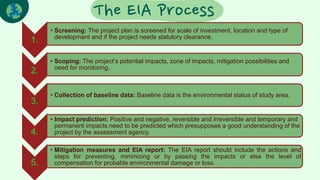
The EIA Process
1.
• Screening: The project plan is screened for scale of investment, location and type of
development and if the project needs statutory clearance.
2.
• Scoping: The project’s potential impacts, zone of impacts, mitigation possibilities and
need for monitoring.
3.
• Collection of baseline data: Baseline data is the environmental status of study area.
4.
• Impact prediction: Positive and negative, reversible and irreversible and temporary and
permanent impacts need to be predicted which presupposes a good understanding of the
project by the assessment agency.
5.
• Mitigation measures and EIA report: The EIA report should include the actions and
steps for preventing, minimizing or by passing the impacts or else the level of
compensation for probable environmental damage or loss.
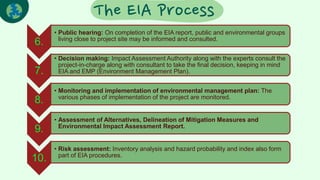
The EIA Process
6.
• Public hearing: On completion of the EIA report, public and environmental groups
living close to project site may be informed and consulted.
7.
• Decision making: Impact Assessment Authority along with the experts consult the
project-in-charge along with consultant to take the final decision, keeping in mind
EIA and EMP (Environment Management Plan).
8.
• Monitoring and implementation of environmental management plan: The
various phases of implementation of the project are monitored.
9.
• Assessment of Alternatives, Delineation of Mitigation Measures and
Environmental Impact Assessment Report.
10.
• Risk assessment: Inventory analysis and hazard probability and index also form
part of EIA procedures.
Image Source:
Environmental Impact Assessment, 2020. Biodiversity & Environment
by DRISHTI
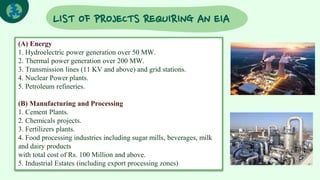
LIST OF PROJECTS REQUIRING AN EIA
(A) Energy
1. Hydroelectric power generation over 50 MW.
2. Thermal power generation over 200 MW.
3. Transmission lines (11 KV and above) and grid stations.
4. Nuclear Power plants.
5. Petroleum refineries.
(B) Manufacturing and Processing
1. Cement Plants.
2. Chemicals projects.
3. Fertilizers plants.
4. Food processing industries including sugar mills, beverages, milk
and dairy products
with total cost of Rs. 100 Million and above.
5. Industrial Estates (including export processing zones)
LIST OF PROJECTS REQUIRING AN EIA
(C) Mining and Mineral Processing.
1. Mining and processing of coal, gold, copper, sulphur and precious stones.
2. Mining and processing of major non-ferrous metals, iron and steel rolling.
3. Smelting plants with total cost of Rs. 50 Million and above.
(D)Transport
1. Airports.
2. Federal or provincial highways (except maintenance, rebuilding or reconstruction of
existing roads) with total cost of Rs.50 million and above.
3. Ports and harbors development for ships 500 gross tons and above.
4. Railway works.
(E)Water Management, Dams, Irrigation and Flood Protection..
1. Dams and reservoirs with storage volume 50 million cubic meters and above or
surface area of 08 square kilometers and above.
2. Irrigation and drainage projects serving 15,000 hectares and above.
(F)Water supply schemes and treatment.
Water supply schemes and treatment plants with total cost of Rs. 25 million and above
LIST OF PROJECTS REQUIRING AN EIA
(G) Waste Disposal
1. Waste disposal and / or storage of hazardous or toxic wastes
(including land fill sites incineration of hospital toxic waste).
2. Waste disposal facility for domestic or industrial waste with annual
capacity more than 10,000 cubic meters.
(H)Urban development and tourism.
1. Land use studies and urban plans (large cities).
2. Large scale tourism development projects with total cost more than
Rs. 50 million.
(I)Environmentally Sensitive Areas.
1. All projects situated in environmentally sensitive areas.
• Provides systematic method of
impact assessment
• Estimates the cost/benefit trade-off
of alternative actions.
• Facilitates the public participation
• Top-level decision making
• Achieves a balance between the
impact of development and
environmental concern
• Provide an effective mechanism for
1. Coordination
2. Environmental integration
3. Negotiations
4. Feedback
EIA Benefits Flaws
• Time consuming
• Costly
• Little public participation in actual
implementation
• Unavailability for reliable data
(mostly in developing countries)
• Too focused to scientific analysis
(sometime)
• Compliance monitoring after EIA is
seldom carried out.
CONCLUSION
EIA is an important tool in assuring
and plans will not give adverse impact
on the environment.
The use of EIA has developed
throughout the world and may different
applications exists.
EIA process thus could not only
prevent costs due to environmental
aspects but also prevent possible
public opinions and protest against a
project.
REFERENCES
1. Environmental Impact Assessment, 2020. Biodiversity & Environment. Available at: <https://www.drishtiias.com/to-the-
points/paper3/environmental-impact-assessment-
1#:~:text=UNEP%20defines%20Environmental%20Impact%20Assessment,project%20prior%20to%20decision%2Dmaking.>
[Accessed 7 April 2021].
2. Cbd.int. 2021. Why is it Important?. [online] Available at: <https://www.cbd.int/impact/importance.shtml> [Accessed 9 April
2021].
3. Sheate, B., 2021. 1.1 What is environmental impact assessment?. [online] Soas.ac.uk. Available at:
<https://www.soas.ac.uk/cedep-demos/000_P507_EA_K3736-
Demo/unit1/page_08.htm#:~:text=Essentially%2C%20environmental%20impact%20assessment%20(EIA,the%20project%20sh
ould%20be%20authorised.&text=EIA%20forms%20part%20of%20the,environmental%20assessment%20(EA)%20processes.>
[Accessed 9 April 2021].
4. Slideshare.net. 2021. Environmental Impact Assessment(EIA). [online] Available at:
<https://www.slideshare.net/DeepikaVerma35/environmental-impact-assessmenteia?from_action=save> [Accessed 9 April
2021].
5. Slideshare.net. 2021. Environmental impact assessment (EIA). [online] Available at:
<https://www.slideshare.net/maaz786/environmental-impact-assessment-44123564> [Accessed 9 April 2021].
6. Slideshare.net. 2021. environmental impact assessment. [online] Available at:
<https://www.slideshare.net/pramodgpramod/environmental-impact-assessment-
74446501#:~:text=INTRODUCTION%20Environmental%20Impact%20Assessment%20(EIA,project%20at%20planning%20pr
ocess%20itself.&text=EIA%20is%20intended%20to%20prevent,overall%20quality%20of%20a%20project.> [Accessed 9 April
2021].
THANK YOU!
Every small action counts.
Let’s protect the
environment together!

Environmental Impact Assessment (EIA)

  • 1.
    Environmental Impact Assessment (EIA) Presented By, PalashMehar M.Sc. Forensic Science Part-II Govt. Institute of Forensic Science, Nagpur (MH).
  • 2.
    What is EnvironmentalImpact Assessment ? Environmental Impact Assessment (EIA) is a systematic and integrative process for considering possible impacts prior to a decision being taken on whether or not a proposal should be given approval to proceed. (Wood 2003) UNEP defines Environmental Impact Assessment (EIA) as a tool used to identify the environmental, social and economic impacts of a project prior to decision-making. It aims to predict environmental impacts at an early stage in project planning and design, find ways and means to reduce adverse impacts, shape projects to suit the local environment and present the predictions and options to decision-makers.
  • 3.
    Contd...  Strategic EnvironmentalAssessment (SEA) is a process of prior examination and appraisal of policies, plans, and programmes and other higher level or pre-project initiatives (Sadler 1996)  Environment Impact Assessment in India is statutorily backed by the Environment Protection Act, 1986 which contains various provisions on EIA methodology and process.
  • 4.
    Evolution of EIAin India  The Indian experience with Environmental Impact Assessment began over 44 years back. It started in 1976-77 when the Planning Commission asked the Department of Science and Technology to examine the river-valley projects from an environmental angle.  Till 1994, environmental clearance from the Central Government was an administrative decision and lacked legislative support.  On 27 January 1994, the then Union Ministry of Environment and Forests, under the Environmental (Protection) Act 1986, promulgated an EIA notification making Environmental Clearance (EC) mandatory for expansion or modernisation of any activity or for setting up new projects listed in Schedule 1 of the notification.
  • 5.
    Contd...  The Ministryof Environment, Forests and Climate Change (MoEFCC) notified new EIA legislation in September 2006. 1) The notification makes it mandatory for various projects such as mining, thermal power plants, river valley, infrastructure (road, highway, ports, harbours and airports) and industries including very small electroplating or foundry units to get environment clearance. 2) However, unlike the EIA Notification of 1994, the new legislation has put the onus of clearing projects on the state government depending on the size/capacity of the project.
  • 6.
    Contd... Environment Impact AssessmentNotification of 2006 has decentralized the environmental clearance projects by categorizing the developmental projects in two categories, i.e., Category A (national level appraisal) and Category B (state level appraisal).  Category A projects are appraised at national level by Impact Assessment Agency (IAA) and the Expert Appraisal Committee (EAC) and Category B projects are apprised at state level.  State Level Environment Impact Assessment Authority (SEIAA) and State Level Expert Appraisal Committee (SEAC) are constituted to provide clearance to Category B process.
  • 7.
    EIA links environmentwith development for environmentally safe and sustainable development. EIA provides a cost effective method to eliminate or minimize the adverse impact of developmental projects. EIA enables the decision makers to analyse the effect of developmental activities on the environment well before the developmental project is implemented. EIA encourages the adaptation of mitigation strategies in the developmental plan. EIA makes sure that the developmental plan is environmentally sound and within the limits of the capacity of assimilation and regeneration of the ecosystem. Importance of EIA
  • 8.
    Goals of EIA Resourceconservation Waste minimization Recovery of by-product Efficient use of equipment Sustainable development
  • 9.
    The EIA Process 1. •Screening: The project plan is screened for scale of investment, location and type of development and if the project needs statutory clearance. 2. • Scoping: The project’s potential impacts, zone of impacts, mitigation possibilities and need for monitoring. 3. • Collection of baseline data: Baseline data is the environmental status of study area. 4. • Impact prediction: Positive and negative, reversible and irreversible and temporary and permanent impacts need to be predicted which presupposes a good understanding of the project by the assessment agency. 5. • Mitigation measures and EIA report: The EIA report should include the actions and steps for preventing, minimizing or by passing the impacts or else the level of compensation for probable environmental damage or loss.
  • 10.
    The EIA Process 6. •Public hearing: On completion of the EIA report, public and environmental groups living close to project site may be informed and consulted. 7. • Decision making: Impact Assessment Authority along with the experts consult the project-in-charge along with consultant to take the final decision, keeping in mind EIA and EMP (Environment Management Plan). 8. • Monitoring and implementation of environmental management plan: The various phases of implementation of the project are monitored. 9. • Assessment of Alternatives, Delineation of Mitigation Measures and Environmental Impact Assessment Report. 10. • Risk assessment: Inventory analysis and hazard probability and index also form part of EIA procedures.
  • 11.
    Image Source: Environmental ImpactAssessment, 2020. Biodiversity & Environment by DRISHTI
  • 12.
    LIST OF PROJECTSREQUIRING AN EIA (A) Energy 1. Hydroelectric power generation over 50 MW. 2. Thermal power generation over 200 MW. 3. Transmission lines (11 KV and above) and grid stations. 4. Nuclear Power plants. 5. Petroleum refineries. (B) Manufacturing and Processing 1. Cement Plants. 2. Chemicals projects. 3. Fertilizers plants. 4. Food processing industries including sugar mills, beverages, milk and dairy products with total cost of Rs. 100 Million and above. 5. Industrial Estates (including export processing zones)
  • 13.
    LIST OF PROJECTSREQUIRING AN EIA (C) Mining and Mineral Processing. 1. Mining and processing of coal, gold, copper, sulphur and precious stones. 2. Mining and processing of major non-ferrous metals, iron and steel rolling. 3. Smelting plants with total cost of Rs. 50 Million and above. (D)Transport 1. Airports. 2. Federal or provincial highways (except maintenance, rebuilding or reconstruction of existing roads) with total cost of Rs.50 million and above. 3. Ports and harbors development for ships 500 gross tons and above. 4. Railway works. (E)Water Management, Dams, Irrigation and Flood Protection.. 1. Dams and reservoirs with storage volume 50 million cubic meters and above or surface area of 08 square kilometers and above. 2. Irrigation and drainage projects serving 15,000 hectares and above. (F)Water supply schemes and treatment. Water supply schemes and treatment plants with total cost of Rs. 25 million and above
  • 14.
    LIST OF PROJECTSREQUIRING AN EIA (G) Waste Disposal 1. Waste disposal and / or storage of hazardous or toxic wastes (including land fill sites incineration of hospital toxic waste). 2. Waste disposal facility for domestic or industrial waste with annual capacity more than 10,000 cubic meters. (H)Urban development and tourism. 1. Land use studies and urban plans (large cities). 2. Large scale tourism development projects with total cost more than Rs. 50 million. (I)Environmentally Sensitive Areas. 1. All projects situated in environmentally sensitive areas.
  • 15.
    • Provides systematicmethod of impact assessment • Estimates the cost/benefit trade-off of alternative actions. • Facilitates the public participation • Top-level decision making • Achieves a balance between the impact of development and environmental concern • Provide an effective mechanism for 1. Coordination 2. Environmental integration 3. Negotiations 4. Feedback EIA Benefits Flaws • Time consuming • Costly • Little public participation in actual implementation • Unavailability for reliable data (mostly in developing countries) • Too focused to scientific analysis (sometime) • Compliance monitoring after EIA is seldom carried out.
  • 16.
    CONCLUSION EIA is animportant tool in assuring and plans will not give adverse impact on the environment. The use of EIA has developed throughout the world and may different applications exists. EIA process thus could not only prevent costs due to environmental aspects but also prevent possible public opinions and protest against a project.
  • 17.
    REFERENCES 1. Environmental ImpactAssessment, 2020. Biodiversity & Environment. Available at: <https://www.drishtiias.com/to-the- points/paper3/environmental-impact-assessment- 1#:~:text=UNEP%20defines%20Environmental%20Impact%20Assessment,project%20prior%20to%20decision%2Dmaking.> [Accessed 7 April 2021]. 2. Cbd.int. 2021. Why is it Important?. [online] Available at: <https://www.cbd.int/impact/importance.shtml> [Accessed 9 April 2021]. 3. Sheate, B., 2021. 1.1 What is environmental impact assessment?. [online] Soas.ac.uk. Available at: <https://www.soas.ac.uk/cedep-demos/000_P507_EA_K3736- Demo/unit1/page_08.htm#:~:text=Essentially%2C%20environmental%20impact%20assessment%20(EIA,the%20project%20sh ould%20be%20authorised.&text=EIA%20forms%20part%20of%20the,environmental%20assessment%20(EA)%20processes.> [Accessed 9 April 2021]. 4. Slideshare.net. 2021. Environmental Impact Assessment(EIA). [online] Available at: <https://www.slideshare.net/DeepikaVerma35/environmental-impact-assessmenteia?from_action=save> [Accessed 9 April 2021]. 5. Slideshare.net. 2021. Environmental impact assessment (EIA). [online] Available at: <https://www.slideshare.net/maaz786/environmental-impact-assessment-44123564> [Accessed 9 April 2021]. 6. Slideshare.net. 2021. environmental impact assessment. [online] Available at: <https://www.slideshare.net/pramodgpramod/environmental-impact-assessment- 74446501#:~:text=INTRODUCTION%20Environmental%20Impact%20Assessment%20(EIA,project%20at%20planning%20pr ocess%20itself.&text=EIA%20is%20intended%20to%20prevent,overall%20quality%20of%20a%20project.> [Accessed 9 April 2021].
  • 18.
    THANK YOU! Every smallaction counts. Let’s protect the environment together!