Enthalpy Change(ΔH)
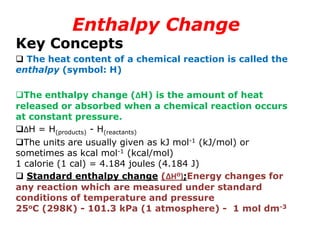
Enthalpy ChangeKey ConceptsThe heat content of a chemical reaction is called the enthalpy (symbol: H)
The enthalpy change (ΔH) is the amount of heat released or absorbed when a chemical reaction occurs at constant pressure.
ΔH = H(products) - H(reactants)
The units are usually given as kJ mol-1 (kJ/mol) or sometimes as kcal mol-1 (kcal/mol)1 calorie (1 cal) = 4.184 joules (4.184 J)
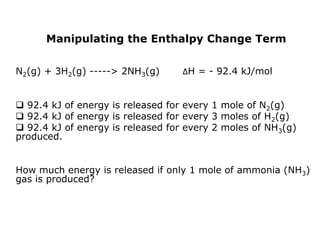
Standard enthalpy change(ΔHѲ);Energy changes for any reaction which are measured under standard conditions of temperature and pressure25oC (298K) - 101.3 kPa (1 atmosphere) -  1 mol dm-3Manipulating the Enthalpy Change TermN2(g) + 3H2(g) -----> 2NH3(g)       ΔH = - 92.4 kJ/mol  92.4 kJ of energy is released for every 1 mole of N2(g)
 92.4 kJ of energy is released for every 3 moles of H2(g)
 92.4 kJ of energy is released for every 2 moles of NH3(g) produced. How much energy is released if only 1 mole of ammonia (NH3) gas is produced?
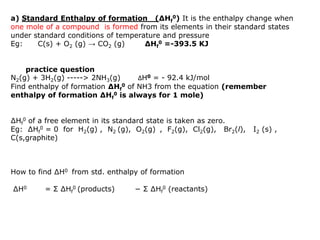
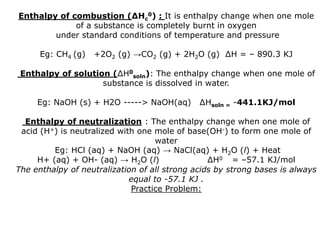
a) Standard Enthalpy of formation   (∆Hf0) It is the enthalpy change when one mole of a compound  is formed from its elements in their standard states under standard conditions of temperature and pressureEg:      C(s) + O2 (g) -> CO2 (g)        ∆Hf0 =-393.5 KJ practice question    N2(g) + 3H2(g) -----> 2NH3(g)       ΔH0 = - 92.4 kJ/molFind enthalpy of formation ∆Hf0of NH3 from the equation (remember enthalpy of formation ∆Hf0 is always for 1 mole)∆Hf0 of a free element in its standard state is taken as zero.Eg:  ∆Hf0 = 0  for  H2(g) ,  N2 (g),  O2(g) ,  F2(g),  Cl2(g),   Br2(l),   I2 (s) ,  C(s,graphite)How to find ∆H0  from std. enthalpy of formation  ∆H0           = Σ ∆Hf0 (products)        − Σ ∆Hf0 (reactants)
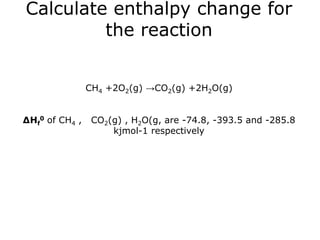
Calculate enthalpy change for the reactionCH4 +2O2(g) ->CO2(g) +2H2O(g) ∆Hf0of CH4 ,   CO2(g) , H2O(g, are -74.8, -393.5 and -285.8 kjmol-1 respectively

Enthalpy change

  • 1.
  • 2.
    Enthalpy ChangeKey ConceptsTheheat content of a chemical reaction is called the enthalpy (symbol: H)
  • 3.
    The enthalpy change(ΔH) is the amount of heat released or absorbed when a chemical reaction occurs at constant pressure.
  • 4.
    ΔH = H(products)- H(reactants)
  • 5.
    The units areusually given as kJ mol-1 (kJ/mol) or sometimes as kcal mol-1 (kcal/mol)1 calorie (1 cal) = 4.184 joules (4.184 J)
  • 6.
    Standard enthalpy change(ΔHѲ);Energychanges for any reaction which are measured under standard conditions of temperature and pressure25oC (298K) - 101.3 kPa (1 atmosphere) - 1 mol dm-3Manipulating the Enthalpy Change TermN2(g) + 3H2(g) -----> 2NH3(g)       ΔH = - 92.4 kJ/mol 92.4 kJ of energy is released for every 1 mole of N2(g)
  • 7.
    92.4 kJof energy is released for every 3 moles of H2(g)
  • 8.
    92.4 kJof energy is released for every 2 moles of NH3(g) produced. How much energy is released if only 1 mole of ammonia (NH3) gas is produced?
  • 9.
    a) Standard Enthalpyof formation (∆Hf0) It is the enthalpy change when one mole of a compound is formed from its elements in their standard states under standard conditions of temperature and pressureEg: C(s) + O2 (g) -> CO2 (g) ∆Hf0 =-393.5 KJ practice question N2(g) + 3H2(g) -----> 2NH3(g)       ΔH0 = - 92.4 kJ/molFind enthalpy of formation ∆Hf0of NH3 from the equation (remember enthalpy of formation ∆Hf0 is always for 1 mole)∆Hf0 of a free element in its standard state is taken as zero.Eg: ∆Hf0 = 0 for H2(g) , N2 (g), O2(g) , F2(g), Cl2(g), Br2(l), I2 (s) , C(s,graphite)How to find ∆H0 from std. enthalpy of formation ∆H0 = Σ ∆Hf0 (products) − Σ ∆Hf0 (reactants)
  • 10.
    Calculate enthalpy changefor the reactionCH4 +2O2(g) ->CO2(g) +2H2O(g) ∆Hf0of CH4 , CO2(g) , H2O(g, are -74.8, -393.5 and -285.8 kjmol-1 respectively