KINETICS OF CHAIN REACTIONS
Dr.P.GOVINDARAJ
Associate Professor & Head , Department of Chemistry
SAIVA BHANU KSHATRIYA COLLEGE
ARUPPUKOTTAI - 626101
Virudhunagar District, Tamil Nadu, India
KINETICS OF CHAIN REACTIONS
Chain reactions
Chemical reactions in which highly reactive short-lived species like atoms (or)
free radicals are produced as intermediates which carry out the reaction at a
rapid rate for a long time are called Chain reactions.
Mechanism of Chain reaction
Chain reaction occur mainly by the following three steps
1. Chain initiation step
In this step active intermediates are produced
2. Chain propagation steps
In these steps active intermediates reacts with reactant
gives product and another active intermediate and this is repeated as a chain
until the reactants (or) active intermediate disappear.
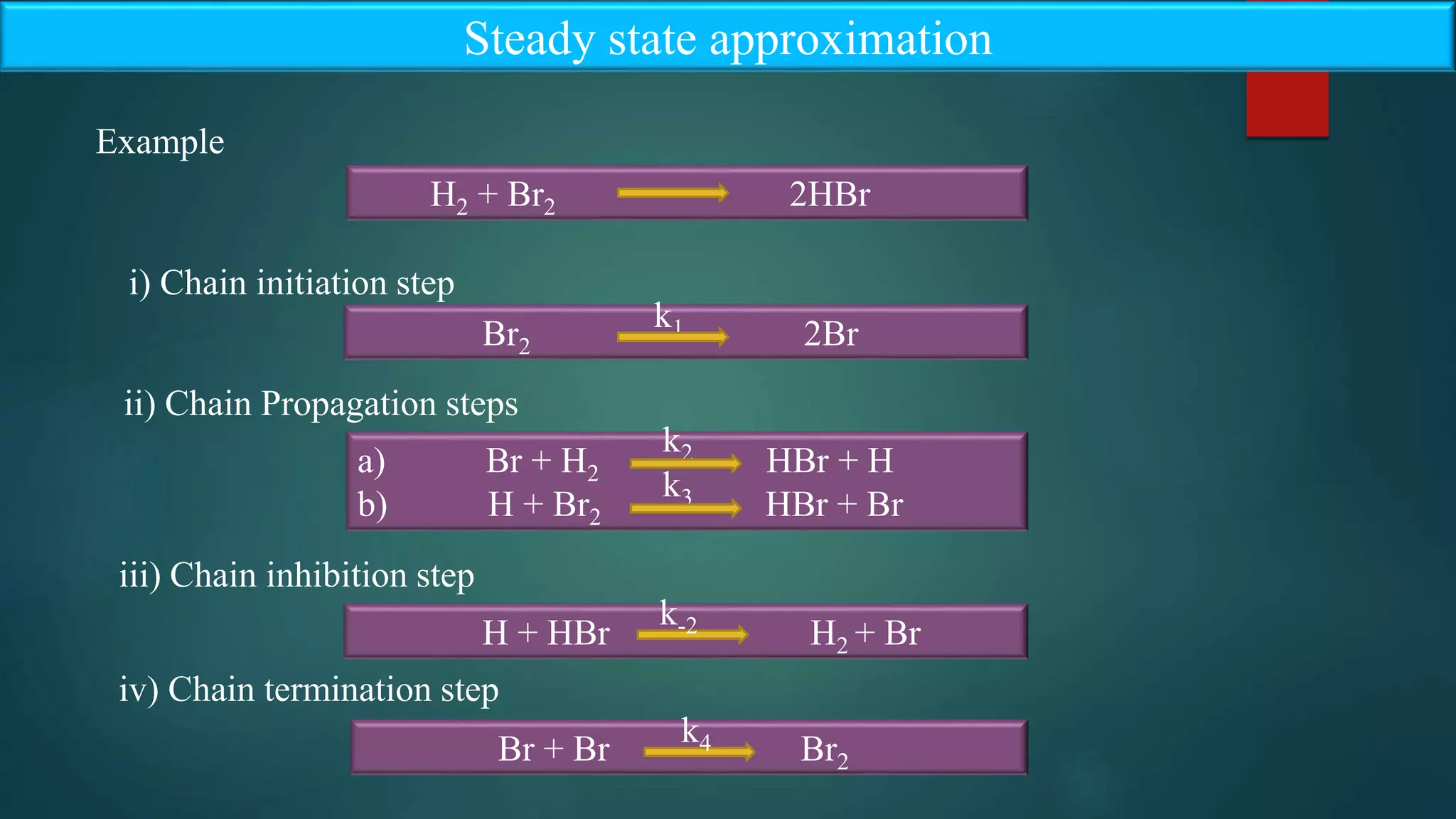
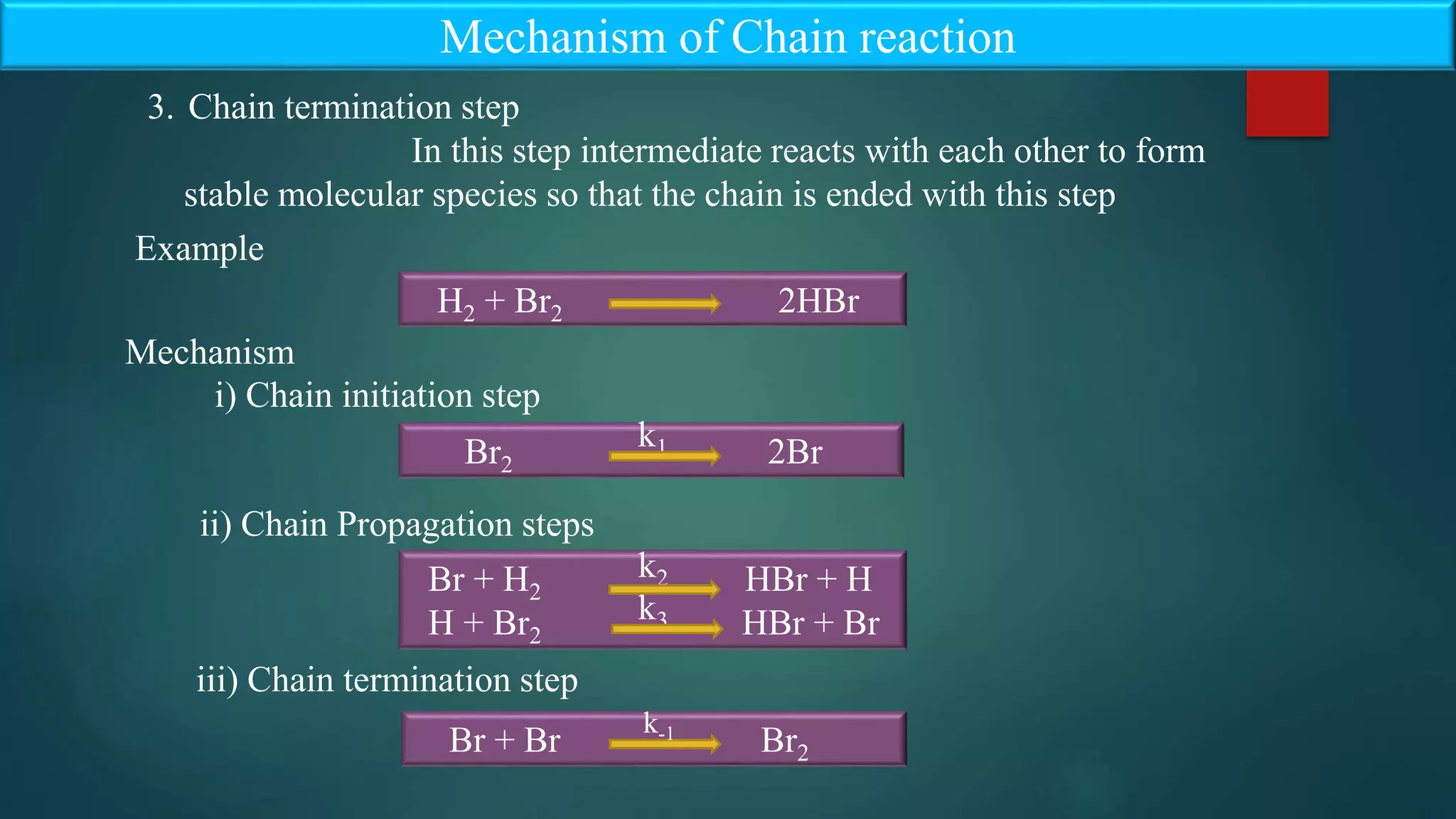
Example
H2 + Br2 2HBr
Mechanism
i) Chain initiation step
Br2 2Br
ii) Chain Propagation steps
Br + H2 HBr + H
H + Br2 HBr + Br
k1
k2
k3
iii) Chain termination step
Br + Br Br2
3. Chain termination step
In this step intermediate reacts with each other to form
stable molecular species so that the chain is ended with this step
k-1
Mechanism of Chain reaction
Characteristics of chain reactions
i) The probability factor P of chain reactions is generally greater than unity
ii) The chain reactions, sometimes possess excessive speeds which may lead to explosion
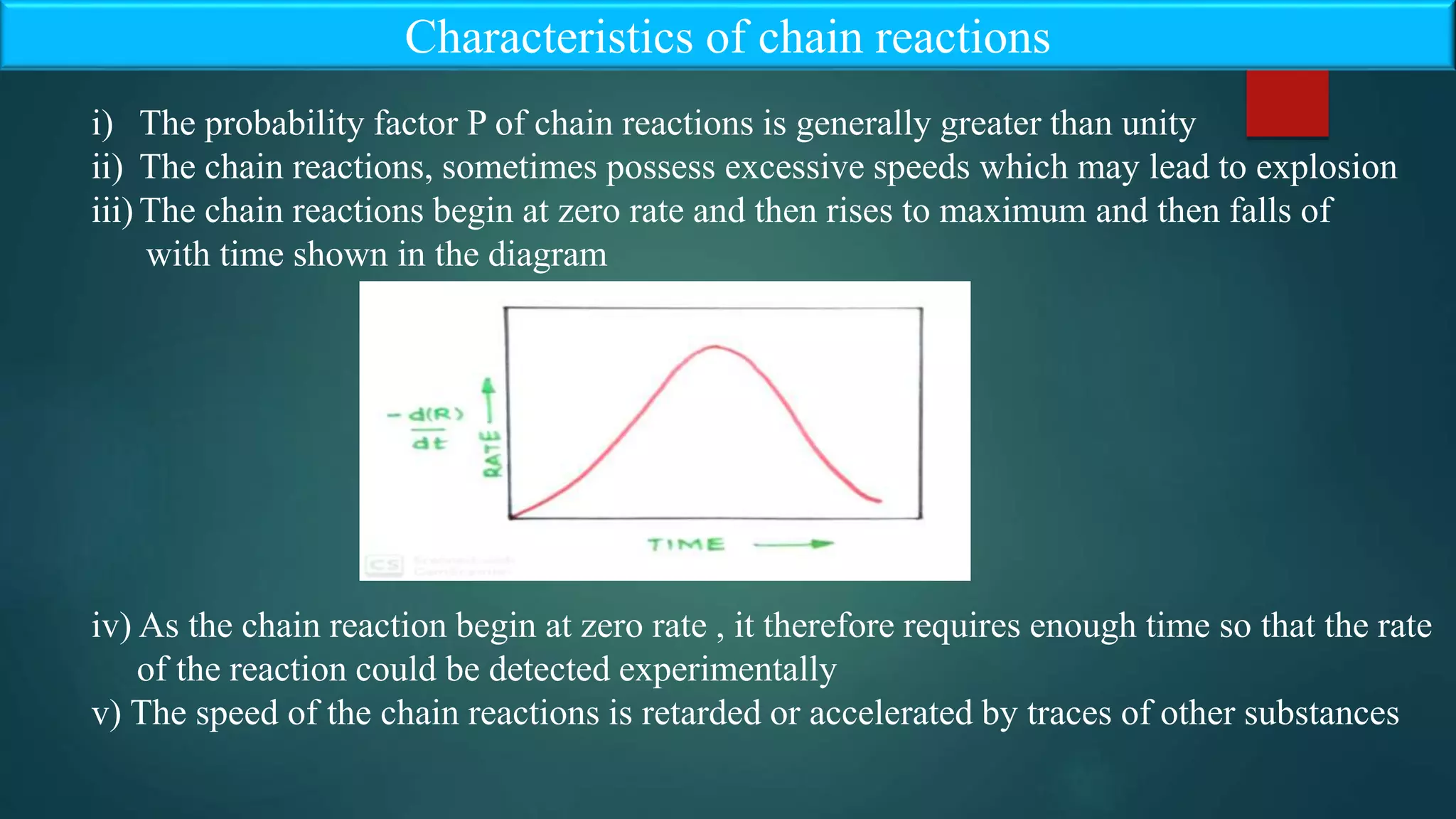
iii) The chain reactions begin at zero rate and then rises to maximum and then falls of
with time shown in the diagram
iv) As the chain reaction begin at zero rate , it therefore requires enough time so that the rate
of the reaction could be detected experimentally
v) The speed of the chain reactions is retarded or accelerated by traces of other substances
vi) The rate of chain reactions is influenced by the changes in shape of the containing vessel.
vii)The chain reactions are rarely of simple orders but have integral orders which depends
upon the vessel shape and other experimental conditions.
Steady state approximation states that the rate of formation of active intermediate is equal
to the rate of disappearance of active intermediate in the chain reactions
Steady state approximation
i.e., the rate of formation of intermediate (R) and the rate of disappearance of intermediate
(R) must be equal to zero
𝑑[𝑅]
𝑑𝑡
= −
𝑑[𝑅]
𝑑𝑡
= 0
Characteristics of chain reactions
Example
H2 + Br2 2HBr
i) Chain initiation step
Br2 2Br
ii) Chain Propagation steps
a) Br + H2 HBr + H
b) H + Br2 HBr + Br
k1
k2
k3
iii) Chain inhibition step
H + HBr H2 + Br
k-2
iv) Chain termination step
Br + Br Br2
k4
Steady state approximation
On applying steady state approximation to the intermediate H
𝑑[𝐻]
𝑑𝑡
= Rate of formation of [H] – Rate of disappearance of [H] = 0 ------(1)
Rate of formation of [H] = k2[Br][H2] ------(2)
Rate of disappearance of [H] = k3[H][Br2] + k-2[H][HBr] ------(3)
Substitute (2) and (3) in (1) we get
𝑑[𝐻]
𝑑𝑡
= k2[Br][H2] - k3[H][Br2] - k-2[H][HBr] = 0
Steady state approximation
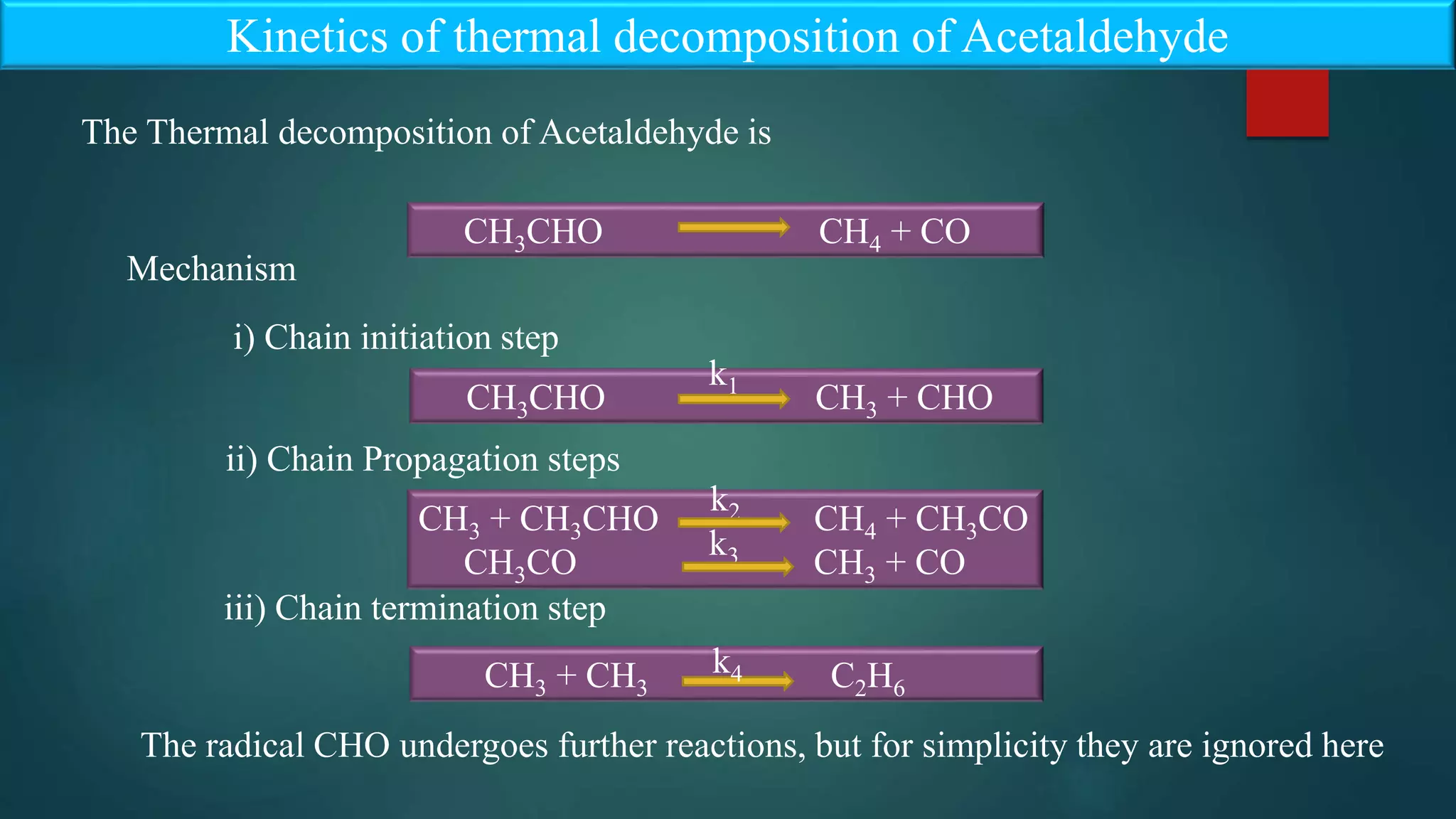
Kinetics of thermal decomposition of Acetaldehyde
CH3CHO CH4 + CO
Mechanism
i) Chain initiation step
CH3CHO CH3 + CHO
ii) Chain Propagation steps
CH3 + CH3CHO CH4 + CH3CO
CH3CO CH3 + CO
k1
k2
k3
iii) Chain termination step
CH3 + CH3 C2H6
k4
The radical CHO undergoes further reactions, but for simplicity they are ignored here
The Thermal decomposition of Acetaldehyde is
i.e., Rate of formation of methyl radical = Rate of disappearance of methyl radical
𝑑[𝐶𝐻4
]
𝑑𝑡
= k2[CH3][CH3CHO] ------(1)
Applying steady state approximation on methyl radicals
The rate of formation of Methane is
k1[CH3CHO] + k3[CH3CO] = k2[CH3][CH3CHO] + k4[CH3][CH3]
k1[CH3CHO] + k3[CH3CO] - k2[CH3][CH3CHO] - k4[CH3][CH3] = 0 ------(2)
Kinetics of thermal decomposition of Acetaldehyde
Applying steady state approximation on CH3CO radicals
i.e., Rate of formation of CH3CO = Rate of disappearance of CH3CO
k2[CH3][CH3CHO] = k3[CH3CO]
k2[CH3][CH3CHO] - k3[CH3CO]= 0 ------(3)
Adding equation (2) and (3) we get the concentration of methyl radicals
k1[CH3CHO] + k3[CH3CO] - k2[CH3][CH3CHO] - k4[CH3][CH3] + k2[CH3][CH3CHO] -
k3[CH3CO] = 0
k1[CH3CHO] - k4[CH3]2 = 0
k1[CH3CHO] = k4[CH3]2
Kinetics of thermal decomposition of Acetaldehyde
k1[CH3CHO] = k4[CH3]2
[CH3]2 =
k1
k4
[CH3CHO]
k4[CH3]2 = k1[CH3CHO]
[CH3] = (
k1
k4
)1/2[CH3CHO]1/2
-------(4)
Substitute (4) in (1) we get
𝑑[𝐶𝐻4]
𝑑𝑡
= k2(
k1
k4
)1/2[CH3CHO]1/2 [CH3CHO]
𝑑[𝐶𝐻4]
𝑑𝑡
= k2(
k1
k4
)1/2[CH3CHO]3/2
This is the rate equation for thermal decomposition of CH3CHO and the
overall order of this reaction is 3/2
Kinetics of thermal decomposition of Acetaldehyde
Kinetics of Chain reaction

Kinetics of Chain reaction

  • 1.
    KINETICS OF CHAINREACTIONS Dr.P.GOVINDARAJ Associate Professor & Head , Department of Chemistry SAIVA BHANU KSHATRIYA COLLEGE ARUPPUKOTTAI - 626101 Virudhunagar District, Tamil Nadu, India
  • 2.
    KINETICS OF CHAINREACTIONS Chain reactions Chemical reactions in which highly reactive short-lived species like atoms (or) free radicals are produced as intermediates which carry out the reaction at a rapid rate for a long time are called Chain reactions. Mechanism of Chain reaction Chain reaction occur mainly by the following three steps 1. Chain initiation step In this step active intermediates are produced 2. Chain propagation steps In these steps active intermediates reacts with reactant gives product and another active intermediate and this is repeated as a chain until the reactants (or) active intermediate disappear.
  • 3.
    Example H2 + Br22HBr Mechanism i) Chain initiation step Br2 2Br ii) Chain Propagation steps Br + H2 HBr + H H + Br2 HBr + Br k1 k2 k3 iii) Chain termination step Br + Br Br2 3. Chain termination step In this step intermediate reacts with each other to form stable molecular species so that the chain is ended with this step k-1 Mechanism of Chain reaction
  • 4.
    Characteristics of chainreactions i) The probability factor P of chain reactions is generally greater than unity ii) The chain reactions, sometimes possess excessive speeds which may lead to explosion iii) The chain reactions begin at zero rate and then rises to maximum and then falls of with time shown in the diagram iv) As the chain reaction begin at zero rate , it therefore requires enough time so that the rate of the reaction could be detected experimentally v) The speed of the chain reactions is retarded or accelerated by traces of other substances
  • 5.
    vi) The rateof chain reactions is influenced by the changes in shape of the containing vessel. vii)The chain reactions are rarely of simple orders but have integral orders which depends upon the vessel shape and other experimental conditions. Steady state approximation states that the rate of formation of active intermediate is equal to the rate of disappearance of active intermediate in the chain reactions Steady state approximation i.e., the rate of formation of intermediate (R) and the rate of disappearance of intermediate (R) must be equal to zero 𝑑[𝑅] 𝑑𝑡 = − 𝑑[𝑅] 𝑑𝑡 = 0 Characteristics of chain reactions
  • 6.
    Example H2 + Br22HBr i) Chain initiation step Br2 2Br ii) Chain Propagation steps a) Br + H2 HBr + H b) H + Br2 HBr + Br k1 k2 k3 iii) Chain inhibition step H + HBr H2 + Br k-2 iv) Chain termination step Br + Br Br2 k4 Steady state approximation
  • 7.
    On applying steadystate approximation to the intermediate H 𝑑[𝐻] 𝑑𝑡 = Rate of formation of [H] – Rate of disappearance of [H] = 0 ------(1) Rate of formation of [H] = k2[Br][H2] ------(2) Rate of disappearance of [H] = k3[H][Br2] + k-2[H][HBr] ------(3) Substitute (2) and (3) in (1) we get 𝑑[𝐻] 𝑑𝑡 = k2[Br][H2] - k3[H][Br2] - k-2[H][HBr] = 0 Steady state approximation
  • 8.
    Kinetics of thermaldecomposition of Acetaldehyde CH3CHO CH4 + CO Mechanism i) Chain initiation step CH3CHO CH3 + CHO ii) Chain Propagation steps CH3 + CH3CHO CH4 + CH3CO CH3CO CH3 + CO k1 k2 k3 iii) Chain termination step CH3 + CH3 C2H6 k4 The radical CHO undergoes further reactions, but for simplicity they are ignored here The Thermal decomposition of Acetaldehyde is
  • 9.
    i.e., Rate offormation of methyl radical = Rate of disappearance of methyl radical 𝑑[𝐶𝐻4 ] 𝑑𝑡 = k2[CH3][CH3CHO] ------(1) Applying steady state approximation on methyl radicals The rate of formation of Methane is k1[CH3CHO] + k3[CH3CO] = k2[CH3][CH3CHO] + k4[CH3][CH3] k1[CH3CHO] + k3[CH3CO] - k2[CH3][CH3CHO] - k4[CH3][CH3] = 0 ------(2) Kinetics of thermal decomposition of Acetaldehyde
  • 10.
    Applying steady stateapproximation on CH3CO radicals i.e., Rate of formation of CH3CO = Rate of disappearance of CH3CO k2[CH3][CH3CHO] = k3[CH3CO] k2[CH3][CH3CHO] - k3[CH3CO]= 0 ------(3) Adding equation (2) and (3) we get the concentration of methyl radicals k1[CH3CHO] + k3[CH3CO] - k2[CH3][CH3CHO] - k4[CH3][CH3] + k2[CH3][CH3CHO] - k3[CH3CO] = 0 k1[CH3CHO] - k4[CH3]2 = 0 k1[CH3CHO] = k4[CH3]2 Kinetics of thermal decomposition of Acetaldehyde
  • 11.
    k1[CH3CHO] = k4[CH3]2 [CH3]2= k1 k4 [CH3CHO] k4[CH3]2 = k1[CH3CHO] [CH3] = ( k1 k4 )1/2[CH3CHO]1/2 -------(4) Substitute (4) in (1) we get 𝑑[𝐶𝐻4] 𝑑𝑡 = k2( k1 k4 )1/2[CH3CHO]1/2 [CH3CHO] 𝑑[𝐶𝐻4] 𝑑𝑡 = k2( k1 k4 )1/2[CH3CHO]3/2 This is the rate equation for thermal decomposition of CH3CHO and the overall order of this reaction is 3/2 Kinetics of thermal decomposition of Acetaldehyde