Downloaded 136 times


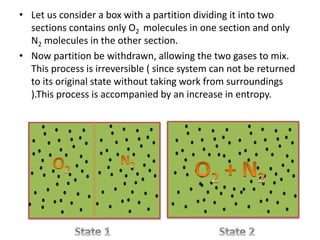


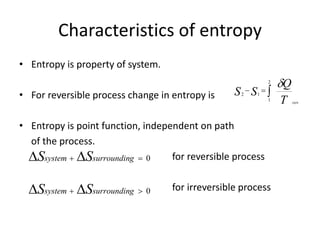


This document discusses entropy in engineering thermodynamics. It defines entropy as a function that shows the possibility of converting heat into work. Entropy increases at a lower rate when heat is added at high temperatures compared to low temperatures. Maximum entropy corresponds to minimum availability to convert heat into work, and minimum entropy corresponds to maximum availability. Entropy can be considered a measure of microscopic disorder in a system. Irreversible processes are associated with a transition from ordered to more disordered states of energy. Mixing gases increases entropy by creating a more random arrangement. Characteristics of entropy include: it is a property of the system, changes depend on temperature for reversible processes, and it is an extensive property expressed in units of energy per degree of temperature.


