BOND ENERGY
BOND ENERGY
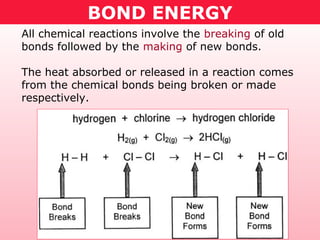
All chemical reactions involve the breaking of old
bonds followed by the making of new bonds.
The heat absorbed or released in a reaction comes
from the chemical bonds being broken or made
respectively.
BOND ENERGY
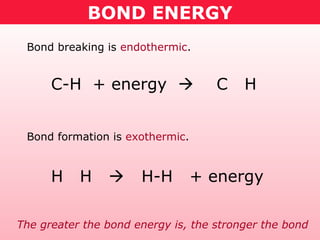
Bond breaking is endothermic.
Bond formation is exothermic.
C-H + energy  C H
H H  H-H + energy
The greater the bond energy is, the stronger the bond
BOND ENERGY
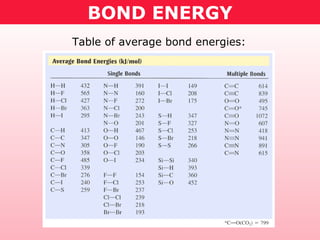
Table of average bond energies:
BOND ENERGY
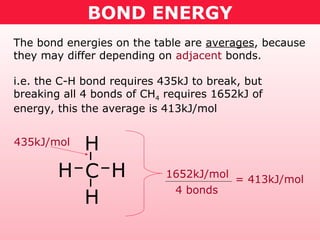
The bond energies on the table are averages, because
they may differ depending on adjacent bonds.
i.e. the C-H bond requires 435kJ to break, but
breaking all 4 bonds of CH4 requires 1652kJ of
energy, this the average is 413kJ/mol
C HH
H
H
435kJ/mol
1652kJ/mol
4 bonds
= 413kJ/mol
BOND ENERGY
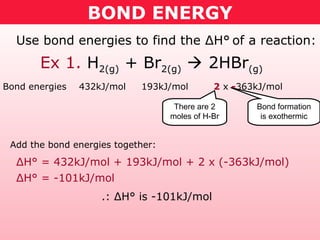
Ex 1. H2(g) + Br2(g)  2HBr(g)
Use bond energies to find the ΔH° of a reaction:
Bond energies 432kJ/mol 193kJ/mol 2 x -363kJ/mol
Add the bond energies together:
There are 2
moles of H-Br
Bond formation
is exothermic
ΔH° = 432kJ/mol + 193kJ/mol + 2 x (-363kJ/mol)
ΔH° = -101kJ/mol
.: ΔH° is -101kJ/mol
BOND ENERGY
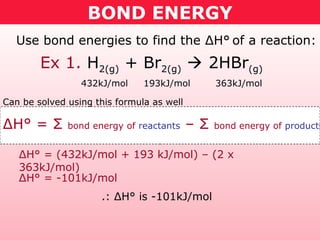
Use bond energies to find the ΔH° of a reaction:
432kJ/mol 193kJ/mol 363kJ/mol
ΔH° = Σ bond energy of reactants – Σ bond energy of products
Can be solved using this formula as well
ΔH° = (432kJ/mol + 193 kJ/mol) – (2 x
363kJ/mol)
ΔH° = -101kJ/mol
.: ΔH° is -101kJ/mol
Ex 1. H2(g) + Br2(g)  2HBr(g)
BOND ENERGY
For more complex molecules…
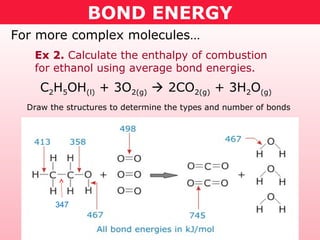
Ex 2. Calculate the enthalpy of combustion
for ethanol using average bond energies.
C2H5OH(l) + 3O2(g)  2CO2(g) + 3H2O(g)
Draw the structures to determine the types and number of bonds
347
BOND ENERGY
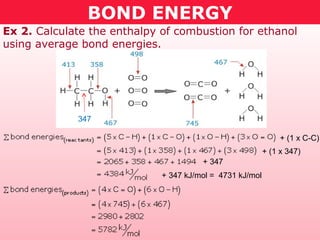
Ex 2. Calculate the enthalpy of combustion for ethanol
using average bond energies.
347
+ (1 x C-C)
+ (1 x 347)
+ 347
+ 347 kJ/mol = 4731 kJ/mol
BOND ENERGY
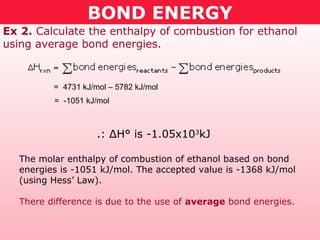
Ex 2. Calculate the enthalpy of combustion for ethanol
using average bond energies.
.: ΔH° is -1.05x10³
kJ
The molar enthalpy of combustion of ethanol based on bond
energies is -1051 kJ/mol. The accepted value is -1368 kJ/mol
(using Hess’ Law).
There difference is due to the use of average bond energies.
= 4731 kJ/mol – 5782 kJ/mol
= -1051 kJ/mol
BOND ENERGY
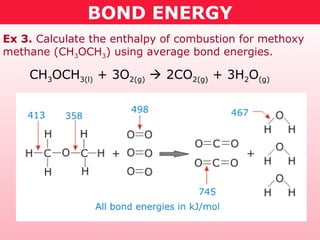
Ex 3. Calculate the enthalpy of combustion for methoxy
methane (CH3OCH3) using average bond energies.
CH3OCH3(l) + 3O2(g)  2CO2(g) + 3H2O(g)
BOND ENERGY
Ex 3. Calculate the enthalpy of combustion for methoxy
methane (CH3OCH3) using average bond energies.
BOND ENERGY
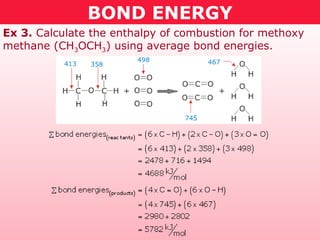
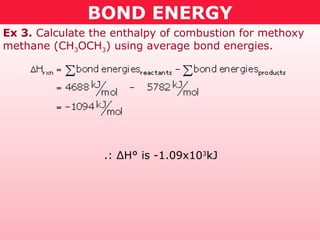
Ex 3. Calculate the enthalpy of combustion for methoxy
methane (CH3OCH3) using average bond energies.
.: ΔH° is -1.09x10³
kJ
BOND ENERGY
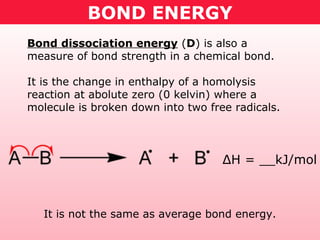
Bond dissociation energy (D) is also a
measure of bond strength in a chemical bond.
It is the change in enthalpy of a homolysis
reaction at abolute zero (0 kelvin) where a
molecule is broken down into two free radicals.
ΔH = __kJ/mol
It is not the same as average bond energy.

Tang 01d bond energy

  • 1.
  • 2.
    BOND ENERGY All chemicalreactions involve the breaking of old bonds followed by the making of new bonds. The heat absorbed or released in a reaction comes from the chemical bonds being broken or made respectively.
  • 3.
    BOND ENERGY Bond breakingis endothermic. Bond formation is exothermic. C-H + energy  C H H H  H-H + energy The greater the bond energy is, the stronger the bond
  • 4.
    BOND ENERGY Table ofaverage bond energies:
  • 5.
    BOND ENERGY The bondenergies on the table are averages, because they may differ depending on adjacent bonds. i.e. the C-H bond requires 435kJ to break, but breaking all 4 bonds of CH4 requires 1652kJ of energy, this the average is 413kJ/mol C HH H H 435kJ/mol 1652kJ/mol 4 bonds = 413kJ/mol
  • 6.
    BOND ENERGY Ex 1.H2(g) + Br2(g)  2HBr(g) Use bond energies to find the ΔH° of a reaction: Bond energies 432kJ/mol 193kJ/mol 2 x -363kJ/mol Add the bond energies together: There are 2 moles of H-Br Bond formation is exothermic ΔH° = 432kJ/mol + 193kJ/mol + 2 x (-363kJ/mol) ΔH° = -101kJ/mol .: ΔH° is -101kJ/mol
  • 7.
    BOND ENERGY Use bondenergies to find the ΔH° of a reaction: 432kJ/mol 193kJ/mol 363kJ/mol ΔH° = Σ bond energy of reactants – Σ bond energy of products Can be solved using this formula as well ΔH° = (432kJ/mol + 193 kJ/mol) – (2 x 363kJ/mol) ΔH° = -101kJ/mol .: ΔH° is -101kJ/mol Ex 1. H2(g) + Br2(g)  2HBr(g)
  • 8.
    BOND ENERGY For morecomplex molecules… Ex 2. Calculate the enthalpy of combustion for ethanol using average bond energies. C2H5OH(l) + 3O2(g)  2CO2(g) + 3H2O(g) Draw the structures to determine the types and number of bonds 347
  • 9.
    BOND ENERGY Ex 2.Calculate the enthalpy of combustion for ethanol using average bond energies. 347 + (1 x C-C) + (1 x 347) + 347 + 347 kJ/mol = 4731 kJ/mol
  • 10.
    BOND ENERGY Ex 2.Calculate the enthalpy of combustion for ethanol using average bond energies. .: ΔH° is -1.05x10³ kJ The molar enthalpy of combustion of ethanol based on bond energies is -1051 kJ/mol. The accepted value is -1368 kJ/mol (using Hess’ Law). There difference is due to the use of average bond energies. = 4731 kJ/mol – 5782 kJ/mol = -1051 kJ/mol
  • 11.
    BOND ENERGY Ex 3.Calculate the enthalpy of combustion for methoxy methane (CH3OCH3) using average bond energies. CH3OCH3(l) + 3O2(g)  2CO2(g) + 3H2O(g)
  • 12.
    BOND ENERGY Ex 3.Calculate the enthalpy of combustion for methoxy methane (CH3OCH3) using average bond energies.
  • 13.
    BOND ENERGY Ex 3.Calculate the enthalpy of combustion for methoxy methane (CH3OCH3) using average bond energies. .: ΔH° is -1.09x10³ kJ
  • 14.
    BOND ENERGY Bond dissociationenergy (D) is also a measure of bond strength in a chemical bond. It is the change in enthalpy of a homolysis reaction at abolute zero (0 kelvin) where a molecule is broken down into two free radicals. ΔH = __kJ/mol It is not the same as average bond energy.