Introduction
Characteristics and factors affecting adsorption
Adsorption isotherm
Gibbs adsorption equation
Discussions of gibbs adsorption equation
Experimental results
Conclusion
References
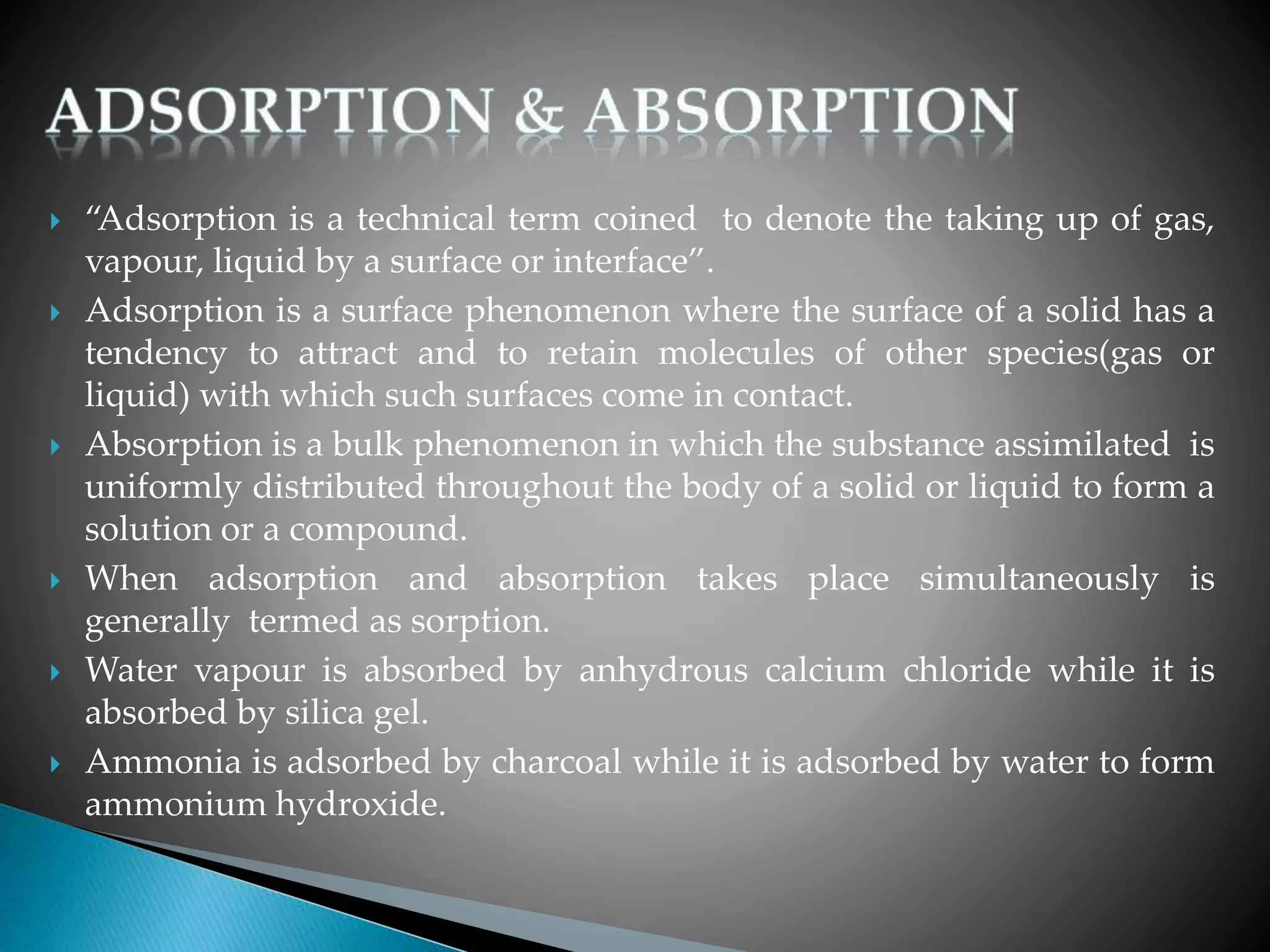
 “Adsorption is a technical term coined to denote the taking up of gas,
vapour, liquid by a surface or interface”.
 Adsorption is a surface phenomenon where the surface of a solid has a
tendency to attract and to retain molecules of other species(gas or
liquid) with which such surfaces come in contact.
 Absorption is a bulk phenomenon in which the substance assimilated is
uniformly distributed throughout the body of a solid or liquid to form a
solution or a compound.
 When adsorption and absorption takes place simultaneously is
generally termed as sorption.
 Water vapour is absorbed by anhydrous calcium chloride while it is
absorbed by silica gel.
 Ammonia is adsorbed by charcoal while it is adsorbed by water to form
ammonium hydroxide.
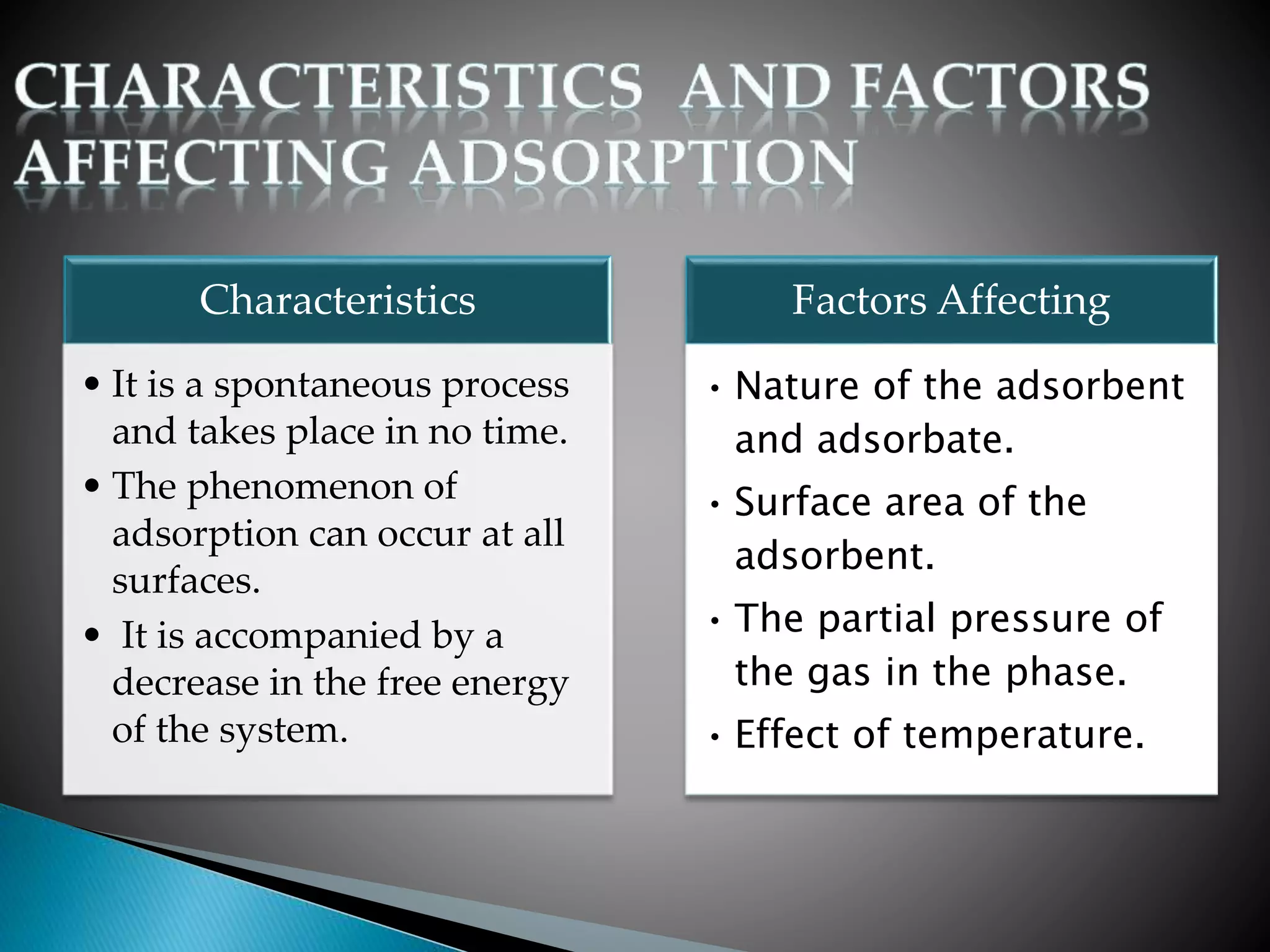
Characteristics
• It is a spontaneous process
and takes place in no time.
• The phenomenon of
adsorption can occur at all
surfaces.
• It is accompanied by a
decrease in the free energy
of the system.
Factors Affecting
• Nature of the adsorbent
and adsorbate.
• Surface area of the
adsorbent.
• The partial pressure of
the gas in the phase.
• Effect of temperature.
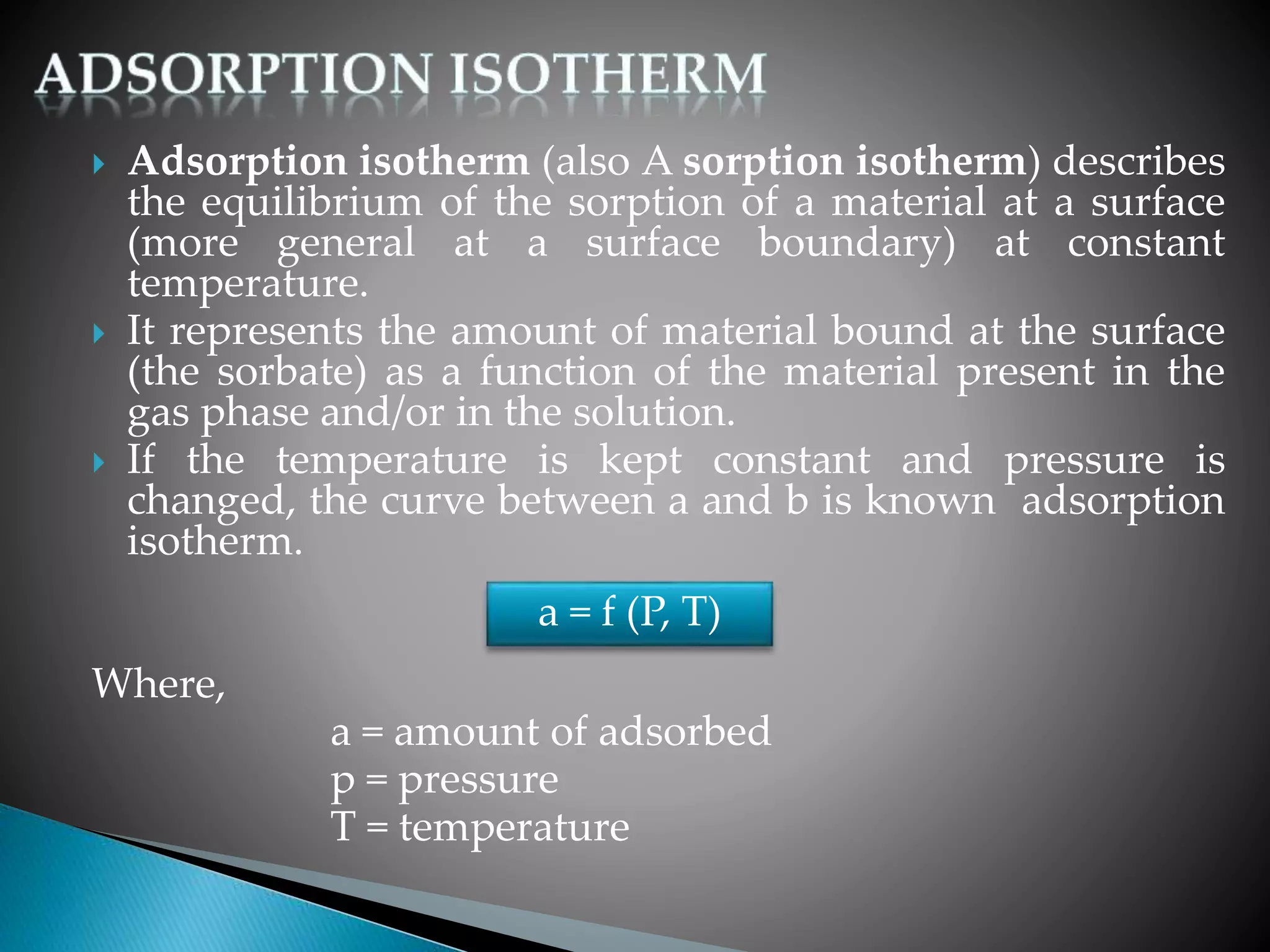
 Adsorption isotherm (also A sorption isotherm) describes
the equilibrium of the sorption of a material at a surface
(more general at a surface boundary) at constant
temperature.
 It represents the amount of material bound at the surface
(the sorbate) as a function of the material present in the
gas phase and/or in the solution.
 If the temperature is kept constant and pressure is
changed, the curve between a and b is known adsorption
isotherm.
Where,
a = amount of adsorbed
p = pressure
T = temperature
a = f (P, T)
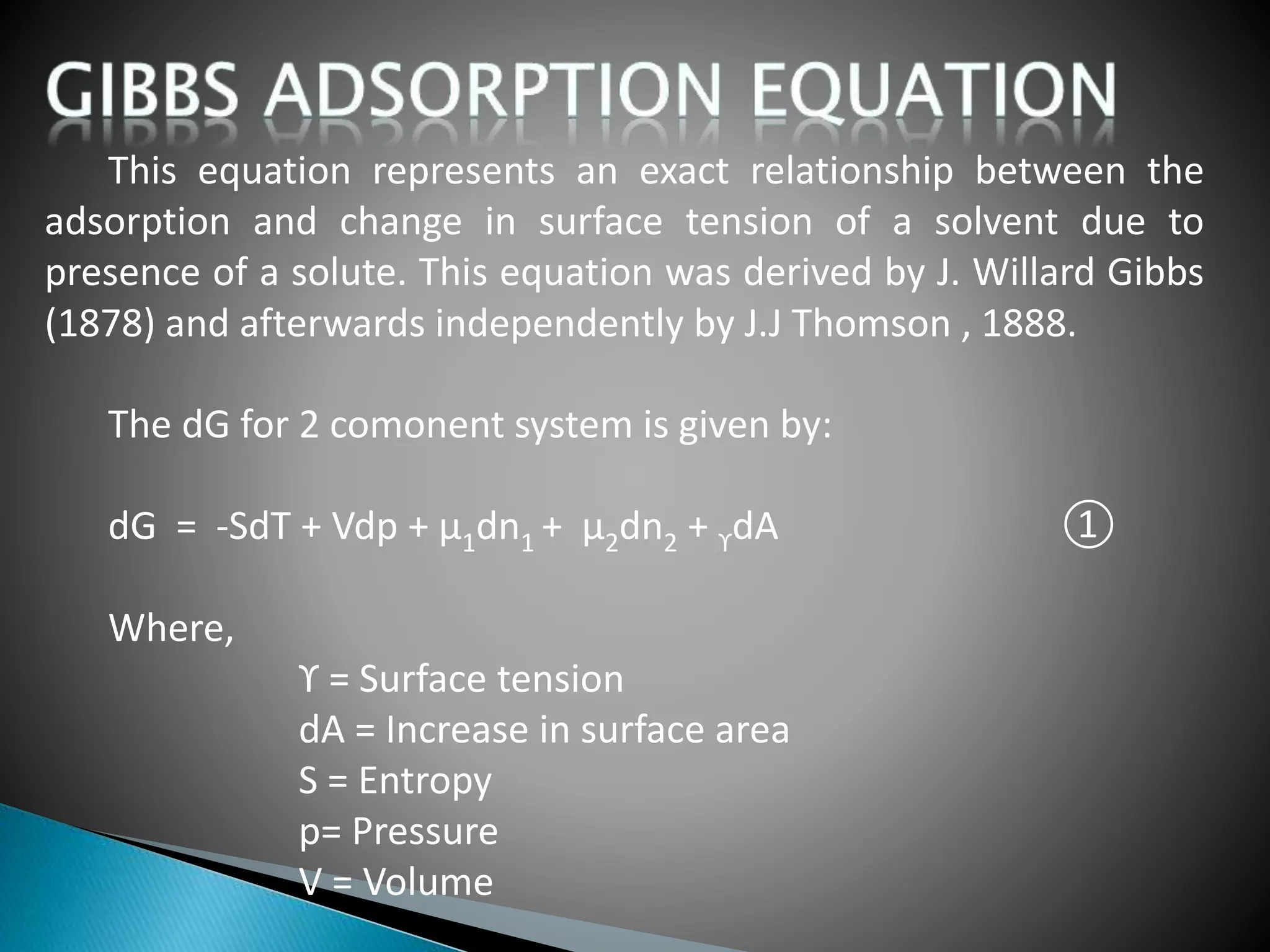
This equation represents an exact relationship between the
adsorption and change in surface tension of a solvent due to
presence of a solute. This equation was derived by J. Willard Gibbs
(1878) and afterwards independently by J.J Thomson , 1888.
The dG for 2 comonent system is given by:
dG = -SdT + Vdp + µ1dn1 + µ2dn2 + ϒdA ①
Where,
ϒ = Surface tension
dA = Increase in surface area
S = Entropy
p= Pressure
V = Volume
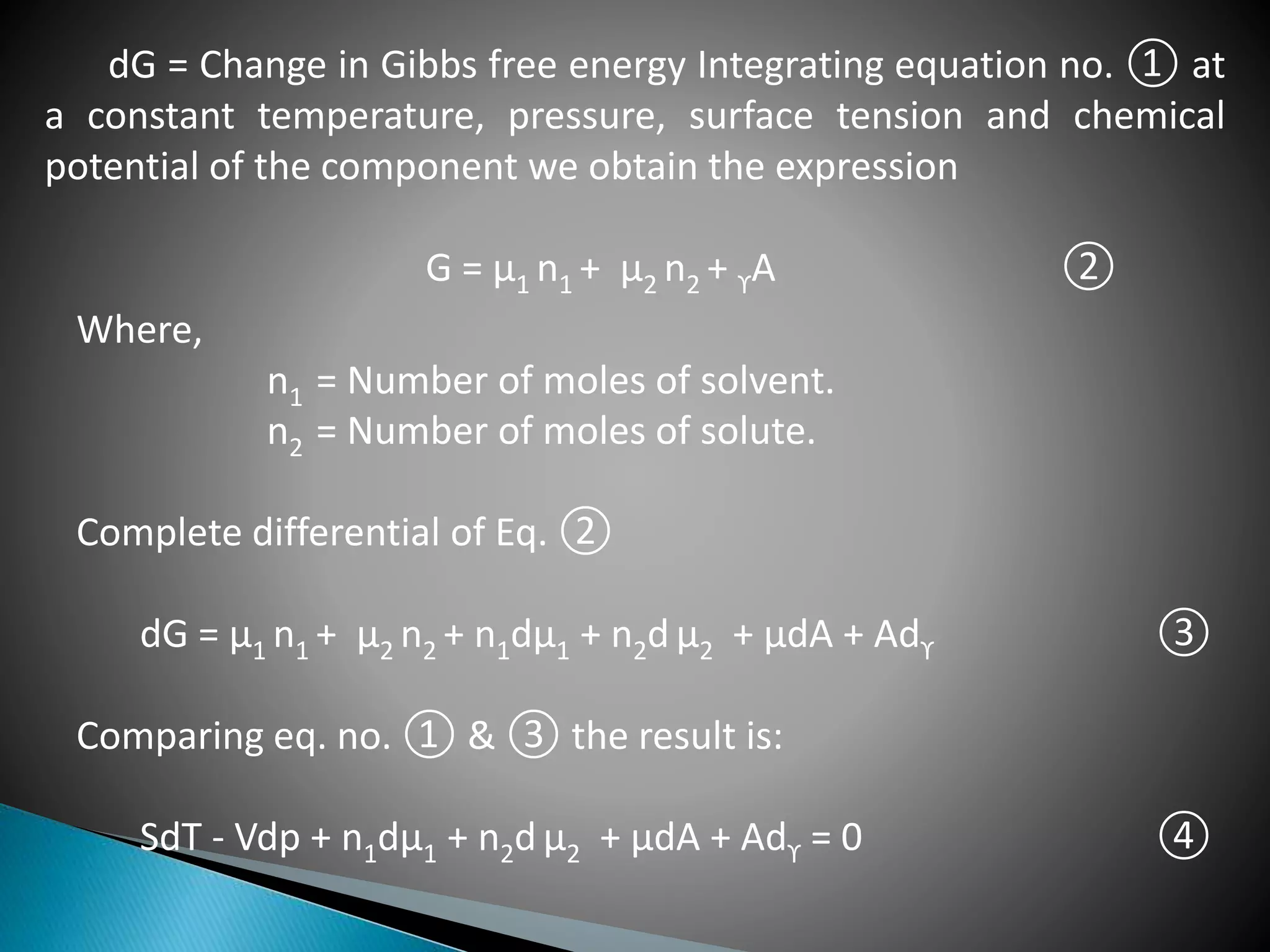
dG = Change in Gibbs free energy Integrating equation no. ① at
a constant temperature, pressure, surface tension and chemical
potential of the component we obtain the expression
G = µ1 n1 + µ2 n2 + ϒA ②
Where,
n1 = Number of moles of solvent.
n2 = Number of moles of solute.
Complete differential of Eq. ②
dG = µ1 n1 + µ2 n2 + n1dµ1 + n2d µ2 + µdA + Adϒ ③
Comparing eq. no. ① & ③ the result is:
SdT - Vdp + n1dµ1 + n2d µ2 + µdA + Adϒ = 0 ④
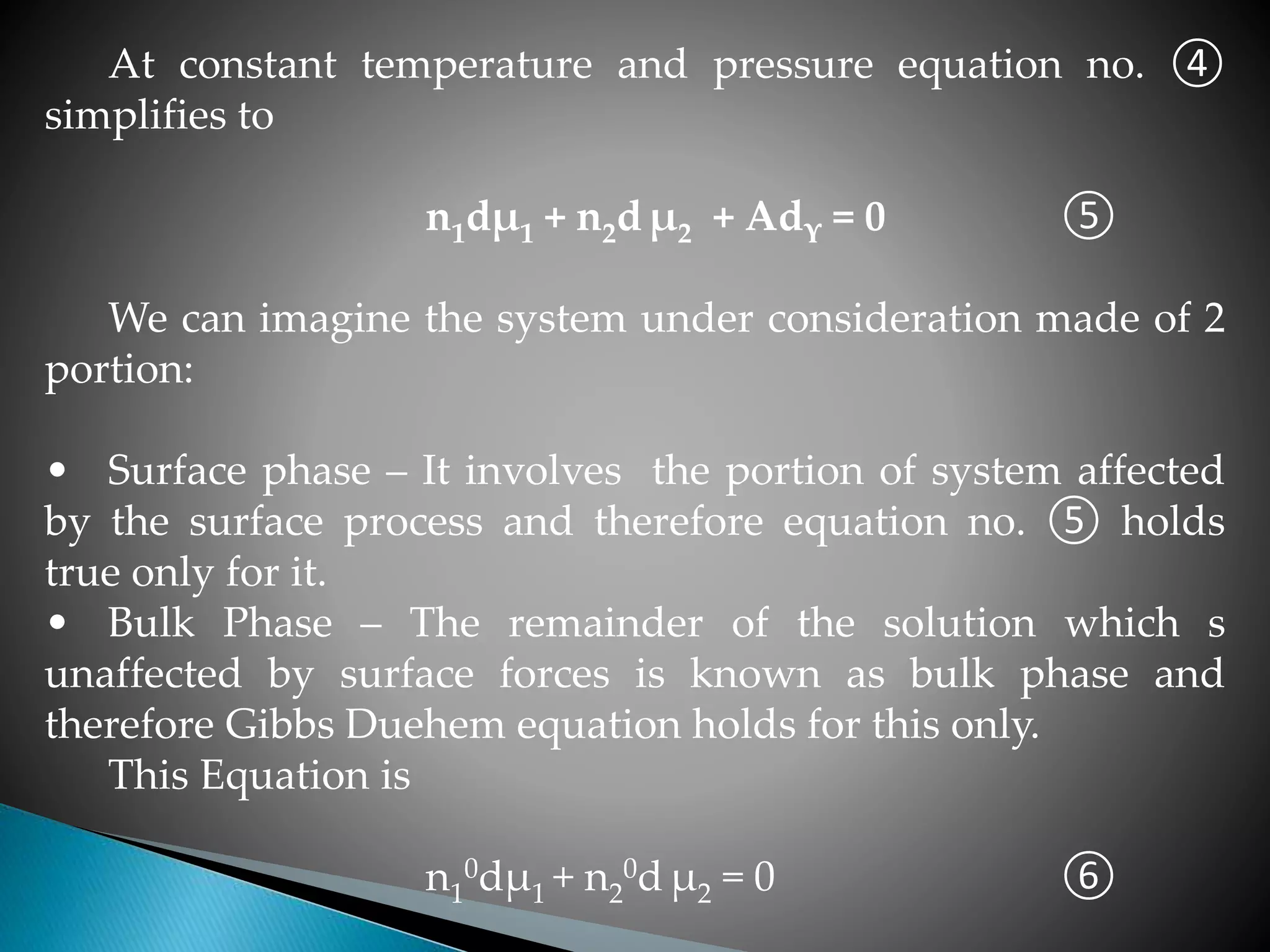
At constant temperature and pressure equation no. ④
simplifies to
n1dµ1 + n2d µ2 + Adϒ = 0 ⑤
We can imagine the system under consideration made of 2
portion:
• Surface phase – It involves the portion of system affected
by the surface process and therefore equation no. ⑤ holds
true only for it.
• Bulk Phase – The remainder of the solution which s
unaffected by surface forces is known as bulk phase and
therefore Gibbs Duehem equation holds for this only.
This Equation is
n1
0dµ1 + n2
0d µ2 = 0 ⑥
Where
On multiplying equation ⑥ by n1/n1
0 and subtracting from
equation no. ⑤ we obtain the expression
Adϒ + (n2 – n1n2
0/n1
0) dµ2 = 0
“Or”
-dϒ/dµ = [n2 - n1n2
0/n1
0]/A ⑦
Where,
n2 Represents no. of moles of solute associated with n1 moles of
solvent in the surface phase and n1n2
0/ n1
0 is the corresponding
quantity in the bulk phase. It therefore, follows that the quantity [n2
- n1n2
0/n1
0]/A is the excess concentration of the solute per unit area
of the surface and is usually designated by the symbol ‘ᴦ’
Thus equation no. 7 becomes as
ᴦ = -dϒ/ dµ2 ⑧
Where ᴦ is independent of n1 and is dependent only on the nature of surface phase
and not on its amount.
ᴦ is also called the surface concentration of solute per unit area of interface .
For a solution :
µ2 = µ2
0 + RT ln a2 ⑨
Where,
a2 is the activity of solute
By differentiating equation no. ⑨ we get:
dµ= RT d ln a2 ⑩
Assuming µ2
0 as a constant
On substituting eq. no. ⑩ in eq. no. ⑧ we get,
ᴦ= 1/ RT ₓ dϒ/d ln a2
or
ᴦ= -a2/ RT ₓ dϒ/da2 [Since d ln a2 = da2/a2 ] ⑪
Equation no. ⑪ is known as Gibbs Adsorption Equation.
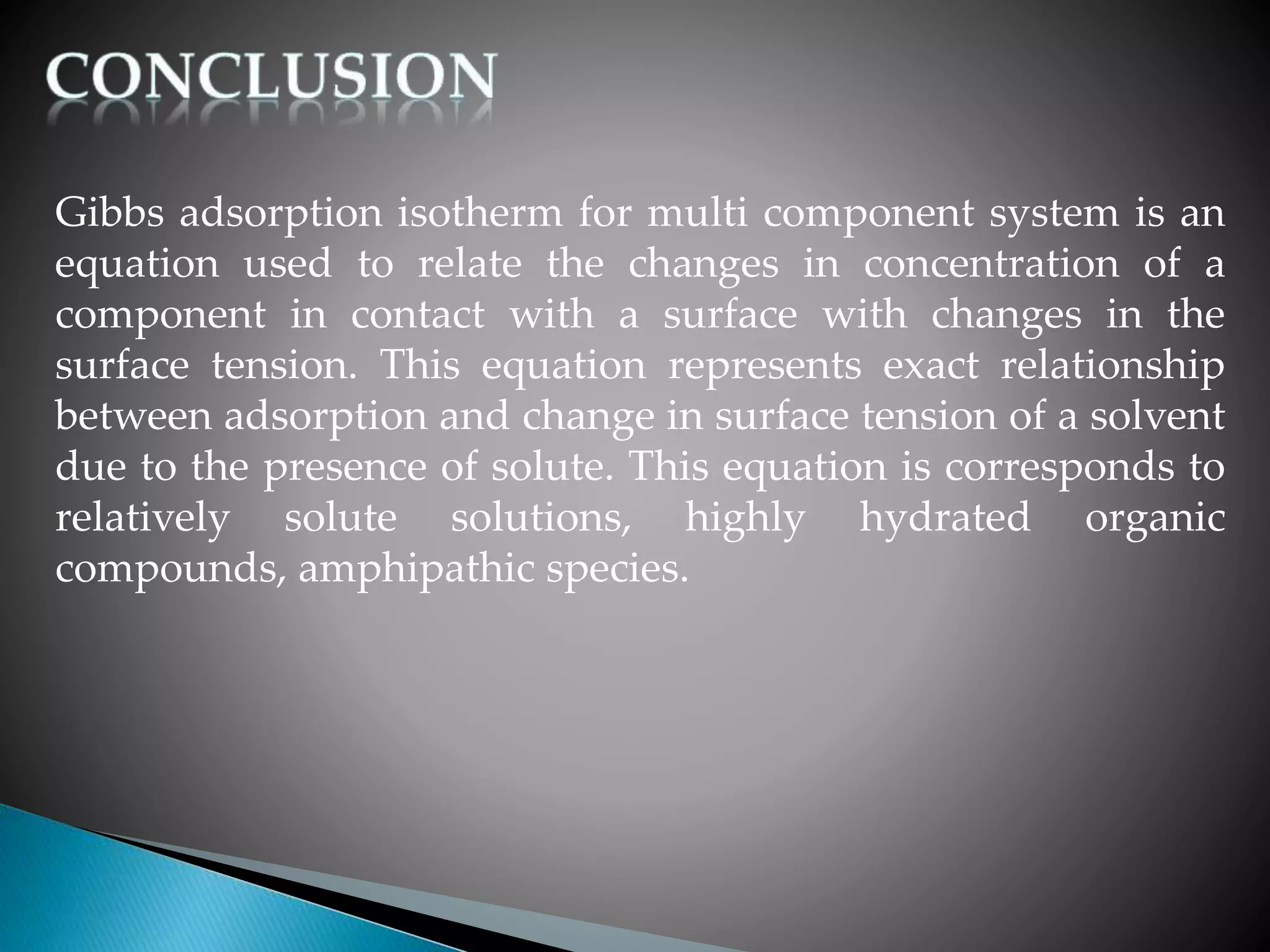
Gibbs adsorption isotherm for multi component system is an
equation used to relate the changes in concentration of a
component in contact with a surface with changes in the
surface tension. This equation represents exact relationship
between adsorption and change in surface tension of a solvent
due to the presence of solute. This equation is corresponds to
relatively solute solutions, highly hydrated organic
compounds, amphipathic species.
Source:
• Advanced physical chemistry Gurdeep Raj, Krishna Prakashan Media,
2012.
• Advanced physical chemistry Gurtu-Gurtu, Pragati Prakashan, Meerut,
2011.
Net Source:
•www.wikipedia.com

Gibbs Adsorption Isotherm

  • 2.
    Introduction Characteristics and factorsaffecting adsorption Adsorption isotherm Gibbs adsorption equation Discussions of gibbs adsorption equation Experimental results Conclusion References
  • 3.
     “Adsorption isa technical term coined to denote the taking up of gas, vapour, liquid by a surface or interface”.  Adsorption is a surface phenomenon where the surface of a solid has a tendency to attract and to retain molecules of other species(gas or liquid) with which such surfaces come in contact.  Absorption is a bulk phenomenon in which the substance assimilated is uniformly distributed throughout the body of a solid or liquid to form a solution or a compound.  When adsorption and absorption takes place simultaneously is generally termed as sorption.  Water vapour is absorbed by anhydrous calcium chloride while it is absorbed by silica gel.  Ammonia is adsorbed by charcoal while it is adsorbed by water to form ammonium hydroxide.
  • 4.
    Characteristics • It isa spontaneous process and takes place in no time. • The phenomenon of adsorption can occur at all surfaces. • It is accompanied by a decrease in the free energy of the system. Factors Affecting • Nature of the adsorbent and adsorbate. • Surface area of the adsorbent. • The partial pressure of the gas in the phase. • Effect of temperature.
  • 5.
     Adsorption isotherm(also A sorption isotherm) describes the equilibrium of the sorption of a material at a surface (more general at a surface boundary) at constant temperature.  It represents the amount of material bound at the surface (the sorbate) as a function of the material present in the gas phase and/or in the solution.  If the temperature is kept constant and pressure is changed, the curve between a and b is known adsorption isotherm. Where, a = amount of adsorbed p = pressure T = temperature a = f (P, T)
  • 6.
    This equation representsan exact relationship between the adsorption and change in surface tension of a solvent due to presence of a solute. This equation was derived by J. Willard Gibbs (1878) and afterwards independently by J.J Thomson , 1888. The dG for 2 comonent system is given by: dG = -SdT + Vdp + µ1dn1 + µ2dn2 + ϒdA ① Where, ϒ = Surface tension dA = Increase in surface area S = Entropy p= Pressure V = Volume
  • 7.
    dG = Changein Gibbs free energy Integrating equation no. ① at a constant temperature, pressure, surface tension and chemical potential of the component we obtain the expression G = µ1 n1 + µ2 n2 + ϒA ② Where, n1 = Number of moles of solvent. n2 = Number of moles of solute. Complete differential of Eq. ② dG = µ1 n1 + µ2 n2 + n1dµ1 + n2d µ2 + µdA + Adϒ ③ Comparing eq. no. ① & ③ the result is: SdT - Vdp + n1dµ1 + n2d µ2 + µdA + Adϒ = 0 ④
  • 8.
    At constant temperatureand pressure equation no. ④ simplifies to n1dµ1 + n2d µ2 + Adϒ = 0 ⑤ We can imagine the system under consideration made of 2 portion: • Surface phase – It involves the portion of system affected by the surface process and therefore equation no. ⑤ holds true only for it. • Bulk Phase – The remainder of the solution which s unaffected by surface forces is known as bulk phase and therefore Gibbs Duehem equation holds for this only. This Equation is n1 0dµ1 + n2 0d µ2 = 0 ⑥
  • 9.
    Where On multiplying equation⑥ by n1/n1 0 and subtracting from equation no. ⑤ we obtain the expression Adϒ + (n2 – n1n2 0/n1 0) dµ2 = 0 “Or” -dϒ/dµ = [n2 - n1n2 0/n1 0]/A ⑦ Where, n2 Represents no. of moles of solute associated with n1 moles of solvent in the surface phase and n1n2 0/ n1 0 is the corresponding quantity in the bulk phase. It therefore, follows that the quantity [n2 - n1n2 0/n1 0]/A is the excess concentration of the solute per unit area of the surface and is usually designated by the symbol ‘ᴦ’ Thus equation no. 7 becomes as ᴦ = -dϒ/ dµ2 ⑧
  • 10.
    Where ᴦ isindependent of n1 and is dependent only on the nature of surface phase and not on its amount. ᴦ is also called the surface concentration of solute per unit area of interface . For a solution : µ2 = µ2 0 + RT ln a2 ⑨ Where, a2 is the activity of solute By differentiating equation no. ⑨ we get: dµ= RT d ln a2 ⑩ Assuming µ2 0 as a constant On substituting eq. no. ⑩ in eq. no. ⑧ we get, ᴦ= 1/ RT ₓ dϒ/d ln a2 or ᴦ= -a2/ RT ₓ dϒ/da2 [Since d ln a2 = da2/a2 ] ⑪ Equation no. ⑪ is known as Gibbs Adsorption Equation.
  • 11.
    Gibbs adsorption isothermfor multi component system is an equation used to relate the changes in concentration of a component in contact with a surface with changes in the surface tension. This equation represents exact relationship between adsorption and change in surface tension of a solvent due to the presence of solute. This equation is corresponds to relatively solute solutions, highly hydrated organic compounds, amphipathic species.
  • 12.
    Source: • Advanced physicalchemistry Gurdeep Raj, Krishna Prakashan Media, 2012. • Advanced physical chemistry Gurtu-Gurtu, Pragati Prakashan, Meerut, 2011. Net Source: •www.wikipedia.com