Embed presentation
Download as PDF, PPTX


This chapter discusses different approaches for incorporating prior knowledge into machine learning algorithms. It describes decision trees/lists that represent knowledge as facts and learning first-order logic sentences that represent objects and relations. It also discusses constructing hypothesis spaces, inductive learning approaches, and search strategies like least-commitment search. Explanation-based learning and inductive logic programming are presented as ways to leverage background knowledge to more efficiently learn from examples. Inverse resolution is discussed as a way to perform inductive logic programming by running proofs backward.
Introduction to the chapter on knowledge in learning by Scott Christley and Alfredo Arvide.
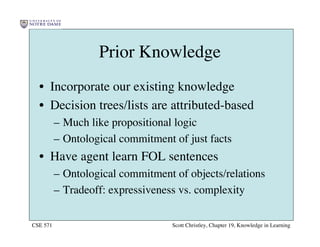
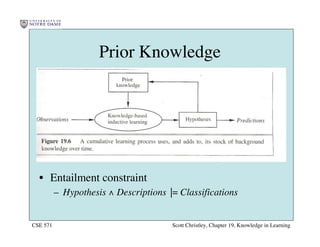
Discusses incorporating existing knowledge in decision trees, ontological commitments, and trade-offs between expressiveness and complexity.
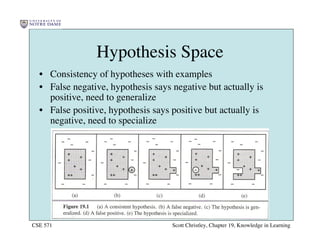
Explains the importance of hypothesis consistency, false positives, and negatives in the context of learning hypotheses.
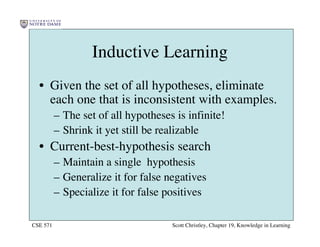
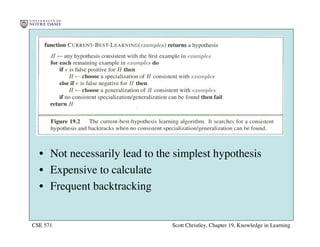
Details the process of inductive learning, including hypothesis elimination, search strategies, and challenges in achieving the simplest hypothesis.
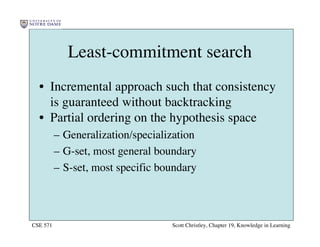
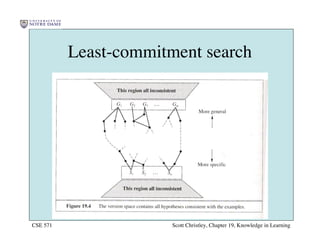
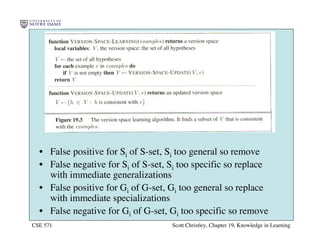
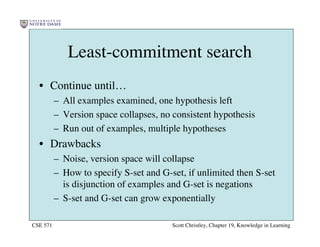
Presents least-commitment search method, its incremental approach, and the implications of false positives and negatives in hypothesis spaces.
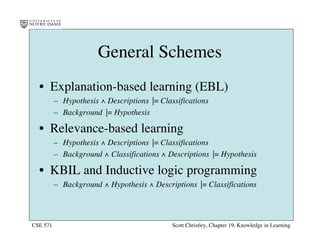
Introduces general schemes for learning including explanation-based learning (EBL), relevance-based learning, and their relationships.
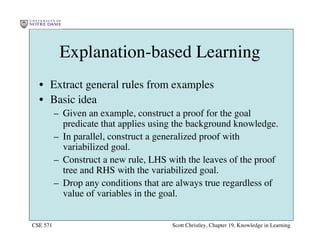
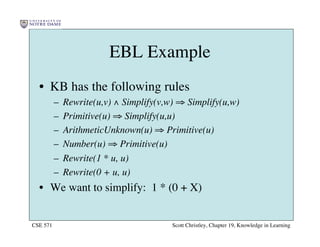
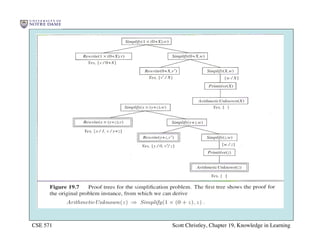
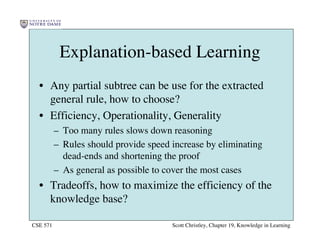
Describes EBL, its process of extracting general rules, and the efficiency concerns in rule extraction.
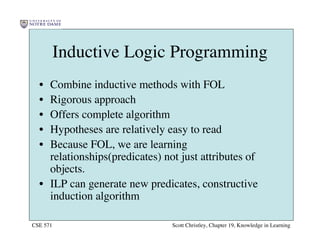
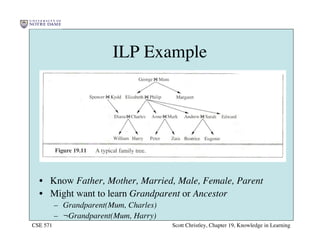
Explains ILP as a combination of inductive methods with first-order logic, including practical applications and algorithms.
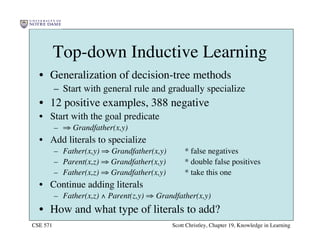
Describes the top-down approach to inductive learning and examples of specializing general rules.
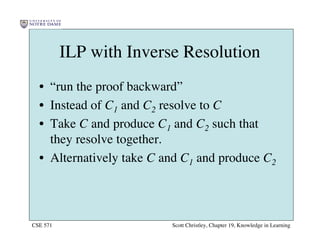
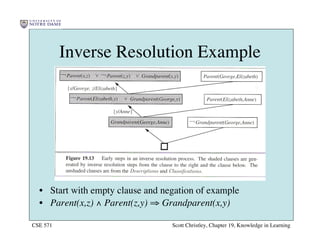
Explains the concept of inverse resolution, how it operates, and its application in generating clauses.
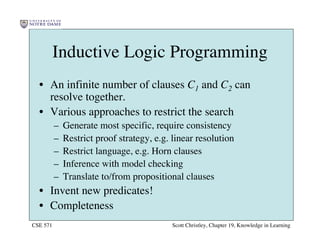
Summarizes the challenges and strategies in ILP, including search restrictions and the ability to invent new predicates.
Final slide expressing thanks and concluding the presentation on knowledge in learning.


