Feature Selection
Feature Selection
• It is the process of selecting a subset of relevant features
for use in model construction.
• It is also called variable selection or attribute selection.
• It reduces the complexity of model.
• It either improve or maintain accuracy of model.
Curse of Dimensionality
• The amount of data required to
achieve the same level of
accuracy increases exponentially
as the number of features
increases.
• But in practice, the volume of
training data available to us is
fixed. Therefore, in most cases,
the performance of the classifier
will decrease with an increased
number of variables.
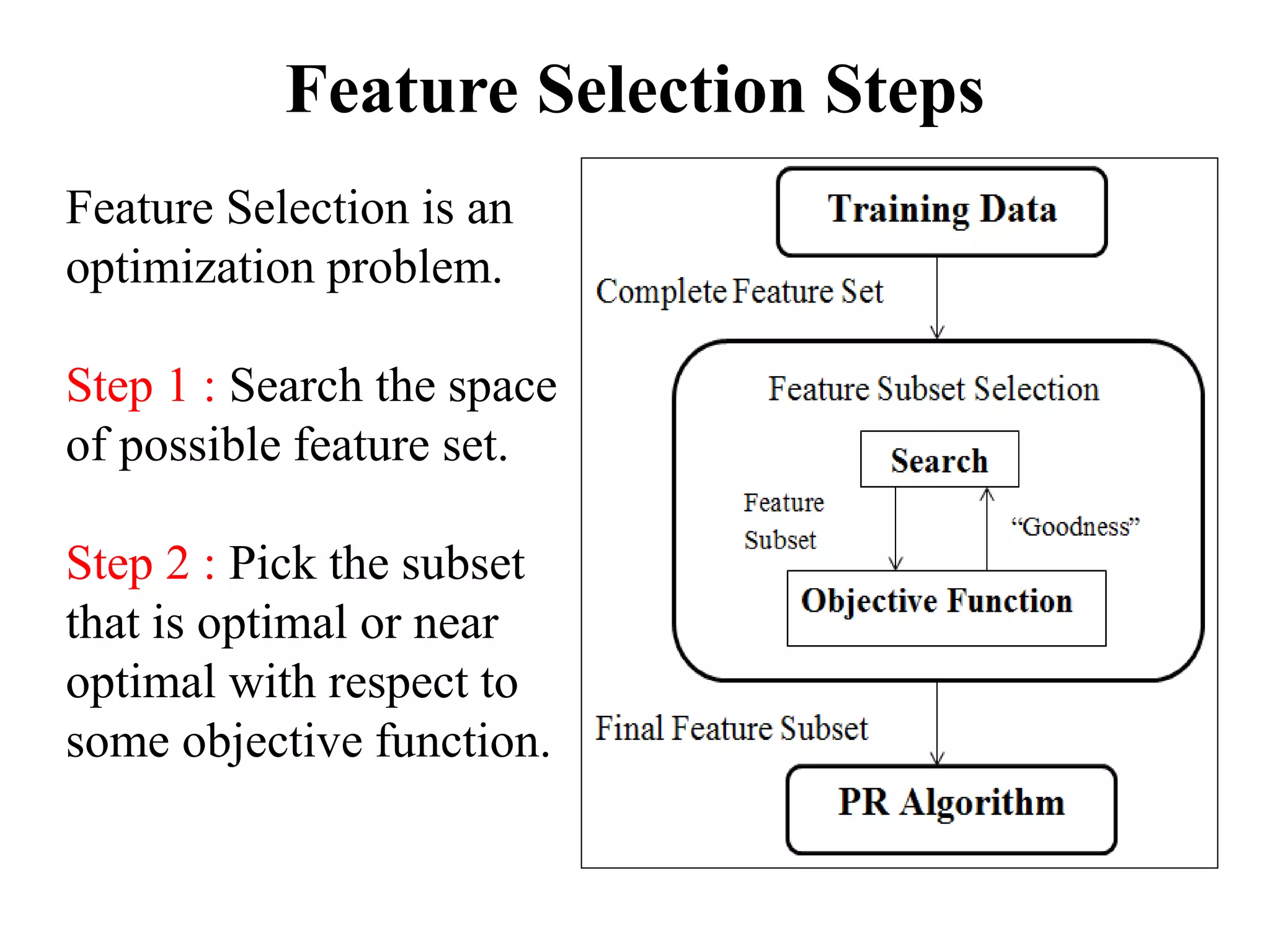
Feature Selection Steps
Feature Selection is an
optimization problem.
Step 1 : Search the space
of possible feature set.
Step 2 : Pick the subset
that is optimal or near
optimal with respect to
some objective function.
Feature Selection Methods
• Feature Selection Algorithms can be broadly
classified into 3 classes :
– Filter Methods
– Wrapper Methods
– Embedded Methods
Filter Methods
• purely Statistical in nature.
• used as a preprocessing step.
• the selection of features is independent of any machine
learning algorithms.
• features are selected on the basis of their scores in various
statistical tests for their correlation with the outcome variable.
Feature
Categorical Continuous
Response
Categorical Chi-Square Anova
Continuous LDA Pearson
Correlation
• LDA: Linear discriminant analysis is used to find a linear combination of
features that characterizes or separates two or more classes (or levels) of a
categorical variable.
• ANOVA: ANOVA stands for Analysis of variance. It is similar to LDA
except for the fact that it is operated using one or more categorical
independent features and one continuous dependent feature. It provides a
statistical test of whether the means of several groups are equal or not.
• Chi-Square: It is a dependency test which helps us to determine either
there is any kind of dependence among the variables under observation or
not.
• Pearson’s Correlation: It is used as a measure for quantifying linear
dependence between two continuous variables X and Y. Its value varies
from -1 to +1.
Wrapper Method
• work on the basic principles of Combinatorics.
• the learning algorithm (classifier) itself is used to perform the
Feature Selection and select the top features.
• Examples :
– forward feature selection
– backward feature elimination
– recursive feature elimination
• Forward Selection: Forward selection is an iterative method in
which we start with having no feature in the model. In each
iteration, we keep adding the feature which best improves our model
till an addition of a new variable does not improve the performance
of the model.
• Backward Elimination: In backward elimination, we start with all
the features and removes the least significant feature at each
iteration which improves the performance of the model. We repeat
this until no improvement is observed on removal of features.
• Recursive Feature elimination: It is a greedy optimization
algorithm which aims to find the best performing feature subset. It
repeatedly creates models and keeps aside the best or the worst
performing feature at each iteration. It constructs the next model
with the left features until all the features are exhausted. It then
ranks the features based on the order of their elimination.
Embedded Methods
• combine the qualities of filter and wrapper methods.
• dynamic Feature Selection Methods.
• Based on the inferences that we draw from the previous
model, we decide to add or remove features from your subset.
The problem is essentially reduced to a search problem.
Thank You !

Feature selection

  • 1.
  • 2.
    Feature Selection • Itis the process of selecting a subset of relevant features for use in model construction. • It is also called variable selection or attribute selection. • It reduces the complexity of model. • It either improve or maintain accuracy of model.
  • 3.
    Curse of Dimensionality •The amount of data required to achieve the same level of accuracy increases exponentially as the number of features increases. • But in practice, the volume of training data available to us is fixed. Therefore, in most cases, the performance of the classifier will decrease with an increased number of variables.
  • 4.
    Feature Selection Steps FeatureSelection is an optimization problem. Step 1 : Search the space of possible feature set. Step 2 : Pick the subset that is optimal or near optimal with respect to some objective function.
  • 5.
    Feature Selection Methods •Feature Selection Algorithms can be broadly classified into 3 classes : – Filter Methods – Wrapper Methods – Embedded Methods
  • 6.
    Filter Methods • purelyStatistical in nature. • used as a preprocessing step. • the selection of features is independent of any machine learning algorithms. • features are selected on the basis of their scores in various statistical tests for their correlation with the outcome variable. Feature Categorical Continuous Response Categorical Chi-Square Anova Continuous LDA Pearson Correlation
  • 7.
    • LDA: Lineardiscriminant analysis is used to find a linear combination of features that characterizes or separates two or more classes (or levels) of a categorical variable. • ANOVA: ANOVA stands for Analysis of variance. It is similar to LDA except for the fact that it is operated using one or more categorical independent features and one continuous dependent feature. It provides a statistical test of whether the means of several groups are equal or not. • Chi-Square: It is a dependency test which helps us to determine either there is any kind of dependence among the variables under observation or not. • Pearson’s Correlation: It is used as a measure for quantifying linear dependence between two continuous variables X and Y. Its value varies from -1 to +1.
  • 8.
    Wrapper Method • workon the basic principles of Combinatorics. • the learning algorithm (classifier) itself is used to perform the Feature Selection and select the top features. • Examples : – forward feature selection – backward feature elimination – recursive feature elimination
  • 9.
    • Forward Selection:Forward selection is an iterative method in which we start with having no feature in the model. In each iteration, we keep adding the feature which best improves our model till an addition of a new variable does not improve the performance of the model. • Backward Elimination: In backward elimination, we start with all the features and removes the least significant feature at each iteration which improves the performance of the model. We repeat this until no improvement is observed on removal of features. • Recursive Feature elimination: It is a greedy optimization algorithm which aims to find the best performing feature subset. It repeatedly creates models and keeps aside the best or the worst performing feature at each iteration. It constructs the next model with the left features until all the features are exhausted. It then ranks the features based on the order of their elimination.
  • 10.
    Embedded Methods • combinethe qualities of filter and wrapper methods. • dynamic Feature Selection Methods. • Based on the inferences that we draw from the previous model, we decide to add or remove features from your subset. The problem is essentially reduced to a search problem.
  • 11.