All images from wikimedia commons, a freely-licensed media repository
“ Classifiers” R & D project by Aditya M Joshi [email_address] IIT Bombay Under the guidance of   Prof. Pushpak Bhattacharyya [email_address] IIT Bombay
Overview
Introduction to Classification
What is classification? A machine learning task that deals with identifying the class to which an instance belongs  A classifier performs classification Classifier Test instance  Attributes (a1, a2,… an) Discrete-valued Class label ( Age, Marital status,  Health status, Salary ) Issue Loan? {Yes, No} ( Perceptive inputs ) Steer? { Left, Straight, Right } Category of document? {Politics, Movies, Biology} ( Textual features : Ngrams )
Classification learning Training  phase Testing  phase Learning the classifier from the available data  ‘Training set’ (Labeled) Testing how well the classifier performs ‘Testing set’
Generating datasets Methods: Holdout (2/3 rd  training, 1/3 rd  testing) Cross validation (n – fold) Divide into n parts Train on (n-1), test on last Repeat for different combinations Bootstrapping Select random samples to form the training set
Evaluating classifiers Outcome: Accuracy Confusion matrix If cost-sensitive, the expected cost of classification ( attribute test cost + misclassification cost) etc.
Decision Trees
Diagram from Han-Kamber Example tree Intermediate nodes :  Attributes Leaf nodes :  Class predictions Edges :  Attribute value tests Example algorithms:  ID3, C4.5, SPRINT, CART
Decision Tree schematic Training data set a1 a2 a3 a4 a5   a6 a1 a2 a3 a4 a5   a6 X Y Z Pure node, Leaf node: Class  RED Impure node, Select best attribute and continue Impure node, Select best attribute and continue
Decision Tree Issues How to avoid overfitting? Problem : Classifier performs well on training data, but fails  to give good results on test data Example:  Split on primary key gives pure nodes and good accuracy on training – not for testing Alternatives: Pre-prune : Halting construction at a certain level of tree /  level of purity Post-prune : Remove a node if the error rate remains the same without it. Repeat process for all nodes in the d.tree How does the type of attribute affect the split? Discrete-valued: Each branch corresponding to a value Continuous-valued: Each branch may be a range of values (e.g.: splits may be age < 30, 30 < age < 50, age > 50 ) (aimed at maximizing the gain/gain ratio) How to determine the attribute for split? Alternatives: Information Gain Gain (A, S) = Entropy (S) –  Σ  ( (Sj/S)*Entropy(Sj) ) Other options: Gain ratio, etc.
Lazy learners
Lazy learners ‘ Lazy ’: Do not create a model of the training instances in advance When an instance arrives for testing, runs the algorithm to get the class prediction Example, K – nearest neighbour classifier  (K – NN classifier) “ One is known by the company one keeps”
K-NN classifier schematic For a test instance,  Calculate distances from training pts. Find K-nearest neighbours (say, K = 3) Assign class label based on majority
K-NN classifier Issues How good is it? Susceptible to noisy values  Slow because of distance calculation Alternate approaches: Distances to representative points only Partial distance Any other modifications? Alternatives: Weighted attributes to decide final label Assign distance to missing values as <max> K=1 returns class label of nearest neighbour How to determine value of K? Alternatives: Determine K experimentally. The K that gives minimum error is selected. How to make real-valued prediction? Alternative: Average the values returned by K-nearest neighbours How to determine distances between values of categorical  attributes? Alternatives: Boolean distance (1 if same, 0 if different) Differential grading (e.g. weather – ‘drizzling’ and ‘rainy’ are  closer than ‘rainy’ and ‘sunny’ )
Decision Lists
A sequence of boolean functions that lead to a result if h1 (y) = 1 then set f (y) = c1 else if h2 (y)  = 1 then set f (y) = c2 … . else set f (y) = cn Decision Lists f ( y ) = cj, if j  = min { i | hi (y) = 1 } exists 0 otherwise
Decision List example Test instance ( h i , c i ) Unit Class label
Decision List learning R S’ = S Set of candidate feature functions For each hi, Qi = Pi U Ni ( hi  = 1 ) U i = max { | Pi| - pn * | Ni | , |Ni| - pp *|Pi| } Select hk, the feature with highest utility ( h k,   ) If  (| Pi| - pn * | Ni | > |Ni| - pp *|Pi| )  then 1 else 0 1 / 0 - Qk
Decision list Issues Pruning? hi is not required if :  c  i  = c  (r+1) There is no h j ( j > i ) such that  Q i = Q j Accuracy / Complexity tradeoff? Size of R : Complexity (Length of the list) S’ contains examples of both classes : Accuracy (Purity) What is the terminating condition? Size of R (an upper threshold) Q k  = null S’ contains examples of same class
Probabilistic classifiers
Based on Bayes rule Naïve Bayes : Conditional independence assumption Probabilistic classifiers : NB
Naïve Bayes Issues How are different types of attributes  handled? Discrete-valued : P ( X | Ci ) is according to  formula Continous-valued : Assume gaussian distribution. Plug in mean and variance for the attribute and assign it to P ( X | Ci ) Problems due to sparsity of data? Problem : Probabilities for some values may be zero Solution : Laplace smoothing For each attribute value,  update probability m / n as : (m + 1) / (n + k)  where k = domain of values
Bayesian belief networks : Attributes ARE dependent A directed acyclic graph and conditional probability tables Probabilistic classifiers : BBN Diagram from Han-Kamber An added term for conditional  probability between attributes:
(when network structure known) Input : Network topology of BBN Output : Calculate the entries in conditional probability table (when network structure not known) ??? BBN learning
Use Naïve Bayes as a basis pattern Add edges as required Examples of algorithms: TAN, K2 Learning structure of BBN Loan Age Family status Marital status
Artificial Neural Networks
Based on biological concept of neurons Structure of a fundamental unit of ANN: Artificial Neural Networks w0 w1 wn threshold output: : activation function p (v) where  p (v)  = sgn (w 0  + w 1 x 1  + … + w n x n  ) input
Initialize values of weights Apply training instances and get output Update weights according to the update rule: Repeat till converges Can represent linearly separable functions only Perceptron learning algorithm n : learning rate t : target output o : observed output
Basis for multilayer feedforward networks Sigmoid perceptron
Multilayer? Feedforward?  Multilayer feedforward networks Input layer Output layer Hidden layer Diagram from Han-Kamber
Apply training instances as input and produce output Update weights in the ‘reverse’ direction as follows: Backpropagation Diagram from Han-Kamber
ANN Issues Addition of momentum But why? Choosing the learning factor A small learning factor means multiple iterations  required. A large learning factor means the learner may skip the global minimum What are the types of learning  approaches? Deterministic: Update weights after summing up Errors over all examples Stochastic: Update weights per example Learning the structure of the network Construct a complete network Prune using heuristics: Remove edges with weights nearly zero Remove edges if the removal does not affect accuracy
Support vector machines
Support vector machines Basic ideas Separating hyperplane : wx+b = 0 Margin Support vectors “ Maximum separating-margin classifier” +1 -1
SVM training Problem formulation Minimize (1 / 2) || w || 2 w.r.t. (y i  ( w x i  + b ) – 1) >=  0 for all i  Lagrangian multipliers are zero for data instances other than support vectors Dot product of xk and xl
Focussing on dot product For non-linear separable points,  we plan to map them to a higher dimensional (and linearly separable) space The product    can be time-consuming. Therefore, we use kernel functions
Kernel functions Without having to know the non-linear mapping, apply kernel function, say,  Reduces the number of computations required to generate Q kl values.
Testing SVM SVM Test instance Class  label
SVM Issues SVMs are immune to the removal of  non-support-vector points What if n-classes are to be predicted? Problem : SVMs deal with two-class classification Solution : Have multiple SVMs each for one class
Combining classifiers
Combining Classifiers ‘Ensemble’ learning Use a combination of models for prediction Bagging : Majority votes Boosting : Attention to the ‘weak’ instances Goal : An improved combined model
Bagging Total set Sample D 1 Classifier model M 1 At random. May use bootstrap sampling with replacement Training dataset D Classifier learning scheme Classifier model M n Test  set Majority vote Class Label
Boosting (AdaBoost) Total set Sample D 1 Classifier model M 1 Selection based on weight. May use bootstrap sampling with replacement Training dataset D Classifier learning scheme Classifier model M n Test  set Weighted vote Class Label Initialize weights of instances to 1/d Weights of  correctly classified instances multiplied by error / (1 – error) If error > 0.5? Error Error `
The last slice
Data preprocessing Attribute subset selection Select a subset of total attributes to reduce complexity Dimensionality reduction Transform instances into ‘smaller’ instances
Attribute subset selection Information gain measure for attribute selection in decision trees Stepwise forward / backward elimination of attributes
Dimensionality reduction High dimensions : Computational complexity Number of attributes of  a data instance instance x in p-dimensions instance x in k-dimensions k < p s = Wx W is k x p transformation mtrx.
Principal Component Analysis Computes k orthonormal vectors : Principal components Essentially provide a new set of axes – in decreasing order of variance Eigenvector matrix ( p X p ) First k are k PCs (  p X n ) ( p X n ) (k X n)  (p X n) (k X p)  Diagram from Han-Kamber
Weka &  Weka Demo
Weka &  Weka Demo Collection of ML algorithms  Get it from :  http://www.cs.waikato.ac.nz/ml/weka/ ARFF Format ‘ Weka Explorer’
ARFF file format @RELATION nursery @ATTRIBUTE children numeric @ATTRIBUTE housing {convenient, less_conv, critical} @ATTRIBUTE finance {convenient, inconv} @ATTRIBUTE social {nonprob, slightly_prob, problematic} @ATTRIBUTE health {recommended, priority, not_recom} @ATTRIBUTE pr_val {recommend,priority,not_recom,very_recom,spec_prior} @DATA 3,less_conv,convenient,slightly_prob,recommended,spec_prior Name of the relation Attribute definition Data instances : Comma separated, each on a new line
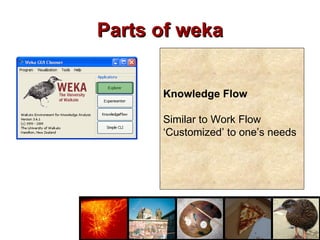
Parts of weka Explorer Basic interface to run ML  Algorithms Experimenter Comparing experiments on different algorithms Knowledge Flow Similar to Work Flow ‘ Customized’ to one’s needs
Weka demo
Key References Data Mining – Concepts and techniques; Han and Kamber, Morgan Kaufmann publishers, 2006. Machine Learning; Tom Mitchell, McGraw Hill publications. Data Mining – Practical machine learning tools and techniques; Witten and Frank, Morgan Kaufmann publishers, 2005.
end of  slideshow
Extra slides 1 Difference between decision lists and decision trees: Lists are functions tested sequentially (More than one  attributes at a time) Trees are attributes tested sequentially Lists may not require a ‘complete’ coverage for values of an attribute. All values of an attribute correspond to atleast one branch of the attribute split.
K2 Algorithm : Consider nodes in an order For each node, calculate utility to add an edge from previous nodes to this one TAN :  Use Naïve Bayes as the baseline network Add different edges to the network based on utility Examples of algorithms: TAN, K2 Learning structure of BBN
Delta rule enables to converge to a best fit if points are not linearly separable Uses gradient descent to choose the hypothesis space Delta rule

[ppt]

  • 1.
    All images fromwikimedia commons, a freely-licensed media repository
  • 2.
    “ Classifiers” R& D project by Aditya M Joshi [email_address] IIT Bombay Under the guidance of Prof. Pushpak Bhattacharyya [email_address] IIT Bombay
  • 3.
  • 4.
  • 5.
    What is classification?A machine learning task that deals with identifying the class to which an instance belongs A classifier performs classification Classifier Test instance Attributes (a1, a2,… an) Discrete-valued Class label ( Age, Marital status, Health status, Salary ) Issue Loan? {Yes, No} ( Perceptive inputs ) Steer? { Left, Straight, Right } Category of document? {Politics, Movies, Biology} ( Textual features : Ngrams )
  • 6.
    Classification learning Training phase Testing phase Learning the classifier from the available data ‘Training set’ (Labeled) Testing how well the classifier performs ‘Testing set’
  • 7.
    Generating datasets Methods:Holdout (2/3 rd training, 1/3 rd testing) Cross validation (n – fold) Divide into n parts Train on (n-1), test on last Repeat for different combinations Bootstrapping Select random samples to form the training set
  • 8.
    Evaluating classifiers Outcome:Accuracy Confusion matrix If cost-sensitive, the expected cost of classification ( attribute test cost + misclassification cost) etc.
  • 9.
  • 10.
    Diagram from Han-KamberExample tree Intermediate nodes : Attributes Leaf nodes : Class predictions Edges : Attribute value tests Example algorithms: ID3, C4.5, SPRINT, CART
  • 11.
    Decision Tree schematicTraining data set a1 a2 a3 a4 a5 a6 a1 a2 a3 a4 a5 a6 X Y Z Pure node, Leaf node: Class RED Impure node, Select best attribute and continue Impure node, Select best attribute and continue
  • 12.
    Decision Tree IssuesHow to avoid overfitting? Problem : Classifier performs well on training data, but fails to give good results on test data Example: Split on primary key gives pure nodes and good accuracy on training – not for testing Alternatives: Pre-prune : Halting construction at a certain level of tree / level of purity Post-prune : Remove a node if the error rate remains the same without it. Repeat process for all nodes in the d.tree How does the type of attribute affect the split? Discrete-valued: Each branch corresponding to a value Continuous-valued: Each branch may be a range of values (e.g.: splits may be age < 30, 30 < age < 50, age > 50 ) (aimed at maximizing the gain/gain ratio) How to determine the attribute for split? Alternatives: Information Gain Gain (A, S) = Entropy (S) – Σ ( (Sj/S)*Entropy(Sj) ) Other options: Gain ratio, etc.
  • 13.
  • 14.
    Lazy learners ‘Lazy ’: Do not create a model of the training instances in advance When an instance arrives for testing, runs the algorithm to get the class prediction Example, K – nearest neighbour classifier (K – NN classifier) “ One is known by the company one keeps”
  • 15.
    K-NN classifier schematicFor a test instance, Calculate distances from training pts. Find K-nearest neighbours (say, K = 3) Assign class label based on majority
  • 16.
    K-NN classifier IssuesHow good is it? Susceptible to noisy values Slow because of distance calculation Alternate approaches: Distances to representative points only Partial distance Any other modifications? Alternatives: Weighted attributes to decide final label Assign distance to missing values as <max> K=1 returns class label of nearest neighbour How to determine value of K? Alternatives: Determine K experimentally. The K that gives minimum error is selected. How to make real-valued prediction? Alternative: Average the values returned by K-nearest neighbours How to determine distances between values of categorical attributes? Alternatives: Boolean distance (1 if same, 0 if different) Differential grading (e.g. weather – ‘drizzling’ and ‘rainy’ are closer than ‘rainy’ and ‘sunny’ )
  • 17.
  • 18.
    A sequence ofboolean functions that lead to a result if h1 (y) = 1 then set f (y) = c1 else if h2 (y) = 1 then set f (y) = c2 … . else set f (y) = cn Decision Lists f ( y ) = cj, if j = min { i | hi (y) = 1 } exists 0 otherwise
  • 19.
    Decision List exampleTest instance ( h i , c i ) Unit Class label
  • 20.
    Decision List learningR S’ = S Set of candidate feature functions For each hi, Qi = Pi U Ni ( hi = 1 ) U i = max { | Pi| - pn * | Ni | , |Ni| - pp *|Pi| } Select hk, the feature with highest utility ( h k, ) If (| Pi| - pn * | Ni | > |Ni| - pp *|Pi| ) then 1 else 0 1 / 0 - Qk
  • 21.
    Decision list IssuesPruning? hi is not required if : c i = c (r+1) There is no h j ( j > i ) such that Q i = Q j Accuracy / Complexity tradeoff? Size of R : Complexity (Length of the list) S’ contains examples of both classes : Accuracy (Purity) What is the terminating condition? Size of R (an upper threshold) Q k = null S’ contains examples of same class
  • 22.
  • 23.
    Based on Bayesrule Naïve Bayes : Conditional independence assumption Probabilistic classifiers : NB
  • 24.
    Naïve Bayes IssuesHow are different types of attributes handled? Discrete-valued : P ( X | Ci ) is according to formula Continous-valued : Assume gaussian distribution. Plug in mean and variance for the attribute and assign it to P ( X | Ci ) Problems due to sparsity of data? Problem : Probabilities for some values may be zero Solution : Laplace smoothing For each attribute value, update probability m / n as : (m + 1) / (n + k) where k = domain of values
  • 25.
    Bayesian belief networks: Attributes ARE dependent A directed acyclic graph and conditional probability tables Probabilistic classifiers : BBN Diagram from Han-Kamber An added term for conditional probability between attributes:
  • 26.
    (when network structureknown) Input : Network topology of BBN Output : Calculate the entries in conditional probability table (when network structure not known) ??? BBN learning
  • 27.
    Use Naïve Bayesas a basis pattern Add edges as required Examples of algorithms: TAN, K2 Learning structure of BBN Loan Age Family status Marital status
  • 28.
  • 29.
    Based on biologicalconcept of neurons Structure of a fundamental unit of ANN: Artificial Neural Networks w0 w1 wn threshold output: : activation function p (v) where p (v) = sgn (w 0 + w 1 x 1 + … + w n x n ) input
  • 30.
    Initialize values ofweights Apply training instances and get output Update weights according to the update rule: Repeat till converges Can represent linearly separable functions only Perceptron learning algorithm n : learning rate t : target output o : observed output
  • 31.
    Basis for multilayerfeedforward networks Sigmoid perceptron
  • 32.
    Multilayer? Feedforward? Multilayer feedforward networks Input layer Output layer Hidden layer Diagram from Han-Kamber
  • 33.
    Apply training instancesas input and produce output Update weights in the ‘reverse’ direction as follows: Backpropagation Diagram from Han-Kamber
  • 34.
    ANN Issues Additionof momentum But why? Choosing the learning factor A small learning factor means multiple iterations required. A large learning factor means the learner may skip the global minimum What are the types of learning approaches? Deterministic: Update weights after summing up Errors over all examples Stochastic: Update weights per example Learning the structure of the network Construct a complete network Prune using heuristics: Remove edges with weights nearly zero Remove edges if the removal does not affect accuracy
  • 35.
  • 36.
    Support vector machinesBasic ideas Separating hyperplane : wx+b = 0 Margin Support vectors “ Maximum separating-margin classifier” +1 -1
  • 37.
    SVM training Problemformulation Minimize (1 / 2) || w || 2 w.r.t. (y i ( w x i + b ) – 1) >= 0 for all i Lagrangian multipliers are zero for data instances other than support vectors Dot product of xk and xl
  • 38.
    Focussing on dotproduct For non-linear separable points, we plan to map them to a higher dimensional (and linearly separable) space The product can be time-consuming. Therefore, we use kernel functions
  • 39.
    Kernel functions Withouthaving to know the non-linear mapping, apply kernel function, say, Reduces the number of computations required to generate Q kl values.
  • 40.
    Testing SVM SVMTest instance Class label
  • 41.
    SVM Issues SVMsare immune to the removal of non-support-vector points What if n-classes are to be predicted? Problem : SVMs deal with two-class classification Solution : Have multiple SVMs each for one class
  • 42.
  • 43.
    Combining Classifiers ‘Ensemble’learning Use a combination of models for prediction Bagging : Majority votes Boosting : Attention to the ‘weak’ instances Goal : An improved combined model
  • 44.
    Bagging Total setSample D 1 Classifier model M 1 At random. May use bootstrap sampling with replacement Training dataset D Classifier learning scheme Classifier model M n Test set Majority vote Class Label
  • 45.
    Boosting (AdaBoost) Totalset Sample D 1 Classifier model M 1 Selection based on weight. May use bootstrap sampling with replacement Training dataset D Classifier learning scheme Classifier model M n Test set Weighted vote Class Label Initialize weights of instances to 1/d Weights of correctly classified instances multiplied by error / (1 – error) If error > 0.5? Error Error `
  • 46.
  • 47.
    Data preprocessing Attributesubset selection Select a subset of total attributes to reduce complexity Dimensionality reduction Transform instances into ‘smaller’ instances
  • 48.
    Attribute subset selectionInformation gain measure for attribute selection in decision trees Stepwise forward / backward elimination of attributes
  • 49.
    Dimensionality reduction Highdimensions : Computational complexity Number of attributes of a data instance instance x in p-dimensions instance x in k-dimensions k < p s = Wx W is k x p transformation mtrx.
  • 50.
    Principal Component AnalysisComputes k orthonormal vectors : Principal components Essentially provide a new set of axes – in decreasing order of variance Eigenvector matrix ( p X p ) First k are k PCs ( p X n ) ( p X n ) (k X n) (p X n) (k X p) Diagram from Han-Kamber
  • 51.
    Weka & Weka Demo
  • 52.
    Weka & Weka Demo Collection of ML algorithms Get it from : http://www.cs.waikato.ac.nz/ml/weka/ ARFF Format ‘ Weka Explorer’
  • 53.
    ARFF file format@RELATION nursery @ATTRIBUTE children numeric @ATTRIBUTE housing {convenient, less_conv, critical} @ATTRIBUTE finance {convenient, inconv} @ATTRIBUTE social {nonprob, slightly_prob, problematic} @ATTRIBUTE health {recommended, priority, not_recom} @ATTRIBUTE pr_val {recommend,priority,not_recom,very_recom,spec_prior} @DATA 3,less_conv,convenient,slightly_prob,recommended,spec_prior Name of the relation Attribute definition Data instances : Comma separated, each on a new line
  • 54.
    Parts of wekaExplorer Basic interface to run ML Algorithms Experimenter Comparing experiments on different algorithms Knowledge Flow Similar to Work Flow ‘ Customized’ to one’s needs
  • 55.
  • 56.
    Key References DataMining – Concepts and techniques; Han and Kamber, Morgan Kaufmann publishers, 2006. Machine Learning; Tom Mitchell, McGraw Hill publications. Data Mining – Practical machine learning tools and techniques; Witten and Frank, Morgan Kaufmann publishers, 2005.
  • 57.
    end of slideshow
  • 58.
    Extra slides 1Difference between decision lists and decision trees: Lists are functions tested sequentially (More than one attributes at a time) Trees are attributes tested sequentially Lists may not require a ‘complete’ coverage for values of an attribute. All values of an attribute correspond to atleast one branch of the attribute split.
  • 59.
    K2 Algorithm :Consider nodes in an order For each node, calculate utility to add an edge from previous nodes to this one TAN : Use Naïve Bayes as the baseline network Add different edges to the network based on utility Examples of algorithms: TAN, K2 Learning structure of BBN
  • 60.
    Delta rule enablesto converge to a best fit if points are not linearly separable Uses gradient descent to choose the hypothesis space Delta rule