1
Engineering Project Management
Student Name:
Class: 4th
Course Title: Engineering Economy and Management
Department: Geomatics Engineering
College of Engineering
Salahaddin University-Erbil
Academic Year 2019-2020
Copyright
2
ABSTRACT
This reportis going to talk about andexplainthebasics ofproject
management, theimportanceofproject management, theroleof project
manager, theskills a good project manager musthave, somekey concepts
that almostevery project mustfollow, thesteps oftheproject and how the
project worksand whateffects it, and someof thereasonsthatmay cause
problems in theprocessoftheway that theproject is going or someof the
problems thatmay actually maketheproject failand not just createsome
problems thatcan be solved, andthereportalso explainsa smallexample
to makeunderstandingtheconceptofengineering project management
easy.
The reportexplainstheentireprocess ofproject managementfrom thefirst
step beforetheproject starts,and it explainson how to achievethegoal of
theproject at theend when the project is finished.
3
TABLE OF CONTENTS
Abstract 2
Tableof Contents 3
Introduction 4
Backgroundand Review 6
Methods 8
Theory /Design 11
Conclusion 15
References 16
4
INTRODUCTION
Effective management ofa team and perfect coordinationbetween
members ofthe team to achieve a common goaland completea task is
called project management(PM). Theuse of tools, techniques,skills, and
knowledgecome into play in themanagementofa project. Adequate
planning, scheduling, and monitoringofall theactivities will ensure
success in theproject. However, for allof the aboveto happenin
synchronization, onealso needs to understandtheproject management
basicconceptswhich includeproject process,project lifecycle, and project
managementsystem. So, let us startat thebeginning.
Whatis a Project?
A project is an effort madeto deliver a uniqueproduct or service. It
involves a definite startandend. Thegoal of any project is significant and
monitored by theproject manager. Theoutcomeofthe project could be
temporary or long-lastingresults, such as creatinga company. A group of
projectsmanaged togetherto enhanceproductivityand efficiency is a
program. A group ofprograms aligned to suit organizationalgoals,values,
and strategies is a portfolio.
Why is Project ManagementImportant?
Apart fromincreasingtheproductivity, improvingproject transparency,
and providinga clear vision to theteam, project managementcan bringthe
followingadvantages to thetable:
• Effective communication
• Efficient resourcemanagement
• Improved customer satisfaction
• Flexibility and higher risk tolerance
• Better qualityofthe output
5
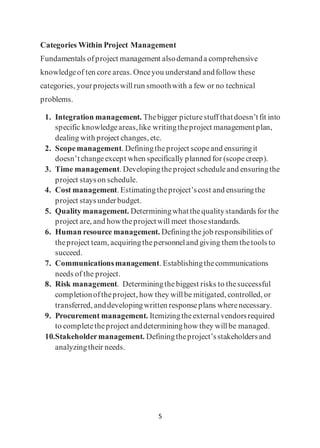
Categories Within Project Management
Fundamentals ofproject management alsodemanda comprehensive
knowledgeof ten core areas. Onceyou understand andfollow these
categories, yourprojectswillrun smoothwith a few or no technical
problems.
1. Integration management. Thebigger picturestuff thatdoesn’tfit into
specific knowledgeareas,like writingtheproject managementplan,
dealing with project changes, etc.
2. Scopemanagement. Definingtheproject scopeand ensuringit
doesn’tchangeexcept when specifically planned for (scopecreep).
3. Time management. Developingtheproject schedule and ensuringthe
project stayson schedule.
4. Cost management. Estimatingtheproject’scost and ensuringthe
project staysunderbudget.
5. Quality management. Determiningwhatthe qualitystandards for the
project are, and howtheprojectwill meet thosestandards.
6. Human resource management. Definingthe job responsibilities of
theproject team, acquiringthepersonneland giving them thetools to
succeed.
7. Communicationsmanagement. Establishingthecommunications
needs of the project.
8. Risk management. Determiningthebiggest risks to thesuccessful
completionoftheproject, how they willbe mitigated, controlled, or
transferred, anddevelopingwritten responseplans wherenecessary.
9. Procurement management. Itemizingtheexternalvendorsrequired
to completetheproject anddetermininghow they willbe managed.
10.Stakeholdermanagement. Definingtheproject’sstakeholdersand
analyzingtheir needs.
6
BACKGROUND & REVIEW
Project managementofany businessor project starts waybeforetheproject
has started, a study needs to be done on the entire project and every step of
the project and the problems or challenges either internal problems or
external problems that the project might face in the future, thus, Creating a
clear and unambiguous backgroundofa project is oneof themost important
actions to be taken at the very beginning to ensure success of the project at
the end. The clearer the background is, the more accurately and
understandablytheproject will be done Below I give a definition of project
background.
A Project’s Background is a formal document containing a common
description of what is expected to be done within the project, what
prerequisitesfor theproject are, and howto producetheexpected amountof
work. Thedocument is to be created prior totheimplementation process to
make a foundation for further goal setting and implementation.
when making a project background a document must be prepared with the
followingpoints:
▪ Primaryfocus (whatis to be addressedby theproject)
▪ A list of prerequisitesand key reasonsfor launch
▪ A very common descriptionofhow to performtheproject
▪ A plain explanationofthe desired outcome
Thereare somekey concepts in projectmanagement,bellow is a list of key
conceptsthatit is advised that projectsfollow:
1. Ensurethat oneperson is responsiblefor theproject scope, budget,
and scheduleso that thingsdo not get mixed up between a group of
people.
7
2. Do not begin work withouta signed contract,regardless ofthe
pressureto start.
3. Confirm thatthescope, budget,and thescheduleofthe project got
approved.
4. Lock in the project scopeat thebeginningof theproject and make
surethereis no change withoutapproval.
5. Makesurethat theplanofthe project is understoodby everyone,
includingthe owner ofthe project or theclient.
6. Build the project staffinto effective teams with different
responsibilities.
7. Appointa team leader to each team that you havemade.
8. Makesureto be in constantcontactwith thedifferent teams and
monitortheir progressor problemsthey may face.
9. Get problemsout in theopen with allthe peoplewho areinvolved so
they can be solved.
10. Documentallthe work, everythingthatis donemust be
documented, becausewhat may seem irrelevantat onepoint may
later be incredibly significant.
11. Establisha project organizationalchartthatshowsauthorityand
responsibilities for all team members.
12. Keep theclient informed with all thesteps taken becausethey pay
for everything.
8
METHODS
Whatis The Role of Project Manager?
Every project needs a project manager theroleof a project manager is to
lead theproject team to ensurea quality project withintime, budget, and
scopeconstraints. below is a tablethat show theroles ofproject manger in
a simpleway:
Interpersonal Role Informational Role Decisional Role Management Role
1. Work with a diverse
range of professionals
2. Solve team disputes
3. Build positive
relationships
4. Motivate team
members
1. Communicate with
all stakeholders
effectively
2. Keep people up-to-
date
3. Organize team
meetings frequently
4. Provide performance
feedback
1. Make a range of
decisions at each stage
2. Stay clear and
focused
3. Balance scope, time,
and resources
4. Prevent scope creep
and budget slippage
1. Recruit and
manage employees
2. Manage
finances
3. Respond well to
ambiguity
4. Adhere to
business priorities
Table1: Roles of project manager
The Phases of Project Management
project managementphasesaredifferent tasks, behaviorsandskillsets that
areessentialto creatinga successfulproject.
Figure1: Project Management Phase
9
1. Initiation The initiationphasemarks thebeginningofa project by
determininghigh-levelexpectations likewhy a project is required,if it is
practical or not, andwhatis needed to completetheproject.
Outputsofthis phaseincluderequired stakeholderapprovals to proceed to
thenext phase,documentationpertainingto project needs (business case),
and rough estimatesoftime and resources requiredto completetheproject
(project charter),and an initiallist of stakeholders.
2. Planning In the planningphase, project managers detailtheproject
scope, timeframe, and risks.Completeness andcontinuity arethemajor
componentsofa successful project plan.
Outputsofthis phaseincludea detailed project plan, a communicationplan
(if thereis no project plan), budget baseline, project scheduling, individual
project goals, scopedocument, andupdatedstakeholder registry.
3. Execution In the execution phase, theproject team membersare
coordinatedand guided through properproject communication to get the
work doneas explained in theapproved project managementplan.
Additionally, this phasealso coverstheproper allocationand management
of other project resources like materialsand budgets. Project
deliverables aretheoutput oftheexecution phase.
4. Monitoring and Control Thetime, cost, and performanceof theproject
arecompared at every stageand necessaryadjustmentsaremadeto the
project activities, resources,and planto keep thingson theright track.
Outputsfrom this phaseinclude project progressreports andother
communicationsthatensureadherenceto project plans andpreventlarger
milestones and deadlinedisruptions.
5. Closure or Completion Theprocess offinalizing theproject, reviewing
theproject deliverables, and transitioningthem to thebusinessleaders is
10
called the project closeoutphasein a project managementlife cycle.
This stageoffers time for both celebrationand reflection. Outputs from this
project managementphaseincludeapproved project resultsandlearnings
that can be applied to similarprojectsin thefuture.
WhatAre SomeCommon ReasonsforProject Failure?
Any viableproject is proneto failuredueto one of the five reasonslisted
below:
• Resourcedeficiency – insufficient resources to completethe project.
• Inadequatetimeframe – havingtroublecompletingtheproject on
time.
• Unclear goals – lack of detailed documentation can lead to
inappropriateresults.
• Poorly managed stakeholder expectations – project scopechanges
that arenot agreed uponby stakeholderscausingvaryingviews of
quality, time, or budget.
• Inadequaterisk management – failing to establishtherisk associated
with each project can causeyourproject to fail.
11
THEORY / DESIGN
Engineers arenot normally taughttheprinciples ofproject management,
althoughit is a critical function in their careers. Mostengineers see
themselves as technicalexperts, notproject managers,but businessis
business.
Most projectshaveat thesepersonals involved in the project
• Project Sponsor. This is theperson thatacceptstheproject’s
deliverables. Whether insideor outsidetheorganization, they also
authorizetheprojectand approveproject funding. They areone
level abovetheproject manager.
• Project Manager. Thepersonwho manages theday to day project
activities and on whom responsibilityfor theproject’ssuccess or
failurerests.
• Project Team. Thepeoplewho perform thetechnicalproject work,
on time, on budget, and to thespecificationsdeveloped withinthe
project managementplan.
• Stakeholders. Anyonewho has an interest in theproject. From
governmentregulatory bodies to adjacentlandownersto funding
agencies, they can all derail theproject and need to be managed.
Figure2
12
But unlikeother typesofprojects, engineeringprojects havea tendency to
need a broadrangeoftheserather thanspecializein one or two.
Project ManagementTriangle(Iron Triangle)
This is a modelof thegeneral constraints ofproject managementand
proves to bevery applicablefor various scales when onehas to analyzethe
project goals and makedecisions based on theinformation available. The
threeconstraintswhich makeup thetriangle(Figure4) are scope, time, and
cost.
Figure3: Iron Triangle
Let’s takean exampleto makethethings we said abovea littleclearer and
easier to understand:
Example:(Constructionmanagersplan, direct, coordinate, and budget a
wide variety ofresidential, commercial, andindustrialconstruction
projectsincluding homes, stores, offices, roads, bridges, wastewater
treatment plants, schools, and hospitals. Strongschedulingskills are
essentialfor this role. Communication skills areoften used in
coordinatingdesign and construction processes,teams executingthe
work, and governanceofspecialtrades(carpentry, plumbing,
13
electrical wiring) as well as governmentrepresentatives for the
permit processes. A construction manager may be called a project
manager or project engineer. Theconstructionmanager ensures that
theproject is completed on timeand within budget whilemeeting
quality specificationsand codes and maintaininga safe work
environment. Thesemanagers createproject plansin which they
divideall required constructionsiteactivities intologicalsteps,
estimatingand budgetingthetime required to meet established
deadlines).
As it shows in this exampletheconstructionproject or companyworks
with many different typesofprojects, such as buildinghomes or making
roadsand becausethey work with different projectsthey aregoing to need
a big number ofteams to work in their projects, causebuildinga houseand
makinga road arevery different and they need different designs and
different specialized people, or even in the sameproject such as building
thehousetakes different teamsto work on different stuff, such as getting
theneeded documentsfrom thegovernment, designingthehouse, plumbing
systems, electricity systems, etc.
this showsthatengineeringprojects requirea bigger network ofteams that
work together.
14
Here aresome of theproject managementskills that engineers, or anyone
can obtainto improveself and get better job opportunities in thefuture:
• Leadership skills
• Communicationskills
• Teamwork
• Gettinggood at organizing
• Negotiationskills
• Remainingcoolunder pressure
• Becominggood at decision making
15
CONCLUSION
After explainingallof the aboveit is clear now having project management
skills is very importantandit helps peopleinto buildingand improving
their careers.
Project managementis not an easy thingto do specially in engineering
fields, becauseas we showed engineeringproject managementdealwith a
big number ofteams and peopleworkingon different things at thesame
time in one project,and noteveryoneis capableto bea project manager, it
takes a lot of skilland experienceto be able to deal with thebig group of
peopleand assign each individualto do a certain thing, not everyonecan
handlethepressureofhandlingbig projects or a group ofa lot of people.
Like we said it is not an easy thingto do but with takingcoursesand
workingfor project managersand gettingtheneeded experienceit is
possibleto do.
16
REFERENCES
1. Garold D. Oberlender, “Project ManagementFor EngineeringAnd
Construction”Second Edition, OklahomaStateUniversity
2. Nigel J. Smith, “EngineeringProject Management”Second Edition,
UniversityofLeeds

Engineering Project Management

  • 1.
    1 Engineering Project Management StudentName: Class: 4th Course Title: Engineering Economy and Management Department: Geomatics Engineering College of Engineering Salahaddin University-Erbil Academic Year 2019-2020 Copyright
  • 2.
    2 ABSTRACT This reportis goingto talk about andexplainthebasics ofproject management, theimportanceofproject management, theroleof project manager, theskills a good project manager musthave, somekey concepts that almostevery project mustfollow, thesteps oftheproject and how the project worksand whateffects it, and someof thereasonsthatmay cause problems in theprocessoftheway that theproject is going or someof the problems thatmay actually maketheproject failand not just createsome problems thatcan be solved, andthereportalso explainsa smallexample to makeunderstandingtheconceptofengineering project management easy. The reportexplainstheentireprocess ofproject managementfrom thefirst step beforetheproject starts,and it explainson how to achievethegoal of theproject at theend when the project is finished.
  • 3.
    3 TABLE OF CONTENTS Abstract2 Tableof Contents 3 Introduction 4 Backgroundand Review 6 Methods 8 Theory /Design 11 Conclusion 15 References 16
  • 4.
    4 INTRODUCTION Effective management ofateam and perfect coordinationbetween members ofthe team to achieve a common goaland completea task is called project management(PM). Theuse of tools, techniques,skills, and knowledgecome into play in themanagementofa project. Adequate planning, scheduling, and monitoringofall theactivities will ensure success in theproject. However, for allof the aboveto happenin synchronization, onealso needs to understandtheproject management basicconceptswhich includeproject process,project lifecycle, and project managementsystem. So, let us startat thebeginning. Whatis a Project? A project is an effort madeto deliver a uniqueproduct or service. It involves a definite startandend. Thegoal of any project is significant and monitored by theproject manager. Theoutcomeofthe project could be temporary or long-lastingresults, such as creatinga company. A group of projectsmanaged togetherto enhanceproductivityand efficiency is a program. A group ofprograms aligned to suit organizationalgoals,values, and strategies is a portfolio. Why is Project ManagementImportant? Apart fromincreasingtheproductivity, improvingproject transparency, and providinga clear vision to theteam, project managementcan bringthe followingadvantages to thetable: • Effective communication • Efficient resourcemanagement • Improved customer satisfaction • Flexibility and higher risk tolerance • Better qualityofthe output
  • 5.
    5 Categories Within ProjectManagement Fundamentals ofproject management alsodemanda comprehensive knowledgeof ten core areas. Onceyou understand andfollow these categories, yourprojectswillrun smoothwith a few or no technical problems. 1. Integration management. Thebigger picturestuff thatdoesn’tfit into specific knowledgeareas,like writingtheproject managementplan, dealing with project changes, etc. 2. Scopemanagement. Definingtheproject scopeand ensuringit doesn’tchangeexcept when specifically planned for (scopecreep). 3. Time management. Developingtheproject schedule and ensuringthe project stayson schedule. 4. Cost management. Estimatingtheproject’scost and ensuringthe project staysunderbudget. 5. Quality management. Determiningwhatthe qualitystandards for the project are, and howtheprojectwill meet thosestandards. 6. Human resource management. Definingthe job responsibilities of theproject team, acquiringthepersonneland giving them thetools to succeed. 7. Communicationsmanagement. Establishingthecommunications needs of the project. 8. Risk management. Determiningthebiggest risks to thesuccessful completionoftheproject, how they willbe mitigated, controlled, or transferred, anddevelopingwritten responseplans wherenecessary. 9. Procurement management. Itemizingtheexternalvendorsrequired to completetheproject anddetermininghow they willbe managed. 10.Stakeholdermanagement. Definingtheproject’sstakeholdersand analyzingtheir needs.
  • 6.
    6 BACKGROUND & REVIEW Projectmanagementofany businessor project starts waybeforetheproject has started, a study needs to be done on the entire project and every step of the project and the problems or challenges either internal problems or external problems that the project might face in the future, thus, Creating a clear and unambiguous backgroundofa project is oneof themost important actions to be taken at the very beginning to ensure success of the project at the end. The clearer the background is, the more accurately and understandablytheproject will be done Below I give a definition of project background. A Project’s Background is a formal document containing a common description of what is expected to be done within the project, what prerequisitesfor theproject are, and howto producetheexpected amountof work. Thedocument is to be created prior totheimplementation process to make a foundation for further goal setting and implementation. when making a project background a document must be prepared with the followingpoints: ▪ Primaryfocus (whatis to be addressedby theproject) ▪ A list of prerequisitesand key reasonsfor launch ▪ A very common descriptionofhow to performtheproject ▪ A plain explanationofthe desired outcome Thereare somekey concepts in projectmanagement,bellow is a list of key conceptsthatit is advised that projectsfollow: 1. Ensurethat oneperson is responsiblefor theproject scope, budget, and scheduleso that thingsdo not get mixed up between a group of people.
  • 7.
    7 2. Do notbegin work withouta signed contract,regardless ofthe pressureto start. 3. Confirm thatthescope, budget,and thescheduleofthe project got approved. 4. Lock in the project scopeat thebeginningof theproject and make surethereis no change withoutapproval. 5. Makesurethat theplanofthe project is understoodby everyone, includingthe owner ofthe project or theclient. 6. Build the project staffinto effective teams with different responsibilities. 7. Appointa team leader to each team that you havemade. 8. Makesureto be in constantcontactwith thedifferent teams and monitortheir progressor problemsthey may face. 9. Get problemsout in theopen with allthe peoplewho areinvolved so they can be solved. 10. Documentallthe work, everythingthatis donemust be documented, becausewhat may seem irrelevantat onepoint may later be incredibly significant. 11. Establisha project organizationalchartthatshowsauthorityand responsibilities for all team members. 12. Keep theclient informed with all thesteps taken becausethey pay for everything.
  • 8.
    8 METHODS Whatis The Roleof Project Manager? Every project needs a project manager theroleof a project manager is to lead theproject team to ensurea quality project withintime, budget, and scopeconstraints. below is a tablethat show theroles ofproject manger in a simpleway: Interpersonal Role Informational Role Decisional Role Management Role 1. Work with a diverse range of professionals 2. Solve team disputes 3. Build positive relationships 4. Motivate team members 1. Communicate with all stakeholders effectively 2. Keep people up-to- date 3. Organize team meetings frequently 4. Provide performance feedback 1. Make a range of decisions at each stage 2. Stay clear and focused 3. Balance scope, time, and resources 4. Prevent scope creep and budget slippage 1. Recruit and manage employees 2. Manage finances 3. Respond well to ambiguity 4. Adhere to business priorities Table1: Roles of project manager The Phases of Project Management project managementphasesaredifferent tasks, behaviorsandskillsets that areessentialto creatinga successfulproject. Figure1: Project Management Phase
  • 9.
    9 1. Initiation Theinitiationphasemarks thebeginningofa project by determininghigh-levelexpectations likewhy a project is required,if it is practical or not, andwhatis needed to completetheproject. Outputsofthis phaseincluderequired stakeholderapprovals to proceed to thenext phase,documentationpertainingto project needs (business case), and rough estimatesoftime and resources requiredto completetheproject (project charter),and an initiallist of stakeholders. 2. Planning In the planningphase, project managers detailtheproject scope, timeframe, and risks.Completeness andcontinuity arethemajor componentsofa successful project plan. Outputsofthis phaseincludea detailed project plan, a communicationplan (if thereis no project plan), budget baseline, project scheduling, individual project goals, scopedocument, andupdatedstakeholder registry. 3. Execution In the execution phase, theproject team membersare coordinatedand guided through properproject communication to get the work doneas explained in theapproved project managementplan. Additionally, this phasealso coverstheproper allocationand management of other project resources like materialsand budgets. Project deliverables aretheoutput oftheexecution phase. 4. Monitoring and Control Thetime, cost, and performanceof theproject arecompared at every stageand necessaryadjustmentsaremadeto the project activities, resources,and planto keep thingson theright track. Outputsfrom this phaseinclude project progressreports andother communicationsthatensureadherenceto project plans andpreventlarger milestones and deadlinedisruptions. 5. Closure or Completion Theprocess offinalizing theproject, reviewing theproject deliverables, and transitioningthem to thebusinessleaders is
  • 10.
    10 called the projectcloseoutphasein a project managementlife cycle. This stageoffers time for both celebrationand reflection. Outputs from this project managementphaseincludeapproved project resultsandlearnings that can be applied to similarprojectsin thefuture. WhatAre SomeCommon ReasonsforProject Failure? Any viableproject is proneto failuredueto one of the five reasonslisted below: • Resourcedeficiency – insufficient resources to completethe project. • Inadequatetimeframe – havingtroublecompletingtheproject on time. • Unclear goals – lack of detailed documentation can lead to inappropriateresults. • Poorly managed stakeholder expectations – project scopechanges that arenot agreed uponby stakeholderscausingvaryingviews of quality, time, or budget. • Inadequaterisk management – failing to establishtherisk associated with each project can causeyourproject to fail.
  • 11.
    11 THEORY / DESIGN Engineersarenot normally taughttheprinciples ofproject management, althoughit is a critical function in their careers. Mostengineers see themselves as technicalexperts, notproject managers,but businessis business. Most projectshaveat thesepersonals involved in the project • Project Sponsor. This is theperson thatacceptstheproject’s deliverables. Whether insideor outsidetheorganization, they also authorizetheprojectand approveproject funding. They areone level abovetheproject manager. • Project Manager. Thepersonwho manages theday to day project activities and on whom responsibilityfor theproject’ssuccess or failurerests. • Project Team. Thepeoplewho perform thetechnicalproject work, on time, on budget, and to thespecificationsdeveloped withinthe project managementplan. • Stakeholders. Anyonewho has an interest in theproject. From governmentregulatory bodies to adjacentlandownersto funding agencies, they can all derail theproject and need to be managed. Figure2
  • 12.
    12 But unlikeother typesofprojects,engineeringprojects havea tendency to need a broadrangeoftheserather thanspecializein one or two. Project ManagementTriangle(Iron Triangle) This is a modelof thegeneral constraints ofproject managementand proves to bevery applicablefor various scales when onehas to analyzethe project goals and makedecisions based on theinformation available. The threeconstraintswhich makeup thetriangle(Figure4) are scope, time, and cost. Figure3: Iron Triangle Let’s takean exampleto makethethings we said abovea littleclearer and easier to understand: Example:(Constructionmanagersplan, direct, coordinate, and budget a wide variety ofresidential, commercial, andindustrialconstruction projectsincluding homes, stores, offices, roads, bridges, wastewater treatment plants, schools, and hospitals. Strongschedulingskills are essentialfor this role. Communication skills areoften used in coordinatingdesign and construction processes,teams executingthe work, and governanceofspecialtrades(carpentry, plumbing,
  • 13.
    13 electrical wiring) aswell as governmentrepresentatives for the permit processes. A construction manager may be called a project manager or project engineer. Theconstructionmanager ensures that theproject is completed on timeand within budget whilemeeting quality specificationsand codes and maintaininga safe work environment. Thesemanagers createproject plansin which they divideall required constructionsiteactivities intologicalsteps, estimatingand budgetingthetime required to meet established deadlines). As it shows in this exampletheconstructionproject or companyworks with many different typesofprojects, such as buildinghomes or making roadsand becausethey work with different projectsthey aregoing to need a big number ofteams to work in their projects, causebuildinga houseand makinga road arevery different and they need different designs and different specialized people, or even in the sameproject such as building thehousetakes different teamsto work on different stuff, such as getting theneeded documentsfrom thegovernment, designingthehouse, plumbing systems, electricity systems, etc. this showsthatengineeringprojects requirea bigger network ofteams that work together.
  • 14.
    14 Here aresome oftheproject managementskills that engineers, or anyone can obtainto improveself and get better job opportunities in thefuture: • Leadership skills • Communicationskills • Teamwork • Gettinggood at organizing • Negotiationskills • Remainingcoolunder pressure • Becominggood at decision making
  • 15.
    15 CONCLUSION After explainingallof theaboveit is clear now having project management skills is very importantandit helps peopleinto buildingand improving their careers. Project managementis not an easy thingto do specially in engineering fields, becauseas we showed engineeringproject managementdealwith a big number ofteams and peopleworkingon different things at thesame time in one project,and noteveryoneis capableto bea project manager, it takes a lot of skilland experienceto be able to deal with thebig group of peopleand assign each individualto do a certain thing, not everyonecan handlethepressureofhandlingbig projects or a group ofa lot of people. Like we said it is not an easy thingto do but with takingcoursesand workingfor project managersand gettingtheneeded experienceit is possibleto do.
  • 16.
    16 REFERENCES 1. Garold D.Oberlender, “Project ManagementFor EngineeringAnd Construction”Second Edition, OklahomaStateUniversity 2. Nigel J. Smith, “EngineeringProject Management”Second Edition, UniversityofLeeds