Developing project objectives and
Execution plan
Student Name: Copyright
Class: 4th
Stage
Course Title: Economic and Management Engineering
Department: Geomatics (Surveying) Engineering
College of Engineering
Salahaddin University-Erbil
Academic Year 2019-2020
2
Abstract
my aim in creating this report is to discuss about developing project objectives and
execution plan ,In every project and work that is done we have to consider a set of
things because each project must have its own goals and objectives.
It has to have its own time and the project has to be successful in all areas And to
further support the report we put an example on the schedule talks about 150m street
in Erbil.
At first we discuss about execution, next discuss about elements, then discuss about
developing project objectives, after that the factors that make the project a success.
3
Table of content
Subject page
Abstract ......................................................................................................................2
Table of content .........................................................................................................3
Introduction................................................................................................................4
Project Execution Planning........................................................................................6
1. Scope Definition...............................................................................................6
2. Statement of Goals............................................................................................7
3. Quality and Technical Specifications...............................................................7
4. Allocation of Resources ...................................................................................8
5. Project Scheduling............................................................................................8
6. Organizational Considerations .......................................................................11
What are learning objectives?..................................................................................12
How to State Your Project’s Objectives..................................................................12
Tips for Writing Successful Project Objectives.......................................................14
Conclusion ...............................................................................................................15
Reference..................................................................................................................16
4
Introduction
Project Objective Definition
A project objective describes the desired results of a project, which often includes a
tangible item. An objective is specific and measurable, and must meet time, budget,
and quality constraints.
Objectives can be used in project planning for business, government, nonprofit
organizations, and even for personal use (for example, in resumes to describe the
exact position a job-seeker wants). A project may have one objective, many parallel
objectives, or several objectives that must be achieved sequentially. To produce the
most benefit, objectives must be defined early in the project life cycle, in phase two,
the planning phase.
Execution Plan Basics
Every day, out in the various discussion boards devoted to Microsoft SQL Server,
the same types of questions come up again and again: Why is this query running
slow? Is my index getting used? Why isn't my index getting used? Why does this
query run faster than this query? The correct response is probably different in each
case, but in order to arrive at the answer you have to ask the same return question in
each case: have you looked at the execution plan?
An execution plan, simply put, is the result of the query optimizer’s attempt to
calculate the most efficient way to implement the request represented by the T-SQL
query you submitted.
5
Execution plans can tell you how a query will be executed, or how a query was
executed. They are, therefore, the DBA’s primary means of troubleshooting a poorly
performing query. Rather than guess at why a given query is performing thousands
of scans, putting your I/O through the roof, you can use the execution plan to identify
the exact piece of SQL code that is causing the problem. For example, it may be
scanning an entire table-worth of data when, with the proper index, it could simply
backpack out only the rows you need. All this and more is displayed in the execution
plan.
The aim of this report is to enable you to capture actual and estimated execution
plans, in either graphical, text or XML format, and to understand the basics of how
to interpret them. In order to do this, we’ll cover the following topics:
 A brief backgrounder on the query optimizer – execution plans are a result of
the optimizer’s calculations so it’s useful to know at least a little bit about what
the optimizer does, and how it works.
 Actual and Estimated execution plans – what they are and how they differ.
 Capturing and interpreting the different visual execution plan formats – we’ll
investigate graphical, text and XML execution plans for a very basic SELECT
query.
 Automating execution plan capture – using the SQL Server Profiler tool.
6
Project Execution Planning
The Project Execution Plan (PEP) is the primary document that defines how the
project will be undertaken. It details the specific activities in the project, the
resources applied to the project, and the organization of the project.
The major elements of a project execution plan are:
1. Scope definition
2. Goal statements
3. Quality and technical specifications
4. Resource allocation
5. Project scheduling
6. Organizational considerations
1. Scope Definition
Scope definition entails defining what the project intends to achieve in specific
terms. For instance, if the aim of the project is to "upgrade the information
technology infrastructure in the organization" the scope definition in the project
execution plan example translates this broad and vague objective into a specific
scope based on output, as "to provide a new computer on every desk, with all
appropriate software installed and ready to operate, and each computer linked
through a network."
7
2. Statement of Goals
The statement of goals lists out specific project requirements such as key project
deliverables, milestones, and the project life cycle. The goal statement also
explains:
 Why the project is carried out, the purpose served by the project, and the
expected benefits from the project
 The unique challenges that the project overcomes.
 The risks associated with the project and how the project plan will overcome
such risks.
3. Quality and Technical Specifications
While the project scope and statement of goals make clear the output of the project,
one important element that needs inclusion in the project execution plan is quality
or technical specifications of the work processes and output. The achievement of
such stipulated standards determine the successful execution of the project. The
parameters of quality and technical specifications include the use of:
 Clear and precise definitions for concepts and terms.
 Measurable descriptions. For instance, "latest computers" are not
measurable, whereas "computers with 16GB of memory" is a measurable
quality standard.
 Attainable standards. For instance, "upgrade all the computers in the office
to Dual Core Processors and 16 GB memory within two weeks" is an
attainable goal, but "upgrade all the computers in the office to Dual Core and
8
16 GB memory overnight to ensure non-interrupted service" may be
impossible in large companies
 Time bound definitions. For instance, "upgrade the computers soon" is
vague, whereas "upgrade the computers within two weeks" is a precise and
time bound specification.
 The level of quality desired in the project usually depends on the project
budget, which is usually determined by the customer.
4. Allocation of Resources
The elements of scope, goals, and quality define in clear terms what the project
hopes to achieve. The next element of a project execution plan is the allocation
of resources to achieve the stated goals and quality standards. Resources include
staff with knowledge or skill sets, money to buy equipment, and time
considerations.
5. Project Scheduling
Scheduling the project is a very important element in a project execution plan. The
best approach is to divide the project into small units or chunks and set time bound
milestones of achievements, mutually acceptable to all stakeholders. The best
examples of preparing a project schedule are Gantt Charts that list what will happen
and when. Of the various project scheduling techniques, the Critical Path Method
(CPM) and PERT charts are two of the best techniques. Bright Hub offers an
9
excellent article on how to create PERT charts in Microsoft Excel. One important
consideration with project scheduling is the need to be ready for exceptions. In
practice, schedules rarely stick to their planned courses and go awry owing to many
reasons such as late supply of input data or raw materials, disruptions in resources,
faulty planning, underestimating the time requires, and forced changes to the
schedule owing to external factors. The project manager needs to make floor level
adjustments to return the schedule to track. Very often, meeting agreed delivery
schedules require project acceleration by working tasks in parallel modes. This
depends on the state on dependencies, or the extent to which the start of one function
depends on the completion of another task; using the Critical Path Method will help
you illustrate this better. Another important consideration when scheduling projects
is setting tolerances for risks, quality standards, budgets, and even deadlines. This
does away with the need to continually seek guidance from the customer.
Example:
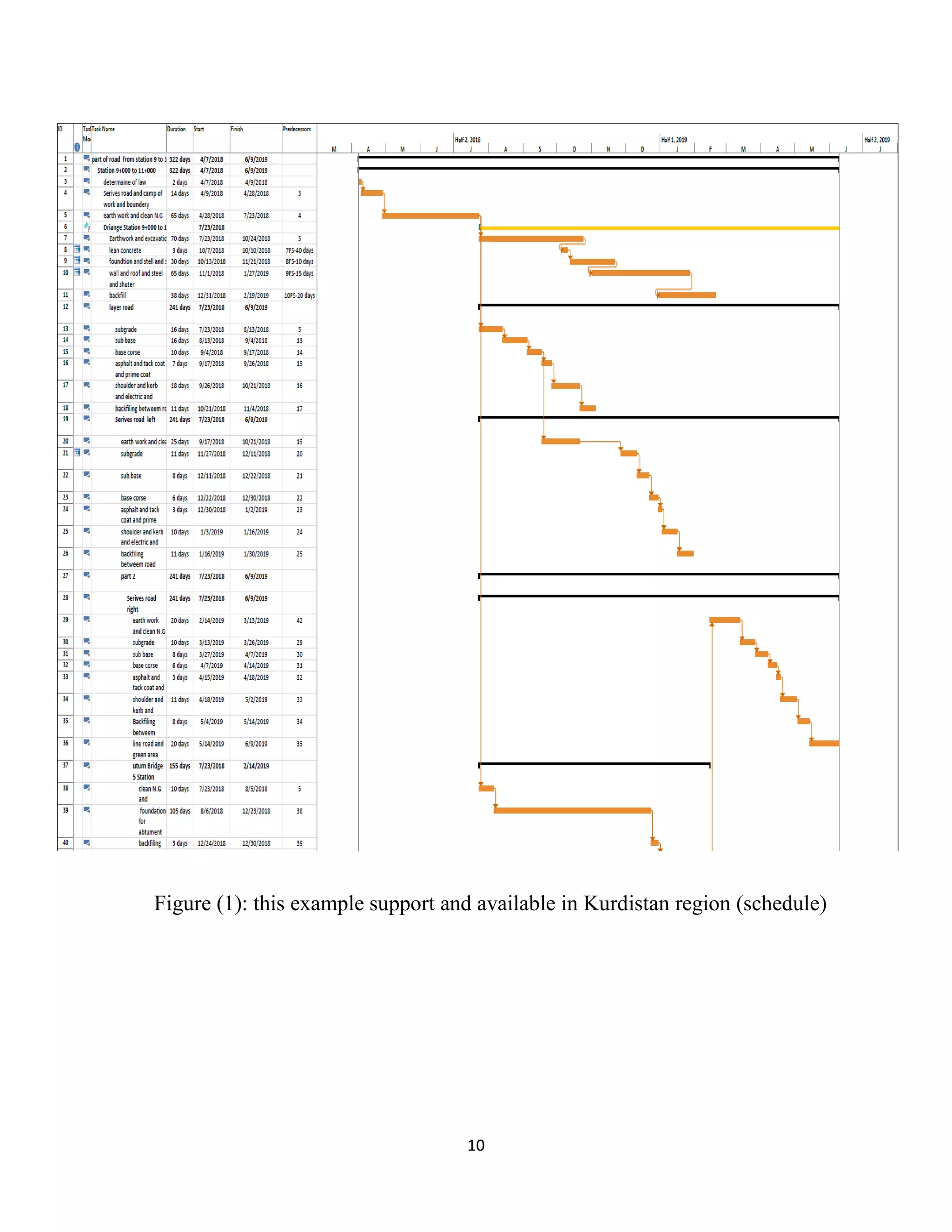
We have some student in Salahaddin University College of Engineering
Department Geomatics (Surveying) create research about (Quantity Estimation
and Schedule for the Project of 150 m Road- Erbil City), the aims of research is
create schedule of project, because the project was very big take a specific part
of zone work will start from station (6+000) to (13+000), so the length of the
zone is seven Kilometer, and the estimated for completed project work was
443 days of work , The schedule had been divided into 4 part in 7 km But it
took just one part from it which was between station( 9+000 to 11+000) road
that is 2 km long the schedule would take 322 days, and we have 40 active using
this schedule , So now this example support and available in Kurdistan region,
show in figure (1).
10
Figure (1): this example support and available in Kurdistan region (schedule)
11
6. Organizational Considerations
One important but often overlooked element of the project execution plan is
organizational considerations. This entails:
•Details of the project manager and other key personnel responsible for
different aspects of the project, with their duties and responsibilities.
•Decision making authority for specific components of the project.
•The reporting relationships of the project team members. The general
approach of undertaking the project, whether the project gets a dedicated
team, whether a matrix type of organizational structure is adopted, or any
other model.
•Method of coordination and reporting.
•Method of project monitoring and status updates.
A properly crafted project execution plan is the foundation to a successful
project.
What we want to have in our project plan is:
1. Aim of Project, and Outputs.
2. Quality Criteria, and Resources.
3. Management, Structure and Milestones.
4. Tolerances, and Dependencies.
5. Risks, and Schedule.
12
What are learning objectives?
• A learning objective is a clear, concise, objective description of what your
learners will be able to do at the end of a given instructional unit
• Of all the activities involved in the instructional design process, developing
objectives is one of the most critical
How to State Your Project’s Objectives?
Managing a project calls for clear objectives. After all, a project’s outcomes may
be the products or services you develop or the results of using these products and
services. The more clearly you define your project’s objectives, the more likely
you are to achieve them.
Include the following elements in your objectives:
Statement: A brief narrative description of what you want to achieve
Measures: Indicators you’ll use to assess your achievement
Performance specifications: The value(s) of each measure that define success
13
Make your objectives SMART, as follows:
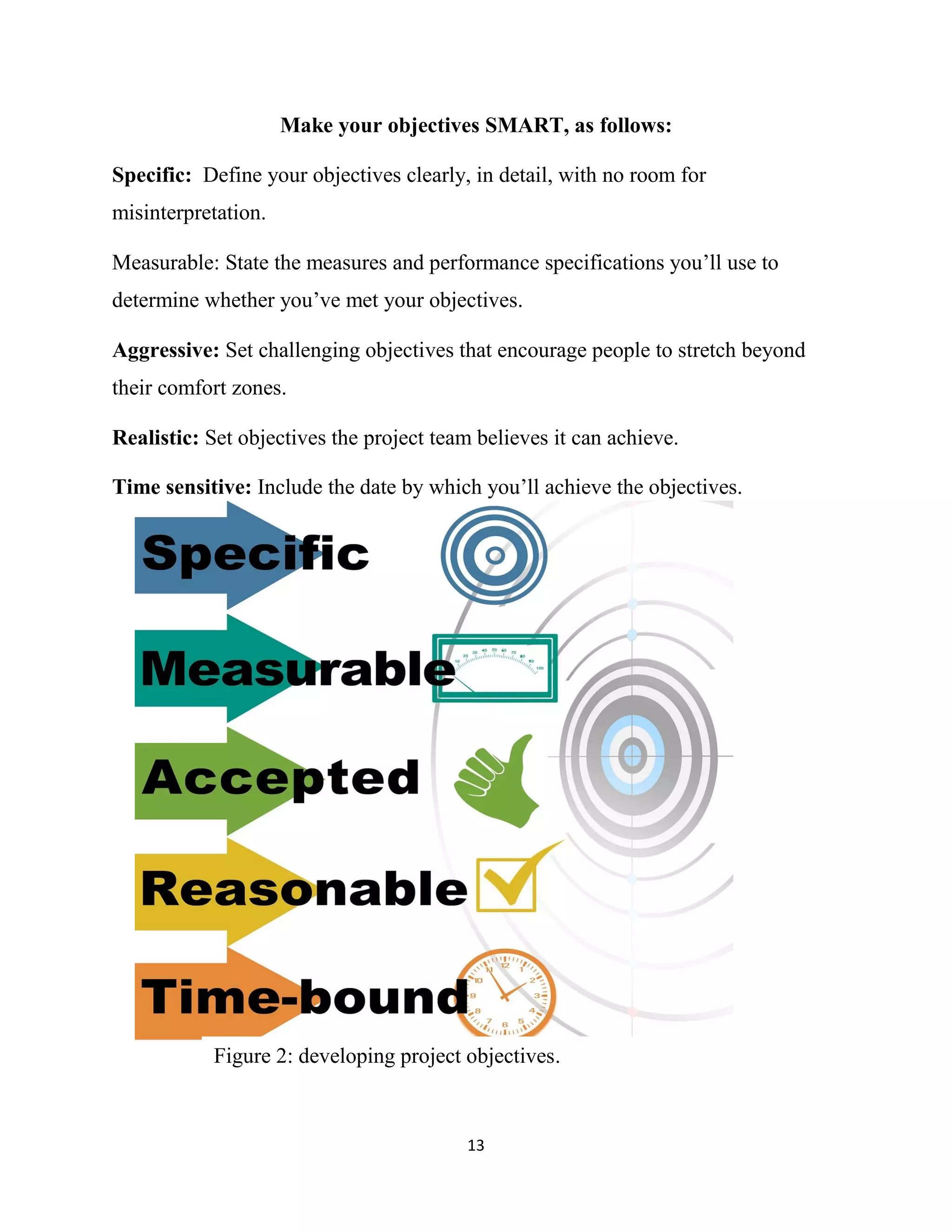
Specific: Define your objectives clearly, in detail, with no room for
misinterpretation.
Measurable: State the measures and performance specifications you’ll use to
determine whether you’ve met your objectives.
Aggressive: Set challenging objectives that encourage people to stretch beyond
their comfort zones.
Realistic: Set objectives the project team believes it can achieve.
Time sensitive: Include the date by which you’ll achieve the objectives.
Figure 2: developing project objectives.
14
Tips for Writing Successful Project Objectives
Objectives are usually expressed as succinct, one-sentence statements. There is some
discrepancy between how specific the verbs may be. Some guides insist that only
general quality and quantity verbs be used (increase, decrease, improve), while
community groups and nonprofits seem to tolerate looser expressions (develop,
educate, setup, estimate).
Keep in mind that an objective should not specify how something is done, and
consider the context and guidelines the organization you’re writing for use.
Here are a few suggestions to help you as you write the statement:
 Write the objective before starting the project.
 Identify all objectives at the beginning.
 An objective cannot be written in isolation. Get support from all levels of the
team. If the team doesn’t believe in the objective, they won’t work towards it
and stakeholders won’t provide resources. If stakeholders disagree with the
objective, work with them until you get a statement you can all stand behind.
 Be brief; it increases the chances of objectives being read and understood.
 Be clear; don’t give a list of options or a range of target numbers. Ask for
what you need and what you expect.
 Use plain English, not jargon so everyone can understand your objective.
 Make sure your objectives are things you actually can control. For example, “I
will send out 50 letters of interest by next week” describes something you can
achieve. “I will book 15 jobs by next week” is not something you can control,
because it’s up to someone else to hire you.
15
Conclusion
The results show us that how much execution plan is important for the project and
it's also in a set of element, and it's consist of six elements, we discussed all and we
put an example on Kurdistan.
And talking about it with explanation developing project objectives which has a
full impact on projects and the proposals that will lead to the success of the project.
So if the implementers of the project having a good developing project objectives
and execution plan they could do it on time and with a successful project.
16
Reference
[1]- https://www.brighthubpm.com/project-planning/96994-elements-of-a-project-
execution-plan/#project-execution-planning
[2]- https://www.projectsmart.co.uk/project-plans-10-essential-elements.php
[3]- https://www.dummies.com/careers/project-management/project-management-
how-to-state-your-projects-objectives/
[4]-https://www.smartsheet.com/how-write-smart-project-objective
[5] - https://www.red-gate.com/simple-talk/sql/performance/execution-plan-
basics/?fbclid=IwAR0Br_8QyG2pIX94ZGQjW3vkpwINVMjjmS2BWzm3G2AB
_PdB8Xzdb_4-90c

Developing project objectives and Execution plan in Economy management

  • 1.
    Developing project objectivesand Execution plan Student Name: Copyright Class: 4th Stage Course Title: Economic and Management Engineering Department: Geomatics (Surveying) Engineering College of Engineering Salahaddin University-Erbil Academic Year 2019-2020
  • 2.
    2 Abstract my aim increating this report is to discuss about developing project objectives and execution plan ,In every project and work that is done we have to consider a set of things because each project must have its own goals and objectives. It has to have its own time and the project has to be successful in all areas And to further support the report we put an example on the schedule talks about 150m street in Erbil. At first we discuss about execution, next discuss about elements, then discuss about developing project objectives, after that the factors that make the project a success.
  • 3.
    3 Table of content Subjectpage Abstract ......................................................................................................................2 Table of content .........................................................................................................3 Introduction................................................................................................................4 Project Execution Planning........................................................................................6 1. Scope Definition...............................................................................................6 2. Statement of Goals............................................................................................7 3. Quality and Technical Specifications...............................................................7 4. Allocation of Resources ...................................................................................8 5. Project Scheduling............................................................................................8 6. Organizational Considerations .......................................................................11 What are learning objectives?..................................................................................12 How to State Your Project’s Objectives..................................................................12 Tips for Writing Successful Project Objectives.......................................................14 Conclusion ...............................................................................................................15 Reference..................................................................................................................16
  • 4.
    4 Introduction Project Objective Definition Aproject objective describes the desired results of a project, which often includes a tangible item. An objective is specific and measurable, and must meet time, budget, and quality constraints. Objectives can be used in project planning for business, government, nonprofit organizations, and even for personal use (for example, in resumes to describe the exact position a job-seeker wants). A project may have one objective, many parallel objectives, or several objectives that must be achieved sequentially. To produce the most benefit, objectives must be defined early in the project life cycle, in phase two, the planning phase. Execution Plan Basics Every day, out in the various discussion boards devoted to Microsoft SQL Server, the same types of questions come up again and again: Why is this query running slow? Is my index getting used? Why isn't my index getting used? Why does this query run faster than this query? The correct response is probably different in each case, but in order to arrive at the answer you have to ask the same return question in each case: have you looked at the execution plan? An execution plan, simply put, is the result of the query optimizer’s attempt to calculate the most efficient way to implement the request represented by the T-SQL query you submitted.
  • 5.
    5 Execution plans cantell you how a query will be executed, or how a query was executed. They are, therefore, the DBA’s primary means of troubleshooting a poorly performing query. Rather than guess at why a given query is performing thousands of scans, putting your I/O through the roof, you can use the execution plan to identify the exact piece of SQL code that is causing the problem. For example, it may be scanning an entire table-worth of data when, with the proper index, it could simply backpack out only the rows you need. All this and more is displayed in the execution plan. The aim of this report is to enable you to capture actual and estimated execution plans, in either graphical, text or XML format, and to understand the basics of how to interpret them. In order to do this, we’ll cover the following topics:  A brief backgrounder on the query optimizer – execution plans are a result of the optimizer’s calculations so it’s useful to know at least a little bit about what the optimizer does, and how it works.  Actual and Estimated execution plans – what they are and how they differ.  Capturing and interpreting the different visual execution plan formats – we’ll investigate graphical, text and XML execution plans for a very basic SELECT query.  Automating execution plan capture – using the SQL Server Profiler tool.
  • 6.
    6 Project Execution Planning TheProject Execution Plan (PEP) is the primary document that defines how the project will be undertaken. It details the specific activities in the project, the resources applied to the project, and the organization of the project. The major elements of a project execution plan are: 1. Scope definition 2. Goal statements 3. Quality and technical specifications 4. Resource allocation 5. Project scheduling 6. Organizational considerations 1. Scope Definition Scope definition entails defining what the project intends to achieve in specific terms. For instance, if the aim of the project is to "upgrade the information technology infrastructure in the organization" the scope definition in the project execution plan example translates this broad and vague objective into a specific scope based on output, as "to provide a new computer on every desk, with all appropriate software installed and ready to operate, and each computer linked through a network."
  • 7.
    7 2. Statement ofGoals The statement of goals lists out specific project requirements such as key project deliverables, milestones, and the project life cycle. The goal statement also explains:  Why the project is carried out, the purpose served by the project, and the expected benefits from the project  The unique challenges that the project overcomes.  The risks associated with the project and how the project plan will overcome such risks. 3. Quality and Technical Specifications While the project scope and statement of goals make clear the output of the project, one important element that needs inclusion in the project execution plan is quality or technical specifications of the work processes and output. The achievement of such stipulated standards determine the successful execution of the project. The parameters of quality and technical specifications include the use of:  Clear and precise definitions for concepts and terms.  Measurable descriptions. For instance, "latest computers" are not measurable, whereas "computers with 16GB of memory" is a measurable quality standard.  Attainable standards. For instance, "upgrade all the computers in the office to Dual Core Processors and 16 GB memory within two weeks" is an attainable goal, but "upgrade all the computers in the office to Dual Core and
  • 8.
    8 16 GB memoryovernight to ensure non-interrupted service" may be impossible in large companies  Time bound definitions. For instance, "upgrade the computers soon" is vague, whereas "upgrade the computers within two weeks" is a precise and time bound specification.  The level of quality desired in the project usually depends on the project budget, which is usually determined by the customer. 4. Allocation of Resources The elements of scope, goals, and quality define in clear terms what the project hopes to achieve. The next element of a project execution plan is the allocation of resources to achieve the stated goals and quality standards. Resources include staff with knowledge or skill sets, money to buy equipment, and time considerations. 5. Project Scheduling Scheduling the project is a very important element in a project execution plan. The best approach is to divide the project into small units or chunks and set time bound milestones of achievements, mutually acceptable to all stakeholders. The best examples of preparing a project schedule are Gantt Charts that list what will happen and when. Of the various project scheduling techniques, the Critical Path Method (CPM) and PERT charts are two of the best techniques. Bright Hub offers an
  • 9.
    9 excellent article onhow to create PERT charts in Microsoft Excel. One important consideration with project scheduling is the need to be ready for exceptions. In practice, schedules rarely stick to their planned courses and go awry owing to many reasons such as late supply of input data or raw materials, disruptions in resources, faulty planning, underestimating the time requires, and forced changes to the schedule owing to external factors. The project manager needs to make floor level adjustments to return the schedule to track. Very often, meeting agreed delivery schedules require project acceleration by working tasks in parallel modes. This depends on the state on dependencies, or the extent to which the start of one function depends on the completion of another task; using the Critical Path Method will help you illustrate this better. Another important consideration when scheduling projects is setting tolerances for risks, quality standards, budgets, and even deadlines. This does away with the need to continually seek guidance from the customer. Example: We have some student in Salahaddin University College of Engineering Department Geomatics (Surveying) create research about (Quantity Estimation and Schedule for the Project of 150 m Road- Erbil City), the aims of research is create schedule of project, because the project was very big take a specific part of zone work will start from station (6+000) to (13+000), so the length of the zone is seven Kilometer, and the estimated for completed project work was 443 days of work , The schedule had been divided into 4 part in 7 km But it took just one part from it which was between station( 9+000 to 11+000) road that is 2 km long the schedule would take 322 days, and we have 40 active using this schedule , So now this example support and available in Kurdistan region, show in figure (1).
  • 10.
    10 Figure (1): thisexample support and available in Kurdistan region (schedule)
  • 11.
    11 6. Organizational Considerations Oneimportant but often overlooked element of the project execution plan is organizational considerations. This entails: •Details of the project manager and other key personnel responsible for different aspects of the project, with their duties and responsibilities. •Decision making authority for specific components of the project. •The reporting relationships of the project team members. The general approach of undertaking the project, whether the project gets a dedicated team, whether a matrix type of organizational structure is adopted, or any other model. •Method of coordination and reporting. •Method of project monitoring and status updates. A properly crafted project execution plan is the foundation to a successful project. What we want to have in our project plan is: 1. Aim of Project, and Outputs. 2. Quality Criteria, and Resources. 3. Management, Structure and Milestones. 4. Tolerances, and Dependencies. 5. Risks, and Schedule.
  • 12.
    12 What are learningobjectives? • A learning objective is a clear, concise, objective description of what your learners will be able to do at the end of a given instructional unit • Of all the activities involved in the instructional design process, developing objectives is one of the most critical How to State Your Project’s Objectives? Managing a project calls for clear objectives. After all, a project’s outcomes may be the products or services you develop or the results of using these products and services. The more clearly you define your project’s objectives, the more likely you are to achieve them. Include the following elements in your objectives: Statement: A brief narrative description of what you want to achieve Measures: Indicators you’ll use to assess your achievement Performance specifications: The value(s) of each measure that define success
  • 13.
    13 Make your objectivesSMART, as follows: Specific: Define your objectives clearly, in detail, with no room for misinterpretation. Measurable: State the measures and performance specifications you’ll use to determine whether you’ve met your objectives. Aggressive: Set challenging objectives that encourage people to stretch beyond their comfort zones. Realistic: Set objectives the project team believes it can achieve. Time sensitive: Include the date by which you’ll achieve the objectives. Figure 2: developing project objectives.
  • 14.
    14 Tips for WritingSuccessful Project Objectives Objectives are usually expressed as succinct, one-sentence statements. There is some discrepancy between how specific the verbs may be. Some guides insist that only general quality and quantity verbs be used (increase, decrease, improve), while community groups and nonprofits seem to tolerate looser expressions (develop, educate, setup, estimate). Keep in mind that an objective should not specify how something is done, and consider the context and guidelines the organization you’re writing for use. Here are a few suggestions to help you as you write the statement:  Write the objective before starting the project.  Identify all objectives at the beginning.  An objective cannot be written in isolation. Get support from all levels of the team. If the team doesn’t believe in the objective, they won’t work towards it and stakeholders won’t provide resources. If stakeholders disagree with the objective, work with them until you get a statement you can all stand behind.  Be brief; it increases the chances of objectives being read and understood.  Be clear; don’t give a list of options or a range of target numbers. Ask for what you need and what you expect.  Use plain English, not jargon so everyone can understand your objective.  Make sure your objectives are things you actually can control. For example, “I will send out 50 letters of interest by next week” describes something you can achieve. “I will book 15 jobs by next week” is not something you can control, because it’s up to someone else to hire you.
  • 15.
    15 Conclusion The results showus that how much execution plan is important for the project and it's also in a set of element, and it's consist of six elements, we discussed all and we put an example on Kurdistan. And talking about it with explanation developing project objectives which has a full impact on projects and the proposals that will lead to the success of the project. So if the implementers of the project having a good developing project objectives and execution plan they could do it on time and with a successful project.
  • 16.
    16 Reference [1]- https://www.brighthubpm.com/project-planning/96994-elements-of-a-project- execution-plan/#project-execution-planning [2]- https://www.projectsmart.co.uk/project-plans-10-essential-elements.php [3]-https://www.dummies.com/careers/project-management/project-management- how-to-state-your-projects-objectives/ [4]-https://www.smartsheet.com/how-write-smart-project-objective [5] - https://www.red-gate.com/simple-talk/sql/performance/execution-plan- basics/?fbclid=IwAR0Br_8QyG2pIX94ZGQjW3vkpwINVMjjmS2BWzm3G2AB _PdB8Xzdb_4-90c