PROJECT MANAGEMENT
Lecture #1
Purpose of the PMBOK® Guide
PMBOK (Project Management Book of Knowledge)
The acceptance of project management as a profession
indicates that the application of knowledge, processes,
skills, tools, and techniques can have a significant impact
on project success.
 The PMBOK® Guide identifies that subset of the project
management body of knowledge that is generally
recognized as good practice.
Generally recognized
 “Generally recognized” means the knowledge
and practices described are applicable to most
projects most of the time, and there is
consensus about their value and usefulness.
Good practice
“Good practice” means there is general agreement that
the application of the knowledge, skills, tools, and
techniques can enhance the chances of success over
many projects.
 “Good practice” does not mean that the knowledge
described should always be applied uniformly to all
projects; the organization and/or project management
team is responsible for determining what is appropriate
for any given project.
What is a Project?
A project is a temporary endeavor undertaken to create a
unique product, service, or result.
The temporary nature of projects indicates that a project
has a definite beginning and end.
The end is reached when the project’s objectives have
been achieved or when the project is terminated because
its objectives will not or cannot be met, or when the need
for the project no longer exists.
What is a Project?
A project may also be terminated if the client
(customer, sponsor, or champion) wishes to terminate
the project.
Temporary does not necessarily mean the duration of
the project is short. It refers to the project’s
engagement and its longevity.
What is a Project?
Temporary does not typically apply to the product,
service, or result created by the project; most projects
are undertaken to create a lasting outcome. For
example, a project to build a national monument will
create a result expected to last for centuries.
 Projects can also have social, economic, and
environmental impacts that far outlive the projects
themselves.
 Every project creates a unique product,
service, or result.
 The outcome of the project may be tangible
or intangible.
Although repetitive elements may be present
in some project deliverables and activities, this
repetition does not change the fundamental,
unique characteristics of the project work.
For Example
 Office buildings can be constructed with the
same or similar materials and by the same or
different teams.
However, each building project remains unique
with a
different location,
different design,
different circumstances and situations,
different stakeholders, and so on.
A project can create:
 •A product that can be either a component of
another item, an enhancement of an item, or an end
item in itself;
 A service or a capability to perform a service (e.g., a
business function that supports production or
distribution);
A project can create:
An improvement in the existing product or service
lines (e.g., A Six Sigma project undertaken to reduce
defects); or
 A result, such as an outcome or document (e.g., a
research project that develops knowledge that can be
used to determine whether a trend exists or a new
process will benefit society).
Examples of projects include, but are not
limited to:
 Developing a new product, service, or result;
 Effecting a change in the structure, processes,
staffing, or style of an organization;
 Developing or acquiring a new or modified
information system (hardware or software);
Examples of projects include, but are not
limited to
Conducting a research effort whose outcome will be
aptly recorded;
Constructing a building, industrial plant, or
infrastructure; or
Implementing, improving, or enhancing existing
business processes and procedures.
What is Project Management?
Project management is the application of knowledge,
skills, tools, and techniques to project activities to
meet the project requirements.
Project management is accomplished through the
appropriate application and integration of the 47
logically grouped project management processes,
which are categorized into five Process Groups.
Five Process Groups
 Initiating,
 Planning,
Executing,
 Monitoring and Controlling, and
 Closing.
International standards and guidelines
1. Integration management – processes to ensure that
the elements of the project are effectively coordinated.
Integration management involves making decisions
throughout the project in terms of objectives and
alternative approaches to meet or exceed stakeholder
expectations.
2. Scope management – processes to ensure that all
the work required to complete the project is defined.
Defining what is or is not in scope.
International standards and guidelines
3. Time management – all processes required to
ensure that the project completes on time (defined
schedule).
4. Cost management – all processes required to
ensure the project is completed within the budget
approved for the project.
International standards and guidelines
5. Quality management – processes to ensure that the
project delivers the need for which it was undertaken.
Includes all quality processes such as quality policy,
objectives, and responsibility and implements these
through quality planning, quality assurance, quality
control, and quality improvement.
6. Risk management – all processes involved in
identifying, assessing/analyzing, responding, and
controlling project risk.
International standards and guidelines
7. Human resource management – all processes required
to make the most effective use of people resources in a
project, including sponsor, stakeholders, partners, team,
etc.
8. Communications management – all processes to
ensure timely and appropriate distribution of project
information, includes providing links between key
people in the project, generating, collecting,
disseminating, storing, and archival of project
information.
International standards and guidelines
9. Procurement management – processes to acquire
goods and services for the project outside of the
organization.
Project management processes
1. Initiating processes – authorizing the project or phase.
2. Planning processes – defining the project objectives and selecting
the most appropriate approach for the project to attain the
objectives.
3. Executing processes – managing the resources required to carry
out the project as defined in the plan.
4. Controlling processes – ensuring that project objectives are met as
defined by monitoring, measuring progress against plan,
identifying variance from the plan, and taking corrective action.
5. Closing processes – formalizing acceptance of a phase and or the
project and closing all associated activities.
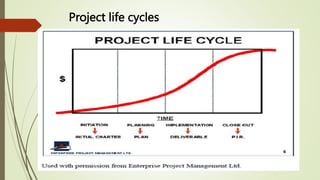
Project life cycles
The project management profession
 The Project Management Institute (PMI) ™ provides certification as
a project management professional (PMP).
 There are also numerous other sources of information on the
project management profession. Here are some other websites you
may wish to check out:
www.gantthead.com
www.projectmanagement.com
www.4pm.com
www.pmforum.org
www.comptia.org/certification/itprojectplus/index.htm
www.allpm.com
www.ipma.ch
www.apm.org.uk
www.projectnet.com
The importance of project stakeholders
Project stakeholders are the people involved in or
affected by project activities.
Internal stakeholders
Project sponsor
Project team
Support staff
Internal customers
Senior management
Functional managers
Other project managers
External stakeholders
External customers
Competitors
Suppliers
Others affected by the project, but not directly
involved (e.g., government, concerned citizens,
etc.).
Techno-economic feasibility analysis
The techno-economic analysis enables an investor to arrive
at decisions about project implementation.
This involves
location decision,
input raw material,
size of the plant,
 infrastructure facilities,
manpower availability,
technology, and
construction process available for the proposed project.
Economic and financial feasibility analysis
 This includes all economic analysis and financial feasibility.
 The estimate of the total cost of project investment and the cash-flow
pattern is important at this stage of project evaluation.
 The capital structure (debt and equity ratio), the financing sources,
interest rates, and working capital requirements are to be decided
before any final decision is taken.
 Financial decisions such as break-even point calculation, pay-back
period, NPV (net present value), IRR (internal rate of return), return on
investment (ROI), and return of assets (ROA) is to be considered at
this feasibility stage of a project.
Project integration management
Project Integration Management is “the processes
involved in coordinating all of the other project
management knowledge areas throughout a project’s
life cycle.”
Integration management is about integrating the work
of the entire project team by focusing on high-quality
communication and relationship building. Thus project
integration management includes what is known as
interface management – or identifying and managing
the points of interaction between the various project
players and elements.
Three Key Components Of Project
Integration Management
Project Plan Development
(creating the Project Plan)
Project Plan Execution
(carrying out the Project Plan)
Change Control
(coordinating changes across the entire project).
The project plan
The project plan is the core high-level document that
guides a project’s execution and control. Project plans:
 document assumptions, definitions and decisions
 facilitate stakeholder communication
 define content, extent, and timing of key management
reviews
provide a baseline for project control and measuring
progress
define a size appropriate to the scope of the project.
Project plan execution
Project integration management considers project
planning and execution as inseparable activities.
The purpose of the project plan is to guide execution.
However, project plans are often changed during the
course of execution as additional knowledge and
information are gained through experience.
Project managers rely on the expertise of team members
in each knowledge area to help guide and build the plan.
Project managers need good leadership, communication,
and political skills to execute project plans.
Project execution tools and techniques
1. Project management software
Project management software has become a standard
tool of the trade.
Microsoft Project™ is the most widely used project
management software tools in the world.
Primavera Project Planner™,
Scheduler Plus™,
Open Plan™ are examples of other scheduling tools on
the market.
Project execution tools and techniques
2. Status review meetings
Regularly scheduled status review meetings are a
standard project management tool for:
exchanging project information
monitoring progress
maintaining motivation
managing risk
identifying issues
stakeholder communication.
Project execution tools and techniques
3. Work authorization systems
Work authorization systems are a formalized process
used on large projects to authorize work to begin on
a particular activity or work package.
They are designed to ensure that the right things are
done by the right people at the right time.
They can be manual or automated.
Overall change control
Overall change control includes identifying,
evaluating, and managing project changes.
Thank
you

PPT1-PROJECT-_-Project-Management.pptx

  • 1.
  • 2.
    Purpose of thePMBOK® Guide PMBOK (Project Management Book of Knowledge) The acceptance of project management as a profession indicates that the application of knowledge, processes, skills, tools, and techniques can have a significant impact on project success.  The PMBOK® Guide identifies that subset of the project management body of knowledge that is generally recognized as good practice.
  • 3.
    Generally recognized  “Generallyrecognized” means the knowledge and practices described are applicable to most projects most of the time, and there is consensus about their value and usefulness.
  • 4.
    Good practice “Good practice”means there is general agreement that the application of the knowledge, skills, tools, and techniques can enhance the chances of success over many projects.  “Good practice” does not mean that the knowledge described should always be applied uniformly to all projects; the organization and/or project management team is responsible for determining what is appropriate for any given project.
  • 5.
    What is aProject? A project is a temporary endeavor undertaken to create a unique product, service, or result. The temporary nature of projects indicates that a project has a definite beginning and end. The end is reached when the project’s objectives have been achieved or when the project is terminated because its objectives will not or cannot be met, or when the need for the project no longer exists.
  • 6.
    What is aProject? A project may also be terminated if the client (customer, sponsor, or champion) wishes to terminate the project. Temporary does not necessarily mean the duration of the project is short. It refers to the project’s engagement and its longevity.
  • 7.
    What is aProject? Temporary does not typically apply to the product, service, or result created by the project; most projects are undertaken to create a lasting outcome. For example, a project to build a national monument will create a result expected to last for centuries.  Projects can also have social, economic, and environmental impacts that far outlive the projects themselves.
  • 8.
     Every projectcreates a unique product, service, or result.  The outcome of the project may be tangible or intangible. Although repetitive elements may be present in some project deliverables and activities, this repetition does not change the fundamental, unique characteristics of the project work.
  • 9.
    For Example  Officebuildings can be constructed with the same or similar materials and by the same or different teams. However, each building project remains unique with a different location, different design, different circumstances and situations, different stakeholders, and so on.
  • 10.
    A project cancreate:  •A product that can be either a component of another item, an enhancement of an item, or an end item in itself;  A service or a capability to perform a service (e.g., a business function that supports production or distribution);
  • 11.
    A project cancreate: An improvement in the existing product or service lines (e.g., A Six Sigma project undertaken to reduce defects); or  A result, such as an outcome or document (e.g., a research project that develops knowledge that can be used to determine whether a trend exists or a new process will benefit society).
  • 12.
    Examples of projectsinclude, but are not limited to:  Developing a new product, service, or result;  Effecting a change in the structure, processes, staffing, or style of an organization;  Developing or acquiring a new or modified information system (hardware or software);
  • 13.
    Examples of projectsinclude, but are not limited to Conducting a research effort whose outcome will be aptly recorded; Constructing a building, industrial plant, or infrastructure; or Implementing, improving, or enhancing existing business processes and procedures.
  • 14.
    What is ProjectManagement? Project management is the application of knowledge, skills, tools, and techniques to project activities to meet the project requirements. Project management is accomplished through the appropriate application and integration of the 47 logically grouped project management processes, which are categorized into five Process Groups.
  • 15.
    Five Process Groups Initiating,  Planning, Executing,  Monitoring and Controlling, and  Closing.
  • 16.
    International standards andguidelines 1. Integration management – processes to ensure that the elements of the project are effectively coordinated. Integration management involves making decisions throughout the project in terms of objectives and alternative approaches to meet or exceed stakeholder expectations. 2. Scope management – processes to ensure that all the work required to complete the project is defined. Defining what is or is not in scope.
  • 17.
    International standards andguidelines 3. Time management – all processes required to ensure that the project completes on time (defined schedule). 4. Cost management – all processes required to ensure the project is completed within the budget approved for the project.
  • 18.
    International standards andguidelines 5. Quality management – processes to ensure that the project delivers the need for which it was undertaken. Includes all quality processes such as quality policy, objectives, and responsibility and implements these through quality planning, quality assurance, quality control, and quality improvement. 6. Risk management – all processes involved in identifying, assessing/analyzing, responding, and controlling project risk.
  • 19.
    International standards andguidelines 7. Human resource management – all processes required to make the most effective use of people resources in a project, including sponsor, stakeholders, partners, team, etc. 8. Communications management – all processes to ensure timely and appropriate distribution of project information, includes providing links between key people in the project, generating, collecting, disseminating, storing, and archival of project information.
  • 20.
    International standards andguidelines 9. Procurement management – processes to acquire goods and services for the project outside of the organization.
  • 21.
    Project management processes 1.Initiating processes – authorizing the project or phase. 2. Planning processes – defining the project objectives and selecting the most appropriate approach for the project to attain the objectives. 3. Executing processes – managing the resources required to carry out the project as defined in the plan. 4. Controlling processes – ensuring that project objectives are met as defined by monitoring, measuring progress against plan, identifying variance from the plan, and taking corrective action. 5. Closing processes – formalizing acceptance of a phase and or the project and closing all associated activities.
  • 22.
  • 23.
    The project managementprofession  The Project Management Institute (PMI) ™ provides certification as a project management professional (PMP).  There are also numerous other sources of information on the project management profession. Here are some other websites you may wish to check out: www.gantthead.com www.projectmanagement.com www.4pm.com www.pmforum.org www.comptia.org/certification/itprojectplus/index.htm www.allpm.com www.ipma.ch www.apm.org.uk www.projectnet.com
  • 24.
    The importance ofproject stakeholders Project stakeholders are the people involved in or affected by project activities.
  • 25.
    Internal stakeholders Project sponsor Projectteam Support staff Internal customers Senior management Functional managers Other project managers
  • 26.
    External stakeholders External customers Competitors Suppliers Othersaffected by the project, but not directly involved (e.g., government, concerned citizens, etc.).
  • 27.
    Techno-economic feasibility analysis Thetechno-economic analysis enables an investor to arrive at decisions about project implementation. This involves location decision, input raw material, size of the plant,  infrastructure facilities, manpower availability, technology, and construction process available for the proposed project.
  • 28.
    Economic and financialfeasibility analysis  This includes all economic analysis and financial feasibility.  The estimate of the total cost of project investment and the cash-flow pattern is important at this stage of project evaluation.  The capital structure (debt and equity ratio), the financing sources, interest rates, and working capital requirements are to be decided before any final decision is taken.  Financial decisions such as break-even point calculation, pay-back period, NPV (net present value), IRR (internal rate of return), return on investment (ROI), and return of assets (ROA) is to be considered at this feasibility stage of a project.
  • 29.
    Project integration management ProjectIntegration Management is “the processes involved in coordinating all of the other project management knowledge areas throughout a project’s life cycle.” Integration management is about integrating the work of the entire project team by focusing on high-quality communication and relationship building. Thus project integration management includes what is known as interface management – or identifying and managing the points of interaction between the various project players and elements.
  • 30.
    Three Key ComponentsOf Project Integration Management Project Plan Development (creating the Project Plan) Project Plan Execution (carrying out the Project Plan) Change Control (coordinating changes across the entire project).
  • 31.
    The project plan Theproject plan is the core high-level document that guides a project’s execution and control. Project plans:  document assumptions, definitions and decisions  facilitate stakeholder communication  define content, extent, and timing of key management reviews provide a baseline for project control and measuring progress define a size appropriate to the scope of the project.
  • 32.
    Project plan execution Projectintegration management considers project planning and execution as inseparable activities. The purpose of the project plan is to guide execution. However, project plans are often changed during the course of execution as additional knowledge and information are gained through experience. Project managers rely on the expertise of team members in each knowledge area to help guide and build the plan. Project managers need good leadership, communication, and political skills to execute project plans.
  • 33.
    Project execution toolsand techniques 1. Project management software Project management software has become a standard tool of the trade. Microsoft Project™ is the most widely used project management software tools in the world. Primavera Project Planner™, Scheduler Plus™, Open Plan™ are examples of other scheduling tools on the market.
  • 34.
    Project execution toolsand techniques 2. Status review meetings Regularly scheduled status review meetings are a standard project management tool for: exchanging project information monitoring progress maintaining motivation managing risk identifying issues stakeholder communication.
  • 35.
    Project execution toolsand techniques 3. Work authorization systems Work authorization systems are a formalized process used on large projects to authorize work to begin on a particular activity or work package. They are designed to ensure that the right things are done by the right people at the right time. They can be manual or automated.
  • 36.
    Overall change control Overallchange control includes identifying, evaluating, and managing project changes.
  • 37.

Editor's Notes

  • #28 The techno-economic analysis enables an investor to arrive at decisions about project implementation. As the project involves a huge sum of money and time, it’s imperative to verify its technical and economical viability. This is otherwise known as techno-economic feasibility analysis. In this section, we will examine how the technical aspects of a project are evaluated for its technical feasibility followed by its economic analysis.
  • #37 Overall change control includes identifying, evaluating, and managing project changes. Remember the triple constraint triangle of project management (quality, time, and cost) and how you cannot change one parameter without impacting at least one of the other constraints. Without proper change control, a project can easily drift into ‘scope creep’ and severe cost and/or time over-runs.