AN INTRODUCTION TO PROJECT MANAGEMENT Ajcon IT.com Ltd. 22 May 2010
WHAT IS PROJECT MANAGEMENT Project management is  no small task . Project management has a  definite beginning and end . It is not a continuous process. Project management uses various tools to measure accomplishments and  track project tasks . These include  Work Breakdown Structures, Gantt charts and PERT charts. Project management  reduces risk  and  increases the chance of success.
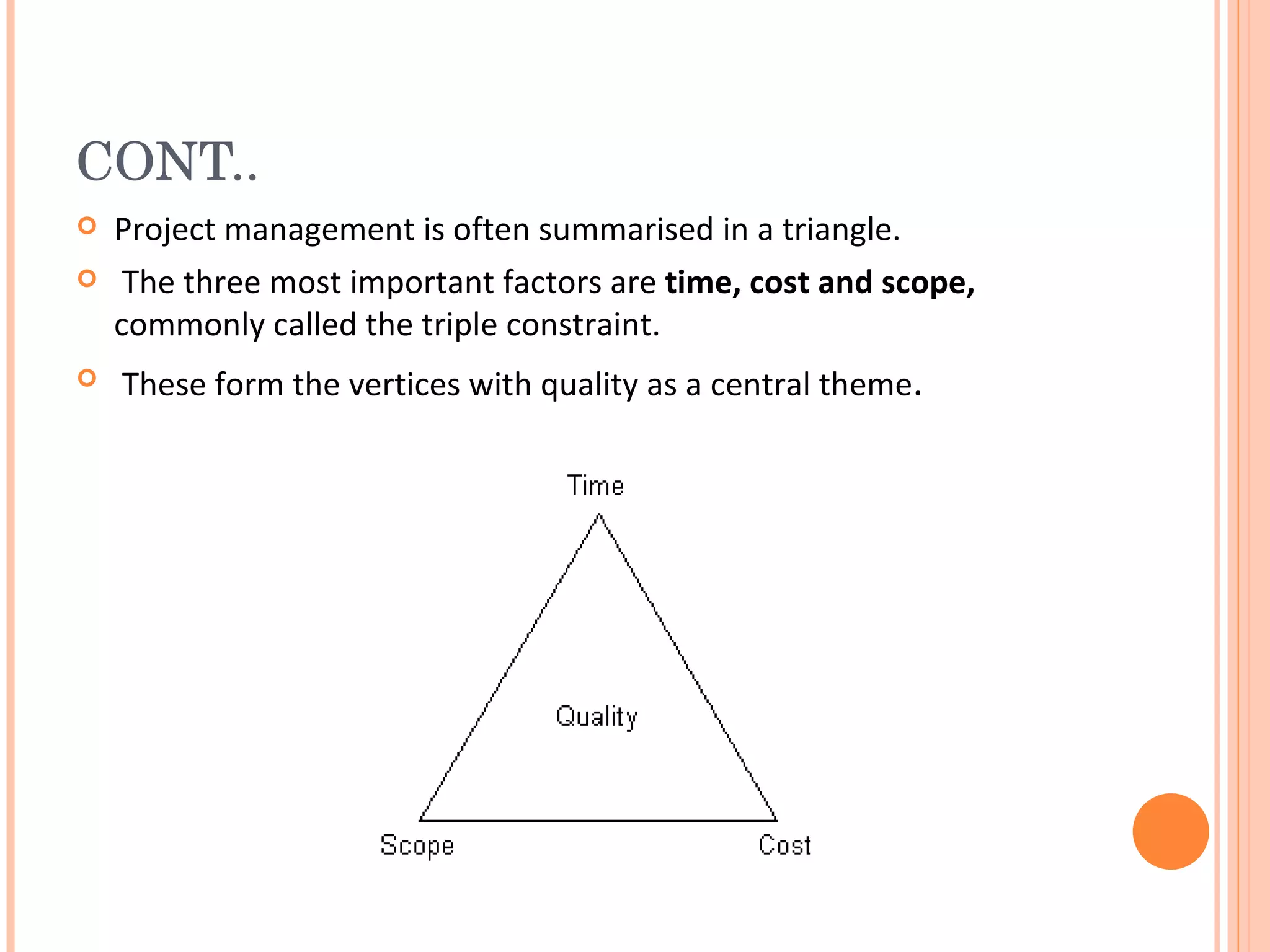
CONT.. Project management is often summarised in a triangle. The three most important factors are  time,   cost and scope,  commonly called the triple constraint. These form the vertices with quality as a central theme .
WHAT IS MUST? Projects must be delivered on time. Projects must be within cost. Projects must be within scope. Projects must meet customer quality requirements .
A PROJECT GOES THROUGH SIX PHASES DURING ITS LIFE: Project Definition:  Defining the goals, objectives and critical success factors for the project. Project Initiation:  Everything that is needed to set-up the project before work can start. Project Planning:  Detailed plans of how the work will be carried out including time, cost and resource estimates.
CONT… Project Execution:  Doing the work to deliver the product, service or desired outcome. Project Monitoring & Control:  Ensuring that a project stays on track and taking corrective action to ensure it does. Project Closure:  Formal acceptance of the deliverables and disbanding of all the elements that were required to run the project.
ROLE OF A PROJECT MANAGER The project manager must define the project, reduce it to a set of manageable tasks, obtain appropriate resources and build a team to perform the work. The project manager must set the final goal for the project and motivate his/her team to complete the project on time. The project manager must inform all stakeholders of progress on a regular basis. The project manager must assess and monitor risks to the project and mitigate them. No project ever goes exactly as planned, so project managers must learn to adapt to and manage change.
HOW TO BECOME A PROJECT MANAGER The Eight Skills Needed on the Path to Project Management: 1.  Be a Leader and a Manager 2. Be a Team Member and a Team Leader 3.  Be a Problem Solver 4.  Be a Negotiator and Influencer 5.  Be an Excellent Communicator 6.  Be a Good Organiser 7.  Be a Competent and Consistent Planner 8.  Set-up and Manage Budgets
PROJECT MANAGER’S ROLE "Project managers bear ultimate responsibility for making things happen. Traditionally, they have carried out this role as mere implementers. To do their jobs they needed to  have basic administrative and technical competencies . Today they play a far broader role. In addition to the traditional skills, they need to have  business skills ,  customer relations skills, and political skills.  Psychologically, they must be  results-oriented self-starters  with a  high tolerance for ambiguity,  because little is clear-cut in today's  tumultuous business environment .  Shortcomings in any of these areas can lead to project failure."  - J. Davidson Frame
BARRIERS OF PROJECT MANAGEMENT Poor communication Disagreement Misunderstandings Bad weather Union strikes Personality conflicts Poor management Poorly defined goals and objectives
A good project management discipline will  not eliminate all risks ,  issues and surprises , but  will provide standard processes and procedures  to deal with them and help prevent the following:
Projects  finishing late ,  exceeding budget  or not meeting  customer expectations. Inconsistency  between the processes and procedures used by projects managers, leading to some being favoured more than others. Successful projects, despite a lack of planning, achieved through  high stress levels, goodwill  and significant amounts of  overtime. Project management seen as not adding value and as a  waste of time and money. Unforeseen internal and/or external events  impacting the project.
CONCLUSION “ Project management  is about  creating an environment and conditions   in which a  defined goal or objective  can be achieved in a  controlled manner  by a  team of people .”
THANKS Presented By: Ashish Mittal AJCON IT.COM LTD.

An Introduction To Project Management

  • 1.
    AN INTRODUCTION TOPROJECT MANAGEMENT Ajcon IT.com Ltd. 22 May 2010
  • 2.
    WHAT IS PROJECTMANAGEMENT Project management is no small task . Project management has a definite beginning and end . It is not a continuous process. Project management uses various tools to measure accomplishments and track project tasks . These include Work Breakdown Structures, Gantt charts and PERT charts. Project management reduces risk and increases the chance of success.
  • 3.
    CONT.. Project managementis often summarised in a triangle. The three most important factors are time, cost and scope, commonly called the triple constraint. These form the vertices with quality as a central theme .
  • 4.
    WHAT IS MUST?Projects must be delivered on time. Projects must be within cost. Projects must be within scope. Projects must meet customer quality requirements .
  • 5.
    A PROJECT GOESTHROUGH SIX PHASES DURING ITS LIFE: Project Definition: Defining the goals, objectives and critical success factors for the project. Project Initiation: Everything that is needed to set-up the project before work can start. Project Planning: Detailed plans of how the work will be carried out including time, cost and resource estimates.
  • 6.
    CONT… Project Execution: Doing the work to deliver the product, service or desired outcome. Project Monitoring & Control: Ensuring that a project stays on track and taking corrective action to ensure it does. Project Closure: Formal acceptance of the deliverables and disbanding of all the elements that were required to run the project.
  • 7.
    ROLE OF APROJECT MANAGER The project manager must define the project, reduce it to a set of manageable tasks, obtain appropriate resources and build a team to perform the work. The project manager must set the final goal for the project and motivate his/her team to complete the project on time. The project manager must inform all stakeholders of progress on a regular basis. The project manager must assess and monitor risks to the project and mitigate them. No project ever goes exactly as planned, so project managers must learn to adapt to and manage change.
  • 8.
    HOW TO BECOMEA PROJECT MANAGER The Eight Skills Needed on the Path to Project Management: 1. Be a Leader and a Manager 2. Be a Team Member and a Team Leader 3. Be a Problem Solver 4. Be a Negotiator and Influencer 5. Be an Excellent Communicator 6. Be a Good Organiser 7. Be a Competent and Consistent Planner 8. Set-up and Manage Budgets
  • 9.
    PROJECT MANAGER’S ROLE"Project managers bear ultimate responsibility for making things happen. Traditionally, they have carried out this role as mere implementers. To do their jobs they needed to have basic administrative and technical competencies . Today they play a far broader role. In addition to the traditional skills, they need to have business skills , customer relations skills, and political skills. Psychologically, they must be results-oriented self-starters with a high tolerance for ambiguity, because little is clear-cut in today's tumultuous business environment . Shortcomings in any of these areas can lead to project failure." - J. Davidson Frame
  • 10.
    BARRIERS OF PROJECTMANAGEMENT Poor communication Disagreement Misunderstandings Bad weather Union strikes Personality conflicts Poor management Poorly defined goals and objectives
  • 11.
    A good projectmanagement discipline will not eliminate all risks , issues and surprises , but will provide standard processes and procedures to deal with them and help prevent the following:
  • 12.
    Projects finishinglate , exceeding budget or not meeting customer expectations. Inconsistency between the processes and procedures used by projects managers, leading to some being favoured more than others. Successful projects, despite a lack of planning, achieved through high stress levels, goodwill and significant amounts of overtime. Project management seen as not adding value and as a waste of time and money. Unforeseen internal and/or external events impacting the project.
  • 13.
    CONCLUSION “ Projectmanagement is about creating an environment and conditions in which a defined goal or objective can be achieved in a controlled manner by a team of people .”
  • 14.
    THANKS Presented By:Ashish Mittal AJCON IT.COM LTD.