Project Management Tools and Techniques Don Duval | Director, Corporate Development | MaRS Discovery District October 6 th  2008
Presentation Objectives There are  three objectives  for today’s interactive and exciting session: Provide an overview of my relevant background and some of my key project management experiences over the past 10 years Understand the fundamentals of project planning, management, and supporting tools that can enhance the delivery and success of projects Engage in discussion on these topics, offer opinions as to what will work and won’t work for your projects
What is a Project? A  project  is a coordinated, once-through set of activities designed to achieve a specific objective…and a  project  functions under conditions of defined schedules, budgets and performance criteria. The most common method to define a project is to utilize a  project charter , a document that outlines the key elements and activities of a project.
Key Components of a Project Charter Project Objectives and Rationale Strategic Significance Scope and Deliverables Approach - Project Plan Structure and Resources Timeframe and Budget Assumptions / Dependencies Risks and Mitigation Communication Strategy Measures of Success
Building a Project Charter Project Charter - Table of Contents Objectives and Rationale Strategic Significance Scope and Deliverables Approach - Project Plan Timeframe and Budget Estimate Project Team Structure and Resources Communication Strategy Project Assumptions / Dependencies Risks and Mitigation Strategies Measures of Success
Objectives, Rationale, and Strategic Significance Essential to understand  why you are doing the project ,  how it fits into the broader strategy  of your department and organization, and what are the  expected benefits Ability to describe in an elevator speech (short and sweet) Provides context and confidence to the organization to ensure buy-in and support Articulates to yourself and the project team that you are doing something of value! Need to imagine someone reading a  one-pager  about your project and have them get it…the “Oh…I get it” moment
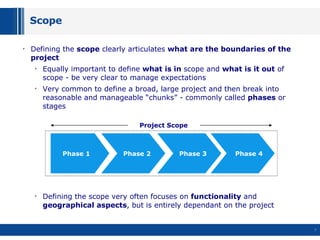
Scope Defining the  scope  clearly articulates  what are the boundaries of the project Equally important to define  what is in  scope and  what is it out  of scope - be very clear to manage expectations Very common to define a broad, large project and then break into reasonable and manageable “chunks” - commonly called  phases  or stages Defining the scope very often focuses on  functionality  and  geographical aspects , but is entirely dependant on the project Phase 1 Phase 2 Phase 3 Phase 4 Project Scope
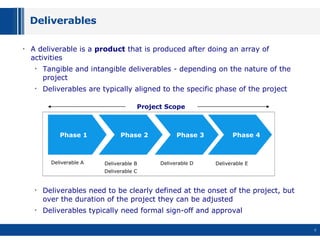
Deliverables A deliverable is a  product  that is produced after doing an array of activities Tangible and intangible deliverables - depending on the nature of the project Deliverables are typically aligned to the specific phase of the project Deliverables need to be clearly defined at the onset of the project, but over the duration of the project they can be adjusted Deliverables typically need formal sign-off and approval Phase 1 Phase 2 Phase 3 Phase 4 Project Scope Deliverable A Deliverable B Deliverable C Deliverable D Deliverable E
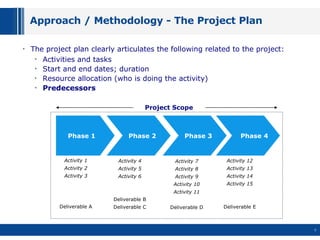
Approach / Methodology - The Project Plan The project plan clearly articulates the following related to the project: Activities and tasks Start and end dates; duration Resource allocation (who is doing the activity) Predecessors Phase 1 Phase 2 Phase 3 Phase 4 Project Scope Activity 1 Activity 2 Activity 3 Deliverable A Activity 4 Activity 5 Activity 6 Deliverable B Deliverable C Activity 7 Activity 8 Activity 9 Activity 10 Activity 11 Deliverable D Activity 12 Activity 13 Activity 14 Activity 15 Deliverable E
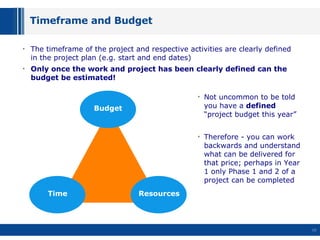
Timeframe and Budget The timeframe of the project and respective activities are clearly defined in the project plan (e.g. start and end dates) Only once the work and project has been clearly defined can the budget be estimated! Budget Time Resources Not uncommon to be told you have a  defined  “project budget this year” Therefore - you can work backwards and understand what can be delivered for that price; perhaps in Year 1 only Phase 1 and 2 of a project can be completed
Organizational Structure and Resources Defining  who is part of the project team  and  their respective roles  is probably one of the most important, yet commonly overlooked aspect of project management Based on the activities that need to be done, who has the skills to complete the work? Very common, especially under aggressive timelines, it is common to bring in consultants / supplementary resources to fill gaps, provide specific skills, or expedite the completion of a project Essential for  workload management  - very often people have day jobs that need to be considered during the planning stage Person Project Role / Responsibility
 
Communication Strategy A clear communication strategy is  essential to ensure project success There are two components of communication:  internal project team  communication and  external  communication  Very important to assess  who will be impacted  by the project,  what information they need  to know, and  when they need to know  it  Critical problems often arise if someone says “I had no idea you were doing that” -  duplicative  efforts or  contradictory  initiatives Frustration! Internal Project Team - Status Update Meetings Completed activities Planned activities Outstanding activities “ Red flags” Status on timeline, resources, budget
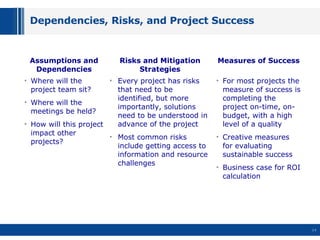
Dependencies, Risks, and Project Success Assumptions and Dependencies Risks and Mitigation Strategies Measures of Success Where will the project team sit? Where will the meetings be held? How will this project impact other projects? Every project has risks that need to be identified, but more importantly, solutions need to be understood in advance of the project Most common risks include getting access to information and resource challenges For most projects the measure of success is completing the project on-time, on-budget, with a high level of a quality Creative measures for evaluating sustainable success Business case for ROI calculation
Building a Project Charter Document Length For most projects, the expected length of a charter is in the range of 8 to 10 pages Creator / Owner of the Document Project manager should own and create the document and communicate to the team Feedback welcome at discretion of project manager Project Charter
Questions / Comments

Project Management Tools and Techniques

  • 1.
    Project Management Toolsand Techniques Don Duval | Director, Corporate Development | MaRS Discovery District October 6 th 2008
  • 2.
    Presentation Objectives Thereare three objectives for today’s interactive and exciting session: Provide an overview of my relevant background and some of my key project management experiences over the past 10 years Understand the fundamentals of project planning, management, and supporting tools that can enhance the delivery and success of projects Engage in discussion on these topics, offer opinions as to what will work and won’t work for your projects
  • 3.
    What is aProject? A project is a coordinated, once-through set of activities designed to achieve a specific objective…and a project functions under conditions of defined schedules, budgets and performance criteria. The most common method to define a project is to utilize a project charter , a document that outlines the key elements and activities of a project.
  • 4.
    Key Components ofa Project Charter Project Objectives and Rationale Strategic Significance Scope and Deliverables Approach - Project Plan Structure and Resources Timeframe and Budget Assumptions / Dependencies Risks and Mitigation Communication Strategy Measures of Success
  • 5.
    Building a ProjectCharter Project Charter - Table of Contents Objectives and Rationale Strategic Significance Scope and Deliverables Approach - Project Plan Timeframe and Budget Estimate Project Team Structure and Resources Communication Strategy Project Assumptions / Dependencies Risks and Mitigation Strategies Measures of Success
  • 6.
    Objectives, Rationale, andStrategic Significance Essential to understand why you are doing the project , how it fits into the broader strategy of your department and organization, and what are the expected benefits Ability to describe in an elevator speech (short and sweet) Provides context and confidence to the organization to ensure buy-in and support Articulates to yourself and the project team that you are doing something of value! Need to imagine someone reading a one-pager about your project and have them get it…the “Oh…I get it” moment
  • 7.
    Scope Defining the scope clearly articulates what are the boundaries of the project Equally important to define what is in scope and what is it out of scope - be very clear to manage expectations Very common to define a broad, large project and then break into reasonable and manageable “chunks” - commonly called phases or stages Defining the scope very often focuses on functionality and geographical aspects , but is entirely dependant on the project Phase 1 Phase 2 Phase 3 Phase 4 Project Scope
  • 8.
    Deliverables A deliverableis a product that is produced after doing an array of activities Tangible and intangible deliverables - depending on the nature of the project Deliverables are typically aligned to the specific phase of the project Deliverables need to be clearly defined at the onset of the project, but over the duration of the project they can be adjusted Deliverables typically need formal sign-off and approval Phase 1 Phase 2 Phase 3 Phase 4 Project Scope Deliverable A Deliverable B Deliverable C Deliverable D Deliverable E
  • 9.
    Approach / Methodology- The Project Plan The project plan clearly articulates the following related to the project: Activities and tasks Start and end dates; duration Resource allocation (who is doing the activity) Predecessors Phase 1 Phase 2 Phase 3 Phase 4 Project Scope Activity 1 Activity 2 Activity 3 Deliverable A Activity 4 Activity 5 Activity 6 Deliverable B Deliverable C Activity 7 Activity 8 Activity 9 Activity 10 Activity 11 Deliverable D Activity 12 Activity 13 Activity 14 Activity 15 Deliverable E
  • 10.
    Timeframe and BudgetThe timeframe of the project and respective activities are clearly defined in the project plan (e.g. start and end dates) Only once the work and project has been clearly defined can the budget be estimated! Budget Time Resources Not uncommon to be told you have a defined “project budget this year” Therefore - you can work backwards and understand what can be delivered for that price; perhaps in Year 1 only Phase 1 and 2 of a project can be completed
  • 11.
    Organizational Structure andResources Defining who is part of the project team and their respective roles is probably one of the most important, yet commonly overlooked aspect of project management Based on the activities that need to be done, who has the skills to complete the work? Very common, especially under aggressive timelines, it is common to bring in consultants / supplementary resources to fill gaps, provide specific skills, or expedite the completion of a project Essential for workload management - very often people have day jobs that need to be considered during the planning stage Person Project Role / Responsibility
  • 12.
  • 13.
    Communication Strategy Aclear communication strategy is essential to ensure project success There are two components of communication: internal project team communication and external communication Very important to assess who will be impacted by the project, what information they need to know, and when they need to know it Critical problems often arise if someone says “I had no idea you were doing that” - duplicative efforts or contradictory initiatives Frustration! Internal Project Team - Status Update Meetings Completed activities Planned activities Outstanding activities “ Red flags” Status on timeline, resources, budget
  • 14.
    Dependencies, Risks, andProject Success Assumptions and Dependencies Risks and Mitigation Strategies Measures of Success Where will the project team sit? Where will the meetings be held? How will this project impact other projects? Every project has risks that need to be identified, but more importantly, solutions need to be understood in advance of the project Most common risks include getting access to information and resource challenges For most projects the measure of success is completing the project on-time, on-budget, with a high level of a quality Creative measures for evaluating sustainable success Business case for ROI calculation
  • 15.
    Building a ProjectCharter Document Length For most projects, the expected length of a charter is in the range of 8 to 10 pages Creator / Owner of the Document Project manager should own and create the document and communicate to the team Feedback welcome at discretion of project manager Project Charter
  • 16.