Lecture No. 7
Project Management
Importance of the project
management
Learning Objectives, Part 1
 Understand the growing need for better project
management, especially for information technology (IT)
projects.
 Explain what a project is, provide examples of IT projects,
list various attributes of projects, and describe the triple
constraint of project management.
 Describe project management and discuss key elements of
the project management framework, including project
stakeholders, the project management knowledge areas,
common tools and techniques, and project success.
2
Learning Objectives, Part 2
 Discuss the relationship between project, program, and
portfolio management and the contributions each makes
to enterprise success.
 Understand the role of project managers by describing
what they do, what skills they need, and career
opportunities for IT project managers.
 Describe the project management profession, including its
history, the role of professional organizations like the
Project Management Institute (PMI), the importance of
certification and ethics, and the advancement of project
management software.
3
Motivation for Studying
Information Technology (IT)
Project Management
4
Advantages of Using Formal
Project Management
 Better control of financial, physical, and human
resources.
 Improved customer relations.
 Shorter development times.
 Lower costs.
 Higher quality and increased reliability.
 Higher profit margins.
 Improved productivity.
 Better internal coordination.
5
What Is a Project?
 A project is “a temporary term undertaken to
create a unique product, service, or result”.
 Operations is work done to sustain the
business.
 Projects end when their objectives have been
reached or the project has been terminated.
 Projects can be large or small and take a short
or long time to complete.
6
Examples of IT Projects
 A team of students creates a smartphone
application and sells it online.
 A government group develops a system to
track child immunizations.
 A global bank acquires other financial
institutions and needs to consolidate
systems and procedures.
7
Project and Program Managers
 Project managers work with project sponsors,
project team, and other people involved in a
project to meet project goals.
 Program: group of related projects managed in a
coordinated way to obtain benefits and control not
available from managing them individually.
 (Program managers often act as bosses for
project managers).
8
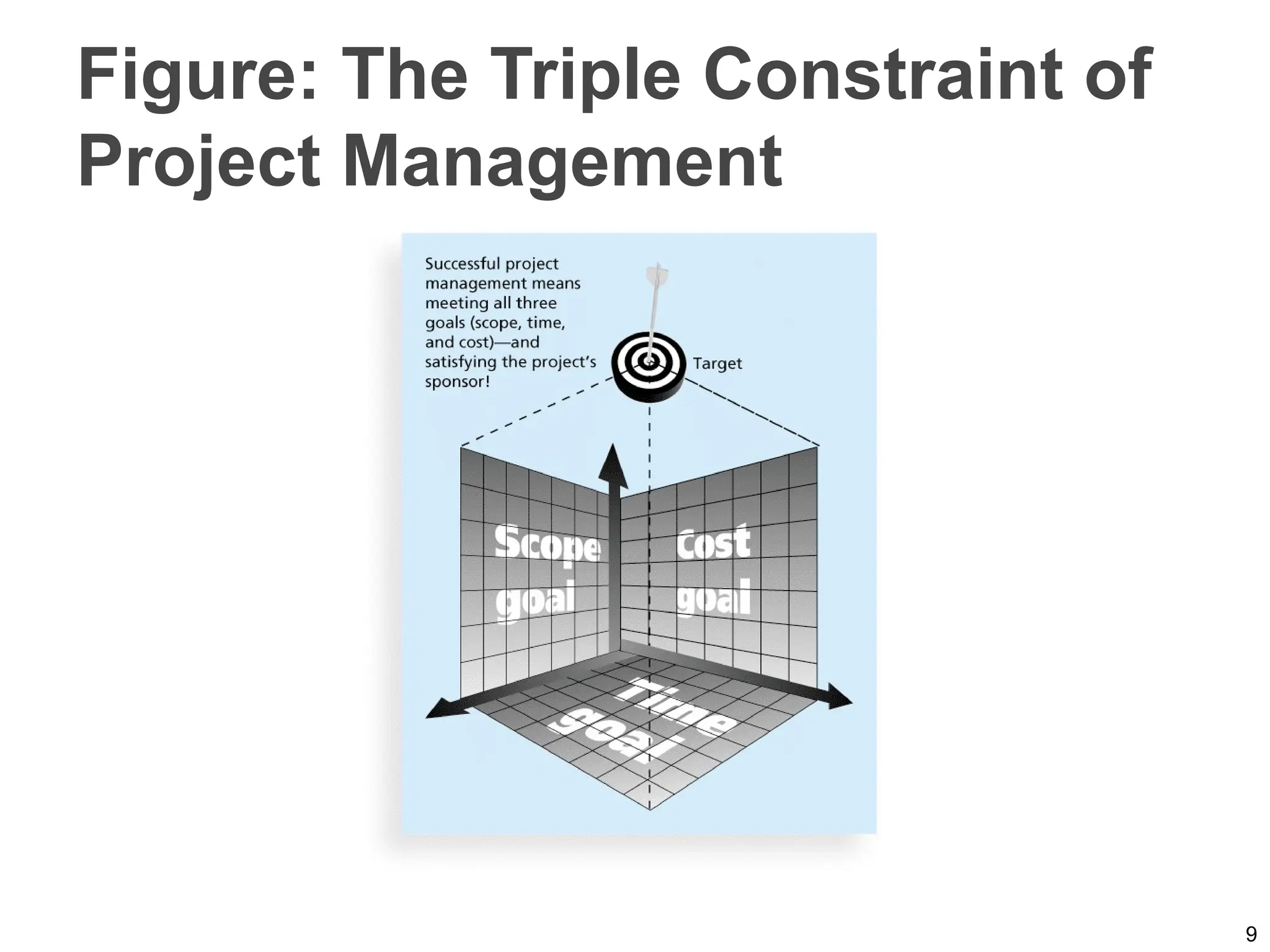
Figure: The Triple Constraint of
Project Management
9
What is Project Management?
 Project management is “the application of
knowledge, skills, tools and techniques to project.
 Project managers strive to meet the triple
constraint (project scope, time, and cost goals)
and also facilitate the entire process to meet the
needs and expectations of project stakeholders.
10
Project Stakeholders
 Stakeholders are the people involved in or
affected by project activities.
 Stakeholders include:
◦ the project sponsor.
◦ the project manager.
◦ the project team.
◦ support staff.
◦ customers.
◦ users.
◦ suppliers.
11
Project Management Knowledge
Areas
 Knowledge areas describe the key competencies
that project managers must develop.
 Project managers must have knowledge and skills
in all 10 knowledge areas (project integration,
scope, time, cost, quality, human resource,
communications, risk, procurement, and
stakeholder management).
 This text includes an entire chapter on each
knowledge area.
12
Project Management Tools and
Techniques
 Project management tools and techniques assist
project managers and their teams in various
aspects of project management.
 Some specific ones include:
◦ Project charter, scope statement.
◦ Gantt charts, network diagrams, critical path analysis,
critical chain scheduling (time).
◦ Cost estimates and earned value management (cost).
13
Project Success
 There are several ways to define project
success:
◦ The project met scope, time, and cost goals.
◦ The project satisfied the customer/sponsor.
◦ The results of the project met its main
objective, such as making or saving a certain
amount of money, providing a good return on
investment, or simply making the sponsors
happy.
14
Table : What Helps Projects?
1. Executive support.
2. User involvement.
3. Clear business objectives.
4. Emotional maturity.
5. Optimizing scope.
6. Project management expertise.
7. Skilled resources.
8. Execution.
9. Tools and infrastructure.
15
The Role of the Project Manager
Job descriptions vary, but most
include responsibilities like
planning, scheduling, coordinating,
and working with people to achieve
project goals.
16
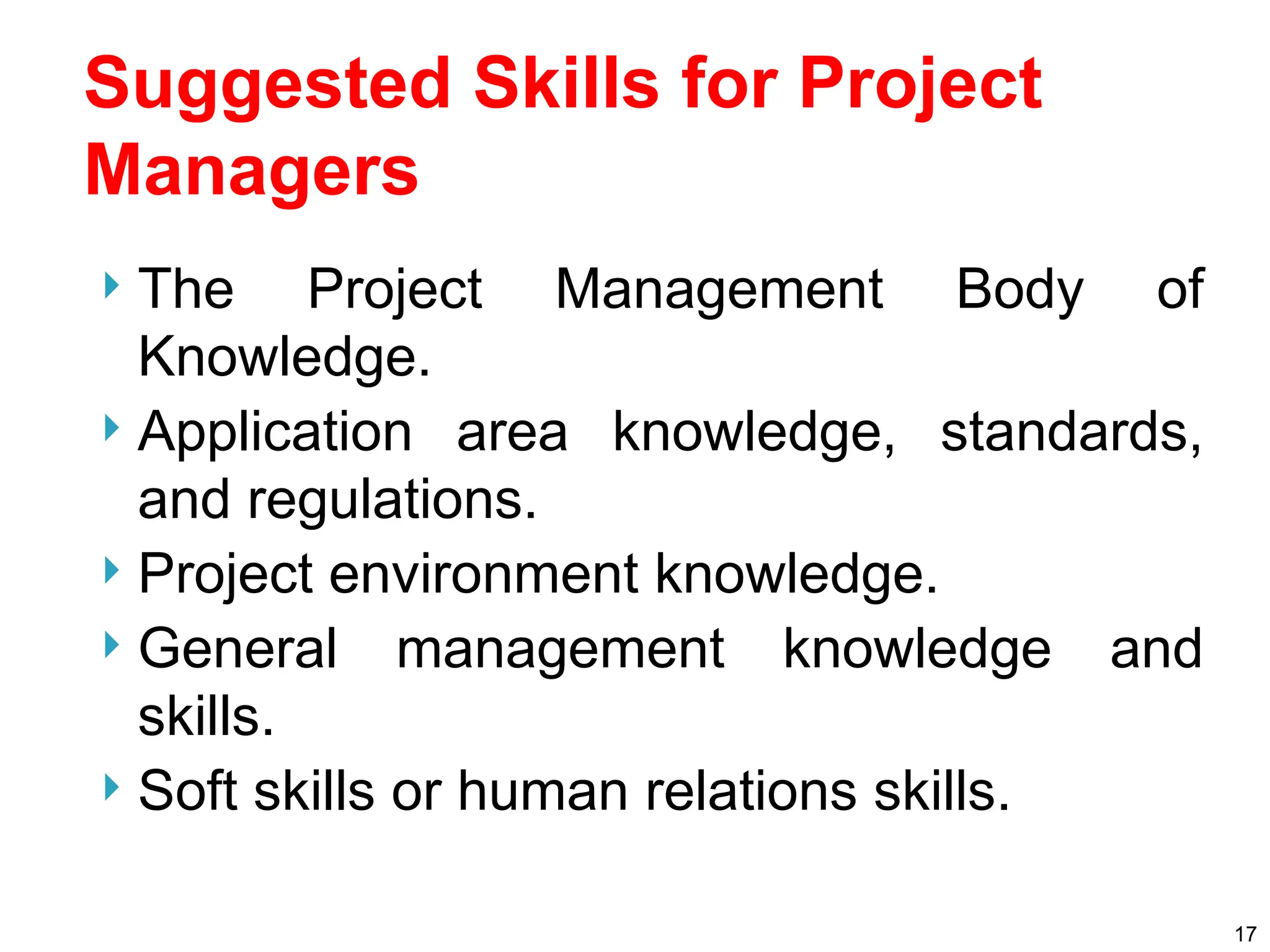
Suggested Skills for Project
Managers
 The Project Management Body of
Knowledge.
 Application area knowledge, standards,
and regulations.
 Project environment knowledge.
 General management knowledge and
skills.
 Soft skills or human relations skills.
17
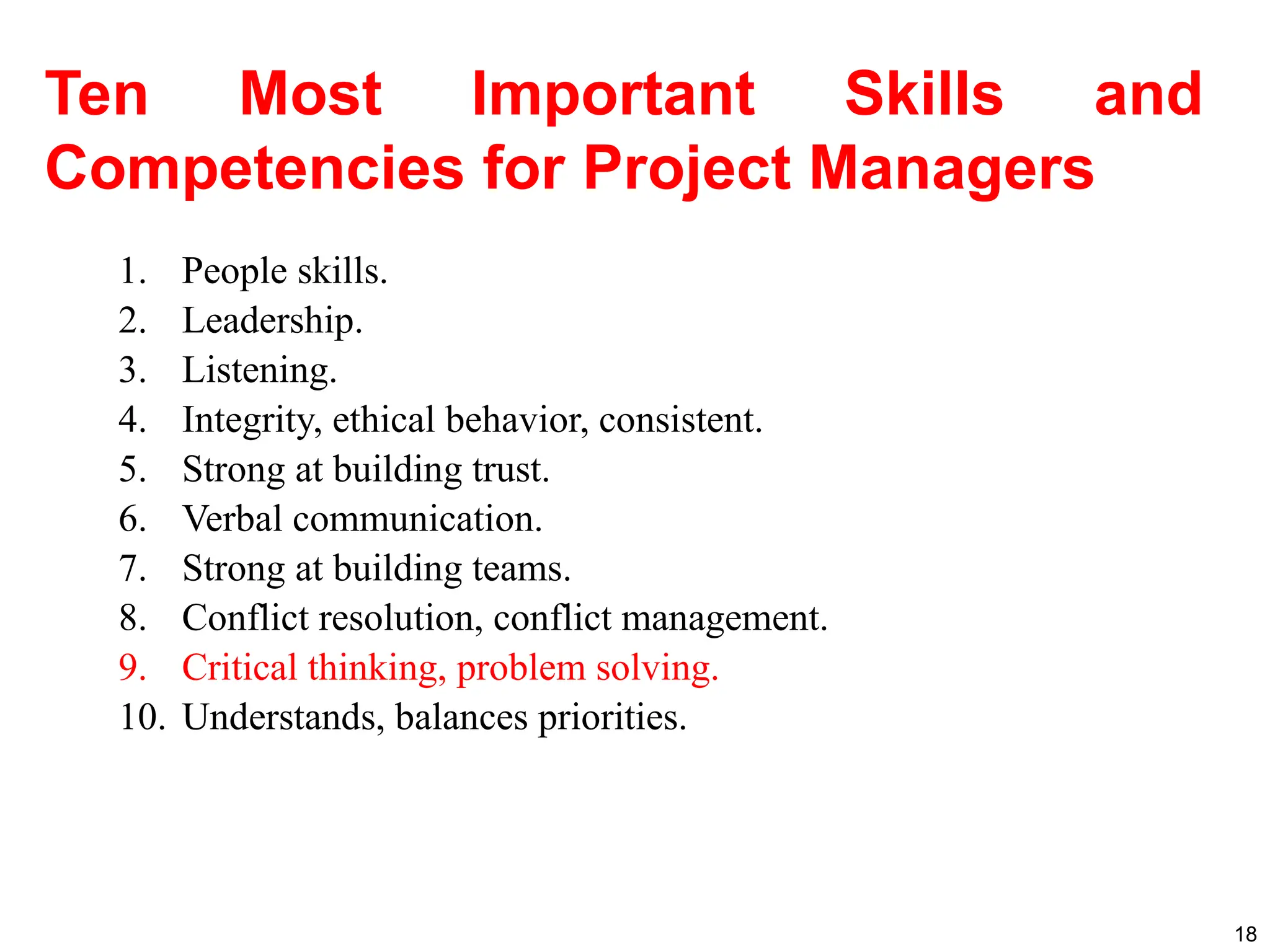
Ten Most Important Skills and
Competencies for Project Managers
1. People skills.
2. Leadership.
3. Listening.
4. Integrity, ethical behavior, consistent.
5. Strong at building trust.
6. Verbal communication.
7. Strong at building teams.
8. Conflict resolution, conflict management.
9. Critical thinking, problem solving.
10. Understands, balances priorities.
18
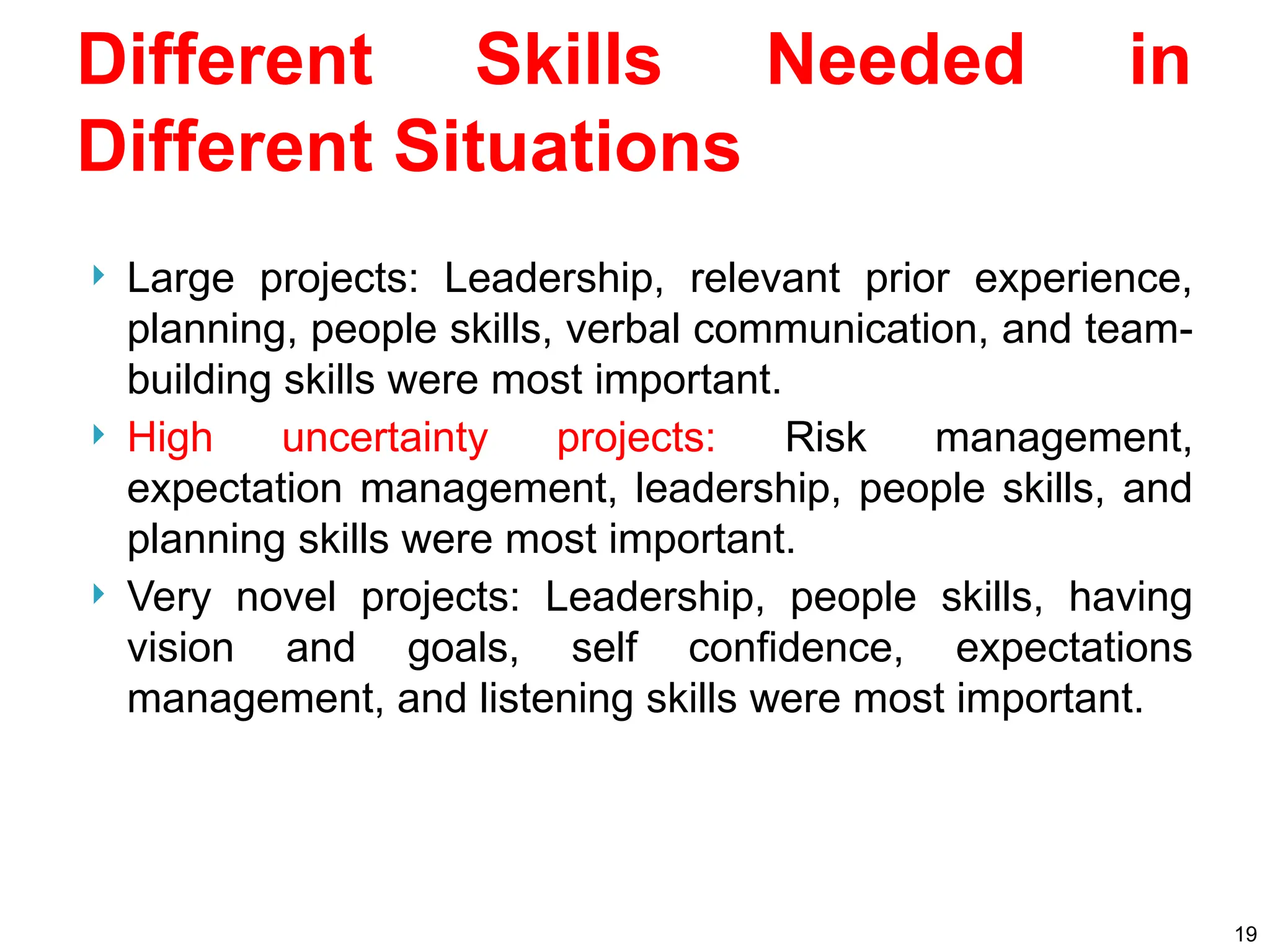
Different Skills Needed in
Different Situations
 Large projects: Leadership, relevant prior experience,
planning, people skills, verbal communication, and team-
building skills were most important.
 High uncertainty projects: Risk management,
expectation management, leadership, people skills, and
planning skills were most important.
 Very novel projects: Leadership, people skills, having
vision and goals, self confidence, expectations
management, and listening skills were most important.
19
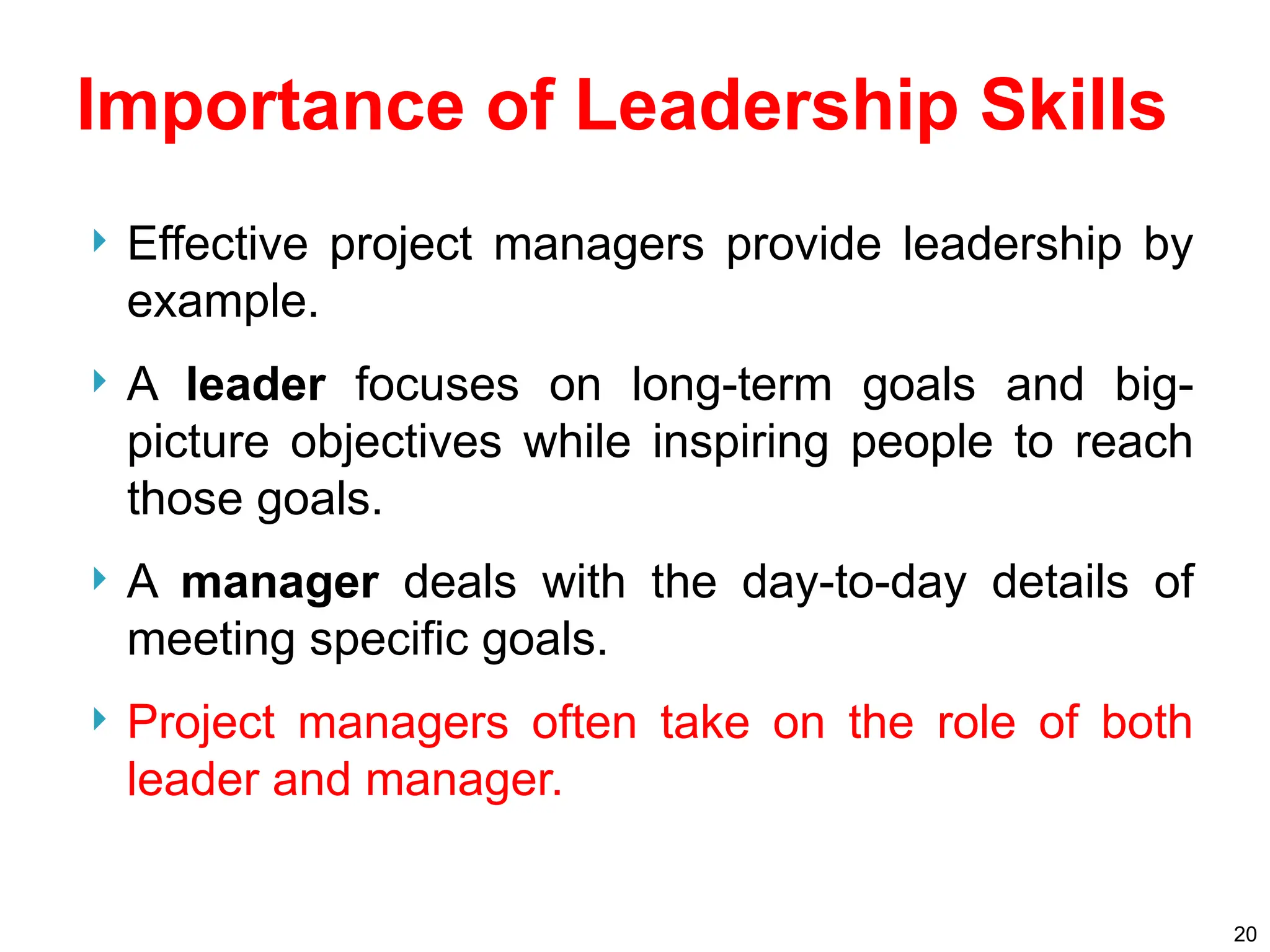
Importance of Leadership Skills
 Effective project managers provide leadership by
example.
 A leader focuses on long-term goals and big-
picture objectives while inspiring people to reach
those goals.
 A manager deals with the day-to-day details of
meeting specific goals.
 Project managers often take on the role of both
leader and manager.
20
The Project Management Institute
 The Project Management Institute (PMI) is an international
professional society for project managers founded in 1969.
 PMI has continued to attract and retain members, reporting
more than 449,000 members worldwide by late 2014.
 There are communities of practices in many areas, like
information systems, financial services, and health care.
 Project management research and certification programs
continue to grow.
 Students can join PMI at a reduced fee and earn the
Certified Associate in Project Management (CAPM).
21
Project Management Certification
 PMI provides certification as a Project
Management Professional (PMP).
 A PMP has documented sufficient project
experience, agreed to follow a code of ethics,
and passed the PMP exam.
 The number of people earning PMP certification
is increasing quickly.
22
Ethics in Project Management
 Ethics, loosely defined, is a set of principles that
guide our decision making based on personal
values of what is “right” and “wrong”.
 In order to earn PMP certification, applicants must
agree to PMI’s Code of Ethics and Professional
Conduct.
 Several questions on the PMP exam are related to
professional responsibility, including ethics.
23
Defined…
Project management is the application of processes,
methods, knowledge, skills and experience to
achieve the project objectives.
-The Association of Project Management
PRESENTATION’S TITLE
Fundamentals Of Project Management
25
IMPORTANCE OF
MANAGEMENT
Some organizations have begun to ask their
contractors to provide only project managers
who have been certified as professionals by
The Project Management Institute.
26
WHAT IS A PROJECT?
• “A project is a problem scheduled for
solution.” This definition forces us to
recognize that projects are aimed at solving
problems and that failure to define the
problem properly is what sometimes gets us
into trouble.
27
What is the problem?
• A desired objective is not a problem by itself. The
key to a problem is that there is an obstacle that
prevents you from closing the gap.
• A problem is a gap(achieving your objective)
between where you are and where you want
to be, with an obstacle that prevents easy
movement to close the gap.
• Problem solving consists of finding ways of
overcoming or getting around obstacles.
28
WHAT IS PROJECT MANAGEMENT?
• Project management is the planning, scheduling,
and controlling of project activities to meet
project objectives.
• The major objectives that must be met include
performance, cost, and time goals, while at the
same time you control or maintain the scope of the
project at the correct level.
29
The scope of project
• The scope of a project should remain constant
throughout the life of the job.
• Unforeseen problems or an inadequately defined
problem the most common reason for scope
changes is that something is forgotten.
• In most cases the magnitude (scope) of the work
increases, as a result of overlooked details.
30
The Four Project Objectives are
:
• Performance.
• Scope.
• Cost.
• Time.
31
Performance, scope, Cost& Time
• Performance: The quality of the work being
done.
• Scope: The magnitude of the work to be
performed.
• Cost: The cost of project work, directly
related to the human and physical resources
applied.
• Time: The schedule that must be met.
32
THE HUMAN SIDE OF PROJECT
MANAGEMENT
• Factors(components)affect the success of a project:
• The Right People
• The Right Type of Management
33
STEPS IN MANAGING A PROJECT
• Define the problem
• Develop solution options
• Plan the project
• Execute the plan
• Monitor and control progress
• Close the project.
34
Develop solution options
• How many different ways might you go about
solving the problem?
• Brainstorm solution alternatives (you can do
this alone or as a group).
• Is it more or less costly than other suitable
choices?
35
Plan the project
• Planning is answering questions—what must
be done, by whom, for how much, how,
when, and so on.
36
Execute the plan
• Once the plan is drafted, it must be
implemented. Interestingly, people
sometimes go to great effort to put together
a plan, then fail to follow it. If a plan is not
followed, there is not much point in planning,
is there?
37
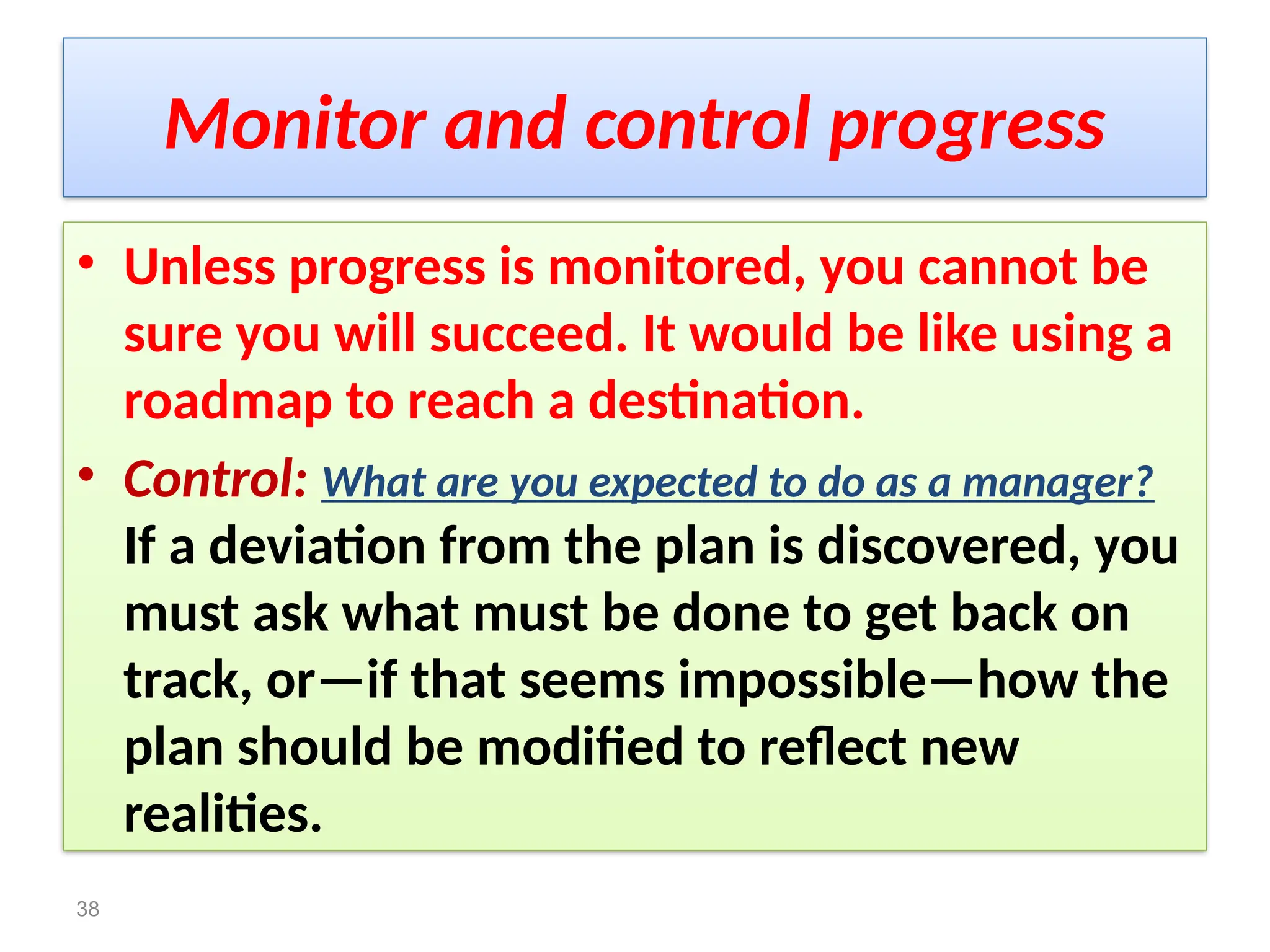
Monitor and control progress
• Unless progress is monitored, you cannot be
sure you will succeed. It would be like using a
roadmap to reach a destination.
• Control: What are you expected to do as a manager?
If a deviation from the plan is discovered, you
must ask what must be done to get back on
track, or—if that seems impossible—how the
plan should be modified to reflect new
realities.
38
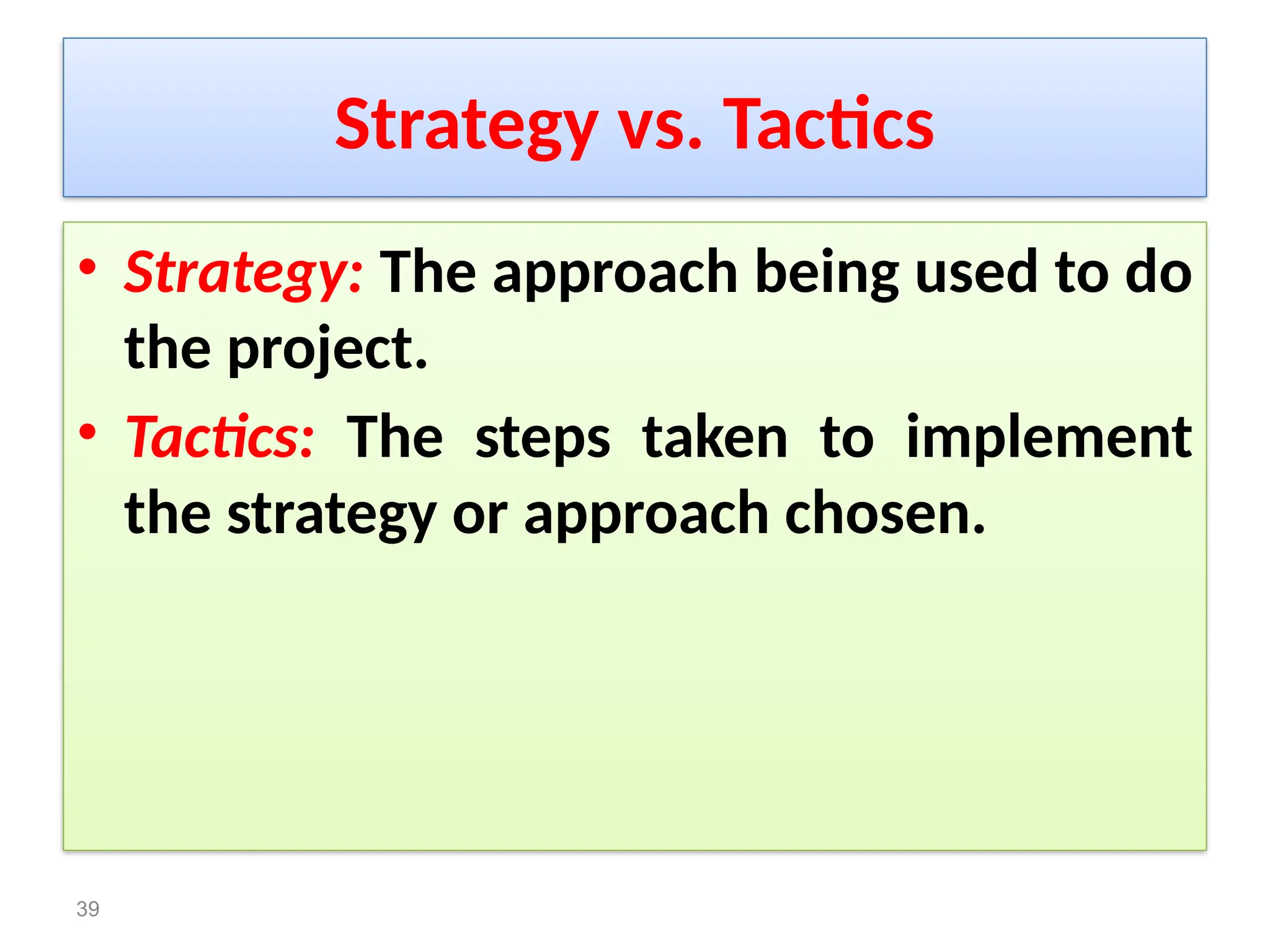
Strategy vs. Tactics
• Strategy: The approach being used to do
the project.
• Tactics: The steps taken to implement
the strategy or approach chosen.
39
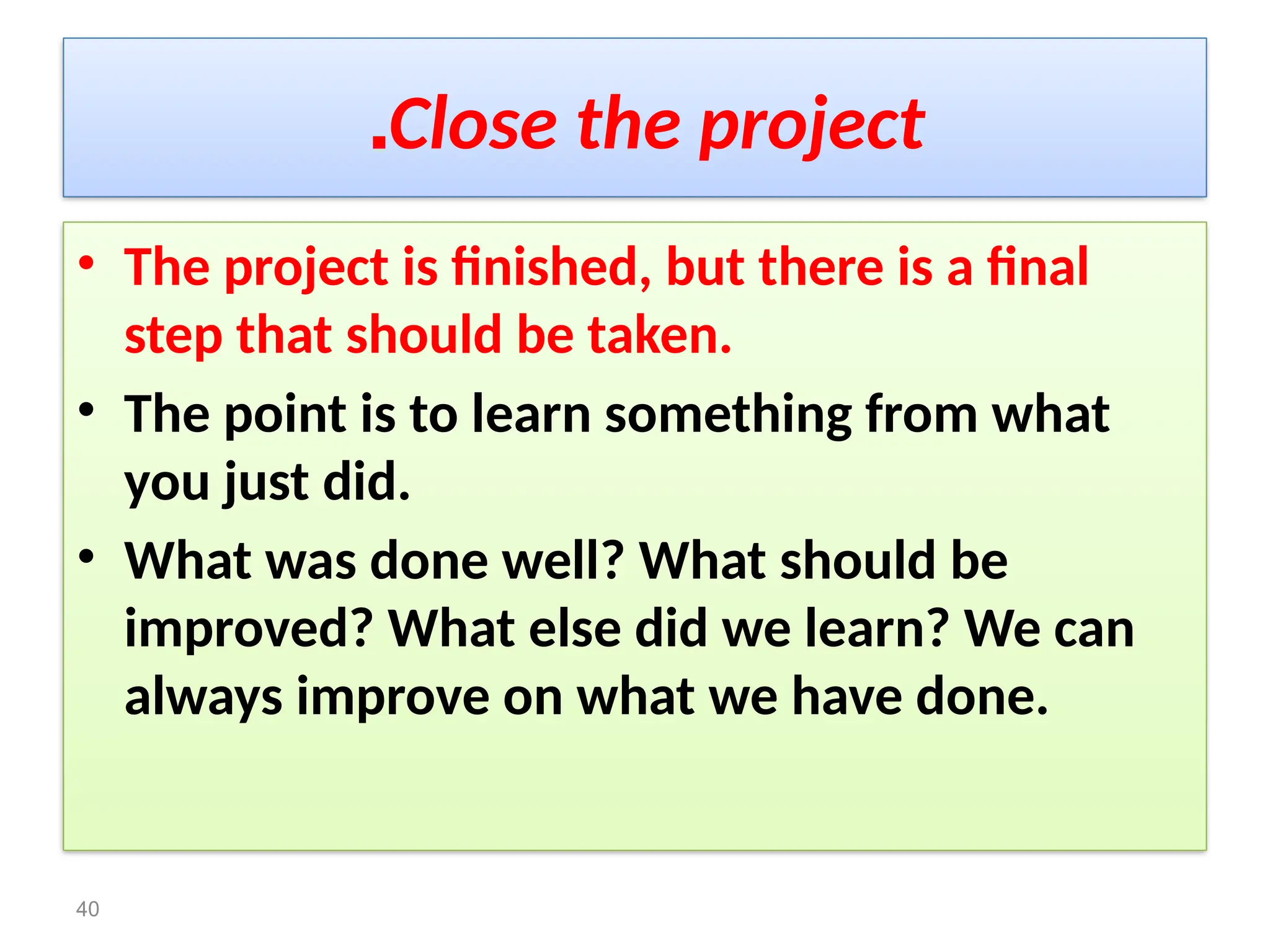
Close the project
.
• The project is finished, but there is a final
step that should be taken.
• The point is to learn something from what
you just did.
• What was done well? What should be
improved? What else did we learn? We can
always improve on what we have done.
40
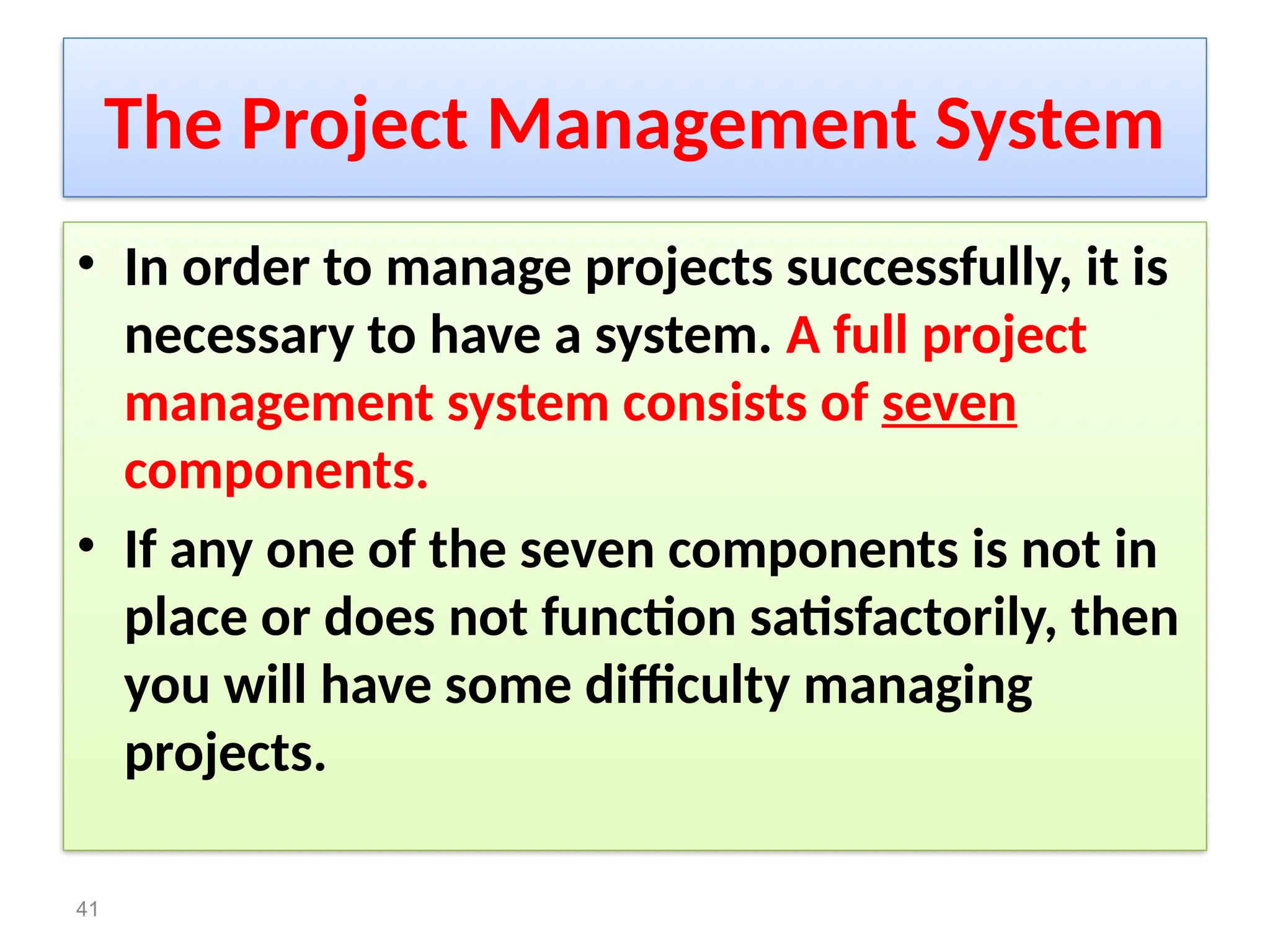
The Project Management System
• In order to manage projects successfully, it is
necessary to have a system. A full project
management system consists of seven
components.
• If any one of the seven components is not in
place or does not function satisfactorily, then
you will have some difficulty managing
projects.
41
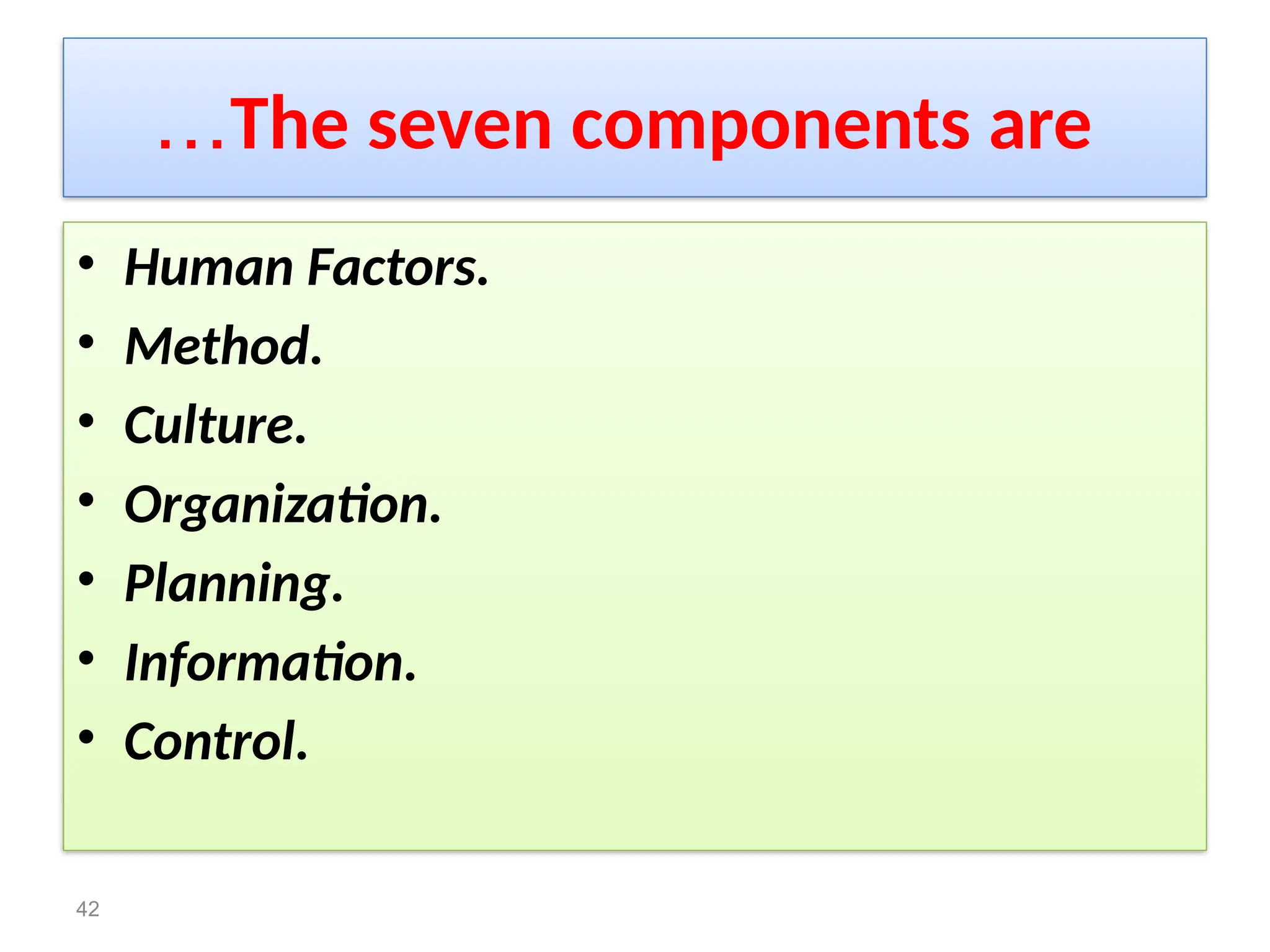
The seven components are
…
• Human Factors.
• Method.
• Culture.
• Organization.
• Planning.
• Information.
• Control.
42
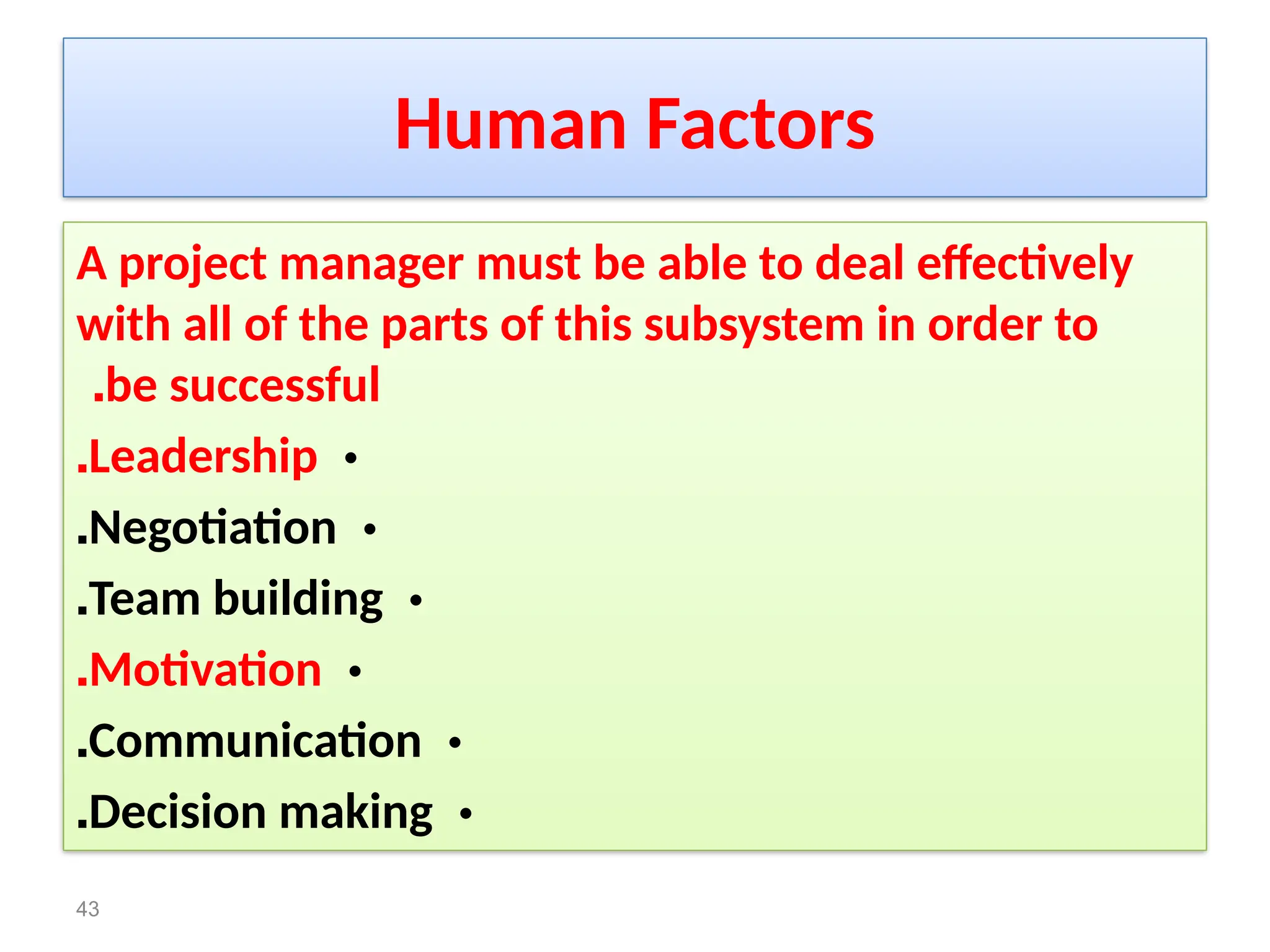
Human Factors
A project manager must be able to deal effectively
with all of the parts of this subsystem in order to
be successful
.
•
Leadership
.
•
Negotiation
.
•
Team building
.
•
Motivation
.
•
Communication
.
•
Decision making
.
43
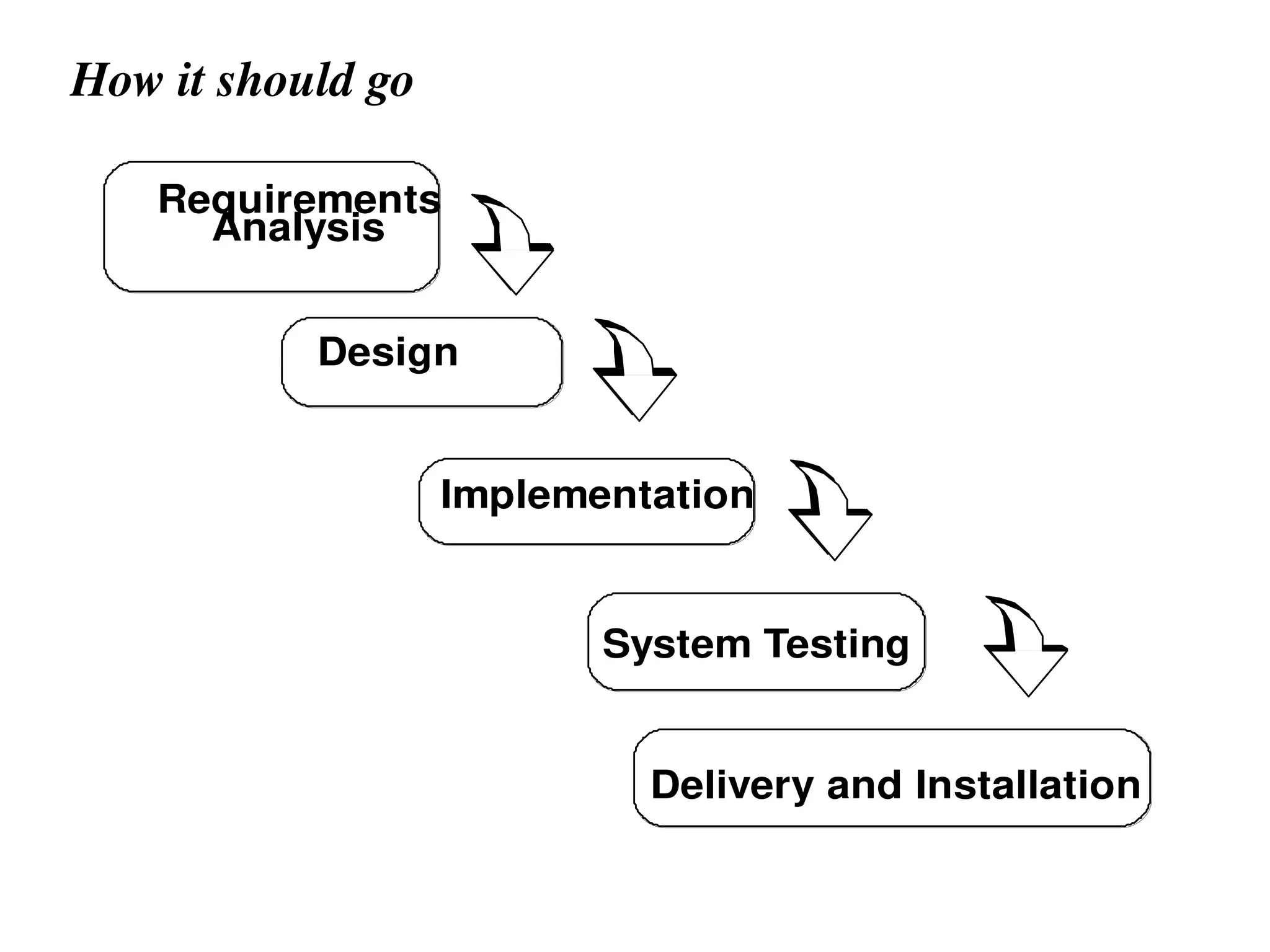
How it should go
Requirements
Analysis
Implementation
Design
System Testing
Delivery and Installation
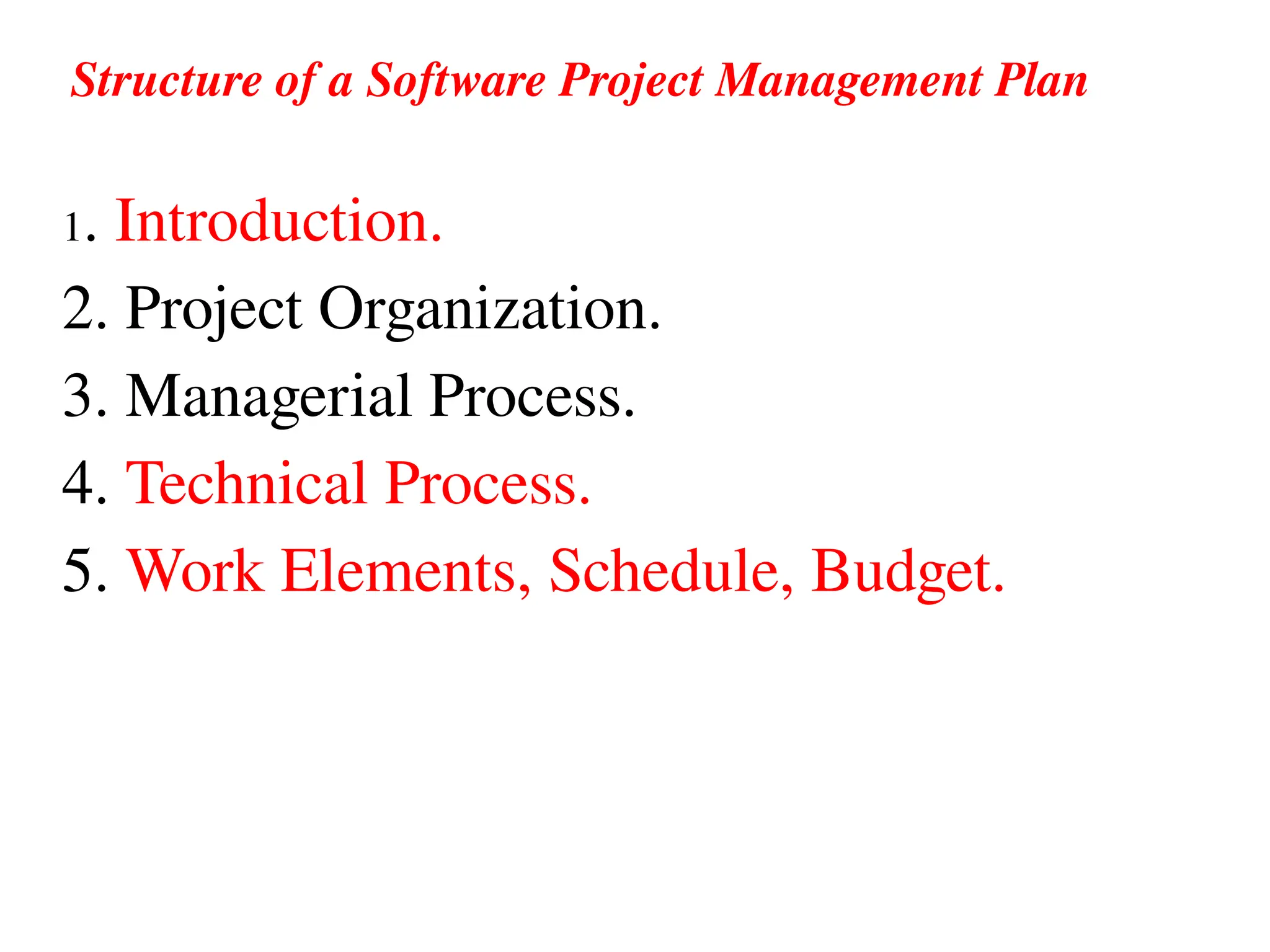
Structure of a Software Project Management Plan
1. Introduction.
2. Project Organization.
3. Managerial Process.
4. Technical Process.
5. Work Elements, Schedule, Budget.
Summary:
¨ Describe the project environment.
¨ Describe the project management in the
various sectors.
¨ Discuss the different forms of the project
management.
¨ Discuss the optimal approach to the project
management.

Lecture No. 1227 Project Management.pptx

  • 1.
    Lecture No. 7 ProjectManagement Importance of the project management
  • 2.
    Learning Objectives, Part1  Understand the growing need for better project management, especially for information technology (IT) projects.  Explain what a project is, provide examples of IT projects, list various attributes of projects, and describe the triple constraint of project management.  Describe project management and discuss key elements of the project management framework, including project stakeholders, the project management knowledge areas, common tools and techniques, and project success. 2
  • 3.
    Learning Objectives, Part2  Discuss the relationship between project, program, and portfolio management and the contributions each makes to enterprise success.  Understand the role of project managers by describing what they do, what skills they need, and career opportunities for IT project managers.  Describe the project management profession, including its history, the role of professional organizations like the Project Management Institute (PMI), the importance of certification and ethics, and the advancement of project management software. 3
  • 4.
    Motivation for Studying InformationTechnology (IT) Project Management 4
  • 5.
    Advantages of UsingFormal Project Management  Better control of financial, physical, and human resources.  Improved customer relations.  Shorter development times.  Lower costs.  Higher quality and increased reliability.  Higher profit margins.  Improved productivity.  Better internal coordination. 5
  • 6.
    What Is aProject?  A project is “a temporary term undertaken to create a unique product, service, or result”.  Operations is work done to sustain the business.  Projects end when their objectives have been reached or the project has been terminated.  Projects can be large or small and take a short or long time to complete. 6
  • 7.
    Examples of ITProjects  A team of students creates a smartphone application and sells it online.  A government group develops a system to track child immunizations.  A global bank acquires other financial institutions and needs to consolidate systems and procedures. 7
  • 8.
    Project and ProgramManagers  Project managers work with project sponsors, project team, and other people involved in a project to meet project goals.  Program: group of related projects managed in a coordinated way to obtain benefits and control not available from managing them individually.  (Program managers often act as bosses for project managers). 8
  • 9.
    Figure: The TripleConstraint of Project Management 9
  • 10.
    What is ProjectManagement?  Project management is “the application of knowledge, skills, tools and techniques to project.  Project managers strive to meet the triple constraint (project scope, time, and cost goals) and also facilitate the entire process to meet the needs and expectations of project stakeholders. 10
  • 11.
    Project Stakeholders  Stakeholdersare the people involved in or affected by project activities.  Stakeholders include: ◦ the project sponsor. ◦ the project manager. ◦ the project team. ◦ support staff. ◦ customers. ◦ users. ◦ suppliers. 11
  • 12.
    Project Management Knowledge Areas Knowledge areas describe the key competencies that project managers must develop.  Project managers must have knowledge and skills in all 10 knowledge areas (project integration, scope, time, cost, quality, human resource, communications, risk, procurement, and stakeholder management).  This text includes an entire chapter on each knowledge area. 12
  • 13.
    Project Management Toolsand Techniques  Project management tools and techniques assist project managers and their teams in various aspects of project management.  Some specific ones include: ◦ Project charter, scope statement. ◦ Gantt charts, network diagrams, critical path analysis, critical chain scheduling (time). ◦ Cost estimates and earned value management (cost). 13
  • 14.
    Project Success  Thereare several ways to define project success: ◦ The project met scope, time, and cost goals. ◦ The project satisfied the customer/sponsor. ◦ The results of the project met its main objective, such as making or saving a certain amount of money, providing a good return on investment, or simply making the sponsors happy. 14
  • 15.
    Table : WhatHelps Projects? 1. Executive support. 2. User involvement. 3. Clear business objectives. 4. Emotional maturity. 5. Optimizing scope. 6. Project management expertise. 7. Skilled resources. 8. Execution. 9. Tools and infrastructure. 15
  • 16.
    The Role ofthe Project Manager Job descriptions vary, but most include responsibilities like planning, scheduling, coordinating, and working with people to achieve project goals. 16
  • 17.
    Suggested Skills forProject Managers  The Project Management Body of Knowledge.  Application area knowledge, standards, and regulations.  Project environment knowledge.  General management knowledge and skills.  Soft skills or human relations skills. 17
  • 18.
    Ten Most ImportantSkills and Competencies for Project Managers 1. People skills. 2. Leadership. 3. Listening. 4. Integrity, ethical behavior, consistent. 5. Strong at building trust. 6. Verbal communication. 7. Strong at building teams. 8. Conflict resolution, conflict management. 9. Critical thinking, problem solving. 10. Understands, balances priorities. 18
  • 19.
    Different Skills Neededin Different Situations  Large projects: Leadership, relevant prior experience, planning, people skills, verbal communication, and team- building skills were most important.  High uncertainty projects: Risk management, expectation management, leadership, people skills, and planning skills were most important.  Very novel projects: Leadership, people skills, having vision and goals, self confidence, expectations management, and listening skills were most important. 19
  • 20.
    Importance of LeadershipSkills  Effective project managers provide leadership by example.  A leader focuses on long-term goals and big- picture objectives while inspiring people to reach those goals.  A manager deals with the day-to-day details of meeting specific goals.  Project managers often take on the role of both leader and manager. 20
  • 21.
    The Project ManagementInstitute  The Project Management Institute (PMI) is an international professional society for project managers founded in 1969.  PMI has continued to attract and retain members, reporting more than 449,000 members worldwide by late 2014.  There are communities of practices in many areas, like information systems, financial services, and health care.  Project management research and certification programs continue to grow.  Students can join PMI at a reduced fee and earn the Certified Associate in Project Management (CAPM). 21
  • 22.
    Project Management Certification PMI provides certification as a Project Management Professional (PMP).  A PMP has documented sufficient project experience, agreed to follow a code of ethics, and passed the PMP exam.  The number of people earning PMP certification is increasing quickly. 22
  • 23.
    Ethics in ProjectManagement  Ethics, loosely defined, is a set of principles that guide our decision making based on personal values of what is “right” and “wrong”.  In order to earn PMP certification, applicants must agree to PMI’s Code of Ethics and Professional Conduct.  Several questions on the PMP exam are related to professional responsibility, including ethics. 23
  • 24.
    Defined… Project management isthe application of processes, methods, knowledge, skills and experience to achieve the project objectives. -The Association of Project Management
  • 25.
  • 26.
    IMPORTANCE OF MANAGEMENT Some organizationshave begun to ask their contractors to provide only project managers who have been certified as professionals by The Project Management Institute. 26
  • 27.
    WHAT IS APROJECT? • “A project is a problem scheduled for solution.” This definition forces us to recognize that projects are aimed at solving problems and that failure to define the problem properly is what sometimes gets us into trouble. 27
  • 28.
    What is theproblem? • A desired objective is not a problem by itself. The key to a problem is that there is an obstacle that prevents you from closing the gap. • A problem is a gap(achieving your objective) between where you are and where you want to be, with an obstacle that prevents easy movement to close the gap. • Problem solving consists of finding ways of overcoming or getting around obstacles. 28
  • 29.
    WHAT IS PROJECTMANAGEMENT? • Project management is the planning, scheduling, and controlling of project activities to meet project objectives. • The major objectives that must be met include performance, cost, and time goals, while at the same time you control or maintain the scope of the project at the correct level. 29
  • 30.
    The scope ofproject • The scope of a project should remain constant throughout the life of the job. • Unforeseen problems or an inadequately defined problem the most common reason for scope changes is that something is forgotten. • In most cases the magnitude (scope) of the work increases, as a result of overlooked details. 30
  • 31.
    The Four ProjectObjectives are : • Performance. • Scope. • Cost. • Time. 31
  • 32.
    Performance, scope, Cost&Time • Performance: The quality of the work being done. • Scope: The magnitude of the work to be performed. • Cost: The cost of project work, directly related to the human and physical resources applied. • Time: The schedule that must be met. 32
  • 33.
    THE HUMAN SIDEOF PROJECT MANAGEMENT • Factors(components)affect the success of a project: • The Right People • The Right Type of Management 33
  • 34.
    STEPS IN MANAGINGA PROJECT • Define the problem • Develop solution options • Plan the project • Execute the plan • Monitor and control progress • Close the project. 34
  • 35.
    Develop solution options •How many different ways might you go about solving the problem? • Brainstorm solution alternatives (you can do this alone or as a group). • Is it more or less costly than other suitable choices? 35
  • 36.
    Plan the project •Planning is answering questions—what must be done, by whom, for how much, how, when, and so on. 36
  • 37.
    Execute the plan •Once the plan is drafted, it must be implemented. Interestingly, people sometimes go to great effort to put together a plan, then fail to follow it. If a plan is not followed, there is not much point in planning, is there? 37
  • 38.
    Monitor and controlprogress • Unless progress is monitored, you cannot be sure you will succeed. It would be like using a roadmap to reach a destination. • Control: What are you expected to do as a manager? If a deviation from the plan is discovered, you must ask what must be done to get back on track, or—if that seems impossible—how the plan should be modified to reflect new realities. 38
  • 39.
    Strategy vs. Tactics •Strategy: The approach being used to do the project. • Tactics: The steps taken to implement the strategy or approach chosen. 39
  • 40.
    Close the project . •The project is finished, but there is a final step that should be taken. • The point is to learn something from what you just did. • What was done well? What should be improved? What else did we learn? We can always improve on what we have done. 40
  • 41.
    The Project ManagementSystem • In order to manage projects successfully, it is necessary to have a system. A full project management system consists of seven components. • If any one of the seven components is not in place or does not function satisfactorily, then you will have some difficulty managing projects. 41
  • 42.
    The seven componentsare … • Human Factors. • Method. • Culture. • Organization. • Planning. • Information. • Control. 42
  • 43.
    Human Factors A projectmanager must be able to deal effectively with all of the parts of this subsystem in order to be successful . • Leadership . • Negotiation . • Team building . • Motivation . • Communication . • Decision making . 43
  • 44.
    How it shouldgo Requirements Analysis Implementation Design System Testing Delivery and Installation
  • 45.
    Structure of aSoftware Project Management Plan 1. Introduction. 2. Project Organization. 3. Managerial Process. 4. Technical Process. 5. Work Elements, Schedule, Budget.
  • 46.
    Summary: ¨ Describe theproject environment. ¨ Describe the project management in the various sectors. ¨ Discuss the different forms of the project management. ¨ Discuss the optimal approach to the project management.