IT Project ManagementIT Project Management
Course ReferenceCourse Reference
This course uses the Project Management
Institute (PMI) Project Management Body of
Knowledge (PMBOK) third edition (2005).
Section OneSection One
Project ManagementProject Management
FrameworkFramework
Introduction to ProjectIntroduction to Project
ManagementManagement
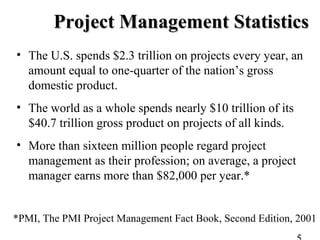
Project Management StatisticsProject Management Statistics
• The U.S. spends $2.3 trillion on projects every year, an
amount equal to one-quarter of the nation’s gross
domestic product.
• The world as a whole spends nearly $10 trillion of its
$40.7 trillion gross product on projects of all kinds.
• More than sixteen million people regard project
management as their profession; on average, a project
manager earns more than $82,000 per year.*
*PMI, The PMI Project Management Fact Book, Second Edition, 2001
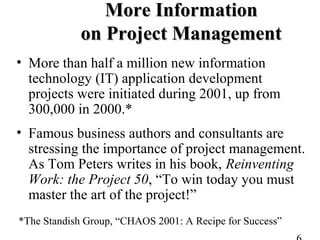
More InformationMore Information
on Project Managementon Project Management
• More than half a million new information
technology (IT) application development
projects were initiated during 2001, up from
300,000 in 2000.*
• Famous business authors and consultants are
stressing the importance of project management.
As Tom Peters writes in his book, Reinventing
Work: the Project 50, “To win today you must
master the art of the project!”
*The Standish Group, “CHAOS 2001: A Recipe for Success”
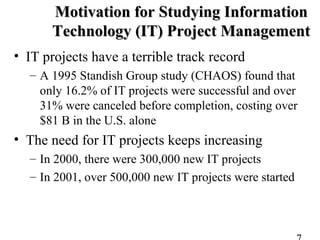
• IT projects have a terrible track record
– A 1995 Standish Group study (CHAOS) found that
only 16.2% of IT projects were successful and over
31% were canceled before completion, costing over
$81 B in the U.S. alone
• The need for IT projects keeps increasing
– In 2000, there were 300,000 new IT projects
– In 2001, over 500,000 new IT projects were started
Motivation for Studying InformationMotivation for Studying Information
Technology (IT) Project ManagementTechnology (IT) Project Management
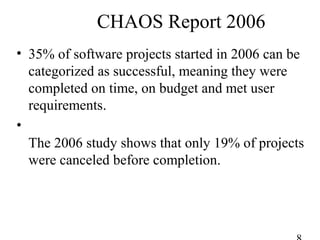
CHAOS Report 2006
• 35% of software projects started in 2006 can be
categorized as successful, meaning they were
completed on time, on budget and met user
requirements.
•
The 2006 study shows that only 19% of projects
were canceled before completion.
Advantages of Using FormalAdvantages of Using Formal
Project ManagementProject Management
• Better control of financial, physical, and human resources
• Improved customer relations
• Shorter development times
• Lower costs
• Higher quality and increased reliability
• Higher profit margins
• Improved productivity
• Better internal coordination
• Higher worker morale
What Is a Project?What Is a Project?
• A project is “a temporary endeavor
undertaken to create a unique product,
service or result” (PMBOK® Guide 2005)
• Attributes of projects
– temporary
– unique product, service or result.
– Progressive elaboration
– require resources, often from various areas
– should have a primary sponsor and/or customer
– involves uncertainty
Projects vs. Operational workProjects vs. Operational work
• Work can be categorized either projects or
operations.
• Although the two some time overlap. They
share many of the following characteristics:
– Performed by people
– Constrained by limited resources.
– Planned, executed and controlled.
Projects vs. Operational workProjects vs. Operational work
• Operations are ongoing and repetitive. while
Projects are temporary and unique.
• Projects are undertaken at all level of
organization.
• Projects can involve one or many organizational
units.
Example of projectsExample of projects
• Developing new product or service.
• Effecting a change in Organizational Structure.
• Designing a new vehicle.
• Developing a new information system.
• Constructing a building.
• Running a campaign for political office.
• Implementing a new business procedure.
Projects and strategic PlanningProjects and strategic Planning
• Projects often utilized as a means of achieving
an organization’s strategic plan.
• Projects are typically authorized as a result of
one or more of the following strategic
considerations:
– A market demand .
– An organizational need.
– A customer request.
– A technological Advance.
– A legal Requirement.
What is ProjectWhat is Project
Management?Management?
Project management is “the application of
knowledge, skills, tools, and techniques to
project activities in order to meet project
requirements” (PMBOK® Guide), 2005)
*The Project Management Institute (PMI) is an international
professional society. Their web site is www.pmi.orgwww.pmi.org.
Project Management
• Managing project Includes:
– Identifying requirements.
– Establishing clear and achievable objectives.
– Balancing the competing demands for quality,
scope, time and cost.
– Adapting the specifications, plans and approach to
the different concerns and expectations of the
various stakeholders.
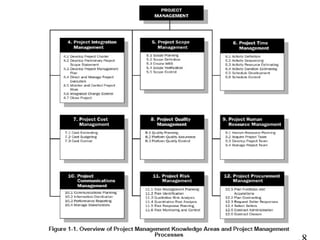
9 Project Management9 Project Management
Knowledge AreasKnowledge Areas
• Knowledge areas describe the key competencies
that project managers must develop
– 4 core knowledge areas lead to specific project
objectives (scope, time, cost, and quality)
– 4 facilitating knowledge areas are the means through
which the project objectives are achieved (human
resources, communication, risk, and procurement
management)
– 1 knowledge area (project integration management)
affects and is affected by all of the other knowledge
areas
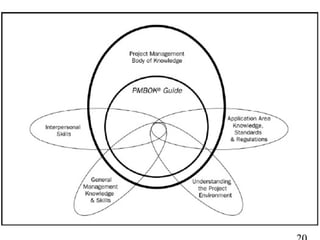
Area of expertiseArea of expertise
• The project manager should understand and
use knowledge and skills from at least five
areas of expertise:
1. The project management body of knowledge
2. Application area knowledge, standards, and
regulations.
3. Understanding the project environment
4. General management knowledge and skills.
5. Interpersonal skills.
Application Area knowledge,Application Area knowledge,
Standards and regulationsStandards and regulations
• Application areas are usually defined in term of:
– Functional departments and supporting disciplines.
– Technical elements.
– Management Specializations.
– Industry Groups
• Each application area generally has a set of
standards and practices often codified in
regulations.
standards and regulationsstandards and regulations
• ISO differentiates between standards and
regulation as following:
– A standard: “Document established by consensus
and approved by a recognized body that provides,
for common and repeated use, rules, guidelines or
characteristics for activities or their results, aimed at
the achievement of the optimum degree of ordering
a given context ”
standards and regulationsstandards and regulations
– A regulation : “government-imposed requirement,
which specifies product, process or service
characteristics, including the applicable
administrative provisions, with which compliance is
mandatory ”
Project EnvironmentProject Environment
• Cultural and social environment.
• International and Political environment.
• Physical environment.
General Management knowledgeGeneral Management knowledge
and skillsand skills
• Planning, organizing, staffing, executing,
controlling and supporting disciplines such as:
– Financial management and accounting.
– Purchasing and procurement.
– Contracts and commercial law.
– Manufacturing and distribution.
– Logistics and supply chain.
– Strategic planning.
– Organizational structure.
– Health and Safety.
– Information Technology.
Interpersonal SkillsInterpersonal Skills
• Effective communication.
• Influencing the organization.
• Leadership.
• Motivation.
• Negotiation and conflict management.
• Problem solving.
Programs and ProgramPrograms and Program
ManagementManagement
• A program is a group of related projects
managed in a coordinated way to obtain benefits
and control not available from managing them
individually.
• Program may include elements of related work
outside the scope of the discrete projects in the
program.
Portfolios and portfolioPortfolios and portfolio
ManagementManagement
• A portfolio is a collection of projects or
programs and other work that grouped together
to facilitate effective management of that work
to meet strategic business objectives.
SubprojectsSubprojects
• Projects are frequently divided into more
manageable components or subprojects.
• Subprojects are often contracted to an external
enterprise or to an other functional unit in the
performing organization.

01 introduction

  • 1.
    IT Project ManagementITProject Management
  • 2.
    Course ReferenceCourse Reference Thiscourse uses the Project Management Institute (PMI) Project Management Body of Knowledge (PMBOK) third edition (2005).
  • 3.
    Section OneSection One ProjectManagementProject Management FrameworkFramework
  • 4.
    Introduction to ProjectIntroductionto Project ManagementManagement
  • 5.
    Project Management StatisticsProjectManagement Statistics • The U.S. spends $2.3 trillion on projects every year, an amount equal to one-quarter of the nation’s gross domestic product. • The world as a whole spends nearly $10 trillion of its $40.7 trillion gross product on projects of all kinds. • More than sixteen million people regard project management as their profession; on average, a project manager earns more than $82,000 per year.* *PMI, The PMI Project Management Fact Book, Second Edition, 2001
  • 6.
    More InformationMore Information onProject Managementon Project Management • More than half a million new information technology (IT) application development projects were initiated during 2001, up from 300,000 in 2000.* • Famous business authors and consultants are stressing the importance of project management. As Tom Peters writes in his book, Reinventing Work: the Project 50, “To win today you must master the art of the project!” *The Standish Group, “CHAOS 2001: A Recipe for Success”
  • 7.
    • IT projectshave a terrible track record – A 1995 Standish Group study (CHAOS) found that only 16.2% of IT projects were successful and over 31% were canceled before completion, costing over $81 B in the U.S. alone • The need for IT projects keeps increasing – In 2000, there were 300,000 new IT projects – In 2001, over 500,000 new IT projects were started Motivation for Studying InformationMotivation for Studying Information Technology (IT) Project ManagementTechnology (IT) Project Management
  • 8.
    CHAOS Report 2006 •35% of software projects started in 2006 can be categorized as successful, meaning they were completed on time, on budget and met user requirements. • The 2006 study shows that only 19% of projects were canceled before completion.
  • 9.
    Advantages of UsingFormalAdvantages of Using Formal Project ManagementProject Management • Better control of financial, physical, and human resources • Improved customer relations • Shorter development times • Lower costs • Higher quality and increased reliability • Higher profit margins • Improved productivity • Better internal coordination • Higher worker morale
  • 10.
    What Is aProject?What Is a Project? • A project is “a temporary endeavor undertaken to create a unique product, service or result” (PMBOK® Guide 2005) • Attributes of projects – temporary – unique product, service or result. – Progressive elaboration – require resources, often from various areas – should have a primary sponsor and/or customer – involves uncertainty
  • 11.
    Projects vs. OperationalworkProjects vs. Operational work • Work can be categorized either projects or operations. • Although the two some time overlap. They share many of the following characteristics: – Performed by people – Constrained by limited resources. – Planned, executed and controlled.
  • 12.
    Projects vs. OperationalworkProjects vs. Operational work • Operations are ongoing and repetitive. while Projects are temporary and unique. • Projects are undertaken at all level of organization. • Projects can involve one or many organizational units.
  • 13.
    Example of projectsExampleof projects • Developing new product or service. • Effecting a change in Organizational Structure. • Designing a new vehicle. • Developing a new information system. • Constructing a building. • Running a campaign for political office. • Implementing a new business procedure.
  • 14.
    Projects and strategicPlanningProjects and strategic Planning • Projects often utilized as a means of achieving an organization’s strategic plan. • Projects are typically authorized as a result of one or more of the following strategic considerations: – A market demand . – An organizational need. – A customer request. – A technological Advance. – A legal Requirement.
  • 15.
    What is ProjectWhatis Project Management?Management? Project management is “the application of knowledge, skills, tools, and techniques to project activities in order to meet project requirements” (PMBOK® Guide), 2005) *The Project Management Institute (PMI) is an international professional society. Their web site is www.pmi.orgwww.pmi.org.
  • 16.
    Project Management • Managingproject Includes: – Identifying requirements. – Establishing clear and achievable objectives. – Balancing the competing demands for quality, scope, time and cost. – Adapting the specifications, plans and approach to the different concerns and expectations of the various stakeholders.
  • 17.
    9 Project Management9Project Management Knowledge AreasKnowledge Areas • Knowledge areas describe the key competencies that project managers must develop – 4 core knowledge areas lead to specific project objectives (scope, time, cost, and quality) – 4 facilitating knowledge areas are the means through which the project objectives are achieved (human resources, communication, risk, and procurement management) – 1 knowledge area (project integration management) affects and is affected by all of the other knowledge areas
  • 19.
    Area of expertiseAreaof expertise • The project manager should understand and use knowledge and skills from at least five areas of expertise: 1. The project management body of knowledge 2. Application area knowledge, standards, and regulations. 3. Understanding the project environment 4. General management knowledge and skills. 5. Interpersonal skills.
  • 21.
    Application Area knowledge,ApplicationArea knowledge, Standards and regulationsStandards and regulations • Application areas are usually defined in term of: – Functional departments and supporting disciplines. – Technical elements. – Management Specializations. – Industry Groups • Each application area generally has a set of standards and practices often codified in regulations.
  • 22.
    standards and regulationsstandardsand regulations • ISO differentiates between standards and regulation as following: – A standard: “Document established by consensus and approved by a recognized body that provides, for common and repeated use, rules, guidelines or characteristics for activities or their results, aimed at the achievement of the optimum degree of ordering a given context ”
  • 23.
    standards and regulationsstandardsand regulations – A regulation : “government-imposed requirement, which specifies product, process or service characteristics, including the applicable administrative provisions, with which compliance is mandatory ”
  • 24.
    Project EnvironmentProject Environment •Cultural and social environment. • International and Political environment. • Physical environment.
  • 25.
    General Management knowledgeGeneralManagement knowledge and skillsand skills • Planning, organizing, staffing, executing, controlling and supporting disciplines such as: – Financial management and accounting. – Purchasing and procurement. – Contracts and commercial law. – Manufacturing and distribution. – Logistics and supply chain. – Strategic planning. – Organizational structure. – Health and Safety. – Information Technology.
  • 26.
    Interpersonal SkillsInterpersonal Skills •Effective communication. • Influencing the organization. • Leadership. • Motivation. • Negotiation and conflict management. • Problem solving.
  • 27.
    Programs and ProgramProgramsand Program ManagementManagement • A program is a group of related projects managed in a coordinated way to obtain benefits and control not available from managing them individually. • Program may include elements of related work outside the scope of the discrete projects in the program.
  • 28.
    Portfolios and portfolioPortfoliosand portfolio ManagementManagement • A portfolio is a collection of projects or programs and other work that grouped together to facilitate effective management of that work to meet strategic business objectives.
  • 29.
    SubprojectsSubprojects • Projects arefrequently divided into more manageable components or subprojects. • Subprojects are often contracted to an external enterprise or to an other functional unit in the performing organization.