Endometriosis ENDOMETRIOSIS
I s characterized by the presence of endometrial tissue on the ovaries, fallopian tubes or other  sites, causing pain or infertility.  The disease tends to progress under the repetitive influence of the menstrual cycle  I
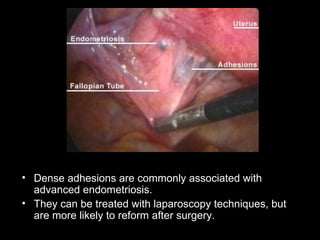
Dense adhesions are commonly associated with advanced endometriosis.  They can be treated with laparoscopy techniques, but are more likely to reform after surgery.
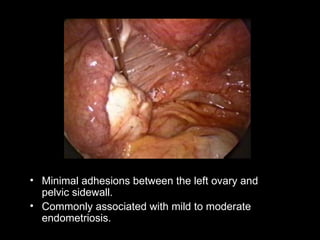
Minimal adhesions between the left ovary and pelvic sidewall.  Commonly associated with mild to moderate endometriosis.
 
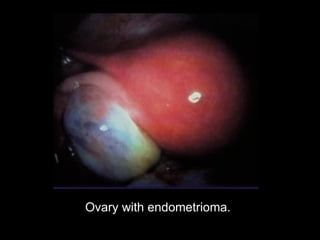
Ovary with endometrioma.
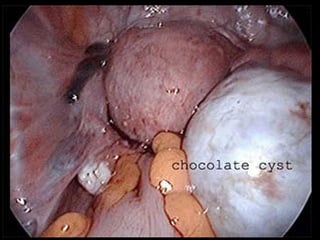
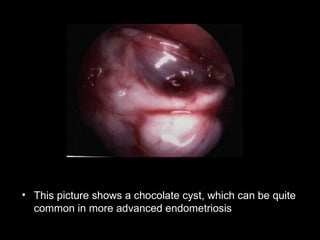
This picture shows a chocolate cyst, which can be quite common in more advanced endometriosis
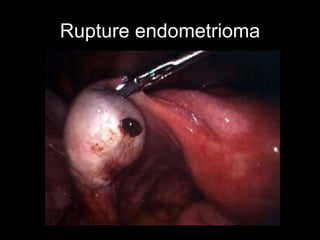
Rupture endometrioma
Endometriosis!  Epidemiology   >  70 million women and girls  have Endometriosis world-wide.  10 - 20 % of women of reproductive age have Endometriosis.  It is more common than breast cancer or Aids, and many other diseases, that  are  well known   Endometriosis is not usually fatal
the longer that this disease goes undiagnosed the more damage it can do.
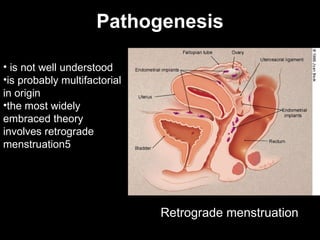
Pathogenesis is not well understood is probably multifactorial in origin the most widely embraced theory involves retrograde menstruation 5 Retrograde menstruation
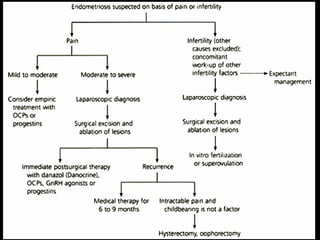
Investigation A definitive diagnosis can be made only by means of  laparoscopy Imaging tests:  ultrasound, MRI, CT, are  occasionally used to identify individual lesions   Biochemical markers   CA-125  A recent study of this antigen level, showed it to be high in 90 percent of women with Endometriosis
Stages of Endometriosis B ased on the severity, location, amount, depth and size of growths.  The stages of the disease do not indicate the level of pain, infertility or symptoms.  the correlation between stage and extent of disease remains controversial
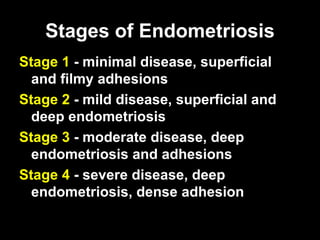
Stages of Endometriosis Stage  1  - minimal disease, superficial and filmy adhesions  Stage  2  - mild disease, superficial and deep endometriosis  Stage  3  - moderate disease, deep endometriosis and adhesions  Stage  4  - severe disease, deep endometriosis, dense adhesion
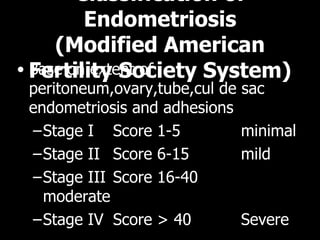
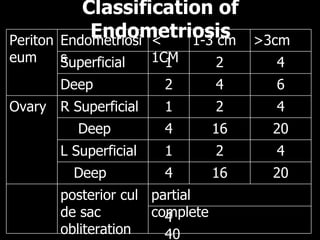
Classification of Endometriosis ( Modified American Fertility Society System) Base on extent of peritoneum,ovary,tube,cul de sac endometriosis and adhesions Stage I Score 1-5  minimal Stage II Score 6-15  mild Stage III Score 16-40  moderate Stage IV Score > 40  Severe
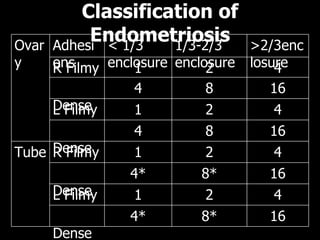
Classification of Endometriosis 16 8* 4 * Dense 4 2 1 L Filmy 16 8* 4 * Dense 4 2 1 R Filmy Tube 16 8 4 Dense 4 2 1 L Filmy 16 8 4 Dense 4 2 1 R Filmy >2/3enclosure 1/3-2/3 enclosure < 1/3 enclosure Adhesions Ovary
Classification of Endometriosis 20 16 4 Deep 4  40 partial  complete posterior cul de sac   obliteration 20 16 4 Deep 4 2 1 L Superficial 4 2 1 R Superficial Ovary 6 4 2 Deep 4 2 1 Superficial >3cm 1-3 cm < 1CM Endometriosis Peritoneum
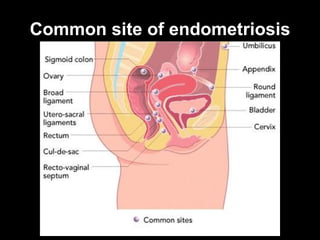
Common site of endometriosis
Endometriosis Symptoms Endometriosis does not follow any distinct pattern   The symptoms of Endometriosis vary from one woman to another  T he most common symptom is pelvic pain.
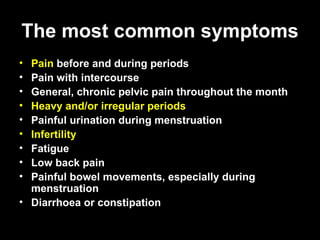
The most common symptoms Pain  before and during periods  Pain with intercourse  General, chronic pelvic pain throughout the month  Heavy and/or irregular periods   Painful urination during menstruation  Infertility   Fatigue  Low back pain  Painful bowel movements, especially during menstruation  Diarrhoea or constipation
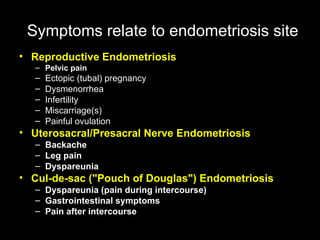
Symptoms   relate to endometriosis site Reproductive Endometriosis   Pelvic pain Ectopic (tubal) pregnancy  Dysmenorrhea  Infertility  Miscarriage(s)  Painful ovulation Uterosacral/Presacral Nerve Endometriosis Backache  Leg pain  Dyspareunia Cul-de-sac (&quot;Pouch of Douglas&quot;) Endometriosis Dyspareunia (pain during intercourse)  Gastrointestinal symptoms  Pain after intercourse
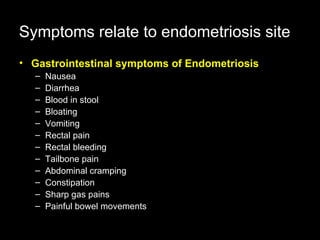
Gastrointestinal symptoms of Endometriosis   Nausea  Diarrhea  Blood in stool  Bloating  Vomiting  Rectal pain  Rectal bleeding  Tailbone pain  Abdominal cramping  Constipation  Sharp gas pains  Painful bowel movements Symptoms   relate to endometriosis site
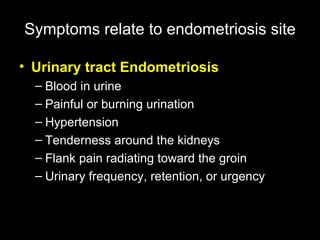
U rinary tract Endometriosis Blood in urine  Painful or burning urination  Hypertension  Tenderness around the kidneys  Flank pain radiating toward the groin  Urinary frequency, retention, or urgency Symptoms   relate to endometriosis site
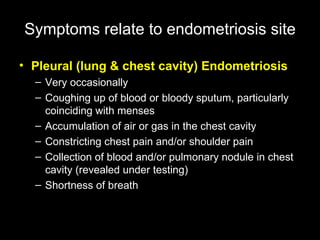
Pleural (lung & chest cavity) Endometriosis   Very occasionally  Coughing up of blood or bloody sputum, particularly coinciding with menses  Accumulation of air or gas in the chest cavity  Constricting chest pain and/or shoulder pain  Collection of blood and/or pulmonary nodule in chest cavity (revealed under testing)  Shortness of breath Symptoms   relate to endometriosis site
Symptoms   relate to endometriosis site Skin Endometriosis Painful nodules, often visible to the naked eye, at the skin's surface. Can bleed during menses and/or appear blue upon inspection.   Sciatic Endometriosis Hip pain pain that radiates from the buttock and down the leg
Differential diagnosis   by symptoms Generalized pelvic pain   Pelvic inflammatory disease E ndometritis Sexual or physical abuse N eoplasms, benign or malignant Ovarian torsion P elvic adhesion Nongynecologic causes
Differential diagnosis   by symptoms Dysmenorrhea   Primary  Secondary (adenomyosis, myomas, infection, cervical stenosis)
Differential diagnosis   by symptoms Dyspareunia   Musculoskeletal causes (pelvic relaxation, levator spasm)  Gastrointestinal tract (constipation, irritable bowel syndrome)  Urinary tract (urethral syndrome, interstitial cystitis)  Infection  Pelvic vascular congestion
Differential diagnosis   by symptoms Infertility  Male factor  Tubal disease (infection)  Anovulation  Cervical factors (mucus, sperm antibodies, stenosis)  Luteal phase deficiency
Treatment options for Endometriosis   There are general points which should be taken into consideration  The severity of the symptoms  The type of symptoms  The age of the patient  The desire to get pregnant or not  Length of treatment  Coping with side-effects of drug treatment  Cost
Treatment options Observation with no medical intervention  Hormone treatment  Surgery  Combined treatment
 
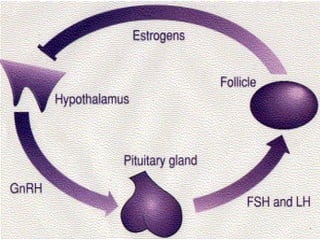
Drugs Commonly used   GnRH agonists   inhibit the secretion of gonadotropin a complete block of egg development, estrogen production and menstrual cycle, makes  'menopausal'  Danazol   is a mild form of the male hormone testosterone  inhibits leuteinizing hormone (LH) and follicle-stimulating hormone (FSH)  Gestrinone   It works in much the same way as danazol with similar, but milder, side effects   Contraceptive pill   suppress LH and FSH and prevent ovulation  Progestational Agents   Depo-Provera Progesterone hormone tablets   The Mirena Coil   (IUD with Levonorgestrel   )
GnRH agonists  Gonadotropin-releasing hormone  agonist leuprolide  (Lupron, Eligard)  buserelin ( Suprefact , Suprecor)  nafarelin (Synarel)  histrelin (Supprelin)  goserelin ( Zoladex )  deslorelin (Suprelorin, Ovuplant)
GnRH antagonist   Abarelix (Plenaxis)  Cetrorelix (Cetrotide), by Serono Ganirelix (Antagon), by Organon International
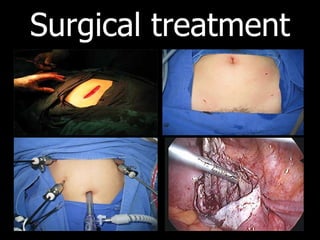
S urgery Definitive surgery, which includes hysterectomy and oophorectomy, is reserved for use in women with intractable pain who no longer desire pregnancy. In less severe cases, one ovary may be retained to preserve ovarian function
Surgical treatment
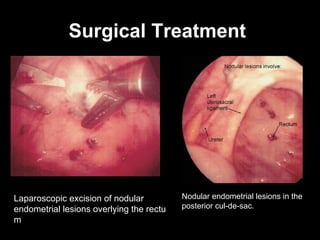
Surgical Treatment   Laparoscopic excision of nodular endometrial lesions overlying the rectum  Nodular endometrial lesions in the posterior cul-de-sac.
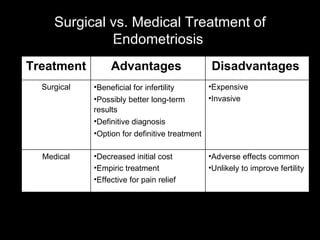
Surgical vs. Medical Treatment of Endometriosis    Effective for pain relief Unlikely to improve fertility Empiric treatment Adverse effects common Decreased initial cost Medical   Option for definitive treatment   Definitive diagnosis Invasive Possibly better long-term results Expensive Beneficial for infertility Surgical Disadvantages Advantages Treatment Adverse effects common Unlikely to improve fertility  Decreased initial cost Empiric treatment Effective for pain relief  Medical Expensive Invasive  Beneficial for infertility Possibly better long-term results Definitive diagnosis  Option for definitive treatment  Surgical Disadvantages   A dvantages   Treatment
Recurrence Rates   a laparoscopically defined cumulative five-year recurrence rate of about  19  percent.  t he long-term benefit of surgical intervention for pain is enhanced by definitive surgery, including bilateral oophorectomy, with a  10  percent cumulative recurrence after  10  years. surgical treatment is the apparently lower recurrence rate compared with medical treatment
 

Endometriosis

  • 1.
  • 2.
    I s characterizedby the presence of endometrial tissue on the ovaries, fallopian tubes or other sites, causing pain or infertility. The disease tends to progress under the repetitive influence of the menstrual cycle I
  • 3.
    Dense adhesions arecommonly associated with advanced endometriosis. They can be treated with laparoscopy techniques, but are more likely to reform after surgery.
  • 4.
    Minimal adhesions betweenthe left ovary and pelvic sidewall. Commonly associated with mild to moderate endometriosis.
  • 5.
  • 6.
  • 7.
    This picture showsa chocolate cyst, which can be quite common in more advanced endometriosis
  • 8.
  • 9.
    Endometriosis! Epidemiology > 70 million women and girls have Endometriosis world-wide. 10 - 20 % of women of reproductive age have Endometriosis. It is more common than breast cancer or Aids, and many other diseases, that are well known Endometriosis is not usually fatal
  • 10.
    the longer thatthis disease goes undiagnosed the more damage it can do.
  • 11.
    Pathogenesis is notwell understood is probably multifactorial in origin the most widely embraced theory involves retrograde menstruation 5 Retrograde menstruation
  • 12.
    Investigation A definitivediagnosis can be made only by means of laparoscopy Imaging tests: ultrasound, MRI, CT, are occasionally used to identify individual lesions Biochemical markers CA-125 A recent study of this antigen level, showed it to be high in 90 percent of women with Endometriosis
  • 13.
    Stages of EndometriosisB ased on the severity, location, amount, depth and size of growths. The stages of the disease do not indicate the level of pain, infertility or symptoms. the correlation between stage and extent of disease remains controversial
  • 14.
    Stages of EndometriosisStage 1 - minimal disease, superficial and filmy adhesions Stage 2 - mild disease, superficial and deep endometriosis Stage 3 - moderate disease, deep endometriosis and adhesions Stage 4 - severe disease, deep endometriosis, dense adhesion
  • 15.
    Classification of Endometriosis( Modified American Fertility Society System) Base on extent of peritoneum,ovary,tube,cul de sac endometriosis and adhesions Stage I Score 1-5 minimal Stage II Score 6-15 mild Stage III Score 16-40 moderate Stage IV Score > 40 Severe
  • 16.
    Classification of Endometriosis16 8* 4 * Dense 4 2 1 L Filmy 16 8* 4 * Dense 4 2 1 R Filmy Tube 16 8 4 Dense 4 2 1 L Filmy 16 8 4 Dense 4 2 1 R Filmy >2/3enclosure 1/3-2/3 enclosure < 1/3 enclosure Adhesions Ovary
  • 17.
    Classification of Endometriosis20 16 4 Deep 4 40 partial complete posterior cul de sac obliteration 20 16 4 Deep 4 2 1 L Superficial 4 2 1 R Superficial Ovary 6 4 2 Deep 4 2 1 Superficial >3cm 1-3 cm < 1CM Endometriosis Peritoneum
  • 18.
    Common site ofendometriosis
  • 19.
    Endometriosis Symptoms Endometriosisdoes not follow any distinct pattern The symptoms of Endometriosis vary from one woman to another T he most common symptom is pelvic pain.
  • 20.
    The most commonsymptoms Pain before and during periods Pain with intercourse General, chronic pelvic pain throughout the month Heavy and/or irregular periods Painful urination during menstruation Infertility Fatigue Low back pain Painful bowel movements, especially during menstruation Diarrhoea or constipation
  • 21.
    Symptoms relate to endometriosis site Reproductive Endometriosis Pelvic pain Ectopic (tubal) pregnancy Dysmenorrhea Infertility Miscarriage(s) Painful ovulation Uterosacral/Presacral Nerve Endometriosis Backache Leg pain Dyspareunia Cul-de-sac (&quot;Pouch of Douglas&quot;) Endometriosis Dyspareunia (pain during intercourse) Gastrointestinal symptoms Pain after intercourse
  • 22.
    Gastrointestinal symptoms ofEndometriosis Nausea Diarrhea Blood in stool Bloating Vomiting Rectal pain Rectal bleeding Tailbone pain Abdominal cramping Constipation Sharp gas pains Painful bowel movements Symptoms relate to endometriosis site
  • 23.
    U rinary tractEndometriosis Blood in urine Painful or burning urination Hypertension Tenderness around the kidneys Flank pain radiating toward the groin Urinary frequency, retention, or urgency Symptoms relate to endometriosis site
  • 24.
    Pleural (lung &chest cavity) Endometriosis Very occasionally Coughing up of blood or bloody sputum, particularly coinciding with menses Accumulation of air or gas in the chest cavity Constricting chest pain and/or shoulder pain Collection of blood and/or pulmonary nodule in chest cavity (revealed under testing) Shortness of breath Symptoms relate to endometriosis site
  • 25.
    Symptoms relate to endometriosis site Skin Endometriosis Painful nodules, often visible to the naked eye, at the skin's surface. Can bleed during menses and/or appear blue upon inspection. Sciatic Endometriosis Hip pain pain that radiates from the buttock and down the leg
  • 26.
    Differential diagnosis by symptoms Generalized pelvic pain Pelvic inflammatory disease E ndometritis Sexual or physical abuse N eoplasms, benign or malignant Ovarian torsion P elvic adhesion Nongynecologic causes
  • 27.
    Differential diagnosis by symptoms Dysmenorrhea Primary Secondary (adenomyosis, myomas, infection, cervical stenosis)
  • 28.
    Differential diagnosis by symptoms Dyspareunia Musculoskeletal causes (pelvic relaxation, levator spasm) Gastrointestinal tract (constipation, irritable bowel syndrome) Urinary tract (urethral syndrome, interstitial cystitis) Infection Pelvic vascular congestion
  • 29.
    Differential diagnosis by symptoms Infertility Male factor Tubal disease (infection) Anovulation Cervical factors (mucus, sperm antibodies, stenosis) Luteal phase deficiency
  • 30.
    Treatment options forEndometriosis There are general points which should be taken into consideration The severity of the symptoms The type of symptoms The age of the patient The desire to get pregnant or not Length of treatment Coping with side-effects of drug treatment Cost
  • 31.
    Treatment options Observationwith no medical intervention Hormone treatment Surgery Combined treatment
  • 32.
  • 33.
    Drugs Commonly used GnRH agonists inhibit the secretion of gonadotropin a complete block of egg development, estrogen production and menstrual cycle, makes 'menopausal' Danazol is a mild form of the male hormone testosterone inhibits leuteinizing hormone (LH) and follicle-stimulating hormone (FSH) Gestrinone It works in much the same way as danazol with similar, but milder, side effects Contraceptive pill suppress LH and FSH and prevent ovulation Progestational Agents Depo-Provera Progesterone hormone tablets The Mirena Coil (IUD with Levonorgestrel )
  • 34.
    GnRH agonists Gonadotropin-releasing hormone agonist leuprolide (Lupron, Eligard) buserelin ( Suprefact , Suprecor) nafarelin (Synarel) histrelin (Supprelin) goserelin ( Zoladex ) deslorelin (Suprelorin, Ovuplant)
  • 35.
    GnRH antagonist Abarelix (Plenaxis) Cetrorelix (Cetrotide), by Serono Ganirelix (Antagon), by Organon International
  • 36.
    S urgery Definitivesurgery, which includes hysterectomy and oophorectomy, is reserved for use in women with intractable pain who no longer desire pregnancy. In less severe cases, one ovary may be retained to preserve ovarian function
  • 37.
  • 38.
    Surgical Treatment Laparoscopic excision of nodular endometrial lesions overlying the rectum Nodular endometrial lesions in the posterior cul-de-sac.
  • 39.
    Surgical vs. MedicalTreatment of Endometriosis   Effective for pain relief Unlikely to improve fertility Empiric treatment Adverse effects common Decreased initial cost Medical   Option for definitive treatment   Definitive diagnosis Invasive Possibly better long-term results Expensive Beneficial for infertility Surgical Disadvantages Advantages Treatment Adverse effects common Unlikely to improve fertility Decreased initial cost Empiric treatment Effective for pain relief Medical Expensive Invasive Beneficial for infertility Possibly better long-term results Definitive diagnosis Option for definitive treatment Surgical Disadvantages A dvantages Treatment
  • 40.
    Recurrence Rates a laparoscopically defined cumulative five-year recurrence rate of about 19 percent. t he long-term benefit of surgical intervention for pain is enhanced by definitive surgery, including bilateral oophorectomy, with a 10 percent cumulative recurrence after 10 years. surgical treatment is the apparently lower recurrence rate compared with medical treatment
  • 41.