ENDOMETRIOSIS
LEARNING OBJECTIVES
• Identify the symptoms and consequences associated with
endometriosis
• Describe various treatment options in the management of
endometriosis
HISTORICAL BACKGROUND
• Characteristics of disease described at least as far back as 1600 BCE
• Schrön described a “female disorder in which ulcers appear[ed] in the
abdominal, the bladder, intestines and outside the uterus and cervix,
causing adhesions”
• First histological description credited to Von Rokitansky
• Cullen later suggested endometriomas (“adenomyomas”) resembled
mucous membrane of uterus
• Sampson generally credited for providing first theory on pathogenesis;
coined term “endometriosis” in 1921
DEFINITION
• Endometriosis is a disease in which endometrial glands
and stroma implant and grow in areas outside the
uterus
• Most commonly implants are found in the pelvis
• Lesions may occur at distant sites: pleural cavity, liver,
kidney, gluteal muscles, bladder, etc
FEATURES OF ENDOMETRIOSIS
• Prevalence 2-10% of women; 21-47% of infertility cases
• Exposure to ovarian hormones appears to be essential
• No known racial or socioeconomic predilection
• Severe disease may occur in families
ETIOLOGIES OF ENDOMETRIOSIS
• Sampson's theory: Retrograde menses and
peritoneal implantation
• Most women retrograde menstruate
• Meyer's theory: Coelomic metaplasia
• Low incidence of pleural disease
• Halban's theory: Hematogenous or lymphatic spread
to distant tissues
• Does not explain gravity dependent disease sites
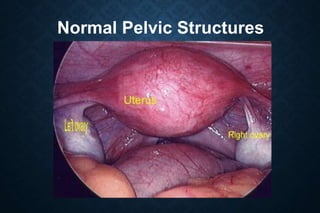
Normal Pelvic Structures
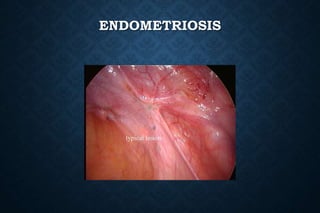
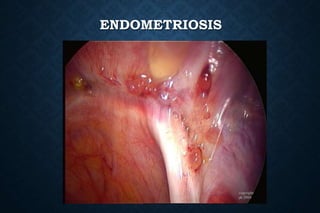
ENDOMETRIOSIS
ENDOMETRIOSIS
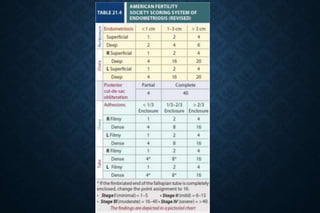
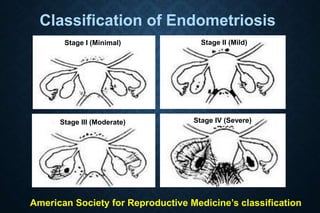
Stage I (Minimal) Stage II (Mild)
Stage III (Moderate) Stage IV (Severe)
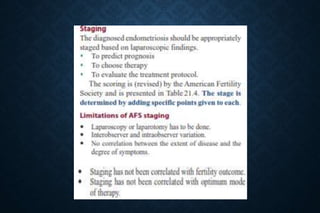
Classification of Endometriosis
American Society for Reproductive Medicine’s classification
CLINICAL PRESENTATION
• 90% severe dysmenorrohoea
• 70% chronic pelvic pain
• 75% dyspareunia
• 55% infertility
PELVIC PAIN
• Frequency
• Cyclic: Variable length prior to and after menses
• Acyclic: constant and unrelenting
• Associated symptoms
• May include dyspareunia, dysuria, or dyschezia
• Other sites of pain
• Muscle regions
• Distant tissues
INFERTILITY
• Moderate to severe disease
• Adhesions
• Distortion of normal anatomy
• Prevent sperm-egg interaction
• Minimal to mild disease
• Mild infertility
• Mechanism(s) unknown
PHYSICAL FINDINGS
• Tender nodules along the uterosacral ligaments or in the
cul-de-sac, especially just before menses
• Pain or induration without nodules commonly in the cul-
de-sac or rectovaginal septum
• Uterine or adnexal fixation, or an adnexal mass
CLINICAL DIAGNOSIS: PELVIC
EXAMINATION & PAIN MAPPING
• Physical examination has poor sensitivity, specificity, and
predictive value in the diagnosis of endometriosis
• Combination of history, physical examination, and laboratory
and diagnostic studies is indicated to determine cause of pelvic
pain and rule out nonendometriosis concerns
• “Pain mapping” may help isolate location-specific disease such
as nodular masses in posterior rectovaginal septum
• Absence of evidence during exam is not evidence of disease
absence
DIAGNOSIS OF ENDOMETRIOSIS
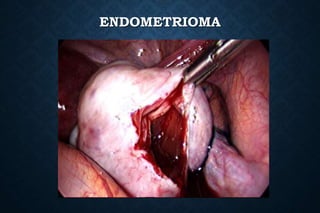
• Direct visualization of implants
• Laparoscopically (is primary means of definitive diagnosis)
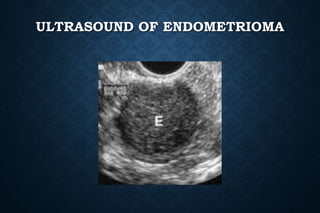
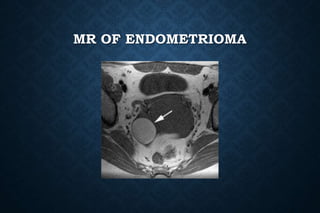
• Imaging of endometriomas
• MRI appears to be best (3 mm implants)
• Ultrasound helpful in office setting
• Biochemical markers
• Lack specificity
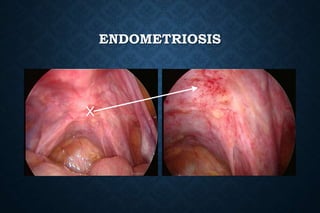
ENDOMETRIOSIS
ULTRASOUND OF ENDOMETRIOMA
MR OF ENDOMETRIOMA
ENDOMETRIOMA
TREATMENT OF ENDOMETRIOSIS
• Management of pain
• Surgery
• Medical therapy
• Treatment of infertility
• Surgery
• Ovulation induction
• Assisted reproductive technology
SURGICAL INTERVENTION
• Indications for surgical management of endometriosis
include:
• diagnosis of unresolved pelvic pain
• severe, incapacitating pain with significant functional
impairment and reduced quality of life
• advanced disease with anatomic impairment (distortion
of pelvic organs, endometriomas, bowel or bladder
dysfunction)
• failure of expectant/medical management
• endometriosis-related emergencies, ie, rupture or
torsion of endometrioma, bowel obstruction, or
obstructive uropathy
• Goals of conservative surgery include removal of disease,
lysis of adhesions, symptom reduction and relief, reduced
risk of recurrence, and restoration of organs to normal
anatomic and physiologic condition
LAPAROSCOPY
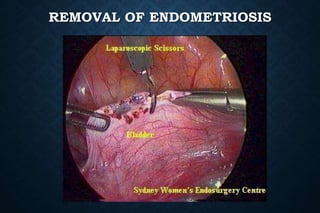
• Surgical destruction recommended with objective to remove
lesions, lyse adhesions, preserve uterus and ovarian tissue,
restore normal anatomy
• Incomplete treatment results in persistent symptoms,
recurrent disease
• Hysterectomy not a cure; remove disease, not organs
• Indigo carmine or methylene blue may improve detection
• Laparoscopic excision significantly improves fertility, general
health, and psycho-emotional status
MANAGEMENT OF PAIN
• Surgical treatment
• Ablation of endometrial implants
• Lysis of adhesions
• Ablation of uterosacral nerves
• Resection of endometriomas
• Combined surgical and medical treatment
REMOVAL OF ENDOMETRIOSIS
TREATMENT OF PAIN
• Medical management
(ovarian suppression, removal of
estrogen)
• Oral contraceptives, progestin, danazol
• GnRH agonist
• Alternating GnRH agonist and OCPs
• Aromatase inhibitors
MEDICAL THERAPIES
• Combination surgical and medical intervention may
provide maximized outcome
• No evidence that medical treatment improves fertility
• Rationale is to induce amenorrhea and create
hypoestrogenic environment, theoretically inhibiting
growths and promoting temporary regression
• Symptoms recur upon cessation of therapy
• Fertility eliminated during treatments as medical
suppression inhibits ovulation
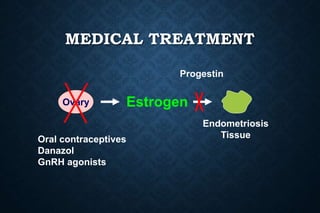
MEDICAL TREATMENT
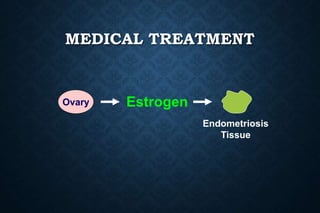
Ovary Estrogen
Endometriosis
Tissue
ORAL CONTRACEPTIVES
• Generally well tolerated; fewer metabolic and hormonal
side effects than similar therapies
• Relieve dysmenorrhea through ovarian suppression and
continuous progestin administration
• Often a simple, effective choice to manage endometriosis
through avoidance or delay of menses for upwards of 2
years
PROGESTINS
• Inhibit growth of lesions by inducing decidualization
followed by atrophy of uterine-type tissue
• Compared to GnRH therapy, both modalities show
comparable effectiveness
• Medroxyprogesterone acetate proven for pain suppression
in both oral and injectable preparations
• Adverse effects include weight gain, fluid retention,
depression, breakthrough bleeding
• Mirena® intrauterine device shown to be effective in
reducing pain and may be considered alternative to
hysterectomy in adenomyosis patients
MEDICAL TREATMENT
Ovary Estrogen
Endometriosis
TissueOral contraceptives
Danazol
GnRH agonists
Progestin
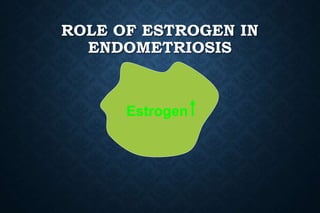
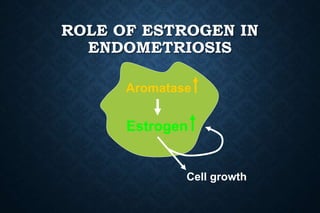
ROLE OF ESTROGEN IN
ENDOMETRIOSIS
Estrogen
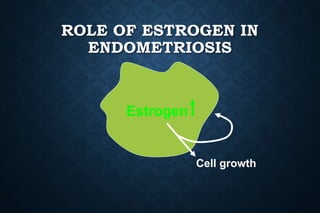
ROLE OF ESTROGEN IN
ENDOMETRIOSIS
Estrogen
Cell growth
ROLE OF ESTROGEN IN
ENDOMETRIOSIS
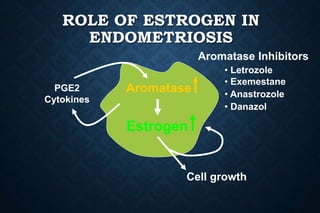
Aromatase
Estrogen
Cell growth
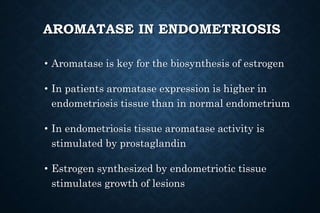
AROMATASE IN ENDOMETRIOSIS
• Aromatase is key for the biosynthesis of estrogen
• In patients aromatase expression is higher in
endometriosis tissue than in normal endometrium
• In endometriosis tissue aromatase activity is
stimulated by prostaglandin
• Estrogen synthesized by endometriotic tissue
stimulates growth of lesions
AROMATASE INHIBITORS
• Endometriotic implants express aromatase and
consequently generate estrogen, maintaining own viability
• Aromatase inhibitors inhibit local estrogen production in
endometriotic implants themselves as well as in ovary,
brain, and adipose tissue
• They significantly reduce endometriosis- associated pain
when compared with GnRH agonists alone
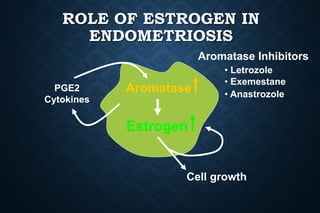
ROLE OF ESTROGEN IN
ENDOMETRIOSIS
Aromatase
Estrogen
Cell growth
PGE2
Cytokines
Aromatase Inhibitors
• Letrozole
• Exemestane
• Anastrozole
ROLE OF ESTROGEN IN
ENDOMETRIOSIS
Aromatase
Estrogen
Cell growth
PGE2
Cytokines
Aromatase Inhibitors
• Letrozole
• Exemestane
• Anastrozole
• Danazol
TREATMENT OF INFERTILITY
• Removal of disease
• Surgery improve conception rates at all
stages
• Ovulation induction
• Gonadotropins with ovarian suppression
• Insemination with either clomiphene or FSH
• Medical suppression of ovarian function
• No benefit
• Assisted reproductive technology
CONCLUSION
• Endometriosis is a chronic, costly disease
requiring long-term, multidisciplinary treatment
• Timely intervention and appropriate,
multifactorial treatments may restore quality of
life, preserve or improve fertility, and lead to long-
term effective management in absence of
permanent cure

Endometriosis

  • 1.
  • 2.
    LEARNING OBJECTIVES • Identifythe symptoms and consequences associated with endometriosis • Describe various treatment options in the management of endometriosis
  • 3.
    HISTORICAL BACKGROUND • Characteristicsof disease described at least as far back as 1600 BCE • Schrön described a “female disorder in which ulcers appear[ed] in the abdominal, the bladder, intestines and outside the uterus and cervix, causing adhesions” • First histological description credited to Von Rokitansky • Cullen later suggested endometriomas (“adenomyomas”) resembled mucous membrane of uterus • Sampson generally credited for providing first theory on pathogenesis; coined term “endometriosis” in 1921
  • 4.
    DEFINITION • Endometriosis isa disease in which endometrial glands and stroma implant and grow in areas outside the uterus • Most commonly implants are found in the pelvis • Lesions may occur at distant sites: pleural cavity, liver, kidney, gluteal muscles, bladder, etc
  • 5.
    FEATURES OF ENDOMETRIOSIS •Prevalence 2-10% of women; 21-47% of infertility cases • Exposure to ovarian hormones appears to be essential • No known racial or socioeconomic predilection • Severe disease may occur in families
  • 6.
    ETIOLOGIES OF ENDOMETRIOSIS •Sampson's theory: Retrograde menses and peritoneal implantation • Most women retrograde menstruate • Meyer's theory: Coelomic metaplasia • Low incidence of pleural disease • Halban's theory: Hematogenous or lymphatic spread to distant tissues • Does not explain gravity dependent disease sites
  • 7.
  • 8.
  • 9.
  • 12.
    Stage I (Minimal)Stage II (Mild) Stage III (Moderate) Stage IV (Severe) Classification of Endometriosis American Society for Reproductive Medicine’s classification
  • 13.
    CLINICAL PRESENTATION • 90%severe dysmenorrohoea • 70% chronic pelvic pain • 75% dyspareunia • 55% infertility
  • 14.
    PELVIC PAIN • Frequency •Cyclic: Variable length prior to and after menses • Acyclic: constant and unrelenting • Associated symptoms • May include dyspareunia, dysuria, or dyschezia • Other sites of pain • Muscle regions • Distant tissues
  • 15.
    INFERTILITY • Moderate tosevere disease • Adhesions • Distortion of normal anatomy • Prevent sperm-egg interaction • Minimal to mild disease • Mild infertility • Mechanism(s) unknown
  • 16.
    PHYSICAL FINDINGS • Tendernodules along the uterosacral ligaments or in the cul-de-sac, especially just before menses • Pain or induration without nodules commonly in the cul- de-sac or rectovaginal septum • Uterine or adnexal fixation, or an adnexal mass
  • 17.
    CLINICAL DIAGNOSIS: PELVIC EXAMINATION& PAIN MAPPING • Physical examination has poor sensitivity, specificity, and predictive value in the diagnosis of endometriosis • Combination of history, physical examination, and laboratory and diagnostic studies is indicated to determine cause of pelvic pain and rule out nonendometriosis concerns • “Pain mapping” may help isolate location-specific disease such as nodular masses in posterior rectovaginal septum • Absence of evidence during exam is not evidence of disease absence
  • 18.
    DIAGNOSIS OF ENDOMETRIOSIS •Direct visualization of implants • Laparoscopically (is primary means of definitive diagnosis) • Imaging of endometriomas • MRI appears to be best (3 mm implants) • Ultrasound helpful in office setting • Biochemical markers • Lack specificity
  • 19.
  • 20.
  • 21.
  • 22.
  • 23.
    TREATMENT OF ENDOMETRIOSIS •Management of pain • Surgery • Medical therapy • Treatment of infertility • Surgery • Ovulation induction • Assisted reproductive technology
  • 24.
    SURGICAL INTERVENTION • Indicationsfor surgical management of endometriosis include: • diagnosis of unresolved pelvic pain • severe, incapacitating pain with significant functional impairment and reduced quality of life • advanced disease with anatomic impairment (distortion of pelvic organs, endometriomas, bowel or bladder dysfunction) • failure of expectant/medical management • endometriosis-related emergencies, ie, rupture or torsion of endometrioma, bowel obstruction, or obstructive uropathy • Goals of conservative surgery include removal of disease, lysis of adhesions, symptom reduction and relief, reduced risk of recurrence, and restoration of organs to normal anatomic and physiologic condition
  • 25.
    LAPAROSCOPY • Surgical destructionrecommended with objective to remove lesions, lyse adhesions, preserve uterus and ovarian tissue, restore normal anatomy • Incomplete treatment results in persistent symptoms, recurrent disease • Hysterectomy not a cure; remove disease, not organs • Indigo carmine or methylene blue may improve detection • Laparoscopic excision significantly improves fertility, general health, and psycho-emotional status
  • 26.
    MANAGEMENT OF PAIN •Surgical treatment • Ablation of endometrial implants • Lysis of adhesions • Ablation of uterosacral nerves • Resection of endometriomas • Combined surgical and medical treatment
  • 27.
  • 28.
    TREATMENT OF PAIN •Medical management (ovarian suppression, removal of estrogen) • Oral contraceptives, progestin, danazol • GnRH agonist • Alternating GnRH agonist and OCPs • Aromatase inhibitors
  • 29.
    MEDICAL THERAPIES • Combinationsurgical and medical intervention may provide maximized outcome • No evidence that medical treatment improves fertility • Rationale is to induce amenorrhea and create hypoestrogenic environment, theoretically inhibiting growths and promoting temporary regression • Symptoms recur upon cessation of therapy • Fertility eliminated during treatments as medical suppression inhibits ovulation
  • 30.
  • 31.
    ORAL CONTRACEPTIVES • Generallywell tolerated; fewer metabolic and hormonal side effects than similar therapies • Relieve dysmenorrhea through ovarian suppression and continuous progestin administration • Often a simple, effective choice to manage endometriosis through avoidance or delay of menses for upwards of 2 years
  • 32.
    PROGESTINS • Inhibit growthof lesions by inducing decidualization followed by atrophy of uterine-type tissue • Compared to GnRH therapy, both modalities show comparable effectiveness • Medroxyprogesterone acetate proven for pain suppression in both oral and injectable preparations • Adverse effects include weight gain, fluid retention, depression, breakthrough bleeding • Mirena® intrauterine device shown to be effective in reducing pain and may be considered alternative to hysterectomy in adenomyosis patients
  • 33.
    MEDICAL TREATMENT Ovary Estrogen Endometriosis TissueOralcontraceptives Danazol GnRH agonists Progestin
  • 34.
    ROLE OF ESTROGENIN ENDOMETRIOSIS Estrogen
  • 35.
    ROLE OF ESTROGENIN ENDOMETRIOSIS Estrogen Cell growth
  • 36.
    ROLE OF ESTROGENIN ENDOMETRIOSIS Aromatase Estrogen Cell growth
  • 37.
    AROMATASE IN ENDOMETRIOSIS •Aromatase is key for the biosynthesis of estrogen • In patients aromatase expression is higher in endometriosis tissue than in normal endometrium • In endometriosis tissue aromatase activity is stimulated by prostaglandin • Estrogen synthesized by endometriotic tissue stimulates growth of lesions
  • 38.
    AROMATASE INHIBITORS • Endometrioticimplants express aromatase and consequently generate estrogen, maintaining own viability • Aromatase inhibitors inhibit local estrogen production in endometriotic implants themselves as well as in ovary, brain, and adipose tissue • They significantly reduce endometriosis- associated pain when compared with GnRH agonists alone
  • 39.
    ROLE OF ESTROGENIN ENDOMETRIOSIS Aromatase Estrogen Cell growth PGE2 Cytokines Aromatase Inhibitors • Letrozole • Exemestane • Anastrozole
  • 40.
    ROLE OF ESTROGENIN ENDOMETRIOSIS Aromatase Estrogen Cell growth PGE2 Cytokines Aromatase Inhibitors • Letrozole • Exemestane • Anastrozole • Danazol
  • 41.
    TREATMENT OF INFERTILITY •Removal of disease • Surgery improve conception rates at all stages • Ovulation induction • Gonadotropins with ovarian suppression • Insemination with either clomiphene or FSH • Medical suppression of ovarian function • No benefit • Assisted reproductive technology
  • 42.
    CONCLUSION • Endometriosis isa chronic, costly disease requiring long-term, multidisciplinary treatment • Timely intervention and appropriate, multifactorial treatments may restore quality of life, preserve or improve fertility, and lead to long- term effective management in absence of permanent cure

Editor's Notes

  • #16 It is estimated that up to 50% of women with endometriosis may suffer from infertility
  • #18 Physical examination has poor sensitivity, specificity, and predictive value in the diagnosis of endometriosis. When probed, the patient may exhibit pain. A thorough combination of history, physical examination, and laboratory and additional diagnostic studies as indicated must be done to determine the cause of pelvic pain and rule out other nonendometriosis concerns. The physical exam should include pain mapping, a helpful procedure used to identify location of the pain with various diagnostic modalities. While some studies have proposed that uterosacral nodularity is better palpated during menses, no studies have conclusively demonstrated this observation; however, hallmark findings of nodular masses along thickened uterosacral ligaments, posterior uterus, or the posterior rectovaginal septum may be present. Obliteration of the cul-de-sac in conjunction with fixed uterine retroversion may also imply extensive disease. Rupture of an ovarian endometrioma may present as an acute abdomen. Extensive involvement of the rectum and other areas of the gastrointestinal tract may cause adhesions and obstruction. ______________________ References Hsu AL, Khachikyan I, Stratton P. Invasive and non-invasive methods for the diagnosis of endometriosis. Clin Obstet Gynecol. 2010;53(2):413-419. Kapoor D. Endometriosis. http://emedicine.medscape.com/article/271899-overview. Accessed June 23, 2012.
  • #19 Laparoscopic intervention remains the gold standard for diagnosis of endometriosis. Histologic confirmation of both endometrial glands and stroma in biopsy specimens is required to make the diagnosis MRI may detect even smallest of lesions and distinguish hemorrhagic signal of endometriotic implants; superior to CT scan in detecting limits between muscles and abdominal subcutaneous tissues Transvaginal or endorectal ultrasonography may reveal ultrasonographic features varying from simple cysts to complex cysts
  • #30 The primary goal of medical suppression is to impede the growth and activity of endometriotic
  • #32 Oral contraceptive pills have been used empirically to alleviate dysmenorrhea for many years. They are generally well tolerated and confer fewer metabolic and hormonal side effects than Danazol® or GnRH therapy
  • #33  Medroxyprogesterone acetate Oral doses of 10 to 20 mg/day can be administered continuously. The time to resumption of ovulation is longer and variable with depot preparations. (Mirena®) When inserted at the time of laparoscopic surgery, it has been found to reduce the recurrence of dysmenorrhea by 35%.
  • #38 Data have demonstrated that endometriotic implants express aromatase and consequently can generate their own estrogen, which can maintain their own viability and growth.
  • #39 Data have demonstrated that endometriotic implants express aromatase and consequently can generate their own estrogen, which can maintain their own viability and growth.
  • #43 Despite receiving very little mention in historical compendiums of disease, it remains without question that endometriosis has impacted lives of women for centuries. The disease remains, even now, a chronic, costly illness requiring long-term, multidisciplinary treatments. Endometriosis, a complex disorder that may go undiagnosed for years, with no absolute cure and high recurrence rate, continues to be a significant reproductive health concern with highly negative and far-reaching effects. The profound economic impact and significantly impaired quality of life of the affected contribute to the urgent need for continued research and improvement in diagnostic and treatment modalities. Focus on better clarifying pathogenesis and pain mechanisms as well as link to certain morbidities, for example, malignancies and autoimmune disease, is necessary. Though prevention remains elusive, increasingly sophisticated research efforts will lead to more timely intervention and appropriate, multifactorial treatments to restore quality of life, preserve or improve fertility, and lead to long-term effective management of this enigmatic disease.