Dr. Mohammed Abdalla Egypt, Domiat G Hospital Adenomyosis
definition Adenomyosis  is a benign disease of the uterus characterized   by ectopic endometrial glands and stroma within the myometrium It is associated with myometrial hypertrophy and   may be either  diffuse  or  focal .
adenomyoma   describes a focus of adenomyosis within a leiomyoma (fibroid).  Both conditions are common so it is not surprising that this overlap condition may occur.  definition
The gland tissue grows during the menstrual cycle and then at menses tries to slough, the old tissue and blood cannot escape This  trapping  of the blood and tissue causes uterine pain in the form of monthly menstrual cramps.  It also produces abnormal uterine bleeding. definition
Over 23% of patients requiring hysterectomy for control of chronic severe pelvic pain had adenomyosis, and almost half of these women had had a  tubal ligation  performed. The possible relationship of adenomyosis to a previous tubal ligation has been explored. Associated factors Women's Health Center of South Orange County
No relationship was found between age at surgery, age at menarche, indications for surgery, menopausal status at intervention, and presence of adenomyosis.But  parity  may be associated with an increased frequency of adenomyosis. Associated factors Clinica Ostetrica e Ginecologica Luigi Mangiagalli, Department of Obstetrics and Gynaecology, University of Milano, Italy
The typical symptoms   include  Pelvic pain,  Dysmenorrhea,  And menorrhagia unresponsive to hormonal therapy or uterine curettage.  Subfertility.And pregnancy termination.  Cyclic, cramping uterine pain beginning later in reproductive life (generally after age 35) and often associated with prolonged and heavy menses classic presentation
Pelvic pain In studies of chronic pelvic pain in which women had hysterectomies, the incidence of adenomyosis is about  15%  to  25%
111  specimens of uteri and cervices  17 with adenomyosis alone 19 with adenomyosis with leiomyomas 39 with leiomyomas alone 36 with neither. 58.8% 47.4% 20.5% 22.2% from patient records the pregnancy terminations rate was: Levgur M, Abadi MA, Tucker A. 2000 May
2,616 consecutive hysterectomy specimens examined during a 7-year period. Adenomyosis was noted in 16% Multiparas between the ages of 30 and 50 years were most commonly affected. Abnormal uterine bleeding was the common symptom Myohyperplasia and leiomyomas were the usual associated lesions. Adenomyosis uteri was seen equally in women of African, Indian and mixed races in this West Indian population Aust N Z J Obstet Gynaecol 1988 Feb
diagnosis The diagnosis can only be proven by the pathologists A good gynecologist may suspect adenomyosis based on the clinical factors, but the final diagnosis usually has to wait until hysterectomy is performed . (Discepoli S, Leocata P, Giangregorio F). examined  1500 surgical bits  had been histologically examined.. In all they have found  310 cases  of adenomyosis  (20,6%);
pelvic exam
pelvic exam there may be uterine enlargement from about 6-10 weeks pregnancy size The uterus can feel soft and boggy on pelvic exam. Sometimes adenomyosis is associated with uterine fibroids (leiomyomata)

repeated bimanual examinations, over several months, just before and after menstruation have been recommended to detect fluctuating changes in contour, size and consistency of the uterus pelvic exam Helen Bickerstaff
The pathological confirmation of clinically suspected cases is also low (10% to 38%)  pelvic exam Azziz R. Adenomyosis: current perspectives. Obsetet Gynecol Clin North Am Seidman JD, Kjerulff KH. Pathological findings from the Maryland Womens Health Study - practice patterns in the diagnosis of of adenomysis. International journal of Gynecolological Pathology 1996, 15:217-221
Hysterography
Hysterography  the presence of ill defined areas of contrast intravasation extending perpendicularly from the uterine cavity into the myometrium isThe most characteristic feature of adenomyosis on hysterography. Unfortunately, the sensitivity of this technique is too low for clinical practice. Marshak RH, Eliasoph J. The roentgen findings in adenomyosis. Radiology 1955; 64:846-51
Filling of cavities in the uterine wall during hysterography was observed   in 54 of 320 surgically excised specimens in which metal threads had been   inserted at different levels for identification. Adenomyosis may have   accounted for these cavities in 24%. Hysterography  Radiological Society of North America , Radiology, Vol 118, 581-586,1976
True adenomyomas (encapsulated) are uncommon tumors of the uterus. At hysterosalpingography, detection of a network of fine channels in a very well-circumscribed area of the myometrium, connected with the uterine cavity, allows a preoperative diagnosis Hysterography  Obstet Gynecol  1989 May;  73 :885-7
Myometrial biopsy laparoscopically or sonographically guided
Myometrial biopsy laparoscopically or sonographically guided a larger study by Popp et al. who took not only needle biopsies immediately after hysterectomy but also at the time of laparoscopy as well as transvaginally under ultrasound guidance A single myometrial biopsy picked up only 8% to 19% of women with adenomyosis. The sensitivity of random needle biopsy is therefore too low for clinical practice. **Popp LW, Schwiedessen JP, Gaetje R. Myometrial biopsy in the diagnosis of adenomyosis uteri. Am J Obstet Gynecol 1993;
CA 125
adenomyosis is associated with increased numbers of myometrial macrophages, elevated antiphospolipid auto-antibodies and CA 125 levels in peripheral blood. CA 125  Ota H, Maki M, Shidara Y, Kodoma H, Takahashi H, Hayakawa M et al.. Effects of danazol at the immunologic level in patients with adenomoysis, with special reference to autoanyibodies: multicenter cooperative study. Am J Obstet Gynecol 1992; 167:481-6.
CA 125 antigens present on adenomyotic epithelial cells have a different molecular mass from those present on eutopic endometrium; the antibody binding site is however the same If an antibody unique to adenomyosis could be isolated and purified then a highly specific serum screening test could be developed. CA 125  Kobayashi H, Ida W, Terao T, Kawashima Y. Molecular characteristics of the CA125 antigen produced by human endometrial epithelial cellls: comparison between eutopic and heterotopic epithelial cells. Am J Obstet Gynecol 1993; 169: 725-30.
TVUS
TVUS The technique is strongly operator dependent
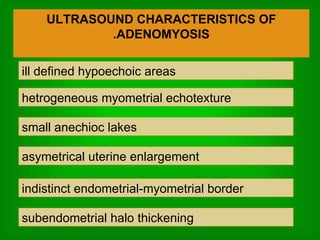
ULTRASOUND CHARACTERISTICS OF ADENOMYOSIS. ill defined hypoechoic areas hetrogeneous myometrial echotexture small anechioc lakes asymetrical uterine enlargement indistinct endometrial-myometrial border subendometrial halo thickening
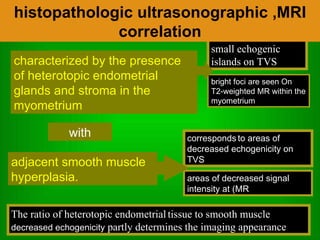
areas of decreased signal intensity at (MR bright foci are seen On T2-weighted MR within the myometrium  characterized by the presence of heterotopic endometrial glands and stroma in the myometrium corresponds   to areas of decreased echogenicity on TVS with small echogenic   islands on TVS The ratio of heterotopic endometrial   tissue to smooth muscle  decreased echogenicity  partly determines the imaging appearance   adjacent smooth muscle hyperplasia. histopathologic ultrasonographic ,MRI correlation
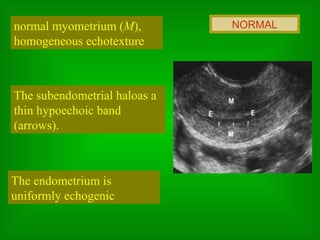
normal myometrium ( M ), homogeneous echotexture The subendometrial haloas a thin hypoechoic band (arrows).  The endometrium is uniformly echogenic NORMAL
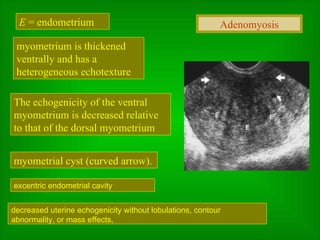
E  = endometrium myometrium is thickened ventrally and has a heterogeneous echotexture  myometrial cyst (curved arrow).  The echogenicity of the ventral myometrium is decreased relative to that of the dorsal myometrium decreased uterine echogenicity without lobulations, contour abnormality, or mass effects,  excentric endometrial cavity Adenomyosis
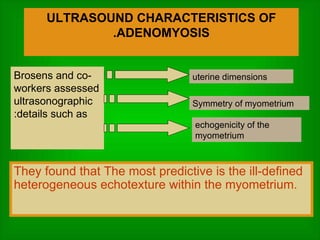
ULTRASOUND CHARACTERISTICS OF ADENOMYOSIS. uterine dimensions Symmetry of myometrium echogenicity of the myometrium Brosens and co-workers assessed ultrasonographic details such as: They found that The most predictive is the   ill-defined heterogeneous echotexture within the myometrium.
Accuracy of endovaginal ultrasonography in the diagnosis of diffuse adenomyosis.  20 90 50 86 17/20 (85) Asher et al. (1994) 77 86 75 53 28/56 (50) Brosens et al. (1995) 94 71 86 29/100 (29) Reinhold et al. (1995) 98 68.4 96.2 86 15/175 (86) Atzori et al. (1996) 96 71 89 89 18/119 (24) Reinhold et al. (1996) NPV% PPV% Specificity% Sensitivity% Prevalence % 86
Transvaginal ultrasonography in the differential diagnosis of adenomyoma versus leiomyoma Transvaginal ultrasonography is an effective, noninvasive, and relatively inexpensive procedure for the preoperative differential diagnosis of adenomyoma versus leiomyoma. Fedele L, Bianchi S, Dorta M, Zanotti F, Brioschi D, Carinelli S Am J Obstet Gynecol  1992 Sep; 167:603-6
Transvaginal sonography is an effective procedure for the preoperative differentiation of adenomyoma from leiomyoma. If the status of the lesion's margins and the presence or absence of hypoechoic lacunae were selected for analysis, leiomyomas could be correctly diagnosed with transvaginal sonography in 95% of cases. Transvaginal ultrasonography in the differential diagnosis of adenomyoma versus leiomyoma Botsis D, Kassanos D, Antoniou G, Pyrgiotis E, Karakitsos P, Kalogirou D J Clin Ultrasound  1998 Jan; 26:21-5
MRI
MRI MRI should be expected to be excellent in recognizing uterine masses like fibroids, cysts, and adenomyomas if they reach 5 mm. or greater in size. MRI may be able to lead us to expect adenomyosis if the myometrial thickness is increased or the consistency of the myometrium is changed.
Magnetic resonance imaging was superior to TVS for the diagnosis of adenomyosis.  Magnetic resonance imaging had a higher specificity than TVS, but their sensitivities were in line. MRI
Comparative study MRI / TVUS
20  women with clinically suspected adenomyosis underwent MR imaging and transvaginal Sonography  Pathologic proof was obtained in all cases.  8/17 1/17 9/17 TVUS 1/17 1/17 15/17 MRI False -ve False +ve Correct diag. 17  patients were proved to have adenomyosis.  Department of Radiology, Georgetown University Medical Center,
Comparative study MRI / TVUS
studied  106  consecutive premenopausal women who underwent hysterectomy for benign reasons.  Transvaginal ultrasonography and MRI were compared with histopathologic examination as the golden standard 22  (21%) patients had adenomyosis. Department of Gynecology and Obstetrics, Aarhus University and Aarhus University Hospital, Aarhus, Denmark 60 89 COMBINED 65 68 TVUS 86 70 MRI specificity sensitivity
On T2-weighted MRI,  focal adenomyosis  are seen in areas of abnormal low signal intensity within the myometrium in approximately 50% of patients. These foci correspond to islands of heterotopic endometrial tissue, cystic dilatation of heterotopic glands, or hemorrhagic foci.  MRI
On T2-weighted MRI,  diffuse adenomyosis  usually manifested   as diffuse thickening of the junctional zone with homogeneous   low signal intensity .T2-weighted imaging provided   significantly better lesion detection than unenhanced or contrast   material–enhanced T1-weighted imaging  MRI
Sagittal T1-weighted MR image shows a mildly enlarged anteverted uterus. The junctional zone is isointense relative to the myometrium.
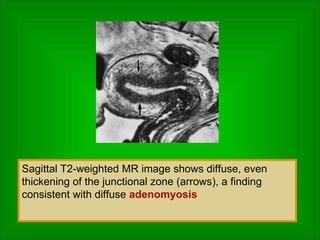
Sagittal T2-weighted MR image shows diffuse, even thickening of the junctional zone (arrows), a finding consistent with diffuse  adenomyosis
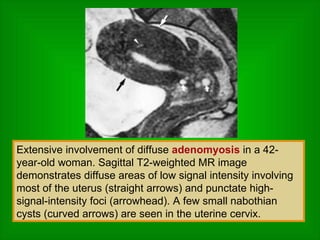
Extensive involvement of diffuse  adenomyosis  in a 42-year-old woman. Sagittal T2-weighted MR image demonstrates diffuse areas of low signal intensity involving most of the uterus (straight arrows) and punctate high-signal-intensity foci (arrowhead). A few small nabothian cysts (curved arrows) are seen in the uterine cervix.
MANEGMENT
MANEGMENT The only definitive treatment for adenomyosis is  total hysterectomy , with or without ovarian conservation.
Gonadotropin releasing hormone agonists in the treatment of adenomyosis with infertility   GnRH- agonists  is efficient in reducing the adenomyotic uterine size, and may facilitate fertility.  (2) For ademyomata associated with infertility, GnRH-alpha therapy may avoid the risk of rupture of uterus which may occur after adenomyomectomy pregnancy.  (3) For infertility, GnRH-alpha treatment before laparoscopic surgery greatly decreases surgical difficulties and blood loss in certain cases. Obstetricts and Gynecology Hospital, Shanghai Medical University, Shanghai 200011 Zhonghua Fu Chan Ke Za Zhi  1999 Apr;  34 :214-6
conservative surgery for adenomyosis   The conservative surgery for  adenomyoma  can reduce symptom and raise pregnancy rate significantly, it can be accepted by young women who want to preserve their reproductive capacity.  Though the pregnancy rate of conservative surgery for  diffused adenomyosis  was low, it still has therapeutic value Zhongguo Yi Xue Ke Xue Yuan Xue Bao  1998 Dec;  20 :440-4
Uterine arterial embolization in the treatment of adenomyosis UAE procedures were performed in  23 patients  with adenomyosis. After treatment the symptoms and uterine volume of all patients were investigated.  All clinical symptoms of 23 patients relieved.  Dysmenorrhea completely disappeared in 19 patients, significantly alleviated in 2 patients. But in other 2 recurred.  The uterine volume shrunk significantly [(50 +/- 18)%] vs [(100 +/- 0)%].  The blood flow within the uterine and lesions detect by color doppler flow imaging decreased immediately after UAE.  Low-abdominal pain and slight fever were seen after treatment and recovered within 1 - 2 weeks. Chen C, Liu P, Lu J, Yu L, Ma B, Wang J, Liu P Zhonghua Fu Chan Ke Za Zhi  2002 Feb;  37 :77-9
UAE is an effective and safe method in the treatment of adenomyosis. BUT the recurrence rate is not yet evaluated. Uterine arterial embolization in the treatment of adenomyosis
THANK YOU DR.MOHAMMED ABDALLA EGYPT, DOMIAT G HOSPITAL

adenomyosis

  • 1.
    Dr. Mohammed AbdallaEgypt, Domiat G Hospital Adenomyosis
  • 2.
    definition Adenomyosis is a benign disease of the uterus characterized by ectopic endometrial glands and stroma within the myometrium It is associated with myometrial hypertrophy and may be either diffuse or focal .
  • 3.
    adenomyoma describes a focus of adenomyosis within a leiomyoma (fibroid).  Both conditions are common so it is not surprising that this overlap condition may occur. definition
  • 4.
    The gland tissuegrows during the menstrual cycle and then at menses tries to slough, the old tissue and blood cannot escape This trapping of the blood and tissue causes uterine pain in the form of monthly menstrual cramps. It also produces abnormal uterine bleeding. definition
  • 5.
    Over 23% ofpatients requiring hysterectomy for control of chronic severe pelvic pain had adenomyosis, and almost half of these women had had a tubal ligation performed. The possible relationship of adenomyosis to a previous tubal ligation has been explored. Associated factors Women's Health Center of South Orange County
  • 6.
    No relationship wasfound between age at surgery, age at menarche, indications for surgery, menopausal status at intervention, and presence of adenomyosis.But parity may be associated with an increased frequency of adenomyosis. Associated factors Clinica Ostetrica e Ginecologica Luigi Mangiagalli, Department of Obstetrics and Gynaecology, University of Milano, Italy
  • 7.
    The typical symptoms include Pelvic pain, Dysmenorrhea, And menorrhagia unresponsive to hormonal therapy or uterine curettage. Subfertility.And pregnancy termination. Cyclic, cramping uterine pain beginning later in reproductive life (generally after age 35) and often associated with prolonged and heavy menses classic presentation
  • 8.
    Pelvic pain Instudies of chronic pelvic pain in which women had hysterectomies, the incidence of adenomyosis is about 15% to 25%
  • 9.
    111 specimensof uteri and cervices 17 with adenomyosis alone 19 with adenomyosis with leiomyomas 39 with leiomyomas alone 36 with neither. 58.8% 47.4% 20.5% 22.2% from patient records the pregnancy terminations rate was: Levgur M, Abadi MA, Tucker A. 2000 May
  • 10.
    2,616 consecutive hysterectomyspecimens examined during a 7-year period. Adenomyosis was noted in 16% Multiparas between the ages of 30 and 50 years were most commonly affected. Abnormal uterine bleeding was the common symptom Myohyperplasia and leiomyomas were the usual associated lesions. Adenomyosis uteri was seen equally in women of African, Indian and mixed races in this West Indian population Aust N Z J Obstet Gynaecol 1988 Feb
  • 11.
    diagnosis The diagnosiscan only be proven by the pathologists A good gynecologist may suspect adenomyosis based on the clinical factors, but the final diagnosis usually has to wait until hysterectomy is performed . (Discepoli S, Leocata P, Giangregorio F). examined 1500 surgical bits had been histologically examined.. In all they have found 310 cases of adenomyosis (20,6%);
  • 12.
  • 13.
    pelvic exam theremay be uterine enlargement from about 6-10 weeks pregnancy size The uterus can feel soft and boggy on pelvic exam. Sometimes adenomyosis is associated with uterine fibroids (leiomyomata)
  • 14.
    repeated bimanual examinations,over several months, just before and after menstruation have been recommended to detect fluctuating changes in contour, size and consistency of the uterus pelvic exam Helen Bickerstaff
  • 15.
    The pathological confirmationof clinically suspected cases is also low (10% to 38%) pelvic exam Azziz R. Adenomyosis: current perspectives. Obsetet Gynecol Clin North Am Seidman JD, Kjerulff KH. Pathological findings from the Maryland Womens Health Study - practice patterns in the diagnosis of of adenomysis. International journal of Gynecolological Pathology 1996, 15:217-221
  • 16.
  • 17.
    Hysterography thepresence of ill defined areas of contrast intravasation extending perpendicularly from the uterine cavity into the myometrium isThe most characteristic feature of adenomyosis on hysterography. Unfortunately, the sensitivity of this technique is too low for clinical practice. Marshak RH, Eliasoph J. The roentgen findings in adenomyosis. Radiology 1955; 64:846-51
  • 18.
    Filling of cavitiesin the uterine wall during hysterography was observed in 54 of 320 surgically excised specimens in which metal threads had been inserted at different levels for identification. Adenomyosis may have accounted for these cavities in 24%. Hysterography Radiological Society of North America , Radiology, Vol 118, 581-586,1976
  • 19.
    True adenomyomas (encapsulated)are uncommon tumors of the uterus. At hysterosalpingography, detection of a network of fine channels in a very well-circumscribed area of the myometrium, connected with the uterine cavity, allows a preoperative diagnosis Hysterography Obstet Gynecol 1989 May; 73 :885-7
  • 20.
    Myometrial biopsy laparoscopicallyor sonographically guided
  • 21.
    Myometrial biopsy laparoscopicallyor sonographically guided a larger study by Popp et al. who took not only needle biopsies immediately after hysterectomy but also at the time of laparoscopy as well as transvaginally under ultrasound guidance A single myometrial biopsy picked up only 8% to 19% of women with adenomyosis. The sensitivity of random needle biopsy is therefore too low for clinical practice. **Popp LW, Schwiedessen JP, Gaetje R. Myometrial biopsy in the diagnosis of adenomyosis uteri. Am J Obstet Gynecol 1993;
  • 22.
  • 23.
    adenomyosis is associatedwith increased numbers of myometrial macrophages, elevated antiphospolipid auto-antibodies and CA 125 levels in peripheral blood. CA 125 Ota H, Maki M, Shidara Y, Kodoma H, Takahashi H, Hayakawa M et al.. Effects of danazol at the immunologic level in patients with adenomoysis, with special reference to autoanyibodies: multicenter cooperative study. Am J Obstet Gynecol 1992; 167:481-6.
  • 24.
    CA 125 antigenspresent on adenomyotic epithelial cells have a different molecular mass from those present on eutopic endometrium; the antibody binding site is however the same If an antibody unique to adenomyosis could be isolated and purified then a highly specific serum screening test could be developed. CA 125 Kobayashi H, Ida W, Terao T, Kawashima Y. Molecular characteristics of the CA125 antigen produced by human endometrial epithelial cellls: comparison between eutopic and heterotopic epithelial cells. Am J Obstet Gynecol 1993; 169: 725-30.
  • 25.
  • 26.
    TVUS The techniqueis strongly operator dependent
  • 27.
    ULTRASOUND CHARACTERISTICS OFADENOMYOSIS. ill defined hypoechoic areas hetrogeneous myometrial echotexture small anechioc lakes asymetrical uterine enlargement indistinct endometrial-myometrial border subendometrial halo thickening
  • 28.
    areas of decreasedsignal intensity at (MR bright foci are seen On T2-weighted MR within the myometrium characterized by the presence of heterotopic endometrial glands and stroma in the myometrium corresponds to areas of decreased echogenicity on TVS with small echogenic islands on TVS The ratio of heterotopic endometrial tissue to smooth muscle decreased echogenicity partly determines the imaging appearance adjacent smooth muscle hyperplasia. histopathologic ultrasonographic ,MRI correlation
  • 29.
    normal myometrium (M ), homogeneous echotexture The subendometrial haloas a thin hypoechoic band (arrows). The endometrium is uniformly echogenic NORMAL
  • 30.
    E =endometrium myometrium is thickened ventrally and has a heterogeneous echotexture myometrial cyst (curved arrow). The echogenicity of the ventral myometrium is decreased relative to that of the dorsal myometrium decreased uterine echogenicity without lobulations, contour abnormality, or mass effects, excentric endometrial cavity Adenomyosis
  • 31.
    ULTRASOUND CHARACTERISTICS OFADENOMYOSIS. uterine dimensions Symmetry of myometrium echogenicity of the myometrium Brosens and co-workers assessed ultrasonographic details such as: They found that The most predictive is the ill-defined heterogeneous echotexture within the myometrium.
  • 32.
    Accuracy of endovaginalultrasonography in the diagnosis of diffuse adenomyosis. 20 90 50 86 17/20 (85) Asher et al. (1994) 77 86 75 53 28/56 (50) Brosens et al. (1995) 94 71 86 29/100 (29) Reinhold et al. (1995) 98 68.4 96.2 86 15/175 (86) Atzori et al. (1996) 96 71 89 89 18/119 (24) Reinhold et al. (1996) NPV% PPV% Specificity% Sensitivity% Prevalence % 86
  • 33.
    Transvaginal ultrasonography inthe differential diagnosis of adenomyoma versus leiomyoma Transvaginal ultrasonography is an effective, noninvasive, and relatively inexpensive procedure for the preoperative differential diagnosis of adenomyoma versus leiomyoma. Fedele L, Bianchi S, Dorta M, Zanotti F, Brioschi D, Carinelli S Am J Obstet Gynecol 1992 Sep; 167:603-6
  • 34.
    Transvaginal sonography isan effective procedure for the preoperative differentiation of adenomyoma from leiomyoma. If the status of the lesion's margins and the presence or absence of hypoechoic lacunae were selected for analysis, leiomyomas could be correctly diagnosed with transvaginal sonography in 95% of cases. Transvaginal ultrasonography in the differential diagnosis of adenomyoma versus leiomyoma Botsis D, Kassanos D, Antoniou G, Pyrgiotis E, Karakitsos P, Kalogirou D J Clin Ultrasound 1998 Jan; 26:21-5
  • 35.
  • 36.
    MRI MRI shouldbe expected to be excellent in recognizing uterine masses like fibroids, cysts, and adenomyomas if they reach 5 mm. or greater in size. MRI may be able to lead us to expect adenomyosis if the myometrial thickness is increased or the consistency of the myometrium is changed.
  • 37.
    Magnetic resonance imagingwas superior to TVS for the diagnosis of adenomyosis. Magnetic resonance imaging had a higher specificity than TVS, but their sensitivities were in line. MRI
  • 38.
  • 39.
    20 womenwith clinically suspected adenomyosis underwent MR imaging and transvaginal Sonography Pathologic proof was obtained in all cases. 8/17 1/17 9/17 TVUS 1/17 1/17 15/17 MRI False -ve False +ve Correct diag. 17 patients were proved to have adenomyosis. Department of Radiology, Georgetown University Medical Center,
  • 40.
  • 41.
    studied 106 consecutive premenopausal women who underwent hysterectomy for benign reasons. Transvaginal ultrasonography and MRI were compared with histopathologic examination as the golden standard 22 (21%) patients had adenomyosis. Department of Gynecology and Obstetrics, Aarhus University and Aarhus University Hospital, Aarhus, Denmark 60 89 COMBINED 65 68 TVUS 86 70 MRI specificity sensitivity
  • 42.
    On T2-weighted MRI, focal adenomyosis are seen in areas of abnormal low signal intensity within the myometrium in approximately 50% of patients. These foci correspond to islands of heterotopic endometrial tissue, cystic dilatation of heterotopic glands, or hemorrhagic foci. MRI
  • 43.
    On T2-weighted MRI, diffuse adenomyosis usually manifested as diffuse thickening of the junctional zone with homogeneous low signal intensity .T2-weighted imaging provided significantly better lesion detection than unenhanced or contrast material–enhanced T1-weighted imaging MRI
  • 44.
    Sagittal T1-weighted MRimage shows a mildly enlarged anteverted uterus. The junctional zone is isointense relative to the myometrium.
  • 45.
    Sagittal T2-weighted MRimage shows diffuse, even thickening of the junctional zone (arrows), a finding consistent with diffuse adenomyosis
  • 46.
    Extensive involvement ofdiffuse adenomyosis in a 42-year-old woman. Sagittal T2-weighted MR image demonstrates diffuse areas of low signal intensity involving most of the uterus (straight arrows) and punctate high-signal-intensity foci (arrowhead). A few small nabothian cysts (curved arrows) are seen in the uterine cervix.
  • 47.
  • 48.
    MANEGMENT The onlydefinitive treatment for adenomyosis is total hysterectomy , with or without ovarian conservation.
  • 49.
    Gonadotropin releasing hormoneagonists in the treatment of adenomyosis with infertility GnRH- agonists is efficient in reducing the adenomyotic uterine size, and may facilitate fertility. (2) For ademyomata associated with infertility, GnRH-alpha therapy may avoid the risk of rupture of uterus which may occur after adenomyomectomy pregnancy. (3) For infertility, GnRH-alpha treatment before laparoscopic surgery greatly decreases surgical difficulties and blood loss in certain cases. Obstetricts and Gynecology Hospital, Shanghai Medical University, Shanghai 200011 Zhonghua Fu Chan Ke Za Zhi 1999 Apr; 34 :214-6
  • 50.
    conservative surgery foradenomyosis The conservative surgery for adenomyoma can reduce symptom and raise pregnancy rate significantly, it can be accepted by young women who want to preserve their reproductive capacity. Though the pregnancy rate of conservative surgery for diffused adenomyosis was low, it still has therapeutic value Zhongguo Yi Xue Ke Xue Yuan Xue Bao 1998 Dec; 20 :440-4
  • 51.
    Uterine arterial embolizationin the treatment of adenomyosis UAE procedures were performed in 23 patients with adenomyosis. After treatment the symptoms and uterine volume of all patients were investigated. All clinical symptoms of 23 patients relieved. Dysmenorrhea completely disappeared in 19 patients, significantly alleviated in 2 patients. But in other 2 recurred. The uterine volume shrunk significantly [(50 +/- 18)%] vs [(100 +/- 0)%]. The blood flow within the uterine and lesions detect by color doppler flow imaging decreased immediately after UAE. Low-abdominal pain and slight fever were seen after treatment and recovered within 1 - 2 weeks. Chen C, Liu P, Lu J, Yu L, Ma B, Wang J, Liu P Zhonghua Fu Chan Ke Za Zhi 2002 Feb; 37 :77-9
  • 52.
    UAE is aneffective and safe method in the treatment of adenomyosis. BUT the recurrence rate is not yet evaluated. Uterine arterial embolization in the treatment of adenomyosis
  • 53.
    THANK YOU DR.MOHAMMEDABDALLA EGYPT, DOMIAT G HOSPITAL