Endometriosis


      By: Tan Hong Yang
          Pang Ing Xiang
What is endometriosis?
• Endometriosis is defined as the presence of
  endometrial-like tissue outside the uterus,
  which induces a chronic, inflammatory
  reaction. The condition is predominantly
  found in women of reproductive age,
  from all ethnic and social groups
Endometriosis - Symptoms
•   ● severe dysmenorrhoea
•   ● deep dyspareunia
•   ● chronic pelvic pain
•   ● ovulation pain
•   ● cyclical or perimenstrual symptoms, such as bowel or
    bladder, with or without abnormal bleeding or
•   pain
•   ● infertility
•   ● chronic fatigue
•   ● dyschezia (pain on defaecation).
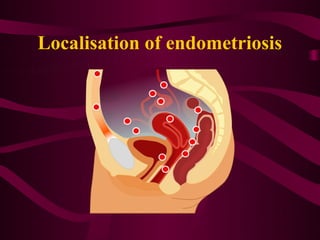
Localisation and appearance of
        endometriosis
• pelvic organs and peritoneum, although other parts of the
  body such as the bowel or lungs are occasionally affected.

• ‘powder-burn’ or ‘gunshot’ lesions on the ovaries, serosal
  surfaces and peritoneum: black, dark-brown or bluish
  puckered lesions, nodules or small cysts containing old
  haemorrhage surrounded by a variable extent of fibrosis
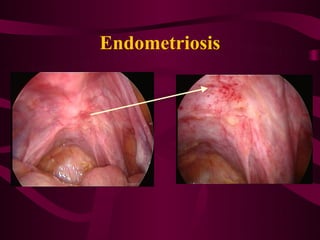
• Atypical or ‘subtle’ lesions are also common,
• including red implants (petechial, vesicular,
  polypoid, hemorrhagic, red flame-like) and serous
  or clear vesicles. Other appearances include white
  plaques or scarring and yellow-brown peritoneal
  discoloration of the peritoneum.
Localisation of endometriosis
Endometriosis
Surgically, endometriosis can be
     staged I–IV (Revised
 Classification of the American
             Society
• Stage I (Minimal) Findings restricted to
  only superficial lesions and possibly a few
  filmy adhesion
• Stage II (Mild) In addition, some deep
  lesions are present in the cul de sac
• Stage III (Moderate) As above, plus
  presence of endometriomas on the ovary
  and more adhesions.
• Stage IV (Severe) As above, plus large
  endometriomas, extensive adhesions.
  Endometrioma on the ovary of any
  significant size (Approx. 2 cm +) must be
  removed surgically because hormonal
  treatment alone will not remove the full
  endometrioma cyst, which can progress to
  acute pain from the rupturing of the cyst
  and internal bleeding
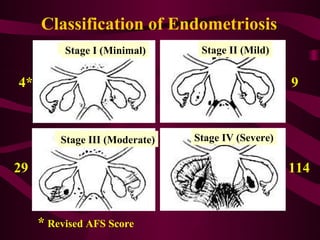
Classification of Endometriosis
          Stage I (Minimal)      Stage II (Mild)


4*                                                  9


         Stage III (Moderate)   Stage IV (Severe)

29                                                  114


     * Revised AFS Score
Endometriosis – Physical Exam
• Uterosacral nodularity
• Adnexal mass (endometrioma)
• Normal exam
Endometriosis - Incidence
•   7-10% of general population
•   20-50% of infertile women
•   70-85% in women w/ CPP
•   No racial predisposition
•   +Familial association with almost 10x
    increased risk of endometriosis if affected 1 st
    degree relative
Endometriosis - Pathogenesis
• Retrograde menstruation (Sampson)
• Hematogenous or lymphatic spread
  (Halban)
• Coelomic metaplasia (Meyer/Novack)
• Iatrogenic dissemination
• Immunologic defects (Dmowski)
• Genetic predisposition
Endometriosis - Pathogenesis
• Retrograde menstruation (Sampson’s theory)
  - Monkey experiments – sutured cervix closed to
  create outflow obstruction  caused development
  of endometriosis
  - Clinical observation of retrograde menstrual flow
  during laparoscopy in humans
  - Increased risk of endometriosis in women with
  cervical/vaginal atresia, other outflow obstruction
  - Increased risk with early menarche, longer and
  heavier flow
  - Decreased risk with decreased estrogen levels
  e.g. exercise-induced menstrual disorders,
  decreased body fat, + tobacco use
Endometriosis - Pathogenesis

• Hematogenous or lymphatic spread
  - Endometriosis found in remote sites – lung, nose,
  spinal cord, pelvic lymph nodes.
Endometriosis - Pathogenesis
• Coelomic metaplasia
  - Mullerian ducts are derived from coelomic
  epithelium during fetal development
  - Hypothesize that coelomic epithelium retains
  ability for multipotential development
  - Endometriosis seen in prepubertal girls, women
  w/ congenital absence of the uterus, and RARELY
  in men
Endometriosis - Pathogenesis
• Iatrogenic dissemination
  - Endometriosis has been found in cesarean
  section scar
• Immunologic defects
• Genetic predisposition
  - polygenic, multi-factorial
Endometriosis - Diagnosis
• For a definitive diagnosis of endometriosis,
  visual inspection of the pelvis at laparoscopy is
  the gold standard investigation, unless disease
  is visible in the posterior vaginal fornix or
  elsewhere
• Good surgical practice is to use an instrument
  such as a grasper, via a secondary port, to
  mobilise the pelvic organs and to palpate
  lesions, which can help determine their
  nodularity
Endometriosis - Diagnosis
• Laparoscopy with biopsy proven histologic
  diagnosis – standard for dx of endometriosis
  - Extent of visible lesions do not correlate with
  severity of sx, but depth of infiltration of lesions
  seems to correlate best with pain severity
• Laparoscopy with biopsy proven histologic
  diagnosis – standard for dx of endometriosis
• Positive histology confirms the diagnosis of
  endometriosis; negative histology does not
  exclude it
• Empiric medical treatment with improvement in
  symptoms
• CA 125 – NOT considered to be of clinical utility
• Imaging – US, MRI, CT – only useful in the
  presence of pelvic or adnexal masses
  (endometriomas)
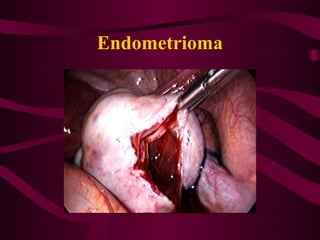
Endometrioma
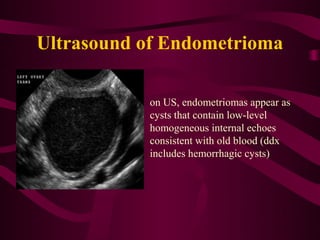
Ultrasound of Endometrioma

           on US, endometriomas appear as
           cysts that contain low-level
           homogeneous internal echoes
           consistent with old blood (ddx
           includes hemorrhagic cysts)
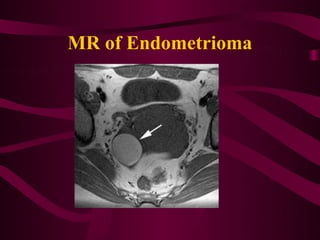
MR of Endometrioma
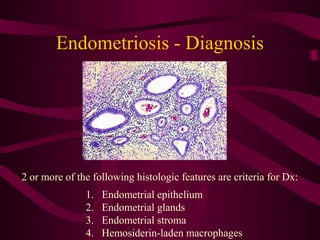
Endometriosis - Diagnosis


2 or more of the following histologic features are criteria for Dx:
               1.   Endometrial epithelium
               2.   Endometrial glands
               3.   Endometrial stroma
               4.   Hemosiderin-laden macrophages
Endometriosis - Treatment
• Hormonal Medications

1 Combination oral contraceptive pills
2 Progestational agents
3 Gonadotropin-releasing hormone analogues
4 Danazol
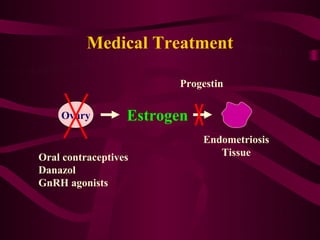
Medical Treatment

                        Progestin

    Ovary         Estrogen
                             Endometriosis
Oral contraceptives             Tissue
Danazol
GnRH agonists
COCP
• COCPs act by ovarian suppression and continuous progestin
  administration. Initially, a trial of continuous or cyclic
• Continuous noncyclical administration of COCPs, omitting
  the placebo menstrual tablets, for 3-4 months helps avoid
  any menstruation and associated pain.
• Women with endometriosis are at increased risk of
  epithelial ovarian cancer, and COCPs are believed to protect
  against this.
• Eg: MARVELON
Progestational agents
• All progestational agents act by decidualization and atrophy
  of the endometrium.
• Medroxyprogesterone acetate has proven efficacy in pain
  suppression in both the oral and injectable depot
  preparations. Oral doses of 10-20 mg/d can be administered
  continuously. The time to resumption of ovulation is longer
  and variable with depot preparations. Adverse effects
  include weight gain, fluid retention, depression, and
  breakthrough bleeding.
• The levonorgestrel intrauterine system (LNG-IUS) has been
  shown to reduce endometriosis-associated pain. It has been
  found to reduce the recurrence of dysmenorrhea by 35%
Danazol
• Danazol acts by inhibiting the midcycle
  follicle-stimulating hormone (FSH) and
  luteinizing hormone (LH) surges and
  preventing steroidogenesis in the corpus
  luteum. It is the most extensively studied
  agent for endometriosis.
• The recommended dose is 600-800 mg/d.
  However, smaller doses have been used
  with success.
GnRH Analogs
• GnRH analogues produce a hypogonadotrophic-
  hypogonadic state by downregulation of the pituitary
  gland. Ie Leucrin ( 3.75mg monthy or 11.25mg 3 monthly)
• GnRH therapy may lead to improvement in pain associated
  with endometriosis in 85-100% of women. Furthermore,
  the pain relief is believed to persist for 6-12 months after
  cessation of treatment.
Treatment is usually restricted to monthly injections for 6
  months. Loss of trabecular bone density caused by GnRH
  is restored by 2 years after cessation of therapy .Other
  prominent adverse effects include hot flashes and vaginal
  dryness
• Add-back therapy
  GnRH agonist treatment with GnRH agonist plus ‘add-
   back’ therapy (i.e. tibolone) for at least 6 months, bone
   mineral density was significantly
• How long a GnRH agonist plus ‘add-back’ may safely be
   continued is unclear, but treatment for
• up to 12 months with ‘add-back’ appears to be effective
• and safe in terms of pain relief and bone mineral density
   protection.
• consideration should be given to the use of GnRH agonists
   in women who may not have reached their maximum bone
  density.
Endometriosis – Treatment
   Considerations in Adolescents

• If no improvement in symptoms after 3
  months of empiric treatment with NSAIDs
  and OCPs, diagnostic laparoscopy should
  be offered
Endometriosis - SURGERY
• Surgical care can be broadly classified as
  1)conservative- preserve reproductive
  ability
• 2)semiconservative- when reproductive
  ability is eliminated but ovarian function is
  retained
• 3) Radical- when the uterus and ovaries are
  removed
Conservative surgery
 Aim- destroy visible endometriotic implants
   and lyse peritubal and periovarian
   adhesions that are a source of pain and may
   interfere with ovum transport.
-laparoscopic drainage
-laparoscopic cystectomy
-laparoscopic ablation
-LUNA
-presacral neurectomy
Semiconservative Surgery

• The indication for this semiconservative
  surgery is mainly in women who have
  completed their childbearing, are too young
  to undergo surgical menopause, and are
  debilitated by the symptoms.
• Such surgery involves hysterectomy and
  cytoreduction of pelvic endometriosis
Radical Surgery

• Radical surgery involves total hysterectomy
  with bilateral oophorectomy (TAH-BSO)
  and cytoreduction of visible endometriosis.
  Adhesiolysis is performed to restore
  mobility and normal intrapelvic organ
  relationships
Endometriosis - Treatment
• Medications vs. Surgery
  - Lack of data to support surgery vs. medical
  treatment for tx of pain symptoms due to
  endometriosis
  - Starting with empiric medical therapy is
  appropriate
  - Offer GnRH agonist therapy if initial medical
  treatment with OCPs and NSAIDs not helping
  - Cost of comparing empiric medical management
  with definitive surgical diagnosis is difficult to
  assess, but 3 months of empiric treatment is less
  than a laparoscopic procedure
Endometriosis - Treatment
• Medications vs. Surgery
  - Surgery is associated with significant
  decrease in pain sx during the 1st 6 months
  following surgery
  - Approximately 40% experience recurrent
  symptoms within 1 yr post-op
  - Cumulative 5-yr recurrence rate of pain sx
  after d/c GnRH tx is ~50%

Endometriosis

  • 1.
    Endometriosis By: Tan Hong Yang Pang Ing Xiang
  • 2.
    What is endometriosis? •Endometriosis is defined as the presence of endometrial-like tissue outside the uterus, which induces a chronic, inflammatory reaction. The condition is predominantly found in women of reproductive age, from all ethnic and social groups
  • 3.
    Endometriosis - Symptoms • ● severe dysmenorrhoea • ● deep dyspareunia • ● chronic pelvic pain • ● ovulation pain • ● cyclical or perimenstrual symptoms, such as bowel or bladder, with or without abnormal bleeding or • pain • ● infertility • ● chronic fatigue • ● dyschezia (pain on defaecation).
  • 4.
    Localisation and appearanceof endometriosis • pelvic organs and peritoneum, although other parts of the body such as the bowel or lungs are occasionally affected. • ‘powder-burn’ or ‘gunshot’ lesions on the ovaries, serosal surfaces and peritoneum: black, dark-brown or bluish puckered lesions, nodules or small cysts containing old haemorrhage surrounded by a variable extent of fibrosis
  • 5.
    • Atypical or‘subtle’ lesions are also common, • including red implants (petechial, vesicular, polypoid, hemorrhagic, red flame-like) and serous or clear vesicles. Other appearances include white plaques or scarring and yellow-brown peritoneal discoloration of the peritoneum.
  • 6.
  • 7.
  • 8.
    Surgically, endometriosis canbe staged I–IV (Revised Classification of the American Society • Stage I (Minimal) Findings restricted to only superficial lesions and possibly a few filmy adhesion • Stage II (Mild) In addition, some deep lesions are present in the cul de sac
  • 9.
    • Stage III(Moderate) As above, plus presence of endometriomas on the ovary and more adhesions. • Stage IV (Severe) As above, plus large endometriomas, extensive adhesions. Endometrioma on the ovary of any significant size (Approx. 2 cm +) must be removed surgically because hormonal treatment alone will not remove the full endometrioma cyst, which can progress to acute pain from the rupturing of the cyst and internal bleeding
  • 10.
    Classification of Endometriosis Stage I (Minimal) Stage II (Mild) 4* 9 Stage III (Moderate) Stage IV (Severe) 29 114 * Revised AFS Score
  • 11.
    Endometriosis – PhysicalExam • Uterosacral nodularity • Adnexal mass (endometrioma) • Normal exam
  • 12.
    Endometriosis - Incidence • 7-10% of general population • 20-50% of infertile women • 70-85% in women w/ CPP • No racial predisposition • +Familial association with almost 10x increased risk of endometriosis if affected 1 st degree relative
  • 13.
    Endometriosis - Pathogenesis •Retrograde menstruation (Sampson) • Hematogenous or lymphatic spread (Halban) • Coelomic metaplasia (Meyer/Novack) • Iatrogenic dissemination • Immunologic defects (Dmowski) • Genetic predisposition
  • 14.
    Endometriosis - Pathogenesis •Retrograde menstruation (Sampson’s theory) - Monkey experiments – sutured cervix closed to create outflow obstruction  caused development of endometriosis - Clinical observation of retrograde menstrual flow during laparoscopy in humans - Increased risk of endometriosis in women with cervical/vaginal atresia, other outflow obstruction - Increased risk with early menarche, longer and heavier flow - Decreased risk with decreased estrogen levels e.g. exercise-induced menstrual disorders, decreased body fat, + tobacco use
  • 15.
    Endometriosis - Pathogenesis •Hematogenous or lymphatic spread - Endometriosis found in remote sites – lung, nose, spinal cord, pelvic lymph nodes.
  • 16.
    Endometriosis - Pathogenesis •Coelomic metaplasia - Mullerian ducts are derived from coelomic epithelium during fetal development - Hypothesize that coelomic epithelium retains ability for multipotential development - Endometriosis seen in prepubertal girls, women w/ congenital absence of the uterus, and RARELY in men
  • 17.
    Endometriosis - Pathogenesis •Iatrogenic dissemination - Endometriosis has been found in cesarean section scar • Immunologic defects • Genetic predisposition - polygenic, multi-factorial
  • 18.
    Endometriosis - Diagnosis •For a definitive diagnosis of endometriosis, visual inspection of the pelvis at laparoscopy is the gold standard investigation, unless disease is visible in the posterior vaginal fornix or elsewhere • Good surgical practice is to use an instrument such as a grasper, via a secondary port, to mobilise the pelvic organs and to palpate lesions, which can help determine their nodularity
  • 19.
    Endometriosis - Diagnosis •Laparoscopy with biopsy proven histologic diagnosis – standard for dx of endometriosis - Extent of visible lesions do not correlate with severity of sx, but depth of infiltration of lesions seems to correlate best with pain severity
  • 20.
    • Laparoscopy withbiopsy proven histologic diagnosis – standard for dx of endometriosis • Positive histology confirms the diagnosis of endometriosis; negative histology does not exclude it • Empiric medical treatment with improvement in symptoms • CA 125 – NOT considered to be of clinical utility • Imaging – US, MRI, CT – only useful in the presence of pelvic or adnexal masses (endometriomas)
  • 21.
  • 22.
    Ultrasound of Endometrioma on US, endometriomas appear as cysts that contain low-level homogeneous internal echoes consistent with old blood (ddx includes hemorrhagic cysts)
  • 23.
  • 24.
    Endometriosis - Diagnosis 2or more of the following histologic features are criteria for Dx: 1. Endometrial epithelium 2. Endometrial glands 3. Endometrial stroma 4. Hemosiderin-laden macrophages
  • 25.
    Endometriosis - Treatment •Hormonal Medications 1 Combination oral contraceptive pills 2 Progestational agents 3 Gonadotropin-releasing hormone analogues 4 Danazol
  • 26.
    Medical Treatment Progestin Ovary Estrogen Endometriosis Oral contraceptives Tissue Danazol GnRH agonists
  • 27.
    COCP • COCPs actby ovarian suppression and continuous progestin administration. Initially, a trial of continuous or cyclic • Continuous noncyclical administration of COCPs, omitting the placebo menstrual tablets, for 3-4 months helps avoid any menstruation and associated pain. • Women with endometriosis are at increased risk of epithelial ovarian cancer, and COCPs are believed to protect against this. • Eg: MARVELON
  • 28.
    Progestational agents • Allprogestational agents act by decidualization and atrophy of the endometrium. • Medroxyprogesterone acetate has proven efficacy in pain suppression in both the oral and injectable depot preparations. Oral doses of 10-20 mg/d can be administered continuously. The time to resumption of ovulation is longer and variable with depot preparations. Adverse effects include weight gain, fluid retention, depression, and breakthrough bleeding. • The levonorgestrel intrauterine system (LNG-IUS) has been shown to reduce endometriosis-associated pain. It has been found to reduce the recurrence of dysmenorrhea by 35%
  • 29.
    Danazol • Danazol actsby inhibiting the midcycle follicle-stimulating hormone (FSH) and luteinizing hormone (LH) surges and preventing steroidogenesis in the corpus luteum. It is the most extensively studied agent for endometriosis. • The recommended dose is 600-800 mg/d. However, smaller doses have been used with success.
  • 30.
    GnRH Analogs • GnRHanalogues produce a hypogonadotrophic- hypogonadic state by downregulation of the pituitary gland. Ie Leucrin ( 3.75mg monthy or 11.25mg 3 monthly) • GnRH therapy may lead to improvement in pain associated with endometriosis in 85-100% of women. Furthermore, the pain relief is believed to persist for 6-12 months after cessation of treatment. Treatment is usually restricted to monthly injections for 6 months. Loss of trabecular bone density caused by GnRH is restored by 2 years after cessation of therapy .Other prominent adverse effects include hot flashes and vaginal dryness
  • 31.
    • Add-back therapy GnRH agonist treatment with GnRH agonist plus ‘add- back’ therapy (i.e. tibolone) for at least 6 months, bone mineral density was significantly • How long a GnRH agonist plus ‘add-back’ may safely be continued is unclear, but treatment for • up to 12 months with ‘add-back’ appears to be effective • and safe in terms of pain relief and bone mineral density protection. • consideration should be given to the use of GnRH agonists in women who may not have reached their maximum bone density.
  • 32.
    Endometriosis – Treatment Considerations in Adolescents • If no improvement in symptoms after 3 months of empiric treatment with NSAIDs and OCPs, diagnostic laparoscopy should be offered
  • 33.
    Endometriosis - SURGERY •Surgical care can be broadly classified as 1)conservative- preserve reproductive ability • 2)semiconservative- when reproductive ability is eliminated but ovarian function is retained • 3) Radical- when the uterus and ovaries are removed
  • 34.
    Conservative surgery Aim-destroy visible endometriotic implants and lyse peritubal and periovarian adhesions that are a source of pain and may interfere with ovum transport. -laparoscopic drainage -laparoscopic cystectomy -laparoscopic ablation -LUNA -presacral neurectomy
  • 35.
    Semiconservative Surgery • Theindication for this semiconservative surgery is mainly in women who have completed their childbearing, are too young to undergo surgical menopause, and are debilitated by the symptoms. • Such surgery involves hysterectomy and cytoreduction of pelvic endometriosis
  • 36.
    Radical Surgery • Radicalsurgery involves total hysterectomy with bilateral oophorectomy (TAH-BSO) and cytoreduction of visible endometriosis. Adhesiolysis is performed to restore mobility and normal intrapelvic organ relationships
  • 37.
    Endometriosis - Treatment •Medications vs. Surgery - Lack of data to support surgery vs. medical treatment for tx of pain symptoms due to endometriosis - Starting with empiric medical therapy is appropriate - Offer GnRH agonist therapy if initial medical treatment with OCPs and NSAIDs not helping - Cost of comparing empiric medical management with definitive surgical diagnosis is difficult to assess, but 3 months of empiric treatment is less than a laparoscopic procedure
  • 38.
    Endometriosis - Treatment •Medications vs. Surgery - Surgery is associated with significant decrease in pain sx during the 1st 6 months following surgery - Approximately 40% experience recurrent symptoms within 1 yr post-op - Cumulative 5-yr recurrence rate of pain sx after d/c GnRH tx is ~50%