Comparative anatomy
( Chordates)
Endocrine SystemEndocrine System
1-Human
2-Ruminant
3-Avian
4-Fish
Dr.Omer
Endocrine SystemEndocrine System
HumanHuman Endocrine SystemEndocrine System
Endocrine SystemEndocrine System
Endocrine System : consists of ductless glands that release
hormones that are transported throughout the body by blood
vessels which provide chemical control of various functions of
the body.
Endocrine glands : secrete chemical compounds called hormones
into the blood system.
• Hormones : are secreted from a secretory cell in a gland and act
on a target cell at another part of the body.
• •Target cells : must have receptors for the specific hormone.
4
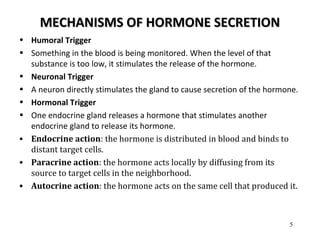
MECHANISMS OF HORMONE SECRETIONMECHANISMS OF HORMONE SECRETION
• Humoral Trigger
• Something in the blood is being monitored. When the level of that
substance is too low, it stimulates the release of the hormone.
• Neuronal Trigger
• A neuron directly stimulates the gland to cause secretion of the hormone.
• Hormonal Trigger
• One endocrine gland releases a hormone that stimulates another
endocrine gland to release its hormone.
• Endocrine action: the hormone is distributed in blood and binds to
distant target cells.
• Paracrine action: the hormone acts locally by diffusing from its
source to target cells in the neighborhood.
• Autocrine action: the hormone acts on the same cell that produced it.
5
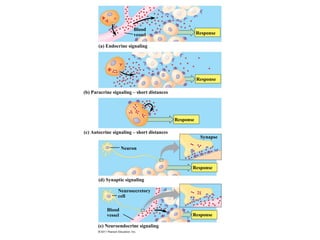
(a) Endocrine signaling
Blood
vessel Response
Response
Response
Synapse
Response
Response
(b) Paracrine signaling – short distances
(c) Autocrine signaling – short distances
Neuron
(d) Synaptic signaling
Neurosecretory
cell
Blood
vessel
(e) Neuroendocrine signaling
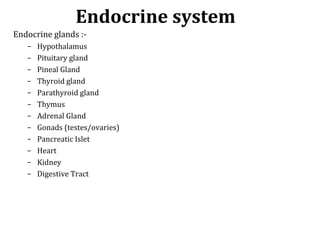
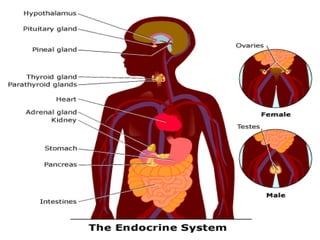
Endocrine glands :-
– Hypothalamus
– Pituitary gland
– Pineal Gland
– Thyroid gland
– Parathyroid gland
– Thymus
– Adrenal Gland
– Gonads (testes/ovaries)
– Pancreatic Islet
– Heart
– Kidney
– Digestive Tract
Endocrine system
9
Endocrine System Functions
• Metabolism and tissue maturation
• Ion regulation
• Water balance
• Immune system regulation
• Heart rate and blood pressure regulation
• Control of blood glucose and other nutrients
• Control of reproductive functions
• Uterine contractions and milk release
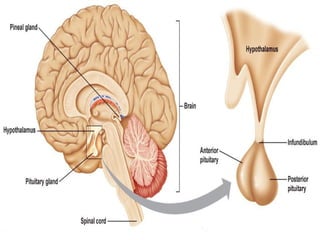
HypothalamusHypothalamus
• This is located at the base of the brain
• The hypothalamus controls the endocrine system by
controlling the pituitary gland.
– Secretes releasing hormones to cause the pituitary to
release hormones.
– Secretes inhibiting hormones to turn off secretion of
pituitary hormones.
10
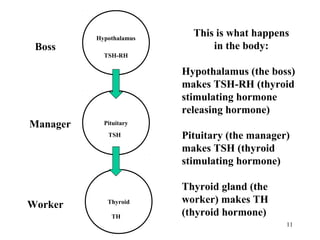
11
Thyroid
Pituitary
Hypothalamus
TSH-RH
TSH
TH
Boss
Manager
Worker
This is what happens
in the body:
Hypothalamus (the boss)
makes TSH-RH (thyroid
stimulating hormone
releasing hormone)
Pituitary (the manager)
makes TSH (thyroid
stimulating hormone)
Thyroid gland (the
worker) makes TH
(thyroid hormone)
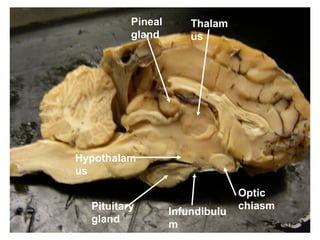
Thalam
us
Hypothalam
us
Pituitary
gland
Pineal
gland
Optic
chiasm
Infundibulu
m 12
Hypothalamus RegulationHypothalamus Regulation
• The hypothalamus produces hormones which affect
the pituitary, for example:
• Thyroid Stimulating Hormone Releasing Hormone (TSH-RH)
– Causes adenohypophysis to secrete TSH
– TSH affects thyroid gland to secrete TH
• Thyroid Stimulating Hormone Inhibiting Hormone (TSH-IH)
– Causes adenohypophysis to stop secreting TSH so thyroid
gland stops secreting thyroid hormone
13
Hypothalamus HormonesHypothalamus Hormones
• Growth Hormone Releasing Hormone (GH-RH)
• Prolactin Releasing Hormone (PRL-RH)
• Thyroid Stimulating Hormone Releasing Hormone (TSH-RH)
• Adrenocorticotropic Hormone Releasing Hormone (ACTH-
RH)
• Melanocyte Stimulating Hormone Releasing Hormone
(MSH-RH)
• Follicle Stimulating Hormone Releasing Hormone (FSH-RH)
• Luteinizing Hormone Releasing Hormone (LH-RH)
14
Hypothalamus HormonesHypothalamus Hormones
• Growth Hormone Inhibiting Hormone (GH-IH)
• Prolactin Inhibiting Hormone (PRL-IH)
• Thyroid Stimulating Hormone Inhibiting Hormone (TSH-IH)
• Adrenocorticotropic Hormone Inhibiting Hormone (ACTH-
IH)
• Melanocyte Stimulating Hormone Inhibiting Hormone
(MSH-IH)
• Follicle Stimulating Hormone Inhibiting Hormone (FSH-IH)
• Luteinizing Hormone Inhibiting Hormone (LH-IH)
15
The Pituitary GlandThe Pituitary Gland
• Secretes nine major hormones
• Attached to the hypothalamus by the
infundibulum (stalk)
• Two basic divisions of the pituitary gland
– Adenohypophysis (anterior lobe)
– Neurohypophysis (posterior lobe)
16
The hormones secreted by the anteriorThe hormones secreted by the anterior
pituitary glandpituitary gland
• Growth Hormone (GH)
• Melanocyte stimulating hormone (MSH)
• Adrenal corticotropic Hormone (ACTH)
• Prolactin (PRL)
• Thyroid stimulating hormone (TSH)
• Luteinizing Hormone (LH)
• Follicle stimulating Hormone (FSH)
18
Growth hormone travels through the blood and
stimulates the liver to produce a protein called insulin-
like growth factor (IGF-1)
In children, IGF-1 stimulates chondrocytes to multiply
in the cartilage at the ends of long bones (epiphyseal
plate)
This leads to growth in the length of the bones and
increases the child's height
In adults, growth hormone plays an important role in
repair and maintenance of the body’s tissues
IGF-1 also acts on immature muscle cells to increase
muscle mass
Growth Hormone (Somatotropin)
• Hypersecretion of GH in children (Gigantism) (overall growth)
• Hypersecretion of GH in adults (Acromegaly): enlarged hands ,
feet, big chin, nose, and forehead.
• Hyposecretion of GH ( dwarfism)
 Stimulates lacrimation (desire to cry)
 Decreased in adolescent males so it decreases desire to cry
 Enlarges the mammary glands and stimulates milk production
 Hyperscretion - over production of milk and enlargement of
breasts (also occurs in men)
 Hyposcretion - under production or no production of milk
Prolactin (PRL)Prolactin (PRL)
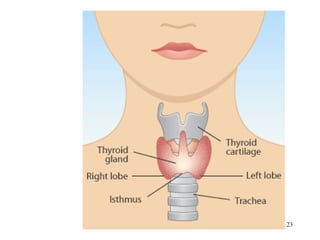
The Thyroid Gland
• Located in the anterior neck, inferior to
thyroid cartilage
23
The Thyroid Gland
 Thyroid Stimulating Hormone (TSH)
Causes the thyroid gland to release thyroid hormone
• Produces two hormones
– Thyroid hormone (TH)
– Calcitonin
24
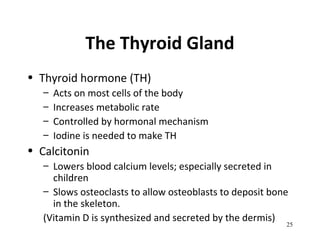
The Thyroid Gland
• Thyroid hormone (TH)
– Acts on most cells of the body
– Increases metabolic rate
– Controlled by hormonal mechanism
– Iodine is needed to make TH
• Calcitonin
– Lowers blood calcium levels; especially secreted in
children
– Slows osteoclasts to allow osteoblasts to deposit bone
in the skeleton.
(Vitamin D is synthesized and secreted by the dermis)
25
 Stimulates the production and release of melanin by
melanocytes in skin
• Hypersecretion - unnaturally dark skin
• Hyposecretion - prone to sunburn
26
Melanocyte Stimulating Hormone (MSH)Melanocyte Stimulating Hormone (MSH)
Adrenal corticotropic Hormone (ACTH)Adrenal corticotropic Hormone (ACTH)
• also called corticotropin or adrenocorticotropin, a
polypeptide hormone formed in the pituitary
gland that regulates the activity of the outer
region (cortex) of the adrenal glands.
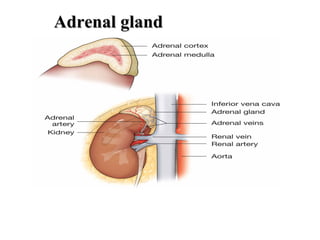
Adrenal glandAdrenal gland
Adrenal Glands:Adrenal Glands:
• located on top of kidneys
• Adrenal medula:
– Epinephrine
– That is secreted mainly by the medulla of the adrenal glands
– Functions primarily to increase cardiac output .
– To raise glucose levels in the blood.
– Epinephrine typically is released during acute stress, and its
prepare an individual for either “fight or flight”
– Norepinephrine
– Norepinephrine is a neurotransmitter and hormone that also is
part of the fight-or-flight response in the body
– It raises the heart rate, which causes glucose to be released as
energy and blood to flow to the muscles.
Adrenal GlandsAdrenal Glands
• Adrenal cortex : synthesizes and secretes
corticosteroids as directed by ACTH from the anterior
pituitary
– Mineralocorticoids : affect salt and water balance
– Aldosterone : stimulates kidney cells to reabsorb
sodium ions and water
– Glucocorticoids – promote glucose synthesis from
noncarbohydrate substances such as proteins
– Androgens and Estrogens
• Male sex hormones (Androgens)
• Female sex hormones (estrogen)
FSH and LH are called gonadotropins because they act on the gonads
and regulate reproductive function.
Follicle-stimulating hormone (FSH)
Regulates the development of ovarian follicles and secretion of
oestrogen
Regulates the production of sperm in men
Luteinizing hormone (LH)
Induces ovulation in females
Induces testosterone in males
Stimulates ovulation and formation of the corpus luteum that
secretes oestrogen and progesterone.
GonadotropinsGonadotropins
The Gonads
Testes
Testosterone
 Regulates the production and maturation of sperm;
 Responsible for the secondary male sexual characteristics
Ovaries
Progesterone
 Prepares the endometrium for implantation and pregnancy
Oestrogen
 Matures the ovum for release.
 Responsible for the secondary female characteristics
The Posterior Pituitary HormonesThe Posterior Pituitary Hormones
((The Neurohypophysis)The Neurohypophysis)
Vasopressin
Anti Diuretic Hormone (ADH)
 Regulates the body fluids.
 To increase water reabsorption .
Hypersecretion - high blood pressure
Hyposecretion- low blood pressure
Oxytocin
 Regulates the release of milk in lactating women
 Induces uterine contractions in labour
 Has a role in orgasm and inducing 'pair bonding'…ie. Love!)
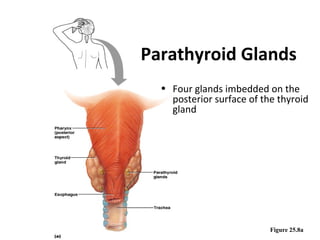
Figure 25.8a
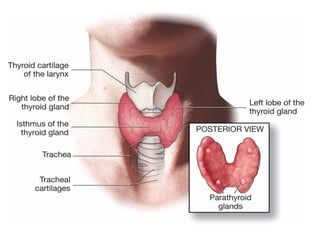
Parathyroid Glands
• Four glands imbedded on the
posterior surface of the thyroid
gland
Parathyroid GlandsParathyroid Glands
• Parathyroid hormone (PTH)
• Increases blood concentration of Ca
• There are three ways that the parathyroid gland raises
blood calcium levels
1) Stimulates osteoclasts to move bone calcium from the
skeleton to the bloodstream
2) Stimulates the kidneys to stop excreting calcium
3) Stimulates the intestines to absorb more calcium from diet
•Activates vitamin D which increases calcium uptake
by intestines
Hypersecretion - Softened bones from lack of calcium
Hyposecretion - Low blood calcium levels
• Thymus GlandThymus Gland
– A pink gland with two lobes located in the thoracic
cavity posterior to the sternum
– Large during childhood and puberty but shrinks
during adulthood
– Functions as part of both the body’s immune
response and the endocrine system
Secretes thymosin
 Involved in the activation of T lymphocytes (T-cells)
HYPOSECRETION - increased susceptibility to disease
The Pineal Hormones
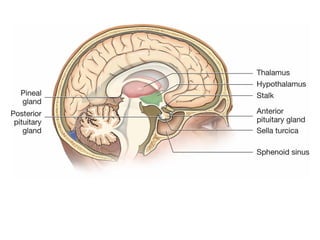
• Pineal Gland
– Located between the two lobes of the thalamus
– Secretes the hormone melatonin
– Maintains the body’s internal clock and regulates
the onset and duration of sleep
– Stimulated by darkness and inhibited by light
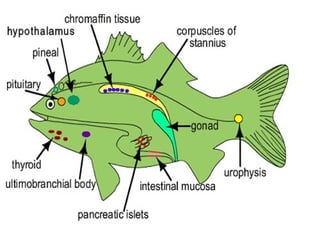
Fish endocrine system
• Fish and humans both have endocrine systems,
and their endocrine systems do the same basic
functions but there are some differing functions.
• fish have ultimobranchial glands that secrete
calcitonin
Fish endocrine system
• Fish also have other glands that aren’t present in humans; those
are the Corpuscles of Stannius, “sac-like bodies in the kidney ,”
• The corpuscles of Stannius are the sites of production of the
hormone called stanniocalcin
• This hormone is responsible for decreasing the blood circulating
level of calcium
The urophysis (Caudal neurosecretory System)
• The hormones of urophysis are called “urotensins
• These are urotensin I, II, III and IV
 Urotensin I : Increases the blood pressure
 Urotensin II :it is involved in the contraction of smooth
muscles such as urinary bladder
 Urotensin III: it induces the sodium intake across the gills
 Urotensin IV :it shows activity like antidiuretic hormones
of pituitary gland
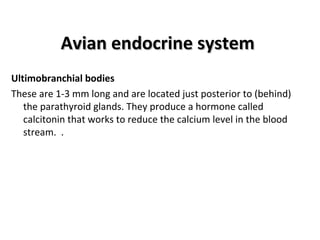
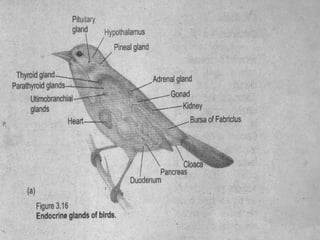
Avian endocrine systemAvian endocrine system
Ultimobranchial bodies
These are 1-3 mm long and are located just posterior to (behind)
the parathyroid glands. They produce a hormone called
calcitonin that works to reduce the calcium level in the blood
stream. .
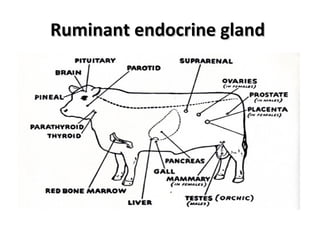
Ruminant endocrine glandRuminant endocrine gland
Ruminant and humans both have endocrine systems, and
their endocrine systems do the same basic functions
Ruminant endocrine glandRuminant endocrine gland
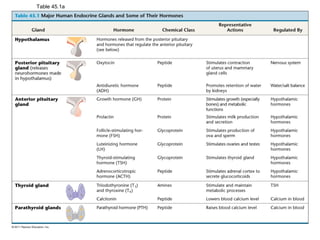
Table 45.1a
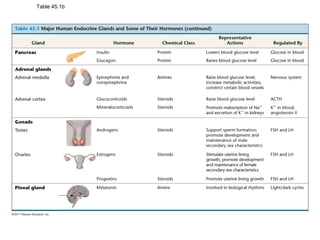
Table 45.1b
Comparative anatomy  endocrine system

Comparative anatomy endocrine system

  • 1.
    Comparative anatomy ( Chordates) EndocrineSystemEndocrine System 1-Human 2-Ruminant 3-Avian 4-Fish Dr.Omer
  • 2.
  • 3.
  • 4.
    Endocrine SystemEndocrine System EndocrineSystem : consists of ductless glands that release hormones that are transported throughout the body by blood vessels which provide chemical control of various functions of the body. Endocrine glands : secrete chemical compounds called hormones into the blood system. • Hormones : are secreted from a secretory cell in a gland and act on a target cell at another part of the body. • •Target cells : must have receptors for the specific hormone. 4
  • 5.
    MECHANISMS OF HORMONESECRETIONMECHANISMS OF HORMONE SECRETION • Humoral Trigger • Something in the blood is being monitored. When the level of that substance is too low, it stimulates the release of the hormone. • Neuronal Trigger • A neuron directly stimulates the gland to cause secretion of the hormone. • Hormonal Trigger • One endocrine gland releases a hormone that stimulates another endocrine gland to release its hormone. • Endocrine action: the hormone is distributed in blood and binds to distant target cells. • Paracrine action: the hormone acts locally by diffusing from its source to target cells in the neighborhood. • Autocrine action: the hormone acts on the same cell that produced it. 5
  • 6.
    (a) Endocrine signaling Blood vesselResponse Response Response Synapse Response Response (b) Paracrine signaling – short distances (c) Autocrine signaling – short distances Neuron (d) Synaptic signaling Neurosecretory cell Blood vessel (e) Neuroendocrine signaling
  • 7.
    Endocrine glands :- –Hypothalamus – Pituitary gland – Pineal Gland – Thyroid gland – Parathyroid gland – Thymus – Adrenal Gland – Gonads (testes/ovaries) – Pancreatic Islet – Heart – Kidney – Digestive Tract Endocrine system
  • 9.
    9 Endocrine System Functions •Metabolism and tissue maturation • Ion regulation • Water balance • Immune system regulation • Heart rate and blood pressure regulation • Control of blood glucose and other nutrients • Control of reproductive functions • Uterine contractions and milk release
  • 10.
    HypothalamusHypothalamus • This islocated at the base of the brain • The hypothalamus controls the endocrine system by controlling the pituitary gland. – Secretes releasing hormones to cause the pituitary to release hormones. – Secretes inhibiting hormones to turn off secretion of pituitary hormones. 10
  • 11.
    11 Thyroid Pituitary Hypothalamus TSH-RH TSH TH Boss Manager Worker This is whathappens in the body: Hypothalamus (the boss) makes TSH-RH (thyroid stimulating hormone releasing hormone) Pituitary (the manager) makes TSH (thyroid stimulating hormone) Thyroid gland (the worker) makes TH (thyroid hormone)
  • 12.
  • 13.
    Hypothalamus RegulationHypothalamus Regulation •The hypothalamus produces hormones which affect the pituitary, for example: • Thyroid Stimulating Hormone Releasing Hormone (TSH-RH) – Causes adenohypophysis to secrete TSH – TSH affects thyroid gland to secrete TH • Thyroid Stimulating Hormone Inhibiting Hormone (TSH-IH) – Causes adenohypophysis to stop secreting TSH so thyroid gland stops secreting thyroid hormone 13
  • 14.
    Hypothalamus HormonesHypothalamus Hormones •Growth Hormone Releasing Hormone (GH-RH) • Prolactin Releasing Hormone (PRL-RH) • Thyroid Stimulating Hormone Releasing Hormone (TSH-RH) • Adrenocorticotropic Hormone Releasing Hormone (ACTH- RH) • Melanocyte Stimulating Hormone Releasing Hormone (MSH-RH) • Follicle Stimulating Hormone Releasing Hormone (FSH-RH) • Luteinizing Hormone Releasing Hormone (LH-RH) 14
  • 15.
    Hypothalamus HormonesHypothalamus Hormones •Growth Hormone Inhibiting Hormone (GH-IH) • Prolactin Inhibiting Hormone (PRL-IH) • Thyroid Stimulating Hormone Inhibiting Hormone (TSH-IH) • Adrenocorticotropic Hormone Inhibiting Hormone (ACTH- IH) • Melanocyte Stimulating Hormone Inhibiting Hormone (MSH-IH) • Follicle Stimulating Hormone Inhibiting Hormone (FSH-IH) • Luteinizing Hormone Inhibiting Hormone (LH-IH) 15
  • 16.
    The Pituitary GlandThePituitary Gland • Secretes nine major hormones • Attached to the hypothalamus by the infundibulum (stalk) • Two basic divisions of the pituitary gland – Adenohypophysis (anterior lobe) – Neurohypophysis (posterior lobe) 16
  • 18.
    The hormones secretedby the anteriorThe hormones secreted by the anterior pituitary glandpituitary gland • Growth Hormone (GH) • Melanocyte stimulating hormone (MSH) • Adrenal corticotropic Hormone (ACTH) • Prolactin (PRL) • Thyroid stimulating hormone (TSH) • Luteinizing Hormone (LH) • Follicle stimulating Hormone (FSH) 18
  • 19.
    Growth hormone travelsthrough the blood and stimulates the liver to produce a protein called insulin- like growth factor (IGF-1) In children, IGF-1 stimulates chondrocytes to multiply in the cartilage at the ends of long bones (epiphyseal plate) This leads to growth in the length of the bones and increases the child's height In adults, growth hormone plays an important role in repair and maintenance of the body’s tissues IGF-1 also acts on immature muscle cells to increase muscle mass Growth Hormone (Somatotropin)
  • 20.
    Growth Hormone (Somatotropin) •Hypersecretion of GH in children (Gigantism) (overall growth) • Hypersecretion of GH in adults (Acromegaly): enlarged hands , feet, big chin, nose, and forehead. • Hyposecretion of GH ( dwarfism)
  • 21.
     Stimulates lacrimation(desire to cry)  Decreased in adolescent males so it decreases desire to cry  Enlarges the mammary glands and stimulates milk production  Hyperscretion - over production of milk and enlargement of breasts (also occurs in men)  Hyposcretion - under production or no production of milk Prolactin (PRL)Prolactin (PRL)
  • 22.
    The Thyroid Gland •Located in the anterior neck, inferior to thyroid cartilage
  • 23.
  • 24.
    The Thyroid Gland Thyroid Stimulating Hormone (TSH) Causes the thyroid gland to release thyroid hormone • Produces two hormones – Thyroid hormone (TH) – Calcitonin 24
  • 25.
    The Thyroid Gland •Thyroid hormone (TH) – Acts on most cells of the body – Increases metabolic rate – Controlled by hormonal mechanism – Iodine is needed to make TH • Calcitonin – Lowers blood calcium levels; especially secreted in children – Slows osteoclasts to allow osteoblasts to deposit bone in the skeleton. (Vitamin D is synthesized and secreted by the dermis) 25
  • 26.
     Stimulates theproduction and release of melanin by melanocytes in skin • Hypersecretion - unnaturally dark skin • Hyposecretion - prone to sunburn 26 Melanocyte Stimulating Hormone (MSH)Melanocyte Stimulating Hormone (MSH)
  • 27.
    Adrenal corticotropic Hormone(ACTH)Adrenal corticotropic Hormone (ACTH) • also called corticotropin or adrenocorticotropin, a polypeptide hormone formed in the pituitary gland that regulates the activity of the outer region (cortex) of the adrenal glands.
  • 28.
  • 29.
    Adrenal Glands:Adrenal Glands: •located on top of kidneys • Adrenal medula: – Epinephrine – That is secreted mainly by the medulla of the adrenal glands – Functions primarily to increase cardiac output . – To raise glucose levels in the blood. – Epinephrine typically is released during acute stress, and its prepare an individual for either “fight or flight” – Norepinephrine – Norepinephrine is a neurotransmitter and hormone that also is part of the fight-or-flight response in the body – It raises the heart rate, which causes glucose to be released as energy and blood to flow to the muscles.
  • 30.
    Adrenal GlandsAdrenal Glands •Adrenal cortex : synthesizes and secretes corticosteroids as directed by ACTH from the anterior pituitary – Mineralocorticoids : affect salt and water balance – Aldosterone : stimulates kidney cells to reabsorb sodium ions and water – Glucocorticoids – promote glucose synthesis from noncarbohydrate substances such as proteins – Androgens and Estrogens • Male sex hormones (Androgens) • Female sex hormones (estrogen)
  • 31.
    FSH and LHare called gonadotropins because they act on the gonads and regulate reproductive function. Follicle-stimulating hormone (FSH) Regulates the development of ovarian follicles and secretion of oestrogen Regulates the production of sperm in men Luteinizing hormone (LH) Induces ovulation in females Induces testosterone in males Stimulates ovulation and formation of the corpus luteum that secretes oestrogen and progesterone. GonadotropinsGonadotropins
  • 32.
    The Gonads Testes Testosterone  Regulatesthe production and maturation of sperm;  Responsible for the secondary male sexual characteristics Ovaries Progesterone  Prepares the endometrium for implantation and pregnancy Oestrogen  Matures the ovum for release.  Responsible for the secondary female characteristics
  • 33.
    The Posterior PituitaryHormonesThe Posterior Pituitary Hormones ((The Neurohypophysis)The Neurohypophysis) Vasopressin Anti Diuretic Hormone (ADH)  Regulates the body fluids.  To increase water reabsorption . Hypersecretion - high blood pressure Hyposecretion- low blood pressure Oxytocin  Regulates the release of milk in lactating women  Induces uterine contractions in labour  Has a role in orgasm and inducing 'pair bonding'…ie. Love!)
  • 34.
    Figure 25.8a Parathyroid Glands •Four glands imbedded on the posterior surface of the thyroid gland
  • 36.
    Parathyroid GlandsParathyroid Glands •Parathyroid hormone (PTH) • Increases blood concentration of Ca • There are three ways that the parathyroid gland raises blood calcium levels 1) Stimulates osteoclasts to move bone calcium from the skeleton to the bloodstream 2) Stimulates the kidneys to stop excreting calcium 3) Stimulates the intestines to absorb more calcium from diet •Activates vitamin D which increases calcium uptake by intestines Hypersecretion - Softened bones from lack of calcium Hyposecretion - Low blood calcium levels
  • 37.
    • Thymus GlandThymusGland – A pink gland with two lobes located in the thoracic cavity posterior to the sternum – Large during childhood and puberty but shrinks during adulthood – Functions as part of both the body’s immune response and the endocrine system Secretes thymosin  Involved in the activation of T lymphocytes (T-cells) HYPOSECRETION - increased susceptibility to disease
  • 38.
    The Pineal Hormones •Pineal Gland – Located between the two lobes of the thalamus – Secretes the hormone melatonin – Maintains the body’s internal clock and regulates the onset and duration of sleep – Stimulated by darkness and inhibited by light
  • 40.
    Fish endocrine system •Fish and humans both have endocrine systems, and their endocrine systems do the same basic functions but there are some differing functions. • fish have ultimobranchial glands that secrete calcitonin
  • 41.
    Fish endocrine system •Fish also have other glands that aren’t present in humans; those are the Corpuscles of Stannius, “sac-like bodies in the kidney ,” • The corpuscles of Stannius are the sites of production of the hormone called stanniocalcin • This hormone is responsible for decreasing the blood circulating level of calcium
  • 42.
    The urophysis (Caudalneurosecretory System) • The hormones of urophysis are called “urotensins • These are urotensin I, II, III and IV  Urotensin I : Increases the blood pressure  Urotensin II :it is involved in the contraction of smooth muscles such as urinary bladder  Urotensin III: it induces the sodium intake across the gills  Urotensin IV :it shows activity like antidiuretic hormones of pituitary gland
  • 44.
    Avian endocrine systemAvianendocrine system Ultimobranchial bodies These are 1-3 mm long and are located just posterior to (behind) the parathyroid glands. They produce a hormone called calcitonin that works to reduce the calcium level in the blood stream. .
  • 46.
    Ruminant endocrine glandRuminantendocrine gland Ruminant and humans both have endocrine systems, and their endocrine systems do the same basic functions
  • 47.
  • 48.
  • 49.

Editor's Notes

  • #7 Figure 45.2 Intercellular communication by secreted molecules.
  • #49 Table 45.1 Major Human Endocrine Glands and Some of Their Hormones
  • #50 Table 45.1 Major Human Endocrine Glands and Some of Their Hormones