Engr. Maria Romina P. Angustia
-Professor-
What is Electronics?
• Electronics deals with electrical circuitsthat
involve active electrical components such
as vacuumtubes, transistors, diodes, integrate
d circuits, associated passive electrical
components, and interconnection
technologies.
• The science of Electronics is also considered to
be a branch of Physics and Electrical
Engineering
History of Electronics
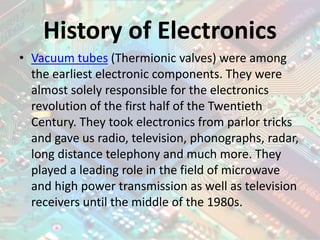
• Vacuum tubes (Thermionic valves) were among
the earliest electronic components. They were
almost solely responsible for the electronics
revolution of the first half of the Twentieth
Century. They took electronics from parlor tricks
and gave us radio, television, phonographs, radar,
long distance telephony and much more. They
played a leading role in the field of microwave
and high power transmission as well as television
receivers until the middle of the 1980s.
Vacuum Tube
• an electron tube containing a near-vacuum
that allows the free passage of electric
current.
• Since that time, solid state devices have all but
completely taken over. Vacuum tubes are still
used in some specialist applications such
as high power RF amplifiers, cathode ray
tubes, specialist audio equipment, guitar
amplifiers and some microwave devices.
• In April 1955 the IBM 608 was the first IBM
product to use transistor circuits without any
vacuum tubes and is believed to be the
world's first all-transistorized calculator to be
manufactured for the commercial market.
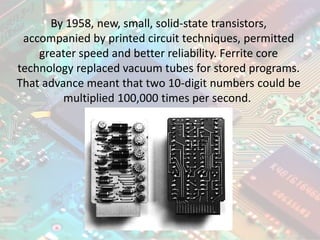
By 1958, new, small, solid-state transistors,
accompanied by printed circuit techniques, permitted
greater speed and better reliability. Ferrite core
technology replaced vacuum tubes for stored programs.
That advance meant that two 10-digit numbers could be
multiplied 100,000 times per second.
• Thomas J. Watson Jr. ordered all future IBM
products to use transistors in their design.
From that time on transistors were almost
exclusively used for computer logic and
peripherals.
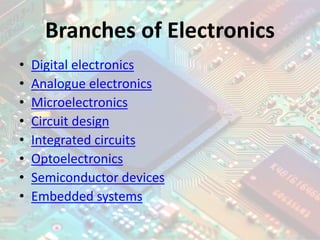
Branches of Electronics
• Digital electronics
• Analogue electronics
• Microelectronics
• Circuit design
• Integrated circuits
• Optoelectronics
• Semiconductor devices
• Embedded systems
• Digital electronics or digital (electronic)
circuits are electronics that handle digital signals.
• Analogue electronics (also spelled analog
electronics) are electronic systems with
a continuously variable signal, in contrast
to digital electronics where signals usually
take only two levels. The term "analogue"
describes the proportional relationship between
a signal and a voltage or current that represents
the signal. The word analogue is derived from the
Greek word ανάλογος (analogos) meaning
"proportional".
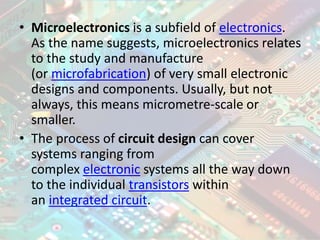
• Microelectronics is a subfield of electronics.
As the name suggests, microelectronics relates
to the study and manufacture
(or microfabrication) of very small electronic
designs and components. Usually, but not
always, this means micrometre-scale or
smaller.
• The process of circuit design can cover
systems ranging from
complex electronic systems all the way down
to the individual transistors within
an integrated circuit.
• An integrated circuit or monolithic integrated
circuit (also referred to as an IC, a chip, or
a microchip) is a set of electronic circuits on
one small flat piece (or "chip")
of semiconductor material, normally silicon.
This can be made much smaller than
a discrete circuit made from
independent electronic components - a
modern chip may have several
billion transistors in an area the size of a
human fingernail.
• Optoelectronics is the study and application
of electronic devices and systems that source,
detect and control light, usually considered a sub-
field of photonics. In this context, light often
includes invisible forms of radiation such
as gamma rays, X-rays, ultraviolet and infrared, in
addition to visible light.
• Semiconductor devices are electronic
components that exploit the electronic properties
of semiconductor materials,
principally silicon, germanium, and gallium
arsenide, as well as organic semiconductors.
• An embedded system is
a computer system with a dedicated function
within a larger mechanical or electrical
system, often with real-time
computingconstraints.It is embedded as part
of a complete device often including hardware
and mechanical parts. Embedded systems
control many devices in common use
today.Ninety-eight percent of
all microprocessors are manufactured as
components of embedded systems.
Application of Electronics
• Entertainment and Communication:
Availability of economical and fast means of
communication paves the way for progress of a
country. Few decades ago, the main application of
electronics was in the field of telephony and
telegraphy. Now, with the aid of radio waves we can
transmit any message from one place to another,
with out the use of wires. Radio and TV
broadcasting offers a means of both entertainment
as well as communication. Today, Electronics
gadgets are widely used for entertainment
• Defence Applications:
Defence applications are completely controlled
by electronic circuits. RADAR that is Radio
Detection and Ranging is the most important
development in electronics field. With the help
of radar it is possible to detect and find the
exact location of enemy aircraft. Radar and anti
craft guns can be linked by an automatic control
system to make a complete unit
• Industrial Application:
Electronics circuits are widely being used in
industrial applications such as control of thickness,
quality, weight and moisture content of a material.
Electronic amplifier circuits are used to amplify
signals and thus control the operations of
automatic door openers, power systems and safety
devices. Electronically controlled systems are used
for heating and welding in the industry. The most
important industrial application is that the power
stations which generate thousands of megawatts of
electricity are controlled by tiny electronic devices
and circuits.
• Medical Services:
Electronics systems are being used by Doctors
and scientists in the diagnosis and treatment of
various diseases. X-rays, ECG, Short eave
diathermy units and oscillographs are some
instruments which have been used so far in
medical science. The use of electronics in
medical science has grown so extremely and is
useful in saving the life of mankind from a lot of
sufferings.
• Instrumentation:
Electronics instruments such as cathode-ray
oscilloscopes, frequency counters, signal
generators, strain gauges are of great help in for
precise measurement of various quantities.
Without these electronic instruments no
research laboratory is complete.
Electronics Introduction

Electronics Introduction

  • 1.
    Engr. Maria RominaP. Angustia -Professor-
  • 2.
    What is Electronics? •Electronics deals with electrical circuitsthat involve active electrical components such as vacuumtubes, transistors, diodes, integrate d circuits, associated passive electrical components, and interconnection technologies. • The science of Electronics is also considered to be a branch of Physics and Electrical Engineering
  • 3.
    History of Electronics •Vacuum tubes (Thermionic valves) were among the earliest electronic components. They were almost solely responsible for the electronics revolution of the first half of the Twentieth Century. They took electronics from parlor tricks and gave us radio, television, phonographs, radar, long distance telephony and much more. They played a leading role in the field of microwave and high power transmission as well as television receivers until the middle of the 1980s.
  • 4.
    Vacuum Tube • anelectron tube containing a near-vacuum that allows the free passage of electric current.
  • 5.
    • Since thattime, solid state devices have all but completely taken over. Vacuum tubes are still used in some specialist applications such as high power RF amplifiers, cathode ray tubes, specialist audio equipment, guitar amplifiers and some microwave devices. • In April 1955 the IBM 608 was the first IBM product to use transistor circuits without any vacuum tubes and is believed to be the world's first all-transistorized calculator to be manufactured for the commercial market.
  • 6.
    By 1958, new,small, solid-state transistors, accompanied by printed circuit techniques, permitted greater speed and better reliability. Ferrite core technology replaced vacuum tubes for stored programs. That advance meant that two 10-digit numbers could be multiplied 100,000 times per second.
  • 7.
    • Thomas J.Watson Jr. ordered all future IBM products to use transistors in their design. From that time on transistors were almost exclusively used for computer logic and peripherals.
  • 8.
    Branches of Electronics •Digital electronics • Analogue electronics • Microelectronics • Circuit design • Integrated circuits • Optoelectronics • Semiconductor devices • Embedded systems
  • 9.
    • Digital electronicsor digital (electronic) circuits are electronics that handle digital signals. • Analogue electronics (also spelled analog electronics) are electronic systems with a continuously variable signal, in contrast to digital electronics where signals usually take only two levels. The term "analogue" describes the proportional relationship between a signal and a voltage or current that represents the signal. The word analogue is derived from the Greek word ανάλογος (analogos) meaning "proportional".
  • 10.
    • Microelectronics isa subfield of electronics. As the name suggests, microelectronics relates to the study and manufacture (or microfabrication) of very small electronic designs and components. Usually, but not always, this means micrometre-scale or smaller. • The process of circuit design can cover systems ranging from complex electronic systems all the way down to the individual transistors within an integrated circuit.
  • 11.
    • An integratedcircuit or monolithic integrated circuit (also referred to as an IC, a chip, or a microchip) is a set of electronic circuits on one small flat piece (or "chip") of semiconductor material, normally silicon. This can be made much smaller than a discrete circuit made from independent electronic components - a modern chip may have several billion transistors in an area the size of a human fingernail.
  • 12.
    • Optoelectronics isthe study and application of electronic devices and systems that source, detect and control light, usually considered a sub- field of photonics. In this context, light often includes invisible forms of radiation such as gamma rays, X-rays, ultraviolet and infrared, in addition to visible light. • Semiconductor devices are electronic components that exploit the electronic properties of semiconductor materials, principally silicon, germanium, and gallium arsenide, as well as organic semiconductors.
  • 13.
    • An embeddedsystem is a computer system with a dedicated function within a larger mechanical or electrical system, often with real-time computingconstraints.It is embedded as part of a complete device often including hardware and mechanical parts. Embedded systems control many devices in common use today.Ninety-eight percent of all microprocessors are manufactured as components of embedded systems.
  • 14.
    Application of Electronics •Entertainment and Communication: Availability of economical and fast means of communication paves the way for progress of a country. Few decades ago, the main application of electronics was in the field of telephony and telegraphy. Now, with the aid of radio waves we can transmit any message from one place to another, with out the use of wires. Radio and TV broadcasting offers a means of both entertainment as well as communication. Today, Electronics gadgets are widely used for entertainment
  • 16.
    • Defence Applications: Defenceapplications are completely controlled by electronic circuits. RADAR that is Radio Detection and Ranging is the most important development in electronics field. With the help of radar it is possible to detect and find the exact location of enemy aircraft. Radar and anti craft guns can be linked by an automatic control system to make a complete unit
  • 18.
    • Industrial Application: Electronicscircuits are widely being used in industrial applications such as control of thickness, quality, weight and moisture content of a material. Electronic amplifier circuits are used to amplify signals and thus control the operations of automatic door openers, power systems and safety devices. Electronically controlled systems are used for heating and welding in the industry. The most important industrial application is that the power stations which generate thousands of megawatts of electricity are controlled by tiny electronic devices and circuits.
  • 20.
    • Medical Services: Electronicssystems are being used by Doctors and scientists in the diagnosis and treatment of various diseases. X-rays, ECG, Short eave diathermy units and oscillographs are some instruments which have been used so far in medical science. The use of electronics in medical science has grown so extremely and is useful in saving the life of mankind from a lot of sufferings.
  • 22.
    • Instrumentation: Electronics instrumentssuch as cathode-ray oscilloscopes, frequency counters, signal generators, strain gauges are of great help in for precise measurement of various quantities. Without these electronic instruments no research laboratory is complete.